Rapping About Science: Watch High School Senior Jabari Johnson Talk Physics with Poetic Lyrics
Christopher Emdin, an Associate Professor at Teachers College, Columbia University, loves to rap. And he loves using rap to teach kids all about science. That’s why he helped put together B.A.T.T.L.E.S., a New York City-wide competition that challenges students to put scientific concepts into lyrical raps. The kids were up to the task and rapped about everything from “rock science, natural selection and genetics to how materials freeze or melt.” And the winner — Jabari Johnson, a senior from Urban Assembly School for the Performing Arts in Harlem — was named on June 21, after the final competition took place on the Columbia University campus. Johnson will now have a chance to make a professional recording of his song about Kinetic Energy and post it on the Rap Genius website.
via Columbia
Related Content:
The Greatness of Charles Darwin Explained with Rap Music
The Large Hadron Collider Rap, Yo
Read More...What Do Most Philosophers Believe? A Wide-Ranging Survey Project Gives Us Some Idea
What do most philosophers believe? The question may only interest other philosophers—and when it comes to such esoteric concerns as the “analytic synthetic distinction,” this is probably true. But when it comes to the big issues that have given every thoughtful person at least one sleepless night, or the questions regularly explored by speculative fictions like Star Trek or zombie movies, the rest of us might sit up and take notice.
Two contemporary philosophers, David Chalmers and David Bourget, decided to find out where their colleagues stood on 30 different philosophical issues by constructing a rigorous survey that ended up accounting for the views of over 3,000 professors, graduate students, and independent thinkers. Most of the respondents were affiliated with prestigious philosophy departments in the English-speaking world, though several continental European departments are also represented.
Some semi-famous names come up in a perusal of the list of public respondents, like A.C. Grayling and Massimo Pigliucci. For the most part, however, the survey group represents the rank-and-file, toiling away as teachers, thinkers, writers, and researchers at colleges across the Western world. You survey geeks out there can dig deeply into Chalmers and Bourget’s detailed accounting of their methodology here. But for a quick and dirty summary, let’s take a couple of general categories and look at the results.
Metaphysics:
The issues that fall under this heading broadly involve questions about what exists, and why and how it does. Here’s a breakdown of some of the biggies:
- God: atheism 72.8%; theism 14.6%; other 12.6%
Granted, this is an oversimplification. Popular notions of these categories don’t necessarily correspond to more subtle distinctions among philosophers, who may be strong or weak atheists (or theists), or hold some version of deism, agnosticism, or none of the above.
- Free will: compatibilism 59.1%; libertarianism 13.7%; no free will 12.2%; other 14.9%
Compatibilism, the majority view here, is the theory that we can choose our actions to some degree, and to some degree they are determined by prior events. Libertarianism (related to, but not synonymous with, the political philosophy) claims that all of our actions are freely chosen.
- Metaphilosophy: naturalism 49.8%; non-naturalism 25.9%; other 24.3%
Naturalism, according to the Oxford English Dictionary, is “the idea or belief that only natural (as opposed to supernatural or spiritual) laws and forces operate in the world,” or “the belief that nothing exists beyond the natural world.” Note that metaphysical naturalism needs to be distinguished from methodological naturalism, which nearly all scholars and scientists embrace.
- Abstract objects: Platonism 39.3%; nominalism 37.7%; other 23.0%
This distinction gets at whether abstractions like geometry or the laws of logic exist in some immutable form “out there” in the universe (as Platonic ideas) or whether they are “nominal,” no more than convenient formulas we create and apply to our observations. It’s a debate at least as old as the ancient Greeks.
Personal Identity:
In this general category, we deal with questions about what it means to be a person and how we can exist as seemingly coherent individuals over time in a world in constant flux. Let’s take two fun examples that deal with these quandaries, shall we?
- Teletransporter: survival 36.2%; death 31.1%; other 32.7%
Here, we’re dealing with a thought experiment proposed by Derek Parfit (one of the participants in the survey) that pretty much takes the Star Trek transporter technology (or the horror version in The Fly) and asks whether the transported individual—completely disintegrated and reconstituted somewhere else—is the same person as the original. In other words, can a “person” survive this process or does the individual die and a new one take its place? The question hinges on ideas about a “soul” or “spirit” that exists apart from the material body and asks whether or not we are nothing more than very specific arrangements of matter and energy.
- Zombies: conceivable but not metaphysically possible 35.6%; metaphysically possible 23.3%; inconceivable 16.0%; other 25.1%
Zombies are everywhere. Try to escape them! You can’t. Their prevalence in popular culture is mirrored in the philosophy world, where zombies have long served as metaphors for the possibility of a pure (and ravenous) bodily existence, devoid of conscious self-awareness. The prospect may be as frightening as the zombies of the Walking Dead, but is it a real possibility? A significant number of philosophers seem to think so.
As I said, these are just a few of the issues Chalmers and Bourget’s survey queries. Physicist Sean Carroll has a quick summary of all of the results on his blog, and Chalmers and Bourget have made all of their data and analysis very transparent and freely available at their Philpapers site. David Chalmers, who specializes in philosophy of mind and looks like one of Spinal Tap’s doomed drummers, spills the beans on his ideas of consciousness in the video at the top.
Related Content:
Do Physicists Believe in God?
50 Famous Academics & Scientists Talk About God
Daniel Dennett and Cornel West Decode the Philosophy of The Matrix in 2004 Film
Download 90 Free Philosophy Courses and Start Living the Examined Life
Josh Jones is a writer and musician based in Washington, DC. Follow him at @jdmagness
Read More...Japanese Animation Director Hayao Miyazaki Shows Us How to Make Instant Ramen
Writer-Director Hayao Miyazaki is renowned for the gorgeousness of his feature length animations, and storylines that combine indigenous Japanese elements with supernatural whimsy. In a world of Disney princesses, let us give thanks for family entertainment in which an eccentric castle roams the countryside on chicken legs, a stink spirit wreaks havoc in a bathhouse, and a fur-lined cat bus transports passengers at top speed.
The first generation of American children to have grown up on Miyazki films — My Neighbor Totoro was released in the States in 1993 — has entered their college years. A portion of them will have eagerly sought out his latest offering, a semi-autobiographical tale directed by his son, Goro. Some will have felt themselves too mature for such fare. Being college students, both groups are likely to be horking down a fair amount of cheap packaged ramen noodles.
As evidenced above, Miyazaki has some pretty specific ideas on what to do with those. Preparing a late night workplace dinner for his Spirited Away team, the great director rivals Good Fellas’ sliced garlic maven Paul Sorvino for culinary sang-froid. Stuffing ten blocks of the stuff into a single pot might get an ordinary mortal voted off of Top Chef, but aside from that Miyazaki’s staff meal is an excellent, instant tutorial for those interested in souping up low budget, collegiate cuisine.
Related Content:
Cookpad, the Largest Recipe Site in Japan, Launches New Site in English
Kafka’s Nightmare Tale, ‘A Country Doctor,’ Told in Award-Winning Japanese Animation
Japanese Cartoons from the 1920s and 30s Reveal the Stylistic Roots of Anime
Watch Sherlock Hound: Hayao Miyazaki’s Animated, Steampunk Take on Sherlock Holmes
Ayun Halliday’s favorite moment is when Totoro and the children make the camphor tree grow. Follow her @AyunHalliday
Read More...Real Women Talk About Their Careers in Science
A year ago the European Union launched a campaign to attract more young women into the scientific professions. In Europe, women lag behind men in science and engineering, making up only a third of science researchers. But the video the EU made was laughable.
You may recall. It was called, Science: It’s a Girl Thing! and featured three young fashionistas parading around in high heels while a male scientist peers quizzically at them over his microscope.
Along comes science journalist Kerstin Hoppenhaus to set the record straight. Hoppenhaus’s new series for the German science site SciLogs is called Significant Details: Conversations with Women in Science. The interviews are fresh, informative, and accessible.
It’s inspiring to see such a range of women explain their research and walk us through their process for doing it.
A recent interview featured Dr. Kristen Panfilio (above), an American biologist on faculty at the University of Cologne. Panfilio’s work focuses on insect extraembryonic development, which means she studies how insect tissues develop into the bug’s ultimate shape by comparing the process in two insects: the milkweed bug and the red flour beetle.
Each conversation begins with a “significant detail” of the woman’s work. With the wry humor and precision of a true scientist, Panfilio demonstrates how she prepares her favorite tool, a glass stick, by softening the end with a cigarette lighter.
Panfilio’s specific field is evolutionary developmental genetics. Along with her lab assistants she studies how embryonic cells know what role they should play in forming a specific organism shape. How does a bone cell know it’s a bone cell?
The interview is about as much like Science: It’s a Girl Thing! as Meryl Streep is like Lindsay Lohan. This is a real person talking about how she has built her career (she wanted to be an artist when she was a teenager and studied ancient Chinese history at a small liberal arts college) and explaining her highly specialized work.
She also touches on one of the most wonderful things about scientific research: Some of the most exciting moments are when the results don’t align at all with expectations.
Best of all, it’s just one of the wonderful interviews in Hoppenhaus’s series.
Related Content:
MAKERS Tells the Story of 50 Years of Progress for Women in the U.S.
No Women Need Apply: A Disheartening 1938 Rejection Letter from Disney Animation
Kate Rix writes about digital media and education. Follow her on Twitter @mskaterix and visit her website to learn more.
Read More...
Making Radiolab: A Soup-to-Nuts Recipe for a Great Radio Show/Podcast
Now that virtually everyone in the Western Hemisphere has the means to make and disseminate a podcast, are there any tips to guarantee success?
Jad Abumrad, a host of the enormously popular, curiosity-based podcast, Radiolab, strives for every show to sound like “two guys talking in a surrealistic multi-dimensional space.” His degree in music composition at Oberlin College is an asset in achieving this goal, as is his easy rapport with cohost Robert Krulwich.
Radiolab’s appeal is such that director David Fine singled it out for his American Hipster project, a year long investigation into the tastes of a certain segment of the populace. The resulting video above sketches out the creation process, from the first impulse to interview an interesting person to the finished episode.
It’s not surprising that Radiolab’s brass has seized on Fine’s effort as a fundraising tool. His depiction of their behind-the-scenes labors is insistently upbeat, complete with a montage of laughing producers, writers and stars. As hard to as it is to believe this tells the whole story of what it’s like to barrel toward a collective creative deadline, it’s also hard to begrudge them their sunny depiction when Abumrad himself volunteers that the creation of a natural-sounding podcast is a far-from-natural thing.
Perhaps the biggest takeaway for aspiring podcast mavens is that quality wins out. Radiolab is rightly renowned for its excellent production values, a level of professionalism that has paved the way for a live show featuring such luminaries as comedian Demetri Martin and Pilobolus Dance Theater. If you’re not familiar Radiolab, then we suggest you catch an episode, “Memory and Forgetting,” below. More episodes can be found on SoundCloud.
Related Content:
The New Yorker’s Fiction Podcast: Where Great Writers Read Stories by Great Writers
Neil deGrasse Tyson’s StarTalk Radio Show Podcast Tackles the History of Video Games
Ayun Halliday owes Radiolab a depth of gratitude for the cheer with which her husband does the dishes.
via Coudal
Read More...Stravinsky’s The Rite of Spring, Visualized in a Computer Animation
Even those of us who only took half a music appreciation course in college know about the impact of Igor Stravinsky’s The Rite of Spring, the orchestral ballet that nearly caused a brawl at its debut. Ah, but how times have changed in the exactly one hundred years since that May evening at the Théâtre des Champs-Élysées. Now no music, no matter how radically it breaks from tradition, causes anything like a riot; at worst, listeners shuffle out early, and that’s making the debatable assumption that such a piece would draw an audience in the first place. Today’s musicophiles like what they like, often to the point of obsession, and simply ignore what they don’t. The past century, of course, has proven Stravinsky’s compositional instincts ahead of their time, now that we all know the name of the The Rite of Spring, and the complex work itself has attracted plenty of obsessive musicophiles of its own.
Some have gone as far as to turn the music into imagery. In 1913, we had no more technologically advanced way to visualize a piece of music than through dance, such as The Rite of Spring’s ballet. In 2013, the art of computer graphics greatly expands the quest for an ever more perfect way to represent music not just to the ear, but to the eye. Composer, pianist and software engineer Stephen Malinowski has long led the way with the various iterations of his Music Animation Machine. At the top of the post, you can see a visualization of The Rite of Spring’s first part, “The Adoration of the Earth.” Just above appears its second part, “The Exalted Sacrifice.” “I was not aware of the kind of harmonic things Stravinsky has going on,” Malinowski told NPR, explaining what he learned about the piece in the process. “It’s incredible — Stravinsky continually torques you, startles you, and frustrates your anticipations.” Imagine how it would have blown those early-twentieth-century Parisian minds to see this at the debut.
Related Content:
The Genius of J.S. Bach’s “Crab Canon” Visualized on a Möbius Strip
Visualizing Bach: Alexander Chen’s Impossible Harp
Stephen Hawking’s Universe: A Visualization of His Lectures with Stars & Sound
Colin Marshall hosts and produces Notebook on Cities and Culture and writes essays on literature, film, cities, Asia, and aesthetics. He’s at work on a book about Los Angeles, A Los Angeles Primer. Follow him on Twitter at @colinmarshall.
Read More...Allen Ginsberg’s “Celestial Homework”: A Reading List for His Class “Literary History of the Beats”

Click for larger image
“Argh, you’re all amateurs in a professional universe!” roared Allen Ginsberg to a young class of aspiring poets in 1977 at the Jack Kerouac School of Disembodied Poetics. Their offense? Most of the students had failed to register for meditation instruction. The story comes to us from Steve Silberman, who was then a 19-year-old student in that classroom and a recipient of Ginsberg’s genius that summer.
Only three years earlier, in 1974, Ginsberg and poet Anne Waldman launched the Jack Kerouac School at Naropa Institute (now Naropa University), in Boulder, Colorado. The Institute—founded by Tibetan teacher Chögyam Trungpa Rinpoche—was modeled on ancient Buddhist learning centers in India and described by Waldman and poet Andrew Schelling as “part monastery, part college, part convention hall or alchemist’s lab.”
Ginsberg taught at Naropa until his death in 1997. The class in which he had his outburst was called “Literary History of the Beats,” at the start of which he handed his students a list called “Celestial Homework” (first page above, second and third pages here and here). Silberman describes the list thus (quoting from Ginsberg’s description):
This “celestial homework” is the reading list that Ginsberg handed out on the first day of his course as “suggestions for a quick check-out & taste of antient scriveners whose works were reflected in Beat literary style as well as specific beat pages to dig into.”
It’s a particularly Ginsberg-ian list, with a healthy mix of genres and periods, most of it poetry—by Ginsberg’s fellow beats, to be sure, but also by Melville, Dickinson, Yeats, Milton, Shelley, and several more. Sadly, it’s too late to sit at Ginsberg’s feet, but one can still find guidance from his “Celestial Homework,” and you can even listen to audio recordings from the class online too.
Silberman has done us all the great service of compiling as many free online versions of Ginsberg’s recommended texts as he could. You’ll find them all here, with author bios linked to each photo. Unfortunately, some of the links have gone dead, but with a little bit of searching, you can work your way through most of Ginsberg’s list. Silberman reports another Ginsberg epigram from his 1977 class: “Poetry is the realization of the magnificence of the actual.” The works on the “Celestial Homework,” Silberman comments, “are gates to that magnificence.”
Related Content:
Allen Ginsberg Reads His Famously Censored Beat Poem, Howl
Allen Ginsberg Recordings Brought to the Digital Age. Listen to Eight Full Tracks for Free
Josh Jones is a writer and musician based in Washington, DC. Follow him @jdmagness
Read More...Download 100 Free Online Philosophy Courses & Start Living the Examined Life

The Philosophy section of our big Free Online Courses collection just went through another update, and it now features 100 courses. Enough to give you a soup-to-nuts introduction to a timeless discipline. You can start with one of several introductory courses.
- Philosophy for Beginners – iTunes – Web Video – Marianne Talbot, Oxford
- Critical Reasoning for Beginners - iTunes Video – iTunes Audio – Web Video – Oxford
- A Romp through Ethics for Complete Beginners - iTunes Video–Web Video – Oxford
- Introduction to Political Philosophy – YouTube – iTunes – Web Video — Steven B. Smith, Yale
- The Art of Living — Web Video – Stanford
- The History of Philosophy Without Any Gaps - Multiple Formats– Peter Adamson, King’s College London
Then, once you’ve found your footing, you can head off in some amazing directions. As we mentioned many moons ago, you can access courses and lectures by modern day legends – Michel Foucault, Bertrand Russell, John Searle, Walter Kaufmann, Leo Strauss, Hubert Dreyfus and Michael Sandel. Then you can sit back and let them introduce you to the thinking of Aristotle, Socrates, Plato, Hobbes, Hegel, Heidegger, Kierkegaard, Kant, Nietzsche, Sartre and the rest of the gang. The courses listed here are generally available via YouTube, iTunes, or the web.
Explore our collection of 950 Free Courses to find topics in many other disciplines — History, Literature, Physics, Computer Science and beyond. As we like to say, it’s the most valuable single page on the web.
Find us on Facebook, Twitter and Google Plus and we’ll make it easy to share intelligent media with your friends!
Related Content:
Michel Foucault: Free Lectures on Truth, Discourse & The Self
Photography of Ludwig Wittgenstein Released by Archives at Cambridge
Take First-Class Philosophy Lectures Anywhere with Free Oxford Podcasts
Walter Kaufmann’s Lectures on Nietzsche, Kierkegaard and Sartre (1960)
Read More...How Famous Writers — From J.K. Rowling to William Faulkner — Visually Outlined Their Novels

Click for a larger version
Every great novel—or at least every finished novel—needs a plan. I remember well a James Joyce course I took in college, taught by a belligerent Irishman who began the first class meeting by slamming his decades-old copy of Ulysses on the table, sending clouds of dust and Post-It notes around his ears and shouting, “This is my Bible!” He proceeded over the next few months to unravel the dark mysteries of Joyce’s design, with chart after chart of floral symbology, musical motifs, Dante allusions, mythic and Catholic rewritings, and Dublin city maps. Needless to say I was intimidated.
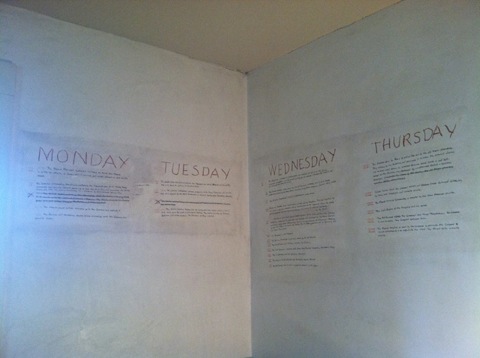
But not every author requires the god-like foresight of Joyce. Witness, for instance, J.K. Rowling’s spreadsheet for Harry Potter and the Order of the Phoenix (top), hand-drawn on lined notebook paper. Fine, Rowling’s no Joyce, but no one can say her method didn’t yield impressive results. For a more canonically literary example, see William Faulkner’s plan for A Fable (above). Faulkner famously outlined his fiction on the walls of his Rowan Oaks study, in-between bottles of bourbon.
Flavorwire has compiled a number of author outlines, from Joseph Heller’s dense, intricate grid design for Catch-22 to Jennifer Egan’s storyboards for “Black Box” and Norman Mailer’s medieval manuscript of a plan for Harlot’s Ghost. Each outline betrays a little of the author’s mind at work.
via Flavorwire
Related Content:
Six Postcards From Famous Writers: Hemingway, Kafka, Kerouac & More
Writers’ Houses Gives You a Virtual Tour of Famous Authors’ Homes
Photos of Famous Writers (and Rockers) with their Dogs
Josh Jones is a writer and musician based in Washington, DC. Follow him @jdmagness
Read More...Keith Richards Waxes Philosophical, Plays Live with His Idol, the Great Muddy Waters
Cadillac Records—a 2008 biopic about the rise and fall of Chicago’s Chess Records—won acclaim for bravura performances, garnered Beyonce a White House performance and threats of violence from Etta James, and took it on the chin for its deeply muddled history. But nobody goes to the movies for a history lesson, right? What stuck with me was its dramatization of that moment (okay, decade) when R&B and “race records” got rebranded by Alan Freed as “Rock n’ Roll” and crossed over the color line. Hundreds of bands hijacked Chuck Berry’s licks (as he saw it), and then Jagger crashed the party with his Muddy Waters impression while his band took their name from one of his blues songs.
The Stones may not have been the first British band to make American electric blues their own, but they were arguably the most popular. In an excerpt (below) from a longer interview from 1973, Keith Richards namechecks both Waters and Berry, as well as usual suspects Little Richard, Bo Diddley, Jimmy Reed, Slim Harpo, and the much earlier Robert Johnson and Blind Lemon Jefferson. The host pushes Keith on his roots influences and the part of black music in the Stones’ sound, asking if their lack of sentimentalism came from the blues. Keith replies,“I don’t get sentimental about things because… it doesn’t lead to clarity of thought.” And when I think clarity, I think Keith Richards. But seriously, it’s a gem of an interview.
Asked about how black musicians reacted to his blues appropriation, Richards gets philosophical: “Probably as many different reactions from them as anybody else.” We know how Chuck Berry felt—robbed—but Keith tells us Waters took it in stride, “grateful” for the introduction to the white college circuit which put more bread in his pocket. Maybe so, but Waters’ crossover before white audiences predated the Stones. Before the British invaded—two years before the Stones formed—Muddy hit England’s shores in 1958 (one year after Sister Rosetta Tharpe brought her electric blues across the pond). While the usual belief that Waters’ blues shocked the Brits may be a misconception, he won a new audience on the folk circuit, returning to England in ‘64. After laying low for a while, Waters saw a career revival late in life, performing into his final years with The Stones, Eric Clapton, Johnny Winters, and his own band. In the video above, see a full performance of Waters with the Stones from 1981, two years before Waters’ death from heart failure. He’s 66 at this gig, three years younger than Richards is now.
Related Content:
Chuck Berry Takes Keith Richards to School, Shows Him How to Rock (1987)
Revisit The Life & Music of Sister Rosetta Tharpe: ‘The Godmother of Rock and Roll’
Muddy Waters and Friends on the Blues and Gospel Train, 1964
Josh Jones is a writer and musician based in Washington, DC. Follow him @jdmagness
Read More...Support Us
We're hoping to rely on loyal readers, rather than erratic ads. Please click the Donate button and support Open Culture. You can use Paypal, Venmo, Patreon, even Crypto! We thank you!

About Us

Open Culture scours the web for the best educational media. We find the free courses and audio books you need, the language lessons & educational videos you want, and plenty of enlightenment in between.
Advertise With Us
FREE UPDATES!
GET OUR DAILY EMAIL
Get the best cultural and educational resources on the web curated for you in a daily email. We never spam. Unsubscribe at any time.
FOLLOW ON SOCIAL MEDIA
Open Culture editor Dan Colman scours the web for the best educational media. He finds the free courses and audio books you need, the language lessons & movies you want, and plenty of enlightenment in between.
Advertise With Us



