Virginia Woolf’s Handwritten Suicide Note: A Painful and Poignant Farewell (1941)
It seems like a very morbid and inhuman practice to treat the suicide note as a piece of literature, even if the author of said note is a writer as famous as Virginia Woolf. And yet, why not? I can anticipate all sorts of ethical objections having to do with decency, and I share some of those sentiments. Let us not forget, however, that death has often been a literary occasion: the long tradition of recorded last words ranges from deathbed confessions to the strangely theatrical genre of the gallows speech (see Socrates, Anne Boleyn, or John Brown). Like those unforgettable figures of history, Virginia Woolf’s last scripted words are pored over by lay readers and scholars alike (see, for example, pages on Woolf’s final words from Smith College and Yale).
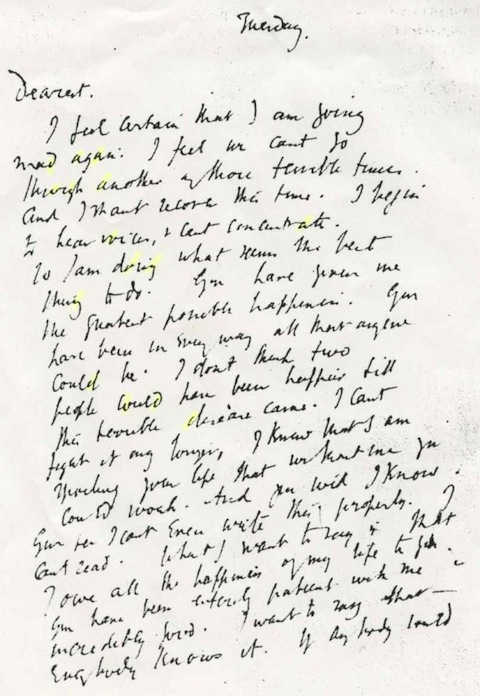
Woolf’s death, in March of 1941, occasioned the third of her suicide letters, and yes, it feels unseemly to linger over her last piece of prose. Perhaps it is the mode of death, suicide still being a societal taboo, thought of as tragic even when it’s undertaken calmly and rationally by someone ready to leave this world. And in many cases, especially those involving mental illness, death seems so needless, so extreme. Such was the case with Woolf, who drowned herself after a long struggle with what would probably be called today bipolar disorder. Her suicide note, written to her husband Leonard, is a haunting and beautiful document, in all its unadorned sincerity behind which much turmoil and anguish lie. See a scan of the handwritten note at the top, and read the full transcript below. Directly above, you can hear a dramatic reading of Woolf’s note, such a wrenching missive because it is not a farewell to the world at large, but rather to a trusted friend and lover.
Dearest,
I feel certain I am going mad again. I feel we can’t go through another of those terrible times. And I shan’t recover this time. I begin to hear voices, and I can’t concentrate. So I am doing what seems the best thing to do. You have given me the greatest possible happiness. You have been in every way all that anyone could be. I don’t think two people could have been happier till this terrible disease came. I can’t fight any longer. I know that I am spoiling your life, that without me you could work. And you will I know. You see I can’t even write this properly. I can’t read. What I want to say is I owe all the happiness of my life to you. You have been entirely patient with me and incredibly good. I want to say that — everybody knows it. If anybody could have saved me it would have been you. Everything has gone from me but the certainty of your goodness. I can’t go on spoiling your life any longer.
I don’t think two people could have been happier than we have been.
Related Content:
“A Haunted House” by Virginia Woolf
Find Works by Virginia Woolf in Our Collections of Free Audio Books and Free eBooks.
Josh Jones is a writer and musician based in Durham, NC. Follow him at @jdmagness
Read More...10 Essential Tips for Making Great Coffee at Home
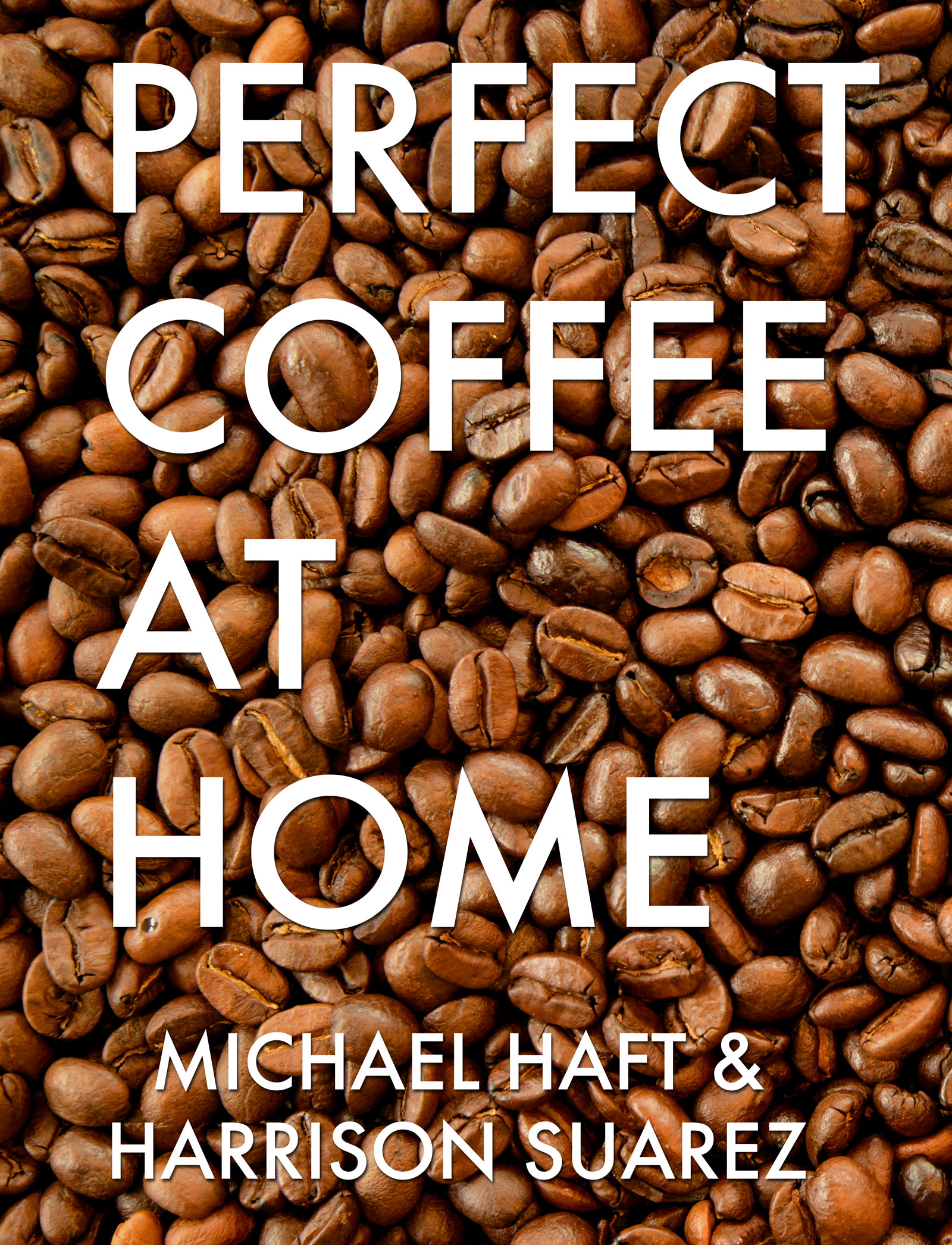
Michael Haft and Harrison Suarez went to college together, served in the Marines in Afghanistan, then, after returning home, stumbled upon the world of specialty coffee and began “an obsessive quest to brew the perfect cup.” That quest resulted in the publication of an interactive digital book designed for the iPad. Perfect Coffee at Home ($4.99) uses illustrations, interactive graphics, videos and a soundtrack to make the tutorial “an immersive experience.” But you don’t need to foot the bill or have an iPad to improve your coffee making skills.
Over at The Atlantic, Haft and Suarez gave some free advice last week, publishing an article where they, among other things, enumerated 10 essential tips for making coffee. They boiled things down to this:
- Buy good coffee beans. Preferably whole beans, sustainably farmed, and roasted within the past few weeks.
- Grind your coffee just before brewing. They say, “it’s the number one thing you can do to improve your coffee at home.”
- Store your coffee properly. Keep the coffee in an airtight container, away from sunlight. Try to avoid freezing the beans, unless they’re going to linger for more than two weeks.
- Use a good amount of coffee, and the right proportion of coffee to water. The ideal is what they call “The Golden Ratio,” 17.42 units of water to 1 unit of coffee.
- Find the right grind size for your coffee beans and aim for a uniform grind.
- Control the temperature of your water. Keep it somewhere between 195 and 202 degrees. Boiling water can sour the coffee.
- If you get really skilled, you can agitate the coffee during the brewing to control the taste.
- Focus on technique. And once you learn the right technique, make sure you’re precise and consistent.
- Use quality tools. Buy the right bean grinder and coffee maker. Make a good investment in your coffee drinking future.
- When experimenting with the brewing process, adjust only one variable at a time so you can accurately track results.
The Atlantic article offers more detail than what we’ve highlighted above. So we’d encourage you to give “How to Make Perfect Coffee” a read. You can also find short video primers on the Haft & Suarez YouTube Channel. If you have your own great coffee making tips, definitely share them with us in the comments sections below. We want to know!
Related Content:
A Short, Animated Look at What’s Inside Your Average Cup of Coffee
“The Vertue of the COFFEE Drink”: An Ad for London’s First Cafe Printed Circa 1652
The Physics of Coffee Rings Finally Explained
The History of Coffee and How It Transformed Our World
Read More...John Baldessari’s “I Will Not Make Any More Boring Art”: A 1971 Conceptual Art Piece/DIY Art Course
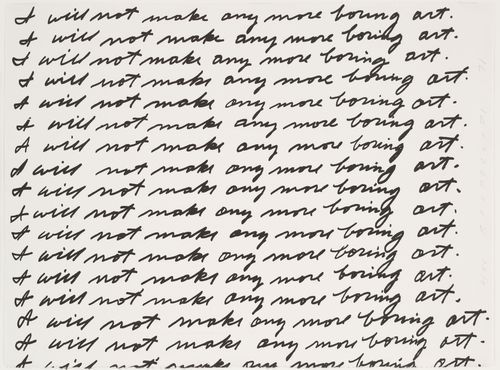
There are any number of ways to take artist John Baldessari’si 1971 piece I Will Not Make Any More Boring Art, so why not a DIY MOOC? No registration required and no course credit. Students who watch the entire 13-minute video above will receive certificates of completion, provided they’re willing to write them out themselves on lined notebook paper. (It’s really not that far fetched in an age where thousands of unofficial students recently took advantage of cartoonist Lynda Barry’s willingness to tweet her assignments for her Unthinkable Mind course at the University of Wisconsin.)
If you’re on the fence about the merits of Conceptual Art, you may be swayed to learn the history of the piece documented above. The year before its creation, John Baldessari incinerated his oeuvre, an act he referred to as The Cremation Project. Shortly thereafter, he responded to Nova Scotia College of Art and Design’s invitation to exhibit with a letter instructing students to be his surrogates in a punishment piece:
The piece is this, from floor to ceiling should be written by one or more people, one sentence under another, the following statement: I will not make any more bad art. At least one column of the sentence should be done floor to ceiling before the exhibit opens and the writing of the sentence should continue everyday, if possible, for the length of the exhibit. I would appreciate it if you could tell me how many times the sentence has been written after the exhibit closes. It should be hand written, clearly written with correct spelling….
Once the students had punished themselves to his specifications, the artist permitted the school to publish a fundraising lithograph, modeled on his handwriting.
It’s not a stretch to imagine that writing this sentence over and over could have changed more than a few participants’ lives, or at least rerouted the path their careers would take. What will happen if you take 13 minutes—the length of the video above—to try it yourself.
Related Content:
Join Cartoonist Lynda Barry for a University-Level Course on Doodling and Neuroscience
A Brief History of John Baldessari, Narrated by Tom Waits
Yoko Ono’s Make-Up Tips for Men
Ayun Halliday will wade through the boring in search of the good. Follow her @AyunHalliday
Read More...New Animation Explains Sherry Turkle’s Theories on Why Social Media Makes Us Lonely
Last fall Sherry Turkle, an MIT psychologist who explores how technology shapes modern relationships, published Alone Together: Why We Expect More from Technology and Less from Each Other. The third in a trilogy of books, Alone Together tries to make sense of a paradox. The more friends and acquaintances we gather on social platforms like Facebook and Twitter, the more we feel alone. We’re connected to other people more than ever, and yet we feel isolated in a new solitude. If you’re looking for a primer on Turkle’s thinking, you can watch a new animation (above) created by Shimi Cohen. It was made as a final project for a course taken at Shenkar College of Engineering and Design in Tel Aviv. Another way to get up to speed on Turkle’s thinking is to watch Turkle’s own TED Talk recorded in February, 2012. Find it right below. And, of course, you could always read her book, Alone Together, in print or digital format. A novel idea that.
If you would like to support the mission of Open Culture, consider making a donation to our site. It’s hard to rely 100% on ads, and your contributions will help us continue providing the best free cultural and educational materials to learners everywhere. You can contribute through PayPal, Patreon, and Venmo (@openculture). Thanks!
Read More...The Three Punctuation Rules of Cormac McCarthy (RIP), and How They All Go Back to James Joyce
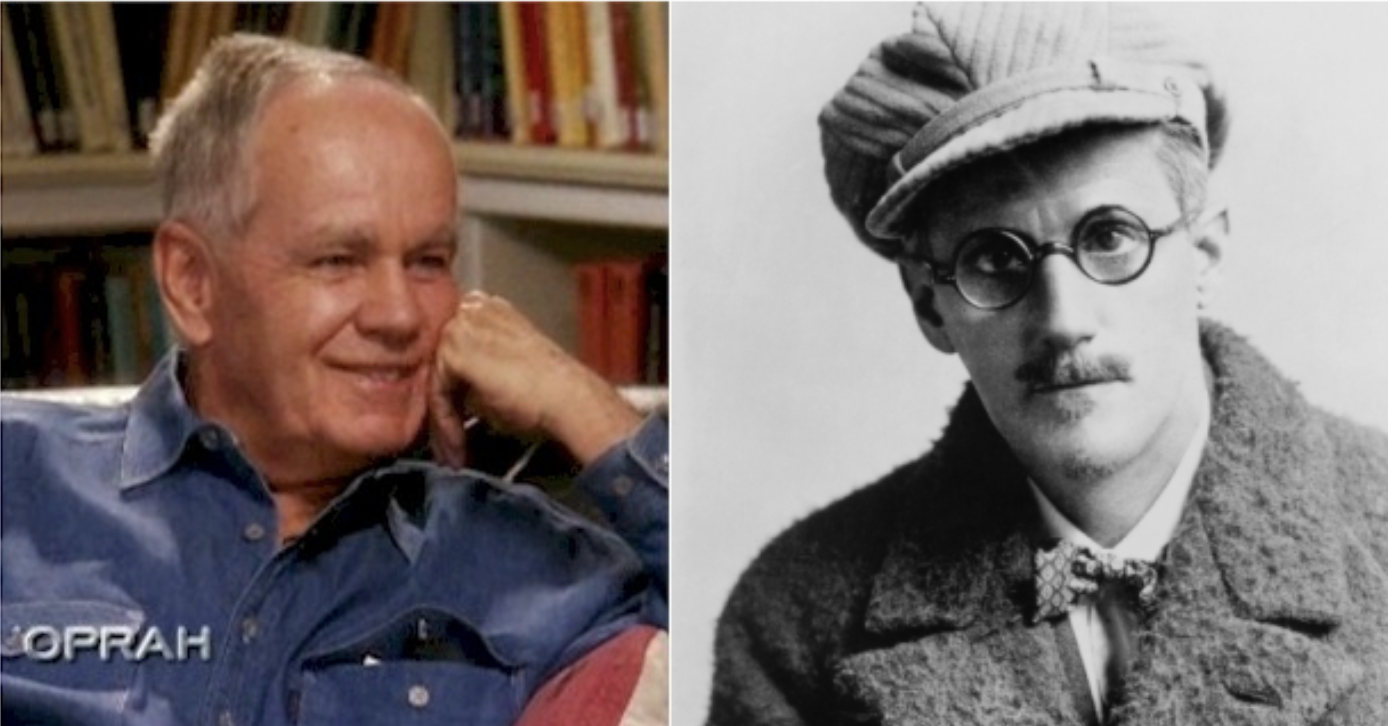
Cormac McCarthy has been—as one 1965 reviewer of his first novel, The Orchard Keeper, dubbed him—a “disciple of William Faulkner.” He makes admirable use of Faulknerian traits in his prose, and I’d always assumed he inherited his punctuation style from Faulkner as well. But in his very rare 2008 televised interview with Oprah Winfrey, McCarthy cites two other antecedents: James Joyce and forgotten novelist MacKinlay Kantor, whose Andersonville won the Pulitzer Prize in 1955. Joyce’s influence dominates, and in discussion of punctuation, McCarthy stresses that his minimalist approach works in the interest of maximum clarity. Speaking of Joyce, he says,
James Joyce is a good model for punctuation. He keeps it to an absolute minimum. There’s no reason to blot the page up with weird little marks. I mean, if you write properly you shouldn’t have to punctuate.
So what “weird little marks” does McCarthy allow, or not, and why? Below is a brief summary of his stated rules for punctuation:
1. Quotation Marks:
McCarthy doesn’t use ’em. In his Oprah interview, he says MacKinlay Kantor was the first writer he read who left them out. McCarthy stresses that this way of writing dialogue requires particular deliberation. Speaking of writers who have imitated him, he says, “You really have to be aware that there are no quotation marks, and write in such a way as to guide people as to who’s speaking.” Otherwise, confusion reigns.
2. Colons and semicolons:
Careful McCarthy reader Oprah says she “saw a colon once” in McCarthy’s prose, but she never encountered a semicolon. McCarthy confirms: “No semicolons.”
Of the colon, he says: “You can use a colon, if you’re getting ready to give a list of something that follows from what you just said. Like, these are the reasons.” This is a specific occasion that does not present itself often. The colon, one might say, genuflects to a very specific logical development, enumeration. McCarthy deems most other punctuation uses needless.
3. All other punctuation:
Aside from his restrictive rationing of the colon, McCarthy declares his stylistic convictions with simplicity: “I believe in periods, in capitals, in the occasional comma, and that’s it.” It’s a discipline he learned first in a college English class, where he worked to simplify 18th century essays for a textbook the professor was editing. Early modern English is notoriously cluttered with confounding punctuation, which did not become standardized until comparatively recently.
McCarthy, enamored of the prose style of the Neoclassical English writers but annoyed by their over-reliance on semicolons, remembers paring down an essay “by Swift or something” and hearing his professor say, “this is very good, this is exactly what’s needed.” Encouraged, he continued to simplify, working, he says to Oprah, “to make it easier, not to make it harder” to decipher his prose. For those who find McCarthy sometimes maddeningly opaque, this statement of intent may not help clarify things much. But lovers of his work may find renewed appreciation for his streamlined syntax.
Related Content:
Werner Herzog Reads From Cormac McCarthy’s All the Pretty Horses
Seven Tips From William Faulkner on How to Write Fiction
David Foster Wallace Breaks Down Five Common Word Usage Mistakes in English
Josh Jones is a writer and musician based in Washington, DC. Follow him at @jdmagness
Read More...The General, “Perhaps the Greatest Film Ever Made,” and 20 Other Buster Keaton Classics Free Online
What motion picture did no less an auteur than Orson Welles call “the greatest comedy ever made, the greatest Civil War film ever made, and perhaps the greatest film ever made”? Why, Joseph Frank “Buster” Keaton’s 1926 The General, unsung in its day but heaped with critical acclaim ever since. The General, as Roger Ebert describes it, “is an epic of silent comedy, one of the most expensive films of its time, including an accurate historical recreation of a Civil War episode, hundreds of extras, dangerous stunt sequences, and an actual locomotive falling from a burning bridge into a gorge far below.” This and all of Keaton’s movies, Ebert adds, showcase “a graceful perfection, such a meshing of story, character and episode, that they unfold like music.”
You can watch The General online right above. If you then find yourself moved to take in more of Keaton’s filmography, have a look at this list of his freely viewable pictures helpfully compiled by MUBI. Its still-active links include all of the following movies:
- One Week
- The General
- The Goat
- The Boat
- Steamboat Bill, Jr.
- The Playhouse
- Three Ages
- Convict 13
- Daydreams
- The Love Nest
- The Frozen North
- The Paleface
- Cops
- The Electric House
- The Balloonatic
- The Scarecrow
- Neighbors
- My Wife’s Relations
- College
- The Cameraman
- Speak Easily
- Sherlock, Jr.
They also provide a list of available films Keaton made in collaboration with his fellow silent star and mentor Roscoe “Fatty” Arbuckle:
- Back Stage
- The Bell Boy
- The Butcher Boy
- Coney Island
- Good Night Nurse
- His Wedding Night
- Out West
- The Rough House
These 21 films will give you a thorough primer on the joy of silent comedy as perfected by Buster Keaton, in Ebert’s words “not the Great Stone Face so much as a man who kept his composure in the center of chaos. Other silent actors might mug to get a point across, but Keaton remained observant and collected. That’s one reason his best movies have aged better than those of his rival, Charlie Chaplin. He seems like a modern visitor to the world of the silent clowns.”
We will add a number of these films to our collection of 500+ Free Movies Online.
Related Content:
The Power of Silent Movies, with The Artist Director Michel Hazanavicius
Hollywood, Epic Documentary Chronicles the Early History of Cinema
535 Free Movies Online: Great Classics, Indies, Noir, Westerns, etc.
25 Free Charlie Chaplin Films Online
Colin Marshall hosts and produces Notebook on Cities and Culture and writes essays on literature, film, cities, Asia, and aesthetics. He’s at work on a book about Los Angeles, A Los Angeles Primer. Follow him on Twitter at @colinmarshall.
Read More...The First Bloomsday: Watch Dublin’s Literati Celebrate James Joyce’s Ulysses in Drunken Fashion, 1954
Here’s a fascinating glimpse of the very first Bloomsday celebration, filmed in Dublin in 1954.
The footage shows the great Irish comedic writer Brian O’Nolan, better known by his pen name Flann O’Brien, appearing very drunk as he sets off with two other renowned post-war Irish writers, Patrick Kavanagh and Anthony Cronin, and a cousin of James Joyce, a dentist named Tom Joyce, on a pilgrimage to visit the sites in James Joyce’s epic novel Ulysses.
The footage was taken by John Ryan, an artist, publisher and pub owner who organized the event. The idea was to retrace the steps of Leopold Bloom and other characters from the novel, but as Peter Costello and Peter van de Kamp explain in this humerous passage from their book, Flann O’Brien: An Illustrated Biography, things began to go awry right from the start:
The date was 16 June, 1954, and though it was only mid-morning, Brian O’Nolan was already drunk.
This day was the fiftieth anniversary of Mr. Leopold Bloom’s wanderings through Dublin, which James Joyce had immortalised in Ulysses.
To mark this occasion a small group of Dublin literati had gathered at the Sandycove home of Michael Scott, a well-known architect, just below the Martello tower in which the opening scene of Joyce’s novel is set. They planned to travel round the city through the day, visiting in turn the scenes of the novel, ending at night in what had once been the brothel quarter of the city, the area which Joyce had called Nighttown.
Sadly, no-one expected O’Nolan to be sober. By reputation, if not by sight, everyone in Dublin knew Brian O’Nolan, otherwise Myles na Gopaleen, the writer of the Cruiskeen Lawn column in the Irish Times. A few knew that under the name of Flann O’Brien, he had written in his youth a now nearly forgotten novel, At Swim-Two-Birds. Seeing him about the city, many must have wondered how a man with such extreme drinking habits, even for the city of Dublin, could have sustained a career as a writer.
As was his custom, he had been drinking that morning in the pubs around the Cattle Market, where customers, supposedly about their lawful business, would be served from 7:30 in the morning. Now retired from the Civil Service, on grounds of “ill-health”, he was earning his living as a free-lance journalist, writing not only for the Irish Times, but for other papers and magazines under several pen-names. He needed to write for money as his pension was a tiny one. But this left little time for more creative work. In fact, O’Nolan no longer felt the urge to write other novels.
The rest of the party, that first Bloomsday, was made up of the poet Patrick Kavanagh, the young critic Anthony Cronin, a dentist named Tom Joyce, who as Joyce’s cousin represented the family interest, and John Ryan, the painter and businessman who owned and edited the literary magazine Envoy. The idea of the Bloomsday celebration had been Ryan’s, growing naturally out of a special Joyce issue of his magazine, for which O’Nolan had been guest editor.
Ryan had engaged two horse drawn cabs, of the old fashioned kind, which in Ulysses Mr. Bloom and his friends drive to poor Paddy Dignam’s funeral. The party were assigned roles from the novel. Cronin stood in for Stephen Dedalus, O’Nolan for his father, Simon Dedalus, John Ryan for the journalist Martin Cunningham, and A.J. Leventhal, the Registrar of Trinity College, being Jewish, was recruited to fill (unkown to himself according to John Ryan) the role of Leopold Bloom.
Kavanagh and O’Nolan began the day by deciding they must climb up to the Martello tower itself, which stood on a granite shoulder behind the house. As Cronin recalls, Kavanagh hoisted himself up the steep slope above O’Nolan, who snarled in anger and laid hold of his ankle. Kavanagh roared, and lashed out with his foot. Fearful that O’Nolan would be kicked in the face by the poet’s enormous farmer’s boot, the others hastened to rescue and restrain the rivals.
With some difficulty O’Nolan was stuffed into one of the cabs by Cronin and the others. Then they were off, along the seafront of Dublin Bay, and into the city.
In pubs along the way an enormous amount of alcohol was consumed, so much so that on Sandymount Strand they had to relieve themselves as Stephen Dedalus does in Ulysses. Tom Joyce and Cronin sang the sentimental songs of Tom Moore which Joyce had loved, such as Silent, O Moyle. They stopped in Irishtown to listen to the running of the Ascot Gold Cup on a radio in a betting shop, but eventually they arrived in Duke Street in the city centre, and the Bailey, which John Ryan then ran as a literary pub.
They went no further. Once there, another drink seemed more attractive than a long tour of Joycean slums, and the siren call of the long vanished pleasures of Nighttown.
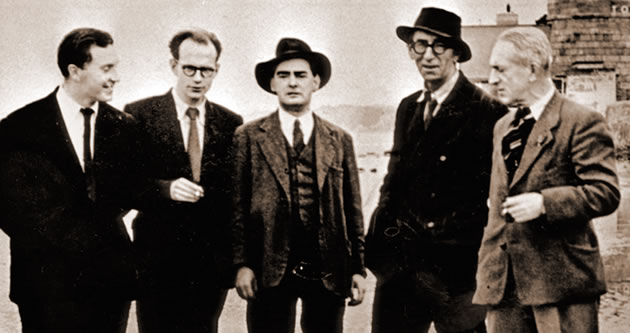
Celebrants of the first Bloomsday pause for a photo in Sandymount, Dublin on the morning of June 16, 1954. From left are John Ryan, Anthony Cronin, Brian O’Nolan (a.k.a. Flann O’Brien), Patrick Kavanagh and Tom Joyce, cousin of James Joyce.
via Biblioklept/Antoine Malette
Related content:
On Bloomsday, Hear James Joyce Read From his Epic Ulysses, 1924
Stephen Fry Explains His Love for James Joyce’s Ulysses
Henri Matisse Illustrates 1935 Edition of James Joyce’s Ulysses
Read More...Henry Rollins: Education is the Cure to “Disaster Capitalism”
We’ve already featured former Black Flag frontman and current spoken-word artist Henry Rollins explaining why, to his mind, only education can restore democracy. He also believes it can cure something he calls “disaster capitalism,” and you can hear more from him about it in the Big Think video above. He addresses, in his characteristically straightforward manner, the questions of what exactly ails the American economy, how that ailment might have come about, and how the country can educate itself back to health. We may individually get our educations now, he grants, but “how long will it be until America fiscally turns itself around” to the point of repaying “the risk of the investment on that student loan to get a person through four years of college? Will that person get a job where paying off that loan and getting a house and affording a family, will that be a possibility? In the present America, it doesn’t look like it is.”
Seeing a dire national situation, Rollins recommends doing like China, but not in the way you might assume. He suggests looking “500 years at a time,” much farther up the road than we have of late. “I’d be looking up the road so far my eyes would fall out of my head.” He wants the country to become “like Europe, where they’ll educate your kid until his head explodes,” producing “three doctors per floor of every apartment building” and doing so by making “college tuition either free or really low.” Generally thought of as liberal, Rollins sums this up in a way that might appeal to his ideological opponents: “If you have a country full of whip-crack smart people, you have a country the rest of the world will fear. They will not invade a country of educated people because we are so smart we’ll build a laser that will burn you, the enemy, in your sleep before you can even mobilize your air force to kill us. We will kill you so fast because we are so smart and we will have foreign policy that will not piss you off to the point to where you have to attack us.”
Related Content:
Henry Rollins Pitches Education as the Key to Restoring Democracy
Colin Marshall hosts and produces Notebook on Cities and Culture and writes essays on literature, film, cities, Asia, and aesthetics. He’s at work on a book about Los Angeles, A Los Angeles Primer. Follow him on Twitter at @colinmarshall.
Read More...Watch Pitch Tar Finally Drip in One of World’s Oldest, Slowest-Moving Experiments
Let’s take a little break from our fast-moving world and watch one of the world’s oldest and slowest-moving experiments in action. Begun in October 1944 at Trinity College Dublin’s School of Physics, the Tar Drop experiment has attempted to measure the viscosity of pitch tar, a polymer that seems solid at room temperature. The goal of the experiment? To demonstrate that pitch tar actually flows and to capture a drop falling from a funnel — something that happens about once a decade. Above, you can watch a timelapse video of all the exciting action. It marks the first time a pitch drop has ever been captured on film.
It’s worth noting that the The University of Queensland has its own Pitch Drop Experiment going. It started back in 1927. And it’s currently listed in the Guinness Book of World Records as the world’s longest-running laboratory experiment.
In the segment below, Radiolab offers a primer on the famous experiment.
via CNET
Read More...Charles Mingus Explains in His Grammy-Winning Essay “What is a Jazz Composer?”
I remember the first time I heard Charles Mingus. My senior year of high school, a friend who, at the time, was studying electric bass at Boston’s Berklee College of Music, introduced me by putting on 1956’s Pithecanthropus Erectus and saying “you have to hear this.” I knew jazz in a passing way—some Ellington, some Miles Davis… not enough to make many distinctions. But I knew right away Mingus was something special. His compositions were so cool, so dynamic and angular and thoughtful, with the push-pull of his measured double bass against the occasional cacophony of piano and sax. Entranced, I sought out more, and discovered favorites like the bluesy “Goodbye Pork Pie Hat”—live at Montreux in 1975 above—from Mingus’s 1959 watershed Mingus Ah Um, a record that shared the spotlight with other instant classics that year, including Miles Davis’ Kind of Blue, John Coltrane’s Giant Steps, and Ornette Coleman’s The Shape of Jazz to Come. (On that note, don’t miss the documentary, 1959: The Year That Changed Jazz.)
Mingus stood among giants, and was a giant himself. But oddly enough, while all of the artists on this list won, often multiple, Grammy awards, Mingus received no nods from the Recording Academy for any of his several dozen original albums. The snubs—if that’s what they were—may have been due to his famously irascible personality, or to the fact that Mingus eluded classification. As his friend Nat Hentoff wrote of him in 1999, jazz critics could not “find a category, a convenient term, to describe him.” Mingus himself told Hentoff, “I am trying to play the truth of what I am. The reason it’s difficult is because I’m changing all the time.” But while the bassist’s musical compositions were ignored, he did receive one nomination, in 1971, for another kind of writing—the liner notes to his 1971 album Let My Children Hear Music, a record he called “the best album I have ever made” (hear it in full below). Mingus’s liner-notes essay—a lost art these days—is titled “What is a Jazz Composer?,” and it’s an insightful exploration of the artist’s own history and compositional technique.
Eloquent, but loose, Mingus’s prose wanders from personal anecdotes to philosophical ruminations. On the role of jazz soloists as composers, he writes,
Each jazz musician when he takes a horn in his hand- trumpet, bass, saxophone, drums-whatever instrument he plays—each soloist, that is, when he begins to ad lib on a given composition with a title and improvise a new creative melody, this man is taking the place of a composer.
Later, however, Mingus seems skeptical of this idea: “each jazz musician is supposed to be a composer. Whether he is or not, I don’t know.” Although Mingus struggled as a child to read music—and faced racial barriers to a classical career—he trained first on the cello and incorporated many elements of classical music, as well as gospel and big band, into his compositions. When the bop era of improvisation came along, Mingus rolled with it, but found himself looking critically at the new wave represented by, for example, Ornette Coleman’s showy solos. The essay, even so many years after the bop revolution, reflects his ambivalence. He writes:
Today, things are at the other extreme. Everything is supposed to be invented, the guys never repeat anything at all and probably couldn’t. They don’t even write down their own tunes, they just make them up as they sit on the bandstand. It’s all right, I don’t question it. I know and hear what they are doing. But the validity remains to be seen—what comes, what is left, after you hear the melody and after you hear the solo. Unless you just want to hear the feeling, as they say.
Mingus was an oddity in the post-bop world; he generally eschewed the soloist approach. Instead, he seems to see himself operating in a classical, or at least more formal, tradition, drawing as much from Stravinsky as from Ellington. As one writer puts it, his music was “schizophrenic in that it both harked back to the New Orleans roots of jazz and looked forward to progressive chamber jazz and ‘third stream’ jazz. His compositions ranged wildly in mood and dynamics, from puntillistic counterpoint to massive Wagner-ian explosions.” In his liner notes, he laments the limited instrumentation of jazz, which he finds “stifling.” Mingus makes it clear that as a composer, he strives for highbrow respectability, while also stressing that he thinks the virtuosity of jazz has pushed all forms forward, including classical. Bequeathing his album to his successors, his musical “children,” Mingus urges future jazz composers to expand their range into symphonic territory:
I think it is time our children were raised to think they can play bassoon, oboe, English horn, French horn, lull percussion, violin, cello. The results would be-well the Philharmonic would not be the only answer for us then. If we so-called jazz musicians who are the composers, the spontaneous composers, started including these instruments in our music, it would open everything up, it would get rid of prejudice because the musicianship would be so high in caliber that the symphony couldn’t refuse us.
Some of Mingus’s contemporaries found his classical aspirations cold and offputting. For example, Mingus describes in an interview how Fats Navarro—who said he “always played with hate”—chided the bassist by saying, “Mingus, you just played the theory. you didn’t tell me how you felt. You didn’t say, ‘Hello, Fats, I love you.’ You didn’t play nothing beautiful” (an observation Mingus says “woke him up”).
The liner notes essay is replete with other reminisces of Mingus’s musical coming-of-age, from his love for Debussy, Stravinsky, and Strauss, to his tutelage under “master musician” Lloyd Reese. You can read the whole thing here at the official Mingus site, which features more of his writing, such as “An Open Letter to Miles Davis,” originally published in Down Beat Magazine in 1955.
Related Content:
1959: The Year that Changed Jazz
How to Potty Train Your Cat: A Handy Manual by Charles Mingus
Rare Miles Davis Live Recordings Capture the Jazz Musician at the Height of His Powers
Josh Jones is a writer and musician based in Washington, DC. Follow him at @jdmagness
Read More...Support Us
We're hoping to rely on loyal readers, rather than erratic ads. Please click the Donate button and support Open Culture. You can use Paypal, Venmo, Patreon, even Crypto! We thank you!

About Us

Open Culture scours the web for the best educational media. We find the free courses and audio books you need, the language lessons & educational videos you want, and plenty of enlightenment in between.
Advertise With Us
FREE UPDATES!
GET OUR DAILY EMAIL
Get the best cultural and educational resources on the web curated for you in a daily email. We never spam. Unsubscribe at any time.
FOLLOW ON SOCIAL MEDIA
Open Culture editor Dan Colman scours the web for the best educational media. He finds the free courses and audio books you need, the language lessons & movies you want, and plenty of enlightenment in between.
Advertise With Us

