Free Audio: Bryan Cranston, Breaking Bad Star, Reads First Chapter of The Things They Carried

If you’re going through Breaking Bad withdrawal, here’s a small way to fill the void. Audible.com has made available a recording of Bryan Cranston, the actor behind Walter White, reading the first chapter from The Things They Carried, Tim O’Brien’s famous story collection that offers a chilling, boots-on-the-ground portrayal of soldiers’ experience during the Vietnam War. A finalist for the 1990 Pulitzer Prize and the National Book Critics Circle Award, the book has sold over 2 million copies worldwide and is now a staple of college and high school English classes across America. Cranston’s reading runs over 47 minutes.
Cranston actually narrates the entire book, and if you’re interested in downloading it, there’s a way to do it for free. Just head over to Audible.com and register for a 30-day free trial. You can download any audio book for free, including The Things They Carried. Then, when the trial is over, you can continue your Audible subscription, or cancel it, and still keep the audio book. The choice is yours. And, in full disclosure, let me tell you that we have a nice arrangement with Audible. Whenever someone signs up for their amazing service, it helps support Open Culture. Get more information on Audible’s free trial here.
Also don’t miss our collection, 1,000 Free Audio Books: Download Great Books for Free. It’s a priceless resource.
via Galley Cat
Related Content:
The Science of Breaking Bad: Professor Donna Nelson Explains How the Show Gets it Right
Watch the Original Audition Tapes for Breaking Bad Before the Final Season Debuts
Stephen Fry Hosts “The Science of Opera,” a Discussion of How Music Moves Us Physically to Tears
I vividly recall my first opera. It was The Marriage of Figaro at the Metropolitan Opera in New York. A friend bought two family circle tickets—nosebleed seats—and insisted that I come along. She was a trained opera singer and aficionado. I was an unlearned neophyte. Most of my expectations were fulfilled: the enormously impressive space, plenty of bombast, intricately designed sets and costuming. And it was long. Very long. But not, as I had feared, boring. Not at all. I had not expected, in fact, to be so physically moved by the performances, and not only moved to basic emotions—I was moved deep in my gut. There’s no way I could adequately explain it.
But the medical scientists in the video above can. In “The Science of Opera,” actor Stephen Fry and comedian Alan Davies convene a panel of researchers from University College London to discuss what happened physiologically when the pair were hooked up to various sensors as they attended Verdi’s Simon Boccanegra at the Royal Opera House. Like the pairing at my first opera, Fry is a knowledgeable lover of the art and Davies is almost an opera virgin (the story of his actual first opera gets a good laugh). The gadgets attached to Fry and Davies measured their heart rates, breathing, sweat, and “various other emotional responses.” What do we learn from the experiment? For one thing, as neurobiologist Michael Trimble informs us, “music is different from all the other arts.” For example, ninety percent of people surveyed admit to being moved to tears by a piece of music. Only five to ten percent say the same about painting or sculpture. Fry and Davies’ autonomic nervous system responses confirm the power of music (and story) to move us beyond our conscious control and awareness.
And why is this? You’ll have to watch the discussion to learn more—I won’t summarize it here. Just know that we get insights not only into the science of opera, but the art as well—Verdi’s art in particular—and the various disciplines represented here do much to expand our appreciation of music, whether we specifically love opera or not. This is not the first talk on opera Fry has been a part of. He previously hosted another Royal Opera Company event called “Verdi vs. Wagner: the 200th birthday debate” (above). Though I favor the Germans, I’d say it’s a draw, but partisans of either one will likely come away with their opinions intact, having learned a thing or two along the way.
Related Content:
Stephen Fry Reads Oscar Wilde’s Children’s Story “The Happy Prince”
Stephen Fry, Language Enthusiast, Defends The “Unnecessary” Art Of Swearing
Find Yale’s Course “Listening to Music” in our Collection of 775 Free Online Courses
Josh Jones is a writer and musician based in Durham, NC. Follow him at @jdmagness
Read More...Ernest Hemingway’s Delusional Adventures in Boxing: “My Writing is Nothing, My Boxing is Everything.”
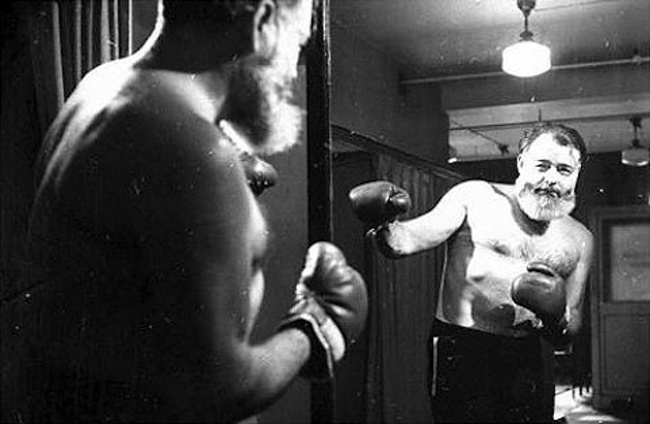
In a 1954 interview in the Paris Review, Ralph Ellison said of one of his literary heroes: “When [Ernest Hemingway] describes something in print, believe him; believe him even when he describes the process of art in terms of baseball or boxing; he’s been there.” I read this thinking that Ellison might be a bit too credulous. Hemingway, after all, has provoked no end of eye-rolling for his legendary machismo, bravado, and maybe several dozen other Latin descriptors for masculine foolhardiness and bluster. As for his “boxing,” we would be wise not to believe him. He may have “been there,” but the real boxers he encountered, and tried to spar with, would never testify he knew what he was doing
Ernest Hemingway wasn’t a boxer so much as he was a “boxer”… a legend in his own mind, a romantic. Hemingway’s friend and sometime sparring partner, novelist Morley Callaghan tells it this way: “we were two amateur boxers. The difference between us was that he had given time and imagination to boxing; I had actually worked out a lot with good fast college boxers.” Or, as the author of an article on the Fine Books & Collections site has it, “Hemingway was lost in the romance of a sport that has no romance to those seriously pursuing it; the romance strictly belongs to spectators.”
As a spectator with pretentions to greatness in the sport, Papa was prone to overestimating his abilities, at the expense of his actual skill as a writer. As he would tell Josephine Herbst, without a hint of irony, “my writing is nothing, my boxing is everything.”

Click for larger image
How did the pros evaluate his self-professed ability? Jack Dempsey, who spent time in Paris in the ‘20s being feted and fawned over, had this to say of Hemingway’s aspirations:
There were a lot of Americans in Paris and I sparred with a couple, just to be obliging…. But there was one fellow I wouldn’t mix it with. That was Ernest Hemingway. He was about twenty-five or so and in good shape, and I was getting so I could read people, or anyway men, pretty well. I had this sense that Hemingway, who really thought he could box, would come out of the corner like a madman. To stop him, I would have to hurt him badly, I didn’t want to do that to Hemingway. That’s why I never sparred with him.
Given Hemingway’s penchant for self-delusion in this matter, he may have interpreted this as Dempsey’s capitulation to his obvious prowess. An even more scathing critique of Hemingway’s bullying… I mean boxing skill … comes to us via Booktryst’s Stephen J. Gertz, who proffers an amusing dissection of the letter above, an unpublished correspondence Hemingway sent in 1943 to George Brown, the writer’s “trainer, coach, friend, and factotum.” Brown, it seems, was kindly, or prudent, enough to encourage his employer in his delusions. However, Gertz writes, “the reality was that anyone who had even the slightest idea of what they were doing in the ring could take Hemingway, who was notorious for foolishly trying to actually fight trained boxers.” He’s lucky, then, that Dempsey practiced such judicious restraint. If not, we may never have seen any fiction from Hemingway after he tried to go a round or two with the champ.
Related Content:
Ernest Hemingway to F. Scott Fitzgerald: “Kiss My Ass”
18 (Free) Books Ernest Hemingway Wished He Could Read Again for the First Time
Ernest Hemingway’s Favorite Hamburger Recipe
Josh Jones is a writer and musician based in Durham, NC. Follow him at @jdmagness
Read More...Alan Lomax’s Music Archive Houses Over 17,400 Folk Recordings From 1946 to the 1990s
The work of folklorists and musicologists like Alan Lomax, Stetson Kennedy, and Harry Smith has long been revered in countercultural communities and libraries; and it occasionally reaches mainstream audiences in, for example, the Coen Brother’s 2000 film Oh Brother, Where Art Thou? and its attendant soundtrack, or the playlists of purists on college radio and NPR. But their recordings are much more than historical novelties.
Archives like Lomax’s Association for Cultural Equity—which we’ve featured before—help remind us of our origins as much as bottom-up accounts like Howard Zinn’s A People’s History of the United States. Lomax and his colleagues believed that folk art and music infuse and renew “high” art and provide bulwarks against the cynical destitution of mass-market commercial media that can seem so deadening and inescapable.
That is not to say that notions of authenticity aren’t fraught with their own problems of exploitation. Approaching folk art as tourists, we can demean it and ourselves. But the problem is less, I think, one of gentrification than of neglect: it’s simply far too easy to lose touch, a much-remarked-upon irony of the age of social networking. Lomax understood this. He founded ACE “to explore and preserve the world’s expressive traditions with humanistic commitment and scientific engagement.” The organization resides at NYC’s Hunter College and, since Lomax’s retirement in 1996, has been overseen by his daughter, Anna Lomax Wood. Through an arrangement with the Library of Congress, which houses the originals, ACE has access to all of Lomax’s collection of field recordings and can disseminate them online to the public. Lomax’s association has also long been active in repatriating recorded artifacts to libraries and archives in their places of origin, giving local communities access to cultural histories that may otherwise be lost to them.
Lomax underscored the significance of his organization’s name in a 1972 essay entitled “An Appeal for Cultural Equity,” in which he lays out the importance of preserving cultural diversity against the “oppressive dullness and psychic distress” imposed upon “those areas where centralized music industries, exploiting the star system and controlling the communication system, put the local musician out of work and silence folk song.” Are we any more improved forty years later for the shocking monopolization of mass media in the hands of a few conglomerates? I’d answer unequivocally no but for one important qualification: mass media in the form of open online archives allows us unprecedented access to, for example, the awesome late-seventies film of R.L. Burnside (top), who like many Mississippi Delta bluesmen before him, would only achieve recognition much later in life. Or we can see native North Carolinian Cas Wallin (above) sing a version of folk song “Pretty Saro” in 1982, a song Bob Dylan recorded and only recently released. Then there’s one of my favorites, “Make Me A Pallet On Your Floor,” picked and sung below by Mississippian Sam Chatmon—a song played and recorded by countless black and white blues and country artists like Mississippi John Hurt and Gillian Welch.
These and thousands of other examples from the ACE archive bring musicologists, historians, folklorists, activists, educators, and everyone else closer to Lomax’s ideal—that we “learn how we can put our magnificent mass communications technology at the service of each and every branch of the human family.” The ACE catalog contains over 17,400 digital files, beginning with Lomax’s first tape recordings in 1946, to his digital work in the 90s. The archive includes songs, stories, jokes, sermons, interviews and other audio artifacts from the American South, Appalachia, the Caribbean, and many more locales. The archive features recordings from famous names like Woody Guthrie and Lead Belly but primarily consists of folk music from anonymous folk, representing a variety of languages and ethnicities. And the archive is ever-expanding as it continues to digitize rare recordings, and to upload vintage film, like the videos above, to its YouTube channel.
Related Content:
Legendary Folklorist Alan Lomax: ‘The Land Where the Blues Began’
Woody Guthrie at 100: Celebrate His Amazing Life with a BBC Film
Hear Zora Neale Hurston Sing the Bawdy Prison Blues Song “Uncle Bud” (1940)
Josh Jones is a writer and musician based in Durham, NC. Follow him at @jdmagness
Read More...Death of An Adjunct: A Sobering, True Story

The Pittsburgh Post-Gazette ran a sad and galling story yesterday about Mary Margaret Vojtko who died of a heart attack at the age of 83. At the time of her death, Daniel Kovalik writes:
She was receiving radiation therapy for the cancer that had just returned to her, she was living nearly homeless because she could not afford the upkeep on her home, which was literally falling in on itself, and now, she explained, she had received another indignity — a letter from Adult Protective Services telling her that someone had referred her case to them saying that she needed assistance in taking care of herself.
Vojtko had ended up in poverty after spending 25 years working as an adjunct professor of French at Duquesne University, a Catholic school located in Pittsburgh, Pa. Until she was terminated last spring, she worked “on a contract basis from semester to semester, with no job security, no benefits and with a salary of between $3,000 and just over $3,500 per three-credit course.” When teaching three classes a semester and two during the summer, Vojtko never earned more than $25,000 a year. (A pittance compared to the pay package of Duquesne’s president — reportedly about $700,000 per year in salary and benefits.) Meanwhile, Duquesne thwarted attempts by adjuncts to unionize, claiming that the school should have a religious exemption.
As Kovalik goes on to note: “Adjuncts now make up well over 50 percent of the faculty at colleges and universities.” And that statistic is bound to increase. You can — and should — read the full story at the Post-Gazette. Read Death of an Adjunct here.
via @stevesilberman
Read More...Edward Said Speaks Candidly about Politics, His Illness, and His Legacy in His Final Interview (2003)
In an excerpt from her memoir published in Salon last month, Najla Said—daughter of literary critic and Palestinian-American political activist Edward Said—recalls her father’s legacy:
To very smart people who study a lot, Edward Said is the “father of postcolonial studies” or, as he told me once when he insisted I was wasting my college education by taking a course on postmodernism and I told him he didn’t even know what it was:
“Know what it is, Najla? I invented it!!!”
I still don’t know if he was joking or serious.
Most likely Said was only half serious, but it’s impossible to overstate the impact of his 1978 book Orientalism on the generations of students and activists that followed. As Najla writes, it’s “the book that everyone reads at some point in college, whether in history, politics, Buddhism, or literature class.” Said’s “postmodernism,” unlike that of Francois Lyotard or many others, avoided the pejorative baggage that came to attach to the term, largely because while he called into doubt certain ossified and pernicious categorical distinctions, he never stopped believing in the positive intellectual enterprise that gave him the tools and the position to make his critiques. He stubbornly called himself a humanist, “despite,” as he writes in the preface to the 2003 edition of his most famous book, “the scornful dismissal of the term by sophisticated post-modern critics”:
It isn’t at all a matter of being optimistic, but rather of continuing to have faith in the ongoing and literally unending process of emancipation and enlightenment that, in my opinion, frames and gives direction to the intellectual vocation.
In that same preface Said also writes of his aging, of the recent death of two mentors, and of “the necessary diminutions in expectations and pedagogic zeal which usually frame the road to seniority.” He does not write about the leukemia that would take his life that same year at the age of 67, ten years ago this month.
For the interview above, however, Said’s last, he speaks candidly about his illness. Fittingly, the video opens with a quote from Roland Barthes: “The only sort of interview that one could, if forced to, defend would be where the author is asked to articulate what he cannot write.” Said tells interviewer Charles Glass that his main preoccupation in the past few months had been his illness, something he thought he had “mastered” but which had forced him to confront the incontrovertible fact of his mortality and sapped him of his will to work.
Said, as always, is articulate and engaging, and the conversation soon turns to his other preoccupations: the situation of the Palestinian people and the politics and personal toll of living “between worlds.” He also expresses his disappointment in friends who had become “mouthpieces of the status quo,” banging the drums for war and Western Imperialism in this, the first year of the war in Iraq. One suspects that he refers to Christopher Hitchens, among others, though he is too discreet to name names. Said has a tremendous amount to say on not only the current events of the time but on his entire career as a writer and thinker. Though he’s given dozens of impassioned interviews over the decades, this may be the most honest and unguarded, as he unburdens himself during his final days of those things, perhaps, he could not bring himself to write.
Thanks to Stephanos for sending this video our way.
Related Content:
Stephen Fry & Friends Pay Tribute to Christopher Hitchens
Christopher Hitchens: No Deathbed Conversion for Me, Thanks, But it was Good of You to Ask
Noam Chomsky Calls Postmodern Critiques of Science Over-Inflated “Polysyllabic Truisms”
Josh Jones is a writer and musician based in Durham, NC. Follow him at @jdmagness
Read More...Disco Saves Lives: Give CPR to the The Beat of Bee Gees “Stayin’ Alive”
What to do if someone one around you goes into cardiac arrest? The American Heart Association has two simple tips. Over at their web site, they write: “If you see a teen or adult suddenly collapse, call 9–1‑1 and push hard and fast in the center of the chest to the beat of the classic disco song ‘Stayin’ Alive.’ CPR can more than double a person’s chances of survival, and ‘Stayin’ Alive’ has the right beat for Hands-Only CPR.” The song also has the right title for the job at hand.
To help spread the word, the AHA produced a series of videos available on YouTube, including this one starring Ken Jeong, an actor and comedian who is also a licensed physician in California. You may well recognize him from Judd Apatow’s film Knocked Up, where, like here, he exhorts people to “focus, pay attention.”
Behind this schtick, there’s some real science. According to NPR:
A study by the University of Illinois College of Medicine has found that the Bee Gees’ “Stayin’ Alive” has the utterly perfect beat for performing cardiopulmonary resuscitation. The 1977 disco hit contains 103 beats per minute. That’s close to the recommended chest compression rate of 100 beats every 60 seconds.
Below, you can find a very different version of the same campaign that aired in the UK. And thanks to this ad campaign, at least one life was actually saved.
Note: Another song to keep in mind in these life or death situations is Queen’s “Another One Bites the Dust.” It has the right beat. But not so much the right title.
Demos for Hands-Only CPR can be found at the AHA web site.
via Metafilter
Read More...Philosopher Portraits: Famous Philosophers Painted in the Style of Influential Artists
Ludwig Wittgenstein/Piet Mondrian:
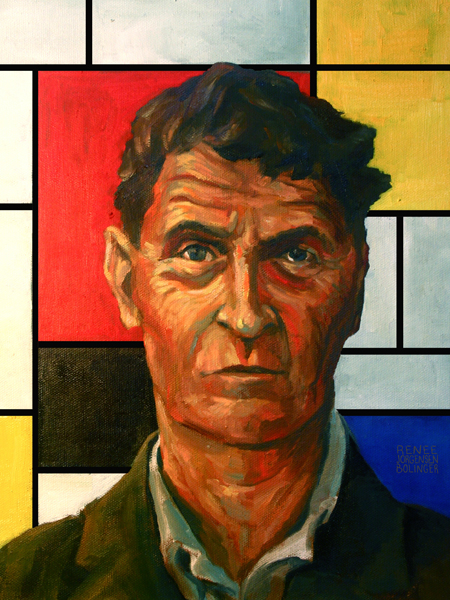
What do the Austrian-British philosopher Ludwig Wittgenstein and the Dutch painter Piet Mondrian have in common? For philosopher and artist Renée Jorgensen Bolinger, the two have similar beliefs about the logic of space.
“Many of Mondrian’s pieces explore the relationships between adjacent spaces,” says Bolinger “and in particular the formative role of each on the boundaries and possibilities of the other. I based this painting [see above] off of Wittgenstein’s Tractatus, in which he develops a theory of meaning grounded in the idea that propositions have meaning only insofar as they constrain the ways the world could be; a meaningful proposition is thus very like one of Mondrian’s color squares, forming a boundary and limiting the possible configurations of the adjacent spaces.”
A second-year PhD student in the philosophy program at the University of Southern California, Bolinger studied painting a Biola University before making philosophy her second major. “I actually came to philosophy quite late in my college career,” Bolinger says, “only adding the major in my junior year. I was fortunate to have two particularly excellent and philosophic art teachers, Jonathan Puls and Jonathan Anderson, who convinced me that my two passions were not mutually exclusive, and encouraged me to pursue both as I began my graduate education.”
Bolinger now works primarily on the philosophy of language, with side interests in logic, epistemology, mind and political philosophy. She continues to paint. We asked her how she reconciles her two passions, which seem to occupy opposite sides of the mind. “I do work in analytic philosophy,” she says, “but it’s only half true that philosophy and painting engage opposite sides of the mind. The sort of realist drawing and painting that I do is all about analyzing the relationships between the lines, shapes and color tones, and so still very left-brain. Nevertheless, it engages the mind in a different way than do the syllogisms of analytic philosophy. I find that the two types of mental exertion complement each other well, each serving as a productive break from the other.”
Bolinger has created a series of philosopher portraits, each one pairing a philosopher with an artist, or art style, in an intriguing way. In addition to Wittgenstein, she painted ten philosophers in her first series, many of them by request. They can all be seen on her Web site, where high quality prints can be ordered.
G.E.M. Anscombe/Jackson Pollock:
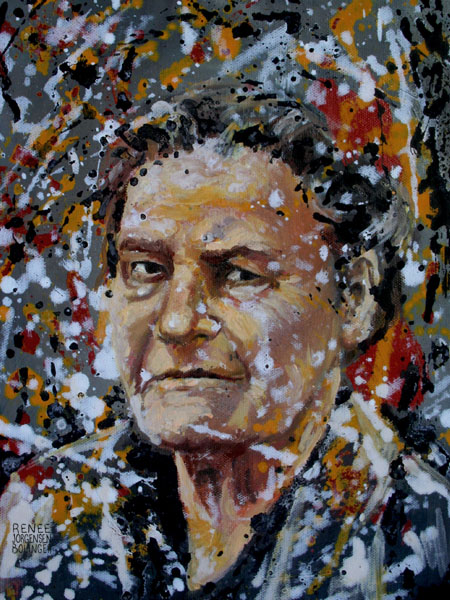
Bolinger says she paired the British analytic philosopher Elizabeth Anscombe with the American abstract painter Jackson Pollock for two reasons: “First, the loose style of Pollock’s action painting fits the argumentative (and organizational) style of Wittgenstein’s Philosophical Investigations, which Anscombe helped to edit and was instrumental in publishing. Second, her primary field of work, in which she wrote a seminal text, is philosophy of action, which has obvious connections to the themes present in any of Pollock’s action paintings.”
Gottlob Frege/Vincent Van Gogh:
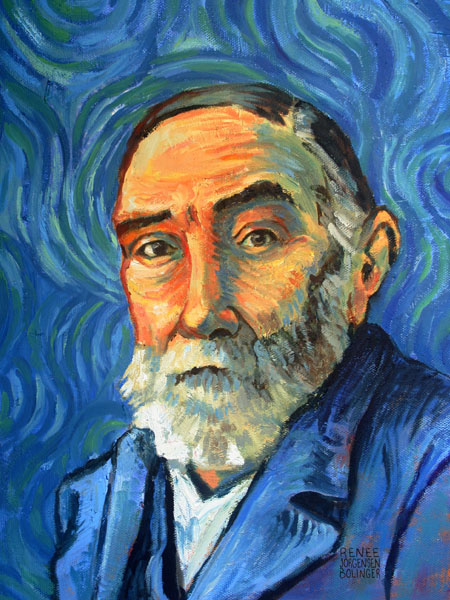
Bolinger paired the German logician, mathematician and philosopher Gottlob Frege with the Dutch painter Vincent Van Gogh as a tongue-in-cheek reference to Van Gogh’s famous painting The Starry Night and Frege’s puzzle concerning identity statements such as “Hesperus is Phosphorus,” or “the evening star is identical to the morning star.”
Bertrand Russell/Art Deco:
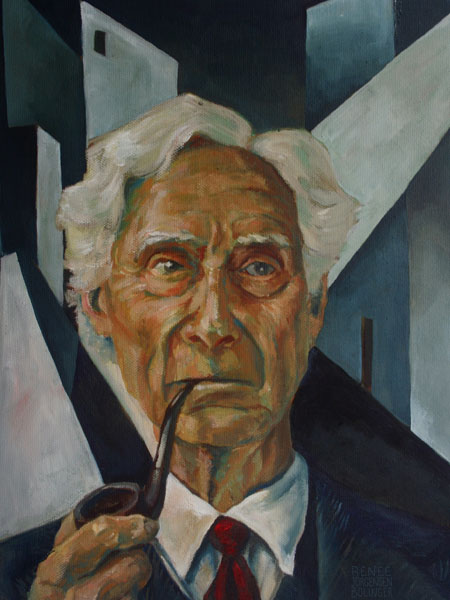
Bolinger painted the British logician and philosopher Bertrand Russell in the Art Deco style. “This pairing is a bit more about the gestalt, and a bit harder to articulate,” says Bolinger. “The simplification of form and reduction to angled planes that takes place in the background of this Art Deco piece are meant to cohere with Russell’s locial atomism (the reduction of complex logical propositions to their fundamental logical ‘atoms’).”
Kurt Gödel/Art Nouveau:
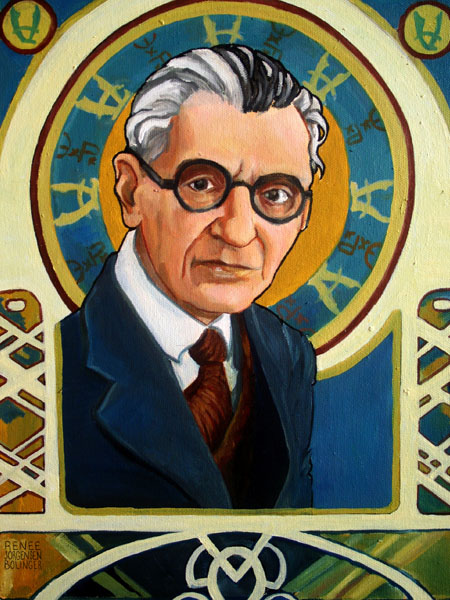
Bolinger paired the Austrian logician Kurt Gödel with Art Nouveau. “The Art Nouveau movement developed around the theme of mechanization and the repetition of forms,” says Bolinger, “and centrally involves a delicate balance between organic shapes — typically a figure that dominates the portrait — and schematized or abstracted patterns, often derived from organic shapes, but made uniform and repetitive (often seen in the flower motifs that ornament most Art Nouveau portraits). I paired this style with Kurt Gödel because his work was dedicated to defining computability in terms of recursive functions, and using the notion to prove the Completeness and Incompleteness theorems.”
To see more of Renée Jorgensen Bolinger’s philosopher portraits, click here to visit her site. And if you like them all, the PhilPortraits Calendar might be perfect for you.
via Leiter Reports
Related Content:
10 Famous Philosophers in Words and Images
Photography of Ludwig Wittgenstein Released by Archives at Cambridge
Read More...Albert Einstein Called Racism “A Disease of White People” in His Little-Known Fight for Civil Rights
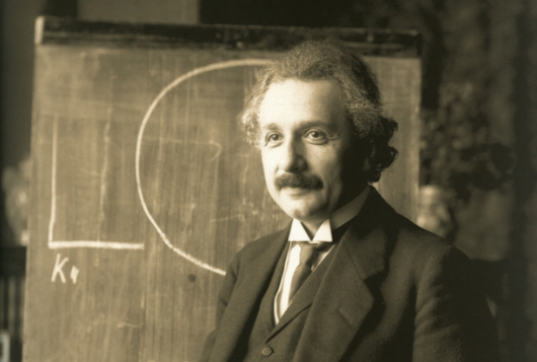
Albert Einstein’s activities as a passionate advocate for peace were well-documented during his lifetime. His celebrity as a famous physicist and one of the world’s most recognizable faces lent a great deal of weight to his pacifism, a view otherwise not given much consideration in the popular press at almost any time in history. However, according to a 2006 book titled Einstein on Race and Racism by Fred Jerome and Roger Taylor, the scientist was also as passionate about combating racism and segregation as he was about combating war. This facet of Einstein’s life was virtually ignored by the media, as was a visit he made in 1946 to Lincoln University in Pennsylvania, the first degree-granting college for African-Americans and the alma mater of Langston Hughes and Thurgood Marshall.
Invited to Lincoln to receive an honorary degree, Einstein gave a lecture on physics but also bluntly addressed the racial animus that held the country in its grip, reportedly calling racism, “a disease of white people” and saying he “did not intend to be quiet” about his opposition to segregation and racist public policy. Lest anyone think the Nobel-prize-winning physicist was pandering to his audience, the Harvard Gazette offers a comprehensive summary of Einstein’s support of progressive anti-racist causes, including his personal support of members of Princeton’s black community (he paid one man’s college tuition), a town Princeton native Paul Robeson once called “the northernmost town in the south.”
Einstein formed relationships with several prominent black leaders—inviting opera singer Marian Anderson to stay in his home after she was refused a room at the Nassau Inn and appearing as a character witness for W.E.B. Dubois when the latter stood accused of “failing to register as a foreign agent.” But it was his 20-year friendship with Robeson that seems central to his involvement in civil rights causes. The Harvard Gazette writes:
Einstein met Paul Robeson when the famous singer and actor came to perform at Princeton’s McCarter Theatre in 1935. The two found they had much in common. Both were concerned about the rise of fascism, and both gave their support to efforts to defend the democratically elected government of Spain against the fascist forces of Francisco Franco. Einstein and Robeson also worked together on the American Crusade to End Lynching, in response to an upsurge in racial murders as black soldiers returned home in the aftermath of World War II.
At the time of the Gazette article, 2007, a movie about Einstein and Robeson’s friendship was apparently in the works, with Danny Glover as Robeson and Ben Kingsley as Einstein. The project is apparently stalled, but with the upsurge in popular interest in the history of civil rights—with the overturning of the Voting Rights Act and the widespread coverage of the 50th anniversary of the March on Washington—perhaps the project will see new life soon. I certainly hope so.
via PourMeCoffee
Related Content:
Albert Einstein Expresses His Admiration for Mahatma Gandhi, in Letter and Audio
Listen as Albert Einstein Calls for Peace and Social Justice in 1945
MLK’s Last Days and Final Speech
Josh Jones is a writer and musician based in Durham, NC. Follow him at @jdmagness
Read More...“Glory to the Conquerors of the Universe!”: Propaganda Posters from the Soviet Space Race (1958–1963)
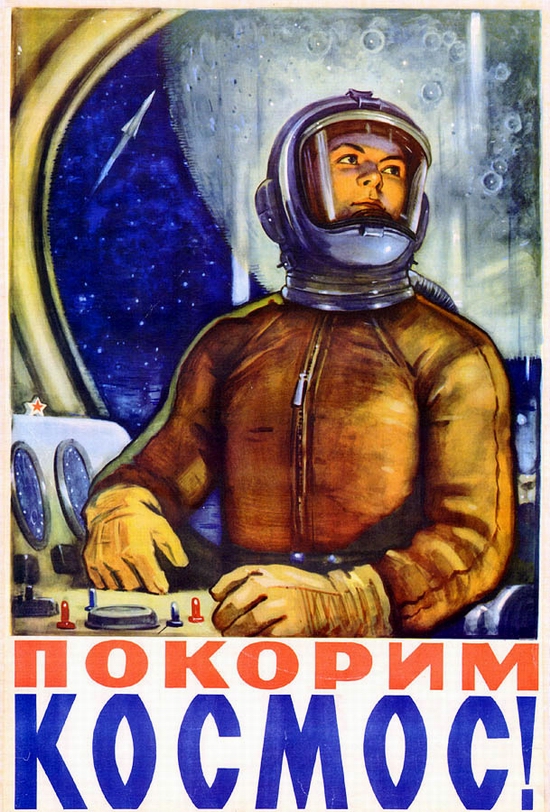
Walking around L.A. just yesterday, I noticed new banners emblazoned with illustrations touting subway stations now under construction. In bold, bright colors, they deliver clear, ambitious imagery of a bright future ahead: dedicated builders, focused students, noble working commuters, surging trains. Why, I thought, those look a bit like Soviet propaganda! I had no political comparisons in mind, only aesthetic ones, and this Retronaut post shows off many perfect examples of the Cold War-era Russian posters the Los Angeles Metro’s brought to my mind. They capture the imagination by exuding even more intense scientific, technological, educational, and social optimism — and doing so in even more visual detail — than I’d remembered.
And boy, speaking of ambition: “From student’s models to spaceships!” “To the Sun! To the stars!” “Glory to the conquerors of the universe!” Children inclined to accept these glorious slogans and the rapturous imagery they accompany could not possibly fail to believe that, thoroughly educated by their country, their generation would go on to usher in a new galaxy-spanning order of peace, prosperity, and socialism. Yet we in the rest of the world now know of the boredom, cynicism, and oppression that attended many Soviet citizens’ everyday lives. A Cold War-specialist college history professor of mine liked to tell a story about a trip to Moscow he took in the sixties, on which he kept seeing adolescents with nothing more productive to do than openly chugging vodka on street corners. Yet, seeing posters like these, you simply want to believe, just like I want to believe in the extension of Los Angeles’ subway — which, at times, seems about as plausible as the conquering of outer space.
“From student’s models to spaceships!”

“Glory to the workers of Soviet science and technology!”

“I am happy — this is my work joining the work of my republic”

“In the 20th century the rockets race to the stars”
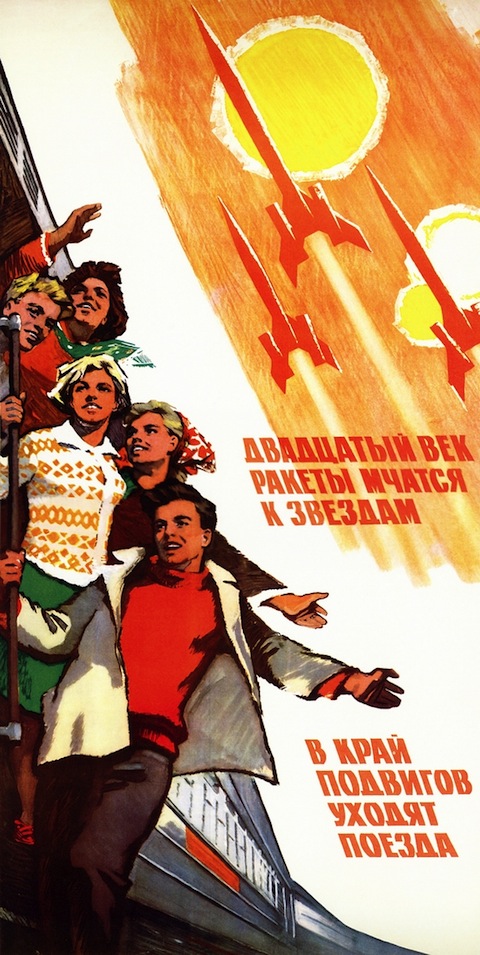
Visit Retronaut for many more space propaganda posters from the Soviet era.
Related Content:
“First Orbit”: Celebrating 50th Anniversary of Yuri Gagaran’s Space Flight
How the CIA Secretly Funded Abstract Expressionism During the Cold War
How to Spot a Communist Using Literary Criticism: A 1955 Manual from the U.S. Military
Colin Marshall hosts and produces Notebook on Cities and Culture and writes essays on literature, film, cities, Asia, and aesthetics. He’s at work on a book about Los Angeles, A Los Angeles Primer. Follow him on Twitter at @colinmarshall.
Read More...Support Us
We're hoping to rely on loyal readers, rather than erratic ads. Please click the Donate button and support Open Culture. You can use Paypal, Venmo, Patreon, even Crypto! We thank you!

About Us

Open Culture scours the web for the best educational media. We find the free courses and audio books you need, the language lessons & educational videos you want, and plenty of enlightenment in between.
Advertise With Us
FREE UPDATES!
GET OUR DAILY EMAIL
Get the best cultural and educational resources on the web curated for you in a daily email. We never spam. Unsubscribe at any time.
FOLLOW ON SOCIAL MEDIA
Open Culture editor Dan Colman scours the web for the best educational media. He finds the free courses and audio books you need, the language lessons & movies you want, and plenty of enlightenment in between.
Advertise With Us

