Teacher Helps His Student Overcome Stuttering and Read Poetry, Using the Sound of Music
Musharaf Asghar, a student at Thornhill Academy in northeast England, overcame an acute stammer when his teacher, Matthew Burton, borrowed an idea from The King’s Speech. The teacher asked his student to put on some headphones playing the music of Ben Howard, and to start reciting a poem called ‘The Moment.’ Suddenly, for the first time, the words began to flow. All of this was captured in a documentary series, Educating Yorkshire, that aired on the BBC. The segment above concludes with Mushy, as he’s known, giving a short talk in front of his class, at what looks like a graduation ceremony. It didn’t take long for his fellow students to break down in tears.
Writing recently in The Guardian, the student recalls. “My nerves over speaking in assembly were TERRIBLE though. I didn’t realise how big 200 people looks like. I was sweating and I had a little wobble but eventually, I managed to get through it. I was excited, if nervous, about the whole thing going out. But I’m really happy and proud to be on telly as I hope it gives other people with a stammer the confidence to have a go at public speaking. My speech is getting better every week. Everyone at college gives me time, but I’m getting quicker anyway so they don’t miss their bus while they are listening to me. I still won’t be applying for any call-centre jobs yet though.” Find more information on how music therapy can help people overcome stuttering here.
Don’t miss anything from Open Culture. Sign up for our Daily Email or RSS Feed. And we’ll send quality culture your way, every day.
via @courosa
Read More...The Power of Empathy: A Quick Animated Lesson That Can Make You a Better Person
Several years back, the RSA (Royal Society of the Arts) created a series of distinctive animated shorts where heavy-hitter intellectuals presented big ideas, and a talented artist rapidly illustrated them on a whiteboard. Some of those talks featured the likes of Slavoj Zizek, Steven Pinker and Barbara Ehrenreich. Now RSA presents a new video series created in an entirely different aesthetic. Above, you can watch what will hopefully be the first of many “espresso shots for the mind.” This clip features Dr. Brené Brown, a research professor at the University of Houston Graduate College of Social Work, providing some quick insights into the difference between sympathy and empathy, and explaining why empathy is much more meaningful. To learn more about The Power of Empathy, you can watch Brown’s complete RSA lecture here. You can also watch her very popular TED Talk on The Power of Vulnerability here.
If you would like to support the mission of Open Culture, consider making a donation to our site. It’s hard to rely 100% on ads, and your contributions will help us continue providing the best free cultural and educational materials to learners everywhere. You can contribute through PayPal, Patreon, and Venmo (@openculture). Thanks!
Related Content:
Free Online Psychology Courses (Part of our list of Free Online Courses)
Jacques Lacan’s Confrontation with a Young Rebel: Classic Moment, 1972
New Animation Explains Sherry Turkle’s Theories on Why Social Media Makes Us Lonely
Read More...
In 1900, Ladies’ Home Journal Publishes 28 Predictions for the Year 2000

At least since that 17th century architect of the scientific revolution, Sir Francis Bacon (who was mostly right), people have been making predictions about the technologies and social advancements of the future. And since Bacon, scientists and futuristic writers have been especially in demand during times of great change and uncertainty, such as at the turn of the last century. In 1900, civil engineer John Elfreth Watkins, Jr. in Ladies’ Home Journal claimed to have surveyed “the most learned and conservative minds in America… the wisest and most careful men in our greatest institutions of science and learning.”
Specifying advances likely to occur 100 years thence, “before the dawn of 2001,” Watkins culled 28 predictions about such things as travel and the transmission of information over great distances, biological and genetic mutations, and the domestic comforts of the average consumer. Several of the predictions are very Baconian indeed—as per the strange list at the end of Bacon’s science fiction fragment New Atlantis, a text obsessed with altering the appearance of the natural world for no particular reason other than that it could be done. Watkins’ list includes such predictions as “Peas as Large as Beets,” “Black, Blue, and Green Roses,” and “Strawberries as Large as Apples.” Some are Baconian in more sinister ways, and these are also a bit more accurate. Take the below, for example:
There will be No Wild Animals except in menageries. Rats and mice will have been exterminated. The horse will have become practically extinct. A few of high breed will be kept by the rich for racing, hunting and exercise. The automobile will have driven out the horse. Cattle and sheep will have no horns. They will be unable to run faster than the fattened hog of to-day. A century ago the wild hog could outrun a horse. Food animals will be bred to expend practically all of their life energy in producing meat, milk, wool and other by-products. Horns, bones, muscles and lungs will have been neglected.
I would defer to ecologists and meat industry watchdogs to confirm my intuitions, but it does seem that some of this, excepting the extermination of vermin and horns, has come to pass or is very likely in regard to several species. Another prediction, this one about our own species, is laughably optimistic:
Everybody will Walk Ten Miles. Gymnastics will begin in the nursery, where toys and games will be designed to strengthen the muscles. Exercise will be compulsory in the schools. Every school, college and community will have a complete gymnasium. All cities will have public gymnasiums. A man or woman unable to walk ten miles at a stretch will be regarded as a weakling.
We’re much closer to the future of Pixar’s Wall‑E than anything resembling this scenario (unless you live in the world of Crossfit). Another prediction is both dead on and dead wrong at once. Claiming that there will be “from 350,000,000 to 500,000,000 people in the Americas and its possessions by the lapse of another century” did in fact turn out to be almost uncannily accurate—current estimates are somewhere around 300,000,000. The “possessions” alluded to, however, display the attitude of blithe Monroe doctrine expansionism that held the nation in its sway at the turn of the century. The prediction goes on to say that most of the “South and Central American republics would be voted into the Union by their own people.” A few more of Watkins’ predictions, some prescient, some preposterous:
Telephones Around the World. Wireless telephone and telegraph circuits will span the world.
Store Purchases by Tube. Pneumatic tubes instead of store wagons, will deliver packages and bundles.
Hot and Cold Air from Spigots. Rising early to build the furnace fire will be a task of the olden times.
Ready-Cooked Meals will be Bought from establishments similar to our bakeries of to-day [see the above Wall‑E reference]
There will be No C, X, or Q in our every-day alphabet. They will be abandoned because unnecessary.
Aeriel War-Ships and Forts on Wheels. Giant guns will shoot twenty-five miles or more, and will hurl anywhere within such a radius shells exploding and destroying whole cities.
How Children will be Taught. A university education will be free to every man and woman.
Ah, if only that last one had come true! To read all of Watkins predictions in detail, click on the image above for a larger, readable, version of the full article.
Related Content:
Isaac Asimov’s 1964 Predictions About What the World Will Look 50 Years Later — in 2014
Arthur C. Clarke Predicts the Future in 1964 … And Kind of Nails It
1930s Fashion Designers Imagine How People Would Dress in the Year 2000
Josh Jones is a writer and musician based in Durham, NC. Follow him at @jdmagness
Read More...Watch Michel Gondry Animate Philosopher, Linguist & Activist Noam Chomsky
As an arts major who doodled my way through every required science course in high school and college, I am deeply gratified by filmmaker Michel Gondry’s approach to documenting the ideas of Noam Chomsky. Having filmed about three hours worth of interviews with the activist, philosopher, and father of modern linguistics in a sterile MIT conference room, Gondry headed back to his charmingly analog Brooklyn digs to spend three years animating the conversations. It’s nice to see a filmmaker of his stature using books to jerry-rig his camera set up. At one point, he huddles on the floor, puzzling over some sequential drawings on 3‑hole punch paper. Seems like the kind of thing most people in his field would tackle with an iPad and an assistant.
Gondry may have felt intellectually dwarfed by his subject, but there’s a kind of genius afoot in his work too. Describing the stop-motion technique he used for Is the Man Who Is Tall Happy?, he told Amy Goodman of Democracy Now, “I have a lightbox, and I put paper on it, and I animate with Sharpies, color Sharpies. And I have a 16-millimeter camera that is set up on a tripod and looks down, and I take a picture. I do a drawing and take a picture.”
A pretty apt summation—watch him in action above—but the curiosity and humanity so evident in such features as Eternal Sunshine of the Spotless Mind and The Science of Sleep is a magical ingredient here, too. He attributes biological properties to his Sharpie markers, and takes a break from some of Chomsky’s more complex thoughts to ask about his feelings when his wife passed away. He doesn’t seem to mind that he might seem a bit of a schoolboy in comparison, one whose talents lie beyond this particular professor’s scope.
As Chomsky himself remarks in the trailer, below, “Learning comes from asking why do things work like that, why not some other way?”
Is the Man Who Is Tall Happy? is available on iTunes.
H/T @kirstinbutler
Related Content:
Filmmaker Michel Gondry Presents an Animated Conversation with Noam Chomsky
Noam Chomsky Schools 9/11 Truther; Explains the Science of Making Credible Claims
Ayun Halliday puts her lifelong penchant for doodling to good use in her award-winning, handwritten, illustrated zine, The East Village Inky. Follow her @AyunHalliday
Read More...View Bill Gates’ Mobile Library: The Books & Courses That Help Him Change The World
Stepping down as Microsoft’s chief executive officer in 2000 had given Bill Gates some extra time, which the autodidact immediately expended by attempting to learn… well, everything. Perhaps Gates threw himself at learning to make up for abandoning college for greater pursuits—he attended Harvard but left after two years’ study to pursue his passion for computers. Whatever his reasons, Gates has begun to assiduously learn all he can about the world, and is recording his education process for posterity on his website, The Gates Notes. As the video above explains, Microsoft’s founder has listened to hundreds of hours of university lectures from The Teaching Company; he got hooked after listening to Robert Whaples’ Modern Economic Issues and breezing through Timothy Taylor’s America and the New Global Economy. His number one pick? Big History which is taught by David Christian and, Gates says, “is still my favorite course of all. The course is so broad that it synthesizes the history of everything including the sciences into one framework.”
Wherever Gates travels, he is also eternally accompanied by his reading bag. Surprised that the herald of the digital age is packing paperbacks? Don’t be. “I’m still pretty much an old-school print guy,” Gates writes, “because I like to jot notes in the margins, but I assume I’ll move over to ebooks when annotation features get better.”
Last week, Gates showed WIRED the contents of his decidedly 20th century mobile library. The books, which Gates replenishes at an impressive rate, encompass an admirable breadth of topics. As befitting the overseer of the Bill and Melinda Gates Foundation, the majority of Gates’ reading consists of non-fiction (only Gary Shteyngart’s recent novel made the fiction cut this round). History, psychology, science, sound business counsel, sociology, economics, and history all make up the dizzying array of Gates’ everyday reading. Here is a selection from WIRED’s partial list, including Gates’ own comments on the importance of each choice:
-Feynman’s Tips on Physics by Richard Feynman– A short companion book to Richard Feynman’s classic Lectures on Physics. Always worthwhile to return to the feet of the master.
-Super Sad True Love Story: A Novel by Gary Shteyngart– I don’t read a lot of fiction, but I thought this was an interesting study of the moral implications of technology. Will technology contribute to everyone’s well-being or just make people more narcissistic?
-The Cartoon Introduction to Statistics by Grady Klein– Bought this to use with one of my kids. Helpful in explaining a complicated subject to a teenager.
-The Path Between the Seas: The Creation of the Panama Canal by David McCullough – I read this to prepare for a family vacation to Panama. It’s pure McCullough: epic drama, political intrigue, heartbreaking defeats, and eventual triumph.
-The Better Angels of Our Nature: Why Violence Has Declined by Steven Pinker– One of the most important books I’ve read. Steven Pinker demonstrates how the world evolved to be far less violent. Counterintuitive, if you watch the news, but true.
We’ve also used the trusty Control + Scroll function to zoom in and name a few additional titles:
An Uncertain Glory: India and its Contradictions by Jean Drèze and Amartya Sen
Engineers of Victory: The Problem Solvers Who Turned The Tide in The Second World War by Paul Kennedy
The Price of Inequality: How Today’s Divided Society Endangers Our Future by Joseph Stiglitz
Why Does College Cost So Much? By Robert Archibald and David Feldman
Mondo Agnelli: Fiat, Chrysler, and the Power of a Dynasty by Jennifer Clark
How Children Succeed: Grit, Curiosity, and the Hidden Power of Character by Paul Tough
The One World Schoolhouse: Education Reimagined by Salman Khan
Far From The Tree by Andrew Solomon
For the original list, head over to WIRED. For more of Gates’ commentary, check out his site, The Gates Notes, here. You can also continue your self-education by visiting our lists of Free Online Courses, Free eBooks, Free Audio Books, Free Language Lessons, Free Textbooks, and Free MOOCs.
Ilia Blinderman is a Montreal-based culture and science writer. Follow him at @iliablinderman.
Read More...The 100 Best Novels: A Literary Critic Creates a List in 1898
 Book lists, despite what younger readers born into Buzzfeed’s ruthless listsicle monopoly may think, have always been popular. Some, like David Bowie’s Top 100 Books, give us a sense of the artist’s development. Others, like Joseph Brodsky’s List of 84 Books for Basic Conversation, provide a Nobel prize-winning benchmark for knowledge. Even though the books are within the reach of most readers, systematically digesting such lists often tries one’s patience. Despite the lack of will or interest in working through someone else’s literary education, however, glancing through such personal anthologies provides us with a glimpse into the maker’s life—be it their private tastes, or their social mores.
In late October, The Times Literary Supplement’s Michael Caines unearthed another Top 100 list; this one, however, has the distinction of hailing from 1898. At the turn of the 20th century, a journalist and author of numerous books on the Brontë sisters named Clement K. Shorter tried his hand at compiling the 100 Best Novels for a journal called The Bookman. The ground rules were simple: the list could feature only one novel per novelist, and living authors were excluded. Today, Shorter’s compendium looks somewhat hit-or-miss. There are some indisputable classics (many of which can be found in our Free eBooks and Free Audio Books collections) and some other texts that have faded into oblivion. Still—one can’t help but experience a certain historical frisson at a 19th century listsicle. Here it goes:
1. Don Quixote — 1604 — Miguel de Cervantes
2. The Holy War — 1682 — John Bunyan
3. Gil Blas — 1715 — Alain René le Sage
4. Robinson Crusoe — 1719 — Daniel Defoe
5. Gulliver’s Travels — 1726 — Jonathan Swift
6. Roderick Random — 1748 — Tobias Smollett
7. Clarissa — 1749 — Samuel Richardson
8. Tom Jones — 1749 — Henry Fielding
9. Candide — 1756 — Françoise de Voltaire
10. Rasselas — 1759 — Samuel Johnson
11. The Castle of Otranto — 1764 — Horace Walpole
12. The Vicar of Wakefield — 1766 — Oliver Goldsmith
13. The Old English Baron — 1777 — Clara Reeve
14. Evelina — 1778 — Fanny Burney
15. Vathek — 1787 — William Beckford
16. The Mysteries of Udolpho — 1794 — Ann Radcliffe
17. Caleb Williams — 1794 — William Godwin
18. The Wild Irish Girl — 1806 — Lady Morgan
19. Corinne — 1810 — Madame de Stael
20. The Scottish Chiefs — 1810 — Jane Porter
21. The Absentee — 1812 — Maria Edgeworth
22. Pride and Prejudice — 1813 — Jane Austen
23. Headlong Hall — 1816 — Thomas Love Peacock
24. Frankenstein — 1818 — Mary Shelley
25. Marriage — 1818 — Susan Ferrier
26. The Ayrshire Legatees — 1820 — John Galt
27. Valerius — 1821 — John Gibson Lockhart
28. Wilhelm Meister — 1821 — Johann Wolfgang von Goethe
29. Kenilworth — 1821 — Sir Walter Scott
30. Bracebridge Hall — 1822 — Washington Irving
31. The Epicurean — 1822 — Thomas Moore
32. The Adventures of Hajji Baba — 1824 — James Morier (“usually reckoned his best”)
33. The Betrothed — 1825 — Alessandro Manzoni
34. Lichtenstein — 1826 — Wilhelm Hauff
35. The Last of the Mohicans — 1826 — Fenimore Cooper
36. The Collegians — 1828 — Gerald Griffin
37. The Autobiography of Mansie Wauch — 1828 — David M. Moir
38. Richelieu — 1829 — G. P. R. James (the “first and best” novel by the “doyen of historical novelists”)
39. Tom Cringle’s Log — 1833 — Michael Scott
40. Mr. Midshipman Easy — 1834 — Frederick Marryat
41. Le Père Goriot — 1835 — Honoré de Balzac
42. Rory O’More — 1836 — Samuel Lover (another first novel, inspired by one of the author’s own ballads)
43. Jack Brag — 1837 — Theodore Hook
44. Fardorougha the Miser — 1839 — William Carleton (“a grim study of avarice and Catholic family life. Critics consider it the author’s finest achievement”)
45. Valentine Vox — 1840 — Henry Cockton (yet another first novel)
46. Old St. Paul’s — 1841 — Harrison Ainsworth
47. Ten Thousand a Year — 1841 — Samuel Warren (“immensely successful”)
48. Susan Hopley — 1841 — Catherine Crowe (“the story of a resourceful servant who solves a mysterious crime”)
49. Charles O’Malley — 1841 — Charles Lever
50. The Last of the Barons — 1843 — Bulwer Lytton
51. Consuelo — 1844 — George Sand
52. Amy Herbert — 1844 — Elizabeth Sewell
53. Adventures of Mr. Ledbury — 1844 — Elizabeth Sewell
54. Sybil — 1845 — Lord Beaconsfield (a. k. a. Benjamin Disraeli)
55. The Three Musketeers — 1845 — Alexandre Dumas
56. The Wandering Jew — 1845 — Eugène Sue
57. Emilia Wyndham — 1846 — Anne Marsh
58. The Romance of War — 1846 — James Grant (“the narrative of the 92nd Highlanders’ contribution from the Peninsular campaign to Waterloo”)
59. Vanity Fair — 1847 — W. M. Thackeray
60. Jane Eyre — 1847 — Charlotte Brontë
61. Wuthering Heights — 1847 — Emily Brontë
62. The Vale of Cedars — 1848 — Grace Aguilar
63. David Copperfield — 1849 — Charles Dickens
64. The Maiden and Married Life of Mary Powell — 1850 — Anne Manning (“written in a pastiche seventeenth-century style and printed with the old-fashioned typography and page layout for which there was a vogue at the period …”)
65. The Scarlet Letter — 1850 — Nathaniel Hawthorne
66. Frank Fairleigh — 1850 — Francis Smedley (“Smedley specialised in fiction that is hearty and active, with a strong line in boisterous college escapades and adventurous esquestrian exploits”)
67. Uncle Tom’s Cabin — 1851 — H. B. Stowe
68. The Wide Wide World — 1851 — Susan Warner (Elizabeth Wetherell)
69. Nathalie — 1851 — Julia Kavanagh
70. Ruth — 1853 — Elizabeth Gaskell
71. The Lamplighter — 1854 — Maria Susanna Cummins
72. Dr. Antonio — 1855 — Giovanni Ruffini
73. Westward Ho! — 1855 — Charles Kingsley
74. Debit and Credit (Soll und Haben) — 1855 — Gustav Freytag
75. Tom Brown’s School-Days — 1856 — Thomas Hughes
76. Barchester Towers — 1857 — Anthony Trollope
77. John Halifax, Gentleman — 1857 — Dinah Mulock (a. k. a. Dinah Craik; “the best-known Victorian fable of Smilesian self-improvement”)
78. Ekkehard — 1857 — Viktor von Scheffel
79. Elsie Venner — 1859 — O. W. Holmes
80. The Woman in White — 1860 — Wilkie Collins
81. The Cloister and the Hearth — 1861 — Charles Reade
82. Ravenshoe — 1861 — Henry Kingsley (“There is much confusion in the plot to do with changelings and frustrated inheritance” in this successful novel by Charles Kingsley’s younger brother, the “black sheep” of a “highly respectable” family)
83. Fathers and Sons — 1861 — Ivan Turgenieff
84. Silas Marner — 1861 — George Eliot
85. Les Misérables — 1862 — Victor Hugo
86. Salammbô — 1862 — Gustave Flaubert
87. Salem Chapel — 1862 — Margaret Oliphant
88. The Channings — 1862 — Ellen Wood (a. k. a. Mrs Henry Wood)
89. Lost and Saved — 1863 — The Hon. Mrs. Norton
90. The Schönberg-Cotta Family — 1863 — Elizabeth Charles
91. Uncle Silas — 1864 — Joseph Sheridan Le Fanu
92. Barbara’s History — 1864 — Amelia B. Edwards (“Confusingly for bibliographers, she was related to Matilda Betham-Edwards and possibly to Annie Edward(e)s …”)
93. Sweet Anne Page — 1868 — Mortimer Collins
94. Crime and Punishment — 1868 — Feodor Dostoieffsky
95. Fromont Junior — 1874 — Alphonse Daudet
96. Marmorne — 1877 — P. G. Hamerton (“written under the pseudonym Adolphus Segrave”)
97. Black but Comely — 1879 — G. J. Whyte-Melville
98. The Master of Ballantrae — 1889 — R. L. Stevenson
99. Reuben Sachs — 1889 — Amy Levy
100. News from Nowhere — 1891 — William Morris
In addition to the canon, Shorter—unable to heed his own cautious counsel and throwing the door open to the winds of literary passion—included 8 books by living novelists whom he called “writers whose reputations are too well established for their juniors to feel towards them any sentiments other than those of reverence and regard:”
An Egyptian Princess — 1864 — Georg Ebers
Rhoda Fleming — 1865 — George Meredith
Lorna Doone — 1869 — R. D. Blackmore
Anna Karenina — 1875 — Count Leo Tolstoi
The Return of the Native — 1878 — Thomas Hardy
Daisy Miller — 1878 — Henry James
Mark Rutherford — 1881 — W. Hale White
Le Rêve — 1889 — Emile Zola
via The Times Literary Supplement
Related Content:
David Bowie’s List of Top 100 Books
Christopher Hitchens Creates a Reading List for Eight-Year-Old Girl
See Nobel Laureate Joseph Brodsky’s Reading List For Having an Intelligent Conversation
Ilia Blinderman is a Montreal-based culture and science writer. Follow him at @iliablinderman
Read More...Joseph Brodsky’s List of 83 Books You Should Read to Have an Intelligent Conversation
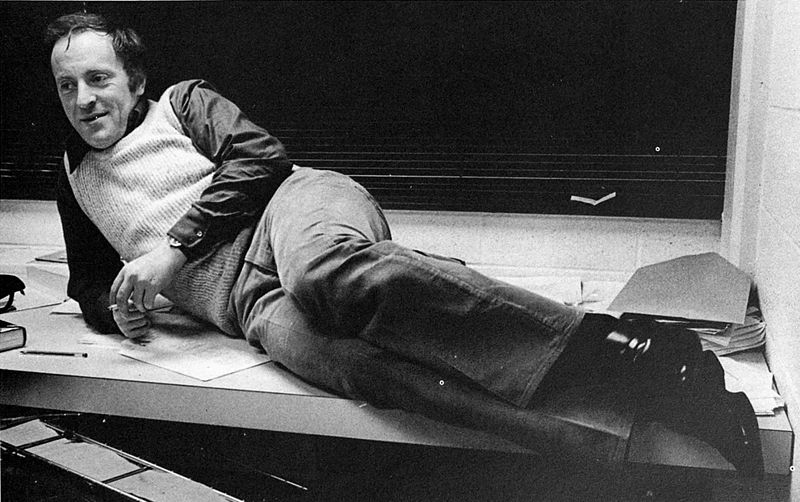
Image via Wikimedia Commons
In 1955, a mere two months into eighth grade, a 15-year-old teenager dropped out of a Leningrad school. He had already repeated seventh grade; the thought of another boring year was unbearable. He wandered into work at a factory, but only lasted six months. For the next seven years, he drifted in and out of menial jobs at a lighthouse, a crystallography lab, and a morgue. For a time, he worked as a manual laborer on geological expeditions and as a stoker at a public bathhouse. Still, it wasn’t a wholly inauspicious start—by the end of his life, he had taught at Yale, Columbia, Cambridge, Michigan, and Mount Holyoke. He had also been awarded the Nobel Prize for literature.
Despite spurning his own formal education, Russian poet and Soviet dissident Joseph Brodsky immediately rose to the highest academic echelon when he arrived in America in 1972. By all accounts, the autodidact held his classes to a high standard, frequently dismissing any student arguments about literary greatness unless they centered on Milosz, Lowell, or Auden.
Monica Partridge, a former student in his class, told Open Culture, “I took a poetry class with [Joseph Brodsky] at Mount Holyoke College my freshman year… It was all 19th [century] Russian poetry, and he would give us four pages of poems to memorize overnight. We would have to come in the next [morning] and transcribe the poems we had memorized. Very Russian.”
No less impressive was the list of books that Brodsky distributed to Partridge’s class.
1. Bhagavad Gita
2. Mahabharata
3. Gilgamesh
4. The Old Testament
5. Homer: Iliad, Odyssey
6. Herodotus: Histories
7. Sophocles: Plays
8. Aeschylus: Plays
9. Euripides: Plays (Hippolytus, The Bachantes, Electra, The Phoenician Women)
10. Thucydides: The Peloponnesian War
11. Plato: Dialogues
12. Aristotle: Poetics, Physics, Ethics, De Anima
13. Alexandrian Poetry: The Greek Anthology
14. Lucretius: On the Nature of Things
15. Plutarch: Lives [presumably Parallel Lives]
16. Virgil: Aeneid, Bucolics, Georgics
17. Tacitus: Annals
18. Ovid: Metamorphoses, Heroides, Amores
19. The New Testament
20. Suetonius: The Twelve Caesars
21. Marcus Aurelius: Meditations
22. Catullus: Poems
23. Horace: Poems
24. Epictetus: Discourses
25. Aristophanes: Plays
26. Claudius Aelianus: Historical Miscellany, On the Nature of Animals
27. Apollonius Rhodius: Argonautica
28. Michael Psellus: Fourteen Byzantine Rulers
29. Edward Gibbon: The Rise and Fall of the Roman Empire
30. Plotinus: The Enneads
31. Eusebius: Ecclesiastical History
32. Boethius: Consolations of Philosophy
33. Pliny the Younger: Letters
34. Byzantine verse romances
35. Heraclitus: Fragments
36. St. Augustine: Confessions
37. Thomas Aquinas: Summa Theologica
38. St. Francis of Assisi: The Little Flowers
39. Niccolò Machiavelli: The Prince
40. Dante Alighieri: Divine Comedy (Tr. By John Ciardi)
41. Franco Sacchetti: Novelle
42. Icelandic sagas
43. William Shakespeare (Anthony and Cleopatra, Hamlet, Macbeth, Henry V)
44. François Rabelais
45. Francis Bacon
46. Martin Luther: Selected Works
47. John Calvin: Institutio Christianae religionis
48. Michel de Montaigne: Essays
49. Miguel de Cervantes: Don Quixote
50. René Descartes: Discourses
51. Song of Roland
52. Beowulf
53. Benvenuto Cellini
54. Henry Adams: Education of Henry Adams
55. Thomas Hobbes: The Leviathan
56. Blaise Pascal: Pensées
57. John Milton: Paradise Lost
58. John Donne
59. Andrew Marvell
60. George Herbert
61. Richard Crashaw
62. Baruch Spinoza: Treatises
63. Stendhal: Charterhouse of Parma, Red and Black, The Life of Henry Brulard
64. Jonathan Swift: Gulliver’s Travels
65. Laurence Sterne: Tristram Shandy
66. Choderlos de Laclos: Les Liaisons Dangereuses
67. Baron de Montesquieu: Persian Letters
68. John Locke: Second Treatise on Government
69. Adam Smith: The Wealth of Nations
70. Gottfried Wilhelm Leibniz: Discourse on Metaphysics
71. David Hume: Everything
72. The Federalist Papers
73. Immanuel Kant: Critique of Pure Reason
74. Søren Kierkegaard: Fear and Trembling, Either/Or, Philosophical Fragments
75. Fyodor Dostoevsky: Notes From the Underground, The Possessed
76. Alexis de Tocqueville: Democracy in America
77. Johann Wolfgang von Goethe: Faust, Italian Journey
78. Astolphe-Louis-Léonor, Marquis de Custine: Empire of the Czar: A Journey Through Eternal Russia
79. Eric Auerbach: Mimesis
80. William H. Prescott: Conquest of Mexico
81. Octavio Paz: Labyrinths of Solitude
82. Sir Karl Popper: The Logic of Scientific Discovery, The Open Society and Its Enemies
83. Elias Canetti: Crowds and Power
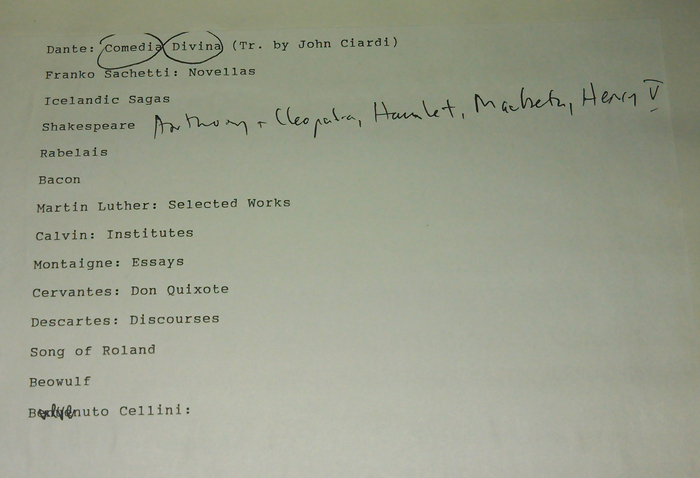
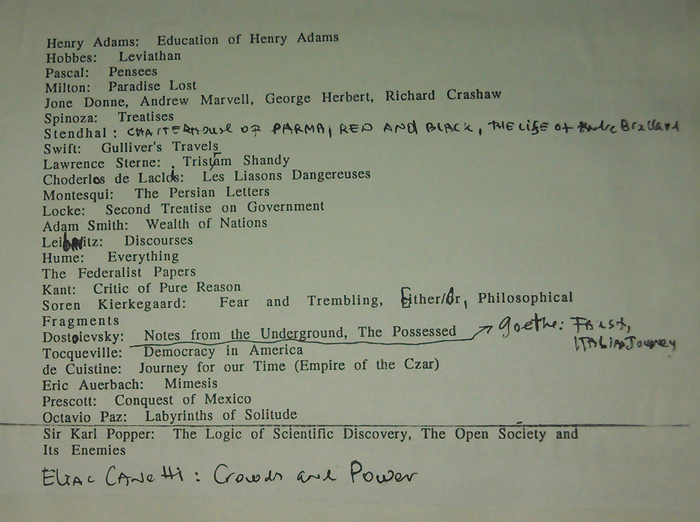
“Shortly after the class began, he passed out a handwritten list of books that he said every person should have read in order to have a basic conversation,” Partridge writes on the Brodsky Reading Group blog. “At the time I was thinking, ‘Conversation about what?’ I knew I’d never be able to have a conversation with him, because I never thought I’d ever get through the list. Now that I’ve had a little living, I understand what he was talking about. Intelligent conversation is good. In fact, maybe we all need a little more.”
In addition to the poet’s 1988 University of Michigan commencement address that we posted last week, we bring you Joseph Brodsky’s requisite reading list, annotated with the poet’s handwritten notes.
Note: You can click each image to read them in a larger format.

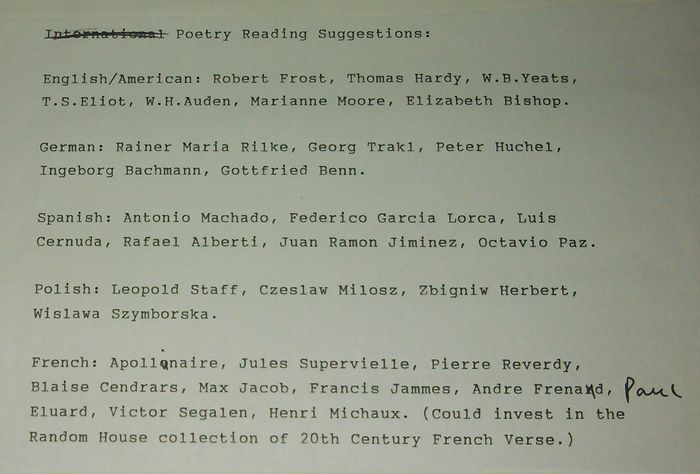
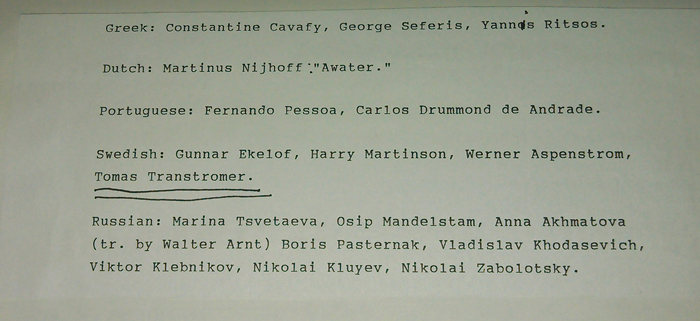
Get reading, friends.
Via Brodsky Reading Group, and with the deepest gratitude to Monica Partridge, who provided photographs of the original. Props go to Stanford for the typed out list of books.
Related Content:
Neil deGrasse Tyson Lists 8 (Free) Books Every Intelligent Person Should Read
Ernest Hemingway’s List for a Young Writer
Carl Sagan’s Undergrad Reading List: 40 Essential Texts for a Well-Rounded Thinker
David Foster Wallace’s 1994 Syllabus: How to Teach Serious Literature with Lightweight Books
Ilia Blinderman is a Montreal-based culture and science write. Follow him at @iliablinderman.
Read More...Watch Goethe’s Haunting Poem, “Der Erlkönig,” Presented in an Artful Sand Animation
Back in college, I took a fall-quarter introductory music course. We happened to have class on Halloween (an event quite seriously taken around the University of California, Santa Barbara, in case you didn’t know), and the professor held an especially memorable lecture that day. He had us study “Der Erlkönig,” music by Franz Schubert, words by none other than Johann Wolfgang von Goethe. While I will not claim that this tale of the haunting of a moribund child, even with its driving score, genuinely frightened me, I will say that it put the fear into me in a more existential way, a blow which only a simple story can land effectively.
“Who rides, so late, through night and wind?” asks Goethe’s poem, translated from the German. “It is the father with his child. He has the boy well in his arm. He holds him safely, he keeps him warm.” The man feels concern for his ailing son, but the boy has troubles of his own: “Father, do you not see the Erlking?” The father explains his son’s vision of this menacingly regal figure away as the fog, as the wind, as the trees. But the child insists: “My father, my father, he’s grabbing me now! The Erlking has done me harm!” By the time their horse reaches home, indeed, the Erlking — or some obscure agent of mortality — has him. Hear this fable sung, and watch it vividly animated with sand on glass (no doubt a painstaking process) by Ben Zelkowicz above. Halloween itself may have just passed, but “Der Erlkönig” remains timelessly haunting.
We’ll add “Der Erlkönig” to the Animation section of our collection of Free Movies Online.
via NFB
Related Content:
World War II Relived through Sand Painting
Colin Marshall hosts and produces Notebook on Cities and Culture and writes essays on literature, film, cities, Asia, and aesthetics. He’s at work on a book about Los Angeles, A Los Angeles Primer. Follow him on Twitter at @colinmarshall.
Read More...Doodlebug, Christopher Nolan’s First Short: What Came Before The Dark Night, Memento & Inception (1997)
We know British filmmaker Christopher Nolan best today for directing the latest trilogy of Batman films, Batman Begins, The Dark Knight, and The Dark Knight Rises. His recent high-profile non-superhero hit Inception made an impressive, if brief, splash as a mainstream brainbender, which, for me, faintly echoed the thrill he sent through the world of crossover independent film with 2000’s backward-told Memento. Yet, if this doesn’t make me too much of an I‑liked-the-early-stuff-cliché, I still think of him most fondly for directing his 1998 feature debut Following, a 16-millimeter, black-and-white, $6000-budget tale of theft, impersonation, and identity shot on the streets of London. (One of the characters breaks into an apartment with a now-striking Batman logo on its door.) But even a project as small-scale as Following has a predecessor, Doodlebug, which you can watch above.
“The depths of insanity are explored by a man chasing something in his apartment with a shoe,” promises the video description of the three-minute Doodlebug. In the center of this shadowy, paranoid tale we have Jeremy Theobald, who would go on to star in Following (and appear as a Gotham Water Board Technician in Batman Begins). Nolan shot it back in his days studying English literature at University College London, a school whose film society he led and which he chose expressly for the availability of its cameras and editing gear. His early, handmade pictures have become even more fascinating to watch in light of his declarations in a DGA Quarterly interview that he far prefers shooting in film to shooting digitally, and that 3D technology hasn’t much impressed him. But he hardly disdains spectacle, and the article contains a good deal of talk about how he uses CGI and crafts action sequences. Over the years, Nolan’s core enthusiasms seemingly haven’t changed; even Doodlebug, especially by student-film standards, has some pretty cool special effects.
Related Content:
The Dark Knight: Anatomy of a Flawed Action Scene
Slavoj Žižek’s Pervert’s Guide to Ideology Decodes The Dark Knight and They Live
The First Films of Great Directors: Kubrick, Coppola, Scorsese, Tarantino & Truffaut
Colin Marshall hosts and produces Notebook on Cities and Culture and writes essays on literature, film, cities, Asia, and aesthetics. He’s at work on a book about Los Angeles, A Los Angeles Primer. Follow him on Twitter at @colinmarshall.
Read More...Jack Kerouac, Allen Ginsberg & Margaret Mead Explain the Meaning of “Beat” in Rare 1950s Audio Clips
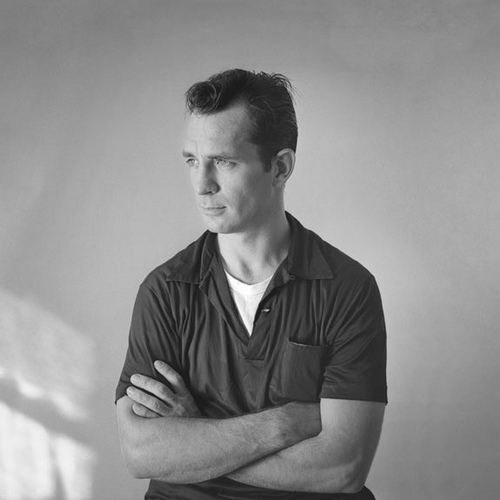
In 1948, Jack Kerouac first started talking about a “Beat Generation,” by which he meant a “swinging group of new American men intent on joy.” Ten years later, the term, now commonplace in America’s lexicon, was getting co-opted by the mainstream media, and not for the better. “Beat” had become a shorthand for “crime, delinquency, immorality, amorality” and more. In 1958, Kerouac delivered a speech at Hunter College where he tried to restore the true principles of the beat movement and sweep aside the fabricated misconceptions. You can listen to a 7 minute excerpt of that speech below, or hear the full speech here:
The next year, Playboy explicitly asked Kerouac to elaborate on the Hunter College speech. He agreed and gave them “The Origins of the Beat Generation,” which, too, you can read online: Page 1 — Page 2 — Page 3 — Page 4.
By ’59, Allen Ginsberg, the poet laureate of the Beats, knew there was little use in trying to reappropriate the term from the magazines and marketers. When asked to define the word, he effectively refused to play the game. But famed anthropologist Margaret Mead, a more neutral outside observer, was willing to take a shot. Listen below, or hear a slightly longer audio clip here:
Related Content:
Pull My Daisy: 1959 Beatnik Film Stars Jack Kerouac and Allen Ginsberg
Hear the Very First Recording of Allen Ginsberg Reading His Epic Poem “Howl” (1956)
Jack Kerouac Reads from On the Road (1959)
“Expansive Poetics” by Allen Ginsberg: A Free Course from 1981
Support Us
We're hoping to rely on loyal readers, rather than erratic ads. Please click the Donate button and support Open Culture. You can use Paypal, Venmo, Patreon, even Crypto! We thank you!

About Us

Open Culture scours the web for the best educational media. We find the free courses and audio books you need, the language lessons & educational videos you want, and plenty of enlightenment in between.
Advertise With Us
FREE UPDATES!
GET OUR DAILY EMAIL
Get the best cultural and educational resources on the web curated for you in a daily email. We never spam. Unsubscribe at any time.
FOLLOW ON SOCIAL MEDIA
Open Culture editor Dan Colman scours the web for the best educational media. He finds the free courses and audio books you need, the language lessons & movies you want, and plenty of enlightenment in between.
Advertise With Us



