David Foster Wallace Talks About Literature (and More) in an Internet Chatroom: Read the 1996 Transcript
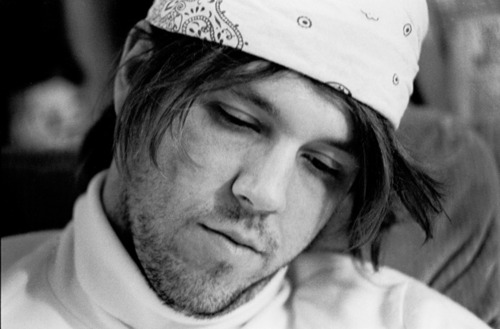
Reddit’s Ask Me Anything (AMA) series, where users get the chance to pose questions to the likes of Neil deGrasse Tyson, Stephen King, and Bill Nye the Science Guy, provides a surprisingly simple way to interact with celebrities. Before Reddit’s arrival in 2005, however, real-time exchanges between your garden-variety Internet user and famous personalities were occasionally conducted in Internet chatrooms. One such early case appears to be a chat between the readers of WORD Magazine and David Foster Wallace (read 30 of his essays free online), which seems to have taken place in May of 1996.
If AMAs are an orderly, if vast, Q & A session, this chat is more like a boozy group meeting with your favorite English lit professor in a smoky bar. (Read the transcript here.) Wallace, using the handle “dfw,” is on a refreshingly level field with the other chat participants, and the conversation naturally drifts from one topic to another. Things, as they often do, begin with a bit of banter:
dfw: I’ve had some unpleasant nicknaames and monikers in my time, but nobody’s ever hung “fosty” on me before.
Keats: You know, I still think it should be spelled Fostie, or Fostey.
Keats: Fosty looks too much like “Frosty” and “sty” to me.Keats: And makes me think of eyeballs packed in ice.
dfw: “Sty” as in an impacted eyelash or a pigpen, you mean?
Keats: Yeah. Is that what a sty as in “sty in your eye” is?
Marisa: I used to think the word “sty” was pronounced “stee”.
Keats: I had no idea exactly, just an unpleasant feeling about it.
dfw: Yes. Massively painful and embarrassing, too. Like a carbuncle on the exact tip of your nose — that sort of thing.
Keats: I used to think the word “trough” was pronounced “troff.”
Keats: You know, I happen to have a carbuncle on the tip of my nose right now.
Keats: Except it’s not a carbuncle, it’s more like a welt. It’s still embarrassing.
dfw: In my very first seminar in college, I pronounced facade “fakade.” The memory’s still fresh and raw.
Soon, things take a turn for the serious, and readers begin to ask Wallace about irony:
dfw: I don’t think irony’s meant to synergize with anything as heartfelt as sadness. I think the main function of contemporary irony is to protect the speaker from being interpreted as naive or sentimental.
Marisa: Why are people afraid to be seen as naive and sentimental?
dfw: Marisa: I think that’s a very deep, very hard question. One answer is that commercial comedy’s often set up to feature an ironist making devastating sport of someone who’s naive or sentimental or pretentious or pompous.
Keats: I’m starting to see a lot of irony in Hollywood and in advertising, but its function seems to be to let them talk out of both sides of their mouths.
dfw: Keats: advertising that makes fun of itself is so powerful because it implicitly congratulates both itself and the viewer (for making the joke and getting the joke, respectively).
Wallace also drops a few mentions of some of his favorite authors:
DaleK: Mr. Wallace, I’m curious…who among current novelists do you find the most interesting?
dfw: Dalek — DeLillo, Ozick, R. Powers, AM Homes, Denis Johnson, David Markson, (old) JA Phillips and Louise Erdrich.
While we can’t conclusively confirm that this was indeed the real DFW conducting the chat, it’s hard to deny that “dfw” sounds very much like the author. Certainly, the complete exchange is as much fun to read for its mid-90s internet chatroom nostalgia as it is for Wallace’s thoughts on irony, Infinite Jest, and the sound of one hand clapping. The whole transcript is available here.
Ilia Blinderman is a Montreal-based culture and science writer. Follow him at @iliablinderman.
Related Content:
30 Free Essays & Stories by David Foster Wallace on the Web
David Foster Wallace’s Love of Language Revealed by the Books in His Personal Library
The David Foster Wallace Audio Archive: A Little Gift For the Novelist’s 50th Birthday
Read More...Harold Bloom Creates a Massive List of Works in The “Western Canon”: Read Many of the Books Free Online
I have little desire to rehash the politics, but the facts are plain: by the time I arrived in college as an undergraduate English major in the mid-90s, the idea of the “Western Canon” as a container of—in the words of a famous hymn—“all that’s good, and great, and true” was seriously on the wane, to put it mildly. And in many quarters of academia, mention of the name of Yale literary critic Harold Bloom provoked, at the very least, a raised eyebrow and pointed silence. Bloom’s reputation perhaps unfairly fell victim to the so-called “Canon Wars,” likely at times because of a misidentification with political philosopher Allan Bloom. That Bloom was himself no ideologue, writes Jim Sleeper; he was a close friend of Saul Bellow and “an eccentric interpreter of Enlightenment thought who led an Epicurean, quietly gay life.” Nonetheless, his fiery attack on changing academic values, The Closing of the American Mind, became a textbook of the neoconservative right.
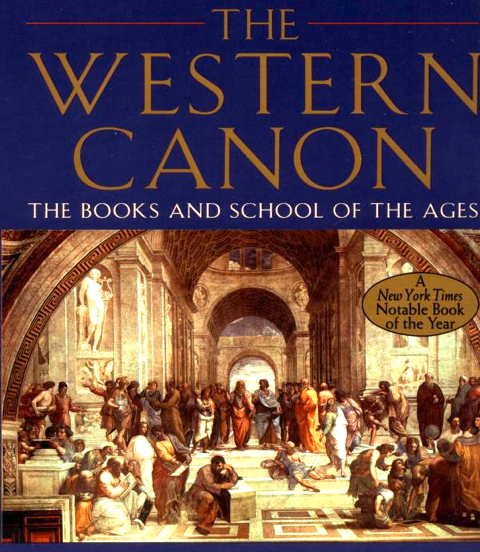
Though Harold Bloom wished to distance himself from culture war polemics, he has unapologetically practiced what Allan Bloom preached, teaching the Canonical “great books” of literature and religion and opposing all manner of critics on the left, whom he lumps together in the phrase “the School of Resentment.” Bloom’s 1973 The Anxiety of Influence has itself exerted a major influence on literary studies, and best-selling popular works, like 1998’s Shakespeare: The Invention of the Human, have kept Harold Bloom’s name in circulation even when scholarly citations of his work declined. In 1994, Bloom re-affirmed his commitment to the Canon with The Western Canon: The Books and School of the Ages, a fierce sortie against his so-called “School of Resentment” adversaries and a work University of Minnesota professor Norman Fruman called a “heroically brave, formidably learned and often unbearably sad response to the present state of the humanities.” (Hear Bloom discuss the book with Eleanor Wachtel in a 1995 CBC interview.)
The Western Canon is tightly focused on only 26 authors, but in a series of four appendices, Bloom lists the hundreds of other names he considers canonical. For all of Bloom’s ornery defensiveness, his list is surprisingly inclusive, as well as—for Fruman—surprisingly idiosyncratic. (Bloom later disavowed the list, claiming that his editor insisted on it.) Like a classical philologist, Bloom divides his Canon into four “ages” or periods: The Theocratic Age (2000 BCE-1321 CE); The Aristocratic Age (1321–1832); The Democratic Age: 1832–1900); and The Chaotic Age (20th Century). You can view the complete list here. Below, we’ve compiled a very partial, but still sizable, excerpt of texts from Bloom’s list that are available online through the University of Adelaide’s ebook library. For all of the unpopular positions he has taken over the past few decades, Bloom’s immense erudition, expansive intellect, and sincere commitment to the humanities have never been in question. As a distinguished exemplar of a fading tradition, he is an invaluable resource for students and lovers of literature.
A: “The Theocratic Age”
The Ancient Greeks
- Homer (ca.800BC)
- Iliad; Odyssey.
- Hesiod (ca.700BC)
- Works and Days; Theogony.
- Sappho (ca.600BC)
- Aeschylus (525 BC — 456 BC)
- Oresteia; Seven Against Thebes; Prometheus Bound; Persians; Suppliant Women.
- Sophocles (c. 496‑c. 405 BC)
- Oedipus the King; Oedipus at Colonus; Antigone; Electra; Ajax; Women of Trachis; Philoctetes.
- Euripides (480 or 484–406 BC)
- Cyclops; Heracles; Alcestis; Hecuba; Bacchae; Orestes; Andromache; Medea; Ion; Hippolytus; Helen; Iphigenia at Aulis.
- Aristophanes (ca. 446 BC — 385 BC)
- The Birds; The Clouds; The Frogs; Lysistrata; The Knights; The Wasps; The Assemblywomen.
- Herodotus, 485–420BCE
- The Histories.
- Thucydides, ca.460 BCE
- The Peloponnesian Wars.
- Plato, c.427‑c.347 BCE
- Dialogues.
- Aristotle, 384–322 BCE
- Poetics; Ethics.
Hellenistic Greeks
- Menander, ca. 342–291 BC
- The Girl from Samos.
- Plutarch, 46–120
- Lives; Moralia.
- Aesop (620 — 560 BC)
- Fables.
- Petronius, c.27–66
-
The Romans
- Terence, 195/185–159 BC
- The Girl from Andros; The Eunuch; The Mother-in-Law.
- Lucretius, 98?–55 BCE
- The Way Things Are.
- Marcus Tullius Cicero, 106–43 BCE
- On the Gods.
- Horace, 65–8 BCE
- Odes; Epistles; Satires.
- Catullus (c.84 B.C. — c.54 B.C.)
- Attis and Other Poems.
- Virgil (70–19 BC)
- Aeneid; Eclogues; Georgics.
- Ovid (43 BC — 17 AD)
- Metamorphoses; The Art of Love; Heroides.
- Seneca, Lucius Annaeus, ca.4 BCE–65 CE
- Tragedies, particularly Medea and Hercules Furens.
- Petronius, c.27–66
- Satyricon.
- Apuleius, c. 123/125‑c. 180
- The Golden Ass.
The Middle Ages: Latin, Arabic, and the Vernacular Before Dante
- Augustine of Hippo, 354–430
- City of God; Confessions.
- Wolfram von Eschenbach, 1170–1220
- Parzival.
- Chrétien de Troyes, 12th cent
- Yvain: The Knight of the Lion.
- Beowulf (ca.800)
B: “The Aristocratic Age”
Italy
- Dante (1265 — 1321)
- The Divine Comedy; The New Life.
- Petrarch, 1304–1374
- Lyric Poems; Selections.
- Giovanni Boccaccio, 1313–1375
- The Decameron.
- Matteo Maria Boiardo, 1440 or 41–1494.
- Orlando Innamorato.
- Lodovico Ariosto, 1474–1533
- Orlando Furioso.
- Machiavelli, Niccolò, 1469–1527
- The Prince; The Mandrake, a Comedy.
- Benvenuto Cellini, 1500–1571
- Autobiography.
- Tommaso Campanella, 1568–1639
- Poems; The City of the Sun.
-
Spain
- Miguel de Cervantes, 1547–1616
- Don Quixote; Exemplary Stories.
- Pedro Calderon de la Barca, 1600–1681
- Life is a Dream; The Mayor of Zalamea; The Mighty Magician; The Doctor of His Own Honor.
England and Scotland
- Chaucer, Geoffrey (ca.1343–1400)
- The Canterbury Tales; Troilus and Criseyde.
- Thomas Malory, 1430–1471
- Le Morte D’Arthur.
- Thomas More, 1478–1535
- Utopia.
- Philip Sidney, 1554–1586.
- The Countess of Pembroke’s Arcadia; Astrophel and Stella; An Apology for Poetry.
- Edmund Spenser, 1552–1599
- The Faerie Queene; The Minor Poems.
- Christopher Marlowe, 1564–1593
- Poems and Plays.
- Thomas Nashe, 1567–1601
- The Unfortunate Traveller.
- William Shakespeare, 1564–1616
- Plays and Poems.
- John Donne, 1572–1631
- Poems; Sermons.
- Ben Jonson, 1573–1637
- Poems, Plays, and Masques.
- Francis Bacon, 1561–1626
- Essays.
- Robert Burton, 1577–1640
- The Anatomy of Melancholy.
- Thomas Browne, 1605–1682
- Religio Medici; Hydriotaphia, or Urne-Buriall; The Garden of Cyrus.
- Thomas Hobbes, 1588–1679
- Leviathan.
- Herrick, Robert, 1591–1674
- Poems.
- Andrew Marvell, 1621–1678
- Poems.
- John Ford, 1586-ca.1640
- ‘Tis Pity She’s a Whore.
- John Webster, c.1580‑c.1634
- The White Devil; The Duchess of Malfi.
- Izaak Walton, 1593–1683
- The Compleat Angler.
- John Milton, 1608–1674
- Paradise Lost; Paradise Regained; Lycidas, Comus, and the Minor Poems; Samson Agonistes; Areopagitica.
- John Aubrey, 1626–1697
- Brief Lives.
- Samuel Butler, 1612–1680
- Hudibras.
- John Dryden, 1631–1700
- Poetry and Plays; Critical Essays.
- Jonathan Swift, 1667–1745
- A Tale of a Tub; Gulliver’s Travels; Shorter Prose Works; Poems.
- Alexander Pope, 1688–1744
- Poems.
- John Gay, 1685–1732
- The Beggar’s Opera.
- James Boswell, 1740–1795
- Life of Johnson; Journals.
- Samuel Johnson, 1709–1784
- Works.
- Edward Gibbon, 1737–1794
- The History of the Decline and Fall of the Roman Empire.
- Edmund Burke, 1729–1797
- A Philosophical Enquiry into the Sublime and Beautiful; Reflections on the Revolution in France
- Oliver Goldsmith, 1728–1774
- The Vicar of Wakefield; She Stoops to Conquer; The Traveller; The Deserted Village.
- Richard Brinsley Sheridan, 1751–1816
- The School of Scandal; The Rivals.
- William Cowper, 1731–1800
- Poetical Works.
- Defoe, Daniel (1661?-1731)
- Moll Flanders; Robinson Crusoe; A Journal of the Plague Year.
- Samuel Richardson, 1689–1761.
- Clarissa; Pamela; Sir Charles Grandison.
- Henry Fielding, 1707–1754
- Joseph Andrews; The History of Tom Jones, a Foundling.
- Tobias Smollett, 1721–1771
- The Expedition of Humphry Clinker; The Adventures of Roderick Random.
- Laurence Sterne, 1713–1768
- The Life and Opinions of Tristram Shandy, Gentleman; A Sentimental Journey Through France and Italy.
- Fanny Burney, 1752–1840
- Evelina.
-
France
- Michel de Montaigne, 1533–1592
- Essays.
- Francois Rabelais, 1494?-1553?
- Gargantua and Pantagruel.
- Marguerite de Navarre, 1492–1549
- The Heptameron.
- Jean de La Fontaine, 1621–1695
- Fables.
- Molière, 1622–1673
- The Misanthrope; Tartuffe; The School for Wives; The Learned Ladies; Don Juan; School for Husbands; Ridiculous Precieuses; The Would-Be Gentleman; The Miser; The Imaginary Invalid.
- Blaise Pascal, 1623–1662
- Pensées.
- Rousseau, Jean–Jacques, 1712–1778
- The Confessions; Émile; La Nouvelle Héloïse.
- Voltaire, 1694–1778
- Zadig; Candide; Letters on England; The Lisbon Earthquake.
Germany
- Erasmus of Rotterdam, 1466–1536
- In Praise of Folly.
- Johann Wolfgang von Goethe, 1749–1832
- Faust, Parts One and Two; Dichtung und Wahrheit; Egmont; Elective Affinities; The Sorrows of Young Werther; Poems; Wilhelm Meister’s Apprenticeship; Wilhelm Meister’s Years of Wandering; Italian Journey; Verse Plays; Hermann and Dorothea; Roman Elegies; Venetian Epigrams; West-Eastern Divan.
- Friedrich Schiller, 1759–1805
- The Robbers; Mary Stuart; Wallenstein; Don Carlos; On the Naïve and Sentimental in Literature.
C: “The Democratic Age”
Italy
- Giovanni Verga, 1840–1922
- Little Novels of Sicily; Mastro-Don Gesualdo; The House by the Medlar Tree; The She-Wolf and Other Stories.
France
- Victor Hugo, 1802–1885
- The Distance, the Shadows: Selected Poems; Les Misérables; Notre-Dame of Paris; William Shakespeare; The Toilers of the Sea; The End of Satan; God.
- Gautier, Théophile, 1811–1872
- Mademoiselle de Maupin; Enamels and Cameos.
- Balzac, Honoré de, 1799–1850
- The Girl with the Golden Eyes; Louis Lambert; The Wild Ass’s Skin; Old Goriot; Cousin Bette; A Harlot High and Low; Eugénie Grandet; Ursule Mirouet.
- Stendhal, 1783–1842
- On Love; The Red and the Black; The Charterhouse of Parma.
- Gustave Flaubert, 1821–1880
- Madame Bovary; Sentimental Education; Salammbô; A Simple Soul.
- George Sand, 1804–1876
- The Haunted Pool.
- Charles Baudelaire, 1821–1867
- Flowers of Evil; Paris Spleen.
- Guy de Maupassant, 1850–1893
- Selected Short Stories.
- Emile Zola, 1840–1902
- Germinal; L’Assommoir; Nana.
Scandinavia
- Henrik Ibsen, 1828–1906
- Brand; Peer Gynt; Emperor and Galilean; Hedda Gabler; The Master Builder; The Lady from the Sea; When We Dead Awaken.
Great Britain
- William Blake, 1757–1827
- Complete Poetry and Prose.
- William Wordsworth, 1770–1850
- Poems; The Prelude.
- Walter Scott, 1771–1832
- Waverley; The Heart of Midlothian; Redgauntlet; Old Mortality.
- Jane Austen, 1775–1817
- Pride and Prejudice; Emma; Mansfield Park; Persuasion.
- Samuel Taylor Coleridge, 1772–1834
- Poems and Prose.
- Hazlitt, William, 1778–1830
- Essays and Criticism.
- George Byron, 1788–1824
- Don Juan; P oems.
- Thomas de Quincey, 1785–1859
- Confessions of an English Opium Eater; Selected Prose.
- Maria Edgeworth, 1767–1849
- Castle Rackrent.
- Elizabeth Gaskell, 1810–1865
- Cranford; Mary Barton; North and South.
- Charles Robert Maturin, 1782–1824
- Melmoth the Wanderer.
- Percy Bysshe Shelley, 1792–1822
- Poems; A Defence of Poetry.
- Mary Shelley, 1797–1851
- Frankenstein.
- John Keats, 1795–1821
- Poems and Letters.
- Robert Browning, 1812–1889
- Poems; The Ring and the Book.
- Charles Dickens, 1812–1870
- The Posthumous Papers of the Pickwick Club; David Copperfield; The Adventures of Oliver Twist; A Tale of Two Cities; Bleak House; Hard Times; Nicholas Nickleby; Dombey and Son; Great Expectations; Martin Chuzzlewit; Christmas Stories; Little Dorrit; Our Mutual Friend; The Mystery of Edwin Drood.
- Alfred Tennyson, 1809–1892
- Poems.
- Dante Gabriel Rossetti, 1828–1882
- Poems and Translations.
- Matthew Arnold, 1822–1888
- Poems; Essays.
- Christina Georgina Rossetti, 1830–1894.
- Poems.
- Thomas Love Peacock, 1785–1866
- Nightmare Abbey; Gryll Grange.
- Thomas Carlyle, 1795–1881
- Selected Prose; Sartor Resartus.
- John Ruskin, 1819–1900
- Modern Painters; The Stones of Venice; Unto This Last; The Queen of the Air.
- John Stuart Mill, 1806–1873
- On Liberty; Autobiography.
- Anthony Trollope, 1815–1882
- The Barsetshire Novels; The Palliser Novels; Orley Farm; The Way We Live Now.
- Lewis Carroll, 1832–1898
- Complete Works.
- George Gissing, 1857–1903
- New Grub Street.
- Charlotte Bronte, 1816–1855
- Jane Eyre; Villette.
- Emily Bronte, 1818–1848
- Poems; Wuthering Heights.
- Anne Bronte, 1820–1849
- William Makepeace Thackeray, 1811–1863
- Vanity Fair; The History of Henry Esmond.
- George Meredith, 1828–1909
- Poems; The Egoist.
- Chesterton, G. K. (Gilbert Keith), 1874–1936
- Collected Poems; The Man Who Was Thursday.
- Samuel Butler, 1835–1902
- Erewhon; The Way of All Flesh.
- Wilkie Collins, 1824–1889
- The Moonstone; The Woman in White; No Name.
- Thomson, James, 1834–1882
- The City of the Dreadful Night.
- Oscar Wilde, 1854–1900
- Plays; The Picture of Dorian Gray; The Artist as Critic; Letters.
- George Eliot, 1819–1880
- Adam Bede; Silas Marner; The Mill on the Floss; Middlemarch; Daniel Deronda.
- Robert Louis Stevenson, 1850–1894
- Essays; Kidnapped; Dr. Jekyll and Mr. Hyde; Treasure Island; The New Arabian Nights; The Master of Ballantrae; Weir of Hermiston.
- William Morris, 1834–1896
- Early Romances; Poems; The Earthly Paradise; The Well at the World’s End; News from Nowhere.
- Bram Stoker, 1847–1912
- Dracula.
- George MacDonald, 1824–1905
- Lilith; At the Back of the North Wind.
Germany
- Jakob Grimm, 1785–1863 and Grimm, Wilhelm, 1786–1859
- Fairy Tales.
- Hoffmann, E. T. A. (Ernst Theodor Amadeus), 1776–1822
- The Devil’s Elixir; Tales.
- Friedrich Nietzsche, 1844–1900
- The Birth of Tragedy; Beyond Good and Evil; On the Genealogy of Morals; The Will to Power.
Russia
- Aleksandr Pushkin, 1799–1837
- Complete Prose Tales; Complete Poetry; Eugene Onegin; Narrative Poems; Boris Godunov.
- Nikolai Gogol, 1809–1852
- The Complete Tales; Dead Souls; The Government Inspector.
- Mikhail Lermontov, 1814–1841
- Narrative Poems; A Hero of Our Time.
- Ivan Turgenev, 1818–1883
- A Sportsman’s Notebook; A Month in the Country; Fathers and Sons; On the Eve; First Love.
- Fyodor Dostoyevsky, 1821–1881
- Notes from the Underground; Crime and Punishment; The Idiot; The Possessed (The Devils); The Brothers Karamazov; Short Novels.
- Leo Tolstoy, 1828–1910
- The Cossacks; War and Peace; Anna Karenina; A Confession; The Power of Darkness; Short Novels.
- Anton Chekhov, 1860–1904
- The Tales; The Major Plays.
The United States
- Washington Irving, 1783–1859
- The Sketch Book.
- James Fenimore Cooper, 1789–1851.
- The Deerslayers.
- Ralph Waldo Emerson, 1803–1882
- Nature; Essays; Representative Men; The Conduct of Life; Journals; Poems.
- Emily Dickinson, 1830–1886
- Complete Poems.
- Nathaniel Hawthorne, 1804–1864
- The Scarlet Letter; Tales and Sketches; The Marble Faun; Notebooks.
- Herman Melville, 1819–1891
- Moby-Dick; The Piazza Tales; Billy Budd; Collected Poems; Clarel.
- Edgar Allan Poe, 1809–1849
- Poetry and Tales; Essays and Reviews; The Narrative of Arthur Gordon Pym; Eureka.
- Henry David Thoreau, 1817–1862
- Walden; Poems; Essays.
- Henry Wadsworth Longfellow, 1807–1882
- Selected Poems.
- Ambrose Bierce, 1842–1913
- Collected Writings.
- Louisa May Alcott, 1832–1888
- Little Women.
- Kate Chopin, 1850–1904
- The Awakening.
- William Dean Howells, 1837–1920
- The Rise of Silas Lapham; A Modern Instance.
- Henry James, 1843–1916
- The Portrait of a Lady; The Bostonians; The Princess Casamassima; The Awkward Age; Short Novels and Tales; The Ambassadors; The Wings of the Dove; The Golden Bowl
- Mark Twain, 1835–1910
- Complete Short Stories; The Adventures of Huckleberry Finn; The Devil’s Racetrack; Number Forty-Four: The Mysterious Stranger; Pudd’nhead Wilson; A Connecticut Yankee in King Arthur’s Court.
- William James, 1842–1910
- The Varieties of Religious Experience; Pragmatism.
-
D: “The Chaotic Age”
France
- Anatole France, 1844–1924
- Penguin Island; Thaïs.
- Marcel Proust, 1871–1922
- Remembrance of Things Past (In Search of Lost Time).
- Albert Camus, 1913–1960
- The Stranger; The Plague; The Fall; The Rebel.
Great Britain and Ireland.
- Yeats, W. B. (William Butler), 1865–1939
- The Collected Poems; Collected Plays; A Vision; Mythologies.
- George Bernard Shaw, 1856–1950
- Major Critical Essays; Heartbreak House; Pygmalion; Saint Joan; Major Barbara; Back to Methuselah.
- John Millington Synge, 1871–1909
- Collected Plays.
- George Douglas Brown, 1869–1902
- The House with the Green Shutters.
- Thomas Hardy, 1840–1928
- The Well-Beloved; The Woodlanders; The Return of the Native; The Mayor of Casterbridge; Far From the Madding Crowd; Tess of the D’Urbervilles; Jude the Obscure; Collected Poems.
- Rudyard Kipling, 1865–1936
- Kim; Collected Stories; Puck of Pook’s Hill; Complete Verse.
- Housman, A. E., 1859–1936
- Collected Poems.
- Joseph Conrad, 1857–1924
- Lord Jim; The Secret Agent; Nostromo; Under Western Eyes; Victory.
- Ronald Firbank, 1886–1926
- Five Novels.
- Ford Madox Ford, 1873–1939
- Parade’s End; The Good Soldier.
- Saki, 1870–1916
- The Short Stories.
- Wells, H. G., 1866–1946
- The Science Fiction Novels.
- David Lindsay, 1876–1945
- A Voyage to Arcturus.
- Arnold Bennett, 1867–1931.
- The Old Wives’ Tale.
- John Galsworthy, 1867–1933
- The Forsyth Saga.
- Lawrence, D. H., 1885–1930
- Complete Poems; Studies in Classic American Literature; Complete Short Stories; Sons and Lovers; The Rainbow; Women in Love.
- Virginia Woolf, 1882–1941
- Mrs. Dalloway; To the Lighthouse; Orlando: A Biography; The Waves; Between the Acts.
- James Joyce, 1882–1941
- Dubliners; Portrait of the Artist as a Young Man; Ulysses; Finnegans Wake.
- George Orwell, 1903–1950
- Collected Essays; 1984.
Germany.
- Franz Kafka, 1883–1924
- Amerika; The Complete Stories; The Blue Octavo Notebook; The Trial; Diaries; The Castle; Parables, Fragments, Aphorisms.
Russia.
- Maksim Gorky, 1868–1936
- Reminiscences of Tolstoy, Chekhov, and Andreev; Autobiography.
Scandinavia.
- Knut Hamsun, 1859–1952
- Hunger; Pan.
Czech.
- Karel Čapek, 1890–1938
- War with the Newts; R.U.R.
Australia and New Zealand.
- Miles Franklin, 1879–1954
- My Brilliant Career.
- Katherine Mansfield, 1888–1923
- The Short Stories.
The United States.
- Edith Wharton, 1862–1937
- Collected Short Stories; The Age of Innocence; Ethan Frome; The House of Mirth; The Custom of the Country.
- Willa Cather, 1873–1947
- My Antonia; The Professor’s House; A Lost Lady.
- Gertrude Stein, 1874–1946
- Three Lives; The Geographical History of America; The Making of Americans; Tender Buttons.
- Theodore Dreiser, 1871–1945
- Sister Carrie; An American Tragedy.
- Sinclair Lewis, 1885–1951
- Babbitt; It Can’t Happen Here.
- Eugene O’Neill, 1888–1953
- Lazarus Laughed; The Iceman Cometh; Long Day’s Journey into Night.
- Fitzgerald, F. Scott, 1896–1940
- Babylon Revisited and Other Stories; The Great Gatsby; Tender is the Night.
- Nathanael West, 1903–1940
- Miss Lonelyhearts; A Cool Million; The Day of the Locust.
Of this last Appendix–which ends with Tony Kushner’s Angels in America and includes a great degree of diversity–Bloom writes: “I am not as confident about this list as the first three. Cultural prophecy is always a mug’s game. Not all of the works here can prove to be canonical . . . literary overpopulation is a hazard to many among them. But I have neither excluded nor included on the basis of cultural politics of any kind.” Again, the selections above are very limited. Before you ask, “what about x, y, or z!” see Bloom’s full list here. And if you still do not find authors you believe deserve inclusion in any version of the Western Canon, pick up a copy of Bloom’s book to learn more about his critical criteria.
Related Content:
Harold Bloom Recites ‘Tea at the Palaz of Hoon’ by Wallace Stevens
Harold Bloom on the Ghastly Decline of the Humanities (and on Obama’s Poetry)
Josh Jones is a writer and musician based in Durham, NC. Follow him at @jdmagness
George Orwell Got a B- at Harvard, When Michael Crichton Submitted an Orwell Essay as His Own
Images via Wikimedia Commons
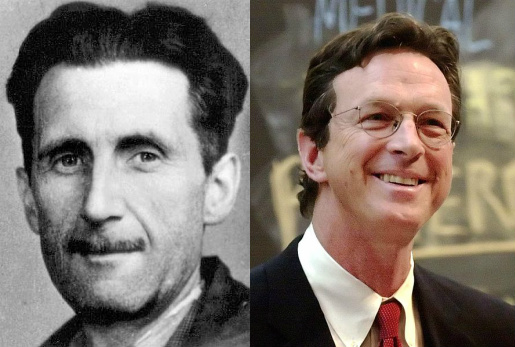
In his 2002 memoir, Travels, Michael Crichton took his readers back several decades, to the early 1960s when, as a Harvard student, he tried an interesting little experiment in his English class. He recalled:
I had gone to college planning to become a writer, but early on a scientific tendency appeared. In the English department at Harvard, my writing style was severely criticized and I was receiving grades of C or C+ on my papers. At eighteen, I was vain about my writing and felt it was Harvard, and not I, that was in error, so I decided to make an experiment. The next assignment was a paper on Gulliver’s Travels, and I remembered an essay by George Orwell that might fit. With some hesitation, I retyped Orwell’s essay and submitted it as my own. I hesitated because if I were caught for plagiarism I would be expelled; but I was pretty sure that my instructor was not only wrong about writing styles, but poorly read as well. In any case, George Orwell got a B- at Harvard, which convinced me that the English department was too difficult for me.
I decided to study anthropology instead. But I doubted my desire to continue as a graduate student in anthropology, so I began taking premed courses, just in case.
Most likely Crichton submitted Orwell’s essay 1946 essay, “Politics vs. Literature: An Examination of Gulliver’s Travels.” He eventually went to Harvard Medical School but kept writing on the side. Perhaps getting a grade just a shade below Orwell’s B- gave Crichton some bizarre confirmation that he could one day make it as a writer.
Follow Open Culture on Facebook and Twitter and share intelligent media with your friends. Or better yet, sign up for our daily email and get a daily dose of Open Culture in your inbox. And if you want to make sure that our posts definitely appear in your Facebook newsfeed, just follow these simple steps.
Looking for free, professionally-read audio books from Audible.com, including works by Crichton and Orwell? Here’s a great, no-strings-attached deal. If you start a 30 day free trial with Audible.com, you can download two free audio books of your choice. Get more details on the offer here.
via Reddit
Related Content:
George Orwell Explains in a Revealing 1944 Letter Why He’d Write 1984
George Orwell’s Harrowing Race to Finish 1984 Before His Death
Read More...“The Tolkien Professor” Presents Three Free Courses on The Lord of the Rings
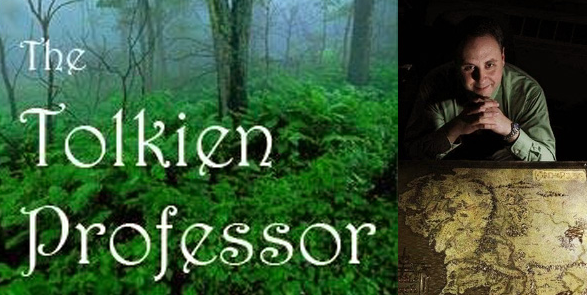
A quick update: Last year, we told you about Corey Olsen, an English Professor at Washington College, who started publishing online lectures on the writing of J.R.R. Tolkien. We initially featured his lecture series on The Hobbit. Now “The Tolkien Professor,” as Olsen is otherwise known, presents a series of online courses on The Lord of the Rings trilogy:
- Lord of the Rings I: The Road Goes Ever On — iTunesU
- Lord of the Rings II: The Two Towers — iTunesU — Web
- Lord of the Rings III: Return of the King - iTunes U — Web
As a bonus, you can access Olsen’s Undergraduate Survey Course on Tolkien (available on the web). The 14-week course was presented and recorded at Washington College in the Spring of 2010.
All of Olsen’s courses are catalogued in the Literature section of our collection of 825 Free Online Courses.
Related Content:
Listen to J.R.R. Tolkien Read a Lengthy Excerpt from The Hobbit (1952)
Fantastic BBC Footage of J.R.R. Tolkien in 1968
Free Audio: Download the Complete Chronicles of Narnia by C.S. Lewis
Read More...Vintage Photos of a Young Virginia Woolf Playing Cricket (Ages 5 & 12)
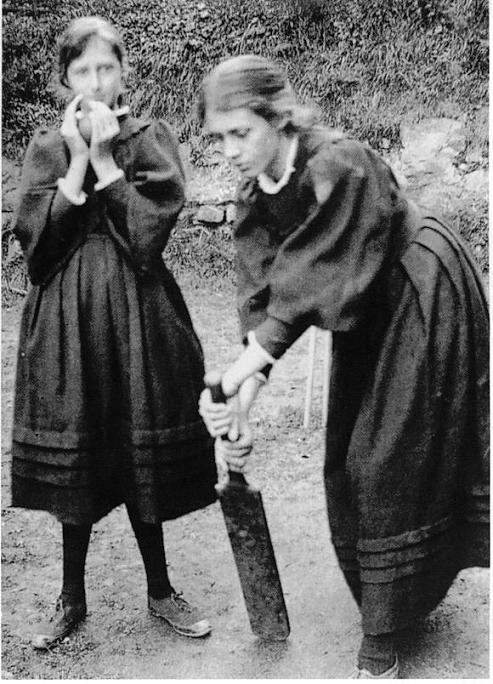
Scenes, I note, seldom illustrate my relation with Vanessa; it has been too deep for ‘scenes’. Vanessa and I were both what we call tomboys; that is, we played cricket, scrambled over rocks, climbed trees, were said not to care for clothes and so on.
Until she was fifteen indeed, she was outwardly sober and austere, the most trustworthy, and always the eldest; sometimes she would lament her “responsibilities”. But beneath the serious surface … there burnt also the…passion for art. …Once I saw her scrawl on a black door a great maze of lines, with white chalk. “When I am a famous painter-” she began, and then turned shy and rubbed it out in her capable way…She was awkward as a long-legged colt.
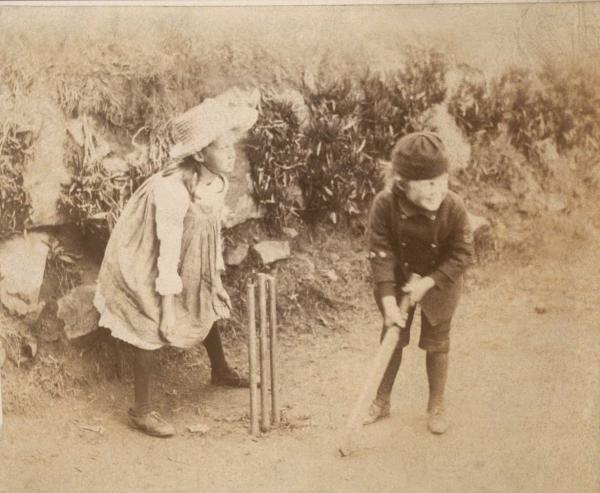
This is how Virginia Woolf remembered her sister Vanessa Bell in correspondence that’s been revived by a Smith College web site. Later in life, of course, Woolf wrote some of the finest modernist works of the 20th century. Meanwhile Vanessa became a respected painter — see 142 of her paintings here — and a central member of the avant-garde Bloomsbury Group. As adults, they both had a lot of cultural clout. But during another time — during their “tomboy” years — they were just kids looking for a good game of cricket. Above, we have an 1894 picture of Virginia (in the front, about 12 years old) and Vanessa, playing cricket at St. Ives. Below we have a shot, courtesy of Smith’s web site, of 5‑year-old Virginia playing cricket with her little brother Adrian Stephen (also later a member of the Bloomsbury Group) in 1886.
Works by Woolf can be found in our Free Audio Books and Free eBooks collections.
via The Paris Review
Related Content:
Read More...“Lol My Thesis” Showcases Painfully Hilarious Attempts to Sum up Years of Academic Work in One Sentence
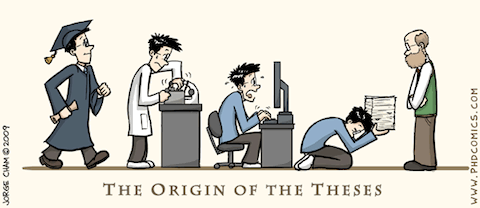
Image from Ph.D. Comics
A true fact about the thesis stage of an advanced degree: Whatever the academic field, whether writing a fifty page bachelor’s or master’s thesis or 250 plus page doctoral dissertation, at some point, you will need to winnow your argument down to an abstract summary of a couple succinct paragraphs. Then, one inevitably finds—when riding elevators with colleagues and mentors, talking to relatives over holiday dinners, justifying one’s existence to friends and acquaintances—that the whole damned thing needs to somehow reduce to one intelligible sentence or two. It’s all anyone has the patience for, honestly, and it saves you the trouble of trying to reconstruct complex arguments for people who won’t understand or care about them and who generally only asked out of politeness anyway.
But how, how, to cram years of research, agony, turmoil, crushing failure and soaring epiphany into bite-sized conversational nuggets without gross oversimplification to the point of tautological absurdity? Can it even be done?! The blog “lol my thesis,” started last year by a Harvard senior studying Human Developmental and Regenerative Biology, suggests that it can, but not without hilarious results. Part of an exploding genre of academic parody (and procrastination) sites, lol my thesis proudly ventures forth in its mission of “summing up years of work in one sentence” with open submissions from current students. Many of the submissions are from the sciences, and many from undergraduate theses, but a fair number also come from humanities and post-graduate studies. Take, for example, the following submission from an MFA Creative Nonfiction student at Emerson College, which directly addresses the intended audience:
“A collection of nonfiction essays, which means they’re written about real people and events, mom. Remember all those times you accused me of not listening to the things you said?”
A passive aggressive example that most of us who’ve been through the process can relate to at some level. Another one that hits home is this, from a Vassar Political Science major, who discovers too late that the argument doesn’t work: “Oops: Turns out self-published poetry didn’t actually affect Indian politics but I’m 60 pages in, so.”
The submissions from the sciences do not disappoint. For example, from a University of Maryland student of Biological Sciences: “We spent thousands of government dollars to create a mouse model for a disease only 32 people in the world have.” And a Science Writing student at M.I.T. gives us this particularly impressive example of brevity: “Wolves + humans, the ultimate frenemies.” Not to be outdone, a Stem Cell Biology student at Harvard offers a grimly terse confessional: “I have killed so many fish.”
The submissions are anonymous, but some good sports have chosen to include links to their theses, endearingly hoping that someone besides their advisor will actually want to read them. Most of the submissions, however, simply combine two qualities every advanced student knows all too well: a well-earned feeling of futility and the mordant wit required to keep going anyway.
More witty summaries can be found at lol my thesis.
Related Contents:
The Illustrated Guide to a Ph.D.
Graduate School Barbie: A New Gift Idea for The Demoralized Grad Student in Your Life
The Ph.D. Grind: Philip J. Guo’s Free Memoir Offers An Insider’s Look at Doctoral Study
Josh Jones is a writer and musician based in Durham, NC. Follow him at @jdmagness
Read More...The University of Richmond Animates the 1932 Atlas of the Historical Geography of the United States
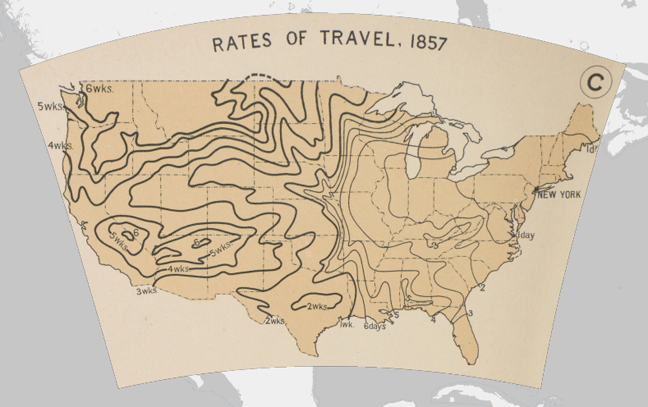
In 1902, the newly established Carnegie Institution of Washington set out to develop “a really first rate atlas of American history.” Work on the atlas began in earnest in 1912, under the direction of the naval historian Charles O. Paullin, who spent the better part of the next 15 years bringing it to life. In 1929, the American Geographic Society (AGS), along with the eminent geographer John K. Wright, took over the project and brought it to completion. The Atlas of the Historical Geography of the United States was finally published in 1932 to wide critical acclaim. Called a “monument to historical scholarship,” the compendium featured nearly 700 individual maps that gave visual insights into 500 years of American history. Topic covered included the “exploration and settlement of the North American continent, the location of colleges and churches, disputes over international and state boundaries, voting in presidential elections and in Congress, reforms from women’s suffrage to workmen’s compensation, transportation, industries, agriculture, commerce, the distribution of wealth, military history” and much more.
The Atlas of the Historical Geography of the United States remains a valuable historical resource today. But, for all of these years, it had one notable shortcoming. Around the time of its first publication, John K. Wright acknowledged that “The ideal historical atlas might well be a collection of motion-picture maps, if these could be displayed on the pages of a book without the paraphernalia of projector, reel, and screen.” The technology that would lend itself to creating motion-picture maps wasn’t available in the 1930s. But it is today. And thanks to the University of Richmond’s Digital Scholarship Lab, we can now view The Atlas of the Historical Geography of the United States in a new digital, sometimes animated format. If you want to see a good example of historical data put into motion, then you might want to check out this map of American Explorations in the West, 1803–1852. (Click here and then click “Animate” at the bottom of the screen.) This map will trace for you the expeditions of Lewis and Clark and many other explorers. Then, if you’re ready to be an explorer yourself, you can start your journey through the digitized atlas by entering the Table of Contents.
Related Content:
Visualizing Slavery: The Map Abraham Lincoln Spent Hours Studying During the Civil War
Henry David Thoreau’s Hand-Drawn Map of Cape Cod (1866)
An Interactive Map of Odysseus’ 10-Year Journey in Homer’s Odyssey
Geography of World Cultures by Martin Lewis (Stanford) in our collection of 825 Free Online Courses
Read More...Download 100 Free Philosophy Courses and Start Living the Examined Life
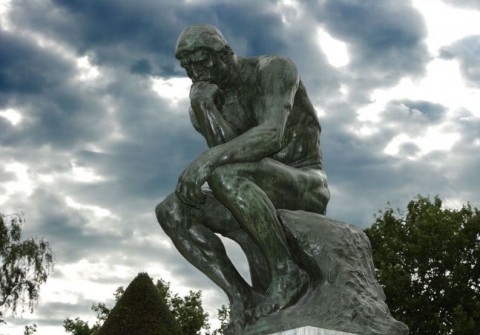
The Philosophy section of our big Free Online Courses collection just went through another update, and it now features 100 courses. Enough to give you a soup-to-nuts introduction to a timeless discipline. You can start with one of several introductory courses.
- Philosophy for Beginners – iTunes – Web Video – Marianne Talbot, Oxford
- Critical Reasoning for Beginners - iTunes Video – iTunes Audio – Web Video – Oxford
- A Romp through Ethics for Complete Beginners — iTunes Video – Web Video – Oxford
- Introduction to Political Philosophy – YouTube – iTunes – Web Video — Steven B. Smith, Yale
- The Art of Living — Web Video – Stanford
- The History of Philosophy Without Any Gaps - Multiple Formats– Peter Adamson, King’s College London
Then, once you’ve found your footing, you can head off in some amazing directions. As we mentioned many moons ago, you can access courses and lectures by modern day legends – Michel Foucault, Bertrand Russell, John Searle, Walter Kaufmann, Leo Strauss, Hubert Dreyfus and Michael Sandel. Then you can sit back and let them introduce you to the thinking of Aristotle, Socrates, Plato, Hobbes, Hegel, Heidegger, Kierkegaard, Kant, Nietzsche, Sartre and the rest of the gang. The courses listed here are generally available via YouTube, iTunes, or the web.
Explore our collection, 1,700 Free Online Courses from Top Universities, to find topics in many other disciplines — History, Literature, Physics, Computer Science and beyond. As we like to say, it’s the most valuable single page on the web.
Don’t miss anything from Open Culture. Sign up for our Daily Email or RSS Feed. And we’ll send quality culture your way, every day.
Related Content:
Michel Foucault: Free Lectures on Truth, Discourse & The Self
Take First-Class Philosophy Lectures Anywhere with Free Oxford Podcasts
Walter Kaufmann’s Lectures on Nietzsche, Kierkegaard and Sartre (1960)
Leo Strauss: 15 Political Philosophy Courses Online
Read More...Short Film Shows What Happens When a Letter from World War II Finally Gets Delivered 69 Years Later
A few years ago, I stumbled upon a never-sent letter written to a friend when we were both in college. The contents weren’t heavy. Disorganization is the most likely explanation for why it never went in the mail. I cracked the envelope and had a look.
It was a time capsule, for sure, a cringe-inducing one. It wasn’t so much the life I was reporting on as how I framed it, self-aggrandizement straining to pass as nonchalance. Fortunately, an artist acquaintance happened to be running a project— send her your shreddable documents, and eventually, she’d send you a few sheets of handmade paper in which your mulched data mingled with that of others. Truly a beautiful way to dispose of the evidence.
But what happens when neither the writer, nor the intended recipient, is the finder of the lost letter? In February 2013, some mail posted by Lt. Joseph O. Matthews, a soldier stationed at a military training facility in Jacksonville, North Carolina, found its way to Abbi Jacobson, an actress (and coloring book author!) renting an apartment on MacDougal Street in New York City. Addressed to Matthew’s wife, the cancellation mark was dated December 2, 1944.
Jacobson opened the letter, the condition of the envelope having suggested that she would not be the first to breach its contents during the 69 years it had spent wandering in the wilderness. The words inside were romantic, a young officer informing the bride he’d left back home that he’d soon be shipping out to Okinawa. Eager to pull an Amélie by reuniting the letter with those to whom it would mean the most, Jacobson enlisted the help of her friend, documentary filmmaker Todd Bieber. Together they searched records at City Hall, looking for clues. When that approach proved fruitless, they created the Lost Letter Project, a web portal that invited the public to join in the search.
An avalanche of tweets, Facebook updates, and human interest pieces ensued. In no time at all, they had their man, or rather his descendants, Lt. Matthews having passed away in 1999, crushing Jacobson’s dreams of hand delivering the letter to “a little old man and a little old lady.” (I’m willing to bet Jacobson will one day wish there was a giant blender capable of turning digital statements like how cute would that be, my god, right? I love old people into handmade paper.)
Bieber’s video reveals what became of Lt. Matthews and his wife. Even more interesting is how the letter resonates with his grown children, particularly a certain theological reference at odds with the man they thought they knew.
Related Content:
In Touching Video, Artist Marina Abramović & Former Lover Ulay Reunite After 22 Years Apart
“Nothing Good Gets Away”: John Steinbeck Offers Love Advice in a Letter to His Son (1958)
Stephen King Writes A Letter to His 16-Year-Old Self: “Stay Away from Recreational Drugs”
Ayun Halliday is all for stuffing your stocking with a holiday gift subscription to the East Village Inky, her award winning hand-illustrated zine. Follow her @AyunHalliday
Read More...Hear Michel Foucault Deliver His Lecture on “Truth and Subjectivity” at UC Berkeley, In English (1980)
Michel Foucault first arrived at the University of California, Berkeley in 1975. By this time, he was already a celebrity in France. He had just published his enormously influential history and critique of the penal system, Discipline and Punish, and he occupied a position at the prestigious Collège de France as chair in the “history of systems of thought,” a position he created for himself. But when he arrived on the West Coast, writes Marcus Wohlsen, “few at Berkeley had heard of Michel Foucault.” Leo Bersani, then chairman of the French department, even had to call philosophy professor Hubert Dreyfus to help “come and fill out the ranks” for Foucault’s lectures.
After the publication of volume one of The History of Sexuality, Foucault would return to Berkeley in the fall of 1979, then again in 1980. By then, the scene had changed dramatically. Foucault was invited to deliver the Howison Lecture that year, a distinguished invitation previously extended to such thinkers as John Dewey, Willard V.O. Quine and, the year previous, John Rawls. By this time, Wohlsen writes, Foucault was, reluctantly, “an international academic superstar.” Filling the hall for his lectures would not be an issue. In fact, Wohlsen tells us,
Crowds crammed the 2,000-seat Zellerbach Hall so quickly that police had to bar the doors. Foucault fans milled around restlessly outside until [philosophy professor Hans] Sluga arranged for a live broadcast of the letures to Wheeler Hall. Its 760 seats filled almost immediately.
According to Sluga, Foucault, increasingly wary of his fame, intentionally titled his lecture—“Truth and Subjectivity: the Stoic Practice of Self Examination”—to sound “learned, abstract, remote” in order to deter a large crowd. That ploy clearly failed.
In the first part of the lecture (at top), the presenter who introduces Foucault begins by gesturing to the philosopher’s fame, then comments that Foucault’s prominent post at the Collège de France was “very paradoxical, since Michel Foucault, although prestigious, is not a typical kind of academic. He is suspicious of all titles and claims to disinterested truth that has been [sic] associated with academia.” After mentioning Foucault’s fierce criticism of every historical assumption and methodology (he was a guest of the History and French Departments), he breaks off his remarks to note that “there’s a mob of people all around, trying to get in.”
Foucault begins his lecture in French (at 8:08), then switches to English for the remainder (at 9:18). He quotes from a historical French psychiatrist’s account of a “cure” involving an “interrogation” and a coerced confession of madness. Foucault calls this one among many examples of “truth therapies,” and it serves—as do such vividly specific archival examples in his books—as a harrowing introduction to the policing of capital‑T Truth that is the essence of the humanist enterprise.
Despite the often profoundly unsettling nature of his investigations, and his attempt to scare off the crowd, Foucault is not dour or boring, nor does he seem at all unapproachable or forbidding. He is patient and self-deprecatingly funny: in a cutting, rueful reference to the growing dominance of analytic philosophy in British and American universities, he says, “I confess, with the appropriate chagrin, that I am not an analytical philosopher. Nobody is perfect.” Then he sums up his project succinctly: “I have tried to explore another direction. I have tried to get from a philosophy of subjectivity to a genealogy of the subject.”
Foucault is a very charming speaker, sprinkling his lecture with little jokes like “It goes without saying… but it goes better with saying…” and dropping in Americanisms like “Monday morning quarterbacking,” to the amusement of the crowd. He shows himself to be very much aware of his audience—these are deeply serious lectures, without a doubt, but Foucault never forgets that he’s facing living human beings, with their own domains of knowledge and subjectivities—and he seeks to reach them where they are while reporting on his disturbing discoveries as an archaeologist of Western humanist discourse.
Foucault returned to Berkeley again as a visiting professor in 1981 and again 1983, the year before his death. Alain Beaulieu, who has catalogued Foucault’s Berkeley archives, described his time in California as happy and productive, “while he remain[ed] critical of some features associated with the ‘Californian cult of the self.’” In fact, “Cult of the Self” was the title of three lectures Foucault delivered at Berkeley in 1983 (listen here), along with six lectures on “Discourse and Truth.” During his time at Berkeley in 1980, when he delivered the lecture above, graduate student Michael Bess interviewed the philosopher. Foucault spoke plainly and passionately about the impetus for his relentless critiques of institutional power and knowledge:
In a sense, I am a moralist, insofar as I believe that one of the tasks, one of the meanings of human existence—the source of human freedom—is never to accept anything as definitive, untouchable, obvious, or immobile. No aspect of reality should be allowed to become a definitive and inhuman law for us.
We have to rise up against all forms of power—but not just power in the narrow sense of the word, referring to the power of a government or of one social group over another: these are only a few particular instances of power.
Power is anything that tends to render immobile and untouchable those things that are offered to us as real, as true, as good.
Read the complete interview, first published in the November 10, 1980 Daily Californian, here.
Related Content:
Clash of the Titans: Noam Chomsky & Michel Foucault Debate Human Nature & Power on Dutch TV, 1971
Download Free Courses from Famous Philosophers: From Bertrand Russell to Michel Foucault
Michel Foucault: Free Lectures on Truth, Discourse & The Self
90 Free Philosophy Courses in our Collection of 800 Free Courses Online
Josh Jones is a writer and musician based in Durham, NC. Follow him at @jdmagness
Read More...Support Us
We're hoping to rely on loyal readers, rather than erratic ads. Please click the Donate button and support Open Culture. You can use Paypal, Venmo, Patreon, even Crypto! We thank you!

About Us

Open Culture scours the web for the best educational media. We find the free courses and audio books you need, the language lessons & educational videos you want, and plenty of enlightenment in between.
Advertise With Us
FREE UPDATES!
GET OUR DAILY EMAIL
Get the best cultural and educational resources on the web curated for you in a daily email. We never spam. Unsubscribe at any time.
FOLLOW ON SOCIAL MEDIA
Open Culture editor Dan Colman scours the web for the best educational media. He finds the free courses and audio books you need, the language lessons & movies you want, and plenty of enlightenment in between.
Advertise With Us



