Oxford’s Free Course Critical Reasoning For Beginners Will Teach You to Think Like a Philosopher
 When I was younger, I often found myself disagreeing with something I’d read or heard, but couldn’t explain exactly why. Despite being unable to pinpoint the precise reasons, I had a strong sense that the rules of logic were being violated. After I was exposed to critical thinking in high school and university, I learned to recognize problematic arguments, whether they be a straw man, an appeal to authority, or an ad hominem attack. Faulty arguments are all-pervasive, and the mental biases that underlie them pop up in media coverage, college classes, and armchair theorizing. Want to learn how to avoid them? Look no further than Critical Reasoning For Beginners, the top rated iTunesU collection of lectures led by Oxford University’s Marianne Talbot.
Talbot builds the course from the ground up, and begins by explaining that arguments consist of a set of premises that, logically linked together, lead to a conclusion. She proceeds to outline the way to lay out an argument logically and clearly, and eventually, the basic steps involved in assessing its strengths and weaknesses. The six-part series, which was recorded in 2009, shows no sign of wear, and Talbot, unlike some philosophy professors, does a terrific job of making the content digestible. If you’ve got some time on your hands, the lectures, which average just over an hour in length, can be finished in less than a week. That’s peanuts, if you consider that all our knowledge is built on the foundations that this course establishes. If you haven’t had the chance to be exposed to a class on critical thought, I can’t recommend Critical Reasoning For Beginners with enough enthusiasm: there are few mental skills that are as underappreciated, and as central to our daily lives, as critical thinking.
Critical Reasoning For Beginners is currently available on the University of Oxford website in both audio and video formats, and also on iTunesU and YouTube. You can find it listed in our collection of Free Online Philosophy Courses, part of our collection of 1100 Free Online Courses.
Ilia Blinderman is a Montreal-based culture and science writer. Follow him at @iliablinderman, or read more of his writing at the Huffington Post.
Related Content:
The Partially Examined Life: A Philosophy Podcast
The History of Philosophy Without Any Gaps – Peter Adamson’s Podcast Still Going Strong
Philosophy Bites: Podcasting Ideas From Plato to Singularity Since 2007
Read More...Enter the Hannah Arendt Archives & Discover Rare Audio Lectures, Manuscripts, Marginalia, Letters, Postcards & More
The work of Hannah Arendt has been in the press recently for two reasons in particular: first, the 50th anniversary of her book Eichmann in Jerusalem, published in 1963 from reports she filed for The New Yorker on the 1961 trial of the archetypal Nazi bureaucrat. Then there is Margarethe von Trotta’s 2012 biopic Hannah Arendt, starring German actress Barbara Sukowa as the German Jewish philosopher. Recent coverage of the book and the film have focused on Arendt’s reputation as a philosophical journalist most closely identified with the famous descriptive phrase “the banality of evil,” a comment on Adolf Eichmann as an exemplar of genocidal murderers who, as the well-worn defense goes, were “just following orders.”
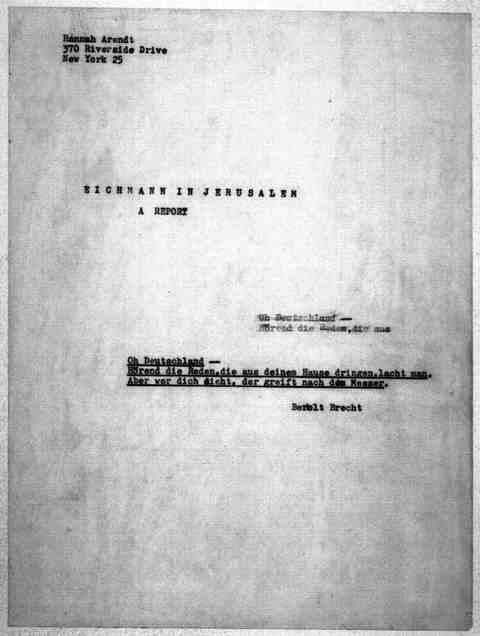
Arendt scholar Roger Berkowitz argues that this reading of Arendt’s book is a profound misreading. Eichmann in Jerusalem was divisive, setting critics against each other in efforts to vindicate or castigate its author. The controversy, however, at the time of publication and again in the recent re-evaluation, has the unfortunate effect of obscuring the breadth of Arendt’s philosophical thinking apart from Eichmann and Nazism. Those interested in connecting with Arendt’s life, scholarship, and philosophical insight can find a wealth of archival materials online from the collections of Bard College and the Library of Congress. Today, we highlight several items in those collections that may be of interest, including the Library of Congress’s scanned copy of the final typescript of Eichmann in Jerusalem.
First, directly above, hear Arendt’s speech “Power & Violence.” The lecture re-iterates ideas Arendt expressed more fully in a lengthy 1969 essay published by the New York Review of Books as “Reflections on Violence” and as a book titled On Violence. In the lecture and the essay, Arendt references the work of thinkers like Friedrich Engels and, especially, Frantz Fanon in a critical discussion of the roles racism and ideology play in state violence.
That same year Arendt delivered a series of lectures for a Spring semester course at The New School for Social Research called “Philosophy and Politics: What is Political Philosophy.” This fascinating investigation grapples not only with political philosophy, but philosophy in general as a meaningful activity. You can view the full typescripts of her course lectures here.
The Library of Congress has also digitized much of Arendt’s correspondence and uploaded images of her letters, including some to and from such well-known figures as W.H. Auden, Lionel Trilling, and Alfred Kazin (most of Arendt’s letters are only available for viewing onsite at the Library of Congress, The New School University, or the University of Oldenburg).
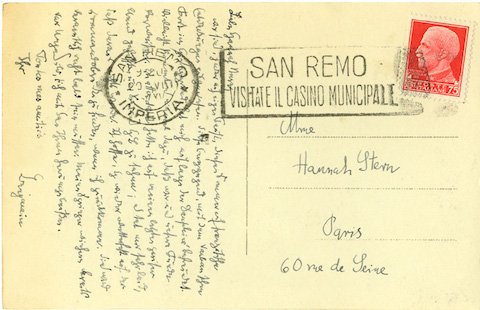
In addition to the “Arendt Marginalia” section, Bard hosts a gallery that includes “inscribed books, journals & manuscripts,” “artwork & photographs,” and “postcards and other correspondence” (such as the above postcard from Walter Benjamin, addressed to “Hannah Stern,” her married name at the time).
Lastly, for an excellent overview of Arendt’s life and work that puts all of the above materials in context, see the Library of Congress’s “Biographical Note” and be sure to read “Three Essays: The Role of Experience in Hannah Arendt’s Political Thought” by Jerome Kohn, director of the New School’s Hannah Arendt Center. As many know, Arendt, and many other German Jewish intellectuals who fled the Nazis, found a home at New York’s New School for Social Research (now New School University). And we have the New School (and an Andrew W. Mellon Foundation grant) to thank for the Library of Congress’s vast, digitized collection of Arendt’s papers, which preserves her legacy for generations to come.
Related Content:
Hannah Arendt Discusses Philosophy, Politics & Eichmann in Rare 1964 TV Interview
Hannah Arendt’s Original Articles on “the Banality of Evil” in the New Yorker Archive
The Trial of Adolf Eichmann at 50
Josh Jones is a writer and musician based in Durham, NC. Follow him at @jdmagness
Read More...Rare Audio: William Faulkner Names His Best Novel, And the First Faulkner Novel You Should Read
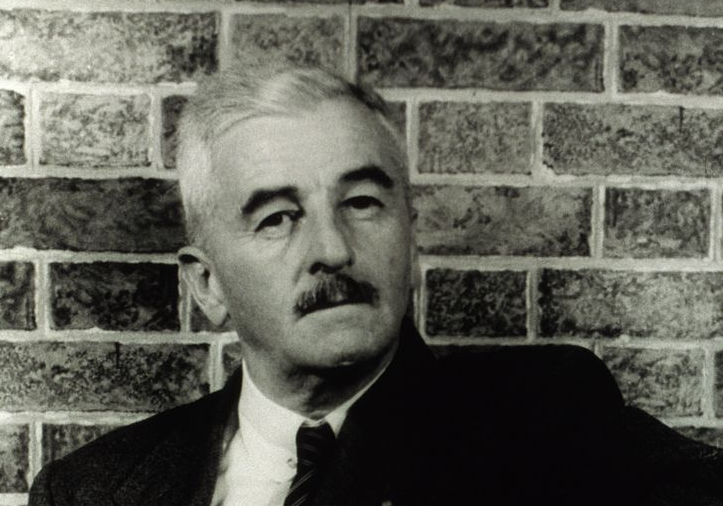
Image by Carl Van Vechten, via Wikimedia Commons
My two favorite William Faulkner novels are, without a doubt, Absalom, Absalom! and The Sound and The Fury. After readers get thrust into the narrators’ dizzying streams of consciousness, both books mount in tension to a frightful, almost unbearable pitch, before reaching their grim, cathartic climaxes. I’ve always felt that the white-hot intensity of the novels meant that, somehow, they had meant more to Faulkner than his other writings. According to an audio recording of Faulkner himself, it turns out that I was half right.
In 1957 and 1958, Faulkner served as the Writer-in-Residence at the University of Virginia at Charlottesville, and today the school retains what is likely to be the largest Faulkner archive in the world. In addition to Faulkner’s private library, original manuscripts, letters, and personal effects, the archive also contains hours upon hours of Faulkner’s Q & A sessions, speeches, and readings. In April of 1957, during a class lecture, a student asked Faulkner about his favorite novel. Listen to the audio clip here:
Unidentified participant: Mr. Faulkner, what do you consider your best book?
William Faulkner: The one that—that failed the most tragically and the most splendidly. That was The Sound and the Fury—the one I worked at the longest, the hardest, that was to me the—the most passionate and moving idea, and made the most splendid failure. That’s the one that’s my—I consider the best, not—well, best is the wrong word—that’s the one that I love the most.
The recordings themselves are a fascinating resource, with Faulkner commenting widely on his novels and stories. Where else could one hear, for example, what the author considered the best book to start with when reading him? Listen here.
Unidentified participant: Do you think that there’s a particular order in which your works should be read […]? Many people have offered a sequence. Do you think there’s a particular sequence that your books should be read in?
William Faulkner: Probably to begin with a book called Sartoris. That has the germ of my apocrypha in it. A lot of the characters are postulated in that book. I’d say that’s a good one to begin with.
For those interested in learning more about Faulkner and his writing, the Southeast Missouri State University’s Center for Faulkner Studies is offering a promising MOOC called Faulkner 101, led by the Center’s founder, Dr. Robert Hamblin, as well as its current director, Dr. Chris Rieger. You can sign up now. Or find countless other MOOCs in our big, ever-expanding list of MOOCs.
Ilia Blinderman is a Montreal-based culture and science writer. Follow him at @iliablinderman, or read more of his writing at the Huffington Post.
Related Content:
William Faulkner Reads from As I Lay Dying
William Faulkner Audio Archive Goes Online
The Art of William Faulkner: Drawings from 1916–1925
Read More...Watch Boy and Bicycle: Ridley Scott’s Very First Film (1965)
Alien, Blade Runner, Gladiator, Prometheus, the Apple Macintosh 1984 Super Bowl ad, the upcoming Biblically-based (and Biblically-sized) Exodus: if you want a thoroughly through-and-through vision, executed at full scale and tinted with more than a touch of dystopian grimness, you go to Ridley Scott. But no director commences his career making pictures like these; most of them have to begin in humbler places, pulling together whatever grant money, film-school resources, and helpful acquaintances they can to realize, and in the process often compromise, their long-incubated cinematic dreams. So it went with Scott himself, who made the short film above, 1965’s Boy and Bicycle, while a student at London’s Royal College of Art. But even this comparatively tiny project, with its rich 16-millimeter images, adept camera movement, and utterly hopeless setting, shows signs of what sort of filmmaker the twentysomething Scott would become a decade or two later.
Though he received his photographic education in London, Scott took his camera out for the Boy and Bicycle shoot to West Hartlepool, where he’d attended art school several years earlier. That bit of the soon-to-be-deindustrialized north of England provided, especially in the British Steel North Works cooling tower and blast furnace, just the sort of background we’d expect to see in the mature director’s work. And through this bleak landscape (which reminds me of nothing so much as the inhospitable Osaka he would portray more than twenty years later in Black Rain) we have the titular boy on the titular bicycle, played by — classic first-time filmmaker’s strategy — the director’s younger brother. In this case, that brother would grow up to become Tony Scott, a celebrated if aesthetically polarizing director (Top Gun, True Romance, Domino) in his own right. Not one to waste a resonant image, Ridley Scott would a decade later revisit Boy and Bicycle in the beloved advertisement for Hovis bread just above.
Other early short films by great directors can be found below, and in our collection of 635 Free Movies Online.
Related Content:
Martin Scorsese’s Very First Films: Three Imaginative Short Works
Stanley Kubrick’s Very First Films: Three Short Documentaries
Andrei Tarkovsky’s Very First Films: Three Student Films, 1956–1960
The Hearts of Age: Orson Welles’ Surrealist First Film (1934)
Colin Marshall hosts and produces Notebook on Cities and Culture and writes essays on cities, Asia, film, literature, and aesthetics. He’s at work on a book about Los Angeles, A Los Angeles Primer. Follow him on Twitter at @colinmarshall or on his brand new Facebook page.
Read More...“Be All You Can Be. Read”: Peter Max’s 1969 Psychedelic Poster for National Library Week
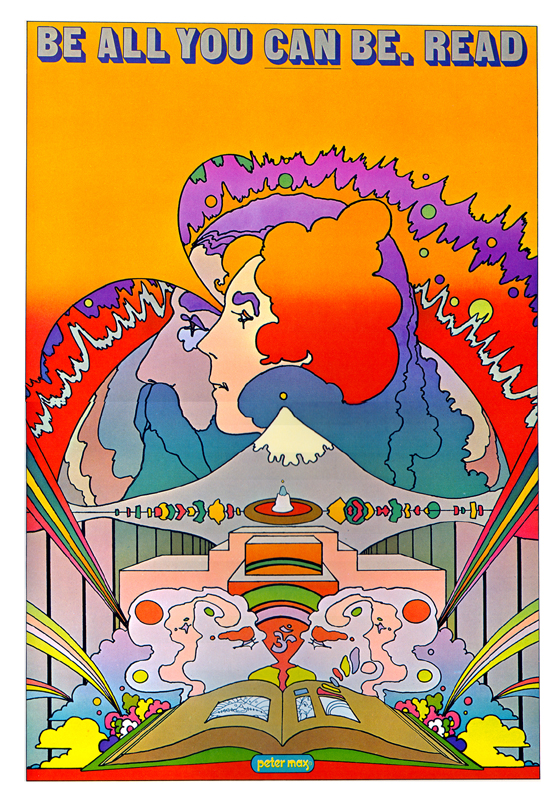
In 1969, Peter Max was creating psychedelic illustrations that captured the countercultural spirit of the 1960s. Bright, trippy, and thought-provoking, Max’s artwork fused together “eastern yogi philosophy, astronomy, comic books, studies in color, and music.” And it certainly found an audience. By the late 60s, college dorm rooms across the U.S. were plastered with Max’s posters. 72 corporations — from General Electric to Burlington Mills, a manufacturer of socks — licensed his art for commercial use. Meanwhile, in ’69, Max appeared on The Tonight Show, The Ed Sullivan Show, and the cover of LIFE magazine (with main article titled “Peter Max: Portrait of the artist as a very rich man”).
Even while the corporate gigs were rolling in, the German-born illustrator took on less commercial projects, like creating this poster for National Library Week, an annual event organized by the American Library Association. Measuring 36 x 24 inches, the 1969 poster, aesthetically speaking, is vintage Max. And it carries a message that sounds as good today as it did then: “Be All You Can Be. Read.” Now dare I steer you toward of our collection of 500 Free eBooks? An easy way to make you, a better you.
If you would like to support the mission of Open Culture, consider making a donation to our site. It’s hard to rely 100% on ads, and your contributions will help us continue providing the best free cultural and educational materials to learners everywhere. You can contribute through PayPal, Patreon, and Venmo (@openculture). Thanks!
via Biblioklept
Read More...15 Minute History: Quick History Lessons from a New, Chart-Topping Podcast
I’ve always been jealous of friends who studied history in college. They’ve got a working knowledge of the causes of wars, economic crises, political upheavals, and any other trivia question-worthy events. Thankfully, whatever I’d like to learn is merely a click away: we’ve got over 800 free online courses (including 67 free history courses) listed on Open Culture at the time of writing, and educational institutions continue to upload new lectures every week. Most of the lectures, however, last from 30 minutes to an hour, requiring users to cordon off a block of time for study. Want something shorter? Enter the 15 Minute History podcast, currently the fourth most popular podcast on iTunesU.
The result of the University of Texas at Austin’s Hemispheres and Not Even Past public outreach efforts, the 15 Minute History podcast focuses on key subjects in world history and U.S. history. Although the podcast is tailored to Texas teachers and students, emphasizing the state’s K‑12 curriculum, it also happens to be a treasure trove of free content for anyone interested in history. The short podcasts, which last some 15 minutes on average, cover everything from Russia’s October 1917 Revolution, to the Ottoman Empire, to the global context of the American Revolution. Each episode is led by one of three UT Austin academics, who discuss the topic at hand with another university professor or graduate student. Conveniently, on the 15 Minute History web site, the podcasts are accompanied by a carefully formatted transcript, plus additional reading materials for those who find themselves curious about a particular topic.
Interested readers can find the whole podcast series on iTunes, or on the web.
Ilia Blinderman is a Montreal-based culture and science writer. Follow him at @iliablinderman.
Related Content:
A Crash Course in World History
The Complete History of the World (and Human Creativity) in 100 Objects
Read More...The Very First Written Use of the F Word in English (1528)
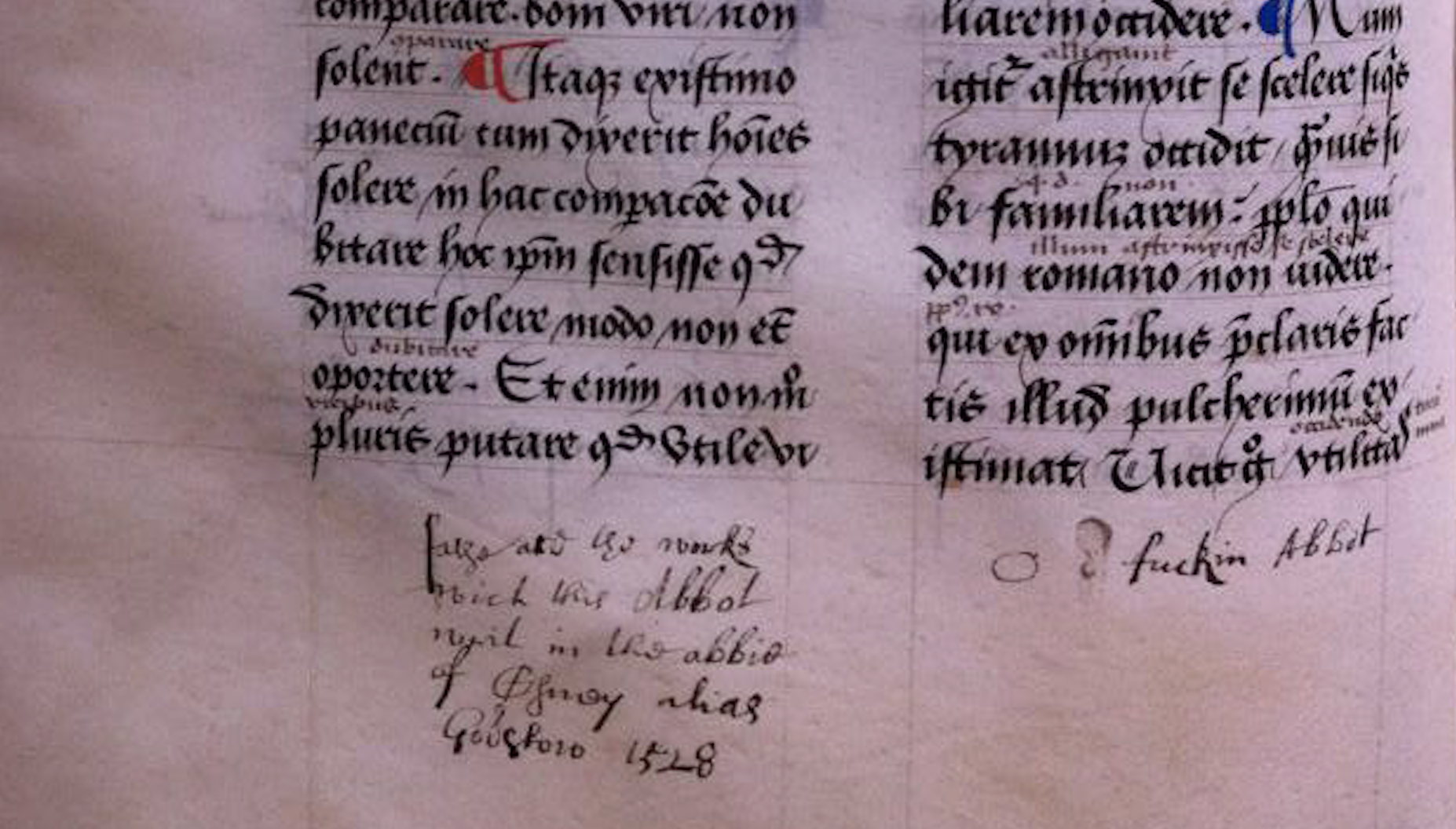
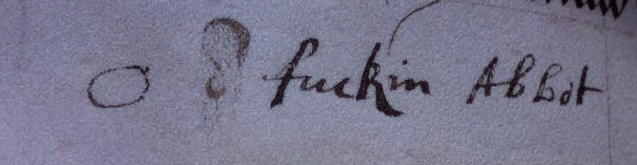
English speakers enjoy what seems like an unmatched curiosity about the origins and historical usages of their language’s curses. The exceedingly popular “F word” has accreted an especially wide body of textual investigation, wide-eyed speculation, and implausible folk etymology. (One of the term’s well-known if spurious creation myths even has a Van Halen album named after it.) “The history begins in murky circumstances,” says the Oxford English Dictionary’s site, and that dictionary of dictionaries has managed to place the word’s earliest print appearance in the early sixteenth century, albeit written “in code” and “in a mixed Latin-and-English context.” Above, you can see one of the few concrete pieces of information we have on the matter: the first definitive use of the F word in “the English adjectival form, which implies use of the verb.”
Here the word appears (for the first time if not the last) noted down by hand in the margins of a proper text, in this case Cicero’s De Officiis. “It’s a monk expressing his displeasure at an abbot,” writes Katharine Trendacosta at i09. “In the margins of a guide to moral conduct. Because of course.” She quotes Melissa Mohr, author of Holy Sh*t: A Brief History of Swearing, as declaring it “difficult to know” whether this marginalia-making monk meant the word literally, to accuse this abbott of “questionable monastic morals,” or whether he used it “as an intensifier, to convey his extreme dismay.” Either way, it holds a great deal of value for scholars of language, given, as the OED puts it, “the absence of the word from most printed text before the mid twentieth century” and the “quotation difficulties” that causes. If you find nothing to like in the F word’s ever-increasing prevalence in the media, think of it this way: at least future lexicographers of swearing will have more to go on.
To view the complete manuscript page, click here. The document seemingly resides at Brasenose College, Oxford.
via io9
Related Content:
Steven Pinker Explains the Neuroscience of Swearing (NSFW)
Stephen Fry, Language Enthusiast, Defends The “Unnecessary” Art Of Swearing
George Carlin Performs His “Seven Dirty Words” Routine: Historic and Completely NSFW
Colin Marshall hosts and produces Notebook on Cities and Culture and writes essays on cities, Asia, film, literature, and aesthetics. He’s at work on a book about Los Angeles, A Los Angeles Primer. Follow him on Twitter at @colinmarshall or on his brand new Facebook page.
Read More...How a Book Thief Forged a Rare Edition of Galileo’s Scientific Work, and Almost Pulled it Off
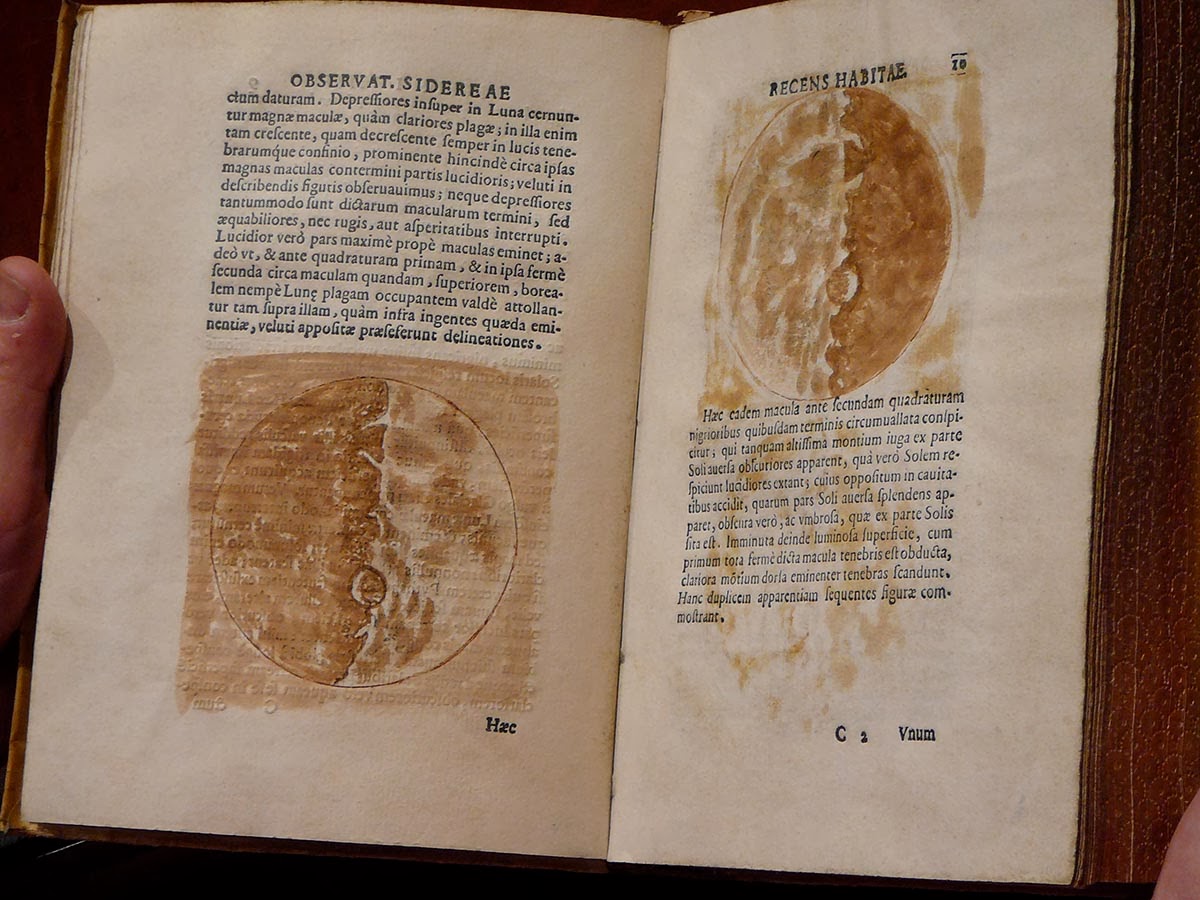
A couple of weeks ago, we published a post that featured Galileo’s Moon drawings, “the first realistic depictions of the moon in history.” As it turns out—some readers alerted us—some of the Moon illustrations attributed to Galileo are actually very convincing forgeries, so convincing, in fact that when the drawings surfaced in 2005, they initially swayed such experts as rare books dealer Richard Lan, Harvard professor of astronomy and history of science Owen Gingerich, and art historian Horst Bredekamp. All of these experts have since come to learn—partially through the investigations of Georgia State University historian Nick Wilding—that an unusual edition containing detailed watercolors, purportedly in Galileo’s own hand (above and below), was in fact created by forger, book thief, and former director of the State Library of Girolamini, Marino Massimo De Caro, who now stands accused of stealing thousands of volumes, including centuries-old editions of Aristotle, Descartes, Galileo and Machiavelli.
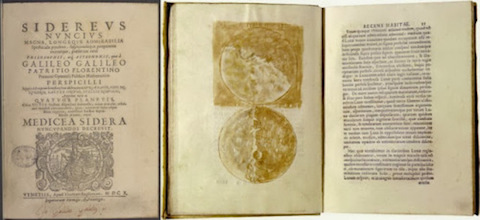
The drawings we featured at the top of our previous post—from a set of five inkwashes made in 1609, called “the Florence Sheet”—are genuine, as are the etchings in the original text of Galileo’s scientific treatise, Sidereus Nuncius. However, as investigative reporter Nicholas Schmidle documented in a lengthy article published in last December’s New Yorker, the edition pictured above—purchased for half a million dollars by Richard Lan of rare booksellers Martayan Lan and once valued at over ten million dollars for its unique rust-colored illustrations—is a fake, despite being authenticated by a team of scholars in 2007.
The story of how De Caro’s forgery came to fool nearly everyone who examined it (ending up in Time magazine and dozens of other publications and scholarly websites) is a long and winding tale. Like many forgers, De Caro acted out of a mixture of greed, envy, and a desire to prove himself to a field he felt did not recognize his talents (De Caro also forged a copy of Galileo’s 1606 Compasso to replace a stolen version). A college dropout, he “held an imperious grudge against people who had spent years studying in libraries,” writes Schmidle. Instead, De Caro had earned an honorary professorship by donating four Galileo editions (presumably genuine) and a chunk of meteorite to a private institution in Buenos Aires. More than just a story of fraud and theft, De Caro’s is one of academic imposture. In 2006, for example, he participated in a panel discussion on Galileo at Fordham University, and despite the skepticism of actual scholars, his expertise was trusted in the rare books and museum worlds until his discovery.
According to Schmidle, De Caro and an accomplice artist aged several bottles of nineteenth-century ink to create the Galileo drawings, using the Florence Sheet as a guide for the seventeenth-century astronomer’s hand. After opening a bottle of red wine, he had his accomplice trace the outline of the moons with the foot of his wineglass. Then they baked the pages in his home oven to age them. It’s hard to believe De Caro’s fake survived scrutiny for over five years, until Wilding began to express his doubts in 2011. Though facing several years in prison, De Caro hopes to work someday with the F.B.I., helping them discover forged and stolen books. He cites famous con man Frank Abagnale, played by Leonardo Di Caprio in the 2002 film Catch Me If You Can, as an inspiration. “I want to do for books what he did for checks,” says De Caro. “I can help them find all the black, offshore accounts of all the booksellers.” Read a facsimile of Schmidle’s article here. And for more on De Caro’s brazen crimes, see this detailed Examiner article.
Related Contents:
Galileo’s Moon Drawings, the First Realistic Depictions of the Moon in History (1609–1610)
Meet “Father Philanthropy”: America’s Most Prolific and Unlikely Master Art Forger
Josh Jones is a writer and musician based in Durham, NC. Follow him at @jdmagness
Read More...Jack Kerouac’s On The Road Turned Into Google Driving Directions & Published as a Free eBook
Note: You can find lectures (1 + 2) discussing the importance of On the Road in Yale’s course, The American Novel Since 1945. It appears in the Literature section of our collection, 1,700 Free Online Courses from Top Universities.
If you would like to support the mission of Open Culture, consider making a donation to our site. It’s hard to rely 100% on ads, and your contributions will help us continue providing the best free cultural and educational materials to learners everywhere. You can contribute through PayPal, Patreon, and Venmo (@openculture). Thanks!
via @SteveSilberman and PRI
Related Content:
Jack Kerouac Lists 9 Essentials for Writing Spontaneous Prose
Pull My Daisy: 1959 Beatnik Film Stars Jack Kerouac and Allen Ginsberg
Jack Kerouac Reads from On the Road (1959)
500 Free eBooks: Download Great Books for Free
Read More...The President of Northwestern University Predicts Online Learning … in 1934!
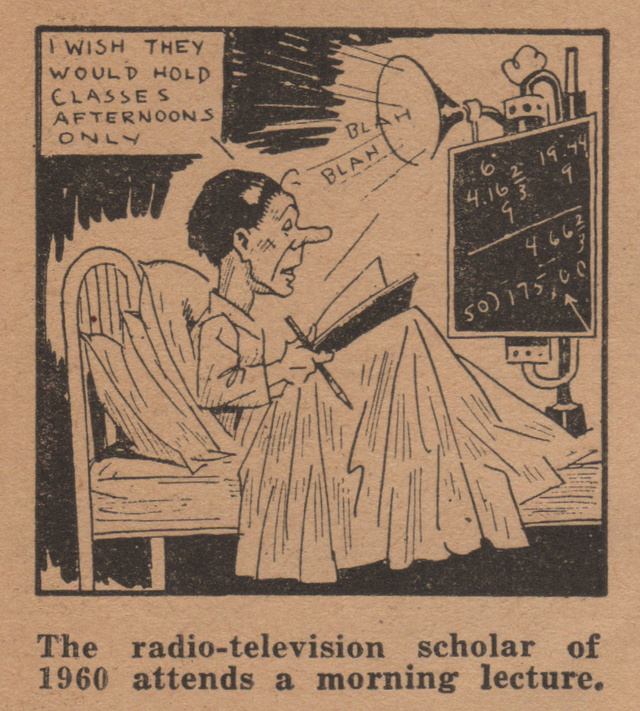
One of our most popular posts this year centered around a prescient set of predictions that Isaac Asimov made for 2014, way back in 1964. Asimov, however, wasn’t the only one whose vision of the future seems to have been realized.
The web site Paleofuture features a 1934 issue of Everyday Science and Mechanics magazine, where Northwestern University president Walter Dill Scott made some farsighted pronouncements of his own. Scott believed that the physical college campus would no longer need to be a lynchpin for education, and that students could learn by way of radio and pictures. Fax machines and televisions would allow students to access lecture materials worldwide, and ensure that researchers could conduct their research remotely. He also figured that we’d all end up commuting by planes. Everyday Science and Mechanics wrote:
The university of twenty-five years from now will be a different looking place, says President Scott of Northwestern. Instead of concentrating faculty and students around a campus, they will “commute” by air, and the university will be surrounded by airports and hangars. The course will be carried on, to a large extent, by radio and pictures. Facsimile broadcasting and television will enlarge greatly the range of a library; and research may be carried on by scholars at great distances.
Airports and hangars aside, Scott’s conjectures hit pretty close to home. While fax machines and radio may have been supplanted by the Internet, the essence of our educational advancements is the same: university students can often listen to lectures and complete assignments online, spending only a few short face-to-face hours in the classroom. Other times, classes may be wholly available online, and students may never step foot on campus altogether. Scholars, too, can trawl through databases like JSTOR and PsycINFO without getting out of bed, conducting research as they travel.
In fact, today almost anyone can have access to university knowledge. Feel like taking a Technology Entrepreneurship class offered by Stanford, or learn about Walt Whitman, courtesy of The University of Iowa? Nothing simpler! Massive Open Online courses (MOOCs) are proliferating, and you can download audio & video lectures from top tier universities. Visit our collection of 825 Free Online Courses to see what we mean.
In the end, it’s a good thing Scott was right. Otherwise, there’d be no Open Culture.
Ilia Blinderman is a Montreal-based culture and science writer. Follow him at @iliablinderman.
Related Content:
Isaac Asimov Predicts in 1964 What the World Will Look Like Today — in 2014
Arthur C. Clarke Predicts the Future in 1964 … And Kind of Nails It
Walter Cronkite Imagines the Home of the 21st Century … Back in 1967
The Internet Imagined in 1969
Marshall McLuhan Announces That The World is a Global Village
Read More...Support Us
We're hoping to rely on loyal readers, rather than erratic ads. Please click the Donate button and support Open Culture. You can use Paypal, Venmo, Patreon, even Crypto! We thank you!

About Us

Open Culture scours the web for the best educational media. We find the free courses and audio books you need, the language lessons & educational videos you want, and plenty of enlightenment in between.
Advertise With Us
FREE UPDATES!
GET OUR DAILY EMAIL
Get the best cultural and educational resources on the web curated for you in a daily email. We never spam. Unsubscribe at any time.
FOLLOW ON SOCIAL MEDIA
Open Culture editor Dan Colman scours the web for the best educational media. He finds the free courses and audio books you need, the language lessons & movies you want, and plenty of enlightenment in between.
Advertise With Us



