Straight Talk about Stem Cells: Another Stanford Course via Podcast
 Last week, we mentioned The Future of the Internet. This week it’s another course available as a free podcast : Straight Talk About Stem Cells (iTunes).
The course was taught by Christopher Scott, the Executive Director of Stanford’s Program on Stem Cells in Society and the author of Stem Cell Now: An Introduction to the Coming Medical Revolution. Originally taught within Stanford’s Continuing Studies program, the course was designed with the general public in mind. So it should be quite accessible. You can now download three of the total five lectures. Two more will be coming soon. (Get it on iTunes here.) Here is the original course description for the course.
Biology’s Brave New World: Straight Talk about Stem Cells
No area of science holds such promise for treating disease and improving human lives as stem cell research. But no area of science causes such fundamental ethical concern and such ferocious political conflict. In this short course, students will learn the fundamentals of stem cell biology, and study how these powerful cells could be used to make functional organs, treat diabetes or repair spinal cord injuries. With the science and technology firmly in hand, we will journey into the deep reaches of the controversy and examine the international explosion of stem cell research and how law and policy are affecting long-held American dominance in cell biology. New science often provokes a redefinition of ethical standards. Stem cells have reignited the debate about the embryo, abortion, and science run amok. We will leave the shrill rhetoric behind, discussing the question at the heart of the debate: How, as a society, do we balance our responsibilities to the unborn and the sick?
Check out our larger collection of free university courses.
Read More...
Filling the Idea Void in Iraq
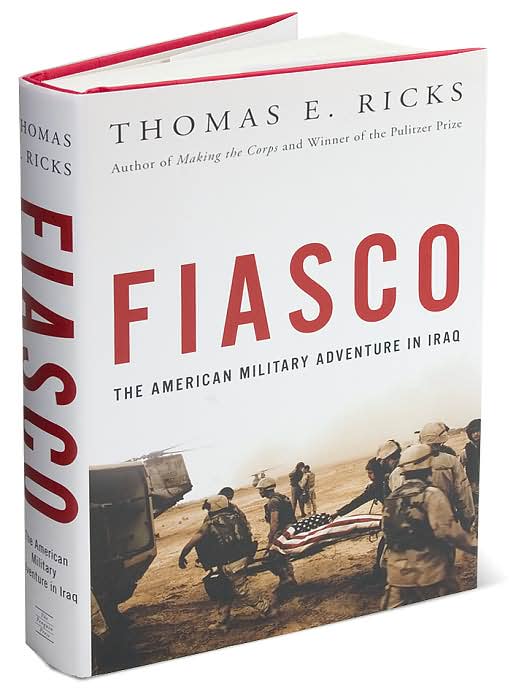 We have hit bottom in Iraq. And you know it because the debates over Iraq (whether the war was just, whether we planned it adequately, whether we have a meaningful exist strategy, etc.) have ground to a halt. The big defenders of the war effort have mostly gone silent, or they’re no longer taken seriously, and what we’re left with is a deficit of ideas all around. There are those who talk about staying in Iraq, but can’t articulate a credible strategy for moving forward. And those who talk about leaving, but can’t outline how we’ll leave Iraq in a morally defensible position. We hear a lot in the way of platitudes, little in the way of substance.
This Fresh Air interview (stream it here) with Thomas Ricks, author of the bestseller Fiasco: The American Military Adventure in Iraq, helps fill the idea void a bit. (His book, by the way, comes out in paperback later this week.) Having recently returned from Iraq, Ricks talks about the real options now available to the US, and what steps the Bush administration will likely take during its last 18 months. Also, he discusses how the American military has changed its m.o. in Iraq. Gone are the days when politics dictated a sunny outlook and no real plans. Now, adults are running the show, and they’re getting a good deal more realistic and pragmatic. But even they recognize that this newfound wisdom is coming perhaps too late.
Related Note: George Packer, the main journalist who covered the war effort for The New Yorker, has recently rolled out a blog for the magazine. It’s called “Interesting Times” and it’s sure to help fill the idea void as well. Give it a look here.
Want to download free courses from top universities? Check out this new podcast collection.
Read More...
Sneak Preview of Nobel Winner’s Next Novel
A quick heads up: You can read an excerpt from J.M. Coetzee’s upcoming novel, Diary of a Bad Year, over at The New York Review of Books. The entire novel will be published in January 2008. And, in case you weren’t already aware of it, Coetzee won the Nobel Prize in Literature in 2003. You can get more background information on the South African author here as well as reviews of his novels here.
 Subscribe to Our Feed - See our list of 100+ Enlightening Culture Blogs
Radio Lab: A Great Science Podcast
RadioLab, a science radio show created by WNYC in New York, is a little unusual for a public radio show. It comes out in short seasons of about five episodes. Each episode addresses a particular question in science through a wide lens–I found their most recently podcast show, on Morality, to be particularly fascinating. We’re adding the new show to our collection of Science Podcasts. Check it out for yourself!
RadioLab (Site, iTunes, Feed)
Read More...The Decline and Fall of the Roman (and American?) Empire: A Free Audiobook
Edward Gibbon’s The Decline and Fall of the Roman Empire – It’s a major work of the Enlightenment, a book that shaped how we moderns write history (and, for that matter, how we aspire to write in the English language), and it’s now available as a free podcast thanks to Librivox. Or at least Volume 1 is. With a runtime of almost 20 hours, this audiobook — click to access individual files or the full zip file — will make it so that you’re not looking for the remaining volumes any time soon. But don’t worry they’re eventually coming.
Published first in 1776, just as the US declared its independence from England, Gibbon’s Decline and Fall looked to offer an empirical explanation for why Ancient Rome fell as a power, and he generally pointed to a decline in civic virtue among its citizenry (why bother fighting the Empire’s wars when you can get mercenaries to do it?) and to the rise of Christianity (why worry about Rome when a better life, an eternal afterlife, awaits you?).
In part, Gibbon’s work has endured because it speaks to questions that modern powers have on their minds. What brings Empires down, and what (implicitly) allows them to endure? These questions have a certain amount of relevance these days in an anxious US. And indeed Gibbon’s name was immediately invoked in a recent podcast that asked whether America, today’s empire, is on the brink. (Click to listen.) The parallels between Gibbon’s Rome and the contemporary United States have also been directly explored by the prolific, young Harvard historian, Niall Ferguson. You may want to check out his October 2006 piece in Vanity Fair, Empire Falls. And depending on what you think, you can give time to his two books on Empire — the first (and better) one focuses on the British Empire, and a second one devotes itself to the US.
 Subscribe to Our Feed - See our complete collection of audiobooks
Elvis Costello: The First Ten Years Podcast
A quick heads up for Elvis Costello fans: In this ten-part podcast (iTunes — Feed — Web Site), Elvis reflects on the first 10 years of his career, taking listeners on a tour that looks back at “his childhood, musical influences, singing, songwriting, changing his name, recording, Nick Lowe, the Attractions, the hits, the misses, getting arrested and much more.” So far, 4 of the 10 segments have been released; the others will be rolled out over the remainder of the  summer.For more podcasts along these lines, check out our Music Podcast Collection as well as our Arts & Culture Podcast Collection.
 Subscribe to Our Feed - Tell a Friend About Open Culture
Ten Podcasts to Build Your Vocabulary
Recently Merriam-Webster announced that they’re adding “ginormous,” “speed dating” and a few other gems to the latest edition of their dictionary. In their honor, we present ten podcasts to help you expand your vocabulary. Enjoy!
- Merriam-Webster’s Word of the Day (Feed, Site)
- Podictionary (Feed, iTunes, Site)
- The Word Nerds (iTunes, Site)
- NPR: On Words with John Ciardi (iTunes, Site)
- KPBS: A Way With Words (Feed, iTunes, Site)
- Just Vocabulary (iTunes, Site)
- WordSmart WordCast (Feed, iTunes, Site)
- Learn English: Very Vocabulary (iTunes, Site)
- Test Prep Vocabulary (Feed, Site)
- The Princeton Review Vocabulary Minute (iTunes, Feed, Site)
How Open Culture Can Enrich Your Summer Travels
We’re now in prime vacation season, and so we figured that we’d highlight several ways in which Open Culture can enrich your summer travels — all for free.
- First and foremost, if you’re traveling to another country, and if you want to speak the mother tongue, then spend some time with our collection of foreign language lesson podcasts. The collection currently covers over 25 languages, so there is a very good chance that we can meet your travel needs.
- Next, if you plan to do a good long road trip, you should sort through our collection of audiobook podcasts. Our list, which gives you access to 90 masterpieces in literature and classics, can help the long travel hours effortlessly slide by.
- A vacation is always a good time to learn something new and worthwhile. Here are five courses from Stanford University, available as free podcasts, that were created with the lifelong learner in mind. So they were essentially custom-made for you. (You can also find here a long list of free courses from other major universities, including MIT, Berkeley, Harvard, Oxford, and Johns Hopkins.)
- Looking for some free Mozart, Beethoven, or Miles Davis to enrich your experience? Find free podcasts in our Music section. See our complete collection of podcasts here.
 Subscribe to Our Feed - Tell a Friend About Open Culture — **@******re.com”>Recommend a New Podcast
Watch “Live Earth” Live (Now)
Unless you’ve been living in a bunker somewhere, you’ve probably heard about Live Earth, a 24-hour, 7‑continent concert that’s been organized to raise awareness about global warming and to inspire action on the environmental front. You can watch these shows live by clicking here. The concerts in Asia are already underway, and the Western Hemisphere shows will start tomorrow (Saturday). Thanks to Al Gore for promoting this event and this important larger cause.

Radio Open Source Goes Radio Silent
As we cover the world of enlightened podcasts, we inevitably uncover ones that become our personal favorites, and this was the case with Radio Open Source (iTunes Feed Web Site). Hosted by Christopher Lydon, the show had a great knack for making heady issues engaging and accessible to a wider audience, and that was mainly because the show took its lead from the Radio Open Source blog and its active online community. Rather uniquely, Lydon and his crew let the online community help produce the show, which meant letting the audience suggest topics and guests for future programs. It was a novel concept that yielded some very good results.
Anyway, as you can tell, we’re talking about things in the past tense, and that’s because the show announced last week that they’ve run out of funding and gone on a summer hiatus. They’re sorting things out and hoping to return this fall with new money and perhaps a new broadcasting/podcasting approach. We hope to see them back in action soon. In meantime, we’d encourage you look back through their media archive — iTunes Feed Web Site — to get a feel for what the fall may bring.
Read More...Support Us
We're hoping to rely on loyal readers, rather than erratic ads. Please click the Donate button and support Open Culture. You can use Paypal, Venmo, Patreon, even Crypto! We thank you!

About Us

Open Culture scours the web for the best educational media. We find the free courses and audio books you need, the language lessons & educational videos you want, and plenty of enlightenment in between.
Advertise With Us
FREE UPDATES!
GET OUR DAILY EMAIL
Get the best cultural and educational resources on the web curated for you in a daily email. We never spam. Unsubscribe at any time.
FOLLOW ON SOCIAL MEDIA
Open Culture editor Dan Colman scours the web for the best educational media. He finds the free courses and audio books you need, the language lessons & movies you want, and plenty of enlightenment in between.
Advertise With Us

