The Story Behind the Iconic Obama Campaign Poster
 The story behind the artwork that defined the Obama campaign is a fascinating one. Shepard Fairey’s posters achieved prominence much in the same way that Obama did. They rose from the ground up. Everyday people supported and promoted his imaginative posters on the web, until they became something of a public phenomenon. And they turned the status quo — in this case, the tradition political poster — into something fresh and new. In this interview (iTunes — Feed — Stream), Fairey, once a self-proclaimed “outlaw street artist,” talks about how got started with his Obama pieces, and how his most celebrated work ended up in the permanent collection at the U.S. National Portrait Gallery.
P.S. As you’ll see, we’re in the midst of launching a new design. Things are going rather smoothly. But if you encounter any problems, please be patient and please let us know. We’ll be making small tweaks here and there. Thanks!
Read More...For MLK on His Birthday
The full “I Have a Dream” speech. The place: The Lincoln Memorial. The Date: August 28, 1963. The Why: To bring about many small changes in American society, which eventually and collectively bring us to Tuesday. Take it away Martin:

Visit the Prado Art Collection with Google Earth
Thankfully, it’s not all bad news here in Silicon Valley. Yesterday, Google and the Prado (the major art museum in Madrid) announced that you can launch Google Earth from wherever you live, travel virtually to Spain, and then take a close look at fourteen of the museum’s finest paintings. And, by “close,” I mean close. According to a Google spokesman said: “The paintings have been photographed in very high resolution and contain as many as 14,000 million pixels (14 gigapixels).” “With this high level resolution you are able to see fine details such as the tiny bee on a flower in The Three Graces (by Rubens), delicate tears on the faces of the figures in The Descent from the Cross (by Roger van der Weyden) and complex figures in The Garden of Earthly Delights (by El Bosco).” The fourteen paintings include pieces by Francisco de Goya, Diego Velázquez and Hieronymus Bosch. You can begin the tour (and get Google Earth software) from this landing page. The video below also offers a nice visual illustration of what this project is all about. (A quick tip: if you have Google Earth, make sure that you have “3D Buildings” checked off under “Layers.” Then do a search for “Prado” and click on “Museu del Prado.” From there, click on the image of the museum. Next, you should see a series of paintings that you can begin to explore.)
Read More...
Learning Ancient History for Free
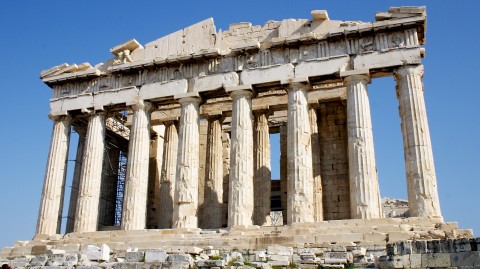
For lifelong learners, courses on Ancient Greece and Rome always remain in steady demand. While these courses are poorly represented in undergraduate programs (at least in the States), they seem be to making a comeback in continuing education programs designed for older students. Eventually, it seems, many come to the conclusion that you can’t skip over the foundations and still make sense of it all. And so they go back to basics.
The Teaching Company, a commercial provider of courses for lifelong learners, has recognized this demand and built a surprisingly rich collection of lectures dedicated to the Ancients. (See full catalogue here.) These courses are polished and well put together. But they cost money. If that’s a concern, then you should know about some of the free alternatives. Thanks to the “open course” movement, you can now find a series of free courses online, including some from top-ranked universities. Let me give you a quick overview of your options:
Last fall, Yale University introduced a new round of open courses that included Donald Kagan’s Introduction to Ancient Greek History (YouTube — iTunes Audio — iTunes Video- Download Course). A leading figure in the field, Kagan takes students from the Greek Dark Ages, through the rise of Sparta and Athens, The Peloponnesian War, and beyond. You’ll cover more than a millennium in 24 lectures. As I’ve noted elsewhere, Yale’s courses are high touch. And what’s particularly nice is that the course can be downloaded in one of five formats (text, audio, flash video, low bandwidth quicktime video, and high bandwidth quicktime video). Simply choose the format that works for you, and you’re good to go.
When you’ve completed the arc of Greek history, you can move next to the UC Berkeley course, The Roman Empire. The course taught by Isabelle Pafford moves from Julius Caesar to Constantine (roughly 40 BC to 300 AD) in 42 lectures. And the audio comes straight from the classroom, which means that you’ll get solid information but you’ll also have to endure some extraneous talk about homework assignments and exams. (It’s free, so don’t complain.) You can download this course in one of three ways: iTunes, streamed audio, or via rss feed. Lastly, I should note that Pafford has taught another related course at Berkeley — The Ancient Mediterranean World (iTunes — Feed - MP3s).
Once you have the big survey courses under your belt, you can switch to some more focused courses coming out of Stanford. Let’s start with Patrick Hunt’s course Hannibal (iTunes). As I’ve noted in a previous post, this podcasted course takes you inside the life and adventures of Hannibal, the great Carthaginian military tactician who maneuvered his way across the Alps and stunned Roman armies in 218 BC. The course also gives you glimpses into cutting-edge trends in modern archaeology. Because Hannibal still remains a figure of intense historical interest, it’s not surprising that this course has ranked as one of the more popular courses on iTunesU.
Another short course worth your time is Virgil’s Aeneid: Anatomy of a Classic. Presented by Susanna Braund (a Stanford classics professor at the time), the course teases apart the epic poem that was an instant when it was written 29–19 BC), and still endures today. Divided into 5 installments, each running about two hours, this podcast offers a good introduction to one of the central texts in the Latin tradition.
Finally, let me throw in a quick bonus course. The Historical Jesus, another Stanford course taught by Thomas Sheehan, looks inside the historical/Roman world of Jesus of Nazareth. This is a history course, not a religion course, and it uses the best literary and historical evidence to answer the questions: “Who was the historical Jesus of Nazareth? What did he actually say and do…? What did the man Jesus actually think of himself and of his mission…? In short, what are the differences — and continuities — between the Jesus who lived and died in history and the Christ who lives on in believers’ faith?
UPDATE: Thanks to a reader, I was reminded of another related course: 12 Byzantine Rulers: The History of the Byzantine Empire (iTunes — Feed — Site). These podcasts cover the legacy of the Roman Empire that emerged in the East (after it had collapsed in the West). You can read more about this course in one of my early blog posts.
All of these courses can be found in the History Section of our larger collection of Free Courses. There you will find 200 high quality online courses that you can listen to anytime, anywhere.
Read More...The Whole Earth Catalog Now Online
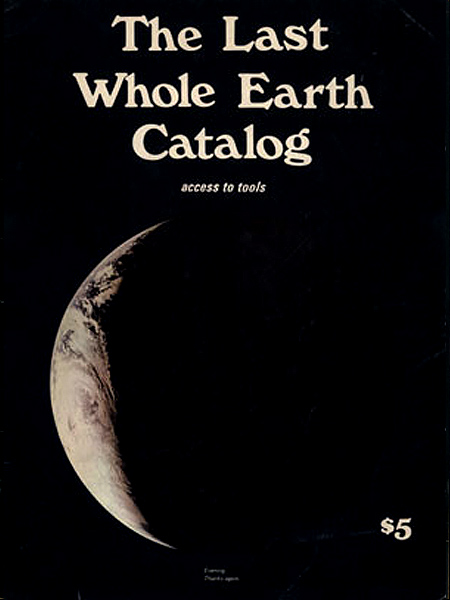 Between 1968 and 1972, Stewart Brand published The Whole Earth Catalog. For Kevin Kelly, the Catalog was essentially “a paper-based database offering thousands of hacks, tips, tools, suggestions, and possibilities for optimizing your life.” For Steve Jobs, it was a “Bible” of his generation, a kind of Google 35 years before Google came along. (On a side note, I highly recommend the commencement speech where Jobs made those comments.) The very good news is that The Whole Earth Catalog and some related publications are now available online. You can read them for free, or download them for a fee. Start delving into things here.
While we’re on this subject, I should also highlight a project that has more recently occupied Stewart Brand’s time. The Seminars About Long Term Thinking is a monthly speaking series hosted by Brand and organized by the Long Now Foundation, which hopes to provide a counterpoint to today’s “faster/cheaper” mind set and to promote “slower/better” thinking. You can access the thought-provoking seminars as a podcast (iTunes — Feed — Web Site) and otherwise find it hosted in our Ideas & Culture Podcast Collection. Have a good weekend.
via Boing Boing
Read More...What Will Change Everything? (According to the World’s Leading Scientific Minds)
At the start of each new year, the Edge.org asks some of the world’s leading scientific thinkers a big enchilada question. This year, it’s “What Will Change Everything? What game-changing scientific ideas and developments do you expect to live to see?” Here you can find the answers given by 151 thinkers. (Collectively, the full set of replies runs 107,000 words.) Some of the intriguing answers include:
- The detection of extraterrestrial life. And this life may take the form of digital organisms that can move through the universe at the speed of light (wow!),
- A major upgrade of the human brain through technology,
- Our life span will potentially be extended to 150 years through genomics,
- The discovery of another universe within our own universe,
- The discovery of new time space dimensions, and
- The creation of a universal translation machine that will facilitate translation across the globe.
For the longer list, visit the full collection.
Read More...
Top 10 Blog Posts of 2008
Here they go, the most popular posts of 2008:
10. Free Stanford Computer Science & Engineering Courses Now Online
9.) The Old Man and the Sea Animated
7.) Turn Your iPod into a Travel Guide: 20 Travel Podcasts
7.) Listening to Famous Poets Reading Their Own Work
6. This American Life Demystifies the Housing/Credit Crisis
5.) Understanding Modern Physics: Download Leonard Susskind Video Lectures
4.) Yale Open Courses: The New Lineup
3.) George Orwell’s 1984: Download Free Audio Book Version
Also, James Joyce’s Ulysses: A Free Audiobook
2.) Top Five Collections of Free University Courses
1.) Intelligent Life at YouTube: 80 Educational Video Collections
Read More...

Put Tolstoy, Twain and Others on Your Mobile Phone
A good find over at Metafilter. Desjardins asks “Need a little Tolstoy while you’re waiting in line? How about some Mark Twain on the subway? Booksinmyphone puts — surprise! — books in your phone, for free.” For more details on how to download classics to your (java-enabled) mobile phone, check out their FAQ.
Read More...
John Lennon Returns to Promote “One Laptop Per Child”
Thanks to some digital hocus pocus, John Lennon is back and helping promote One Laptop Per Child, a charity working to bring cheap computers and internet access to children in developing countries. Done with the approval of Yoko Ono, the commercial stitches together old recordings of Lennon’s voice and adds at least a couple of new words (did Lennon ever say “laptop”?). In the end, it all comes out fairly seamlessly. If you want to give a laptop (starting at $199) and change the world, go here. Otherwise, here’s John:

via Goings On via Rolling Stone
Read More...Unauthorized Beatles Masterpieces
This weekend’s New York Times ran a piece detailing how the record industry has dithered and continually failed to release several long-awaited Beatles’ projects. It also mentioned how fans and collectors have forged ahead and put together unauthorized bootleg projects, some of which the Times calls “curatorial masterpieces.” In particular, the article highlights the Purple Chick label, which “has assembled deluxe editions of each commercially released [Beatles] album, offering the original discs in their mono and stereo mixes, along with the singles (also in mono and stereo) released at the time, as well as every known demo, studio outtake and alternative mix.” Some of Purple Chick’s include “Beatles Deluxe” (which covers 10 CDs); “A/B Road” (which gives you 96 hours of the “Let It Be” sessions); and a series of BBC radio performances.
So how do you get this stuff? It’s a question that Rolling Stone asked rhetorically when it recently gave another positive review to Purple Chick recordings. And it answered the question with this: “Google is your friend: Try searching ‘purple chick and megaupload’ to get started.”
Read More...
Support Us
We're hoping to rely on loyal readers, rather than erratic ads. Please click the Donate button and support Open Culture. You can use Paypal, Venmo, Patreon, even Crypto! We thank you!

About Us

Open Culture scours the web for the best educational media. We find the free courses and audio books you need, the language lessons & educational videos you want, and plenty of enlightenment in between.
Advertise With Us
FREE UPDATES!
GET OUR DAILY EMAIL
Get the best cultural and educational resources on the web curated for you in a daily email. We never spam. Unsubscribe at any time.
FOLLOW ON SOCIAL MEDIA
Open Culture editor Dan Colman scours the web for the best educational media. He finds the free courses and audio books you need, the language lessons & movies you want, and plenty of enlightenment in between.
Advertise With Us

