15,000+ Hours of Free Video & Audio Lectures from World-Class Universities
We took our collection of 550 Free Online Courses from Great Universities and did a back-of-the-envelope estimate of the total number of hours of free audio/video lectures it offers. A conservative estimate puts it north of 15,000 hours. Pretty staggering, especially considering that these lectures come from world-class institutions like Stanford, MIT, Yale, UC Berkeley, and Oxford. And, what’s more, they’re free. Yes, there is such a thing as a free lunch … and dinner. Above, we’re featuring the first lecture from Michael Sandel’s famous Harvard course called Justice: What’s the Right Thing to Do?. The remaining 549 Free Courses await you here.
And if you need a little late night snack too, then check out these other collections:
175 Free Online Certificate Courses & MOOCs from Great Universities
450 Free Audio Books: Download Great Books for Free
375 Free eBooks: Download to Kindle, iPad/iPhone & Nook
500 Free Movies Online: Great Classics, Indies, Noir, Westerns, etc.
Read More...Bertrand Russell and F.C. Copleston Debate the Existence of God, 1948
On January 28, 1948 the British philosophers F.C. Copleston and Bertrand Russell squared off on BBC radio for a debate on the existence of God. Copleston was a Jesuit priest who believed in God. Russell maintained that while he was technically agnostic on the existence of the Judeo-Christian God–just as he was technically agnostic on the existence of the Greek gods Zeus and Poseidon–he was for all intents and purposes an atheist.
The famous debate is divided into two parts: metaphysical and moral. In the metaphysical part, which is presented here, Copleston espouses what is known as the cosmological argument for the existence of God. Elements of the cosmological argument go back at least as far as Plato and Aristotle, who held that the universe required a “prime mover” outside of itself. The version embraced by Copleston is derived from one of Thomas Aquinas’ five ways to prove the existence of God. In his Summa Theologica, Aquinas writes:
The third way is taken from possibility and necessity and runs thus. We find in nature things that are possible to be and not possible to be, since they are found to be generated and corrupted. But it is impossible for these always to exist, for that which can not-be at some time is not. Therefore, if everything can not-be, then at one time there was nothing in existence, because that which does not exist begins to exist only through something already existing. Therefore if at one time nothing was in existence, it would have been impossible for anything to have begun to exist; and thus now nothing would be in existence–which is absurd. Therefore, not all beings are merely possible, but there must exist something the existence of which is necessary. But every necessary thing has its necessity caused by another, or not. Now it is impossible to go on to infinity in necessary things which have their necessity caused by another, as has already been proved in regard to efficient causes. Therefore, we cannot but admit the existence of some being having of itself its own necessity, and not receiving it from another, but rather causing in others their necessity. This all men speak of as God.
Copleston adopts Gottfried Wilhelm Leibniz’s Principle of Sufficient Reason as a cornerstone of his argument. In his 1714 essay “The Principles of Nature and Grace, Based on Reason,” Leibniz asserts that nothing can exist without a sufficient reason, including the Universe. “This sufficient reason for the existence of the Universe cannot be found in the series of contingent things,” writes Leibniz. “The sufficient reason, therefore, which needs not further reason, must be outside of this series of contingent things and is found in a substance which…is a necessary being bearing the reason for its existence within itself; otherwise we should not yet have a sufficient reason with which to stop. This final reason for things is called God.”
Russell takes exception to Copleston’s use of Leibniz’s concept of a necessary being. The term “necessary,” he argues, can only be applied to analytic propositions–propositions which are derived logically and which would be self-contradictory to deny. An analytic proposition would fall under Leibniz’s category of “truths of reason,” or a priori truths. Yet Copleston admits his argument is based on a posteriori grounds, or what Leibniz called “truths of fact.” Russell first poked holes in Leibniz’s version of the cosmological argument nearly half a century before his debate with Copleston. In A Critical Exposition of the Philosophy of Leibniz, published in 1900, Russell says of the cosmological argument:
It has a formal vice, in that it starts from finite existence as its datum, and admitting this to be contingent, it proceeds to infer an existent which is not contingent. But as the premiss is contingent, the conclusion also must be contingent. This is only to be avoided by pointing out that the argument is analytic, that it proceeds from a complex proposition to one which is logically presupposed in it, and that necessary truths may be involved in those that are contingent. But such a procedure is not properly a proof of the presupposition. If a judgement A presupposes another B, then, no doubt, if A is true, B is true. But it is impossible that there should be valid grounds for admitting A, which are not also grounds for admitting B. In Euclid, for example, if you admit the propositions, you must admit the axioms; but it would be absurd to give this as a reason for admitting the axioms.
Perhaps the most memorable moment of the debate on the cosmological argument comes near the end, when Russell criticizes Copleston’s assertion that because everything contained within the Universe is contingent, the Universe as a whole must also be contingent. “I can illustrate what seems to me your fallacy,” says Russell. “Every man who exists has a mother, and it seems to me your argument is that therefore the human race must have a mother, but obviously the human race hasn’t a mother–that’s a different logical sphere.” For Russell it was enough to accept that the Universe simply exists. Or as David Hume points out in his Dialogues Concerning Natural Religion, if there must be a necessarily existent being, why can’t it be the Universe as a whole?
The audio version of the debate above is abridged. To read a transcript of the entire debate, click here to open the text in a new window.
Related content:
Face to Face with Bertrand Russell: ‘Love is Wise, Hatred is Foolish’
Three Passions of Bertrand Russell (and a Collection of Free Texts)
Read More...Watch Suddenly: Frank Sinatra Stars in a 1954 Noir Film
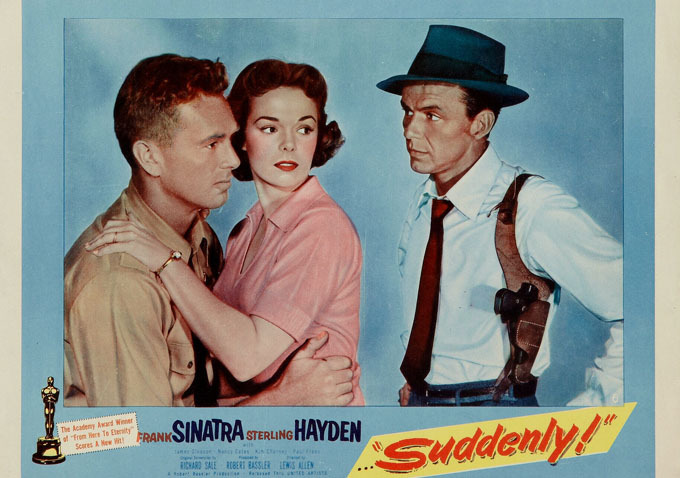
For Frank Sinatra’s 100 birthday today, we’re bringing back to the top a post from our archive that highlights the 1954 noir film, “Suddenly.” In this public domain flick, Sinatra played the role of a psychopath. And he played the role convincingly, getting some very fine reviews from The New York Times. Enjoy the film and our original post from 2012 below:
Tricky business, casting a world-famous musician in a movie’s starring role: it seems you must either craft the part to perfectly match their persona, or to run perfectly against it. Nicolas Roeg, that inimitable employer of singers to his own semi-fathomable cinematic ends, has rigorously explored this range of possibilities. David Bowie seemed the only possible choice for the terminally lonely alien of The Man Who Fell to Earth, just as Art Garfunkel seemed the last possible choice for the psychosexual tormentor of Bad Timing.
I personally regret that Roeg never got to work with Frank Sinatra, used to such striking effect by John Frankenheimer in The Manchurian Candidate and Otto Preminger in The Man with the Golden Arm. To hold those pictures up against, say, the Rat Pack free-for-all of Ocean’s Eleven is to understand that casting against persona, though on average the riskier option, produces more fascinatingly contradictory performances. In the 1954 noir Suddenly, available free on Archive.org, you can watch an early example of this in Sinatra’s career, when director Lewis Allen turns him into a psychopath bent on assassinating none other than the President of the United States.
Given the project’s unquestioned B‑movie context, critics regarded Sinatra as having made a reasonably rich meal of this villainous part. “Mr. Sinatra deserves a special chunk of praise,” wrote the New York Times’ Bosley Crowther. “In Suddenly he proves a melodramatic tour de force.” Variety also looked favorably upon him: “Thesp inserts plenty of menace into a psycho character, never too heavily done, and gets good backing from his costar, Sterling Hayden, as sheriff, in a less showy role but just as authoritatively handled.” Yes, you read that right: this movie pits Frank Sinatra against Sterling Hayden. Sinatra and his crew of killers take over a small-town hilltop family home, the ideal vantage point from which to shoot the passing President. Then Hayden, the town’s sheriff, turns up to check things out. How will this clash of titanic personalities resolve? Hit play and find out whether “the number-one man in the nation,” as Suddenly’s sensationalistic poster puts it, falls victim to this “kill-hungry hoodlum.”
You will find Suddenly listed in our collection of Free Noir Films and also our larger list 4,000+ Free Movies Online: Great Classics, Indies, Noir, Westerns, Documentaries & More.
Colin Marshall hosts and produces Notebook on Cities and Culture. Follow him on Twitter at @colinmarshall.
Read More...
Great Big Ideas: Free Course Features Top Thinkers Tackling the World’s Most Important Ideas in 12 Lectures
Begun in 2011 by Big Think and the Jack Parker Corporation, The Floating University is an online educational initiative that debuted at Harvard, Yale, and Bard College. The purpose of The Floating University, according to its site, is to “democratize access to the world’s best thinkers” by providing free, approximately one hour-long courses on a wide range of topics, taught at a university level by experts and professors in the various fields. The inaugural course, the most favored at the three universities, is Great Big Ideas, and it more or less does what it says: tackles some of the largest, most perplexing questions in digestible introductions that also manage to be rigorous, informative, and thought-provoking.
In the lecture above, for example, Harvard cognitive psychologist and linguist Steven Pinker presents an “eSeminar” in linguistics, addressing dogged questions in the field over whether or not humans have an innate, universal grammar (as Noam Chomsky has famously argued); why language is so fundamental to our social relationships; and how language evolved.
Pinker, who describes human language in broad terms as a “miracle” and a “window into the human mind,” also gets into the specific subfields of linguistics, discussing them in terms that any layperson can understand without much diluting the fascinating philosophical and scientific debates around what Darwin called our “instinctive tendency to speak” to one another, from infancy onward, all over the world, in some 6000 different languages.
The Great Big Ideas (now added to our list of 1200 Free Online Courses) lecture series consists of twelve lectures total, including Pinker’s. The other eleven are:
- Malthus Miffed: Are People the Problem, the Solution, or Both? An Introduction to Demography and Populations Study Through an Examination of the World’s Population. by Joel Cohen (Columbia).
- The Universe in a Nutshell: The Physics of Everything. by Michio Kaku (CUNY).
- Of the People, by the People, for the People? The Rawls-Nozick Debates as an Introduction to the Philosophy of Politics and Economics. by Tamar Gendler (Yale)
- Do Not Pass Go, Do Not Collect $200: Monopolies as an Introduction to Economics. by Saul Levmore (U Chicago)
- The Psychology of Everything: What Compassion, Racism, and Sex tell us about Human Nature. by Paul Bloom (Yale)
- If You’re So Free, Why Do You Follow Others? The Sociological Science Behind Social Networks and Social Influence. by Nicholas Christakis (Harvard)
- Who Wants to Be a Billionaire? Everything You Need to Know About Finance and Investing in Under an Hour. by William Ackman
- What’s Up, Doc? Is Biomedical Research Really Close to Curing Anything? by Douglas Melton (Harvard)
- Art Now: Aesthetics Across Music, Painting, Architecture, Movies, and More. by Leon Boststein (Harvard)
- Standing on the Shoulders of Giants: The Essential Value of a Classic Education. by Jeffrey Brenzel (Yale)
- The Authority of Ideas: Decoding the DNA of Education in Search of Actual Knowledge. by Lawrence Summers (Harvard)
Josh Jones is a doctoral candidate in English at Fordham University and a co-founder and former managing editor of Guernica / A Magazine of Arts and Politics.
Read More...The Normandy Invasion Captured on 16 mm Kodachrome Film (1944)
The Normandy Invasion, otherwise known as “Operation Overlord,” was launched by the Allies on June 6, 1944. On that day — D‑Day — American, British and Canadian troops landed on five separate beachheads in Normandy, on the western shores of France. By the end of August 1944, the Allies had liberated all of northern France and started marching towards Nazi Germany.
At the time, the filmmaker George Stevens (1904–1975) was a lieutenant colonel in the U.S. Army’s Signal Corps. Dwight D. Eisenhower, tasked with planning and carrying out the Allied invasion of Normandy, wanted film crews present at the invasion to provide footage for a documentary film. Stevens took charge of the Special Motion Pictures Unit and gathered a group of cameramen and writers dubbed the “Stevens Irregulars”. They used the standard Army motion picture stock, 35 mm black and white newsreel film. But they also brought along a hand-held camera and some 16 mm Kodachrome color film. Stevens shot several hours’ worth of color footage from France, Belgium and Germany. The scenes from the liberation of Dachau concentration camp are particularly shocking and left their mark on the lives of the cameramen. In 1994, Stevens’ son used this film footage to assemble the documentary George Stevens: D‑Day to Berlin.
Bonus material:
- Photos of Normandy in 1944 and today
- An excellent collection of photos from D‑Day
- Eisenhower’s call-to-arms letter for the D‑Day landings in Normandy
By profession, Matthias Rascher teaches English and History at a High School in northern Bavaria, Germany. In his free time he scours the web for good links and posts the best finds on Twitter.
Read More...‘The Needle and the Damage Done’: Neil Young Plays on The Johnny Cash Show, 1971
Here’s a scene from a classic episode of The Johnny Cash Show, with Neil Young singing a deeply personal song that he had only recently written.
“Johnny Cash on Campus” was a special edition that aired on February 17, 1971. Cash and his crew visited Vanderbilt University in Nashville to talk with students. In the program, one of them raises the subject of drugs in the music industry, and Cash speaks briefly about his own problem with drugs before introducing Young, who sings “The Needle and the Damage Done” in front of an all-student audience at the Ryman Auditorium. Young then puts down his guitar and moves to a piano to play “Journey Through the Past.”
It was a busy time for Young. While he was in Nashville to appear on the show he was persuaded by a local record producer to record his next album there. He began work almost immediately on what would become his masterpiece, Harvest. On the night of the Johnny Cash Show Young invited two other guests that night, Linda Ronstadt and James Taylor, to go back to the studio with him afterward. Together the three sang the backing vocals on “Heart of Gold” and “Old Man,” and Taylor played the distinctive banjo guitar part on “Old Man.”
The February 17, 1971 episode of The Johnny Cash Show is also notable for being the first time Cash performed “Man in Black.” He got the idea for the song from his discussions with the students at Vanderbilt, and finished writing the lyrics on the day of the show. The song was so new he needed cue cards to sing the words.
Related content:
Neil Young Busking in Glasgow, 1976: The Story Behind the Footage
Neil Young Reveals the New Killer Gadget That Will Save Music
Read More...Google Revisits the Fall of the Iron Curtain in New Online Exhibition
I like to collect sounds while traveling. A few favorites that come to mind include the whine of scooters buzzing down the streets of Paris, the calm female voice announcing the next stop on the Prague Metro and the clink clink of people chipping away chunks of the Berlin Wall.
That was 1990, just a few months after millions of Germans—from both sides of the wall—succeeded in ending the East German regime through street protests.
The Google Cultural Institute captures this amazing period of recent history with The Fall of the Iron Curtain, a new collection of historical documents, videos and photos curated by Niall Ferguson, an eminent Harvard historian.
The 1980s saw the Cold War come to an end with a wave of citizen protests that swept across Europe. Google’s collection includes 13 exhibits that begin with Poland’s Solidarity Movement but then considers the history and significance of the Berlin Wall.
Google partnered with major German and Polish museums to create the exhibits so the experience is rich with context, including interviews with historians and images from the popular culture of the time.
Follow the riveting events of December 14, 1989 as Romanian citizens crowded Maria Plaza in Timisoara calling for leaders Nicolae and Elena Ceaucescu to step down. By evening the crowd filled all of the roads off the plaza and the military opened fire, killing 62 people. The period of the Ceaucescu trial and execution is brought to life in another exhibit with images and interviews.
The exhibits conclude with the rapid acceleration of events that led to the fall of the Berlin Wall itself.
Each exhibit is rich and complete with anecdotes, including a diary of life during German reunification.
Speaking of collecting sounds while traveling, check out the Pink Floyd’s live performance we brought you of The Wall in eastern Berlin, a mere eight months after the Wall had come down.
Kate Rix writes about digital media and education. You can contact her and find more of her work at and thenifty.blogspot.com.
Read More...The Creators Project Presents the Future of Art and Design, Brought to You by Intel and Vice Magazine
The Creators Project, a collaboration between Intel and Vice Magazine, produces behind-the-scenes short films with contemporary artists, musicians, and filmmakers. Calling itself “a global celebration of art and technology,” the three-year-old project offers perhaps the best way to keep up with incredible advances in visual and audio technology in the arts. The project also sponsors new work (from, for example, visual artists Mick Rock and Barney Clay and musicians J. Spaceman and Karen O) and hosts global events and meet-ups.
I personally check in with the project’s YouTube channel on a semi-daily basis, and I never fail to find something captivating, whether an introduction to a new artist or new work from an old favorite (if you prefer Vimeo, they’ve got you covered there too). Most recently I’ve discovered the astonishing work of a performance artist/photographer from Beijing, Li Wei, whose work involves Buster Keaton-style stunts—or, more precisely, Kung Fu-film high-wire action—captured on camera in vertigo-inducing images of impossibility. In the short film above, Li Wei walks us through his process and his philosophy, which begins with the unsettling notion, “We are all controlled by someone else. Our thoughts and actions are controlled by unseen forces.” His work is a high-tech attempt to outwit one of those forces for brief moments, rendered timeless by photography and the magic of Photoshop.
In the video below, a former aerospace engineer for NASA, James Powderly, now occupies strange territory between design and engineering. Inspired by another corporate engineering dropout, Powderley left aerospace engineering for a residency at New York art and technology center Eyebeam to refine his visual aesthetic, which he’s taken all over the world.
Finally, in the short video below, The Creators Project visited MinSuk Cho, founder of futuristic Seoul architecture firm Mass Studies. Cho describes the vision and purpose of Mass Studies over a mind-blowing series of images of architectural designs from worlds you’ve never seen before but (if you’re like me) always hoped existed somewhere.
https://vimeo.com/44749711
Josh Jones is a doctoral candidate in English at Fordham University and a co-founder and former managing editor of Guernica / A Magazine of Arts and Politics.
Read More...Reefer Madness, 1936’s Most Unintentionally Hilarious “Anti-Drug” Exploitation Film, Free Online
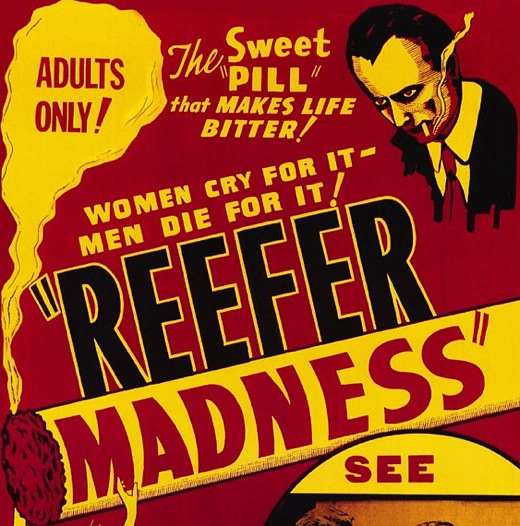
The motion picture you are about to witness may startle you. It would not have been possible, otherwise, to sufficiently emphasize the frightful toll of the new drug menace which is destroying the youth of America in alarmingly increasing numbers. Marihuana is that drug — a violent narcotic — an unspeakable scourge — The Real Public Enemy Number One! Or at least that’s how the opening crawl of Reefer Madness tells it.
Also known, in other forms, as Tell Your Children, The Burning Question, Dope Addict, Doped Youth and Love Madness, the film has spent the past forty years accruing cult credibility on the (highly overlapping) midnight-movie and cannabis-culture circuits. That peculiar spelling of what we know as marijuana reveals only a whiff of its distinctive blend of hand-wringing salaciousness, aggressive squareness, and sheer ignorance. Keith Stroup, founder of the National Organization for the Reform of Marijuana Laws, spotted the movie’s unintended comedic potential back in 1971, when he bought a print and began college-campus screenings. It today draws more prolonged, disbelieving guffaws and chortles than ever before.
Since Reefer Madness has fallen into the public domain, you can hold your own midnight screening nearly without effort by watching it online. Behold the deeply askew motion picture that began as a church-funded morality play, got into the hands of early exploitation-film icon Dwain Esper (he of 1934’s Maniac, 1937’s How to Undress in Front of Your Husband, and 1938’s Sex Madness), and wound up as an uproarious mainstay of hazy university auditoria. While the film clearly knows nothing of marijuana or its real effects — or, seemingly, of the real effects of any narcotic — that doesn’t stop its script from yielding a host of resonant lines. These run from the “straightforward question” of whether “you have, perhaps unwillingly, acquired a certain habit through association with certain undesirable people” to the recollection of having been “high enough to take over the marines and the navy” to that immortal imperative, “Bring me some reefers!” Laugh if you must, but bear in mind the final words from the solemn Dr. Carroll: “The next tragedy may be that of your daughter’s… or your son’s… or yours… or yours… or yours!”
You can always find Reefer Madness in our collection, 4,000+ Free Movies Online: Great Classics, Indies, Noir, Westerns, Documentaries & More.
Related content:
This is What Oliver Sacks Learned on LSD and Amphetamines
Bela Lugosi Discusses His Drug Habit as He Leaves the Hospital in 1955
Beyond Timothy Leary: 2002 Film Revisits History of LSD
Colin Marshall hosts and produces Notebook on Cities and Culture. Follow him on Twitter at @colinmarshall.
Read More...Monsterpiece Theater Presents Waiting for Elmo, Calls BS on Samuel Beckett
Throughout the years, Sesame Street aired 37 episodes of Monsterpiece Theater, a fun-loving parody of PBS’s long-running drama series Masterpiece Theatre. In this particular episode, the host Alistair Cookie (aka Cookie Monster) introduces “a modern masterpiece, a play so modern and so brilliant that it makes absolutely no sense to anybody.” Yes, we’re talking about Waiting for Elmo, a two-minute clip that lampoons — or dare I say politely calls bull$hit on — Samuel Beckett’s absurdist 1953 play, Waiting for Godot. If you’ve never experienced the original play, you can watch a staging that Beckett directed in 1985 or read the original play here.
In the meantime, it unfortunately looks like we’re all going to be waiting for Elmo a bit longer … or, then again, maybe not.
via Biblioklept
Read More...Support Us
We're hoping to rely on loyal readers, rather than erratic ads. Please click the Donate button and support Open Culture. You can use Paypal, Venmo, Patreon, even Crypto! We thank you!

About Us

Open Culture scours the web for the best educational media. We find the free courses and audio books you need, the language lessons & educational videos you want, and plenty of enlightenment in between.
Advertise With Us

FREE UPDATES!
GET OUR DAILY EMAIL
Get the best cultural and educational resources on the web curated for you in a daily email. We never spam. Unsubscribe at any time.
FOLLOW ON SOCIAL MEDIA

Open Culture editor Dan Colman scours the web for the best educational media. He finds the free courses and audio books you need, the language lessons & movies you want, and plenty of enlightenment in between.
Advertise With Us

