Salvador Dalí Reveals the Secrets of His Trademark Moustache (1954)
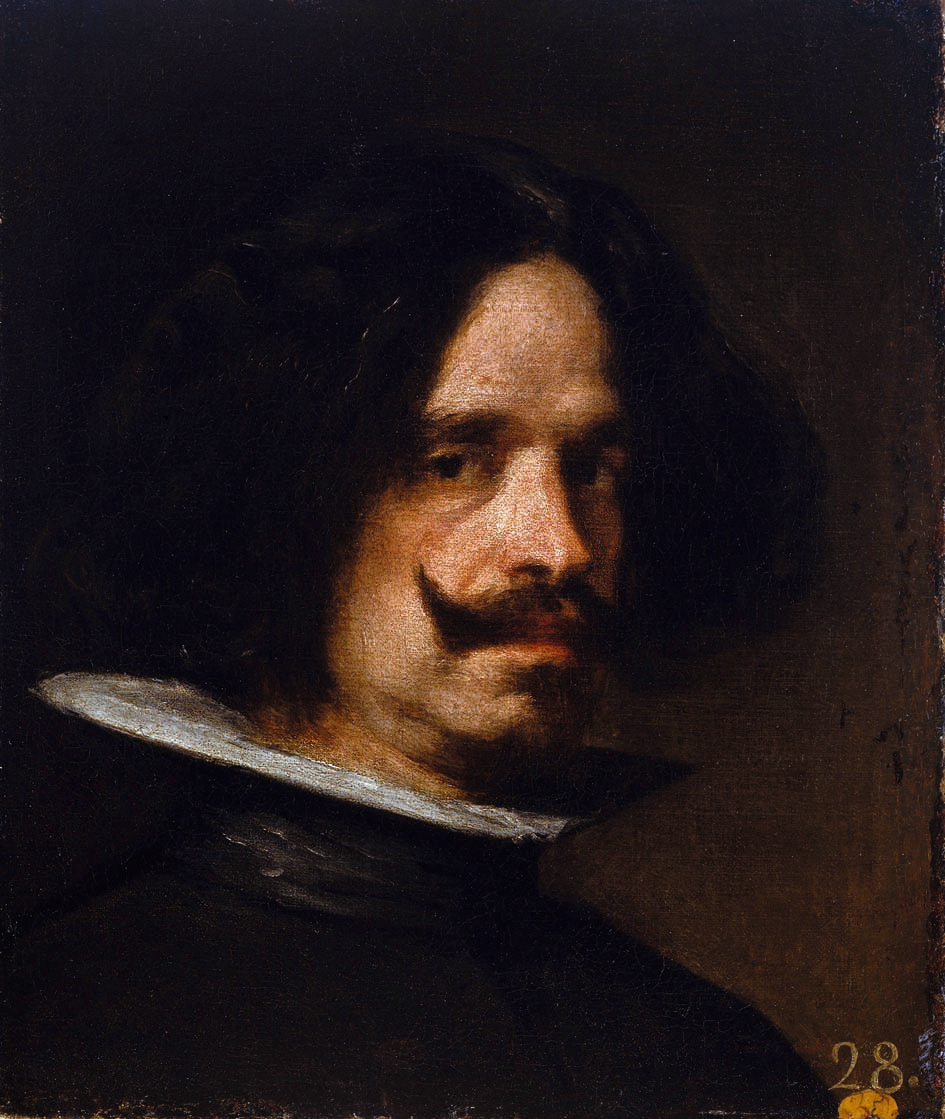
In a 2010 poll, Salvador Dalí’s facial hair was voted the most famous moustache of all time. The flamboyant moustache was part of his schtick, there’s no denying that. But some have assigned a deeper meaning to it. The Wikepedia entry for Dalí attributed the facial hair to 17th-century Spanish master painter Diego Velázquez (see image). And yet perhaps the influence was more literary than painterly. Appearing on the game show The Name’s the Same in January, 1954, Dalí was asked (at the 4:00 mark) whether the stache was a joke. To which the Spanish painter responded, “It’s the most serious part of my personality. It’s a very simple Hungarian moustache. Mr. Marcel Proust used the same kind of pomade for this moustache.” And there you have it, the artistic influence of the world’s most famous facial hair.
Related Content:
Salvador Dalí’s 100 Illustrations of Dante’s The Divine Comedy
Salvador Dali Gets Surreal with Mike Wallace (1958)
Q: Salvador Dalí, Are You a Crackpot? A: No, I’m Just Almost Crazy (1969)
A Tour Inside Salvador Dalí’s Labyrinthine Spanish Home
Read More...The Best Music to Write By, Part II: Your Favorites Brought Together in a Special Playlist
Last Friday, we raised the topic of writing to music, and we asked all of you out there what music you write to, if you write to music at all. The number and variety of your suggestions was a little overwhelming, and very welcome, and provided a wealth of recommendations to put together into a playlist. There was quite a lot of agreement among you and a near-consensus on instrumental music over vocal. But it also came as no surprise that Open Culture readers’ tastes span a range of genres, cultures, and periods and that everyone who wrote in seemed to raise the bar a little higher for drop-dead gorgeous, meditative compositions.
Out of all of your recommendations, I have made a selection of sixteen artists that I believe is representative. (Apologies if your suggestions didn’t make the cut—there’s bound to be some bias here). Whatever your posture and preference for volume levels, lighting arrangements, or time of day or night, you might try on each of these while you tap away at your latest piece of work. Who knows? You could strike a new rhythm, hit an unfamiliar groove and shake out of a too-familiar rut, or shift the tempo just so, change perspective, temper an unruly mood….
Or maybe just find some cool new music to dig while you cook dinner.
Last week’s post began with Miles Davis’s In a Silent Way, which I believe inspired some jazz lovers to comment. Komiska suggested the top-notch Modern Jazz Quartet’s rendition of “Lonely Woman” (above).
Bill Evans’ name also came up quite a bit in your suggestions. Below is his “You Must Believe in Spring.”
Minimalist composer Steve Reich, and other contemporaries of his like Philip Glass, got many a mention. Below is a live performance of the first two sections of Reich’s Music for 18 Musicians.
Ambient synthesizer music by the likes of the Scottish duo Boards of Canada, Tangerine Dream, former Cocteau Twin Robin Guthrie, and Brian Eno came up quite a bit as well. Commenter Emma Gray Munthe mentioned the work of less famous but very influential electronic composer Jean Michel Jarre. Listen to his groundbreaking album Equinoxe below:
A few of you pointed out that any kind of music serves to distract from your process. Cheeky Michael West said as much and more however with his laconic reference to John Cage’s 4’33″, the ultimate minimalist composition. Below, listen to (or observe, rather) an orchestral interpretation of Cage’s concept:
Stanford “Election 2012” Course Draws to Close with a Post Mortem and Predictions
Worth a quick mention: Stanford’s Election 2012 course (previously mentioned here) wrapped up with a post-mortem. It starts with Steve Schmidt, a former John McCain and George W Bush advisor, giving a fairly blunt assessment of where the Republican Party stands right now. (The video above starts with his assessment.) Then Tom Steyer, an asset manager, philanthropist and environmentalist active in Democrat politics, explains why Obama’s victory is the product of trends (not necessarily healthy ones) already seen in California politics for the past decade. And Simon Jackman, a Stanford prof immersed in polling, shows why data matters and Nate Silver (538 blog) got things right.
The rolling conversation is moderated by David Kennedy (Pulitzer Prize-winning historian), Rob Reich, and Jim Steyer. We’ve provided YouTube links to the remaining lectures below. You can also find them on iTunes. Plus we’ve catalogued Election 2012 in our collection of 550 Free Online Courses.
- Mark McKinnon, Chris Lehane, and Gary Segura on the state of the 2012 Presidential Election
- David Kennedy on the history of the American presidency
- John Taylor and Ken Arrow on the economy and the election
- Pamela Karlan and Goodwin Liu discuss the election’s impact on the Supreme Court
- Michael Armacost and Mike McCurry discuss foreign policy
- John Hennessy (Stanford’s president) and experts take a global look at the election
- Bruce Cain and Gavin Newsom discuss the future of California politics
How a Crossword Puzzle is Made: Behind the Scenes with The New York Times
If you still subscribe to old-fashioned print newspapers, chances are it’s because you like doing crossword puzzles and putting pen(cil) to paper. If you fall into this camp, we give you this: Will Shortz, the crossword puzzle editor for The New York Times (and the only known person to hold a college degree in enigmatology) presenting a quick, behind-the-scenes look at how the NYT puzzle gets made. Off we go.
Read More...
The Best Music to Write By: Give Us Your Recommendations
Writing is hard. It’s hard to begin, hard to continue, hard to finish. To write successfully and consistently requires an alchemical combination of discipline and inspiration so personal that reading advice on the subject amounts to watching someone else die to learn how it’s done. And while it often feels enlightening to read about the habits of, say, Steinbeck or Austen, their methods are non-transferable. You’ve got to find your own way. So it is with writing to music. It’s always there in the background, goading you on quietly. Not everyone writes to music; not everyone can. But a good many do, including Wired contributor Steve Silberman who calls the practice one of many rituals writers use “to evoke that elusive flow of inspiration.”
Silberman just wrote a piece for NeuroTribes in which he surveyed ten authors on their favorite music to write by. One of Silberman’s own choices, Miles Davis’s In a Silent Way (above), is one I’m stealing. With its brilliant assemblage of musicians and haunting moodiness it sets the perfect tone for my process. Also, there’s no singing. Like Silberman, I can’t compete with a wise, witty lyricist (he mentions Elvis Costello, I prefer Morrissey). In Silberman’s piece, John Schwartz, a New York Times reporter, listens to nothing. Jane Hirschfield, a chancellor of the Academy of American Poets, likes David Byrne, Dylan’s Modern Times, and Gillians Welch’s The Harrow and the Harvest. Wired contributing editor David Wolman makes a playlist of mostly indie-pop songs entitled “Write the Book!” His main criterion for the songs he chooses: DO NOT BE BORING! My default writing music is exemplified by Australian three-piece instrumental rock band Dirty Three (below).
So now it’s your turn, readers. Do you write to music? If so, what is it? What artists/composers/albums help you find your rhythm and why? Can you stand lyrics in the music you write by or no? Leave your selections in the comments. On Monday, we’ll compile them in an article and leave you with a great Open Culture playlist. Whether you find something you can steal or not, it should be a fun exercise.
*See our follow-up post with a list of your favorites here
Josh Jones is a doctoral candidate in English at Fordham University and a co-founder and former managing editor of Guernica / A Magazine of Arts and Politics.
Read More...Hitchcock (Anthony Hopkins) Pitches Janet Leigh (Scarlett Johansson) on the Famous Shower Scene
First we have a film, the 1960 piece — some would say pinnacle — of psychological horror, Psycho. Then we have a man, Alfred Hitchcock, Psycho’s director, the famously mannered but seemingly troubled master craftsman of midcentury cinematic suspense. Then we have a book, Stephen Rebello’s Alfred Hitchcock and the Making of Psycho, which Anthony Perkins, who played the psycho, called “required reading not only for Psycho-files, but for anyone interested in the backstage world of movie-creation.” And, next week, we’ll have a new period drama, set during the production of the film, based on the book, and centered on the man. It’s impossible to imagine the aficionado of twentieth-century motion pictures who wouldn’t want to watch Anthony Hopkins take on Hitchcock’s title role. Behold the brief clip above, wherein Hopkins-as-Hitchcock explains to young Janet Leigh how, exactly, he plans to shoot the shower scene, as his wife Alma looks nervously on.
You’ll notice, in the roles of Janet Leigh and Alma Reville, two more well-respected performers, Scarlett Johansson and Helen Mirren. Indeed, the list of actors involved in Hitchock and that of characters they play look equally interesting: A Serious Man star Michael Stuhlbarg as talent agent Lew Wasserman, Karate Kid Ralph Macchio as screenwriter Joseph Stefano, Wallace Langham as graphic artist and title designer Saul Bass, and Michael Wincott as real-life serial killer Ed Gein. In the clip just above, watch Hitchcock explain to Alma his insistence upon self-financing Psycho’s production after getting turned down by Paramount: “Do you remember the fun we had when we started out, all those years ago?” he asks. “We didn’t have any money then, did we? We didn’t have any time, either, but we took risks, do you remember? We experimented. We invented new ways of making pictures, because we had to. I just want to feel that kind of freedom again.” Before seeing exactly how he enjoyed that freedom again when Hitchcock comes out on November 23rd, be sure to revisit our posts featuring Psycho’s tantalizing original trailer, and the filmmaker’s own rules for watching the movie.
Related content:
22 Free Hitchcock Movies Online
Martin Scorsese Brings “Lost” Hitchcock Film to Screen in Short Faux Documentary
François Truffaut’s Big Interview with Alfred Hitchcock (Free Audio)
Colin Marshall hosts and produces Notebook on Cities and Culture. Follow him on Twitter at @colinmarshall.
Read More...How to Operate Your Brain: A User Manual by Timothy Leary (1993)
Speaking at the Human Be-In in January 1967, Timothy Leary uttered the famous phrase borrowed from Marshall McLuhan, “Turn on, tune in, drop out.” It was shorthand for saying experiment with psychedelics and achieve new levels of consciousness.
Almost 30 years later, Leary hadn’t lost his missionary zeal. In 1993 (and only a few years before his death), the former Harvard psychology professor recorded “a public service video” called How to Operate Your Brain. Here, Leary narrates an almost epileptic seizure-inducing video, providing what some consider “a guided meditation” of sorts. I’d prefer to call it an unorthodox “user manual” that tries to impart Leary’s unique sense of enlightenment:
The aim of human life is to know thyself. Think for yourself. Question authority. Think with your friends. Create, create new realities. Philosophy is a team sport. Philosophy is the ultimate, the ultimate aphrodisiac pleasure. Learning how to operate your brain, learning how to operate your mind, learning how to redesign chaos.
As you get deeper into the meditation, you’ll realize one thing. Three decades may have passed since Leary popularized the catchphrase of the counterculture. But he’s still getting his ideas from McLuhan. If you follow the video (or transcript) to the end, you’ll discover that ones and zeros have basically taken the place of LSD. Leary says:
Now we have digital communication. We can create our fantasies. We can create our rhythms, design on screen.… Anyone in any culture watching this screen will get the general picture. It’s one global village. It’s one global human spirit, one global human race. As we link up through screens, linked by electrons and photons, we will create for the first time a global humanity, not separated by words or minds or nationalities or religious biases.
You can find McLuhan meditating on the concept of an Electronic Global Village in another vintage clip.
Related Content:
Beyond Timothy Leary: 2002 Film Revisits History of LSD
This is What Oliver Sacks Learned on LSD and Amphetamines
Aldous Huxley’s LSD Death Trip
McLuhan Said “The Medium Is The Message”; Two Pieces Of Media Decode the Famous Phrase
Read More...Louis CK Plays Abraham Lincoln, America’s 16th President and (Yes) Stand-Up Comedian Too
Abraham Lincoln fretted over the timing of emancipation, General George McClellan’s reluctance to take decisive action, North-South reunification, and his wife’s mental instability.
Louis CK worries about sex, his kids, and the decline of his flabby, middle-aged body.
The tendency to dwell on weighty matters makes CK a fitting choice to embody our 16th president on the small screen. (A distinction shared by such luminaries as Lance Henriksen and Sam Waterston, though not at the behest of Saturday Night Live). Movie star Daniel Day-Lewis’ currently running portrayal may net him a Best Actor Triple Crown come awards season, but CK’s the one who takes Abe to another dimension, tailoring the Great Empancipator to fit the established template of his own critically acclaimed sitcom.
History comes alive in a whole new way as the stovepipe-hatted, pudgier-than-normal Lincoln trudges up from the subway, choking down an anonymous West Village slice to get him through a set at the Comedy Cellar. Abe’s routine on slave ownership has definite echoes of Louis’ Season One musings on bestiality, a there-but-for-the-grace-of-god-go‑I flirtation rescued by profanity-laced moral outrage.
No disrespect to Day-Lewis’ First Lady Sally Field, but there’s similar freshness to be found in Saturday Night Live regular Aidy Bryant’s interpretation of Mary Todd Lincoln. Particularly when one factors in a Director’s Cut that restores the petticoat peeling material cut from the late night broadcast.
Related Content:
David Lynch Teaches Louis C.K. How to Host The David Letterman Show
How the Great George Carlin Showed Louis CK the Way to Success (NSFW)
Read More...After a Tour of Slavoj Žižek’s Pad, You’ll Never See Interior Design in the Same Way
How to react to celebrity academic Slavoj Žižek? You could see him as a wild-eyed visionary and grow infatuated with his powerful-sounding ideas about power, violence, cinema, psychoanalysis, and perversion. Or you could see him as a Pied Piper for delusional graduate students and grow enraged at his perpetuation of fashionable nonsense. But you’d do best, I would argue, to take him simply as a source of entertainment. How could you do otherwise, watching the above clip from Astra Taylor’s documentary Žižek! (previously featured on Open Culture here)? In these three minutes, the sweating Sublime Object of Ideology author gives us a tour of his pad, spending much time and excitement on his kitchen repurposed as a closet: clothes and sheets in the cupboards, socks in the drawers. “I am a narcissist. I keep everything,” he pronounces, having moved onto the shelves and shelves of his own work, from the pamphlets of his “dissident days” to his latest books in Japanese translation.
But it’s his poster of Josef Stalin that really draws your attention — just as Žižek meant it to. If he didn’t, he wouldn’t have hung it in his entryway, making it the first sight every guest gets of his home. Here he describes it not as a proclamation of Stalinism, exactly, but as — in line with everything else he does — a provocation. “This is just for people who come to be shocked and hopefully to get out,” he explains. “My big worry is not to be ignored, but to be accepted. Of course, it’s not that I’m simply a Stalinist. That would be crazy, tasteless, and so on. But obviously there is something in it that it’s not simply a joke. When I say the only change is that the left appropriates fascism and so on, it’s not a cheap joke. The point is to avoid the trap of standard liberal oppositions: freedom versus totalitarian order, and so on, to rehabilitate notions of discipline, collective order, subordination, sacrifice, all that. I don’t think this is inherently fascist.”
via Biblioklept
Related content:
Žižek!: 2005 Documentary Reveals the “Academic Rock Star” and “Monster” of a Man
Examined Life Drops Academic Celebrities Into the Real World (2008)
Derrida: A 2002 Documentary on the Abstract Philosopher and the Everyday Man
Colin Marshall hosts and produces Notebook on Cities and Culture. Follow him on Twitter at @colinmarshall.
Read More...Skeptic Michael Shermer Shows You How to Bend Spoons with Your Mind
Ever want to know how to bend spoons like Uri Geller? There are quite a few ways, apparently. But according to Geller’s arch-nemesis, skeptic and magician James Randi, “if Geller bends spoons with divine powers, then he’s doing it the hard way.” In the video above, editor-in-chief of Skeptic magazine, Michael Shermer, shows us how to do it the easy way, and still make it look like magic. While “psychics” like Geller have dined out on their supposed powers for as long as there have been people willing to pick up the tab, skeptics like Randi and Shermer have probably been around as long, using logic and a healthy dose of disbelief. Randi’s exposure of Geller on the Johnny Carson show is the stuff of legend. For a lesser-known debunking, check out the video below from Thames Television. Geller, like so many self-proclaimed psychics, can be persuasive, but most phenomena are better explained by science than by magical thinking.
Josh Jones is a doctoral candidate in English at Fordham University and a co-founder and former managing editor of Guernica / A Magazine of Arts and Politics.
Read More...Support Us
We're hoping to rely on loyal readers, rather than erratic ads. Please click the Donate button and support Open Culture. You can use Paypal, Venmo, Patreon, even Crypto! We thank you!

About Us

Open Culture scours the web for the best educational media. We find the free courses and audio books you need, the language lessons & educational videos you want, and plenty of enlightenment in between.
Advertise With Us

FREE UPDATES!
GET OUR DAILY EMAIL
Get the best cultural and educational resources on the web curated for you in a daily email. We never spam. Unsubscribe at any time.
FOLLOW ON SOCIAL MEDIA

Open Culture editor Dan Colman scours the web for the best educational media. He finds the free courses and audio books you need, the language lessons & movies you want, and plenty of enlightenment in between.
Advertise With Us