The Photography of Ludwig Wittgenstein
Philosophers have often ruminated on the aesthetics of photography. Roland Barthes’ Camera Lucida begins with a poignant memorialization of his mother, as remembered through her photograph. Pierre Bourdieu’s Photography: A Middle-Brow Art wondered why and how the medium became so widespread that “there are few households, at least in towns, which do not possess a camera.” And Jacques Derrida’s posthumous Athens, Still Remains, a travel memoir accompanied by the photographs of Jean-Francois Bonhomme, begins with the mystical phrase “We owe ourselves to death.”
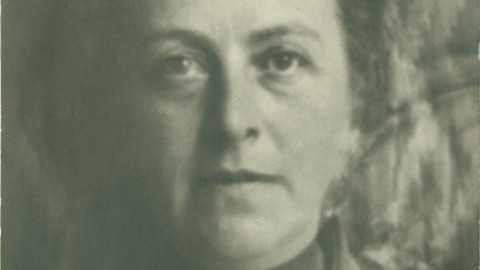
For Barthes and Derrida, photography was a medium of suspended mortality—every photograph a memento mori. For another philosopher, the cryptic, polymath, and notoriously surly Ludwig Wittgenstein, photography was a concrete expression of his preferred means of perception. As he famously wrote in the Philosophical Investigations, “Don’t think, look!” For the unsentimentally cerebral Wittgenstein, a photograph is not a memorial, but a “probability.” The philosopher’s archive at the University of Cambridge includes the photograph above, a true “probability” in that it does not represent any one person but is a composite image of his face and the faces of his three sisters, made in collaboration with the “founding father of eugenics,” Francis Galton. The four separate photographs that Wittgenstein and Galton blended together are below.
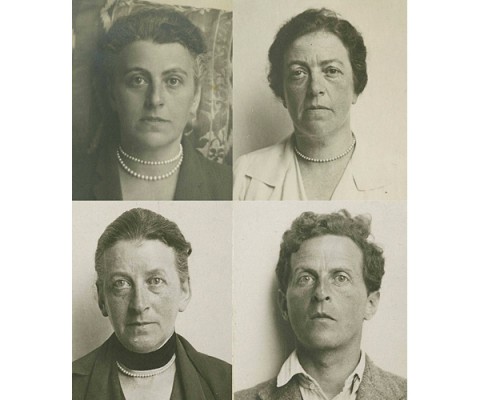
Of the composite image, keeper of the Wittgenstein archives Michael Nedo writes that “Wittgenstein was aiming for different clarity expressed by the photography of fuzziness.”:
Galton wanted to work out one probability, whereas Wittgenstein saw this as a summary in which all manner of possibilities are revealed in the fuzziness.
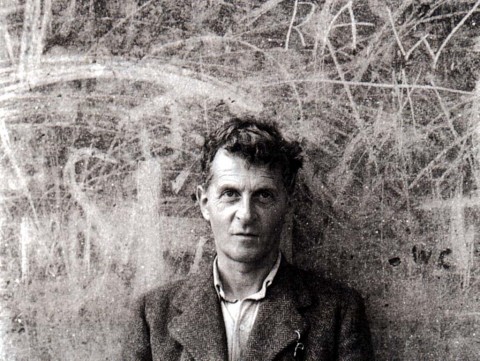
Fuzziness is a word rarely applied to Wittgenstein’s thought—at least his early work in the Tractatus Logico-Philosophicus where his only goal is a clarity of thought that supposedly dissolves all the “fuzzy” problems of philosophy in a series of elliptical aphorisms. The philosopher also called himself a “disciple of Freud,” in that he sought to “think in pictures,” and reach beyond language to the images produced by dreams and the unconscious, “to enable us to see things differently.” Wittgenstein’s photographs are as strangely detached and mysterious as the man himself. Salon has a gallery of the philosopher’s photographs, which includes the portrait of him (below), taken at his instruction in Swansea, Wales in 1947. It’s an iconic image; Wittgenstein half-sneers disdainfully at the camera, his steady gaze a challenge, while the blackboard behind him shows a riot of scratches and scrawls. In the upper right-hand corner, the word RAW hangs ominously above the philosopher’s head.
Wittgenstein’s grim portrait presents a contrast to the warmer recent photographic portraits of philosophers like those in Steve Pyke’s new book of philosopher portraits Philosophers. We’ve previously featured Pyke’s portraits of philosophers like Richard Rorty, David Chalmers, and Arthur Danto. For much a much less formal series of portraits of contemporary philosophers as everyday people, swing by the Tumblr Looks Philosophical.
Josh Jones is a doctoral candidate in English at Fordham University and a co-founder and former managing editor of Guernica / A Magazine of Arts and Politics.
Read More...Alice’s Restaurant Illustrated: A Thanksgiving Counterculture Classic
Alice’s Restaurant. It’s now a Thanksgiving classic, and something of a tradition around here. Recorded in 1967, the 18+ minute counterculture song recounts Arlo Guthrie’s real encounter with the law, starting on Thanksgiving Day 1965. And it builds steadily into a satirical protest against the Vietnam War draft. We have featured Guthrie’s classic during past years. But, for this Thanksgiving, we give you the illustrated version. Happy Thanksgiving to all who will celebrate today.
Related Content:
Bed Peace Revisits John Lennon & Yoko Ono’s Famous Anti-Vietnam War Protest
Willie Nelson, Pete Seeger, and Arlo Guthrie at Occupy Wall Street
The Alan Lomax Sound Archive Now Online: Features 17,000 Recordings
Read More...The Making of Stanley Kubrick’s The Shining (As Told by Those Who Helped Him Make It)
Last year, we featured Making The Shining, the behind-the-scenes documentary on Stanley Kubrick’s Stephen King-adapting horror film shot by his teenage daughter Vivian. (Find Part 1 below, and Part 2 here.) If you can’t get enough knowledge about Kubrick’s working methods — and true Kubrick aficionados never can — you’ll want to watch Staircases to Nowhere as well. This extended cut version of the film offers something of an oral history of The Shining’s production from those who toiled hard on it: a scenic artist and prop man, a camera operator, a camera technician, a continuity supervisor, and even a publicist. Those who know Kubrick’s work know that, in every aspect of filmmaking, the man had very specific ideas about what he wanted. He also had high expectations for his crew’s ability to realize them, even if that would require untested, or even yet unenvisioned, techniques and devices. One interviewee describes Kubrick as “a frustrated technician,” and indeed, this documentary fills out the image of the director as an artistic innovator willing to experiment and improvise with the physical technology of filmmaking.
The on-set stories told in Staircases to Nowhere come, so the video description puts it, as “extracts from full-length interviews with each of the contributors about their careers working at studios in Elstree and Borehamwood, and form part of ‘The Elstree Project’ — a collaboration between Elstree Screen Heritage and the University of Hertfordshire. This work has been done on a voluntary basis with student volunteers and staff giving up their own time to help preserve the legacy of the ‘British Hollywood’.” You can learn more about the project at its official site, which continues to document the English towns of Borehamwood and Elstree’s rich history of film and television production. The American-born but British-resident Kubrick certainly found something that worked for him in England. Whether that came down to a simple affinity for the country or the country’s tolerance of his uncommonly rigorous approach to craft, you can’t argue with the results today — as much as the man individually re-painting hundreds of ballroom tiles gold for lighting reasons might have felt like arguing at the time.
Related content:
Rare 1960s Audio: Stanley Kubrick’s Big Interview with The New Yorker
Stanley Kubrick’s Very First Films: Three Short Documentaries
Terry Gilliam: The Difference Between Kubrick (Great Filmmaker) and Spielberg (Less So)
Colin Marshall hosts and produces Notebook on Cities and Culture. Follow him on Twitter at @colinmarshall.
Read More...Astronaut Sunita Williams Gives an Extensive Tour of the International Space Station
After a 125-day stay aboard the International Space Station, ISS Commander Sunita (Suni) Williams touched down in Kazakhstan on Monday, along with Flight Engineers Aki Hoshide and Yuri Malanchenko. Part of what is known as Expedition 33, the three boarded their Soyuz TMA-05M on Sunday to return to Earth, but before they left, Williams downlinked an extensive tour above of the ISS orbital laboratory. Williams has given several interviews from her ISS post, so you may have already seen her floating weightless in front of the camera, a nimbus of dark hair around her face.
Here we see a number of interesting features of the station. She begins with the Japanese laboratory, then moves to the European module, “Columbus,” where many of the medical experiments take place. Interestingly, every surface is a suitable workstation; since there’s no reference for floor, walls, or ceiling, and no need for anything to stand on, one can maneuver into any position without losing a sense of direction. As Williams demonstrates the “sleep stations,” phone booth-size compartments with sleeping bags, she shows how the astronauts can also sleep in any position at all without feeling like they’re “upside-down” or disoriented in any way. There’s also a lengthy tour of the “facilities” (in case you’ve ever wondered how that works) and the “cupola,” a small transparent room like a WWII gunnery station where the astronauts can gaze out at their home planet.
So, yes, I will admit, I’ve always liked to imagine the interior of the ISS like the smooth, padded corridors of Stanley Kubrick’s 2001, but the reality is still seriously cool. The Washington Post has a slideshow of Expedition 33’s touchdown near the town of Arkalyk in northern Kazakhstan, and the video below shows the small ceremony that greeted the crew hours after their arrival back on Earth.
via Universe Today
Josh Jones is a doctoral candidate in English at Fordham University and a co-founder and former managing editor of Guernica / A Magazine of Arts and Politics.
Read More...Mashup Duet: Miles Davis Improvising on LCD Soundsystem
It’s cute. It’s clever. Just two Youtube videos in sync. Nothing more. Enjoy. h/t BoingBoing
Related Content:
‘The Sound of Miles Davis’: Classic 1959 Performance with John Coltrane
1959: The Year that Changed Jazz
John Coltrane Plays Only Live Performance of A Love Supreme
Read More...Adam Savage (Host of MythBusters) Explains How Simple Ideas Become Great Scientific Discoveries
A good TED talk is like a commercial for a great idea. There might not be much meat to sink into, but like any good ad agency, TED has its own unique formula for making even the most esoteric subject grabby.
Who, after all, would have thought that a video of a British guy lecturing about how schools kill creativity would get more than 8 million hits? Evidently the folks at TED did, and were they ever right.
Good TED talks come in a few flavors. That British guy I mentioned? Sir Ken Robinson’s talk about contemporary education is one of TED’s best policy critique talks (and its most popular overall). There are also the personal stories that compel and the demonstrations of great new ideas.
This talk by actor and educator Adam Savage might fall into more than one of those buckets. In the video above, Savage—who designed models for two Star Wars movies and hosts Mythbusters on the Discovery Channel—talks plain and simple about some of humanity’s most amazing scientific discoveries. He walks us through how Eratosthenes calculated the Earth’s circumference more than 2000 years ago and how Hippolyte Fizeau measured the speed of light in the mid-1880s.
These two men used nothing more than their own brains and a few relatively simple tools to make astonishingly accurate observations. It’s stuff we already know, but in true TED style Savage makes the whole thing revelatory and inspiring.
“What happens when you think about the discoveries and what they were thinking is you understand that they were not so different from us,” Savage says. “The people who made these discoveries just thought a little bit harder about what they were looking at. And they were a little bit more curious.”
Savage’s video is part of TEDEd’s Lessons Worth Sharing, which comes bundled with other videos and exercises that teachers can use to discuss the notion that simple ideas can lead to scientific discovery.
It’s also a very good commercial for curiosity. Seven and a half minutes promoting curiosity. Take a look. Curiosity, as Savage says, can change the world.
Related Content:
Adam Savage (Host of Mythbusters) Tells Sarah Lawrence Grads to Think Broadly … and Don’t Work for Fools
1370 TED Talks Listed in a Neat Spreadsheet
TED-Ed Brings the Edginess of TED to Learning
Kate Rix writes about digital media and education. See more of her work at and thenifty.blogspot.com.
Read More...Brian Eno Once Composed Music for Windows 95; Now He Lets You Create Music with an iPad App
Now running through my speakers, even as I write this: Brian Eno’s latest album, Lux. The disc offers four pieces of ambient music, a style that, even if Eno didn’t technically invent it, he certainly took it to a new level of fascination and popularity. He composed these tracks — if “composed” is indeed the word — as generative music, a process rather than a style, but one he named and has promoted since the nineties. For a definition of generative music, I turn to Eno’s A Year with Swollen Appendices, a book that does not leave my nightstand. “One of my long-term interests has been the invention of ‘machines’ and ‘systems,’ ” he writes, “to make music with materials and processes I specified, but in combinations and interactions I did not. My first released piece of this kind was Discreet Music (1975), in which two simple melodic cycles of different durations separately repeat and are allowed to overlay each other arbitrarily.”
In Lux, we have the latest iteration of that musical model. But even if this new record or its predecessors won’t make your playlist, there’s at least one Brian Eno composition with which you’ll already feel intimately familiar. I refer, of course, to the Windows 95 startup sound. Eno describes the musical challenge as follows: “The thing from the agency said,‘We want a piece of music that is inspiring, universal, blah- blah, da-da-da, optimistic, futuristic, sentimental, emotional,’ this whole list of adjectives, and then at the bottom it said ‘and it must be three and one quarter seconds long.’ ”
From that list of 150 vague words, Eno crafted 84 miniature pieces of music. You may have heard the one Microsoft ultimately went with hundreds, or thousands, of times. Obviously they’ve sounded the same on every play, and this very fact displeases their creator, especially when he creates with generative systems in the first place. “What I always wanted to do was sell the system itself, so that a listener would know that the music was always unique,” Eno continues in A Year. “With computer technology I began to think there might be a way of doing it.” Computer technology, which has come a long way since the days of Windows 95, has brought us to the release of Scape, the first generative music iPad app ($5.99) from Eno and Peter Chilvers. “The idea is that you assemble pieces of music out of sonic building blocks — we call them ‘elements’ — which then respond intelligently to each other,” Eno says in the introductory video just above. Scape follows Bloom and Trope, the duo’s previous generative music apps for the iPhone. Does it strike you as strange that the man behind such an iconic Microsoft theme now releases apps only for Apple devices? It’s no big surprise: Eno even composed the Windows 95 sound on a Mac.
Related content:
How David Byrne and Brian Eno Make Music Together: A Short Documentary
Brian Eno on Creating Music and Art As Imaginary Landscapes (1989)
Colin Marshall hosts and produces Notebook on Cities and Culture. Follow him on Twitter at @colinmarshall.
Read More...Resurrecting the Sounds of Abraham Lincoln in Steven Spielberg’s New Biopic
If you’re heading to see Steven Spielberg’s new biopic of Abraham Lincoln, you can go there knowing one thing (other than Daniel Day-Lewis has delivered another Academy Award-wining performance) — and that’s that the director, cast and crew paid close attention to the historical details. In an interview yesterday, Sally Field (who plays Lincoln’s wife Mary Todd) described how she immersed herself in the language of the era, pored over letters exchanged between Lincoln and his wife, gained 25 pounds to resemble Mary’s documented measurements. And then there’s this curious detail. During the filming of Lincoln (watch the trailer below), Daniel Day-Lewis and Sally Field never spoke to one another out of character. They knew each other simply as “Mary Lincoln” and “Mr. Lincoln” throughout.
In the video above, we get to listen to sound designer Ben Burtt talk about his own quest for historical authenticity — that is, how he tried to recapture the sounds that Lincoln heard during his lifetime. Of course, we don’t have audio recordings from the 1860s. But Burtt found creative ways to resurrect sounds from the period, like recording the tick-tocks of Lincoln’s personal watch, or capturing the sounds made by mahogany doors that still stand in the White House. We’ll let Burtt explain the rest above.
Related Content:
The Last Surviving Witness of the Lincoln Assassination (1956)
Louis CK Plays Abraham Lincoln, America’s 16th President and (Yes) Stand-Up Comedian Too
Watch Steven Spielberg’s Debut: Two Films He Directed as a Teenager
Read More...Watch The White Shadow, the Recently-Discovered and Earliest-Surviving Hitchcock Film
We’ve hooked you up with 20 free Alfred Hitchcock movies online. We’ve written about Hitchcock, the new Anthony Hopkins-starring film that opens this week. Now we’d like to direct your attention dear Open Culture readers to The White Shadow. Even if you think you’ve seen every Hitchcock movie, you probably haven’t seen this one, given that its surviving elements only recently came to light. “Forget about that Alfred Hitchcock movie starring Anthony Hopkins that opens next week,” says the Hollywood Reporter. “Fans can watch another film with the famed director’s fingerprints all over it — the oldest one anyone could possibly see, in fact — starting today [ … ] the earliest surviving feature credited to Hitchcock.” It comes to us as a project of the New Zealand Film Archive, whose efforts have made the film streamable here.
The catch: only three reels of The White Shadow survive. But that’s three more than cinephiles could enjoy before their sudden discovery last year. A fundraising drive drawing on Hitchcock enthusiasts the world over made possible the restoration and scoring of these reels, not to mention their online streaming availability through January 15, 2013.
You’ll even get a suite of associated features, including notes by critic David Sterritt, a bio of salvager/projectionist Jack Murtaugh, and a slide show documenting the discovery of the film. But this is Hitchcock we’re talking about, and even though The White Shadow came only three years into his career and appears in a halved state, it still delivers his signature combination of atmosphere, suspense, and controlled sensationalism. Whether or not you also plan to see Hopkins play Hitchcock or have a 20-picture online Hitchcock marathon, enjoy, while you can, this partial Parisian tale of twin sisters, “one angelic and the other without a soul.”
Find The White Shadow in our collection, 4,000+ Free Movies Online: Great Classics, Indies, Noir, Westerns, Documentaries & More.
Related content:
22 Free Hitchcock Movies Online
Martin Scorsese Brings “Lost” Hitchcock Film to Screen in Short Faux Documentary
François Truffaut’s Big Interview with Alfred Hitchcock (Free Audio)
Colin Marshall hosts and produces Notebook on Cities and Culture. Follow him on Twitter at @colinmarshall.
Read More...David Sedaris Reads You a Story By Miranda July
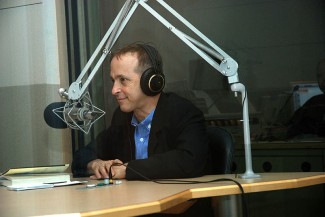
Thanks to his frequent appearances on radio’s This American Life, David Sedaris possesses one of the most recognizable author voices in the world. Simultaneously light and insinuating, it has come to seem as much a part of his oeuvre as the Santaland Diaries and his anecdotes about his parents, siblings and boyfriend. His arch spin on various regional and generational phrases is nothing if not instantly recognizable.
What a pleasure, then, to hear the sincerity with which he deploys this instrument in service of a fellow author’s work. Invited to choose a story to read aloud for the New Yorker’s fiction podcast, Sedaris went with “Roy Spivey” by Miranda July, another writer who could never be accused of hiding behind her work. One suspects there are elements of autobiography within this tale, though don’t drive yourself nuts trying to figure out the identity of the male movie star seated next to the main character. Just enjoy the non-winking generosity with which Sedaris embodies July’s female narrator, even when called upon to get her through a bathroom scene that — in spirit, anyway — recalls one of his most celebrated, nonfictional follies.
(Speaking of which, stay tuned for the post-story interview for the sort of admission Sedaris fans have come to crave.)
For more literary readings, see our previous post: The New Yorker’s Fiction Podcast: Where Great Writers Read Stories by Great Writers.
- Ayun Halliday’s regional accent does nothing for her book sales.
Read More...Support Us
We're hoping to rely on loyal readers, rather than erratic ads. Please click the Donate button and support Open Culture. You can use Paypal, Venmo, Patreon, even Crypto! We thank you!

About Us

Open Culture scours the web for the best educational media. We find the free courses and audio books you need, the language lessons & educational videos you want, and plenty of enlightenment in between.
Advertise With Us

FREE UPDATES!
GET OUR DAILY EMAIL
Get the best cultural and educational resources on the web curated for you in a daily email. We never spam. Unsubscribe at any time.
FOLLOW ON SOCIAL MEDIA

Open Culture editor Dan Colman scours the web for the best educational media. He finds the free courses and audio books you need, the language lessons & movies you want, and plenty of enlightenment in between.
Advertise With Us

