Transit of Venus: A Quick Guide to a Last-of-a-Lifetime Event
Something extraordinary happens this week. The planet Venus will move across the face of the Sun for the last time in our lives.
Transits of Venus occur on a 243-year cycle, with pairs of transits eight years apart separated by gaps of 121.5 and 105.5 years. The last Venus transit happened in 2004. The next won’t occur until December of 2117. So if you want to see one, don’t put it off! “This is it, folks,” said Robert Naeye, Editor in Chief of Sky & Telescope magazine. “Unless modern medicine comes up with a miracle to extend human lifespans, this transit of Venus will be your final opportunity to watch our sister planet cross the Sun’s fiery disk as seen from Earth.”
The event will take place tomorrow, June 5, or the next day, June 6, depending on your location. In North America the transit will begin tomorrow, just after 6 p.m. Eastern Daylight Time. Because of the great distance between the Earth and Venus, the duration will be far longer than for a Solar eclipse: over six hours.
Here are six tips for making the most of this last-of-a-lifetime event:
1: Read up about it. For a quick and neatly organized overview your best bet is astronomer Chuck Bueter’s Transit Of Venus.org. The site includes all kinds of useful and interesting information, including the video above.
2: Find out when you can see it from your location. The international non-profit group Astronomers Without Borders has created an extremely handy Web page that will automatically generate a schedule of the transit for your location, based on your computer’s IP address. The site allows you to choose between a simple graphic representation (the default setting) or a more detailed data sheet. It even predicts the likelihood of cloud cover where you are.
3: Prepare for safe viewing. Looking directly into the sun can cause severe and permanent eye damage. There are a number of safe ways to view the transit of Venus, but it’s essential that you follow the advice of experts. Bueter has published an overview, “Six Ways to See the Transit.” Rick Fienberg of the American Astronomical Society has published a detailed article on how to build a “sun funnel.” And Doug Duncan, director of the University of Colorado’s Fiske Planetarium, has created a video explaining a very simple way to safely project an image of a solar event onto a two-dimensional surface using a pair of binoculars.
4: Check for events in your area. If you follow the links in step three you should be able to watch the transit on your own, but you might have more fun–and learn more–if you join a group. Astronomy clubs, planetariums and other science groups will be hosting transit-viewing events around the world. Check your local listings or go to the NASA Sun-Earth Day Web site for a comprehensive round-up of events across the globe. Just scroll the map on the NASA site over to your own geographic region and zoom in.
5: Download the app. If you have an Apple or Android device you can download a free Transit of Venus phone app that will allow you to send your own observations of the transit to a global experiment to measure the size of the Solar System. “In centuries past,” writes Steven van Roode of Astronomers Without Borders, which is organizing the project, “explorers traveled around the globe to time the transit of Venus to determine the size of the solar system. We invite you to inspire international collaboration during the 2012 transit of Venus by enabling a digital re-creation of those global expeditions. The phone app will allow citizens around the world to witness this rare phenomenon and to contribute their observation to a collective experiment to measure the sun’s distance.” Also, Sky & Telescope is helping people make the most of the transit by offering free use of its SkyWeek astronomy app through June 7. You can download it for iPhone or Android.
6: Watch the webcast. If you are unable to get a clear view of the transit from your location–or even if you are–you should check out either of a pair of live webcasts which will be held during the event. Astronomers Without Borders will transmit its webcast live from the Mount Wilson Observatory in California. The program will include interviews with experts and contributions from amateur astronomers, along with video tours of the historic observatory and its equipment, both antique and state-of-the-art. You can access the Astronomers Without Borders webcast here. Another major webcast will be broadcast by NASA from Mauna Kea, Hawaii beginning tomorrow at 9:45 p.m. UTC (Coordinated Universal Time) or 5:45 p.m. Eastern Time. You can access the NASA webcast here. For a schedule of the program, which will include many videos and interviews throughout the event, you can download a PDF.
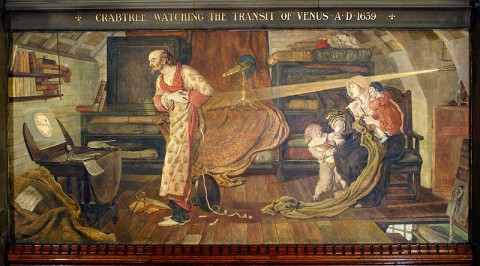
British astronomer William Crabtree, depicted observing the 1639 transit of Venus in a mural at Manchester Town Hall, painted in 1903 by Ford Madox Brown.
Read More...Dark Side of the Moon: A Mockumentary on Stanley Kubrick and the Moon Landing Hoax
Poor moon-landing conspiracy theorists. Lacking the historical and cultural gravitas of JFK assassination conspiracy theorists or the brazen pseudo-relevance of 9/11 conspiracy theorists, those who believe the Apollo 11 mission came out of a Hollywood backlot must toil in deepest obscurity. Imagine suffering from the aching conviction that the United States government, in league with a respected auteur or two, hoodwinked the entire world with a few minutes of blurry, amateurish video and garbled walkie-talkie speech — hoodwinked the entire world except you, that is. Now imagine a Truther and a second-gunman obsessive sharing a laugh about all your important revelations. If indeed you do hold that mankind has never visited the moon, make sure you don’t watch usually serious documentarian William Karel’s Dark Side of the Moon. In it, you’ll see your ideas further ridiculed, which would be unpleasant — or, even worse, you’ll see them vindicated.
These moon-landing conspiracy theorists offer many alternative historical narratives, and Karel picks a rich one. He proceeds from the question of how, exactly, filmmaker Stanley Kubrick came into possession of the advanced camera lenses he used to shoot 1975’s candle-lit Barry Lyndon. Perhaps NASA, who had the lenses in the first place, owed Kubrick for certain services rendered six years earlier? Cutting decontextualized file footage together with scripted lines delivered by actors, NASA staffers, and Kubrick’s actual widow, Karel tells an ominously earnest story of how the CIA recruited Kubrick and his 2001-tested cinematic craftsmanship to “win” the space race, at least on television. Though liberally peppered with small falsehoods and inside jokes for film buffs, Dark Side of the Moon has nonetheless inadvertently won its share of sincere adherents, including self-styled “Speaker of Truth” Wayne Green. It’s been said many times, many ways: humanity isn’t quite smart enough to effectively conspire, but we’re just smart enough to invent an infinitude of conspiracy theories.
Related content:
Stanley Kubrick’s Very First Films: Three Short Documentaries
Terry Gilliam: The Difference Between Kubrick (Great Filmmaker) and Spielberg (Less So)
The Best of NASA Space Shuttle Videos (1981–2010)
Colin Marshall hosts and produces Notebook on Cities and Culture. Follow him on Twitter at @colinmarshall.
Read More...The “Collapse” of the Sydney Opera House Sails
Multi-award winning German design collective URBANSCREEN specializes in large-scale projection on urban surfaces. Their first great international success was “555 KUBIK — How it would be if a house was dreaming,” a brilliant media installation using the façade of the Kunsthalle Hamburg. This project quickly found its way to all major blogs and sites on the Internet and gained so much fame that it surpassed the popularity of lolcat videos for almost an hour.
This year, URBANSCREEN was commissioned to transform the sails of the iconic Sydney Opera House as part of Vivid Sydney, a festival of light, music and ideas. The truly amazing projections explore the sculptural form of the Opera House and its place as a home for music, dance and drama. The conclusion is not to be missed.
By profession, Matthias Rascher teaches English and History at a High School in northern Bavaria, Germany. In his free time he scours the web for good links and posts the best finds on Twitter.
Read More...Allen Ginsberg Reads His Famously Censored Beat Poem, Howl (1959)
Before Banned Books Week comes to a close, we bring you Allen Ginsberg’s 1955 poem, Howl. The controversial poem became his best known work, and it now occupies a central place in the Beat literary canon, standing right alongside Jack Kerouac’s On the Road and William S. Burroughs’s Naked Lunch. Ginsberg first read the poem aloud on October 7, 1955, to a crowd of about 150 at San Francisco’s Six Gallery. (James Franco reenacted that moment in the 2010 film simply called Howl.)
Things got dicey when City Lights published the poem in 1956, and especially when they tried to import 520 printed copies from London in ’57. US customs officials seized the copies, and California prosecutors tried City Lights founder Lawrence Ferlinghetti and his partner, Shigeyosi Murao, on obscenity charges that same year. Nine literary experts testified to the redeeming social value of Howl, and, after a lengthy trial, the judge ruled that the poem was of “redeeming social importance.”
Above, we give you Ginsberg reading Howl in 1959. It’s also listed in the Poetry section of our Free Audio Books collection. An online version of the text appears here.
If you would like to support the mission of Open Culture, consider making a donation to our site. It’s hard to rely 100% on ads, and your contributions will help us continue providing the best free cultural and educational materials to learners everywhere. You can contribute through PayPal, Patreon, and Venmo (@openculture). Thanks!
Related Content:
John Waters Reads Steamy Scene from Lady Chatterley’s Lover for Banned Books Week (NSFW)
See Patti Smith Give Two Dramatic Readings of Allen Ginsberg’s “Footnote to Howl”
2,000+ Cassettes from the Allen Ginsberg Audio Collection Now Streaming Online
Read More...
Dimensions of Dialogue by Jan Svankmajer (1982)
Jan Svankmajer is a surrealist Czech animator whose work has influenced Tim Burton, The Brothers Quay, and Terry Gilliam himself. With his list of The Ten Best Animated Films, Gilliam points us to one film, Svankmajer’s stunning 1982 claymation short, Dimensions of Dialogue, writing:
Read More...Jan Svankmajer’s stop-motion work uses familiar, unremarkable objects in a way which is deeply disturbing. The first film of his that I saw was Alice, and I was extremely unsettled by the image of an animated rabbit which had real fur and real eyes. His films always leave me with mixed feelings, but they all have moments that really get to me; moments that evoke the nightmarish spectre of seeing commonplace things coming unexpectedly to life.
All Eyes on Ai Weiwei: Life Under Surveillance … and on Twitter … After His Arrest
As the one-year anniversary of Chinese artist and dissident Ai Weiwei’s release from jail draws near, the whole world seems to be watching his every move. The whole world, that is, except for the Chinese people.
Ai is cut off from most of the population of his own country after the government shut down his blog and stopped him from using Chinese social media. When he was released from jail on June 22 of last year, after 81 days of detention, Ai found that the government had installed surveillance cameras all around his Beijing home and studio. He counted 15 within a 100-meter area. In response, he set up four of of his own cameras inside his home earlier this spring and began streaming a 24-hour live webfeed, called “Weiwei Cam.” The regime quickly shut that site down, too.
But the Chinese authorities have not completely cut off Ai’s access to the world outside of China. More than 147,000 people follow him on Twitter, one of the many Western sites blocked in China, and a steady stream of foreign journalists have been making their way to his Beijing compound for interviews. Last week The New York Times published a harrowing account of the day in April, 2011, when police pulled a hood over Ai’s head and drove him to an undisclosed detention center. And this week Slate published an article, “Someone’s Always Watching Me,” along with videos (above and below) of an interview with Ai conducted by Slate Group Editor-in-Chief Jacob Weisberg on May 14. “I feel that what makes them most frightened,” Ai told Weisberg, referring to the Chinese government, “is my international profile, my interviews with Western media.”
Ai is restricted to Beijing until June 22. Whenever he leaves his house he must tell the police where he is going and who he will meet. “I basically obey their orders,” he told Evan Osnos of The New Yorker in January, “because it doesn’t mean anything. I also want to tell them I’m not afraid. I’m not secretive.” Every week he has to meet with the Public Security Bureau for a chat. Like the foreign journalists, the Chinese police are eager to learn what Ai plans to do when restrictions on his movement are lifted later this month. “They asked me what I would do next when I met them last weekend,” Ai told a reporter for The Telegraph this week. “They tried to make it very casual. After a chat, they said, ‘What comes next?’ I said: ‘It is an interesting question. What does this nation do next?’ ”
Read More...The 15 Worst Covers of Beatles Songs: William Shatner, Bill Cosby, Tiny Tim, Sean Connery & Your Excellent Picks
Thanks to The Wall Street Journal, you can endure boxer Manny Pacquiao singing a version of John Lennon’s 1971 peace anthem, Imagine. It’s pretty painful, not quite as painful as taking a Pacquiao punch, but painful nonetheless. We floated it on Twitter (follow us here) and we were quickly reminded that Pacquiao is hardly the first person to butcher The Beatles. (No real knock on him, we’re just having some fun here.) So we started pulling together your favorites. What are the worst Beatles’ covers you’ve ever heard — ones so bad, they’re good? Let us know in the comments or on Twitter, and we’ll start adding them to the post.
In 1968, William Shatner, riding high on his Star Trek fame, released his first music album, The Transformed Man. It featured poetry mixed with pop lyrics and a nearly blasphemous version of Lucy in the Sky with Diamonds. It’s here that the cheese began.
Also in 1968, the young comedian Bill Cosby released Bill Cosby Sings Hooray For The Salvation Army Band!. The parody album starts with Cosby singing a semi-serious version of Sgt. Pepper’s Lonely Hearts Club Band. It was a high point for neither the comedian nor the band.
Telly Savalas — you know him from Kojak — sings George Harrison’s Something in a very lounge lizard kind of way. So awful it’s awesome.
Michael McKean (This is Spinal Tap!) offers up this: Milton Berle singing The Yellow Submarine. It wasn’t one of The Beatles’ best songs, let’s admit it. But Berle didn’t exactly elevate it. Uncle Miltie’s recording was made in 1968 (do you see a trend here?), not long after the animated Yellow Submarine hit theaters.
From her 1966 album Way Out West, old time movie star Mae West sings Day Tripper. Recommended by @tonymolloy.
Sean Connery talking his way through In My Life. And amazingly George Martin is responsible for this.
You can’t talk about so-bad-they’re-good Beatles covers without giving a nod to Wing. The Hong Kong-born singer, now based in New Zealand, has recorded a full album in her out-of-tune singing style. Is it parody? Is it serious? Who knows. Her album can be had here: Wing Sings the Beatles
Elva Ruby Connes Miller, otherwise known as Mrs. Miller, covered numerous songs during the 1960s, including A Hard Day’s Night. Her voice was compared to the sound of “roaches scurrying across a trash can lid.” More recently, this clip was featured on EarBleed.com … for pretty good reason. Good find Daniel.
And now the male answer to Mrs. Miller, the immortal Tiny Tim and his version of Nowhere Man.
Here is Germany’s answer to Wing. It is Klaus Beyer’s remake of Back in the U.S.S.R.
This is from “Banda Plástica de Tepetlixpa.” According to legend, John and Paul went to Mexico, to a town called Tepetlixpa, where people received them as distinguished guests. Local brass bands started playing the Beatles’ music and moved the singer-songwriter duo to tears. Some time later, the Tepetlixpa band recorded Adios a Los Beatles (Goodbye to the Beatles), a 10-song tribute to the geniuses from Liverpool. Jaime Ortega has more backstory in the comments section below.
@Brian_M_Cassidy asks: Is this what you’re looking for? Indeed it is. The Red Navy Singers, Dancers & Musicians sings Let It Be, during the final days of the Soviet Union.
We wouldn’t want to leave France out. Here, Les compagnons de la chanson sing Le Sous-Marin Vert. Thanks Pierre.
And finally pulling up the rear, The Metropolitan Police Male Voice Choir sing When I’m Sixty Four. H/T Olidez
Read More...“Good Chemistry” Explains Chemical Bonds with Cutout Animation and Teenage Romance
Love, or the promise of it, sells clothes, cologne and many a compact disc—but who’d think love could sell chemistry? Sixteen-year-old Eli Cirino did, and was he ever right. The tenth grader submitted an extra credit video for his chemistry class and what he got was probably way more than he bargained for. Good Chemistry explains chemical bonds using construction paper animation of positive and negative ions and covalent bonds set against an original song sung by Cirino. It’s all edited together with images of a cute couple reaching out and clasping hands. A sample of Cirino’s lyrics: “We always on the lookout for a partnership, positive and negative you get the drift.” It’s catchy and sweet, to the tune of more than 290,000 views on YouTube by the end of the day Wednesday. Extra credit for Cirino for bringing the video in at pi-time: three minutes, fourteen seconds.
Kate Rix is an Oakland-based freelancer. Find more of her work at .
Get more intelligent media by following us on Facebook, Twitter and now Google Plus and share intelligent media with your friends! They’ll thank you for it.
Read More...Entitled Opinions, the “Life and Literature” Podcast That Refuses to Dumb Things Down
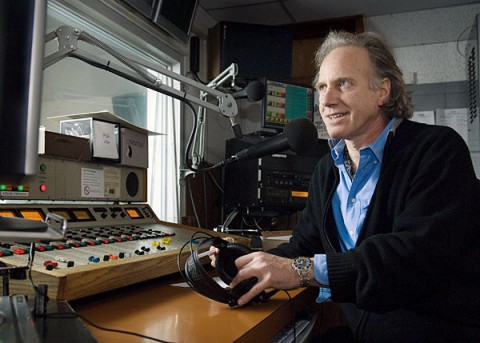
Proust. Mimetic desire. The inflationary universe. 1910, American writers in Paris. The history of the book. These topics may sound unusual enough to pique your interest. They may float through your mind once in a while, capturing an hour or two of your curiosity. They may periodically send you to the library on reading binges. But for KZSU-FM’s Entitled Opinions, they are meat and drink. Since 2005, professor-broadcaster Robert Harrison has explored these topics and many more besides in the intellectually expansive long-form conversations he conducts on Stanford University’s radio station. Always beginning with a monologue, Harrison spends the bulk of his broadcasts thinking aloud about these rich topics with philosophers like Richard Rorty, novelists like Orhan Pamuk, many a fellow academic, listeners, and his own brother. (Sometimes he up and conducts the entire show in French.) Each and every one of these he makes available as a podcast, on the show’s site and on iTunes.
“These are not like Stanford courses online,” said Harrison in a Stanford University News profile. “These are programs where intellectuals speak to each other at a high level of intellectual exchange—no one is excluded per se, but you do have to have intellectual curiosity. We refuse to dumb it down.” Having recently returned from a prolonged hiatus, Entitled Opinions has kept not dumbing it down with conversations on geography, hermaphroditism, political philosopher John Rawls, and Petrarch and Petrarchism. I myself engaged Harrison in a long-form interview on my previous podcast, The Marketplace of Ideas, in which we discussed the evolution of his show; his books on forests, gardens, and the dead; his life as a rock musician (so that explains those episodes on Pink Floyd, The Doors, and Jimi Hendrix); and getting called “the most pretentious man in the world” over e‑mail. We die-hard Entitled Opinions fans demand to know these things.
Colin Marshall hosts and produces Notebook on Cities and Culture. Follow him on Twitter at @colinmarshall.
The Art of Making a Flamenco Guitar: 299 Hours of Blood, Sweat & Tears Experienced in 3 Minutes
The Flamenco guitar grew up in Andalusia, the major province in southern Spain, where it became integral to the culture during the 19th century. The modern flamenco guitar (a first cousin of the modern classical guitar) is typically made with two of three woods — spruce on the top, and cypress or sycamore on the back and sides. When put in the hands of the right luthier, the guitar can become a thing of beauty. Case in point: This artful video by Greek filmmaker Dimitris Ladopoulos brings you inside the workshop of Vasilis Lazarides, who specializes in making high quality flamenco guitars by hand. (Visit his guitars online here.) 299 hours of blood, sweat, tears and love go into making each fine guitar. But you can watch it all happen in a matter of three minutes, with the music of Edsart Udo de Haes providing the soundtrack.
If electric guitars happen to be your thing, you can also watch Fenders being made in 1959 and 2012.
If you would like to support the mission of Open Culture, consider making a donation to our site. It’s hard to rely 100% on ads, and your contributions will help us continue providing the best free cultural and educational materials to learners everywhere. You can contribute through PayPal, Patreon, and Venmo (@openculture). Thanks!
Related Content:
Read More...Support Us
We're hoping to rely on loyal readers, rather than erratic ads. Please click the Donate button and support Open Culture. You can use Paypal, Venmo, Patreon, even Crypto! We thank you!

About Us

Open Culture scours the web for the best educational media. We find the free courses and audio books you need, the language lessons & educational videos you want, and plenty of enlightenment in between.
Advertise With Us

FREE UPDATES!
GET OUR DAILY EMAIL
Get the best cultural and educational resources on the web curated for you in a daily email. We never spam. Unsubscribe at any time.
FOLLOW ON SOCIAL MEDIA

Open Culture editor Dan Colman scours the web for the best educational media. He finds the free courses and audio books you need, the language lessons & movies you want, and plenty of enlightenment in between.
Advertise With Us

