Building the Golden Gate Bridge: A Retro Film Featuring Original Archival Footage
This past weekend, San Francisco celebrated the 75th anniversary of the Golden Gate Bridge. And if Bethlehem Steel were still around, it would have been celebrating too. Once America’s second-largest steel producer, the now bankrupt company fabricated the steel used in the construction of the iconic bridge — all 68,000 tons of it. Somewhere during the 1950s, the Pennsylvania-based firm revisited the making of the Golden Gate Bridge, producing a 26 minute film that incorporated some amazing archival footage. Every phase of construction gets covered, and the film ends with the bridge’s big opening day in 1937. It’s not to be missed.
via The Atlantic
Read More...Download David Hockney’s Playful Drawings for the iPhone and iPad
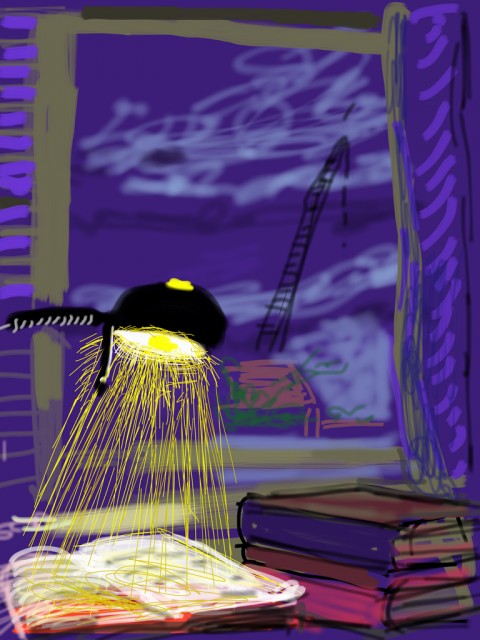
Last year, the Royal Ontario Museum (ROM) in Toronto staged an exhibit of David Hockney’s playful drawings produced with/for the iPhone and iPad. Hockney became an early adopter of Apple’s popular devices and started creating finger-drawn images (using the Brushes app) in 2008. Initially, the English painter only shared his digital drawings with a small circle of friends. Then he decided to make them available to the larger world, presenting them first in Paris in 2010, and then later in Toronto. Here, Hockney explains the basic thinking behind his Fresh Flowers exhibitions.
Throughout the Canadian exhibition, the ROM invited the public to download a series of free images by Hockney. They’re all still online, and we’ve gathered them below. What will you do with them? Put them on your iPhone or iPad, of course. (Find instructions here and here.) Or whatever other device you please.
via coudal.com
Read More...
When Respected Authors, from Goethe to Henry Miller, Try Their Hand at Painting
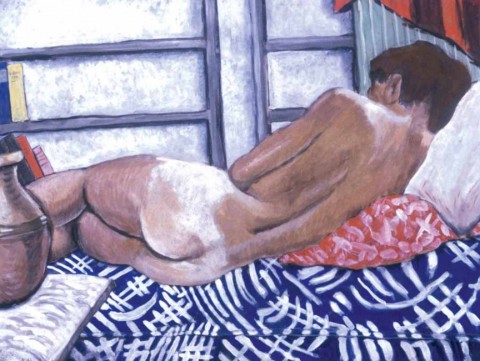
Freshly posted on publisher Melville House’s blog, you’ll find examples of visual art by textual artists; drawings and paintings, in other words, drawn and painted by people who have gone down in history for their way with sentences. This could easily turn into a lesson about not quitting one’s day job. But, as you can see from the work above, Maria Nys Huxley at Siesta, Melville House blogger Kevin Murphy hasn’t put together a study in the incompetence of the dilettante. You’ve surely already guessed the literary connection: the painting came from the hand of Brave New World author Aldous Huxley, who put his wife Maria Nys to canvas in 1920, when both were still in their twenties.
The post features more paintings from the late eighteenth century to the mid-twentieth by Johann Wolfgang von Goethe, Victor Hugo, Marcel Proust, Hermann Hesse, e.e. cummings, Zelda Fitzgerald, Jack Kerouac, Flannery O’Connor, and Henry Miller. Each one reflects something familiar about the painter’s main line of work: Goethe’s, bucolic reverie; Proust’s, the sketchiness of fading memory enriched by a scattering of bold details; Hesse’s, a stare of unbroken intensity. One particular outlier, with its simple pen-and-ink composition as well as its overt humor, expresses the literary personality of its creator more strongly than all the others put together:
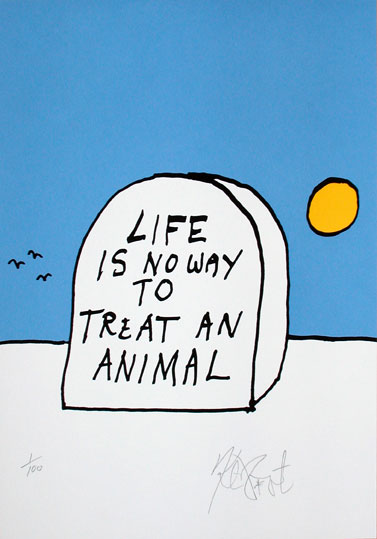
Find the full collection here.
via @KirstinButler
Related content:
Photos of Famous Writers (and Rockers) with their Dogs
The Writing Rooms of Famous Writers
Famous Authors Read Other Famous Authors
Colin Marshall hosts and produces Notebook on Cities and Culture. Follow him on Twitter at @colinmarshall.
Read More...William F. Buckley Meets (Possibly Drunk) Jack Kerouac, Tries to Make Sense of Hippies, 1968
The first modern use of the word hippie can be traced back to 1965, when Michael Fallon, a San Francisco journalist, used the word to refer to the bohemian lifestyle emerging in the city’s Haight-Ashbury district. (Apparently, Fallon took the word hipster used by Norman Mailer and then shortened it into hippie.) By 1967, the mass media couldn’t stop talking about hippies. It was the Summer of Love in San Francisco, the defining moment of the counterculture, and the rest of the country was scratching its collective head, trying to make sense of it all. Who better to do it than William F. Buckley, the emerging voice of conservative America?
In this classic 1968 episode of Firing Line, Buckley tries to demystify the hippie movement with the help of three guests: Lewis Yablonsky, a professor of sociology and criminology at Cal State-Northridge; Ed Sanders, the activist poet who helped form The Fugs; and then Jack Kerouac, author of the Beat classic, On the Road. In many ways, Kerouac inspired the hippie movement. And he, himself, acknowledges the relationship between the Beats and the hippies. But, in watching this clip, one thing becomes clear: in style and substance, he and the hippies were also worlds apart.…
Don’t miss Yale’s lecture on Kerouac and On the Road here.
Related Content:
Jack Kerouac Reads from On the Road (1959)
Ken Kesey’s First LSD Trip Animated
William F. Buckley Flogged Himself to Get Through Atlas Shrugged
Read More...Breaking News: Socrates Tried Again in Athens and Acquitted!
Note: the action starts at about the two minute mark, and the video is accompanied by an English translation.
The trial and execution of Socrates at Athens in 399 B.C.E. has come down to us as the archetype of intellectual martyrdom. But the facts of the case, as filtered through the writings of Socrates’ students Xenophon and Plato, are sketchy. “Why,” asks Douglas Linder on the Famous Trials Web site, “in a society enjoying more freedom and democracy than any the world had ever seen, would a seventy-year-old philosopher be put to death for what he was teaching?”
Last Friday the Onassis Cultural Centre in Athens gave Socrates a new trial, assembling a panel of distinguished jurists from Europe and America to reopen the case. As the Onassis Centre’s Web site explains, the event was “not a re-enactment but a modern perspective based on current legal framework supplemented with ancient Greek elements and comical theatrics.” This time the verdict was different–but just barely. The vote by the jury was a 5–5 tie, which meant Socrates was acquitted. The audience’s vote was more decisive: 5 to convict, 584 to acquit. Of course, it was a little late for Socrates.
You can download The Apology of Socrates from our collection of Free Audio Books and Free eBooks.
Read More...The Ideas of Noam Chomsky: An Introduction to His Theories on Language & Knowledge (1977)
We’ve featured the linguist and polemicist Noam Chomsky here before, and not two weeks ago we posted about philosopher-broadcaster Bryan Magee. The Ideas of Noam Chomsky brings the two men together for a chat about linguistics, the philosophy of language, human cognitive programming, and the philosophy of science. Though Magee introduces Chomsky, a highly nontraditional intellectual to his adherents and detractors alike, as “something of a joker in the pack, as far as philosophy is concerned,” he interviews him with all the attentiveness and respect he brings to discussions with purely philosophical luminaries. Clearly, Magee wants to know more about Chomsky’s theories of language, and especially about their implications for what he calls the dominant philosophical problem: “that of the relationship between language and the world.”
Rarely questioned along these lines in the media, Chomsky responds thoughtfully and in detail. This ultimately leads to a conversation about the divide between where meaningful scientific theories can develop, and where our cognitive limitations might prevent them from developing. You’ll notice that none of this has to do with politics, and political guidance is what most of Chomsky’s fans have expected from him over the decades. While even Chomsky himself has admitted to seeing no connection between his academic and activist careers, Magee pursues a line of inquiry late in the broadcast meant to tie them together. Magee asks astute questions and Chomsky provides honest answers, but finding a common root between ideas like deep grammar and anarchist socialism perhaps remains an intellectual stunt best not tried at home.
If you would like to support the mission of Open Culture, consider making a donation to our site. It’s hard to rely 100% on ads, and your contributions will help us continue providing the best free cultural and educational materials to learners everywhere. You can contribute through PayPal, Patreon, and Venmo (@openculture). Thanks!
Related content:
Noam Chomsky & Michel Foucault Debate Human Nature & Power (1971)
Bryan Magee’s In-Depth, Uncut TV Conversations With Famous Philosophers (1978–87)
Ali G and Noam Chomsky Talk Linguistics
Colin Marshall hosts and produces Notebook on Cities and Culture. Follow him on Twitter at @colinmarshall.
Video: Glenn Gould Plays the Goldberg Variations by J.S. Bach
Here’s the studio video shot when Glenn Gould recorded Bach’s Goldberg Variations in 1981. The now famous recording was released on CD/MP3. We’re adding this vintage clip to our Culture Icons collection, which features great artists and thinkers captured in original video and audio.
Related Content:
How a Bach Canon Works. Brilliant!
Glenn Gould Predicts Mash-up Culture in 1969 Documentary
A Young Glenn Gould Plays Bach
Glenn Gould and Leonard Bernstein Play Bach
Read More...Measuring the Universe: How Astronomers Learned to Measure Celestial Distances Explained with Animation
Have you ever wondered how astronomers figure out the mind-boggling distances between the Earth and various astronomical objects? In this informative animated video from the Royal Observatory at Greenwich, we learn the fundamentals of the Cosmic Distance Ladder, the succession of methods used to determine those distances.
The video was made for “Measuring the Universe: from the transit of Venus to the edge of the cosmos,” an exhibit that will be on display at the observatory through September 2. The exhibit is timed to coincide with this year’s rare transit of Venus, which will be visible from Earth on June 5 and 6 and won’t happen again until 2117. The transit of Venus played a key role in the history of astrometry. In 1663 the Scottish mathematician and astronomer James Gregory proposed a method of timing the movement of Venus across the Sun from two widely separated points on the Earth and using the differential to calculate the sun’s mean equatorial parallax and, by triangulation, the Sun’s distance from the Earth.
Knowing the distance from the Earth to the Sun, we can then figure out the distances of some stars using the same method of trigonometric parallax. But as astronomer Olivia Johnson explains in the video, that technique can only be used to measure the closest stars. For distances greater than 500 light years, other methods are required. When the objects in question have a known luminosity–in other words, when they are “standard candles”–the inverse square law of light can be used to calculate distances. Those measurements, along with Hubble’s Law and the Doppler Effect, enable even further calculations extending to the edge of the known cosmos.
“What’s most incredible to me,” says Johnson, “is how all these measurements build on each other. It’s only by knowing the scale of our Solar System–the distance between the Earth and Sun–that we’re able to measure distances to nearby stars using parallax. If we can learn how far it is to some nearby standard candles using parallax, we can then use comparisons between standard candles to measure the distances to farther stars and galaxies. Finally, by studying the motions of galaxies with standard candles, we learn we can use redshift to measure distances throughout our expanding Universe.”
via Devour
Related Content:
The Higgs Boson, AKA the God Particle, Explained with Animation
Read More...Daniel Dennett (a la Jeff Foxworthy) Does the Routine, “You Might be an Atheist If…”
The American comedian Jeff Foxworthy has a well known comedy routine called “You Might be a Redneck If,” where he lists the self-mocking possibilities that answer the question. For example: You Might be a Redneck If …
- Your wife has ever said, “Come move this transmission so I can take a bath.”
- You own a homemade fur coat.
- You think a subdivision is part of a math problem.
- You’ve ever financed a tattoo.
- You have ever used lard in bed.
The philosopher and cognitive scientist Daniel Dennett picked up on this schtick when speaking at the Global Atheist Convention in Melbourne, Australia. And he asked a series of questions meant to show that people might be a little less religious, or a bit more atheist, than they might care to admit. So here it goes: You Might be an Atheist If…
- You don’t believe that Jesus is literally the son of God.
- You don’t believe God actually listens to each and everyone’s prayers.
- You don’t think God picks sides when countries go to war (or when football teams play each other).
- Or, to put things differently, If you believe God isn’t a personal God, but rather is a benign force, a concept that enriches people’s lives.
You get the gist. By the time you’re done with the 45 minute talk, you’ll know whether you’re indeed a theist, or perhaps an atheist after all. It’s a reality check either way.
Read More...Vladimir Nabokov–Channelled by Christopher Plummer (RIP)–Teaches Kafka at Cornell
“From my point of view,” writes Vladimir Nabokov in Lectures on Literature, “any outstanding work of art is a fantasy insofar as it reflects the unique world of a unique individual.” He also says it in the video above, a lecture on Franz Kafka’s The Metamorphosis originally aired by WQED in Pittsburgh. (Find Kafka’s classic work in our collection of Free eBooks and Free Audio Books.) But he doesn’t say it himself; he says it through Christopher Plummer, who portrays Nabokov teaching in a 1989 re-creation of late-1940s Cornell University. Literarily inclined students of the era (including United States Supreme Court Justice Ruth Bader Ginsburg) must have experienced a similar introduction to Kafka in Nabokov’s classes, perhaps down to his sketch of poor Gregor Samsa’s beetle form. But this production adds the theatrical touch, surely not a feature of Cornell’s lecture halls in those days, of spotlighting Plummer-as-Nabokov and darkening everything else whenever he reads from the story.
Plummer himself says a few words about Nabokov at the beginning of the video, and he assumes the Russian novelist’s persona at about 1:38. Does Plummer nail Nabokov’s distinctively multinational accent? Does Nabokov’s observation that Gregor Samsa never uses his wings mean anything of importance?
Will we ever enter another era when public television resurrects cultural luminaries to give lectures by way of our time’s most respected thespians? This half-hour program gives us many such questions to ponder, and even if we can’t answer them, those of us who failed to draw inspiration from the Robin Williams of Dead Poets Society will surely find, in Plummer’s majestic eccentricity, a briefer but more memorable teacherly performance.
If you would like to support the mission of Open Culture, consider making a donation to our site. It’s hard to rely 100% on ads, and your contributions will help us continue providing the best free cultural and educational materials to learners everywhere. You can contribute through PayPal, Patreon, and Venmo (@openculture). Thanks!
Related content:
Nabokov Reads Lolita, Names the Great Books of the 20th Century
Nabokov Makes Editorial Improvements to Kafka’s The Metamorphosis
Franz Kafka’s It’s a Wonderful Life
Colin Marshall hosts and produces Notebook on Cities and Culture. Follow him on Twitter at @colinmarshall.
Read More...Support Us
We're hoping to rely on loyal readers, rather than erratic ads. Please click the Donate button and support Open Culture. You can use Paypal, Venmo, Patreon, even Crypto! We thank you!

About Us

Open Culture scours the web for the best educational media. We find the free courses and audio books you need, the language lessons & educational videos you want, and plenty of enlightenment in between.
Advertise With Us

FREE UPDATES!
GET OUR DAILY EMAIL
Get the best cultural and educational resources on the web curated for you in a daily email. We never spam. Unsubscribe at any time.
FOLLOW ON SOCIAL MEDIA

Open Culture editor Dan Colman scours the web for the best educational media. He finds the free courses and audio books you need, the language lessons & movies you want, and plenty of enlightenment in between.
Advertise With Us


