Andy Samberg Announces Death of Liberal Arts, Coolness of Science Majors at Harvard Class Day
Every time Harvard Class Day rolls around, you can expect a few good laughs from a comedian. In years past, Sacha Baron Cohen (a Cambridge grad), appearing as Ali G, offered some words of nonsensical wisdom to Harvard grads. Amy Poehler and Will Ferrell have done the same. This year brings Andy Samberg, a Saturday Night Live cast member and co-star in various comic films. The highlights?
- 4:29 mark: Announces that History, Literature, anything related to Art, and anything that ends with “Studies,” are officially useless.
- 5:12 mark: Declares that Math and Science majors are cool .… finally.
- 9:13 mark: Reads poem by WB Yeats in his own, novel way.
- 10:20 mark: Impressions begin.
- 14:07: Awkwardly comes on to all the mothers in the crowd.
- 15:04: Awkwardly comes on to all the fathers in the crowd.
Related Content:
‘This Is Water’: Complete Audio of David Foster Wallace’s Kenyon Graduation Speech (2005)
Conan O’Brien Kills It at Dartmouth Graduation
J.K. Rowling Tells Harvard Grads Why Success Begins with Failure
Read More...Bill Murray Stars in Playful, Slo-Mo, Mock Trailer (and More Culture from Around the Web)
As Wes Anderson’s new film with Bill Murray hits theaters this weekend, a fun video starring the actor has surfaced on the web. Here’s the quick backstory. Last year, a crew working on a commercial shoot with Bill Murray got something better than an autograph. They got to appear in a slow-motion scene with him, all set to music by The Kinks. The Wes Anderson-style shoot was then turned into a short “trailer” for a faux film, Les cinéastes, and it’s now online for your enjoyment. via @protoncharging
Now discover more culture from Around the Web (all links originally appeared on our Twitter Stream):
Home Recording of 5‑Year-Old Sofia Coppola Being Interviewed by Her Father
John Waters Tries Some Desperate Living on a Cross-Country Hitchhiking Odyssey
Oxford University’s Lecture Series on Great Writers and Why They Inspire (iTunes)
Young Girl Writes Einstein and Asks, “Do Scientists Pray?” And He Replies (1936)
Entrepreneur Tells Techies to Get a PhD in the Humanities
Frank Zappa Lectures at Syracuse University, 1975
David Foster Wallace Reads “Consider the Lobster” (Added to our list of Free Audio Books)
Video: Woody Allen Reads “Not A Creature Was Stirring”
Intensive Introduction to Computer Science from Harvard (Added to our Free Online Course Collection)
Read More...How David Byrne and Brian Eno Make Music Together: A Short Documentary
On Monday, we posted the Artist Series, short profiles of various aesthetically-oriented creators by the late Hillman Curtis. Today, please enjoy what feels like the jewel in the Artist Series’ crown, despite not officially being part of it: Curtis’ promotional documentary on Brian Eno and David Byrne and their collaboration on 2008’s Everything That Happens Happen Will Happen Today.
Curtis interviews Eno and Byrne in their separate workspaces, captures their conversations about parts of their songs, and even — presumably in keeping with the album’s do-it-yourself promotional spirit — lets them photograph one another. He also shows them doing what they do best when not creating: cycling, of course, in Byrne’s case, and looking pensively through windows in Eno’s.
In none of these nine minutes do Byrne or Eno perform anything. Curtis doesn’t need them to; he taps instead into the combination of articulacy, clarity, and idiosyncrasy that has earned them nearly forty years of status as cerebral popular music icons. Just as the early eighties’ nascent sampling technology gave Byrne and Eno a new framework with which to think about music when they recorded My Life in the Bush of Ghosts together, the ability to send sounds over the internet and extensively modify absolutely any recording after the fact shaped the construction of Everything That Happens Will Happen Today.
The resulting production legitimately earns the critically abused adjective “dreamlike” — have a listen to the track “I Feel My Stuff” above — and the feel of Curtis’ video aligns with the feel of the album, using unblinking gazes and drifting tracking shots that wouldn’t feel out of place in an Apichatpong Weerasethakul film. If you still want to see these guys actually play something, watch Ride, Rise, Roar (trailer here, clip below), Curtis’ concert film of the Songs of David Byrne and Brian Eno Tour.
Related content
Brian Eno on Creating Music and Art As Imaginary Landscapes (1989)
David Byrne: From Talking Heads Frontman to Leading Urban Cyclist
Sketches of Artists by the Late New Media Designer Hillman Curtis
Colin Marshall hosts and produces Notebook on Cities and Culture. Follow him on Twitter at @colinmarshall.
Read More...Jennifer Egan, Pulitzer Prize-Winner, Tweets New Story with The New Yorker
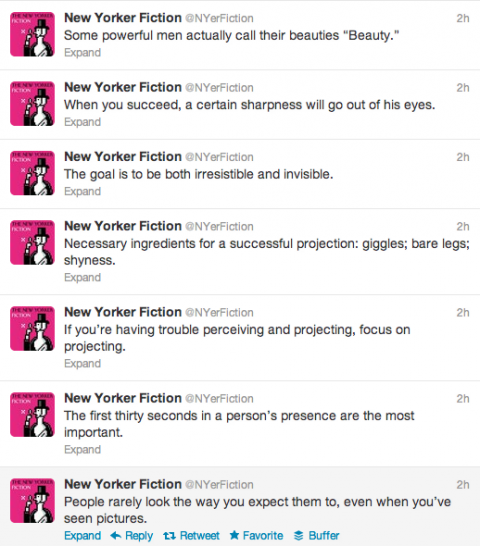
In March, Jennifer Egan (A Visit From the Goon Squad) paid a visit to Google and was asked to sum up her year since winning the Pulitzer Prize in 2011. She said: “I am still not used to the idea that I won it. Maybe I will finally really grab hold of that idea when someone else wins it. I will say ‘No, I want it!’ ” Little did she know that just a few weeks later the Pulitzer Prize judges would decline to name a successor, leaving her in mental limbo for yet another year. She seems to be handling it pretty well — well enough to publish a new short story on The New Yorker’s Fiction twitter stream. Yes, you read that right, its Twitter stream.
Starting last night, The New Yorker began tweeting her new story, “Black Box,” and the story will continue to unfold over nine more nightly installments. It’s a gimmick, you’re thinking, right? Well, for Egan, it’s not. She explains on The New Yorker web site:
I’d also been wondering about how to write fiction whose structure would lend itself to serialization on Twitter. This is not a new idea, of course, but it’s a rich one—because of the intimacy of reaching people through their phones, and because of the odd poetry that can happen in a hundred and forty characters. I found myself imagining a series of terse mental dispatches from a female spy of the future, working undercover by the Mediterranean Sea. I wrote these bulletins by hand in a Japanese notebook that had eight rectangles on each page. The story was originally nearly twice its present length; it took me a year, on and off, to control and calibrate the material into what is now “Black Box.”
If you’re a Twitter user, you can catch the live stream between 8 and 9 P.M. EDT. (And you can also follow our lively Twitter stream here.) If micro-serialized fiction isn’t your thing, then you can always follow the story on The New Yorker’s “Page Turner” blog.
Read More...Leonard Susskind, Father of String Theory, Warmly Remembers His Friend, Richard Feynman
Leonard Susskind — he’s the father of String Theory, someone who won the black hole wars with Stephen Hawking, and a Stanford professor who likes to bring physics to the broader public. (Find his 6‑course introduction to Modern Theoretical Physics in the Physics section of our collection of Free Online Courses.) Last year, Susskind headed to CalTech to talk about Richard Feynman. Of course, he’s the late, great physicist who won the Nobel Prize for his work on Quantum Electrodynamics (find his public lectures on that here). He also shared Susskind’s enthusiasm for popularizing science, creating memorable shows like Fun to Imagine, a television series for the BBC, and The Pleasure of Finding Things Out. In this warm talk, Susskind remembers his mentor and friend, a complex person few got to know very well. Feynman was many things — a great scientist, a showman, a philosopher, drummer, teacher, a bit of an egotist who could co-exist with other big egos, and much more.
Read More...Bill Murray Introduces Wes Anderson’s Moonrise Kingdom (And Plays FDR In December)
Excited Wes Anderson fans: do you need one more watchable to tide you over before Moonrise Kingdom enters wide release tomorrow? Wes Anderson-neutral filmgoers: do you need a little help cutting through the fans’ cloud of anticipation so you can make out what Moonrise Kingdom actually is? Both groups could benefit from a tour of the film by comedic superstar and unlikely Anderson regular Bill Murray. The film, a story of two young sweethearts on the run in 1965 New England, features Murray in the role of the girl’s father. Or, in his own words: “I play a, um… a man in the film.” He goes on to describe the director (“a nice guy, he’s made some good movies”), his co-stars (“Bruce Willis, playing a policeman — typecast, I guess”), and the production’s simple accommodations (“we had tents — like, pup tents”). He even crosses a wall from one set to another, echoing his tour of the Belafonte in The Life Aquatic with Steve Zissou, three Anderson movies back. Whether you need the excitement inflated or deflated, leave it to Murray, master of the deadpan multiple meaning.
If you follow Murray’s craft and the sometimes unexpected challenges to which he applies it, keep your eyes open this awards season for Hyde Park on Hudson, a drama built around Murray as former United States President Franklin Delano Roosevelt. Can’t envision it? Then give the trailer above a watch. The picture comes from director Roger Michell, best known in the last decade for Venus, and Notting Hill in the decade before that. This new period piece represents not a break from his usual English territory and sensibility so much as a recontextualization of it: it takes place during a particular weekend in 1939, the first time a British monarch made the trip to America, when Roosevelt entertained the King and Queen at his upstate New York home. The Wes Anderson faithful will note a reunion of sorts between Murray and Olivia Williams, who nearly fourteen years ago played Miss Cross in Anderson’s Rushmore. Her role in Hyde Park on Hudson? Eleanor Roosevelt.
Related Content:
Fact Checking Bill Murray: A Short, Comic Film from Sundance 2008
Wes Anderson’s New Commercials Sell the Hyundai Azera
Rare Footage: Home Movie of FDR’s 1941 Inauguration
Colin Marshall hosts and produces Notebook on Cities and Culture. Follow him on Twitter at @colinmarshall.
Read More...The First Films of Great Directors: Kubrick, Coppola, Scorsese, Tarantino & Truffaut
Great directors — unless they’re Orson Welles — rarely start off making masterpieces. Their craft evolves, reminding us that great filmmaking (like everything else) takes talent, but also hard work. In case you’re doubtful, we’re presenting the first films by five iconic directors, all featured here before, but never brought together into one place. Some first films are downright choppy; some are workmanlike; some are more refined. But none exactly soar to cinematic heights. Above, we start you off with Quentin Tarantino’s 1987 debut film My Best Friend’s Birthday, a choppy production that has something unmistakably Tarantinoesque about it, according to Colin Marshall.
In some sense, [My Best Friend’s Birthday] bears an even deeper imprint of Tarantino’s personality than his subsequent films [Pulp Fiction, Reservoir Dogs], since he stars in it as well. To behold the early-twentysomething Tarantino portraying the good-hearted and aggressively enthusiastic but jittery and distractible rockabilly DJ Clarence Poole is to behold the Quentin Tarantino public persona in an embryonic form, a distilled form — or both.
Long before Francis Ford Coppola shot Apocalpyse Now and The Godfather in the 1970s, he made his real directorial debut with a 75-minute, black-and-white psychological horror film called Dementia 13 (1963). He had made a couple of small-time nudie films before that. But this was his first mainstream, legit effort.
As Colin, our resident film critic has noted here, “To watch Dementia 13 now is to witness Coppola’s control of tension and darkness in its embryonic — but still impressive — form. Nobody involved in the production could have deluded themselves about its goal of shooting a few maximally gruesome axe murders as quickly and cheaply as possible, but even such straitened circumstances allow for pockets of artistry to bubble through.”
When you think Coppola, you think Scorsese too, another director who put his stamp on 1970s and 1980s cinema with Mean Streets, Taxi Driver, Raging Bull, and Goodfellas. We recently revisited Scorsese’s NYU film school days during the early 1960s, when he first cut his teeth as a director. We showed you several of his early shorts (find them all here), but highlighted one of his earliest works, What’s a Nice Girl Like You Doing in a Place Like This (1963). Scorsese would later describe the film as “nine minutes of visual nonsense,” while also saying “it had no depth at all, but it was a lot of fun. And it won me a scholarship, so my father was able to use it for the tuition for the next year.”
Whereas Martin Scorsese went to NYU and leisurely studied the history and aesthetics of cinema, Stanley Kubrick, a poor student, skipped college, started working as a photographer for Look magazine, and eventually began making movies to eke out a living. In the early 1950s, Kubrick started shooting newsreel documentaries, hoping to turn a tidy profit. And here you’ll find his first effort, Day of the Fight, a 1951 noirish documentary on middleweight boxer Walter Cartier and his match with Bobby James. It’s a workmanlike film, yes. But not exactly an obvious prelude to 2001: A Space Odyssey and A Clockwork Orange. Mike Springer has more on Kubrick’s early documentaries here.
The 1957 film, Les Mistons (The Brats), was technically François Truffaut’s second film but the first that ever satisfied him. Senses of Cinema has elsewhere called it “the director’s first short film of any real consequence.” Relative to the early efforts of other directors, this short demonstrates a more mature set of filmmaking skills, the kind that would be on display two years later when Truffaut released Les quatre cents coups (The 400 Blows), one of the defining films of French New Wave cinema. Colin Marshall takes a closer look at Les Mistons right here.
If you would like to support the mission of Open Culture, consider making a donation to our site. It’s hard to rely 100% on ads, and your contributions will help us continue providing the best free cultural and educational materials to learners everywhere. You can contribute through PayPal, Patreon, and Venmo (@openculture). Thanks!
Read More...Seven Questions for Stephen Hawking: What Would He Ask Albert Einstein & More
If Stephen Hawking could talk with Albert Einstein, what would he say?
“I would ask him why he didn’t believe in black holes,” says Hawking in this video from Time magazine. “The field equations of his General Theory of Relativity implied that a large star or cloud of gas would collapse in on itself and form a black hole. Einstein was aware of this but somehow managed to convince himself that something like an explosion would always occur to throw off mass and prevent the formation of a black hole. What if there was no explosion?”
The famous cosmologist, theoretical physicist and author of the bestseller A Brief History of Time made the remark in late 2010, when he agreed to take part in the Time’s “10 Questions” series. The magazine invited readers from around the world to submit questions for Hawking, but because of the scientist’s disability–he is fully paralyzed due to motor neurone disease and has to painstakingly compose his answers using a single cheek muscle to operate his word processor–the interview was pared down to seven questions.
One reader asks if Hawking thinks civilization will survive long enough to extend itself into deep space. “I think we have a good chance of surviving long enough to colonize the Solar System,” says Hawking. “However, there is nowhere else in the solar system anything like as suitable as the Earth, so it is not clear if we would survive if the Earth was made unfit for habitation. To ensure our long-term survival we need to reach for the stars. That will take much longer. Let’s hope we can last until then.”
Related content:
A Brief History of Time: Errol Morris’s Film of Stephen Hawking
Stephen Hawking’s Universe: A Visualization in Stars and Sound
Stephen Hawking: Abandon Earth or Face Extinction
Read More...Ridley Scott Demystifies the Art of Storyboarding (and How to Jumpstart Your Creative Project)
Some filmmakers put storyboards, those comic book-looking shot plans you sometimes glimpse in making-of documentaries, at the center of their creative process. Terry Gilliam, he of Brazil and 12 Monkeys, has described storyboards as the one thing he can safely “lock onto” during the complicated, ever-shifting shooting process. Other filmmakers, such as the heartily improvisational Werner Herzog, have dismissed storyboards as the tool of “cowards,” of “those who lack imagination,” of “those who are bureaucratic and nothing else on the set.” Having spent seven formative years in art school, Alien and Blade Runner director Ridley Scott develops his films by thinking as much through the framework of visual art as through that of cinema. In the video above, a laid-back Scott, cigar in hand, discusses how storyboards, sketches, and other pieces of hand-drawn imagery help him make movies.
Telling how he’s found locations, envisioned scenes within them, and used drawings to build those scenes, Scott offers an insight into the look and feel of his own work and useful advice to fellow creators, whether or not they work in a visual medium. His inspiration begins with an activity as simple — but nonetheless a source of “great enjoyment” — as looking at industrial landscapes out the window of a car. Sometimes he even begins thumbnail sketches then and there, in transit. Not only does his drafting background enable him to do that, but it leads to closer working relationships with his professional storyboard artists. Conferring with them mentally prepares him to “hit the floor” and shoot the scene. He reveals that, whether you’re directing a $120 million motion picture, painting a painting, or even writing a blog post, you face the same challenge: “Get rid of the white canvas. Get something right across the canvas. Otherwise you’re always looking at that area of white, which is like a blank sheet.” He notes that his methods have led to some calling his films “overdesigned and over-thought out,” but admits that, at this point, “I’ll probably just stay with the plan.”
via @webacion
Related Content:
Ridley Scott Readies a Prequel to Alien; Guy Pearce Gives Its “TED Talk”
Colin Marshall hosts and produces Notebook on Cities and Culture. Follow him on Twitter at @colinmarshall.
Read More...Sigmund Freud’s Home Movies: A Rare Glimpse of His Private Life
Not long ago we posted the only known recording of Sigmund Freud’s voice. Today we present rare home movies of the founder of modern psychology, captured during the last decade of his life.
The scenes are narrated by Freud’s youngest daughter Anna, who allowed the footage to be shown only within the psychoanalytic community before her death in 1982. The first scenes in the clip above were filmed in 1932 at Freud’s summer home in Pötzleinsdorf, a suburb of Vienna. He is shown visiting with his old friend Emanuel Löwy, an archaeologist, and petting his dog Jofi. The next sequence was shot between 1934 and 1937 at Freud’s later summer home in Grinzing, now a district of Vienna. It shows Freud relaxing with a book while his wife Martha and her sister, Minna Bernays, do their sewing. The movies were made by Freud’s friend and patient Mark Brunswick, husband of the psychoanalyst Ruth Mack Brunswick, a close associate of Freud’s.
You can watch the complete 24-minute film from which these scenes were taken on YouTube. And you can view or download a series of annotated clips at the Freud Museum Web site.
If you would like to support the mission of Open Culture, consider making a donation to our site. It’s hard to rely 100% on ads, and your contributions will help us continue providing the best free cultural and educational materials to learners everywhere. You can contribute through PayPal, Patreon, and Venmo (@openculture). Thanks!
Read More...Support Us
We're hoping to rely on loyal readers, rather than erratic ads. Please click the Donate button and support Open Culture. You can use Paypal, Venmo, Patreon, even Crypto! We thank you!

About Us

Open Culture scours the web for the best educational media. We find the free courses and audio books you need, the language lessons & educational videos you want, and plenty of enlightenment in between.
Advertise With Us

FREE UPDATES!
GET OUR DAILY EMAIL
Get the best cultural and educational resources on the web curated for you in a daily email. We never spam. Unsubscribe at any time.
FOLLOW ON SOCIAL MEDIA

Open Culture editor Dan Colman scours the web for the best educational media. He finds the free courses and audio books you need, the language lessons & movies you want, and plenty of enlightenment in between.
Advertise With Us

