Charles Bukowski: Depression and Three Days in Bed Can Restore Your Creative Juices (NSFW)
Pico Iyer once called Charles Bukowski the “laureate of American lowlife,” and that’s because he wrote poems for and about ordinary Americans — people who experienced poverty, the tedium and grind of work, and sometimes frayed relationships, bouts of alcoholism, drug addiction and the rest. Bukowski could write so eloquently about this because he came from this world. He grew up in a poor immigrant household with an abusive father, took to the bottle at an early age, worked at a Los Angeles post office for a decade plus, and had a long and tumultuous relationship with Jane Cooney Baker, a widow eleven years his senior, who drank to excess and died at 51, leaving Bukowski broken.
And then there’s the depression. Bukowski experienced that too. But he knew how to channel it, how to turn days of darkness into sources of personal and creative renewal. He explains it in some characteristically NSFW detail above.
To gain a more in-depth understanding of depression and its biological basis, we’d recommend watching this lecture by Stanford’s Robert Sapolksy.
Here’s a transcript of what Bukowski has to say:
I have periods where, you know, when I feel a little weak or depressed. Fuck it! The Wheaties aren’t going down right. I just go to bed for three days and four nights, pull down all the shades and just go to bed. Get up. Shit. Piss. Drink a beer down and go back to bed. I come out of that completely re-enlightened for 2 or 3 months. I get power from that.
I think someday…they’ll say this psychotic guy knew something that…you know in days ahead and medicine, and how they figure these things out. Everybody should go to bed now and then, when they’re down low and give it up for three or four days. Then they’ll come back good for a while.
But we’re so obsessed with, we have to get up and do it and go back to sleep. In fact there’s a woman I’m living with now, get’s around 12:30, 1pm, I say: “I’m sleepy. I want to go to sleep.” She says: “What? You want to go to sleep, it’s only 1pm!” We’re not even drinking, you know. Hell, there’s nothing else to do but sleep.
People are nailed to the processes. Up. Down. Do something. Get up, do something, go to sleep. Get up. They can’t get out of that circle. You’ll see, someday they’ll say: “Bukowski knew.” Lay down for 3 or 4 days till you get your juices back, then get up, look around and do it. But who the hell can do it cause you need a dollar. That’s all. That’s a long speech, isn’t it? But it means something.
via Biblioklept
If you would like to support the mission of Open Culture, consider making a donation to our site. It’s hard to rely 100% on ads, and your contributions will help us continue providing the best free cultural and educational materials to learners everywhere. You can contribute through PayPal, Patreon, and Venmo (@openculture). Thanks!
Related Bukowski:
Tom Waits Reads Charles Bukowski
The Last Faxed Poem of Charles Bukowski
Charles Bukowski Reads His Poem “The Secret of My Endurance”
Read More...Manuel Lima Visualizes Knowledge in Our Interconnected World in a Brand New RSA Animated Video
Throughout 2010 and 2011, the Royal Society of the Arts (RSA) developed a series of catchy videos that feature the words of thought leaders accompanied by the fast-moving animation of Andrew Park. Along the way, we have highlighted RSA talks by Stephen Pinker, Slavoj Zizek, Barbara Ehrenreich, Daniel Pink, Sir Ken Robinson, and Renata Salecl. Now, after a fairly long hiatus, the series returns — this time with Manuel Lima (senior UX design lead at Microsoft Bing) explaining how networks helps us map and create knowledge in our modern world. You can watch the full unanimated) lecture here.
Want to share intelligent media with family and friends? Join us on Facebook and Twitter.
Read More...A Most Unfortunate Commencement Typo at UT Austin
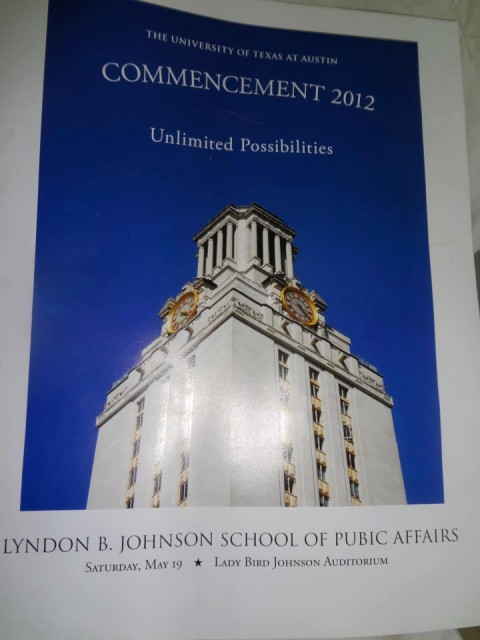
We’ll let you spot the typo to end all typos. Needless to say, the school has issued its mea culpa on Twitter and started printing new commencement brochures. Now they’ll wait with bated breath to see if their goof becomes fodder for The Daily Show. We all make mistakes and then we move on. via Jim Romanesko
Give us a follow on Facebook and Twitter, and you can share intelligent media (and the occasional joke) with family and friends.
Read More...Neil Gaiman Gives Graduates 10 Essential Tips for Working in the Arts
Neil Gaiman, considered one of the top ten living post-modern writers, never went to college. He neither started nor finished his advanced studies, but rather put himself into the world and started writing. And write he did. He’s now the New York Times bestselling author of the novels Neverwhere, Stardust, and American Gods, among others, and he’s also the winner of the 2009 Newbery Medal and 2010 Carnegie Medal in Literature. (We have gathered free versions of Gaiman’s writing in audio & text here.) This weekend, Gaiman spoke at The University of the Arts in Philadelphia and told the graduating class all the things he wish he knew at their age. The talk runs 19 minutes. The distilled version appears below.
- Embrace the fact that you’re young. Accept that you don’t know what you’re doing. And don’t listen to anyone who says there are rules and limits.
- If you know your calling, go there. Stay on track. Keep moving towards it, even if the process takes time and requires sacrifice.
- Learn to accept failure. Know that things will go wrong. Then, when things go right, you’ll probably feel like a fraud. It’s normal.
- Make mistakes, glorious and fantastic ones. It means that you’re out there doing and trying things.
- When life gets hard, as it inevitably will, make good art. Just make good art.
- Make your own art, meaning the art that reflects your individuality and personal vision.
- Now a practical tip. You get freelance work if your work is good, if you’re easy to get along with, and if you’re on deadline. Actually you don’t need all three. Just two.
- Enjoy the ride, don’t fret the whole way. Stephen King gave that piece of advice to Neil years ago.
- Be wise and accomplish things in your career. If you have problems getting started, pretend you’re someone who is wise, who can get things done. It will help you along.
- Leave the world more interesting than it was before.
via Metafilter
Read More...Last Night’s Solar Eclipse in a 60-Second, 700-Picture Timelapse Video
If you missed the big solar eclipse and its strange shadows last night, not to worry. Cory Poole, a science teacher in Redding, California, has you covered. Above, you’ll find his video that brings together 700 images (view them individually in high res here) into a 60 second time-lapse film. The images were viewed/taken through a Coronado Solar Max 60 Double Stacked Hydrogen Alpha Solar Telescope. The music was composed in Abelton Live. Find courses on Astronomy in our collection of Free Online Courses. via Gizmodo
Want to share intelligent media with family and friends? Join us on Facebook and Twitter.
Read More...Mussolini Sends to America a Happy Message, Full of Friendly Feelings, in English (1927)
Strange as it sounds, Benito Mussolini played a historic role in the introduction of talking motion pictures.
Throughout the early 1920s, various sound technologies for cinema were tested and exhibited publicly. By 1927 two rival companies were on the home stretch in the race to introduce a viable synchronized sound system for widespread commercial use in theaters. Warner Bros. had invested heavily in a recording-on-disc method trade-named “Vitaphone,” and would unveil the first feature film with recorded dialogue sequences, The Jazz Singer, on October 6, 1927. Meanwhile the Fox Film Corporation was developing a sound-on-film technology, called “Movietone,” that would later become the industry standard. With Movietone the audio was recorded as a variable-density optical track on the film, alongside the visual image, instead of on a separate gramophone record.


To beat Warner Bros. to the punch, Fox premiered its Movietone feature Sunrise, by the German expressionist filmmaker F.W. Murnau, at Times Square in New York on September 23, 1927, two weeks ahead of The Jazz Singer. Murnau’s film had synchronized music and sound effects, but no dialogue. The heavily publicized event included the screening of a pair of Movietone newsreels: one of the Vatican choir, the other of Mussolini. “See and Hear ‘The Man of the Hour’ His Excellency Benito Mussolini, Premier of Italy,” said a Fox advertisement. “He speaks to you and lives before your eyes on the Movietone!” The ground-breaking newsreel was a publicity coup for both the movie company and the dictator. Film historian Donald Crafton provides some background in his book The Talkies: American Cinema’s Transition to Sound, 1926–1931:
On 20 April 1927, Charles Pettijohn, general counsel for the Hays Office and head of the Film Boards of Trade, was meeting with Benito Mussolini. He suggested that the dictator sit for a filming, and Mussolini, a longtime film buff, readily agreed. Il Duce liked the result so much that he ‘is having a talking film prepared that will show his daily activities.’ Mussolini reportedly said, ‘Let me speak through [the newsreel] in twenty cities in Italy once a week and I need no other power.’ This film would enable him to appear in public with no threat of assassination.
The original version of the “Mussolini Movietone” included footage of Fascist regiments drilling, and a grand introduction of the dictator by the American ambassador to Italy, Henry P. Fletcher. “I am very glad,” Mussolini says in the newsreel, “to be able to express my friendly feelings towards the American nation, friendship with which Italy looks at the millions of citizens, who from Alaska to Florida, from the Pacific to the Atlantic, live in the United States, which lay deeply rooted in our hearts.” Fourteen years later Italy and the United States were at war, and less than four years after that, on April 28, 1945, Mussolini was killed by his own people. They made a newsreel about that, too.
If you would like to support the mission of Open Culture, consider making a donation to our site. It’s hard to rely 100% on ads, and your contributions will help us continue providing the best free cultural and educational materials to learners everywhere. You can contribute through PayPal, Patreon, and Venmo (@openculture). Thanks!
Read More...Sketches of Artists by the Late New Media Designer Hillman Curtis
Hillman Curtis began his career in the San Francisco new wave group Mrs. Green, served as Macromedia’s design director, founded the design firm hillmancurtis, Inc., wrote manuals on new media, and shot short documentaries. He accomplished much of note across the design professions before his untimely passing last month, and these projects reveal his great affinity for like-mindedly multidisciplinary and aesthetically inclined creators. He won a great deal of his internet fame examining just such people in the Artist Series, a cycle of five-to-ten minute profiles of, broadly speaking, his colleagues. These include Milton Glaser, the man behind the look of the immortal I Love New York campaign; David Carson, art director of the nineties’ cultishly coveted rock magazine Ray Gun; and Mark Romanek, director of striking commercials and feature films like One Hour Photo.
At the top of this post, you’ll find Curtis’ Artist Series short on Daniel Libeskind, the architect overseeing the rebuilding of the World Trade Center. It examines the architect’s buildings, his sketches, his meetings, and his ideas about the built environment as a tool for liberation rather than a “neutral world that confirms all our ideas.” Ultimately, Libeskind asks this of his craft, his profession, and his worldview: “How will it carry people into a world that is good?” Directly above is Curtis’ profile of graphic designer Paula Scher, who talks about the speed with which she sketched the Citibank logo. The client seems to have balked at this, assuming that anything so quickly created couldn’t possibly warrant the cost. Scher argues that, while it appeared to take her only a second, it really took her “a second and 34 years,” “a second and every experience and every movie and every thing of my life that’s in my head.” Neither she nor anyone else in the Artist Series sees divisions between their work, their life, and the rest of humanity. Hillman Curtis, by all accounts, lived the same way.
Related content:
Powers of Ten: The 1968 Documentary by Legendary Designers Ray and Charles Eames
Paola Antonelli on Design as the Interface Between Progress and Humanity
Classic Jazz Album Covers Animated, or the Re-Birth of Cool
Colin Marshall hosts and produces Notebook on Cities and Culture. Follow him on Twitter at @colinmarshall.
Read More...Adam Savage (Host of Mythbusters) Tells Sarah Lawrence Grads to Think Broadly … and Don’t Work for Fools
Adam Savage was born in New York City, not far from Sarah Lawrence College, the liberal arts school where he delivered the commencement speech this past weekend. Savage never went to Sarah Lawrence. Nor did he finish his own degree at NYU. But he had plenty to tell the graduating class. On his own web site, Savage calls himself “a maker of things.” As a kid, he made his own toys. As a young adult, he began experimenting with special effects for films, then served stints as an “animator, graphic designer, rigger, stage and interior designer, carpenter, scenic painter, welder, actor, writer, and television host.” (Perhaps you have seen his popular Discovery Channel show, Mythbusters.) In short, Savage is a “collector of skills, a polymath. How did he get this way? By casting his intellectual net widely and by continuing to learn throughout life — which is pretty much what we’re all about here. There’s a lot of good advice in this short, feel-good speech. Some of my favorite bits include:
“Don’t work for fools. It’s not worth it. Getting paid less to work for people you like and believe in is much better for you (and your career) in the long run.”
“Stay obsessed. That thing you can’t stop thinking about? Keep indulging it. Obsession is the better part of success. You will be great at the things that you can’t not do.”
“F. Scott Fitzgerald wrote The Great Gatsby and is one of our national treasures. A true giant of writing.The silliest thing he ever wrote is the quote, “There are no second acts in American lives.” This is insane. If there’s one thing that typifies the American experience it is that reinvention and rebirth are intrinsic to it. Raymond Chandler didn’t write a single word of any consequence until his 40s. Julia Child learned to cook at 40! Clint Eastwood directed his first film at 41. Don’t be afraid to be a late bloomer. Repeatedly.”
Good thoughts, all of them. You can find the full transcript here. H/T @opedr
More Commencement Speeches:
‘This Is Water’: Complete Audio of David Foster Wallace’s Kenyon Graduation Speech (2005)
Conan O’Brien Kills It at Dartmouth Graduation
J.K. Rowling Tells Harvard Grads Why Success Begins with Failure
Read More...Moons, Moons, They’re Everywhere. The Unexpected Shadows of the Solar Eclipse
 The eerie (and, for me, the unexpected) part of the solar eclipse now in full bloom in Northern California is that you can see the moon in the shadows. They’re everywhere. Here they appear on the door of a parked car.
Says Wired:
Those not directly in the path of the eclipse will still see some strange effects by stepping outside. Shadows cast from trees and bushes will contain thousands of tiny odd crescents, as the spaces between leaves become pinhole cameras.
Anyone remember those pinhole cameras from elementary school? You can watch a live stream of the eclipse below:
Read More...Einstein Explains His Famous Formula, E=mc², in Original Audio
Last week we played for you the only known recording of Sigmund Freud’s voice (1938). Now it’s time to revive the voice of another intellectual giant, Albert Einstein. In this recording, the physicist offers the briefest explanation of the world’s most famous equation, E=mc2. When was this recorded? We’re unfortunately not sure. Let’s just say somewhere between 1932 (a date Einstein mentions in the clip) and his death in 1955. Somewhere in those 20+ years, give or take a few. Don’t miss the recently-opened Einstein archive and many free Physics courses in our collection of Free Online Courses from top universities.
If you would like to support the mission of Open Culture, consider making a donation to our site. It’s hard to rely 100% on ads, and your contributions will help us continue providing the best free cultural and educational materials to learners everywhere. You can contribute through PayPal, Patreon, and Venmo (@openculture). Thanks!
Read More...Support Us
We're hoping to rely on loyal readers, rather than erratic ads. Please click the Donate button and support Open Culture. You can use Paypal, Venmo, Patreon, even Crypto! We thank you!

About Us

Open Culture scours the web for the best educational media. We find the free courses and audio books you need, the language lessons & educational videos you want, and plenty of enlightenment in between.
Advertise With Us

FREE UPDATES!
GET OUR DAILY EMAIL
Get the best cultural and educational resources on the web curated for you in a daily email. We never spam. Unsubscribe at any time.
FOLLOW ON SOCIAL MEDIA

Open Culture editor Dan Colman scours the web for the best educational media. He finds the free courses and audio books you need, the language lessons & movies you want, and plenty of enlightenment in between.
Advertise With Us


