Explorer David Livingstone’s Diary (Written in Berry Juice) Now Digitized with New Imaging Technology
One of the 19th century’s most intriguing figures, the Scottish explorer David Livingstone may be best known for words uttered by a reporter when the two men met on the shores of Lake Tanganyika: “Dr. Livingstone, I presume?”
David Livingstone disappeared in Africa for six years before meeting the famously quoted Henry Morton Stanley. He was a hero in Victorian England for his rags-to-riches story of an impoverished boy who went on to become a scientific investigator and anti-slavery crusader. Livingstone became impassioned about the potential of Christianity to eradicate the slave trade in Africa and took his missionary work into the African interior.
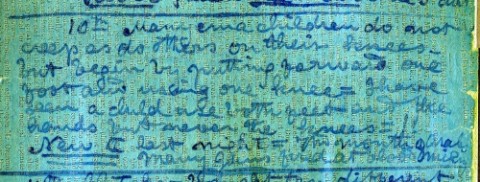
An avid chronicler of his adventures, Livingstone left behind a number of journals, but one of his most vivid accounts—of a massacre hit witnessed in 1871—has been inaccessible until now. Livingstone’s 1871 Field Diary captures a five-month period when the explorer was stranded in a village in the Congo. He had run out of paper and ink to maintain his usual journal, so he improvised by writing over an old copy of The Standard newspaper using ink made from the seeds of a local berry.
In collaboration with British and American archivists, the UCLA Digital Library Program used spectral imaging technology to digitize the delicate material. Overall the site offers an interesting presentation of Livingstone’s work, though the diary pages themselves aren’t too legible. Critical notes are abundant and intriguing, and diary pages appear side-by-side with transcriptions. Viewers can zoom in to study Livingstone’s spidery script written perpendicular to the newspaper copy. The spectral imaging process itself is worth a look. Without this technique, the diaries appear as nothing more than ghostly scribbles.
Previous to keeping this field diary, Livingstone embarked on a mission to find the source of the Nile River, which he misidentified. But his theories about central African water systems are fascinating. Livingstone was the first European to see Mosi-oa-Tunya, “the smoke that thunders,” waterfall, which he renamed Victoria Falls after his monarch. His diaries provide a peek into a time when exploration was dangerous, difficult and even deadly. Livingstone died of Malaria in present-day Zambia, where his heart is buried under a tree. The rest of his remains were interred at Westminster Abbey.
Kate Rix is an Oakland based freelance writer. See more of her work at .
Read More...Neil Young’s New Album, Americana, Electrifies the Folklore You Know and Love
Neil Young’s new album, his first with Crazy Horse in nine years, is a raw, heavily amplified interpretation of classic American folk songs of the kind many of us learned in elementary school, like “She’ll Be Coming ‘Round the Mountain” and “Oh My Darling, Clementine.”
But while the guitar chords may be distorted, the lyrics are not. As Young told Terry Gross this week on NPR’s “Fresh Air,” he wants listeners to hear the words as they were originally written. So, for example, he has restored the scathing protest-song elements of Woody Guthrie’s “This Land is Your Land.” And in “Clementine” he sings a verse teachers didn’t want innocent little children to hear: “How I missed her, how I missed her, how I missed my Clementine. So I kissed her little sister, and forgot my Clementine.”
One of the best tracks on the new album is a rollicking version of “She’ll Be Coming ‘Round the Mountain.” (See the video above.) In the “Fresh Air” interview, Young explains the origin of his arrangement:
I heard that song back in 1964, and I was really into the groove and the melody and the fact that it was an old song with a new melody and old lyrics. And then, when I did it in 2012, I started relating more to the lyrics and started doing more research on the lyrics. I actually got into what the lyrics were really about more than I was in 1964. I chose a few verses that emphasized a certain darkness, but they were all the original verses.
Young was first exposed to a few of the songs on Americana when he heard Tim Rose and The Thorns play in Canada in 1964. He was deeply impressed by Rose’s rocking arrangement of “Oh, Susanna” (another song on the new album). “I saw what he did to ‘Oh, Susanna,’ and thought, wow, I could do that to a lot of these songs,” Young told Gross. “And that’s a really cool thing to do to them, because it gives them a new life. Plus I have drums in my band, and the Thorns didn’t have drums, so I knew we could really rock these things.”
You can listen to Young’s interview with Terry Gross, which includes more songs from the new album, at the NPR Web site. And you can get your copy of Americana right here.
Read More...Ray Bradbury Reads Moving Poem, “If Only We Had Taller Been,” on the Eve of NASA’s 1971 Mars Mission
Powerful. Simply powerful. In November, 1971, the Mariner 9 space orbiter was about to make history. It was rapidly approaching Mars, making it the first spacecraft to orbit another planet. There, it would produce a global mapping of the Martian surface and capture “the first detailed views of the martian volcanoes, Valles Marineris, the polar caps, and the satellites Phobos and Deimos.” This marked a major milestone in the great era of space exploration. The excitement leading up to the moment was palpable.
Just days before the Mariner 9 reached Mars, two of our greatest sci-fi writers, the dearly departed Ray Bradbury and Arthur C. Clarke, shared the stage with two eminent scientists, Carl Sagan and Bruce Murray, at a symposium held at Caltech. At one point, Bradbury captivated the audience when he read his poem, “If Only We Had Taller Been,” and gave an almost spiritual inflection to the Mariner 9 mission, reminding us of something that Neil deGrasse Tyson once said: the line separating religious epiphany and feelings created by space exploration is awfully, awfully thin.
The video, which comes to us via BoingBoing, was put online by NASA’s Jet Propulsion Laboratory.
Follow Open Culture on Facebook and Twitter and share intelligent media with your friends. Or better yet, sign up for our daily email and get a daily dose of Open Culture in your inbox. And if you want to make sure that our posts definitely appear in your Facebook newsfeed, just follow these simple steps.
Read More...The Transit of Venus in HD Video
We told you how to get ready for the great 2012 Transit of Venus. Now it’s only fitting that we show you how it all went down. Courtesy of NASA’s Solar Dynamics Observatory, we have high def video of the “rarest predictable solar event.” The good people at NASA have made this video free to download on their web site. Get it right here.
Read More...Ray Bradbury Offers 12 Essential Writing Tips and Explains Why Literature Saves Civilization
We woke up today to learn about the sad passing of Ray Bradbury. Bradbury now joins Isaac Asimov, Arthur C. Clarke, Robert A. Heinlein, and Philip K. Dick in the pantheon of science fiction. It’s a place well deserved, seeing that he effectively brought modern science fiction into the literary mainstream. His first short story, “Hollerbochen’s Dilemma,” appeared in 1938. And his last one, “Take Me Home,” was just published this week in The New Yorker’s first special issue devoted to science fiction. During the 74 years in between, Bradbury published eleven novels, including the great Fahrenheit 451, and countless short stories. His books, now translated into 36 languages, have sold over eight million copies.
To help celebrate his literary legacy, we want to revisit two moments when Bradbury offered his personal thoughts on the art and purpose of writing. Above, we start you off with a 1970s clip where Bradbury explains why literature serves more than an aesthetic purpose — it’s actually the safety valve of civilization. (See our original post here.) And below we bring you back to Bradbury’s 2001 keynote address at Point Loma Nazarene University’s Writer’s Symposium By the Sea. There, he gives 12 essential pieces of writing advice to young writers. You can find a nice list of his tips in our original post here. And, if you’re hungering for more, let us direct you to another clip recommended by one of our readers: a lengthy talk recorded in 2005 at the Los Angeles Times Festival of Books.
Related Content:
Free Science Fiction Classics on the Web: Huxley, Orwell, Asimov, Gaiman & Beyond
Read More...
Salvador Dalí’s Illustrations of Dante’s The Divine Comedy
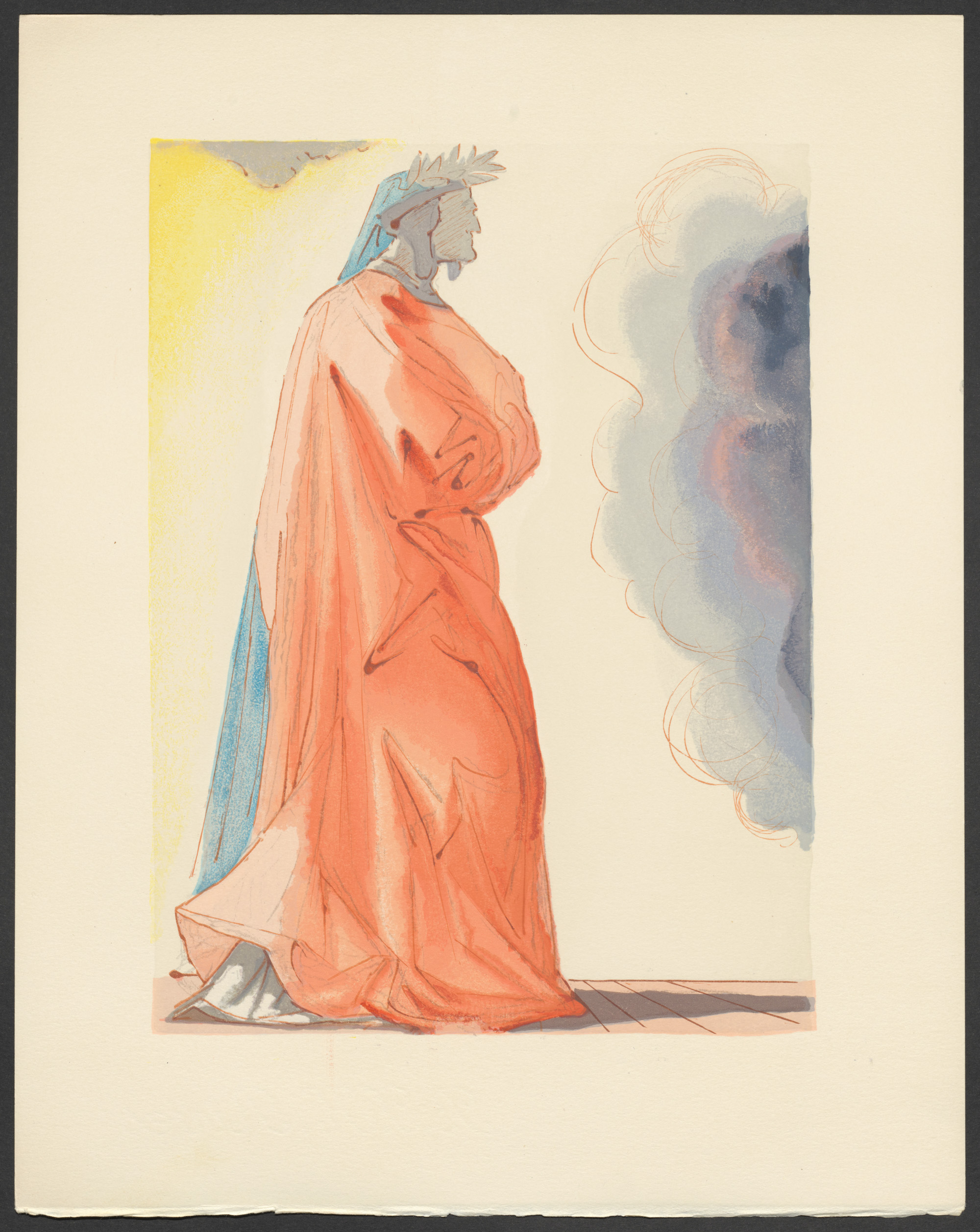
In 1957, the Italian government commissioned Salvador Dalí to paint a series of 100 watercolor illustrations of Dante’s Divine Comedy, the greatest literary work written in the Italian language. The illustrations were to be finished by 1965, the 700th anniversary of the poet’s birth, and then reproduced and released in limited print editions. The deal fell apart, however, when the Italian public learned that their literary patrimony had been put in the hands of a Spaniard. Undeterred, Dalí pushed forward on his own, painting illustrations for the epic poem that collectively recount Dante’s symbolic travels through Hell, Purgatory and Heaven. After Dalí did his part, the project was handed over to two wood engravers, who spent five years hand-carving 3,500 blocks used to create the reproductions of Dalí’s masterpiece. Almost 50 years later, print editions can still be purchased online. And the paintings themselves still travel the globe, making their way to museums large and small. You can view images from the collection at this Cornell University website.
Related Content
Salvador Dalí’s Haunting 1975 Illustrations for Shakespeare’s Romeo and Juliet
Read More...Talking Heads Live in Rome, 1980: The Concert Film You Haven’t Seen
Few bands can boast a performance so image-defining as the one the Talking Heads pulled off in Jonathan Demme’s Stop Making Sense. Given its physical meticulousness, its seamless editing, and its refined aesthetic sense — qualities rarely prioritized in rock concert films — its place in the zeitgeist seems well earned. But that picture opened in 1984, when the band had already released its most widely respected albums, and when they had only four years to go before effectively dissolving. Live in Rome, which you can now watch uncut on YouTube, captures the Heads in 1980, a less established moment in their history. David Byrne and company express the same kind of off-kilter energy on display in Stop Making Sense — the enthusiasm of punks who also happen to be musicology nerds — but here they express it in a simpler, more traditionally “rock concert-ish” setting.
Talking Heads enthusiasts, note that Live in Rome features the group’s full “Afro-Funk Orchestra” lineup. Additionally, you’ll see on guitar a certain Adrian Belew, who would begin fronting King Crimson the following year. (As he might, in another reality, have fronted the Heads themselves; in our reality, he turned down an offer to take Byrne’s place.) The songs not heard in Stop Making Sense include “Stay Hungry,” “Cities,” “I Zimbra,” “Drugs,” “Houses in Motion,” “Born Under Punches,” and “The Great Curve.” No die-hard fan will feel completely satisfied with this concert, of course, until someone remasters it on Blu-Ray with a complete surround sound mix. But if you simply need a hit of a pack of art-school rockers unlike any others America has produced, this Remain in Light-era hour merits a permanent bookmark. H/T Biblioklept
Related content:
David Byrne Interviews Himself, Plays Seven Characters, in Funny Promo for Stop Making Sense
David Byrne: From Talking Heads Frontman to Leading Urban Cyclist
Colin Marshall hosts and produces Notebook on Cities and Culture. Follow him on Twitter at @colinmarshall.
Read More...Great Violinists Playing as Kids: Itzhak Perlman, Anne-Sophie Mutter, & More
For most children the word “playing” brings to mind things like wiffleball or hide-and-seek. But for a very few talented and dedicated kids it means Mozart, or Mendelssohn. Today we bring you four videos of famous violinists playing when they were incredibly young.
Itzhak Perlman, age 13: “When I came to the United States, ” Itzhak Perlman told Pia Lindstrom of The New York Times in 1996, “I appeared on The Ed Sullivan Show as a 13-year-old and I played a Mendelssohn Concerto and it sounded like a talented 13-year-old with a lot of promise. But it did not sound like a finished product.” In the clip above, Perlman plays from the third movement of Felix Mendelssohn’s Concerto in E minor during his debut Sullivan Show appearance in 1958. The young boy was an instant hit with the audience, and Sullivan invited him back. Encouraged by his sudden celebrity, Perlman’s parents decided to move from Israel to New York and enroll him in Julliard. But despite his precocity, Perlman modestly asserts that he was no child prodigy. “A child prodigy is somebody who can step up to the stage of Carnegie Hall and play with an orchestra one of the standard violin concertos with aplomb,” Perlman told Lindstrom. “I couldn’t do that! I can name you five people who could do that at the age of 10 or 11, and did. Not five, maybe three. But I couldn’t do that.”
Anne-Sophie Mutter, age 13:
One violinist who certainly was able to perform at a high level at a very early age was the German virtuoso Anne-Sophie Mutter, shown here performing the Méditation from the Jules Massenet opera Thaïs with Herbert von Karajan and the Berlin Philharmonic in 1976, when she was 13. Mutter began playing the violin at the age of five, and by nine she was performing Mozart’s Second Violin Concerto in public. Karajan took her under his wing when she was 13, calling her “the greatest musical prodigy since the young Menuhin.”
Jascha Heifetz, age 11:
Jascha Heifetz was indisputably one of the greatest violinists of the 20th century. His father, a music teacher, first put a violin into his hands when Heifetz was only two years old. He entered music school in his hometown of Vilnius, Lithuania, at the age of five, and by seven he was performing in public. At nine he entered the St. Petersburg Conservatory, where he studied with Leopold Auer. In this very rare audio recording from November 4, 1912, an 11-year-old Heifetz performs Auer’s transcription of Wolfgang Amadeus Mozart’s Gavotte in G from the opera Idomeneo. It was made by Julius Block on a wax-cylinder Edison phonograph in Grünewald, Germany. Heifetz is accompanied by Waldemar Liachowsky on piano. At the end of the performance the young boy’s voice can be heard speaking in German. Roughly translated, he says, “I, Jascha Heifetz of Petersburg, played with Herr Block, Grünewald, Gavotte Mozart-Auer on the fourth of November, nineteen hundred and ten.” A week earlier, Heifetz made his debut appearance with the Berlin Philharmonic. In a letter of introduction to the German manager Herman Fernow, Auer said of Heifetz: “He is only eleven years old, but I assure you that this little boy is already a great violinist. I marvel at his genius, and I expect him to become world-famous and make a great career. In all my fifty years of violin teaching, I have never known such precocity.”
Joshua Bell, age 12:
The American violinist Joshua Bell began playing when he was four years old, and made his debut as a soloist with the Philadelphia Orchestra when he was 14. The video above is different from the others, in that it doesn’t present a polished performance. Instead, we watch as the legendary violin teacher Ivan Galamian conducts a lesson in 1980, when Bell was 12. Bell spent two summers studying at Galamian’s Meadowmount School of Music in the Adirondack Mountains of upstate New York. In the video, the elderly teacher works with Bell as he plays from Pierre Rode’s Etude No. 1.
Read More...Author Flannery O’Connor Captured on Film at Age 5, with Her Chickens
In 1961, Flannery O’Connor wrote an essay called “Living with a Peacock,” which begins like this:
When I was five, I had an experience that marked me for life. Pathé News sent a photographer from New York to Savannah to take a picture of a chicken of mine. This chicken, a buff Cochin Bantam, had the distinction of being able to walk either forward or backward. Her fame has spread through the press and by the time she reached the attention of Pathé News, I suppose there was nowhere left for her to go—forward or backward. Shortly after that she died, as now seems fitting.
If I put this information in the beginning of an article on peacocks, it is because I am always being asked why I raise them, and I have no short or reasonable answer.
From that day with the Pathé man I began to collect chickens. What had been only a mild interest became a passion, a quest. I had to have more and more chickens. I favored those with one green eye and one orange or with over-long necks and crooked combs. I wanted one with three legs or three wings but nothing in that line turned up. I pondered over the picture in Robert Ripley’s book, Believe It Or Not, of a rooster that had survived for thirty days without his head; but I did not have a scientific temperament . I could sew in a fashion and I began to make clothes for chickens. A gray bantam named Colonel Eggbert wore a white piqué coat with a lace collar and two buttons in the back. Apparently Pathé News never heard of any of these other chickens of mine; it never sent another photographer.
Now you have the backstory for the video above — the young girl caught on film, tending to her chickens, many years before she wrote “A Good Man is Hard to Find” (listen to her read it here) and other stories. Thanks goes to Josh for flagging this for us.…
Read More...This is Coffee!: A 1961 Tribute to Our Favorite Stimulant
Water. Coffee. Time. It’s those three special ingredients that went into making the traditional cup of American coffee. In case you missed that, let me remind you: It’s water, coffee, and time. Don Draper had nothing to do with this 13-minute, nostalgia-inducing infomercial from 1961. Rather, it’s the work of the Coffee Brewing Institute, which turned the art of making coffee into a dismal science — that is, until glorious Peet’s came around. This clip permanently resides in the Prelinger Archive, and comes to us via The Atlantic.
If you would like to support the mission of Open Culture, consider making a donation to our site. It’s hard to rely 100% on ads, and your contributions will help us continue providing the best free cultural and educational materials to learners everywhere. You can contribute through PayPal, Patreon, and Venmo (@openculture). Thanks!
Related Content:
Everything You Wanted to Know About Coffee in Three Minutes
Jim Henson’s Violent Wilkins Coffee Commercials (1957–1961)
A Rollicking French Animation on the Perils of Drinking a Little Too Much Coffee
Read More...Support Us
We're hoping to rely on loyal readers, rather than erratic ads. Please click the Donate button and support Open Culture. You can use Paypal, Venmo, Patreon, even Crypto! We thank you!

About Us

Open Culture scours the web for the best educational media. We find the free courses and audio books you need, the language lessons & educational videos you want, and plenty of enlightenment in between.
Advertise With Us

FREE UPDATES!
GET OUR DAILY EMAIL
Get the best cultural and educational resources on the web curated for you in a daily email. We never spam. Unsubscribe at any time.
FOLLOW ON SOCIAL MEDIA

Open Culture editor Dan Colman scours the web for the best educational media. He finds the free courses and audio books you need, the language lessons & movies you want, and plenty of enlightenment in between.
Advertise With Us

