Acclaimed BBC Production of Hamlet, Starring David Tennant (Doctor Who) and Patrick Stewart (Star Trek)
In 2008 the Royal Shakespeare Company drew rave reviews for its production of William Shakespeare’s Hamlet, which featured the Scottish actor David Tennant, star of the hit BBC science fiction show Doctor Who, as the tragically indecisive Prince of Denmark.
“Gregory Doran’s production is one of the most richly textured, best-acted versions of the play we have seen in years,” wrote Michael Billington in The Guardian. “And Tennant, as anyone familiar with his earlier work with the RSC would expect, has no difficulty in making the transition from the BBC’s Time Lord to a man who could be bounded in a nutshell and count himself a king of infinite space. He is a fine Hamlet whose virtues, and occasional vices, are inseparable from the production itself.”
The cast included Mariah Gale as Ophelia, Peter de Jersey as Horatio, Oliver Ford Davies as Polonius, Penny Downie as Gertrude, and Patrick Stewart of Star Trek fame in what Charles Spencer of The Telegraph called “the strongest, scariest performance as Claudius I have seen. A modern tyrant in a surveillance state full of spies, informers and two-way mirrors in Doran’s thriller-like production, he presents a façade of smiling, bespectacled geniality.” Stewart also played the Ghost of Hamlet’s father.
“This is a Hamlet of quicksilver intelligence, mimetic vigour and wild humour,” wrote Billington: “one of the funniest I’ve ever seen.” According to Nicholas de Jongh of The Evening Standard, Tennant brought new insights into his character’s unpredictable behavior: “His humorous Hamlet emerges as an undiagnosed manic depressive, whose mood swings render him temperamentally incapable of fulfilling a revenge scenario.”
For those of us unable to see the stage production, we’re fortunate that Doran held the original cast together long enough to make a film version, first broadcast on BBC Two in 2009. You can watch the complete three-hour movie online over at PBS. A scene where Tennant performs Hamlet’s Soliloquy can be viewed above. And for more of Hamlet and Shakespeare, you can access text and audio versions of the great writer’s complete works in our Free eBooks and Free Audio Books collections.
The BBC production of Hamlet has been added to our collection, 4,000+ Free Movies Online: Great Classics, Indies, Noir, Westerns, Documentaries & More.
Read More...
Bruce Springsteen Exhibition Held in Philadelphia; It’s Now Official, The Boss is an American Icon
It’s official. Bruce Springsteen has gone from musician to American icon, joining the likes of Woody Guthrie and Pete Seeger. Want some proof of his transcendence? Just look to Philadelphia where The National Constitution Center is holding the first major exhibition about the American songwriter. From Asbury Park to the Promised Land: The Life and Music of Bruce Springsteen takes a comprehensive look at Springsteen’s body of musical work with the help of 15o artifacts. Ask why a Springsteen exhibit deserves to be held in The National Constitution Center, and its CEO/President David Eisner will tell you that the “Constitution Center is about the values [e.g. freedom & equality] and dreams on which America was based, and Springsteen’s music is all about achieving the American Dream.” What’s more, Springsteen’s music touches on deeply American political issues, including the First Amendment.
The exhibition runs through September 3rd (tickets available here), and every Friday the Constitution Center plans to publish on its blog articles inspired by Bruce Springsteen and the First Amendment.
Read More...McLuhan Said “The Medium Is The Message”; Two Pieces Of Media Decode the Famous Phrase
For my money, “I don’t necessarily agree with everything I say” tops the list of Marshall McLuhan-isms, followed closely and at times surpassed by “You don’t like those ideas? I got others.” Many prefer the immortal “You know nothing of my work!”, the line McLuhan delivers during his brief appearance in Woody Allen’s Annie Hall. In 1977, the same year Allen’s protagonist would summon him to defeat that pontificating academic, McLuhan flew to Sydney to deliver a lecture. Then, for the Australian Broadcasting Corporation’s Radio National, he recorded a program answering questions from students, nuns, and others about his views on media. (Find Part 1 above, and Parts 2 and 3 here and here.) McLuhan happened to view media in a way nobody else did at the time, and the fields of media studies and media theory would go on to develop in large part from his work. This Joyce-loving, God-fearing, sixteenth-century-pamphlet-studying professor of English literature nevertheless deployed modern sound bites with as much industry as he scrutinized them. Hence the endurance, over thirty years after his death and over forty years past the peak of his popularity, of “The medium is the message,” a phrase that, seemingly since the moment McLuhan first uttered it, has stood as a lightning rod to his detractors.
Very often, someone will insist that, no, the content of a message matters too, making the pronouncement with the attitude of having seen through the emperor’s clothes. A disembodied voice makes a similar criticism of McLuhan’s critics in The Medium is the Massage, the 1968 album that mirrors both the content and the dense, experimental visual collage form of McLuhan and graphic designer Quentin Fiore’s eponymous book. Listen to the album (side A, side B) at UBUweb’s Marshall McLuhan sound archive and get an aural glimpse into the mind that, upon receiving a proof of his book back from the printer’s with the title misspelled, suddenly realized that only the word Massage, with connotations of the mass media in whose age he lived, expressed the full extent of his meaning. But he did believe that the very existence of the telephone or television, and the effects of their existence on humanity as a whole, made for an infinitely richer object of study than whatever content humans happened to send across them. Through the pieces of media in this post, you can see and hear McLuhan expand upon this idea in his deliberate, oratorically metaphorical, sometimes maddeningly oblique manner. He works through the implications of, extensions of, and possible contradictions to this oddly robust notion, which some, in our hypercommunicative, endlessly mediated internet age, would in hindsight call prophecy.
Related content:
Marshall McLuhan on the Stupidest Debate in the History of Debating
Marshall McLuhan: The World is a Global Village
Norman Mailer & Marshall McLuhan Debate the Electronic Age
Colin Marshall hosts and produces Notebook on Cities and Culture. Follow him on Twitter at @colinmarshall.
Read More...An Easy, Scientifically-Proven Way to Make Yourself Smarter. Go for a Good Walk or Swim Every Day

This week, The New York Times gave us some good news. According to an article by Gretchen Reynolds, a decade of research by neuroscientists and physiologists shows fairly convincingly that exercise can make you smarter. She writes:
Using sophisticated technologies to examine the workings of individual neurons — and the makeup of brain matter itself — scientists in just the past few months have discovered that exercise appears to build a brain that resists physical shrinkage and enhance cognitive flexibility. Exercise, the latest neuroscience suggests, does more to bolster thinking than thinking does.
There’s apparently a lot to be gained from a simple daily walk (assuming it checks out with your doctor). And, as the video below shows, the gains goes beyond cognition itself:
The photo above was provided courtesy of BigStockPhoto
Read More...Celestial Lights: Spectacular Auroras Move Across the Scandinavian Skies
Norwegian photographer Ole C. Salomonsen has created a stunning time-lapse film of the aurora borealis over rugged Nordic landscapes.
Salomonsen lives in the city of Tromsø, 200 miles north of the Arctic Circle, where the sun doesn’t rise above the horizon between November and January. Tromsø is considered one of the best (inhabited) places on Earth to see Northern Lights. This past winter the light show was particularly intense, as the sun moved closer to the peak (expected in early 2013) of its 11-year cycle of electromagnetic activity.
The photographer went to extraordinary lengths to capture these images, traveling across northern Norway, Sweden and Finland over a half-year period beginning in September and ending earlier this month, when the daylight hours grew too long. “I have driven thousands of km between locations up here in the arctic this season,” Salomonsen writes on his Vimeo page. “I was running between 2–3 cameras like a madman.” He estimates he shot about 150,000 exposures to get the 6,000 or so frames used in the four-and-a-half-minute video above. He writes:
The video is a merge of two parts; the first part contains some more wild and aggressive auroras, as well as a few milky way sequences, hence either auroras are moving fast because they are, or they are fast due to motion of the milky way/stars. Still, some of the strait up shots are very close to real-time speed, although auroras mostly are slower, she can also be FAST! The second part has some more slow and majestic auroras, where I have focused more on composition and foreground.
The music is by Norwegian composer Kai-Anders Ryan. To learn about the technical aspects of Celestial Lights, and to see the film Salomonsen made during last year’s aurora season, visit his Vimeo page. And to see his beautiful still images, visit Salomonsen on Facebook and Flikr.
via Universe Today
Read More...Martin Scorsese Captures Levon Helm and The Band Performing “The Weight” in The Last Waltz
Born in Arkansas in 1940, Levon Helm grew up listening Elvis Presley, Little Richard, Johnny Cash and Jerry Lee Lewis. By the 1960s, he began putting his personal stamp on rock ’n’ roll. During those years, Helm and guitarist Robbie Robertson joined Bob Dylan’s ever-so-controversial electric band and played together during the infamously tumultuous 1966 tour. Then, Helm and Robertson decided to form their own band — The Band. Robertson wrote or co-wrote most of their songs, while Helm often gave voice to them. And so things went until they didn’t.
In 1976, The Band broke up, but not before they played an epic final concert that Martin Scorsese documented for posterity in his film, The Last Waltz. Decades later, many critics consider it “the greatest rock concert movie ever made.” And although the film consisted mostly of live footage from their farewell concert in San Francisco, Scorsese filmed one of The Band’s memorable songs, “The Weight,” on an MGM soundstage. You can find the performance above, and Levon Helm singing soulfully on drums. The scene also features a guest appearance by Mavis Staples, along with her father and sisters in The Staple Singers.
Related Content:
Jean-Luc Godard Films The Rolling Stones Recording “Sympathy for the Devil” (1968)
Martin Scorsese’s Very First Films: Three Imaginative Short Works
Read More...The Geometry of Sound Waves Visualized
Turn down your speakers … but not all of the way off. Now see what sound waves look like when they’re visualized and the geometric patterns they make. They’re called Chladni patterns, and they get their name from Ernst Chladni (1756–1827), a German physicist and musician whose work earned him the title, “The Father of Acoustics.”
Related Content:
Visualizing WiFi Signals with Light
Magnetic Fields Made Visible
Futurist Arthur C. Clarke on Mandelbrot’s Fractals
Follow us on Facebook, Twitter and now Google Plus and share intelligent media with your friends! They’ll thank you for it.
Read More...Roger McGuinn, Frontman of The Byrds, Curates Folk Den, Lets You Download Free Folk Music
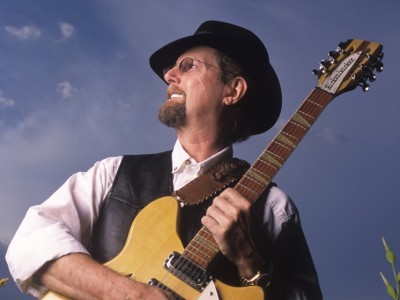
Roger McGuinn of the Byrds was one of the most influential singers and guitarists of the 1960s. Although his own influences range from Ravi Shankar to John Coltrane, McGuinn’s roots are in folk music. The Byrds were among the first to fuse folk with rock and roll. “I’ve always considered myself a folksinger,” McGuinn told Neal Conan this week on NPR’s Talk of the Nation, “even though we strapped on Rickenbacker guitars and played pretty loud. But I was a folksinger at heart because we always loved folk music. I loved the melodies and the stories.”
In the mid 1990s McGuinn was listening to a Smithsonian Folkways record when it occurred to him that he wasn’t hearing traditional songs played anymore, even in folk clubs. “So I thought, ‘What’s going to happen when Odetta dies?’ Well, as you know, she just passed away. And Pete Seeger’s, what, he’s 92, 93. He’s getting up there. So I thought I’d do something about it.”
McGuinn had always been an early adopter of new technologies. He owned a mobile telephone in the early 1970s and bought his first personal computer in 1981. So in 1995 he got the idea of establishing Folk Den, a website dedicated to preserving the traditional folk music that he loves. On the first day of each month, McGuinn posts a new song. There are now almost 200 MP3 files online, available for free download. In some of the recordings McGuinn is joined by his wife, Camilla. To get the flavor of what’s available, here are three quick examples:
But you really must visit the Folk Den Web site, which includes lyrics, chords, visual material and a little introduction to each song written by McGuinn. And to hear McGuinn’s Talk of the Nation interview, which includes musical performances, visit the NPR Web site.
Read More...Coursera Adds Humanities Courses, Raises $16 Million, Strikes Deal with 3 Universities

During the past two months, two ventures offering free MOOCS (Massive Open Online Courses) have spun out of Stanford. One is Udacity run by Sebastian Thrun. And the other is Coursera, which announced a slew of big news today.
To start with, it raised $16 million in funding from venture capital firms Kleiner Perkins Caufield & Byers and New Enterprise Associates.
Next it announced agreements to offer courses by Princeton, the University of Pennsylvania, and the University of Michigan (in addition to Stanford).
And finally it has added humanities courses to its upcoming fall curriculum — a departure from the MOOC norm of only offering courses in computer science & engineering. Courses include:
- A History of the World since 1300 (Princeton)
- Fantasy and Science Fiction: The Human Mind, Our Modern World (Michigan)
- Greek and Roman Mythology (Penn)
- Listening to World Music (Penn)
- Modern & Contemporary American Poetry (Penn)
The courses will get started in the Fall. In the meantime, don’t miss our collection of 450 Free Courses from top universities, including Stanford, MIT, Yale, Harvard, Oxford and beyond.
Read More...Frankenweenie: Tim Burton Turns Frankenstein Tale into Disney Kids Film (1984)
When Tim Burton was 25 years old The Walt Disney Company gave him a budget of almost a million dollars to make a movie about a boy and his dog. It’s the usual story, except that the dog is run over by a car and the boy’s name is Victor Frankenstein.
We don’t want to give away too much of the plot. Let’s just say that jumper cables are involved.
Burton had been recruited by Disney in 1979, when he graduated from art school. In certain ways it was a dream job, but there was friction right from the beginning. Burton and Disney were a strange match. He started out as an animator on The Fox and the Hound. “It was like Chinese water torture,” he says in Burton on Burton. “Imagine drawing a cute fox with Sandy Duncan’s voice for three years.”
After his time in cute-fox purgatory, Burton got a chance to express his gothic imagination in Vincent, a six-minute animated film narrated by his boyhood idol, Vincent Price. The film impressed people, but the studio didn’t quite know what to do with it. “I felt very happy to have made it,” Burton says in the book. “It was a little odd, though, because Disney seemed to be pleased with it, but at the same time kind of ashamed.”
At about that time the company was developing a project for television called The Disney Channel, which featured a series on fairy tales. Burton’s idea was to do a version of Hansel and Gretel with an all-Japanese cast and a big kung-fu fight at the end. Somehow he managed to receive a green light for the project, and it became his first live-action film. “I had a room filled with drawings,” he says, “and I think that was the thing that made them feel comfortable about me, to some degree. Even though, visually, the drawings aren’t easy to imagine in three dimensions, or in any other form than those drawings, I think it made them feel I wasn’t completely insane, and that I could actually do something.”
Hansel and Gretel was an important stepping stone for the project that had been percolating in Burton’s subconscious since he was a horror film-obsessed child growing up in Burbank, California. The idea of taking the classic Frankenstein tale and transforming it into a children’s story about an American boy and his beloved dog somehow seemed natural to Burton. He saw echoes of James Whale’s classic film, and its sequels, all around him. He says:
What was great was that you almost didn’t even have to think about it, because growing up in suburbia there were these miniature golf courses with windmills which were just like the one in Frankenstein. These images just happened to coincide, because that was your life. There were poodles that always reminded you of the bride of Frankenstein with the big hair. All those things were just there. That’s why it felt so right or easy for me to do–those images were already there in Burbank.
Although the film would eventually get Burton into hot water with Disney, Frankenweenie marks a milestone in his development as a filmmaker. As Aurélien Ferenczi writes in Masters of Cinema: Tim Burton, “the seeds of Edward Scissorhands are already visible in Frankenweenie.” The 30-minute film, which can be viewed above in its entirety, stars Barret Oliver as the young Victor Frankenstein and Daniel Stern and Shelley Duvall as his parents. The story was written in collaboration with Leonard Ripps, based on Burton’s sketches and their shared emotional responses to the 1931 Frankenstein. Says Burton:
Something that’s always been very important to me is not to make a direct linkage. If I was to sit down with somebody, and we were to look at a scene from Frankenstein and say ‘Let’s do that’, I wouldn’t do it, even if it’s a homage or an inspired-by kind of thing. In fact, if I ever use a direct link to something, I try to make sure in my own mind that it’s not a case of ‘Let’s copy that’. Instead it’s, ‘Why do I like that, what’s the emotional context in this new format?’ That’s why I always try to gauge if people get me and are on a similar wavelength. The writer Lenny Ripps was that way. he got it. He didn’t want to sit there and go over Frankenstein; he knew it well enough. It’s more like it’s being filtered through some sort of remembrance.
The film was completed in 1984, and was intended to be screened with a re-release of Pinocchio, but disaster struck. The Motion Picture Association of America gave Frankenweenie a PG rating. Disney couldn’t show a PG film with the G‑rated Pinocchio. The studio executives were furious. “I was a little shocked,” Burton says, “because I don’t see what’s PG about the film: there’s no bad language, there’s only one bit of violence, and the violence happens off-camera. So I said to the MPAA, ‘What do I need to get a G rating?’ and they basically said, ‘Thre’s nothing you can cut, it’s just the tone.’ I think it was the fact that it was in black and white that freaked them out. There’s nothing bad in the movie.”
There are differing accounts on whether Burton was fired or quit, but in any case Frankenweenie marked the end of Burton’s employment at Disney. But enough people saw the film and recognized Burton’s brilliance that he was able to move on to the next phase of his career. One of those people was Stephen King, who gave a tape of Frankenweenie to an executive at Warner Bros. who was looking for a fresh talent to direct a movie starring Pee-wee Herman. This Fall, Burton will have his triumphal revenge when Disney brings out an IMAX 3D animated remake of Frankenweenie. You can watch the trailer below:
Support Us
We're hoping to rely on loyal readers, rather than erratic ads. Please click the Donate button and support Open Culture. You can use Paypal, Venmo, Patreon, even Crypto! We thank you!

About Us

Open Culture scours the web for the best educational media. We find the free courses and audio books you need, the language lessons & educational videos you want, and plenty of enlightenment in between.
Advertise With Us

FREE UPDATES!
GET OUR DAILY EMAIL
Get the best cultural and educational resources on the web curated for you in a daily email. We never spam. Unsubscribe at any time.
FOLLOW ON SOCIAL MEDIA

Open Culture editor Dan Colman scours the web for the best educational media. He finds the free courses and audio books you need, the language lessons & movies you want, and plenty of enlightenment in between.
Advertise With Us

