HDR Skies: Beautiful Time-Lapse Film of the French Countryside
French photographer Tanguy Louvigny created this time-lapse film of bucolic Normandy and Brittany using High Dynamic Range (HDR) imaging techniques.
From forest floor to setting sun, Louvigny’s shots render fine detail across an extremely wide range of luminosity. To achieve this he used the auto-bracketing feature of his Canon EOS 400D and 60D cameras to create three different exposures for each frame in the film. (At 30 frames per second, that’s 90 exposures for each second of screen time.) Louvigny then merged each set of three exposures into one image using Photomatrix Pro 4.0 software, selectively tone mapping each sequence to hold detail in some areas while allowing others to go dark.
To create the moving-camera effects, Louvigny designed and built his own robotic three-axis motion system using Tetrix motors and a LEGO Mindstorms control system, which he programmed in ROBOTC language. This allowed him to automate the tortoise-like dolly, pan and tilt movements. Louvigny edited the digital film in Adobe Premiere and After Effects software. To top it off he composed his own music on a Roland MC-808 groovebox. For more information, go to the photographer’s website and Vimeo page.
Related Content:
Inventing the Digital Camera: A Short Portrait of Steven Sasson
Walt Disney Presents the Super Cartoon Camera
Read More...Philip Glass & Lou Reed at Occupy Lincoln Center: An Artful View
Last week, composer Philip Glass and rock legend Lou Reed embraced the Occupy Wall Street movement. Initial video & audio clips capturing their appearances were shoddy at best. Now Jean Thevenin (who joined the protest at Lincoln Center Plaza) has given us a better view, producing a short, elegant film simply called Visible Shape. The accompanying music is “Protest” from Satyagraha, written by Philip Glass and performed by New York City Opera Orchestra.
Read More...High School Student Talks Symbolism with 75 Big Authors (1963)
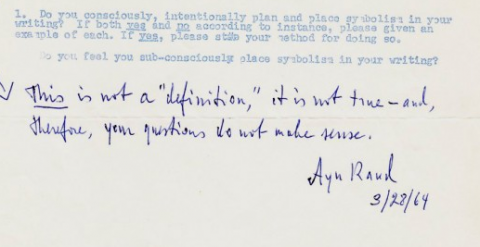
Let’s let The Paris Review give you the backstory:
In 1963, a sixteen-year-old San Diego high school student named Bruce McAllister sent a four-question mimeographed survey to 150 well-known authors of literary, commercial, and science fiction. Did they consciously plant symbols in their work? he asked. Who noticed symbols appearing from their subconscious, and who saw them arrive in their text, unbidden, created in the minds of their readers? When this happened, did the authors mind?
Of the 150 authors McAllister solicited, 75 wrote back, and most offered the youngster some substantive thoughts. Over at The Paris Review, you will find replies by Jack Kerouac, Ayn Rand (above), Ralph Ellison, Ray Bradbury, John Updike, Saul Bellow, and Norman Mailer. Not bad for a kid who sent out a form letter … and never bothered to send a thank-you letter.
Related Content:
The Paris Review Interviews Now Online
Download 20 Popular High School Books Available as Free eBooks & Audio Books
Read More...Life-Affirming Talks by Cultural Mavericks Presented at The School of Life
Since the late 1990′s, Alain de Botton has been breaking down difficult philosophical and literary ideas and seeing how they apply to people’s everyday lives. He did this with his 1997 bestseller, How Proust Can Change Your Life. And he took things a step further with his television series called Philosophy: A Guide to Happiness.
Then, in the summer of 2008, de Botton and some colleagues set up The School of Life, a London-based institution that offers courses “in the important questions of everyday life,” in areas we all tend to care about: careers, relationships, politics, travels, families, etc. The school also hosts a series of “Sunday Sermons” that feature “maverick cultural figures” talking about the virtues they cling to, and the vices to be wary of.
Today, we’re featuring several of these sermons. Above, the actress, writer, and director Miranda July takes an offbeat and endearing look at strangers, and the role they play in our lives. Then come some notable mentions:
Physicist Lawrence Krauss on Cosmic Connections. (Also don’t miss this other unrelated but splendid talk by Krauss.)
Author Rebecca Solnit on Hope.
And Alain de Botton himself on the importance of defying pessimism.
Again, you can find the full list of sermons organized chronologically here.
Related Content:
Read More...Philosophy in Prison: Weighty Conversations about Right and Wrong
When not founding tech companies, Damon Horowitz teaches philosophy through the Prison University Project, bringing college-level classes to inmates of San Quentin State Prison. In three minutes, Horowitz raps about philosophy meeting real life — about how prisoners convicted of serious crimes come to terms with Socrates (who finished his days in prison), Heidegger, Kant, categorical imperatives, questions of right and wrong, and the rest. The “talk” was originally presented at TED 2011 last March.
Related Content:
Download Free Courses from Famous Philosophers: From Bertrand Russell to Michel Foucault
Noam Chomsky & Michel Foucault Debate Human Nature & Power (1971)
The History of Philosophy Without Any Gaps
Bertrand Russell & Other Big Thinkers in BBC Lecture Series (Free)
Read More...Can Ants Count? Do They Have Built-In Pedometers? Animated Video Explains
Saharan desert ants are known to wander great distances in search of food. Twisting and turning on their way, the ants manage to return to their nests along surprisingly direct paths. They sense direction using light from the sky, but how do they judge distance? By counting steps, apparently.
As National Public Radio science correspondent Robert Krulwich explains in this engaging little cartoon, a group of German and Swiss scientists have discovered that by manipulating the stride of the ants halfway through their trip–by either lengthening or shortening their legs–the ants would invariably overshoot or undershoot their return destination. As Princeton biologist James Gould told NPR, “These animals are fooled exactly the way you’d expect if they were counting steps.”
The experimental results were originally published in 2006. You can listen to Krulwich’s radio report on the research here.
Related Content:
Fire Ants Create Life Raft in 100 Seconds Flat
Read More...Ryan Adams Live at the Ed Sullivan Theatre (Free Pass)
The Live on Letterman concert series has brought you Peter Gabriel, Coldplay and Wilco (click to watch concerts), and now it returns with Ryan Adams playing solo at the Ed Sullivan Theatre in New York city. During the 70-minute concert recorded Monday night, Adams performed “Lucky Now” from his new album Ashes and Fire, plus some fan favorites “Oh My Sweet Carolina” and “New York, New York.” Enjoy, and don’t miss Adams on his tour that kicks off Thursday in Boston.
Read More...Animated Video Shows Curiosity, NASA’s Mars Rover, in Dramatic Action
In late November, NASA’s Curiosity, the world’s biggest extraterrestrial rover, began rocketing toward Mars (see photos of the launch here) in search of any hint that the red planet might have provided a home for microscopic life. The Curiosity will eventually reach Mars in August after covering 345 million miles. Earlier this year, an artist released a rather dramatic animation depicting key moments in the mission — the voyage, the landing (don’t miss this part!), the exploration, and all of the rest. It’s another candidate for our collection of Great Science Videos.
via Coudal.com
Read More...Miniatur Wunderland: The World’s Largest Model Railroad
The construction began in the year 2000, and over the years, Miniatur Wunderland, located in Hamburg, Germany, has staked its claim as the largest model railway in the world. Watch as you take a ride across the seven sections: Harz, the fictitious city of Knuffingen, the Alps and Austria, Hamburg, America, Scandinavia, and Switzerland.
As the video attests, it took more than 500,000 working hours to create this massive miniature world. The most recent addition is the Knuffingen airport, located on 150 square meters, and boasting 40 airplanes that can taxi, take off, and land.
Miniatur Wunderland is constantly evolving: the final phase of the project is slated to be completed in 2020, by which time the model area will grow to nearly 25,000 square feet. No wonder Miniatur Wunderland is Hamburg’s most popular attraction.
via Gizmodo
Eugene Buchko is a blogger and photographer living in Atlanta, GA. He maintains a photoblog, Erudite Expressions, and writes about what he reads on his reading blog.
Read More...Crowded House: How the World’s Population Grew to 7 Billion People
This fall, the world’s population reached seven billion. A sobering thought. How did we get to this point? Producer Adam Cole and photographer Maggie Starbard of National Public Radio have put the world’s accelerating population growth in perspective in a two-and-a-half minute video, above.
In those two and a half minutes, 638 babies will be born worldwide, according to statistics from the United States Census Bureau, and 265 people will die. That’s a net gain of 373 people, just while you watch the film. The biggest growth, according to NPR, is happening in sub-Saharan Africa, where access to family planning is low and infant mortality rates are high.
It may seem counter-intuitive that population growth rates are high where infant survival rates are low, but as Swedish global health expert Hans Rosling put it during a recent TED talk, “Only by child survival can we control population growth.” Because population growth and infant mortality rates are both correlated to poverty rates, he argues, eliminating poverty is the key to achieving a sustainable world population. You can learn more in our November 1 feature, “Hans Rosling Uses IKEA Props to Explain World of 7 Billion People.”
Read More...Support Us
We're hoping to rely on loyal readers, rather than erratic ads. Please click the Donate button and support Open Culture. You can use Paypal, Venmo, Patreon, even Crypto! We thank you!

About Us

Open Culture scours the web for the best educational media. We find the free courses and audio books you need, the language lessons & educational videos you want, and plenty of enlightenment in between.
Advertise With Us

FREE UPDATES!
GET OUR DAILY EMAIL
Get the best cultural and educational resources on the web curated for you in a daily email. We never spam. Unsubscribe at any time.
FOLLOW ON SOCIAL MEDIA

Open Culture editor Dan Colman scours the web for the best educational media. He finds the free courses and audio books you need, the language lessons & movies you want, and plenty of enlightenment in between.
Advertise With Us

