M.I.T. Camera Captures Speed of Light: A Trillion-Frames-Per-Second
Think of it as the ultimate slow-motion movie camera. Researchers at M.I.T. have developed an imaging system so fast it can trace the motion of pulses of light as they travel through liquids and solids. To put it into perspective, writes John Markoff in The New York Times, “If a bullet were tracked in the same fashion moving through the same fluid, the resulting movie would last three years.”
The research was directed by Ramesh Raskar of the Camera Culture group at the M.I.T. Media Lab. In an abstract, the research team writes:
We have built an imaging solution that allows us to visualize the propagation of light. The effective exposure time of each frame is two trillionths of a second and the resultant visualization depicts the movement of light at roughly half a trillion frames per second. Direct recording of reflected or scattered light at such a frame rate with sufficient brightness is nearly impossible. We use an indirect ‘stroboscopic’ method that records millions of repeated measurements by careful scanning in time and viewpoints. Then we rearrange the data to create a ‘movie’ of a nanosecond long event.
You can learn more by watching the video above by Melanie Gonick of the M.I.T. News Office, or by visiting the project website.
via Kottke
Read More...A Panoramic Virtual Tour of the Smithsonian National Museum of Natural History
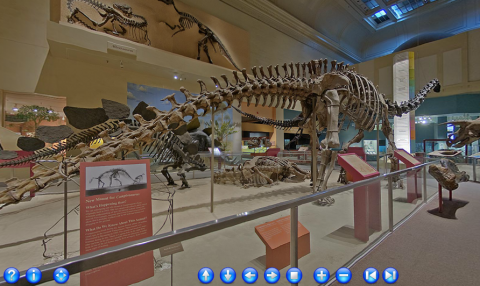 These days, you can take a virtual tour of paintings at the MoMA, Met, Uffizi Gallery, Hermitage, Rijksmuseum, and National Gallery and other major museums, thanks to Google’s Art Project. And don’t forget the Sistine Chapel and the Dead Sea Scrolls.
Now let’s add one more to the list — a panoramic virtual tour of the Smithsonian National Museum of Natural History. You can visit the whole museum on your own, walking from room to room, checking out fossils of countless dinosaurs, specimens of early sea life, exhibits on the ice age, and much more. Begin the general tour here, or find a more targeted area of interest here.
Note: the tour requires Adobe Flash Player, version 9.0.28 or later.
via metafilter
Read More...Google Presents YouTube for Schools, Makes Video World Safe for Teachers
On YouTube, the path to education is as narrow and as difficult to walk as a razor’s edge. Left to their own devices, kids have a tendency to veer away from the math tutorials and head straight for the water-skiing squirrels. What’s an educator to do?
Google believes it has the answer with “YouTube for Schools,” a new service that gives teachers and administrators the ability to filter out everything but their own selections from YouTube EDU, a curated collection of educational videos from sources ranging from Sesame Street to Harvard.
“We’ve been hearing from teachers that they want to use the vast array of educational videos on YouTube in their classroom, but are concerned that students will be distracted by the latest music video or a video of a cute cat, or a video that might not be appropriate for students,” writes YouTube Product Manager Brian Truong. “While schools that completely restrict access to YouTube may solve this distraction concern, they also limit access to hundreds of thousands of educational videos on YouTube that can help bring photosynthesis to life, or show what life was like in ancient Greece.”
To help teachers find the best material with ease, YouTube has organized the educational videos by subject and grade level, with more than 300 playlists to choose from at youtube.com/teachers. To learn more, or to sign up, go to youtube.com/schools.
Also don’t miss our own curated list of Intelligent YouTube Channels, which highlights the best video collections on the Google-owned service.
Read More...Incredible Mental Math Gymnastics on “Countdown”
Countdown is a British TV game show revolving around words and numbers. In the numbers round, contestants select six of twenty-four shuffled tiles with numbers on them. Next, a computer generates a random three-digit target number and the contestants have thirty seconds to get as close to that number as possible by combining the six numbers through addition, subtraction, multiplication and division. This memorable episode of Countdown aired in March 1997 and starred James Martin and his rather unusual way of arriving at the target number of 952.
One YouTube user suggested a different way: 6 x 75 = 450; 450 ÷ 50 = 9; 100 + 3 = 103; 9 x 103 = 927; 927 + 25 = 952
I found yet another way: 100 + 3 = 103; 103 x 6 = 618; 618 x 75 = 46,350; 46,350 ÷ 50 = 927; 927 + 25 = 952
What about you? Any more suggestions?
By profession, Matthias Rascher teaches English and History at a High School in northern Bavaria, Germany. In his free time he scours the web for good links and posts the best finds on Twitter.
Related Content:
Mathematics in Movies: Harvard Prof Curates 150+ Scenes
Multiplication: The Vedic Way
Read More...David Attenborough Reads “What a Wonderful World” in a Moving Video
Sir David Attenborough is England’s finest natural history filmmaker, best known for his Life collection, a series of nine nature documentaries aired on the BBC between 1979 and 2008. It’s widely considered the standard by which all other wildlife programs are measured.
In recent weeks, British and American audiences have been treated to Attenborough’s latest production, Frozen Planet (see trailer below). It’s thought to be his last major program with the BBC, and to commemorate this milestone, the ad agency RKCR/Y&R has produced a moving video that features Attenborough reading lines from “What a Wonderful World” — you know, the Louis Armstrong classic — as scenes from Attenborough’s documentaries fill the screen.
The ad agency introduced the video last week with a little blog post, which concluded by saying: “If you’ve had a shitty journey into work today, I promise, this will put your smile back in place.” We could haven’t have said it any worse or better.
Read More...Ice Cube & Charles Eames Revel in L.A. Architecture
Here’s a little known fact about the rapper and actor Ice Cube. During his younger days, before he became a star, Mr. Cube studied architectural drafting at the Phoenix Institute of Technology in Arizona, where he gained an appreciation for the way architects, like rappers, can take existing materials and work them into entirely new creations. Yes, architects can do mashups, too. And perhaps no one did them better than the husband-and-wife design duo, Charles and Ray Eames, who built the Eames House, a landmark of modern architecture, in 1949.
In a video promoting a collaborative exhibit, “Pacific Standard Time: Art in L.A. 1945–1980,” Ice Cube drives the streets of L.A. and explains his admiration for the Eames House and other Los Angeles landmarks. Meanwhile below, you’ll find some vintage footage that captures Charles Eames (1907–1978), driving around the city, giving his own analysis of the hodge-podge architectural styles that define Los Angeles.
via The New York Times and Curiosity Counts
Read More...Download The Beatles’ Yellow Submarine as a Free, Interactive eBook
 A year ago, Apple began selling The Beatles’ catalogue of music on iTunes. Now, twelve months and many millions of downloads later, Apple is giving away The Beatle’s Yellow Submarine as a free ebook.
It’s not just any ebook. Based on the 1968 film, this ebook features animated illustrations, 14 video clips from the original film, audio functionality that magically turns the book into an audio book, and various interactive elements. You can “read” the book (download it here) on any iPad, iPhone, or iPod touch. Our apologies in advance if you use other devices.
The Yellow Submarine will be added to our collection of Free eBooks, which features 250 classics, including texts by Isaac Asimov, Philip K. Dick, Dostoevsky, Kafka, Joyce, Nabokov, Austen, Nietzsche and others. Also don’t miss our equally large collection of Free Audio Books.
Related Content:
The Beatles’ Rooftop Concert: The Last Gig
Jimmy Page Tells the Story of Kashmir
The Beatles Complete on Ukulele
Read More...Why is the U.S. F’ed Up? 8 Lectures from Occupy Harvard Teach-In Provide Answers
Last Wednesday, the Occupy movement gained a little more intellectual momentum when eight faculty members from Harvard, Boston College, and N.Y.U. gathered in Cambridge to present a daylong Teach-In. In one talk, Archon Fung (Ford Foundation Professor of Democracy and Citizenship and Co-Director of Transparency Policy Project at Harvard) took a vague thesis of the Occupy movement — “Shit is Fucked Up and Bullshit” — and gave it some academic depth in a data-filled talk called “Why Has Inequality Grown in America? And What Should We Do About It?” The other talks are available on YouTube (see links below) or via audio stream:
Heterodox Economics: Alternatives to Mankiw’s Ideology - Stephen Marglin, Walter Barker Professor of Economics, Faculty of Arts and Sciences, Harvard University
Wall Street’s Role in the European Financial Crisis - Richard Parker, Lecturer in Public Policy and Senior Fellow at the Shorenstein Center, Kennedy School of Government, Harvard University
The Occupy Movement and Student Debt Refusal — Andrew Ross, Professor of Social and Cultural Analysis, New York University
Economics for the 99% — Juliet Schor, Professor of Sociology, Boston College
Booms and Busts: The Legal Dynamics of Modern Money — Christine Desan, Professor of Law, Harvard Law School, Harvard University
Fear and Power — Brad Epps, Professor of Romance Languages & Literatures and Department Chair for Studies in Women, Gender, and Sexuality, Faculty of Arts and Sciences, Harvard University
Vigilance, Inquiry, Alienation & Hope at Harvard and in the USA - John Womack, Robert Woods Bliss Professor of Latin American History and Economics, Faculty of Arts and Sciences, Harvard University
Related Content:
Noam Chomsky at Occupy Boston
Harvard Thinks Big, a TED-Esque Event
Read More...Jean-Paul Sartre Breaks Down the Bad Faith of Intellectuals
How many of the great philosophers have you actually heard speak? This clip comes from the 1976 documentary Sartre by Himself, which features discussions with Jean-Paul Sartre and his near-equally famous partner Simone de Beauvoir, among others. The film was released with English subtitles in 1979, a year before Sartre died.
In this clip, Sartre criticizes modern intellectuals as “specialist workers in practical knowledge,” who apply “universal notions and practices” to particular purposes determined by a political establishment. This can cause a conflict of conscience: Sartre gives the example of scientists working on the atomic bomb, but also professors whose efforts solely benefit a small group of prosperous students. Sartre thinks intellectuals use this kind of conflict to feel better about themselves–they may sign petitions, side with the working class, etc.–while still not seriously questioning themselves. Intellectuals rage against the machine but are still playing their assigned role in it. “[They are] very pleased to have an unhappy conscience, because that is what allows [them] to denounce.”
This is an example of his famous notion of “bad faith,” where we disassociate ourselves from our actions, or more commonly where we claim to have more limited choices than we actually do. Bad faith is possible because of the nature of the self, according to Sartre: there is no predetermined “human nature” or “true you,” but instead you are something built over time, by your own freely chosen actions, too often using the roles and characteristics others assign to you.
Early in his career, he constructed a theory of consciousness and the self that makes this plausible. The work in which he did this, “The Transcendence of the Ego,” is the subject of the most recent episode of The Partially Examined Life philosophy podcast, profiled in this earlier Open Culture post. The podcast has since taken off: it’s currently featured on the main podcast page in the iTunes store and has broken the top 40 in “top audio podcasts,” reaching #1 in the philosophy category.
Visit the Partially Examined Life web page, get the episodes on iTunes, and subscribe to the PEL blog feed.
Mark Linsenmayer hosts The Partially Examined Life and fronts a band called New People.
Read More...Stephen Fry Introduces the Strange New World of Nanoscience
What is nano? And how will nanoscience (the study of phenomena and manipulation of materials at the nanoscale) shape our future, from the way we build houses to how we cure diseases? It’s all explained in a snappy 17 minute video narrated by Stephen Fry (British writer, actor and director). Produced in partnership with Cambridge University, NANO YOU was named the best short film at the Scinema Science Film Festival in 2010.
If you would like to support the mission of Open Culture, consider making a donation to our site. It’s hard to rely 100% on ads, and your contributions will help us continue providing the best free cultural and educational materials to learners everywhere. You can contribute through PayPal, Patreon, and Venmo (@openculture). Thanks!
Related Content:
Stephen Fry & Friends Pay Tribute to Christopher Hitchens
Stephen Fry on Philosophy and Unbelief
Stephen Fry Gets Animated about Language
Read More...Support Us
We're hoping to rely on loyal readers, rather than erratic ads. Please click the Donate button and support Open Culture. You can use Paypal, Venmo, Patreon, even Crypto! We thank you!

About Us

Open Culture scours the web for the best educational media. We find the free courses and audio books you need, the language lessons & educational videos you want, and plenty of enlightenment in between.
Advertise With Us

FREE UPDATES!
GET OUR DAILY EMAIL
Get the best cultural and educational resources on the web curated for you in a daily email. We never spam. Unsubscribe at any time.
FOLLOW ON SOCIAL MEDIA

Open Culture editor Dan Colman scours the web for the best educational media. He finds the free courses and audio books you need, the language lessons & movies you want, and plenty of enlightenment in between.
Advertise With Us

