This is Your Brain on Sex and Religion: Experiments in Neuroscience
If you attended the recent Society for Neuroscience conference, you had the chance to see some unprecedented 3D imaging of the brain — images that showed the exact order in which women’s brain regions (80 in total) are activated in the sequence leading to an orgasm. For Barry Komisaruk (professor of psychology at Rutgers University), this imaging isn’t gratuitous. The whole point is to demystify how the brain experiences pleasure, something that could eventually inform our understanding of addiction and depression. Komisaruk said:
It’s a beautiful system in which to study the brain’s connectivity. We expect that this movie [above], a dynamic representation of the gradual buildup of brain activity to a climax, followed by resolution, will facilitate our understanding of pathological conditions such as anorgasmia by emphasizing where in the brain the sequential process breaks down.
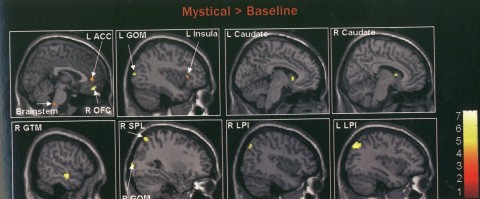
Meanwhile, back at the neuroscience ranch, researchers are also using imaging technology to observe the human brain in another state, the state where people experience mystical awakenings during prayer and meditation or other spiritual epiphanies. Scientific American took a fairly deep look at this cutting-edge field several years ago (read the full piece here), and now NPR has produced a multimedia glimpse into the evolving science of spirituality. The presentation (click here or the image above) combines audio, video, articles, book excerpts, etc. and delves into the fundamental question: Is God a delusion created by brain chemistry, or is brain chemistry a necessary conduit for people to reach God?
If you want to learn more about the brain and neuroscience, don’t miss the courses listed in the Psychology/Neuroscience section of our big collection of Free Online Courses.
Time and The Guardian have more on the first story above here and here.
Read More...Malcolm McLaren: The Quest for Authentic Creativity
In early October of 2009, Malcolm McLaren was nearing death but didn’t know it yet. He showed up at the 2009 Handheld Learning conference feeling fatigued, but managed to deliver a provocative and heartfelt speech titled, “Never Mind the Bollocks, Here’s the Txt Pistols,” in which he reflects on his life growing up in post-World War II England and expresses dismay over the rise of what he called “karaoke culture.”
“All popular culture today,” said McLaren, “goes to great lengths to promote the idea that it’s cool to be stupid.” He championed instead the “messy process of creativity” in which struggle, failure and the acquisition of skill and knowledge are valued above instant fame. You can watch the complete speech above. A few days after it was given, McLaren went into the hospital and learned that he had cancer. He died six months later, on April 8, 2010. The next day Handheld Learning founder Graham Brown-Martin wrote:
Read More...The talk from Malcolm at the Handheld Learning Conference 2009 will, I believe, stand the test of time. The speech doesn’t elaborate about the period of the Sex Pistols, New York Dolls, Vivienne Westwood, his impact on design, fashion and music culture and many other important achievements of Malcolm’s life that will be reported in obituaries over the coming days. Instead and in keeping with the theme of the conference, Malcolm discusses in his inimitable style–his life, learning, authenticity vs karaoke culture and what we gain from the experience of failure. Ironically, failure was something Malcolm never achieved. The talk was anything but ordinary, it polarised our audience and instantly trended globally on Twitter but what else would you expect?
Meetin’ WA: Jean-Luc Godard Meets Woody Allen in a 26 Minute Film
The great French New Wave director, Jean-Luc Godard, turns 81 years old today. And Woody Allen, the legendary comedic filmmaker, turned 76 just two days ago. So what could be more perfect than to serve up Godard’s 1986 short film Meetin’ WA? What you get is Godard, one of the driving forces behind La Nouvelle Vague, in conversation with Woody Allen. Godard’s trademark approach to filmmaking, the expected dose of Woody Allen neuroses — they’re all there, packed into 26 minutes.
For great films (classics, indies, noir, westerns, etc.) don’t miss our collection, 4,000+ Free Movies Online: Great Classics, Indies, Noir, Westerns, Documentaries & More.
If you would like to support the mission of Open Culture, consider making a donation to our site. It’s hard to rely 100% on ads, and your contributions will help us continue providing the best free cultural and educational materials to learners everywhere. You can contribute through PayPal, Patreon, and Venmo (@openculture). Thanks!
Read More...Philip Glass, Lou Reed Speak At Occupy Lincoln Center
Last night, two American icons lent support to the Occupy Wall Street movement, speaking at a protest held outside of Lincoln Center in New York City. After a performance of Satyagraha at the Met, Philip Glass spoke to demonstrators. According to Alex Ross, the music critic for the New Yorker, Glass recited the closing lines of Satyagraha (see around 3:00 minute mark in the video above), which come from the Bhagavad Gita:
When righteousness withers away and evil rules the land, we come into being, age after age, and take visible shape, and move, a man among men, for the protection of good, thrusting back evil and setting virtue on her seat again.
He repeated the saying several times, and the “human microphone” amplified the message for him.
Lou Reed was also in attendance and helped someone crawl over a police barricade at one point, then said: “I was born in Brooklyn, and I’ve never been more ashamed than to see the barricades tonight. The police are our army. I want to be friends with them. And I wanna occupy Wall Street. I support it.” A not-so-clear audio clip appears below:
via Gothamist and The Rest is Noise
More Occupy Videos:
Noam Chomsky at Occupy Boston
Slavoj Zizek Takes the Stage at Occupy Wall Street
Joseph Stiglitz and Lawrence Lessig at Occupy Wall Street
David Crosby & Graham Nash at Occupy Wall Street; Echoes of Woodstock
Read More...The Denali Experiment: A Test of Human Limits
How does the saying go? It’s the journey, not the destination, that counts?
The short film above, The Denali Experiment, documents the gnarly expedition of some rock star skiers. Their goal? To summit Denali, the highest mountain peak in North America, and then ski down its steep slopes. The beautifully-shot film by Jimmy Chen focuses almost entirely on the journey up the mountain, a big 20,320 feet. For the skiers, the high altitude mountaineering was the hard part, the test of human limits. Not the trip down. Sit back and enjoy the journey.
Related Content:
Extreme Photography: Shooting Big Climbs at Yosemite
Read More...Stanley Kubrick’s Photographs: Browse Them or Own Them
 In 1945, a young Stanley Kubrick graduated from high school and almost immediately started working for LOOK Magazine as a photojournalist, becoming the youngest staff photographer in the magazine’s history. It’s during this period that Kubrick began to master his visual craft and produced some stunning images. Now, more than 65 years later, you can purchase … or simply browse through … Kubrick’s photographic work for the first time.
Working with curators from the Museum of the City of New York, VandM.com has selected 25 images to showcase (out of a larger collection of 10,000 images). Photos include prizefighter Walter Cartier in the corner between rounds; the elegant actress Betsy Von Furstenberg reading in a window; street scenes from New York City; and a young woman walking down a steep set of stairs while carrying a pile of books, all rather precariously.
You can browse the full collection here, or visit another set of Kubrick images, all taken in Chicago, here.
Related Kubrick Content:
Terry Gilliam: The Difference Between Kubrick (Great Filmmaker) and Spielberg (Less So)
Kubrick’s A Clockwork Orange: Malcolm McDowell Looks Back
Read More...A Brief Visual Introduction to Saul Bass’ Celebrated Title Designs
Title sequences begin and end every movie. They can be “engaging or wildly entertaining … or simply drop dead beautiful.” They can “ooze with visual poetry and sophisticated imagery.” And they can put the audience in the right mood for the movie, or close it in the right way, says the web site Forget the Films, Watch the Titles.
When it comes to title design, no one did it better than Saul Bass (1920–1996). During his long career in Hollywood, Bass designed sequences for Otto Preminger’s The Man with the Golden Arm (full movie here), Scorsese’s Goodfellas and Cape Fear, Kubrick’s Spartacus, and several films by Alfred Hitchcock. And that’s just beginning to scratch the surface.
Created by Ian Albinson, the montage above offers a brief visual history of Bass’s most celebrated work, stitching together designs from 25 films. (Find the full film list here.) If this whets your appetite, you’ll want to check out the newly-published book Saul Bass: A Life in Film & Design and this web site dedicated to Bass’s title design. And don’t miss our big collection of Free Movies Online.
If you would like to support the mission of Open Culture, consider making a donation to our site. It’s hard to rely 100% on ads, and your contributions will help us continue providing the best free cultural and educational materials to learners everywhere. You can contribute through PayPal, Patreon, and Venmo (@openculture). Thanks!
Read More...To Infinity and Beyond: A Mind-Bending Documentary from the BBC
Infinity. It’s a puzzling concept. Is it real, or a mathematical fiction?
Aristotle believed infinity could only be potential, never actual. To speak of an actual infinity, he argued, is to fall into logical contradiction: “The infinite turns out to be the contrary of what it is said to be,” Aristotle wrote in the Physics. “It is not what has nothing outside it that is infinite, but what always has something outside it.”
Aristotle’s logic rested on common sense: the belief that the whole is always greater than the part. But in the late 19th Century, Georg Cantor and Richard Dedekind turned common sense upside down by demonstrating that the part can be equal to the whole. Cantor went on to show that there are many orders of infinity–indeed, an infinity of infinities.
But what relation does the Platonic realm of pure mathematics have to the physical world? Physics is an empirical science, but that hasn’t stopped theorists from imagining the mind-boggling consequences of an infinite universe. To Infinity and Beyond, a one-hour BBC Horizon special featuring interviews with leading mathematicians and physicists, is an entertaining exploration of a subject which, by definition, you won’t be able to wrap your mind around.
Related Content:
Dangerous Knowledge: 4 Brilliant Mathematicians & Their Drift to Insanity
Futurist Arthur C. Clarke on Mandelbrot’s Fractals
Mathematics in Movies: Harvard Prof Curates 150+ Scenes
Read More...Stanford Launching 14 Free Online Courses in January/February: Enroll Today
 Two weeks ago, we mentioned that Stanford will be rolling out seven new courses in its experiment with online learning. Fast forward to today, and yet another seven courses have been added to the winter lineup, bringing the total to 14.
Immediately below, you’ll find the latest additions. All of these courses feature interactive video clips; short quizzes that provide instant feedback; the ability to pose high value questions to Stanford instructors; and feedback on your overall performance in the class.
Courses start in January and February. Enroll today for free. And, if something doesn’t pique your interest below, don’t miss our big list of 400 Free Online Courses.
Newly added:
Technology Entrepreneurship
Making Green Buildings
Anatomy
Information Theory
Design and Analysis of Algorithms I
The Lean Launchpad
Cryptography
Originally mentioned:
Computer Science 101
Software Engineering for SaaS
Human Computer Intereaction
Natural Language Processing
Game Theory
Probabilistic Graphical Models
Machine Learning
More Free Courses from Top Universities
Yale Rolls Out 10 New Courses – All Free
MIT Introduces Complete Courses to OpenCourseWare Project
Harvard Presents Free Courses with the Open Learning Initiative
Read More...Free Films by Andrei Tarkovsky, Sergei Eisenstein & Other Russian Greats
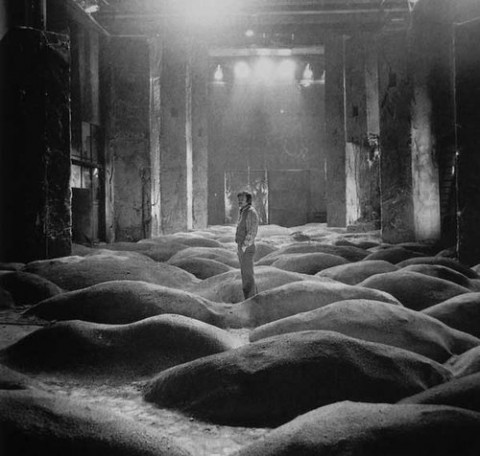
During the past two years, the films of Andrei Tarkovsky have quietly come online, giving viewers the chance to encounter the Soviet director’s great body of work. If you’re not familiar with Tarkovsky, it’s worth mentioning that Ingmar Bergman considered him his favorite director, and Akira Kurosawa once said, “Every cut from his films is a marvelous image in itself.” The list of available films now includes:
- Ivan’s Childhood — Web — Buy DVD (1962)
- Solaris — Part 1 — Part 2 — Buy DVD (1972)
- The Mirror — Web — Buy DVD (1975)
- Stalker — Web — Buy DVD (1979)
(Note: If you access the films via YouTube, be sure to click “CC” at the bottom of the videos to access the subtitles.)
You can thank Mosfilm, the oldest film studio in Russia, if not Europe, for bringing these films to the web. If you head to Mosfilm’s YouTube Channel, you can watch more than 50 Russian classics, including Sergei Bondarchuk’s 1969 adaptation of Tolstoy’s War & Peace, a film that Roger Ebert called “the definitive epic of all time.” In a concession to Western capitalism, each film is preceded by a short commercial, proving yet again that there’s no such thing as a truly free lunch.
Finally, don’t miss our collection of 1100 Free Movies Online, which features six films by Sergei Eisenstein, Russia’s pioneering filmmaker and film theorist: Strike, Battleship Potemkin, Romance Sentimentale, October: Ten Days That Shook the World, Old and New and Alexander Nevsky. They’re all there.
Related Content:
Ingmar Bergman Visits Dick Cavett, 1971
The Kurosawa Digital Archive
Read More...Support Us
We're hoping to rely on loyal readers, rather than erratic ads. Please click the Donate button and support Open Culture. You can use Paypal, Venmo, Patreon, even Crypto! We thank you!

About Us

Open Culture scours the web for the best educational media. We find the free courses and audio books you need, the language lessons & educational videos you want, and plenty of enlightenment in between.
Advertise With Us

FREE UPDATES!
GET OUR DAILY EMAIL
Get the best cultural and educational resources on the web curated for you in a daily email. We never spam. Unsubscribe at any time.
FOLLOW ON SOCIAL MEDIA

Open Culture editor Dan Colman scours the web for the best educational media. He finds the free courses and audio books you need, the language lessons & movies you want, and plenty of enlightenment in between.
Advertise With Us

