Download The Edupunks’ Guide to a DIY Credential (Free eBook)
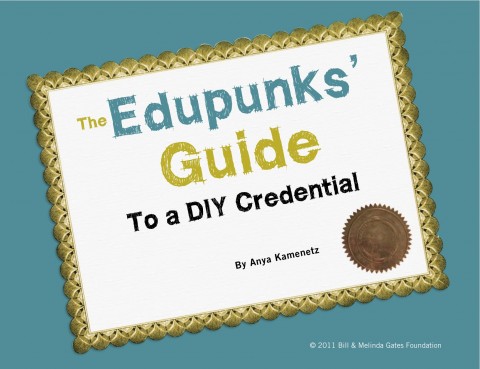 It’s hot off the digital press. Anya Kamenetz, a senior writer at Fast Company Magazine and author of DIY U: Edupunks, Edupreneurs, and the Coming Transformation of Higher Education, has teamed up with the Gates Foundation to release a free ebook, The Edupunks’ Guide to a DIY Credential.
The new ebook offers a “comprehensive guide to learning online and charting a personalized path to an affordable credential,” and it comes complete with some handy-sounding tutorials: how to write a personal learning plan, how to teach yourself online, how to build your personal learning network, 7 ways to get college credit without taking a college course, etc.
The book also smartly features a long list of open educational resources, where the author was nice enough to give us a small mention.
You can read The Edupunks’ Guide to a DIY Credential on Scribd, or alternatively you can download it in multiple formats (PDF, Kindle, ePub, RTF, etc.) at the bottom of this page.
Read More...Animated: Stephen Fry & Ann Widdecombe Debate the Catholic Church
Intelligence Squared (iTunes – Feed – Web Site) brings Oxford-style debating to America. Each debate features one motion, one moderator, and three panelists arguing for a motion, and three arguing against. Should Airports Use Racial and Religious Profiling? Is Islam A Religion Of Peace? Is The Two-Party System Making the U.S. Ungovernable? These are some of the recent topics that have been tackled.
Now, taking a page out of the RSA playbook, Intelligence Squared has produced a short animated video that gives artistic life to a debate held in October 2009. The motion — “The Catholic Church is a force for good in the world” — was supported by Ann Noreen Widdecombe, a former British Conservative Party politician turned novelist. And taking the contrary position was popular British actor and writer Stephen Fry.
You can watch the animated version above, and the full debate (which also featured Christopher Hitchens) here. More iq2 videos can be found at their Youtube Channel, which otherwise appears in our collection of Intelligent YouTube Channels. H/T @joabaldwin
Related Content:
Stephen Fry on Philosophy and Unbelief
Stephen Fry: What I Wish I Had Known When I Was 18
Stephen Fry Gets Animated about Language
Read More...The First 10 Videos Played on MTV: Rewind the Videotape to August 1, 1981
On August 1, 1981, MTV took to the U.S. airwaves, forever changing the landscape of American music and pop culture. If you were around then, you’ll remember the Apollo 11 moon landing, the astronaut planting the MTV flag on the moon’s surface, and then the first aptly picked video — the Buggles’ “Video Killed the Radio Star.” Fast forward four years, and we were all saying, I Want My MTV.
A list of the first ten videos aired on MTV appears below. Click the links to take a walk down memory lane.
- “Video Killed the Radio Star” by The Buggles
- “You Better Run” by Pat Benatar
- “She Won’t Dance with Me” by Rod Stewart
- “You Better You Bet” by The Who
- “Little Suzi’s on the Up” by Ph.D.
- “We Don’t Talk Anymore” by Cliff Richard
- “Brass in Pocket” by The Pretenders
- “Time Heals” by Todd Rundgren
- “Take It on the Run” by REO Speedwagon (not original)
- “Rockin’ the Paradise” by Styx (ditto)
Thanks Robin for the reminder…
Related Content:
Time Capsule: The Internet in 1995
“Jersey Shore” in the Style of Oscar Wilde
Read More...How the Egyptian Pyramids Were Built: A New Theory in 3D Animation
Jean-Pierre Houdin spent a couple of decades working as an independent architect around Paris. Then, his career took a big turn. Working with his father, Houdin tried to crack an ancient mystery — how were the great pyramids of Egypt built?
Throughout the centuries, various theories have been put forth. Herodotus, who visited Egypt around 450 B.C., speculated that some “machines” were involved. Others thought that mounds serving as ramps played a central role in the construction. And still others have guessed that extraterrestrials were the real builders (seriously).
Now Houdin enters into the debate with what Egyptologist Bob Brier calls a “radical new theory.” Using state-of-the-art 3‑D software, Houdin has concluded that the bottom portion of the pyramids were built with an external ramp, and the upper portions with internal ramps. Brier summarizes the theory rather well in this short article.
Houdin’s work has focused particularly on the Great Pyramid of Giza, otherwise known as the Pyramid of Khufu, built circa 2500 B.C. (See image here). And he has gone so far as to create a 3D interactive film that visually documents his hypothesis. We’ve embedded a good clip above. You can also head to Khufu Reborn to get the full interactive experience. (Note: You’ll need a PC, 3D glasses and some downloadable plugins to make it all work.)
If you would like to support the mission of Open Culture, consider making a donation to our site. It’s hard to rely 100% on ads, and your contributions will help us continue providing the best free cultural and educational materials to learners everywhere. You can contribute through PayPal, Patreon, and Venmo (@openculture). Thanks!
Read More...Klaus Nomi: Watch the Final, Brilliant Performance of a Dying Man
Klaus Sperber was born in Immenstadt, southern Germany, in 1944. As a teenager, he discovered his love for opera and also pop music. In the early 1970s, he moved to New York and soon found many friends among the East Village artists there. Around this time, he started using the pseudonym Klaus Nomi, an allusion to the American SciFi magazine Omni and an anagram of the Latin word omni(s) (all, every). David Bowie discovered Nomi in 1978 and helped him sign with RCA records two years later. But Nomi’s musical career was cut short when he was diagnosed with AIDS — an illness virtually unheard of in those days. He died in New York on August 6th, 1983, at the age of 39 — two years before Rock Hudson’s death raised public awareness of this new illness. His ashes were scattered over New York City.
Klaus Nomi’s musical style was undoubtedly unique: he combined opera and New Wave pop music and performed his music in elaborate stage shows reminiscent of retro-futuristic Science Fiction visions of the 1920s: face painted white in Kabuki style, black lips, extravagant clothes and hairstyles inspired by Cubism. One of his most famous live performances is Total Eclipse from the music film Urgh! A Music War (1981).
The video above shows Klaus Nomi’s last performance before his death. Towards the end of 1982, he returned to Europe for a small concert tour and also performed at Eberhard Schoener’s Classic Rock Night in Munich, close to the place where he was born. He chose the Aria of the “Cold Genius” from Henry Purcell’s 1691 opera “King Arthur or, The British Worthy.” In the third scene of Act Three (The Frost Scene), the Cold Genius is awakened by Cupid and ordered to cover the landscape with ice and frost. The answer of the Cold Genius is sung by Klaus:
What power art thou, who from below / Hast made me rise unwillingly and slow / From beds of everlasting snow? / See’est thou not how stiff and wondrous old, / Far unfit to bear the bitter cold, / I can scarecly move or draw my breath? / Let me, let me freeze again to death.
This performance is certainly one of the most memorable in operatic history — Klaus Nomi conveys the message of the text with every fiber of his body (note in particular the movements of his hands and eyes). And as one YouTube commenter put it, the fact that Klaus knew that “he was dying of AIDS when he gave this performance (…) gives an added albeit unwanted poignancy to his performance.”
There are two other famous performances of The Cold Song: by Andreas Scholl and Sting. You can decide for yourself how they compare to Klaus Nomi’s interpretation.
Bonus material: In 2004, the documentary film The Nomi Song took a closer look at Klaus’s life and music (view the trailer here). YouTube also has two interviews with Klaus Nomi: Klaus Nomi on NYC 10 o’Clock News (c. 1981) and a 1982 interview from French TV.
By profession, Matthias Rascher teaches English and History at a High School in northern Bavaria, Germany. In his free time he scours the web for good links and posts the best finds on Twitter.
Read More...The Concert for Bangladesh Streaming Free on iTunes
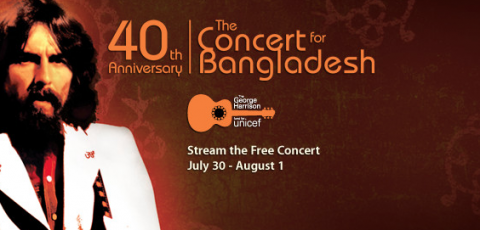
A quick heads up: You can stream The Concert for Bangladesh for free on iTunes this weekend. Exactly 40 years ago (August 1, 1971), Beatles’ guitarist George Harrison and sitarist Ravi Shankar teamed up to stage two benefit concerts at Madison Square Garden, hoping to raise money for refugees from East Pakistan (now independent Bangladesh). The concert film came out a year later in 1972, and now, to mark its anniversary, the good folks at Apple are streaming the film for free. Acts include Ravi Shankar, George Harrison (his first since The Beatles’ breakup), Bob Dylan, Eric Clapton, Billy Preston and more.
Our friends on Twitter (follow us here) tell us that the film should be accessible throughout most of the world, although there are some exceptions. Apologies in advance if you run into difficulties. H/T to Ed.
Note: NPR is carrying a video stream of The Newport Folk Festival. Catch it here.
Read More...Time Capsule: The Internet in 1995
On January 27, 1994, the Today Show ran a hilarious segment trying to unravel this crazy new thing called “The Internet.” A year later, however, it looks like the media had it all figured out. Check out this 1995 MTV trend piece by Kurt Loder: We got a kick out of the clunkiess of the old new media (Compuserve! Dial-up! Netscape!), but Loder also touches on hacking, internet pornography, privacy, and freedom of speech issues that still haven’t been resolved. The biggest shocker of the clip is not how much things have changed but how much they haven’t.
Oh, and also, Moby had hair?
via The Awl
Sheerly Avni is a San Francisco-based arts and culture writer. Her work has appeared in Salon, LA Weekly, Mother Jones, and many other publications. You can follow her on twitter at @sheerly.
Read More...Richard Dawkins’ Uncut Interviews with Peter Singer & Big Thinkers
In 2008, the evolutionary biologist Richard Dawkins presented The Genius of Charles Darwin, a three-part documentary that was later named “Best TV Documentary Series” at the British Broadcast Awards. During the filming of the program, Dawkins interviewed various experts — biologists, philosophers, clergyman, evolutionary psychologists, etc. — and wound up with 18 hours of raw footage. Some of the uncut interviews have now made their way online (as well as DVD), and we’re highlighting a few today.
Above, Dawkins spends a good while with Peter Singer, the Princeton philosopher, otherwise known as the Father of the Animal Rights Movement. The wide-ranging conversation continually comes back to animal rights and vegetarianism and why Darwinism lends support to both. The best part comes toward the end, when Singer tells Dawkins (a meat eater), “I have assimilated Darwin on this issue better than you have because .… you’re still influenced by these vestiges of religious belief that separate us from the animals.…” Dawkins out-Dawkinsed.
Other uncut interviews feature conversations with Steven Pinker, Daniel Dennett, and Craig Venter.
Related note: We’d like to thank RichardDawkins.net for re-broadcasting our post earlier this week: 50 Famous Academics & Scientists Talk About God
Read More...The Persecution of Daniel Lee
 A story appearing in July’s Stanford Magazine begins with the caption: “An Internet smear campaign nearly destroyed the South Korean star, but he fought back with the only weapon he had: the truth.” And, from there, you’re launched into one of the more flabbergasting stories you’ve read in some time. Give The Persecution of Daniel Lee a read, and you’ll see that we’re not being the least bit hyperbolic.
The internet can be a wonderful place. We all know that. But, as with any other place humans inhabit, it has a dark side, and that’s what we encounter here…
Read More...Salman Rushdie: Machiavelli’s Bad Rap
Cynicism. Ruthlessness. Deviousness. Power politics. These words are often associated with Niccolò Machiavelli, the author of The Prince (1532). But, it turns out, he was anything but. He was a sweet man (though something of a philanderer), a profound democrat, good looking, a party animal. In short, Machiavelli has gotten a bad rap, says novelist Salman Rushdie.
To get more insight into this badly misunderstood figure, we’d recommend spending time with Philosophy Bites’ interview (MP3 or iTunes) with Quentin Skinner, one of England’s finest intellectual historians who has written extensively on Machiavelli. You can also find The Prince listed in our collection of Free eBooks. H/T Andrew Sullivan
If you would like to support the mission of Open Culture, consider making a donation to our site. It’s hard to rely 100% on ads, and your contributions will help us continue providing the best free cultural and educational materials to learners everywhere. You can contribute through PayPal, Patreon, and Venmo (@openculture). Thanks!
Related Content:
Leo Strauss: 15 Political Philosophy Courses Online
Introduction to Political Philosophy: A Free Yale Course
Alain de Botton Tweets Short Course in Political Philosophy
Read More...Support Us
We're hoping to rely on loyal readers, rather than erratic ads. Please click the Donate button and support Open Culture. You can use Paypal, Venmo, Patreon, even Crypto! We thank you!

About Us

Open Culture scours the web for the best educational media. We find the free courses and audio books you need, the language lessons & educational videos you want, and plenty of enlightenment in between.
Advertise With Us

FREE UPDATES!
GET OUR DAILY EMAIL
Get the best cultural and educational resources on the web curated for you in a daily email. We never spam. Unsubscribe at any time.
FOLLOW ON SOCIAL MEDIA

Open Culture editor Dan Colman scours the web for the best educational media. He finds the free courses and audio books you need, the language lessons & movies you want, and plenty of enlightenment in between.
Advertise With Us


