Introducing the New Google eBookstore (with Free Classics)
This morning, Google officially opened up the new Google eBookstore, which gives consumers access to three million ebooks, including many free classics. Taking a page out of Amazon’s playbook, Google now lets you purchase books at competitive ebook prices and read them across multiple platforms – meaning you can start reading a novel on your computer’s web browser, then seamlessly switch to the iPad, Kindle, or smartphone. And the content will stay in sync, all in the cloud. (Get instructions and apps here.) Another plus: you’re not forced to buy books from just Google. The new bookstore is open to independent booksellers and retail partners, which gives these smaller players a chance to play (and perhaps even thrive) in the ebook market. You can get more information on the new bookstore on the Google Books blog, and don’t miss our Free eBooks collection, which comes packed with many classics.
Note: the Google eBookstore is currently limited to the US market.
Read More...Jazz Legend Dave Brubeck Celebrates His 90th Today
Last year, Dave Brubeck’s jazz standard, Take Five, turned 50 years old. (Watch his 1961 performance above.) And, today, the artist celebrates his 90th birthday. Throughout his 80s, Brubeck continued to perform across the US (we have him playing Take Five at the Montreal Jazz Festival just last year) and onward he plans to go — although his touring was recently halted by pacemaker surgery. To commemorate his birthday, Turner Classic Movies will premiere tonight In His Own Sweet Way, a documentary revisiting Brubeck’s life and music. And NPR’s Fresh Air has re-aired a 1999 interview where (in addition to his music) Brubeck talks about his early days on a California cattle ranch, and his first love: rodeo roping. The conversation runs 34 minutes. You can listen right here.
Read More...200 Countries & 200 Years in 4 Minutes, Presented by Hans Rosling
Hans Rosling, a professor of global health at Sweden’s Karolinska Institute, focuses on ‘dispelling common myths about the so-called developing world’ (as his TED bio well notes). And he has established a reputation for presenting data in extremely imaginative ways. Just watch the video above, an outtake from the BBC show “The Joy of Stats”). In four minutes, Rosling visually traces the health of 200 countries over 200 years, using 120,000 data points, and we end up with a little reason for optimism. Great stuff… Thanks to @Sheerly for flagging this.
Read More...3D Rome Was Built in a Day
Computer scientists at UNC-Chapel Hill and colleagues at the Swiss university, ETH-Zurich, have created an algorithm that searches through millions of photos on Flickr, then uses them to build a 3D model of landmarks and geographical locations. Case in point, the video above. According to The Daily Tar Heel, “researchers demonstrated the technique by using 3 million images of Rome to reconstruct the city’s primary landmarks. A single PC processed the images in less than 24 hours. Landmarks in Berlin were reconstructed in the same manner.” Not bad for a day’s work…
via ReadWriteWeb
Read More...Who is Julian Assange? Three Profiles of the WikiLeaks Founder
 Trying to make heads or tails of WikiLeaks, which just released 250,000 US diplomatic cables this week? Then you may want to spend some time with one article and one video. First, The New Yorker published this summer an extensive profile of Julian Assange, the driving force behind WikiLeaks. A key passage explaining Assange’s world view appears below, and you can get the full profile right here. Next up, we have Chris Anderson, the head of TED, in conversation Assange. The interview, running 20 minutes, tells you essentially “Why the World Needs WikiLeaks.” And then why not add to the list Forbes’ lengthy interview with Assange, published earlier this week. (Thanks Avi for that.)
Read More...He had come to understand the defining human struggle not as left versus right, or faith versus reason, but as individual versus institution. As a student of Kafka, Koestler, and Solzhenitsyn, he believed that truth, creativity, love, and compassion are corrupted by institutional hierarchies, and by “patronage networks”—one of his favorite expressions—that contort the human spirit. He sketched out a manifesto of sorts, titled “Conspiracy as Governance,” which sought to apply graph theory to politics. Assange wrote that illegitimate governance was by definition conspiratorial—the product of functionaries in “collaborative secrecy, working to the detriment of a population.” He argued that, when a regime’s lines of internal communication are disrupted, the information flow among conspirators must dwindle, and that, as the flow approaches zero, the conspiracy dissolves. Leaks were an instrument of information warfare.
Dear Monsieur Picasso: A Free eBook
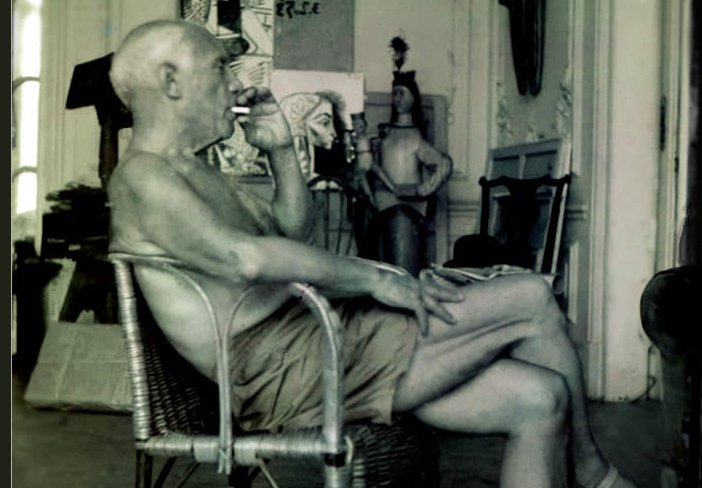
In the summer of 1955, Frederick Baldwin, a college student at Columbia University, set out on a pilgrimage of sorts, hoping to meet Pablo Picasso. Baldwin traveled first to Le Havre (presumably by boat), then headed south, down to Vallauris and Cannes, until he eventually reached Picasso’s home on the Riviera, known as Villa la Californie. It took a little craftiness and moxie, but the young American gained entrance into Picasso’s studio. And there he was, the great painter himself, wearing shorts, sandals and not much else.
More than five decades later, Baldwin has produced an elegant e‑book (available for free right here) that uses photographs and text to preserve the memory of this defining moment. After meeting Picasso, Baldwin became a professional photographer, working for Audubon, LIFE, National Geographic, Smithsonian Magazine, and The New York Times, among other magazines. And, later, he looked to “replicate the Picasso experience professionally,” always controlling his own agenda, never taking a job where he wasn’t making his own decisions. You can download the 22 page e‑book, Dear Monsieur Picasso, right here. Find more great texts in our collection of Free eBooks.
Related Content:
Free: The Guggenheim Puts 65 Modern Art Books Online
Read More...The World in a Satirical Nutshell
Greece and Ireland are down. Portugal is teetering. And Spain may soon be the biggest domino to fall. All of this makes this satirical clip a little timely – perhaps a bit too painfully timely. Featured here are two Australian satirists John Clarke and Bryan Dawe…
Read More...A Darwinian Theory of Beauty, or TED Does Its Best RSA
You have undoubtedly seen one, if not many, of RSA’s catchy videos during the past year. They feature the words of thought leaders accompanied by the fast-moving animation of Andrew Park. Along the way, we have featured RSA talks by Daniel Pink, Sir Ken Robinson, and Barbara Ehrenreich, among others.
The RSA videos have always struck me as a good alternative, or perhaps complement, to the more well-known TED videos. TED developed its style of presentation – speakers presenting on a live stage in a crisp 18 minutes (or less). Then RSA rolled out its distinctive animated videos. And now this: TED has Andrew Park animate Denis Dutton’s talk – A Darwinian Theory of Beauty – in RSA style. Intriguing talk. But a strange move on TED’s part. Hopefully, it’s just a one-off, and not a jump-the-shark moment…
Read More...Developing Apps for iPhone & iPad: A Free Stanford Course
 Looking to design apps for the iPhone or iPad? Stanford University now has a course online that will help you do just that.
Simply called Developing Apps for iOS, the course features 20 video lectures (the last installment was uploaded just this week) and, somewhat fittingly, they’re all available on Apple’s iTunesU.
Paul Hegarty teaches the course, and he assumes that you have experience programming in C, and some familiarity with UNIX, object-oriented programming and graphical toolkits.
You can find Developing Apps for iOS in the Computer Science section of our big collection of Free Online Courses, along with two previous Stanford app development courses, both called iPhone Application Development.
Read More...Donald Duck Wants You to Pay Your Taxes (1943)
During World War II, some of the greatest living filmmakers put aside their commercial aspirations and directed propaganda films for the Allies. Frank Capra, Alfred Hitchcock, Howard Hawks, John Ford, John Huston – they all made a cinematic contribution to the war effort. (More on that here.) And so did Walt Disney, big time. 90% of Disney employees produced propaganda films for the American government, creating 68 hours of continuous film, including this short film for the Treasury Department. The Spirit of ’43 puts Donald Duck in the always unenviable position of asking Americans to pay high taxes to fund their wars. (Imagine doing that today!) Some 26 million Americans viewed the short film, and apparently 37% of those interviewed in a Gallup poll later admitted that the film affected their willingness to pay Uncle Sam. You can find this Disney film and other wartime propaganda films (among other goodies) in our collection, 4,000+ Free Movies Online: Great Classics, Indies, Noir, Westerns, Documentaries & More.
If you would like to support the mission of Open Culture, consider making a donation to our site. It’s hard to rely 100% on ads, and your contributions will help us continue providing the best free cultural and educational materials to learners everywhere. You can contribute through PayPal, Patreon, and Venmo (@openculture). Thanks!
Related Content:
Donald Duck Discovers Glenn Beck: A Remix
Mickey Mouse Discovers Conspiracy Against Glenn Beck
Read More...Support Us
We're hoping to rely on loyal readers, rather than erratic ads. Please click the Donate button and support Open Culture. You can use Paypal, Venmo, Patreon, even Crypto! We thank you!

About Us

Open Culture scours the web for the best educational media. We find the free courses and audio books you need, the language lessons & educational videos you want, and plenty of enlightenment in between.
Advertise With Us

FREE UPDATES!
GET OUR DAILY EMAIL
Get the best cultural and educational resources on the web curated for you in a daily email. We never spam. Unsubscribe at any time.
FOLLOW ON SOCIAL MEDIA

Open Culture editor Dan Colman scours the web for the best educational media. He finds the free courses and audio books you need, the language lessons & movies you want, and plenty of enlightenment in between.
Advertise With Us

