China’s Open Courses & Other Tech Dispatches from Asia
Back in 2003, the Chinese government launched its answer to MIT’s OpenCourseWare project. The “National Quality Course Plan” scoured China’s vast university system and selected 3,000 best-of-breed courses in various subject areas. Then, millions of dollars were earmarked to put lectures and related course materials online, with the hope that other professors could draw inspiration from these resources. But, things didn’t go so well. Apparently roughly 50% of these materials never made their way online. And the materials that did were rarely updated. (More on that here.) Will the project get renewed? Jeff Young, a reporter for The Chronicle of Higher Education, went to China to find out. His report (read it here) is part of a month long series of dispatches that takes you inside Asia’s wired classrooms and high-tech research labs. You can read Jeff’s daily posts from Singapore, China, South Korea, and India throughout this entire month.
Update: One of our readers wrote a thesis on China’s opencourseware initiative and offers much more detail on what went right, and what went wrong. You can download Stian Håklev’s thesis (for free) here, and be sure to check out Stian’s other brainchild, Peer2Peer University, otherwise known more simply as P2PU.
Read More...Gustavo Dudamel with the Vienna Philharmonic: A Free Live Webcast
Mark this on your calendar. This coming Saturday, at 7:30 a.m. California time, Gustavo Dudamel (soon to open the 2010-11 season of the Los Angeles Philharmonic) will conduct a concert with the Vienna Philharmonic at the Lucerne Festival in Switzerland. As the LA Times reports, the concert will be webcast live for free at www.medici.tv. It will also be available for 90 days on demand. Pieces will include Rossini’s overture to “La gazza ladra,” Orbón’s “Tres versiones sinfónicas,” Bernstein’s “Divertimento for Orchestra” and Ravel’s “Pavane pour une infante défunte” and “Boléro.”
Read More...William S. Burroughs Reviews a Led Zeppelin Concert for Crawdaddy! Magazine (1975)
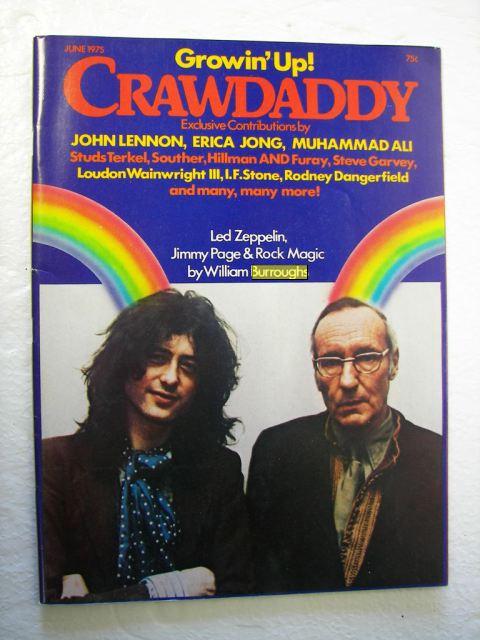
Crawdaddy! It was the first US magazine of rock music criticism, preceding both Rolling Stone and Creem. Paul Williams, then a student at Swarthmore College, first launched the magazine in 1966. And by the 1970s, Crawdaddy! hit its stride, publishing exclusive contributions by John Lennon, Joseph Heller, and Studs Terkel, to name a few. On one occasion, the self-described “first magazine to take rock and roll seriously” sent William S. Burroughs, the great beat writer, to a Led Zeppelin concert. He came back in June 1975 with a rather offbeat concert review. There’s a strange innocence, even naivete, to the whole piece (though we know better than to confuse Burroughs himself with innocence). We give you an excerpt right below, and the rest here.
So there we sat, I decline earplugs; I am used to loud drum and horn music from Morocco, and it always has, if skillfully performed, an exhilarating and energizing effect on me. As the performance got underway I experienced this musical exhilaration, which was all the more pleasant for being easily controlled, and I knew then that nothing bad was going to happen. This was a safe and friendly area–but at the same time highly charged. There was a palpable interchange of energy between the performers and the audience which was never frantic or jagged. The special effects were handled well and not overdone.
A few special effects are much better than too many. I can see the laser beams cutting dry ice smoke, which drew an appreciative cheer from the audience. Jimmy Page’s number with the broken guitar strings came across with a real impact, as did John Bonham’s drum solo and the lyrics delivered with unfailing vitality by Robert Plant. The performers were doing their best, and it was very good. The last number, “Stairway to Heaven”, where the audience lit matches and there was a scattering of sparklers here and there, found the audience well-behaved and joyous, creating the atmosphere of a high school Christmas play. All in all a good show; neither low nor insipid. Leaving the concert hall was like getting off a jet plane.
The Burroughs piece continues here.
Related Content:
‘Stairway to Heaven’: Watch a Moving Tribute to Led Zeppelin at The Kennedy Center
Led Zeppelin Plays One of Its Earliest Concerts (Danish TV, 1969)
Hear Led Zeppelin’s Mind-Blowing First Recorded Concert Ever (1968)
Read More...The Illustrated Guide to a Ph.D.
Matthew Might, a computer science professor at the University of Utah, writes: “Every fall, I explain to a fresh batch of Ph.D. students what a Ph.D. is. It’s hard to describe it in words. So, I use pictures.” Here it goes. Matt’s Illustrated Guide:
Imagine a circle that contains all of human knowledge:

By the time you finish elementary school, you know a little:

By the time you finish high school, you know a bit more:

With a bachelor’s degree, you gain a specialty:

A master’s degree deepens that specialty:

Reading research papers takes you to the edge of human knowledge:

Once you’re at the boundary, you focus:

You push at the boundary for a few years:

Until one day, the boundary gives way:

And, that dent you’ve made is called a Ph.D.:

Of course, the world looks different to you now:

So, don’t forget the bigger picture:

Keep pushing.
You can find Matt’s Illustrated Guide hosted on his web site. This guide/reality check is published under a Creative Commons License. You can also buy a print version for $6.50. (The money goes to charity.) Matt offers more insights for Ph.D. students here.
Read More...The Lunch Date
In 1989, Adam Davidson, while still a student at Columbia University, directed a short film called The Lunch Date. Although the film has a vintage look to it, the commentary is entirely contemporary – a product of 1980s debates on race in America. The Lunch Date picked up the Short Film Palme d’Or at the 1990 Cannes Film Festival and then an Academy Award for the best Live Action Short Film in 1991. Not too shabby for a student film that happens to run a quick 9:10.
The Lunch Date now appears in our collection of Free Movies Online along with many other award winning movies. Many thanks to Patrick for sending this short our way.
Read More...Hitchcock on the Art of Suspense
In 1939, Alfred Hitchcock gave a lecture at Radio City Music Hall organized by The Museum of Modern Art and Columbia University. The talk (read the full transcript here) takes you inside the creative evolution of Hitchcock’s filmmaking. First comes the bare bones plot, then a fuller treatment, complete with the dialogue and a suspenseful story that drives the movie along for two hours. Hitchcock was the master of creating suspense – of giving the audience the “dope,” as he otherwise calls it – that strings viewers along. And, just what was in that “dope”? He describes it below:
That is the one thing that disturbs me a little. You see modern novels, psychological novels, with frank characterizations and very good psychology, but there has been a tendency, with the novel and with a lot of stage plays, to abandon story. They don’t tell enough story or plot. For a motion picture, we do need quite an amount of story.
Now the reason we need a lot of story is this: a film takes an hour and twenty minutes to play, and an audience can stand about an hour. After an hour, it starts to get tired, so it needs the injection of some dope. One might also say there should be a slogan, “Keep them awake at the movies!”
That dope, as one might call it, is action, movement, and excitement; but more than that, keeping the audience occupied mentally. People think, for example, that pace is fast action, quick cutting, people running around, or whatever you will, and it is not really that at all. I think that pace in a film is made entirely by keeping the mind of the spectator occupied. You don’t need to have quick cutting, you don’t need to have quick playing, but you do need a very full story and the changing of one situation to another. You need the changing of one incident to another, so that all the time the audience’s mind is occupied.
Now so long as you can sustain that and not let up, then you have pace. That is why suspense is such a valuable thing, because it keeps the mind of the audience going. Later on I will tell you how I think the audience should participate in those things.
The rest of the lecture continues here. And be sure to find many Hitchcock films in our collection of Free Movies Online.
Read More...Sundown in Southwestern France
Two weeks in Southwestern France. All footage was shot by Jon Bryant simply using a Canon 7D. You can also watch the video directly on Vimeo here.
Via @brainpicker.
Read More...NASA Lauches Photo Archive on Flickr
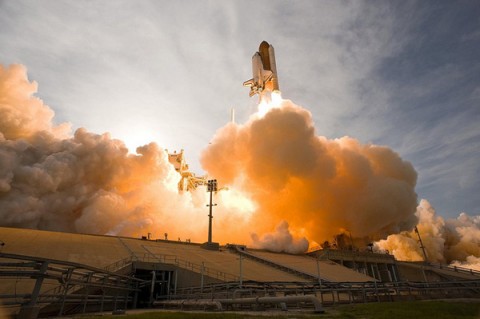
This week, NASA rolled a big archive of historical images into Flickr Commons, giving users access to more than a half century of NASA’s photographic history. The images are divided into three neat sets – “Launch and Takeoff,” “Building NASA” and “Center Namesakes” – and they’re all copyright-free, meaning that you can share and use these images however you like. You can jump into the archive here and watch it grow over time. Thanks for the heads up @eugenephoto! They’re always appreciated…
Read More...What Makes Us Human?
Some of the most basic questions about human existence (how did we develop language? why do we love music and art but kill in war? how did we develop certain eating habits? etc.) come back to a more singular question: how are we different from chimpanzees? This question is slowly getting answered by some of today’s leading primatologists and evolutionary biologists, including Robert Sapolsky, Daniel Lieberman, Richard Wrangham, Jane Goodall, Steven Pinker, all featured above.
Read More...Syllabus & Book List for Sci-Fi Newbies
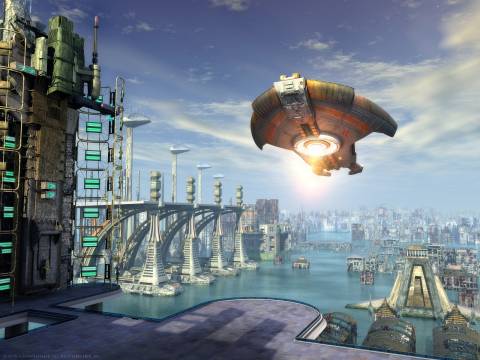
Always wanted to read science fiction? But never knew where to start? io9, a blog dedicated to futurism and sci-fi, has you covered. Today, they published a handy sci-fi syllabus/reading list “intended to introduce the novice student … to the major themes in the genre, as well as books and authors who are representative of different eras in SF lit (including the present day).” The io9 reading list breaks down a vast body of sci-fi literature into six useful categories – 1) Foundational Works/Classics, 2) Utopias and Dystopias, 3) Robots, 4) Aliens, 5) Space Travel, and 6) Science Fiction as Political Philosophy. Wells, Lovecraft, Huxley, Orwell, Dick, Asimov, Gibson, Heinlein, LeGuin – they’re all on the list.
Related FYIs: you can find many of HP Lovecraft’s writings online here. Thanks Julie for the recent heads up.
Also, you can download an audio version of Huxley narrating A Brave New World here.
Read More...Support Us
We're hoping to rely on loyal readers, rather than erratic ads. Please click the Donate button and support Open Culture. You can use Paypal, Venmo, Patreon, even Crypto! We thank you!

About Us

Open Culture scours the web for the best educational media. We find the free courses and audio books you need, the language lessons & educational videos you want, and plenty of enlightenment in between.
Advertise With Us

FREE UPDATES!
GET OUR DAILY EMAIL
Get the best cultural and educational resources on the web curated for you in a daily email. We never spam. Unsubscribe at any time.
FOLLOW ON SOCIAL MEDIA

Open Culture editor Dan Colman scours the web for the best educational media. He finds the free courses and audio books you need, the language lessons & movies you want, and plenty of enlightenment in between.
Advertise With Us

