Download George Orwell’s Animal Farm and 1984 as Free Audio Books

Image via Wikimedia Commons
Writing in The Guardian in years past, Christopher Hitchens revisited Animal Farm, George Orwell’s “dystopian allegorical novella” that took aim at the corruption of the Soviet Union and its totalitarian rule. Published in 1945, the short book appears on the Modern Library’s list of the 100 Best Novels of the 20th century, and Time Magazine’s own honors list. But, as Hitchens reminds us, Animal Farm was almost never published. The manuscript barely survived the Nazi bombing of London during World War II, and then initially TS Eliot (an important editor at Faber & Faber) and other publishers rejected the book. It eventually came to see the light of day, but, 65 years later, Animal Farm still can’t be legally read in China, Burma and North Korea, or across large parts of the Islamic world. But, no matter where you come from, you can listen to Animal Farm for free. That’s right, I said it – free. The Internet Archive offers free access to audio versions of Animal Farm and Orwell’s other major classic, 1984. Both texts appear in our collection of Free Audio Books, and you can download them directly from the Internet Archive here (Animal Farm) and here (1984), or stream them below:
Animal Farm
1984
The text versions of these classics also appear in our collection of Free eBooks.
Finally, if you’re interested in downloading a free audio book from Audible.com (pretty much any book you want), you can get more details here.
Related Content:
James Joyce’s Ulysses: Download the Free Audio Book
Lit2Go’s 200 Free (and Teacher-Friendly) Audio Books: Ready for Downloads
500 Free Audio Books: Download Great Books for Free
Read More...
Bill Gates: Solving the World’s Problems Through Technology
Last week, we showed you a clip of Bill Gates speaking at the recent Techonomy conference in Lake Tahoe. Our comments concentrated on a shorter segment where Gates talks about the coming transformation of education – about how the internet will start displacing the traditional university within five years. That clip figures into a larger talk, now fully available online, called “Reinventing Capitalism: How to Jumpstart What the Marketplace Can’t” (48 minutes). And it puts Gates’ views on education (not to mention his overall philanthropic work) into a larger context. What’s generally on display here is his limitless faith that science and technology can solve the world’s problems. It’s an approach that makes perfect sense for ridding the world of malaria. But it’s potentially a double-edge sword for education. You can watch the full talk above, or view it here. (His full comments on education & technology come around the 21 minute mark, and again later on.) You can also learn more about what Gates is reading, watching and listening to on his website.
Get 250 Free Courses Online or Learn 37 Languages for Free!
Read More...Why the World Needs WikiLeaks (According to Julian Assange)
After yesterday’s post, I’ll never get a sniff of a TED conference. But even so, we’ll keep featuring Ted Talks from time to time, and so why not today? Above, we have TED’s Chris Anderson interviewing Julian Assange, founder of WikiLeaks, the whistle-blowing website that made headlines last month when it released the Afghan War Diaries, all 92,000 pages worth. During the 19 minute interview, Assange talks a little more about the philosophy behind WikiLeaks, how the organization decides when to release information (or not), how the site has changed world events, and what some more ordinary leaks look like. No matter what stance you take on WikiLeaks, the interview is worth a watch. You’ll only hear more about them down the line.
Read More...Brian Wilson Reimagines Gershwin (Listen Online This Sunday)
Brian Wilson was the driving force behind The Beach Boys, the band who gave us Pet Sounds (1966), the LP ranked 2nd on Rolling Stone’s list of “The 500 Greatest Albums of All Time.” Now, almost 50 years after forming the band, Wilson will release a new solo album next Tuesday. Brian Wilson Reimagines Gershwin features covers – imaginative re-interpretations, if you will – of classic songs written by the iconic Gershwin Brothers. The video above spells out the backstory behind the album. But if you want a real taste of the project, then get this. This Sunday, the album will be streamed live on Brian Wilson’s web site at 12:00 noon Pacific Time. And thereafter Wilson himself will take questions on his Facebook page for one hour (12:45pm — 1:45pm). Get the details here. And also check out this good find: Gershwin plays Gershwin: Rhapsody in Blue.
Bill Gates: The Internet Will Displace the Traditional University in 5 Years
Speaking at the Techonomy conference in Lake Tahoe last week, Bill Gates argued that the cost of college needs to come down, and the only way to accomplish this is through technology and lessening the importance of “place-based” colleges. That’s how you keep college education open to all. During the talk, he went further and asserted, “Five years from now, on the Web for free, you’ll be able to find the best lectures in the world. It will be better than any single university.”
To be sure, I don’t dispute this particular point. You can already find hundreds of free courses online, and that’s part of our reason for being. But, as I have frequently reminded people, listening to lectures doesn’t mean you’re getting a rounded education. Lectures inform you. They’re great in that way. But you get an education when you couple lectures with readings, when you chew over ideas in a discussion section, when you analyze the lectures and readings in critical papers, when you take exams that force you to synthesize everything you’ve learned during the entire semester, etc. Right now, it is very hard to accomplish this online. On a relative basis, e‑learning tools have evolved strikingly slowly during the past decade. The widely deployed tools are often still klunky and rudimentary. And it still takes considerable time, money and labor to produce a truly excellent online course. (At least that’s what I have found during my ten years in the space.) Will we make progress here? Yes. Would I welcome it? Of course. But will we offer a substantive and highly scalable online alternative in five years? Very doubtful, unless a catalyst comes along who can dramatically sweep away the existing major players (who just bog things down) and introduce some serious innovation. Mr. Gates, are you that catalyst?
via Wired Campus
Read More...Michael Sandel on Justice, Aristotle & Gay Marriage
We have mentioned him here many times before. Michael Sandel teaches philosophy at Harvard, including the ever-popular course, “Justice,” taken by some 14,000 students during the past two decades. (The legendary course is now freely available online.) Speaking at the Aspen Institute not too long ago, Sandel gave a very abbreviated version of the course. Call it “Justice in Under an Hour.” (My title, not his.) And, by the time he wrapped things up, he got down to a timely question in America. Is it just for the state to withhold the institution of marriage from same sex couples? What would Aristotle (who laid the foundation for western thinking about justice) have to say about this question? And how do Sandel’s Harvard students grapple with it? The full presentation is available above; the particular section on gay marriage is here.
Looking for free philosophy courses? Have a look through the Philosophy section of our big collection of Free Online Courses.
Read More...Visit 890 UNESCO World Heritage Sites with Free iPhone/iPad App
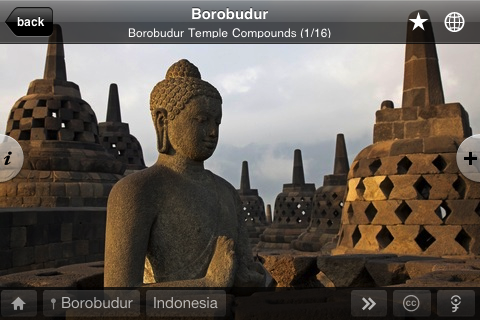
The new Fotopedia Heritage app for the iPhone and iPad lets the world come to you. (Download here.) Drawing on 20,000 curated photos taken by thousands of photographers from the Fotopedia community, this FREE app lets you visit (at least virtually) 890 UNESCO World Heritage sites. In a matter of minutes, you can move from Notre Dame in Paris, to the Dome of the Rock in Jerusalem, to Machu Picchu in Peru, to the Great Pyramid of Giza in Egypt. You get the picture. And speaking of pictures, it’s worth noting that all photos are released under a Creative Commons license. A very nice touch. Let me finally mention that the app has some smart mashup features, including maps showing the location of each site, plus Wikipedia entries offering background information on each location. You can start downloading the app right here. (Many thanks to Jane for calling this out.)
Related Content:
Visit Pompeii (also Stonehenge & Versailles) with Google Street View
Read More...Science Under a Microscope
What happens when you study science in a scientific way? When you apply scientific methods to science itself? When you put science under its own microscope and ask, “What is science really all about?” These are some of the fundamental questions that the CBC program Ideas tackles when it spends 24 hours interviewing historians, sociologists, philosophers and scientists who have thought long and hard about the nature of science. You can access the first five episodes below, or go straight to the full collection here.
Episode 1 — Steven Shapin and Simon Schaffer
Episode 2 — Lorraine Daston
Episode 3 — Margaret Lock
Episode 4 — Ian Hacking and Andrew Pickering
Episode 5 — Ulrich Beck and Bruno Latour
Many thanks to Paul for the tip here.
Read More...Journey to the Center of a Triangle
In 1977, Bruce and Katharine Cornwell used a Tektronics 4051 Graphics Terminal to create animated short films that demystify geometry. The films have now reemerged on the Internet Archive. Journey to the Center of a Triangle appears above. You can also watch Congruent Triangles, which features the memorable ‘Bach meets Third Stream Jazz’ musical score. Enjoy.
Read More...Harvard Presents Free Courses with the Open Learning Initiative
 Always good to see another major university making a contribution to the open course movement. The Open Learning Initiative undertaken by the Harvard University Extension School now offers eight free courses. This cluster of courses – the first Harvard has put forward – covers a nice range of topics. They feature some heavy-hitting members of the Harvard faculty. And they’re freely available in audio and video. The full list appears below as well as in our big list of 500 Free Online Courses:
- China: Traditions and Transformations (Peter K. Bol, PhD, Charles H. Carswell Professor of East Asian Languages and Civilizations, and William C. Kirby, PhD, T. M. Chang Professor of China Studies)
- Shakespeare After All: The Later Plays (Marjorie Garber, PhD, William R. Kenan Jr. Professor of English)
- The Heroic and the Anti-Heroic in Classical Greek Civilization (Gregory Nagy, PhD, Francis Jones Professor of Classical Greek Literature)
- World War and Society in the 20th Century: World War II (Charles S. Maier, PhD, Leverett Saltonstall Professor of History)
- Bits (Harry R. Lewis, PhD, Gordon McKay Professor of Computer Science)
- Intensive Introduction to Computer Science Using C, PHP, and JavaScript (David J. Malan, PhD, Lecturer on Computer Science)
- Abstract Algebra (Benedict Gross, PhD, George Vasmer Leverett Professor of Mathematics)
- Sets, Counting, and Probability (Paul G. Bamberg, DPhil, Senior Lecturer on Mathematics)
Related Content:
What’s the Right Thing to Do?: Popular Harvard Course Now Online
Read More...Support Us
We're hoping to rely on loyal readers, rather than erratic ads. Please click the Donate button and support Open Culture. You can use Paypal, Venmo, Patreon, even Crypto! We thank you!

About Us

Open Culture scours the web for the best educational media. We find the free courses and audio books you need, the language lessons & educational videos you want, and plenty of enlightenment in between.
Advertise With Us

FREE UPDATES!
GET OUR DAILY EMAIL
Get the best cultural and educational resources on the web curated for you in a daily email. We never spam. Unsubscribe at any time.
FOLLOW ON SOCIAL MEDIA

Open Culture editor Dan Colman scours the web for the best educational media. He finds the free courses and audio books you need, the language lessons & movies you want, and plenty of enlightenment in between.
Advertise With Us

