Insults Shakespeare Style
Searching for a stinging insult that has a nice literary quality? Let the Shakespeare Insult Finder be your guide. And, if you find yourself needing a good insult on the go, you can always download a free app for the iPhone.
“Your means are very slender, and your waste is great.”
–Henry IV, part 2
(Thanks Veronica!)
Read More...Beyond Silicon Valley: Online Education in Emerging Markets
I live in Silicon Valley where it’s easy to assume that you’re living at the center of technological innovation. But, as Sarah Lacy reminds us today in TechCrunch, Silicon Valley will probably not realize the promise of e‑learning. Rather, it will be investors and entrepreneurs in Brazil, India, South Africa and other emerging markets. Why will they get the job done? Because their educational systems haven’t fully matured. They’re still a work-in-progress. And this creates an environment much more favorable to innovation. You can get the rest of her thinking here.
Read More...David Lynch Debuts Lady Blue Shanghai
David Lynch is no stranger to commercials. In the past, he lent his filmmaking talents to Calvin Klein, Giorgio Armani and others (watch the ads here). And now it’s Dior. Shot in Shanghai, Lynch’s internet movie, Lady Blue Shanghai, runs 16 minutes and stars the Oscar-winning French actress Marion Cotillard. Although largely given free reign here, Lynch had to include a few basic elements: images of a Dior bag, Old Shanghai, and the Pearl Tower. The short movie is the third in a series of mini-features launched on christiandior.com. You can watch the first part above, the second part here.
You can now find Lady Blue Shanghai in our collection of Free Movies Online, along with several other short David Lynch films.
Read More...Viktor Frankl on Our Search for Meaning
Viktor Frankl, a trained Austrian psychiatrist, spent five long years in Nazi concentration camps during World War II, eventually ending up in Auschwitz. During this time, he helped fellow prisoners cope with their ordeal and worked out a new approach to psychology called Logotherapy. This theory embodied Frankl’s belief that we’re all fundamentally driven by a “search for meaning.” It’s what makes us human, and we can continue this search even in the worst of situations. Not even the Nazis could take that away. This belief sustained Frankl during his imprisonment, something he wrote about in his epic work of survival literature called Man’s Search for Meaning. (It’s a must read.) The grainy footage above was recorded at a conference held in Toronto (probably during the 1960s). It gives you a quick introduction to a man who, despite personally confronting the worst humanity had to offer, still believed in our core goodness and possibilities.
Read More...Stanford Online Writing Courses (Summer)
A quick fyi: Stanford Continuing Studies will open up registration Monday morning (8:30 am California time) for its summer lineup of online writing courses. Offered in partnership with the Stanford Creative Writing Program (one of the most distinguished writing programs in the country), these online courses give beginning and advanced writers, no matter where they live, the chance to refine their craft with gifted writing instructors.
Classes will start in late June. And many of these classes fill quickly (some very quickly). To get more information on these writing courses, click here, or separately check out this FAQ.
Caveat emptor: These classes are not free, and I helped set them up. So while I wholeheartedly believe in these courses, you can take my views with a grain of salt.
- Writing Fiction with The New York Times
- Creative Nonfiction I: The Powerful Beginning
- No Fear Poetry
- Writing from Life: The Art of Creative Nonfiction
- One-on-One, Together: The Writing Course Built Around You
- Novel Writing: Making the Great Debut
- Writing for Magazines: Think Like a Freelancer
- Short Story Writing
- Get in the Zone! A Starting Place for Writers
- Novel III: Writing Toward the Finish
Tom Waits Reads Charles Bukowski
Next up: Tom Waits reads Charles Bukowski’s poem, The Laughing Heart. As Zoran (a reader from Greece) observes, Waits reads the poem much like Bukowski would have read it himself.
Of course, this raises the question: How did Bukowski read his poetry? The Secret of My Endurance holds the answer.
Thanks Zoran…
Read More...Jorge Luis Borges: The Mirror Man, A Free Documentary on the Argentine Writer
He was Argentina’s favorite son, one of the great South American writers of the last century (along with Gabriel Garcia Marquez, Carlos Fuentes, and Mario Vargas Llosa), and the winner of 46 national and international literary prizes. We’re talking about Jorge Luis Borges, the master of the postmodern short story. Borges was born in 1899, and to celebrate his 100th birthday (though he died in 1986), Philippe Molins directed the documentary, Jorge Luis Borges: The Mirror Man. The film’s major strength (as one reviewer put it) is that it’s a “bit of everything – part biography, part literary criticism, part hero-worship, part book reading, and part psychology.” It runs 47 minutes and includes a fair amount of archival footage. (You can watch it in a larger format on Vimeo here.)
A big thanks goes to Mike for sending The Mirror Man our way. If you have your own great piece of cultural media to share with us and your fellow OC readers, please feel free to send it along.
Read More...The Walker Library of Human Imagination
The tech/internet billionaires of the 1990s were never known for their largesse. They built their massive yachts. They bought their sports teams. They didn’t give much back to the public domain, as the Rockefellers, Mellons and the Gettys once did (despite their many other flaws).
There are some exceptions, of course. Bill Gates finally found religion and got involved in philanthropy in a big way. Then, on a lesser scale, there’s Jay Walker, the founder of Priceline and Walker Digital. He plowed many of his millions into creating The Walker Library of Human Imagination. As Wired magazine has put it, the library is a kind of intellectual Disneyland, a 3600 square foot room that displays great works of human imagination in an imaginative setting. Artifacts on display include: a complete Bible handwritten on sheepskin from 1240 AD, the first illustrated medical book from 1499, a 1699 atlas containing the first maps that put the sun at the center of the universe, the napkin on which FDR sketched his plan to win WWII, and an original 1957 Russian Sputnik satellite. You can get a full list of cultural curiosities here, watch the recently produced video tour of the library above, and spend a few minutes watching Walker talk about his library at TED.
Thanks Colleen for flagging the new video.
Read More...Listen to Brave New World for Free: Dramatized Version Read by Aldous Huxley
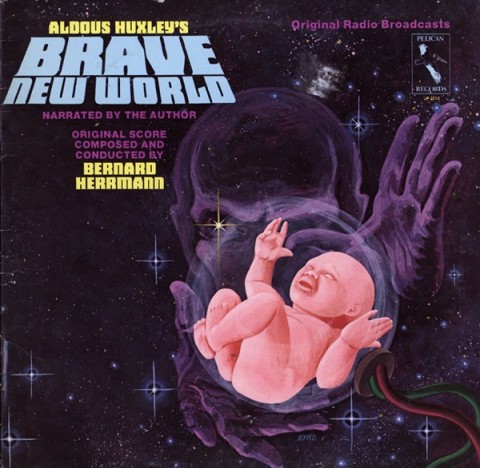
The CBS Radio Workshop was an “experimental dramatic radio anthology series” that aired between 1956 and 1957. And it premiered with a two-part adaptation of Aldous Huxley’s now classic 1932 novel, Brave New World. Huxley himself introduced and narrated the program, and now this classic radio drama has resurfaced online. You can listen to Part 1 and Part 2 below. The mp3s will be permanently housed in our collection of Free Audio Books.
Part 1
Part 2
Building The Colosseum: The Icon of Rome
When you think Rome, you think the Colosseum. It’s one of the great structures of the Roman Empire, and it still dominates the landscape of the modern city. But how deep does your knowledge of the Colosseum actually go? Which emperor built the Amphitheatrum Flavium (as it was originally called)? For what purpose? And how, stylistically, was it originally built and decorated? All of this gets answered in an image-packed lecture by Yale professor Diana E.E. Kleiner, which forms part of her larger course on Roman Architecture. (Find it on YouTube, iTunes and Yale’s Open Course web site). I queued up the lecture at the 20 minute, when Kleiner starts talking about the Colosseum itself. But you can move back to the very beginning if you want to get some more political context.
Finally, let me mention that Google also lets you revisit Ancient Rome. Google Earth offers a nice 3D view of the Colosseum and other important Roman monuments, while Google Street View you tour the ancient ruins of Pompeii. It’s all free, of course.
Please visit our collection of Free Online Courses to learn more about history, literature, philosophy or whatever else piques your interest. You’ll find a good 250 free courses in the collection.
Read More...Support Us
We're hoping to rely on loyal readers, rather than erratic ads. Please click the Donate button and support Open Culture. You can use Paypal, Venmo, Patreon, even Crypto! We thank you!

About Us

Open Culture scours the web for the best educational media. We find the free courses and audio books you need, the language lessons & educational videos you want, and plenty of enlightenment in between.
Advertise With Us

FREE UPDATES!
GET OUR DAILY EMAIL
Get the best cultural and educational resources on the web curated for you in a daily email. We never spam. Unsubscribe at any time.
FOLLOW ON SOCIAL MEDIA

Open Culture editor Dan Colman scours the web for the best educational media. He finds the free courses and audio books you need, the language lessons & movies you want, and plenty of enlightenment in between.
Advertise With Us

