David Bowie Sends a Christmas Greeting in the Voice of Elvis Presley (and Sings “I Can’t Help Falling in Love With You”)
After David Bowie died in 2016, we discovered that the musician had a knack for doing impressions of fellow celebrities. Could he sing a song in the style of Iggy Pop, Lou Reed, Tom Waits, and Bruce Springsteen? Turns out, he could. And yes, he could do an Elvis impression too.
The clip above aired back in 2013 on “This Is Radio Clash,” a radio show hosted by the Clash’s Mick Jones, Paul Simonon and Topper Headon. “Hello everybody,” this is David Bowie making a telephone call from the US of A. At this time of the year I can’t help but remember my British-ness and all the jolly British folk, so here’s to you and have yourselves a Merry little Christmas and a Happy New Year. Thank you very much.”
It’s maybe not as memorable as his 1977 Christmas duet with Bing Crosby, but, hey, it’s still a fun little way to get the holiday season in swing.
Bonus: Below hear Bowie sing Presley’s classic “I Can’t Help Falling in Love With You.” I hadn’t heard it before, and it’s a treat.
If you would like to support the mission of Open Culture, consider making a donation to our site. It’s hard to rely 100% on ads, and your contributions will help us continue providing the best free cultural and educational materials to learners everywhere. You can contribute through PayPal, Patreon, and Venmo (@openculture). Thanks!
Related Content:
Read More...
Holidays Spent with the Muppets — Pretty Much Pop: A Culture Podcast #164

For Pretty Much Pop’s annual holiday episode, your hosts Mark Linsenmayer, Lawrence Ware, Sarahlyn Bruck, and Al Baker talk all things Muppets, but in particular the 1992 film The Muppet Christmas Carol, wherein Michael Caine gives us just as strong and serious a Scrooge as you might find. What’s the appeal of this puppet act? Is the humor actually supposed to be good, or post-funny ironic? How do Muppets change the way we experience music?
Even though Jim Henson had died by the time of Christmas Carol, nearly all the rest of the creative team from The Muppet Movie (1979) was still in place, including scriptwriter Jerry Juhl and songwriter by Paul Williams. Should the property still exist now that a new generation has largely taken over, and can it ever recapture that old magic? We consider recent iterations including the current Muppet Mayhem, the classic movies and various revivals, past Christmas specials (John Denver! Emmet Otter!), pre-Muppet-Show iterations of Henson’s act, the Dark Crystal and Labyrinth films, the role of humans in Muppet media, the ideology of Dickens’ story, and much more. Which Muppet personality type are you?
Follow us @law_writes, @sarahlynbruck, @ixisnox, @MarkLinsenmayer.
For some more Partially Examined Life network holiday antics, watch Mark and Bill’s video chit-chat for Philosophy vs. Improv. The ghost of Pretty Much Pop Christmas past brings you episodes about Xmas songs and holiday viewing. We also mention our Peanuts episode.
Hear more Pretty Much Pop, including many recent episodes that you haven’t seen on this site. Support the show and hear bonus talking for this and nearly every other episode at patreon.com/prettymuchpop or by choosing a paid subscription through Apple Podcasts. This podcast is part of the Partially Examined Life podcast network. Pretty Much Pop: A Culture Podcast is the first podcast curated by Open Culture. Browse all Pretty Much Pop posts.
Read More...The Story of The Pogues’ “Fairytale of New York,” the Boozy Ballad That Became a Beloved Christmas Song
Note: With the recent passing of Shane Macgowan, we’re bringing back a post from 2018 and revisiting The Pogues’ song “Fairytale of New York.” The offbeat Christmas classic is currently #5 on the Billboard Singles Chart in the UK.
Drugstore Cowboy, Barfly, Leaving Las Vegas, even Bonnie and Clyde… we love a good story about doomed, down-and-out lovers. Whatever emotional reservoir they tap into, when written well and honestly, such stories have broad cultural appeal. Which in part explains the overwhelming popularity of The Pogues’ 1987 classic “Fairytale of New York,” the kind of “anti-Christmas song,” writes Dorian Lynsky at The Guardian, “that ended up being, for a generation, the Christmas song.”
Many holiday stories cynically trade on the fact that, for a great many people, the holidays are filled with pain and loss. But “Fairytale of New York” doesn’t play this for laughs, nor does it pull the old trick of cheap last-minute redemption.
Sung as a duet by Shane MacGowan and Kirsty MacColl to the boozy tune of an Irish folk ballad, the song “is loved because it feels more emotionally ‘real’ than the homesick sentimentality of ‘White Christmas.’ ” Even if we can’t identify with the plight of a burned-out Irish dreamer spending Christmas in a New York drunk tank, we can feel the ache of broken dreams set in high relief against holiday lights.
The song’s history itself makes for a compelling tale, whether we believe the origin story in accordion player James Fearnley’s memoir Here Comes Everybody: The Story of the Pogues or that told by MacGowan, who maintains that Elvis Costello, the band’s producer, bet the singer that he couldn’t write a Christmas duet. (Fearnley writes that they were trying to top The Band’s 1977 “Christmas Must Be Tonight.”)
Either way, a Christmas song was a good idea. “For a band like the Pogues, very strongly rooted in all kinds of traditions rather than the present, it was a no-brainer,” says banjo-player and co-writer Jem Finer. Not to mention the fact that MacGowan was born on Christmas Day 1957.
Finer began the song as a tale about a sailor missing his wife on Christmas, but after the banjo player’s wife called it “corny” he took her suggestion to adapt the “true story of some mutual friends living in New York.” MacGowan took the title from J.P. Donleavy’s 1973 novel A Fairy Tale of New York, which happened to be lying around the recording studio. After a promising start, the song then went through two years of revisions and re-recordings before the band finally settled on the version millions know and love, produced by Steve Lillywhite and released on the 1988 album If I Should Fall From Grace with God.
Originally intended as a duet between MacGowan and bass player Cait O’Riordan, a version recorded with her was “not quite there,” guitarist Philip Chevron has said. Soon after, O’Riordan left the band, and MacGowan recorded the song again at Abbey Road in 1987, singing both the male and female vocal parts himself. Eventually Lillywhite took the track home to have his wife, English singer Kirsty MacColl, record a temporary guide vocal for the female parts. When MacGowan heard it, he knew he had found the right foil for the character he plays in the song.
“Kirsty knew exactly the right measure of viciousness and femininity and romance to put into it and she had a very strong character and it came across in a big way,” MacGowan later remarked in an interview. “In operas, if you have a double aria, it’s what the woman does that really matters. the man lies, the woman tells the truth.” As part of her character’s “viciousness”, she hurls the slur “f*ggot” at MacGowan, who calls her a “slut.” The offensive words have been censored on radio stations, then uncensored, and good cases have been made for bleeping them out (most recently by Irish DJ Eoghan McDermott on Twitter).
MacGowan himself has issued a statement defending the lyrics as in keeping with the characters. “Sometimes characters in songs and stories have to be evil or nasty in order to tell the story effectively,” he writes, adding, “If people don’t understand that I was trying to accurately portray the character as authentically as possible then I am absolutely fine with them bleeping the word but I don’t want to get into an argument.” Whatever position one takes on this, it’s hard to deny that MacGowan, co-writer Finer, and MacColl totally hit the mark when it comes to authenticity.
The genuine emotions “Fairytale of New York” taps into has made it the most beloved Christmas song of all time in TV, radio, and magazine polls in the UK and Ireland. It has become “far bigger than the people who made it,” writes Lynskey. Or, as Fearnley puts it, “It’s like ‘Fairytale of New York’ went off and inhabited its own planet.” An artist can’t ask for more. See making-of videos by the BBC and Polyphonic at the top. Watch the band sloppily mime the song with MacColl on Top of the Pops further up (MacGowan cannot actually play the piano). And just above, see the official video, starring Drugstore Cowboy’s Matt Dillon—filmed inside a real police station on the Lower East Side during a freezing Thanksgiving week in 1987, for maximum holiday vérité.
Related Content:
An Old-Time Radio Yuletide: Hear 20+ Hours of Vintage Christmas Radio Shows (1938–1956)
Hear Paul McCartney’s Experimental Christmas Mixtape: A Rare & Forgotten Recording from 1965
Josh Jones is a writer and musician based in Durham, NC. Follow him at @jdmagness
Read More...How Pantone Became the Global Authority on Color
Pantone has declared “Peach Fuzz” the Color of the Year. This selection, however, raises the question: How did Pantone become the global authority on color? Above, the Wall Street Journal describes how Pantone began as a commercial printing company during the 1950s. Then, in the early 60s, it evolved into something quite different. Recognizing that its clients (and other companies) need to print materials with consistent colors, Pantone created a universal color language, the Pantone Matching System (PMS), where each color is assigned a specific number. For instance, “Peach Fuzz” corresponds to #FFBE98. As Slate points out, this system ensured that “printers and clients would have a shared reference when they talk to one another—an industry standard, so that a color would mean the same thing all the way from a designer’s vision to the printed item.” Over the next 60 years, Pantone continued to nurture the Pantone Matching System, undoubtedly generating significant revenue along the way and, more importantly, making itself the arbiter of color worldwide.
If you would like to support the mission of Open Culture, consider making a donation to our site. It’s hard to rely 100% on ads, and your contributions will help us continue providing the best free cultural and educational materials to learners everywhere. You can contribute through PayPal, Patreon, and Venmo (@openculture). Thanks!
Related Content
A 900-Page Pre-Pantone Guide to Color from 1692: A Complete Digital Scan
Prince Gets an Official Purple Pantone Color
The Vibrant Color Wheels Designed by Goethe, Newton & Other Theorists of Color (1665–1810)
Read More...Hear the Haunting Aztec “Death Whistle,” the Instrument That Made Sounds Resembling a Human Scream
The received image of the Aztecs, with their savage battles and frequent acts of human sacrifice, tends to imply a violence-saturated, death-obsessed culture. Given that, it will hardly come as a surprise to learn of an Aztec musical instrument discovered in the hands of a sacrificed human body, or that the instrument has come to be known as the “death whistle.” Not that it was an especially recent find: the excavation in question happened in Mexico City in the late nineteen-nineties. But only over the past decade, with the creation of replicas like the one played by the late Xavier Quijas Yxayotl in the clip above, have listeners around the world been able to hear the death whistle for themselves.
“The sound of the death whistle is the most frightening thing we’ve ever heard,” writes Reuben Westmaas at Discovery.com. “It literally sounds like a screeching zombie. We can only imagine what it would be like to hear hundreds of whistles from an Aztec army on the march. We’re not entirely certain what the whistles were used for, however.”
Whatever its application, the distinctive sound of the death whistle is created by blown air interacting “with a well or ‘spring’ of air inside a rounded internal chamber, creating distortions,” as Dave Roos writes at How Stuff Works. In his analysis of the death whistle’s inner workings, mechanical engineer Roberto Velázquez Cabrera gives that component the evocative name “chaos chamber.”
That the death whistle would be used in war and human sacrifice certainly aligns with the reputation of the Aztecs, but the instrument has also inspired other historically informed speculations. In the video from Gizmodo just above, professor of Mesoamerican and Latino studies Jaime Arredondo even suggests that it could have had its therapeutic uses, as a tool to create a “hypnotic, sort of soothing atmosphere.” It could well have been designed to imitate the sound of the wind, given that the sacrificial victim had been buried at the temple of the wind god Ehecatl. And though the death whistle may seem the least likely tool of relaxation imaginable, put your mind to it and just hear it as sounding less like the screech of a zombie than like the fifteenth-century equivalent of a white-noise machine.
via Boing Boing
Related content:
Based in Seoul, Colin Marshall writes and broadcasts on cities, language, and culture. His projects include the Substack newsletter Books on Cities, the book The Stateless City: a Walk through 21st-Century Los Angeles and the video series The City in Cinema. Follow him on Twitter at @colinmarshall or on Facebook.
Read More...The History of Cartography, the “Most Ambitious Overview of Map Making Ever,” Is Free Online
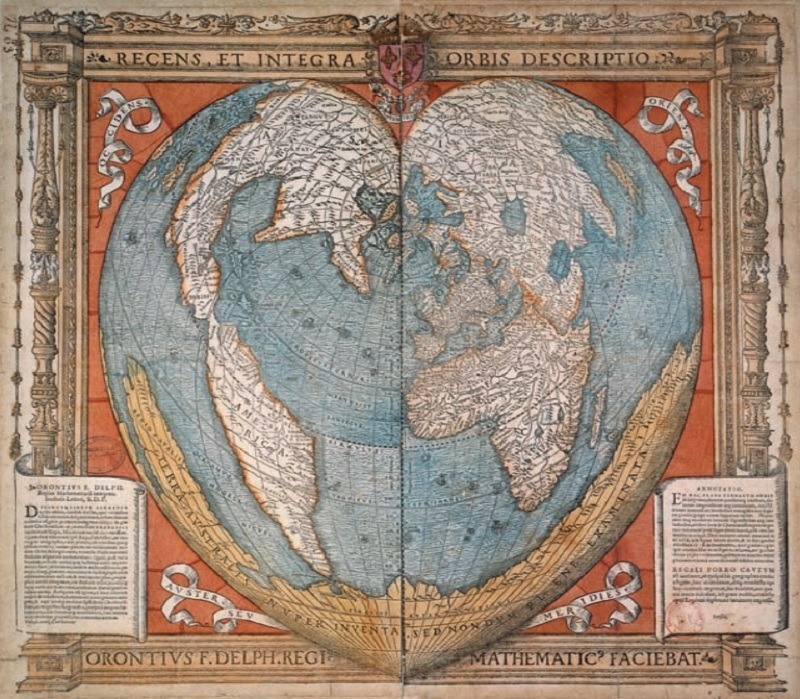
FYI: The University of Chicago Press has made available online — at no cost –five volumes of The History of Cartography. Or what Edward Rothstein, of The New York Times, called “the most ambitious overview of map making ever undertaken.” He continues:
People come to know the world the way they come to map it—through their perceptions of how its elements are connected and of how they should move among them. This is precisely what the series is attempting by situating the map at the heart of cultural life and revealing its relationship to society, science, and religion…. It is trying to define a new set of relationships between maps and the physical world that involve more than geometric correspondence. It is in essence a new map of human attempts to chart the world.
If you head over to this page, you will see links (in the left margin) to five volumes available in a free PDF format. The image above, appearing in Vol. 2, dates back to 1534. Created by Oronce Fine, the first chair of mathematics in the Collège Royal (aka the Collège de France), the map features the world drawn in the shape of a heart. A pretty beautiful design. Below you can find links to the individual volumes available online.
Volume 1
Volume 2: Book 1
Cartography in the Traditional Islamic and South Asian Societies
Volume 2: Book 2
Cartography in the Traditional East and Southeast Asian Societies
Volume 2: Part 3
Volume 3:
Cartography in the European Renaissance: Part 1
Cartography in the European Renaissance, Part 2
Volume 4:
Cartography in the European Enlightenment
Volume 5:
Cartography in the Nineteenth Century, Forthcoming
Volume 6:
Cartography in the Twentieth Century
If you buy any of the printed versions on Amazon, each edition will cost you $400-$500. As beautiful as the book probably is, you’ll likely appreciate this free digital offering.
If you would like to support the mission of Open Culture, consider making a donation to our site. It’s hard to rely 100% on ads, and your contributions will help us continue providing the best free cultural and educational materials to learners everywhere. You can contribute through PayPal, Patreon, and Venmo (@openculture). Thanks!
Related Content:
Download 91,000 Historic Maps from the Massive David Rumsey Map Collection
40,000 Early Modern Maps Are Now Freely Available Online (Courtesy of the British Library)
Behold an Incredibly Detailed, Handmade Map Of Medieval Trade Routes
The World Map That Introduced Scientific Mapmaking to the Medieval Islamic World (1154 AD)
Read More...
The History of the Earth (All 4.5 Billion Years) in 1 Hour: A Million Years Covered Every Second
From Kurzgesagt comes the history of our planet in one hour. They write: “Earth is 4.5 billion years old — which is approximately the same amount of time it took us to create this video. We’ve scaled the complete timeline of our Earth’s life into our first animated movie! Every second shows about a million years of the planet’s evolution. Hop on a musical train ride and experience how long a billion years really is.” Below, you can find the timestamps for the geologic periods covered in the video.
0:00 Intro
0:51 Hadean
8:04 Eoarchean
13:20 Paleoarchean
18:35 Mesoarchean
23:51 Neoarchean
27:47 Siderian
30:24 Rhyacian
33:42 Orosirian
36:58 Statherian
39:38 Calymmian
42:15 Ectasian
44:52 Stenian
47:30 Tonian
51:12 Cryogenian
52:18 Ediacaran
53:35 Cambrian
54:17 Ordovician
54:49 Silurian
55:08 Devonian
55:55 Carboniferous
56:43 Permian
57:21 Triassic
58:02 Jurassic
58:46 Cretaceous
59:48 Paleogene
1:00:21 Neogene
1:00:38 Quaternary
1:00:45 Ending
If you would like to support the mission of Open Culture, consider making a donation to our site. It’s hard to rely 100% on ads, and your contributions will help us continue providing the best free cultural and educational materials to learners everywhere. You can contribute through PayPal, Patreon, and Venmo (@openculture). Thanks!
Read More...Two Tiny Rembrandt Paintings Have Been Rediscovered & Put On Display in Amsterdam
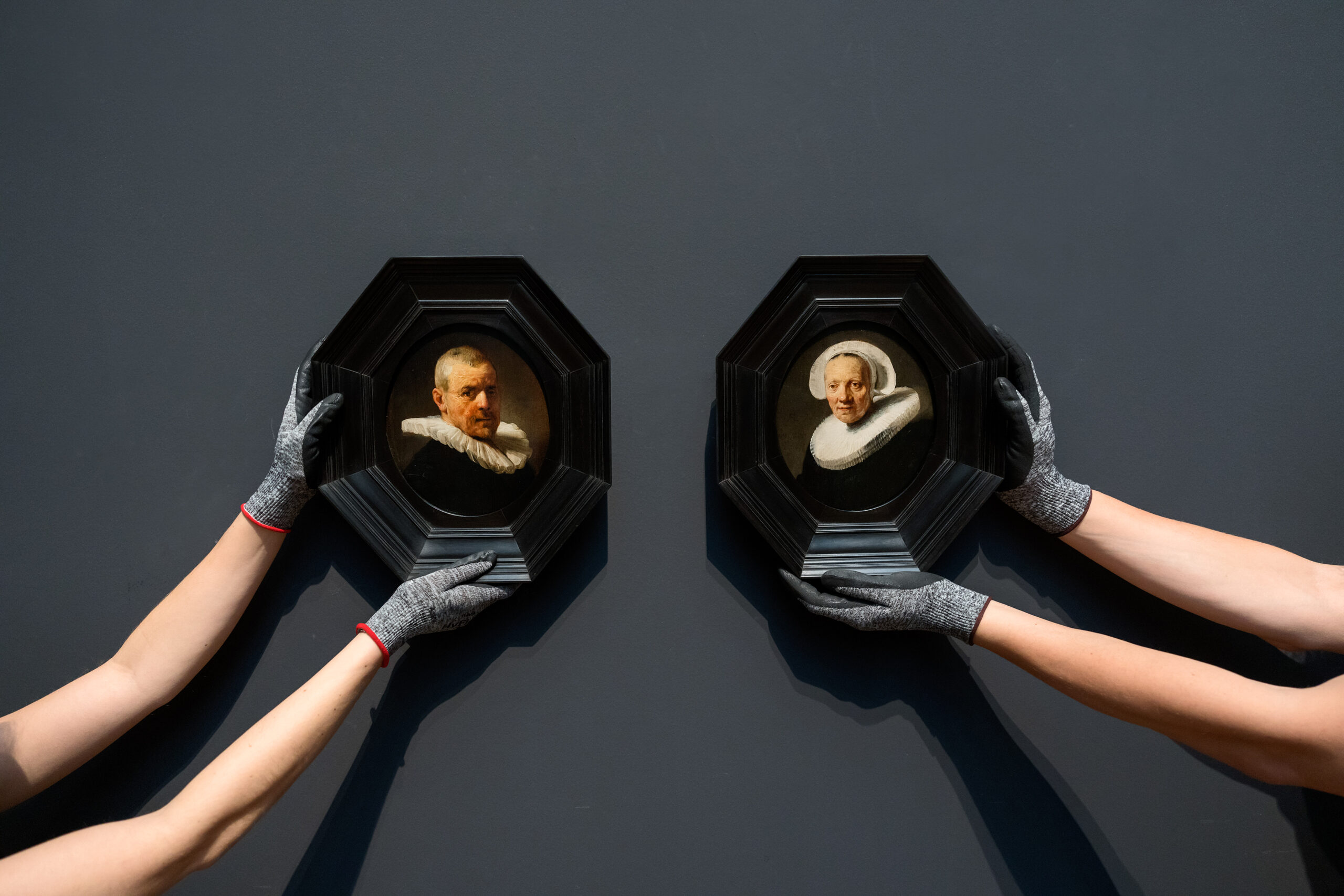
Many first-time visitors to the Louvre experience a letdown to discover how small the Mona Lisa is -just 21” x 30”.
Meanwhile, over in Amsterdam, visitors have been flocking to the Rijksmuseum, eager to lay eyes on the two smallest formal works in the museum’s collection.
Measuring slightly less than 8” tall, they are about as tall as the average retail banana as per US Department of Agriculture estimates.
It’s not just the matching oval portraits’ size that’s packing ’em in.
The recently rediscovered paintings have been identified as the work of Rembrandt Harmenszoon van Rijn, the leading artist of the Dutch Golden Age.
Painted in 1635, the portraits feature Jan Willemsz van der Pluym, a wealthy 17th-century plumber and his wife, Jaapgen Caerlsdr, dressed in black with stiff white ruffs. The couple owned the garden next to the painter’s mother, and he was distantly related to them through a marriage on her side.
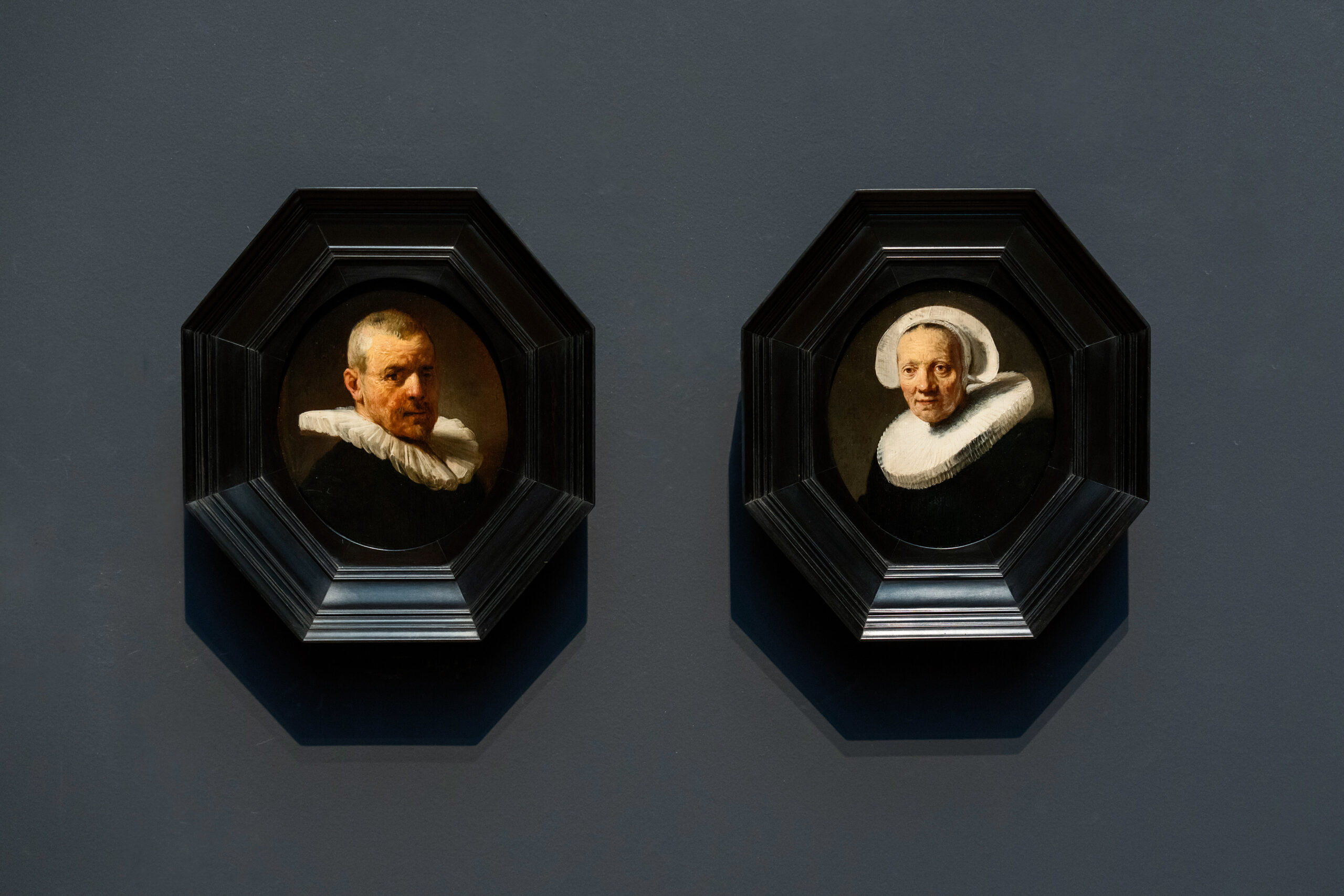
Their triple-great-grandchildren put the portraits up for auction in 1760, after which they passed through several private collections, before dropping entirely from public view following an auction in the summer of 1824.
Nearly two hundred years later, Jan and Jaapgen’s portraits weren’t making much of an impression on that winning bidder’s descendants.
As Henry Pettifer, an Old Master Paintings specialist at Christies, which conducted both the 1824 auction and the one last summer, where the portraits fetched 14.3 million dollars, told the Washington Post, “the family liked the pictures but were never certain that they were by Rembrandt and never really looked into that:”
The pictures were completely absent from the Rembrandt literature in the 19th and 20th centuries, which was extraordinary. They have intimacy about them, a dignity. They’re extraordinary… They’re unlike some of his grand, formal commissioned portraits, and they are something much more spontaneous and intimate. I think the reason for that is that the sitters were very closely connected to Rembrandt. They were very much from Rembrandt’s own inner circle. We should regard them as personal documents rather than formal commissions.
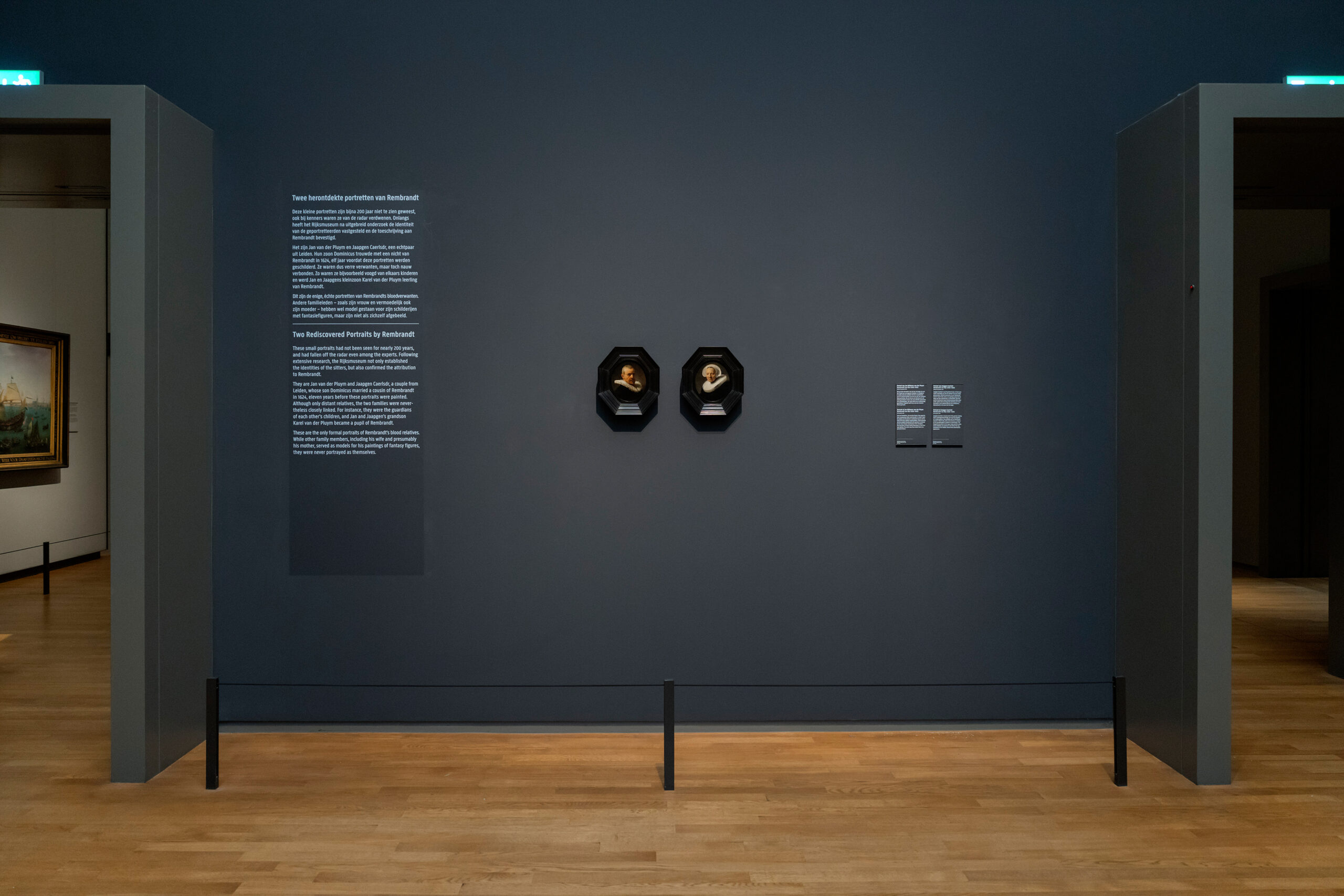
The most recent winning bidder is committed to keeping the paintings in the public eye with a long term-loan to the Rijksmuseum, where extensive research using X‑radiography, infrared photography, infrared reflectography, macro X‑ray fluorescence, stereomicroscopy and paint sample analysis confirmed their provenance.
Experts have also noted similarities in composition, color, and painting technique between these works and larger portraits Rembrandt executed during the same period.
Jonathan Bikker, the Rijksmuseum’s curator of 17th-century Dutch painting, describes the verification of provenance as “mindblowing:”
Totally unknown works hardly ever happen. We really wanted to be able to show them.
Related Content
300+ Etchings by Rembrandt Now Free Online, Thanks to the Morgan Library & Museum
The Rembrandt Book Bracelet: Behold a Functional Bracelet Featuring 1400 Rembrandt Drawings
– Ayun Halliday is the Chief Primatologist of the East Village Inky zine and author, most recently, of Creative, Not Famous: The Small Potato Manifesto and Creative, Not Famous Activity Book. Follow her @AyunHalliday.
Read More...Threads Now Available in Europe & UK (Plus the US): Get Our Daily Culture Posts There at @OpenCulture

Threads is on the rise. After getting released in over 100 countries (including the US and UK) earlier this year, Meta has just made Threads available in the EU. And that’s where we’re now sharing our daily posts, along with other objects of cultural interest. If you sign up, please search for @openculture, and give us a follow. Or just click right here.
If you would like to support the mission of Open Culture, consider making a donation to our site. It’s hard to rely 100% on ads, and your contributions will help us continue providing the best free cultural and educational materials to learners everywhere. You can contribute through PayPal, Patreon, and Venmo (@openculture). Thanks!
Read More...The World Map That Introduced Scientific Mapmaking to the Medieval Islamic World (1154 AD)
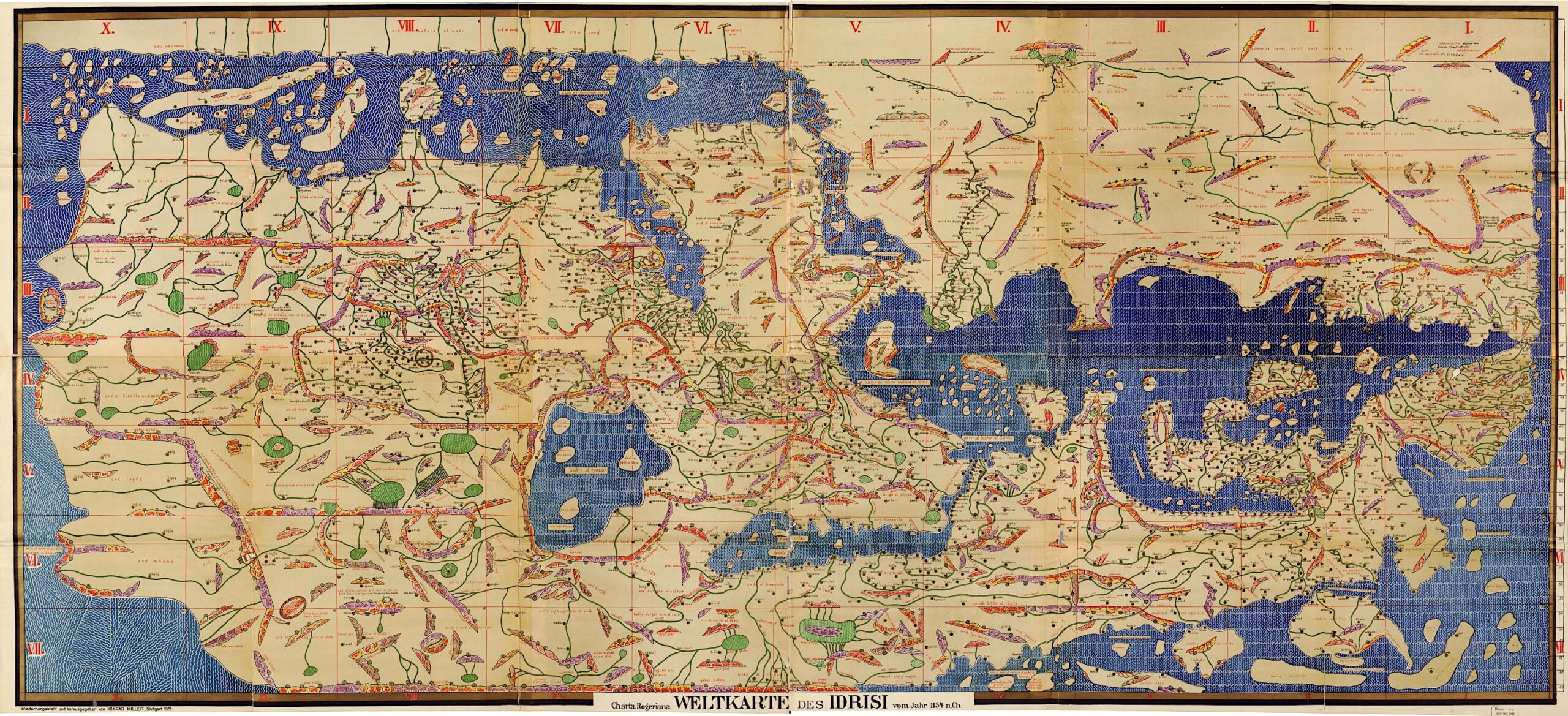
Cast your mind, if you will, to the city of Ceuta. If you’ve never heard of it, or can’t quite recall its location, you can easily find out by searching for it on your map application of choice. Back in the twelfth century, however, you might have had to consult an image of the known world engraved on a 300-pound, six-and-a-half-foot wide silver disk — but then, if you had access to that disk, you’d know full well where Ceuta was in the first place. For it belonged to King Roger II of Sicily, who’d commissioned it from the geographer, traveler, and scholar Abū Abdallāh Muhammad ibn Muhammad ibn Abdallāh ibn Idrīs al-sharif al-Idrīsī — more succinctly known as Muhammad al-Idrisi — perhaps Ceuta’s most accomplished son.
“Al-Idrisi studied in Cordoba and traveled widely as a young man, visiting Asia Minor, Hungary, the French Atlantic coast, and even as far north as York, England,” writes Big Think’s Frank Jacobs. In 1138, Roger II “invited al-Idrisi to his court at Palermo, possibly to explore whether he could install the Muslim nobleman as a puppet ruler in the bits of North Africa under his dominion, or in Spain, which he hoped to conquer.” The project that resulted from this meeting, fifteen years of work later, was “a new and accurate map of the world.” In addition to knowledge gained on his own extensive travels, Al-Isidiri consulted ancient sources like Ptolemy’s Geography and “interviewed ship’s crews and other seasoned travelers, but retained only those stories on which all were in agreement,” leaving out the mythical tribes and fantastical creatures.
In addition to the grand disk, Al-Idrisi created an atlas consisting of 70 detailed, annotated maps called Nuzhat al-mushtāq fi’khtirāq āl-āfāq. That Arabic title has been variously translated — “the book of pleasant journeys into faraway lands,” “the excursion of the one who yearns to penetrate the horizons,” “the excursion of one who is eager to traverse the regions of the world” — but in Latin, the book was simply called the Tabula Rogeriana. Alas, writes Jacobs, “the original Latin version of the atlas (and the silver disk) were destroyed in 1160 in the chaos of a coup against William the Wicked, Roger’s unpopular son and successor.” Still, Al-Idrisi did manage to bring the Arabic version back with him to North Africa, where it became an influential example of scientific cartography for the Islamic world.
A glance at the Library of Congress’ German facsimile from 1928 at the top of the post reveals that Al-Idrisi’s world map looks quite unlike the ones we know today. He put south, not north, at the top, the better for Islamic converts to orient themselves toward Mecca. “His Europe is sketchy, his Asia amorphous, and his Africa manages to be both partial and oversized,” Jacobs notes, but nevertheless, he got a lot right, including such little-known regions as the kingdom of Silla (located in modern-day Korea) and calculating — approximately, but still impressively — the circumference of the entire Earth. We might consider paying tribute to Al-Idrisi’s achievements by making a trip to his hometown (a Spanish-held city, for the record, at the very tip of Africa north-east of Morocco), which seems like a pleasant place to spend a few weeks — and a promising starting point from which to penetrate a few horizons of our own.
via Big Think
Related content:
How Did Cartographers Create World Maps before Airplanes and Satellites? An Introduction
40,000 Early Modern Maps Are Now Freely Available Online (Courtesy of the British Library)
500+ Beautiful Manuscripts from the Islamic World Now Digitized & Free to Download
The Birth and Rapid Rise of Islam, Animated (622‑1453)
Based in Seoul, Colin Marshall writes and broadcasts on cities, language, and culture. His projects include the Substack newsletter Books on Cities, the book The Stateless City: a Walk through 21st-Century Los Angeles and the video series The City in Cinema. Follow him on Twitter at @colinmarshall or on Facebook.
Read More...Support Us
We're hoping to rely on loyal readers, rather than erratic ads. Please click the Donate button and support Open Culture. You can use Paypal, Venmo, Patreon, even Crypto! We thank you!

About Us

Open Culture scours the web for the best educational media. We find the free courses and audio books you need, the language lessons & educational videos you want, and plenty of enlightenment in between.
Advertise With Us
FREE UPDATES!
GET OUR DAILY EMAIL
Get the best cultural and educational resources on the web curated for you in a daily email. We never spam. Unsubscribe at any time.
FOLLOW ON SOCIAL MEDIA
Open Culture editor Dan Colman scours the web for the best educational media. He finds the free courses and audio books you need, the language lessons & movies you want, and plenty of enlightenment in between.
Advertise With Us

