Stanford Online Writing Courses — The Spring Lineup
A quick fyi: This morning, Stanford Continuing Studies opened up registration for its spring lineup of online writing courses. Offered in partnership with the Stanford Creative Writing Program (one of the most distinguished writing programs in the country), these online courses give beginning and advanced writers, no matter where they live, the chance to refine their craft with gifted writing instructors.
As you will see, there are a couple of courses offered in conjunction with The New York Times. The idea here is that you’ll learn writing from a Stanford writing instructor and then get your work reviewed by a Times book critic. Quite a perk, I must say.
For more information, click here, or separately check out the FAQ.
Caveat emptor: These classes are not free, and I helped set them up. So while I wholeheartedly believe in these courses, you can take my views with a grain of salt.
- Creative Nonfiction with The New York Times (one spot left)
- Writing Fiction with The New York Times
- Fiction I: Beginning Short Story Writing
- Fiction II: Voices That Live
- Travel Writing
- Magazine Writing
- Introduction to Creative Writing
- Putting a Spin on Science Writing
- Novel Writing III: A Plan for Success
- Memoir I: What I Saw, What I Wore, What I Ate, and More
The Unrepentant Terrorist? A Conversation with Bill Ayers
Bill Ayers, founder of the Weather Underground and favorite whipping boy of the failed McCain campaign, gives a primer on the summer of ’68, discusses his favorite tattoo, and explains how the Chicago Police Department now loves him. The interview was conducted by a colleague of mine, Scott Hutchins, and you have to like the ironic way it begins:
…our interview [started] with a bomb scare. We sat down on the couch in a busy hotel lobby and a worried security guard approached. “Is that your bag?” she asked, pointing to a backpack and coat that were definitely not ours. “Nope,” we said. “Oh boy,” she said. She asked a few other people. The owner was not there. She radioed in. I considered the irony of being blown up while interviewing Bill Ayers. I figured it would at least get me a wikipedia entry.
Get the full interview over at The Rumpus.
Read More...Stream the New U2 Album
U2’s next album, No Line on the Horizon, will be released internationally in early March. But not terribly surprisingly the album is already being circulated (not legally) on BitTorrent. And this has motivated the band to give fans free access to a streamed version on MySpace. To listen, just click here, scroll down to the music player, and toggle the “Feature Playlist” to No Line on the Horizon. You should be able to access the album in its entirety.
Read More...Hitchens & D’Souza Go Mano-a-Mano on Faith
I didn’t think it would be possible, but it happened. I found my two least favorite intellectuals together on the same stage, and King’s College in NYC made it all possible. So, to mark the occasion, I bring you Dinesh D’Souza, the academy’s dressed up version of Ann Coulter, debating the ever surly Christopher Hitchens. The topic is faith and atheism. The debate is heated. And as you watch, you’ll see the charming personalities come out. The video continues with Part 2, Part 3, Part 4, Part 5, Part 6, Part 7, Part 8, Part 9, and Part 10. 90 minutes in total.
Read More...Welcome to the New Age of Upheaval
Harvard historian Niall Ferguson has written extensively about the rise and fall of great empires and financial systems. Writing for Foreign Policy, Ferguson now warns that the spiraling economic crisis may soon pose serious threats to international peace and American security. As we saw during the late 1930s, economic crisis often sets the stage for full-blown political and possibly military crisis, and we’re already seeing the risk of upheaval in nine countries, including Somalia, Russia, and Mexico. Ferguson closes by saying: “Economic volatility, plus ethnic disintegration, plus an empire in decline: That combination is about the most lethal in geopolitics. We now have all three. The age of upheaval starts now.”
via The Daily Dish
Read More...On the Blogging and Cultural Virtues of Twitter
 Earlier in the month, we made the leap into the world of Twitter, prompted partly by Makeuseof.com, which mentioned our site in a Twitter-related article. (Thanks Mark for that.)
When we first created our Twitter feed, my hopes weren’t especially high. And while I’m still not completely sold on the personal uses of Twitter, I’m definitely liking the way that it works for a blogger. For starters, Twitter has given us insight into who actually reads Open Culture. Since we started things in October 2006, I haven’t known much about who visits the site. I’ve been flying in the dark, to be honest. But now Twitter gives us a snapshot of our regular readers. Because you can see who subscribes to your Twitter feed (something that doesn’t happen with RSS feeds), you can get a feel for readers’ geographical location, their general age range, and most importantly their professional and personal interests — all of which helps us tailor the blog’s content a bit better.
Still more perks come from our subscribers. Twitter gives you the ability to see who your “followers” also follow. And that inevitably means that your subscribers, sharing similar tastes, will turn you on to new and different sources of information/inspiration. Essentially, your subscribers help you develop intellectual affinity groups that provide good grist for the mill. In addition, our readers also do their own microblogging on Twitter, and, here again, their short, pithy 140 word “posts” have surfaced interesting content that we bring back to you … with proper attribution, of course.
Based on our brief time with Twitter, we’ve put together an initial list of culturally-redeeming Twitter feeds. Have a look, and feel free to let us know if we’re missing some good ones. Of course, this list will grow over time.
Lastly, if you’re not on Twitter, it’s time to get on and see if it works for you. Join here. And if you want to subscribe to our feed, click here and then click “Follow.”
Read More...Sounds of Opera 1907
In 1907, executives from the Gramophone Company headed to the basement of the Paris Opera and sealed up some wax recordings of famous opera singers. Now, a century later, these recordings have been opened, dusted off, and (yes) even commercialized. Later this month, EMI will release the recordings under the title, “Treasures From the Paris Opera Vaults.” If you click on this NYTimes article and scroll down a little to the Multimedia section, you can sample these century old recordings. The Times collection features outtakes from Verdi’s Aida, Otello and Rigoletto. Find them here.
Read More...Swapping Your Way to Enlightenment: A Recession Special
Here’s a handy way to weather the recession with your intellect and pocket book intact…
In this very down economy, you can keep feeding your reading habit by book swapping. Yes, that’s right, book swapping. What goes on here is fairly straightforward. You give away books that you’ve already read. In exchange, you get books that you want to read. And the cost (aside from shipping fees) is zero. Plus you’ll save more than a few trees.
On the web, you’ll find two major online book swapping services. The first is PaperBackSwap.com. The second is BookMooch. You can learn more about each service (respectively) here and here.
Read More...Who Believes in Evolution?
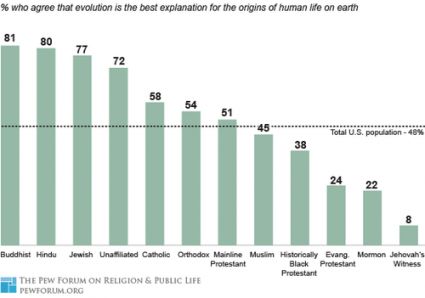
This chart comes from a new Pew Research Center study that looks at the worldwide acceptance of evolution 150 years after Darwin’s On the Origin of Species by Means of Natural Selection. At least in the United States, only a minority of the public believes in evolution, largely because evangelical protestants (a large portion of the American population) resist Darwin’s thinking far more strongly than other world populations. (The chart makes that simple fact fairly clear.) A piece newly published by the Pew Center goes on to add:
Recent public opinion polls indicate that challenges to Darwinian evolution have substantial support among the American people. According to an August 2006 survey by the Pew Research Center’s Forum on Religion & Public Life and the Pew Research Center for the People & the Press, 63 percent of Americans believe that humans and other animals have either always existed in their present form or have evolved over time under the guidance of a supreme being. Only 26 percent say that life evolved solely through processes such as natural selection. A similar Pew Research Center poll, released in August 2005, found that 64 percent of Americans support teaching creationism alongside evolution in the classroom.
For more information, see the Pew Center’s larger web collection dedicated to the Darwin debate. Also see a new Gallup poll that puts American belief in evolution at 39%.
via The Daily Dish
Read More...Watch Educational Videos Offline with YouTube
It’s another good day for the open education movement. As part of an experiment, YouTube has partnered with a select number of universities (Stanford, UC Berkeley, Duke, and UCLA) to make lectures, courses and other videos available for free download. This gives educators and lifelong learners the freedom to watch educational videos offline, whenever and wherever they want, including airplanes or classrooms with limited connectivity. The videos (all high-resolution mp4s) can be watched on any computer loaded with QuickTime and also on many portable devices, including newer iPods. When I spoke with the YouTube team today, they flagged another perk: the videos are being distributed under a Creative Commons license, which means that you can reuse them under certain non-commercial conditions.
For someone who has helped develop courses appearing in Stanford’s YouTube collection, today’s news was certainly welcome. These courses are not cheap to develop, and we do it as a public service. So we’re always happy when we encounter new ways of getting the educational content to a broader audience. This new download capability does just that. It extends our reach just a little more, and it’s hard to quibble with that.
As a practical note, if you’re wondering how to download the YouTube videos mentioned above, here’s what to do. Find a video from Stanford, UC Berkeley, Duke, or UCLA, look at the lower left-hand corner of the video, click the “Download this video” link, and you should be good to go.
Related Content:
- For thousands of hours of free educational content, see our collection of Free University Courses.
- To quickly find intelligent video collections appearing on YouTube, visit this page.
Support Us
We're hoping to rely on loyal readers, rather than erratic ads. Please click the Donate button and support Open Culture. You can use Paypal, Venmo, Patreon, even Crypto! We thank you!

About Us

Open Culture scours the web for the best educational media. We find the free courses and audio books you need, the language lessons & educational videos you want, and plenty of enlightenment in between.
Advertise With Us

FREE UPDATES!
GET OUR DAILY EMAIL
Get the best cultural and educational resources on the web curated for you in a daily email. We never spam. Unsubscribe at any time.
FOLLOW ON SOCIAL MEDIA

Open Culture editor Dan Colman scours the web for the best educational media. He finds the free courses and audio books you need, the language lessons & movies you want, and plenty of enlightenment in between.
Advertise With Us

