The Psychology of Evil: The Stanford Prison Experiment to Abu Ghraib
Back in 1971, Philip Zimbardo, a Stanford psychology professor, set up an experiment that quickly and now famously went awry. Here, Zimbardo had undergraduates play the role of prisoners and prison guards in a mock prison environment. Meant to last two weeks, the experiment was cut short after only six days when, as The Stanford Prison Experiment web site puts it, the guards “became sadistic and [the] prisoners became depressed and showed signs of extreme stress.” For Zimbardo, the way things played out says a lot about what happens when good, average people are put in bad situations. And it speaks to how torture scenarios, like those at Abu Ghraib, become possible. (For more on the parallels between the prison experiment and the torture in Iraq, you may want to check out Zimbardo’s recent video-captured talk at Googleplex.
Below, we’ve posted a video that offers a quick version, with original footage, of how the prison experiment went down. If you’re interested in understanding what he calls the “Lucifer Effect,” the title of his new book (which, by the way, was just reviewed by Martha Nussbaum in the Times Online), then it’s worth your time.
Deadhead Hunter and Dirty Hairy
Catch the full collection of animated New Yorker cartoons here on YouTube and our personal favorite here.

Read More...
How Radiohead’s Experiment Turned Out
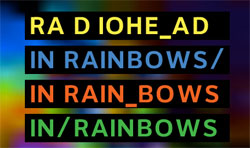 In mid-October, Radiohead released its latest album, In Rainbows, and began a fairly novel experiment. They cut the record labels out of the equation and let fans download the album directly from the Radiohead web site, for whatever price they saw fit. A few weeks later, some financial figures are coming out, giving us a sense of how well the experiment went.
According to a study by comScore Inc., 62% of the estimated 1.2 million visitors (in October) to the Radiohead site downloaded the album and paid nothing whatsoever. The remaining 38% paid an average of $6. Overall, the band averaged $2.26 per download and netted about $2.7 million dollars in total, a number that’s well below the earlier estimates of $6-$10 million. In the end, it’s important to remember that the band gets to keep all the revenue (instead of sharing it with the record companies), and apparently the traffic to Radiohead’s web site generated handsome incremental sales of high-priced discboxes. It’s estimated that for every $1 spent on digital downloads, another $2 was spent on hard copies, which makes Radiohead’s overall take even higher. What conclusions to draw? One is that Radiohead fans didn’t exactly deliver the goods and demonstrate the power of this new direct distribution model. It may have worked moderately well for Radiohead. But will a lesser band take the risk? Not so likely. At least not now.
A quick PS: It looks like Radiohead is planning to do its first webcast in five years. Watch for more information here.
Source: comScore press release and blog

Read More...
America’s Endless Capacity to Reward Failure
Please God give me the luck to enter the upper echelons of the American elite — the upper, upper crust where normal rules don’t apply, where illogic reigns, where failure doesn’t have consequences, only out-sized rewards. Please give me the luck to fail splendidly one day (even to bring a major company or a nation itself to near ruin) and yet get nothing less than the platinum parachute that a lucky few deserve:
- Stan O’Neal, CEO of Merill Lynch, recently led the bank to take a $7.9 billion write-down because of bad deals in the sub-prime market, resulting in a $2.3 billion loss, the worst loss in 93 years for Merrill. As he began to feel the heat, O’Neal secretly started looking to sell the bank to Wachovia, a deal that could have personally netted him an estimated $250 million. Instead, the board of directors ousted him last week and he got to walk with $161.5 million in securities and retirement benefits, the fifth-largest exit-pay package for a U.S. executive. It’s good to be the king.
- As the subprime mortgage market melted down this summer, James Cayne, the chief executive of Bear Stearns, was nowhere to be found. In this midst of the crisis, two of the bank’s hedge funds collapsed. But, according to The Wall Street Journal, Cayne was out of town for ten days and incommunicado. No cellphone. No Blackberry. Nothing. Where was he? Playing in a bridge tournament in Nashville (and it’s alleged by the Journal that he has a penchant for smoking pot at such tournaments). Fortunately, his team placed in the top third of the competition, and he gets to keep his highly lucrative job. In the meantime, Cayne let Warren Spector, the company’s President, take the fall. And Bear just announced that it’s laying off 2% of its workforce. It’s good to be the king.
- Don Rumsfeld, the former Secretary of Defense, used the Iraq War as a proving ground for his theories about how the US army should fight the modern war and defend itself against the unknown and the unexpected. Rumsfeld’s mantra was to keep the armies small, mobile and high-tech. And that’s what we did for four years in Iraq, despite mounting evidence that we had too few troops on the ground. Rumsfeld, who could never adjust his theories to the realities in Iraq (see this piece in the Armed Forces Journal), eventually got forced out, leaving behind a mess that will consume the US for a decade or more. What’s the fallout? Months later, Rumsfeld gets Stanford’s seal of approval. In September, Stanford’s Hoover Institution announced that he will join as a “distinguished visiting fellow” where he will participate on a task force of scholars and experts focusing on “issues pertaining to ideology and terror” in a post 9–11 environment. It’s precisely the same flawed vision that landed the US in a deep hole that the Stanford-affiliated think tank is choosing to honor. Once again, it’s good to be the king.
Amen.
Read More...
The Nine Minute Sopranos
The popular internet video, The Seven Minute Sopranos, has now been updated to include the last season of the hit HBO series. This means that you can get all six seasons (or 86 episodes) summarized in a speedy nine minutes. Watch below.
(P.S. HBO has just published The Sopranos: The Complete Book. Fans will want to take a look.)
Contact Us. Suggest a Link.
Feel free to contact us to share a great link or a concern with us. Just fill out the form below, or, if you have any problems, email us at ma**@*********re.com and we will get back to you as soon as we can. P.S. If you are looking to get our daily email, it has been sadly discontinued :(
Read More...The Godfather Without Brando?: It Almost Happened
It’s hard to imagine The Godfather, the iconic 1972 film, without Marlon Brando. But that’s almost how it turned out.
During casting, Paramount executives originally pushed for Laurence Olivier. But when he couldn’t take the film, and when the director, Francis Ford Coppola, asked them to consider Brando, they initially responded: “Marlon Brando will never appear in this motion picture.” Below, Coppola and co-star James Caan explain how the execs were eventually cajoled into changing their minds, and how film history fell into place. As you watch this, also keep in mind that Paramount originally asked two other directors to make The Godfather before approaching Coppola, and they later wanted Robert Redford or Ryan O’Neal to play Michael Corleone. But Coppola, who threatened to quit production, eventually got his way and put the relatively unknown Al Pacino into the film.
FYI: Best Week Ever has a good post on the Top 10 Actor / Director Tandems In Movie History.
Read More...
Where to Get Online Music For Free
Head over to Wired and you’ll find a “How-To Wiki” that lists web sites where you can stream or download music online for free. As you’ll see, Wired is not shy about admitting what it’s trying to accomplish here. The wiki page is called “Cheat the Music Industry: Never Pay for Music.”
To access more online music, visit Lifehacker’s guide to finding free music on the web, and peruse our collection of free music podcasts.
Read More...
Human Species May Split into Two: Life Imitates Art Again?
Here’s a zinger to mull over: The BBC has posted an article about a theory advanced by Oliver Curry, an “evolutionary theorist” working out of The London School of Economics, who suggests that humanity may split into two sub-species about 100,000 years down the road. And what we’d be left with is “a genetic upper class” ruling over “a dim-witted underclass.” This is a scenario, of course, that HG Wells laid out in his 1895 classic, The Time Machine (listen to free audiobook on iTunes here). And, if Curry’s theory holds water, Welles may offer the most extreme example of science fiction anticipating the shape of the future. Does Curry’s theory have anything to it? We haven’t the foggiest. But does it make for strangely compelling yet disturbing reading? It sure does.
See our Science Podcast Collection as well as our collection of Audiobook Podcasts.
Read More...
Timely Talk About Fire
 It’s been an unspeakably bad week throughout much of fire-ravaged Southern California. As of Thursday, the toll looked liked this: 500,000 acres burned; 1,800 homes destroyed; 57 people injured and at least six killed. As all of this transpires, a new book has come out that gives you an inside look at firefighters who make their living battling natural wildfires. On the Fireline: Living and Dying with Wildland Firefighters is written by Matthew Desmond, who spent four years tackling these blazes. And, in this lengthy free excerpt you get graphically exposed to the risks and losses that they experience professionally and personally. It certainly makes you feel for the firefighters on the frontlines this week, and we wish them and our fellow Californians the best.

Support Us
We're hoping to rely on loyal readers, rather than erratic ads. Please click the Donate button and support Open Culture. You can use Paypal, Venmo, Patreon, even Crypto! We thank you!

About Us

Open Culture scours the web for the best educational media. We find the free courses and audio books you need, the language lessons & educational videos you want, and plenty of enlightenment in between.
Advertise With Us

FREE UPDATES!
GET OUR DAILY EMAIL
Get the best cultural and educational resources on the web curated for you in a daily email. We never spam. Unsubscribe at any time.
FOLLOW ON SOCIAL MEDIA

Open Culture editor Dan Colman scours the web for the best educational media. He finds the free courses and audio books you need, the language lessons & movies you want, and plenty of enlightenment in between.
Advertise With Us

