Clare Torry’s Rare Live Performances of “Great Gig in the Sky” with Pink Floyd
When Clare Torry went into the studio to record her now-legendary vocals for Pink Floyd’s “Great Gig in the Sky,” the centerpiece of 1973’s Dark Side of the Moon, neither the singer nor the band were particularly impressed with each other. David Gilmour remembered the moment in an interview on the album’s 30th anniversary:
Clare Torry didn’t really look the part. She was Alan Parsons’ idea. We wanted to put a girl on there, screaming orgasmically. Alan had worked with her previously, so we gave her try. And she was fantastic. We had to encourage her a little bit. We gave her some dynamic hints: “Maybe you’d like to do this piece quietly, and this piece louder.” She did maybe half a dozen takes, and then afterwards we compiled the final performance out of all the bits. It wasn’t done in one single take.
Asked the follow-up question “what did she look like?,” Gilmour replied, “like a nice English housewife.”
Torry, for her part, was hardly starstruck. “If it had been the Kinks,” she later said, “I’d have been over the moon.” She also remembers the session very differently. “They had no idea” what they wanted,” she says. Told only “we don’t want any words,” she decided to “pretend to be an instrument.” She remembers “having a little go” and knocking out the session in a couple takes.
This Rashomon scenario involves not only faulty memory but also the legal question as to who composed the song’s melody and vocal concept—a question eventually decided, in 2004, in Torry’s favor, entitling her to royalties.
She clearly wasn’t about to become a touring member of the band, even after the album’s massive success and two subsequent tours. Still, while Torry may not have suited Gilmour’s physical preferences for female singers, and while she may not have thought much of Pink Floyd, she has appeared live with their different iterations over the years, including a show at the Rainbow Theatre in London just months after the album’s release (further up). Later, in 1987, Torry appeared again, this time with Roger Waters at Wembley Stadium on his K.A.O.S. on the Road Tour.
Torry would then join the David Gilmour-led Pink Floyd in 1990 for “Great Gig in the Sky” at Knebworth. I do not think she resembles an English housewife in the concert film at the top—or at least no more than the rest of the band look like middle-aged English husbands. But she still pulls off the soaring vocal, more or less, seventeen years after she first stepped into the studio, having little idea who Pink Floyd was or what would become of that fateful session.
Related Content:
Watch Documentaries on the Making of Pink Floyd’s Dark Side of the Moon and Wish You Were Here
Josh Jones is a writer and musician based in Durham, NC. Follow him at @jdmagness
Read More...The Evocativeness of Decomposing Film: Watch the 1926 Hollywood Movie The Bells Become the Experimental 2004 Short Film, Light Is Calling
We think of movies as lasting forever. And since we can pull up videos of films from 50, 80, even 100 years ago, why shouldn’t we? But as everyone who dives deep into this history of cinema knows, the further back in time you go, the more movies are “lost,” wholly or partially. In the case of the latter, bits and pieces remain of film — actual, physical film — but often they’ve been poorly preserved and thus have badly degraded. Still, they have value, and not just to cinema scholars. The thirty-year-long career of filmmaker Bill Morrison, for instance, demonstrates just how evocatively film at the end of its life can be put to artistic use.
“Created using a decomposing 35mm print of the crime drama The Bells (1926), the experimental short Light Is Calling (2004) depicts a dreamy encounter between a soldier and a mysterious woman,” says Aeon. “With images that reveal themselves only to distort and disappear into the decaying amber-tinted nitrate,” Morrison “invites viewers to meditate on the fleeting nature of all things physical and emotional, while a minimalistic violin score suffuses the century-old images with a wistful, haunting beauty.” Light Is Calling would have one kind of poignancy if The Bells were a lost film, but since you can watch it in full just below — and with a decently kept-up image, by the standards of mid-1920s movies — it has quite another.
Like many pictures of the silent era, The Bells was adapted from a stage play, in this case Alexandre Chatrian and Emile Erckmann’s Le Juif Polonais. Originally written in 1867, the play was turned into an opera before it was turned into a film — which first happened in 1911 in Australia, then in 1913 and 1918 in America, then in 1928 in a British-Belgian co-production. This 1926 Hollywood version, which features such big names of the day as Boris Karloff and Lionel Barrymore, came as Le Juif Polonais’ fifth film adaptation, but not its last: two more, made in Britain and Australia, would follow in the 1930s. The material of the story, altered and altered again through generations of use, feels suitable indeed for Light Is Calling, whose thoroughly damaged images make us imagine the intentions of the original, each in our own way.
Related Content:
What the First Movies Really Looked Like: Discover the IMAX Films of the 1890s
Watch Alain Resnais’ Short, Evocative Film on the National Library of France (1956)
See What David Lynch Can Do With a 100-Year-Old Camera and 52 Seconds of Film
Based in Seoul, Colin Marshall writes and broadcasts on cities, language, and culture. His projects include the book The Stateless City: a Walk through 21st-Century Los Angeles and the video series The City in Cinema. Follow him on Twitter at @colinmarshall, on Facebook, or on Instagram.
Read More...How “Strawberry Fields Forever” Contains “the Craziest Edit” in Beatles History
The story of “Strawberry Fields Forever” is more or less the story in miniature of the Beatles’ reinvention after they swore off touring in 1966 and disappeared into the studio to make their most innovative albums. It was not, as some Beatles fans might remember, an easy transition right away. Some of their fans, it turned out, were fickle, easily swayed by gossip as the latest TV trends. “While unsubstantiated break-up rumors swirled, some music fans became disenchanted with the group,” writes Ultimate Classic Rock. “You need only watch a 1967 clip from American Bandstand to see how many teenagers in the audience thought the Beatles were has-beens.”
Eager to get something out and fight the whims of fashion, Parlophone and Capitol both released John Lennon’s latest, “Strawberry Fields Forever,” with Paul McCartney’s “Penny Lane” as the B‑side, in 1967. Since the band no longer toured, they were “directed to make film clips to accompany each song and promote the single.”
Here, they debuted their new psychedelic look, and in the singles they demonstrated the new direction their music would go. Thematically, both songs are nostalgic trips through childhood, with Lennon taking a mystical, psych-rock approach and McCartney diving headlong into his sentimental music hall ambitions.
“Strawberry Fields Forever” also firmly established the band as studio wizards, thanks to the wizardry, primarily, of George Martin. In the video at the top from You Can’t Unhear This, we learn just what a marvel—as a technical achievement—the band’s new single was at the time, containing “the craziest edit in Beatles history.” The song itself went through a very lengthy gestation period, as Colin Fleming details in Rolling Stone, from sketchy, ghostly early acoustic demoes called “It’s Not Too Bad” (below) to the wild cacophony of crashing rhythms and looping melodies it would become.
Recording take after take, the band spent 55 hours in the studio working on “Strawberry Fields Forever.” Nothing seemed to satisfy Lennon, though he was leaning toward a darker, heavier take, Fleming notes:
This was a version approaching proto-metal. Lennon couldn’t decide if he wanted to go the ethereal route, or the stomping one, and famously told George Martin to combine the two versions. This was less than practical.
“Well, there are two things against it,” Martin informed Lennon. “One is that they’re in different keys. The other is that they’re in different tempos.”
But for a man who had started his most personal, honest musical journey, within the parameters of a single song, back in Spain, this was merely part of the process.
“You can fix it, George,” Lennon concluded, and that was that, with Martin now tasked with finding a solution to a problem that seemingly violated the laws of musical physics.
Martin’s solution involved slowing one version down and speeding up the other until they were close enough in pitch that “only a musicologist, really, would know that there was that much of a difference,” Fleming writes. Speeding up and slowing down tracks was common practice in the studio, and is today, but given the incredible number of instruments and amount of overdubbing that went into making “Strawberry Fields,” the endeavor defied the logic of what was technologically possible at the time.
While the time spent on the song might seem extravagant, we should consider that these days bands can pluck the sounds they want, whatever they are, from pull-down menus, and splice anything together in a matter of minutes. In the mid-60s, Brian Jones, Brian Wilson, Jimi Hendrix, the Beatles and other studio pioneers dreamed up sounds no one had heard before, and brought together instrumentation that had never shared space in a mix. Producers and engineers like Martin had to invent the techniques to make those new sounds come together on tape. Learning the ins-and-outs of how Martin did it can give even the most die-hard Beatles fans renewed appreciation for songs as widely beloved as “Strawberry Fields Forever.”
Related Content:
Josh Jones is a writer and musician based in Durham, NC. Follow him at @jdmagness
Read More...Watch 36 Beastie Boys Videos Now Remastered in HD
The Beastie Boys are still the only group to have their music videos receive a Criterion Collection release, having delivered a steady stream of hilarious and fun promo spots since “She’s on It” in 1985. As the documentary Beastie Boys Story recently dropped on AppleTV, the remaining B‑Boys and their record label remastered 36 of their videos, now re-uploaded to YouTube in HD. And now’s as good a time as any to restock and rethink their impact on the art form of music video.
The first videos are silly, cartoonish slapstick, with a fratboy sense of humor that played better then than now, especially with several references to faux-aphrodesiac Spanish Fly. But the sped up action and costume changes placed them in a lineage usually associated with British acts like The Beatles and Madness.
The Beasties always poked fun at themselves, which other American acts rarely did, especially in the very macho worlds of hip-hop and metal. Even in their final videos they were slapping on wigs and fake mustaches.
But if the Beastie Boys really had one main legacy it was the use of the fish-eye lens. Used first in the “Hold It Now Hit It” video (an afternoon’s filming intercut with shots from their Dionysian first world tour), it would return for 1989’s “Shake Your Rump”, where the group have learned exactly how to work its distorting powers (MCA’s fingers feel like they’re going to reach through the screen). This style reaches its apex in “So What’cha Want” where the distortion is matched with a slowed motion (the band miming to a sped up version, then the video slowed to the correct speed). The music’s THC-laced grind is matched with decayed visuals. Rap videos ever since have used the immediacy of the direct-to-camera performance, and directors like Hype Williams made a career of turning a fisheye lens onto performers like Busta Rhymes and Missy Elliot, with even more surreal results.
But the Beastie Boys really flourished when they teamed up with director Spike Jonze, who directed the Beastie Boys Story and would direct six of their videos. A rising photographer and director connected with the skateboarding scene, his first collaboration with the group was 1992’s “Time for Living,” a punk rock non-single from Check Your Head. But things really took off with “Sabotage,” one of the band’s best videos, a parody of 1970s cop shows. Watching the Beasties and their friends play dress-up, run rampant through the streets of Los Angeles, jump across rooftops, and toss a dummy off a bridge is like the platonic ideal of a home movie made with your best friends. Absolutely silly and hilarious, but life-affirming at the same time, a distillation of what made the band great.
You probably have your own favorites too, as there’s so many: the Godzilla tribute of “Intergalactic,” the parody of Diabolik for “Body Movin’ “, the psychedelic paint explosion of “Shadrach,” the homage to Pink Floyd Live at Pompeii with “Gratitude”, the celebrity lovefest of “Make Some Noise”, and the years-before-their-time ‘70s disco-and-polyester indulgence of “Hey Ladies” where Jean Cocteau and Dolemite share a cokespoon-ful of influences.
The playlist also features a number of non-album tracks done for the hell of it, some real rarities even for the fan. Good God y’all.
Related Content:
Ted Mills is a freelance writer on the arts who currently hosts the Notes from the Shed podcast and is the producer of KCRW’s Curious Coast. You can also follow him on Twitter at @tedmills, and/or watch his films here.
Read More...David Lynch Releases an Animated Film Online: Watch Fire (Pozar)
David Lynch began his artistic career as a painter. Before long his paintings became animations, of a kind, as exemplified by 1967’s Six Men Getting Sick (Six Times) and 1968’s The Alphabet. By 1977, when the years-in-the-making Eraserhead finally saw the light of day, Lynch’s transformation into a live-action filmmaker must have seemed complete. But his imagination has never accepted confinement to one medium: even while working on ever higher-profile projects — The Elephant Man, Blue Velvet, Twin Peaks — he continued to paint, to draw, to take photographs. Lynch’s completely static comic strip The Angriest Dog in the World was a compelling fixture in the LA Reader during the 1980s, but apart from the online series Dumbland and the Interpol collaboration I Touch a Red Button Man, little Lynchian in the way of animation has appeared over the past few decades.
This past Monday, however, Lynch announced the release of one such rarity free to watch on Youtube. Like I Touch a Red Button Man, Fire (Pozar) is a joint effort between filmmaker and musician, in this case composer Marek Zebrowski. “The whole point of our experiment was that I would say nothing about my intentions and Marek would interpret the visuals in his own way,” said Lynch in a USC School of Music interview.
As collaborators, Lynch and Zebrowski go back to Inland Empire, the 2006 feature Lynch shot partially in Poland. This necessitated a translator, and the Polish-American Zebrowski stepped up to the job. In 2007 the two continued down that cultural avenue, recording an album called Polish Night Music. Fire (Pozar)‘s bilingual title also honors Zebrowski’s ancestral homeland, though the film itself may lack any direct reference to Poland — or to any real place, for that matter.
Lynch is credited with having “written, drawn, and directed” the short (its animator, Noriko Miyakawa, was an editor on 2017’s Twin Peaks: The Return), and on the visual level it plays out like a journey through what will feel, to many of us, like the familiar realm of the Lynchian imagination. The titular fire — or rather, pozar — starts early on. Then we’re transported to a silhouette landscape that brings to mind David Foster Wallace’s description of one of Lynch’s painting’s, “the sort of diagnostic House-Tree-Person drawing that gets a patient institutionalized in a hurry.” But there are no people here, or at least no whole people: the first even faintly humanoid figure to emerge brings to mind the menacing baby in Eraserhead, and by the end the scene will have been overtaken by creatures neither properly animal nor man. Zebrowski’s score gets thoroughly enough into this stark but frenetic spirit to make Lynch fans believe that further collaborations must surely be on the way.
This short film will be added to our collection, 4,000+ Free Movies Online: Great Classics, Indies, Noir, Westerns, Documentaries & More.
Related Content:
David Lynch Releases a Disturbing, New Short Film: Watch “Ant Head” Online
The Paintings of Filmmaker/Visual Artist David Lynch
The Surreal Filmmaking of David Lynch Explained in 9 Video Essays
Based in Seoul, Colin Marshall writes and broadcasts on cities, language, and culture. His projects include the book The Stateless City: a Walk through 21st-Century Los Angeles and the video series The City in Cinema. Follow him on Twitter at @colinmarshall, on Facebook, or on Instagram.
Read More...Robert Fripp & King Crimson Perform a Stirring Cover of “Heroes,” Shortly after David Bowie’s Death (2016)
In 2016, King Crimson performed “Heroes” at the Admiralspalast in Berlin, just after David Bowie’s death, and nearly forty years after the song was written and recorded next to the Berlin Wall. It was “a celebration, a remembrancing and an homage,” gentleman guitarist Robert Fripp wrote in a statement. The following year, they released the live version on an EP called Heroes, in honor of the classic Bowie album’s 40th anniversary.
King Crimson sounds absolutely amazing in the concert recording. Yet it’s Fripp’s keening guitar line—part violin, part theremin—that most calls out to us, a gorgeously heavenly wail. Like many Bowie songs, the writing and recording of “Heroes” produced many a fascinating story. Fripp’s contribution, as a legendary character and prog-rock genius, is no exception.
Fripp’s angelic tone on “Heroes,” as Tony Visconti tells it above (at 2:15), came about mostly by happy accident. Visconti explains more fully in a Sound Opinions interview:
Fripp was available only one weekend. So he came to Berlin, brought his guitar, no amplifier. He recorded his guitar in the studio. We had to play the track very very loud because he was relying on the feedback from the studio monitors. So it was deafening working with him.
Whereas everyone thinks it’s an ebow, this magical guitar gadget called an ebow. In fact it wasn’t an ebow, it was just the feedback–Fripp playing this “dah uhhhh dahh uhhh” that beautiful motif. And Fripp recorded a second time without hearing the first one. It was a little bit more cohesive, but still quite wasn’t right, and he said, “Let me do it again. Just give me another track. I’ll do it again.” And we silenced the first two tracks and he did a third pass, which was really great. He nailed it. And then I had the bright idea: I said, “Look let me just hear what it sounds like with the other two tracks. You never know.”
We played it, all three tracks together, and you know, I must reiterate Fripp did not hear the other two tracks when he was doing the third one so he had no way of being in sync. But he was strangely in sync. And all his little out-of-tune wiggles suddenly worked with the other previously recorded guitars. It seemed to tune up. It got a quality that none of us anticipated. It was this dreamy, wailing quality, almost crying sound in the background. And we were just flabbergasted.
It was a typically Eno-Visconti way to find a new sound. That sound, Visconti says above, is all over the track. For this reason, Fripp has been engaged in legal battles with David Bowie’s estate over his credit, insisting that he should have “featured player” status, a legal designation that would give him greater rights to remuneration. Always a shame when wrangling over money comes between the creators of great music, but in this case, Brian Eno and Tony Visconti both support Fripp’s claims, and so perhaps would Bowie if he were here.
Whatever it takes to be a “featured player,” Fripp sailed over the threshold on “Heroes.” He demonstrates it again in the King Crimson tribute, making one guitar sound like three onstage, and in the video above, which he released with his wife Toyah for VE Day. The backing track is from the Berlin performance at the top, with dubbed vocals by Toyah and guitar, of course, by Fripp, playing the same Gibson Les Paul he flew into the studio with in 1977, and looking just as singularly unimpressed by the proceedings.
Related Content:
Watch David Byrne Lead a Massive Choir in Singing David Bowie’s “Heroes”
David Bowie’s “Heroes” Delightfully Performed by the Ukulele Orchestra of Great Britain
Josh Jones is a writer and musician based in Durham, NC. Follow him at @jdmagness
Read More...Roger Waters Performs a Socially-Distanced Version of Pink Floyd’s “Mother”
The video comes prefaced with these words: “Social distancing is a necessary evil in Covid world. Watching ‘Mother’ reminds me just how irreplaceable the joy of being in a band is.”
He’s joined here by his band: vocalists Holly Laesig and Jess Wolfe of Lucius, keyboardist Drew Erickson, guitarists Dave Kilminster and Jonathan Wilson, bassist Gus Seyffert, and drummer Joey Waronker.
Find more socially distanced performances in the Relateds below.
If you would like to support the mission of Open Culture, consider making a donation to our site. It’s hard to rely 100% on ads, and your contributions will help us continue providing the best free cultural and educational materials to learners everywhere. You can contribute through PayPal, Patreon, and Venmo (@openculture). Thanks!
Related Content:
Neil Finn Sings a Lovely Version of David Bowie’s “Heroes,” Live from Home
Read More...Watch Florian Schneider (RIP) in Classic Early Kraftwerk Performances
The seventies, am I right….?
Not that I can claim to have experienced it firsthand. But if I could have been a witness to any period in pop history it would have been the decade in which experimental fusion movements invaded rock and roll. There was Miles Davis and his protegees, of course. But there was much more besides: The Wailers’ fusion of rock, reggae, and soul; Fela Kuti’s fusion of Ghanaian high life, James Brown funk, and Nigerian jazz; Ryuchi Sakamoto’s fusion of indigenous, classical, and electronic dance music….
Few of these influential international artists became widely known among U.S. audiences at the time, but we have their music to thank for some of the most interesting directions post-punk and New Wave bands would take.
One of the most influential artists of the seventies, the recently departed Florian Schneider, who resembled an office manager at a German Dunder-Mifflin, was truly an unlikely character for major international stardom. And yet the mild-mannered flautist from Düsseldorf co-founded one of the most famous experimental fusion bands of all time with classmate Ralf Hütter.
I’m talking about Kraftwerk, of course, though the label “fusion” may not especially come to mind when thinking of the robotic German funk of the band’s major eighties’ releases. But Kraftwerk first emerged from the psych-blues-jazz-conceptual-electronic hybrid of the so-called “krautrock” scene, a somewhat derisive label applied to bands like Popul Vuh, Tangerine Dream, Can, and Neu!, one of the most obscurely influential bands of the decade, and one whose two members—guitarist Michael Rother and drummer Klaus Dinger—played in an early version of Kraftwerk. “We had no father figures,” says Hütter. “We were part of this ’68 movement, where suddenly there were possibilities, and we performed at happenings and art situations.”
For a brief time, in fact, Kraftwerk consisted only of Rother, Dinger, and Florian Schneider on the flute. They made one appearance in this configuration on the German TV program Beat Club. See them at the top play “Rückstoss-Gondoliere.” No, it’s not at all like “Autobahn,” although synthesizers were always central to the band’s sound. It’s a lot more like Pink Floyd, and they look the part. To what might we compare the sound of the band’s first TV appearance, above, live at Rockpalast in 1970? Hütter, looking like a Ramone, plays some sort of keytar-like synth that sounds like a dying goose; Dinger shows off his strict-yet-funky, now world-famous “motorik” beat; and Schneider lays down some very heavy flute grooves.
Rother and Dinger took these experiments and turned them into what David Bowie would call “the sound of the eighties.” He might have said the same of Kraftwerk, who heavily influenced Bowie, especially after Schneider and Hütter adopted their tongue-in-cheek businessmen/technician personae, inspired by po-faced artists Gilbert & George. Kraftwerk brought a deadpan sense of humor to New Wave that was adopted by every eighties synthpop star from Gary Numan to Depeche Mode to New Order, whose “Blue Monday” was partly inspired by “Uranium” from 1975’s Radio-Activity. This is a strange, transitional album, and one perhaps most often cited by other musicians inspired by Kraftwerk. It was their fifth album, but only the first in which they went fully electronic, and featured members Karl Bartos and Wolfgang Flür, who would complete the classic lineup of the late seventies and early eighties.
As you can see in the “Radioactivity” video further up, they have not become robots just yet. These are clearly humans, still a little loose and shaggy around the edges. (If Hütter’s delivery, haircut, and the band’s sound in general, make you think of Joy Division’s Ian Curtis—he was a huge fan.) How silly were Kraftwerk’s later concepts? Tremendously silly. But so too was Radio-Activity, an album full of punning banalities and geeky astrophysics references. By the time of The Man-Machine, Schneider and Hütter had so committed to their roles that we might almost, for a moment, believe the fan-made video above is a “rare pilot for the uncommissioned Kraftwerk sitcom, ‘Ralf and Florian.’” The single “Das Model,” below, has a bit more of a 70s Cabaret feel to it. And maybe a bit more dancing than we’re used to seeing from Kraftwerk.
They were in on the joke, but also so musically and technologically savvy they could update its premise every few years and shift pop music in new, weirder, funnier, and more danceable directions. “Do you want to know what the eighties will sound like?” they asked in 1981. And there was Computer World, which you can see the band perform in part below in Nagoya, Japan. Schneider’s flute is nowhere to be seen, but his penchant for penetrating, repetitive grooves and waves of weird synthesized sounds still drives the sound. Kraftwerk’s fusion of influences evolved principally through the partnership of Schneider and Hütter, the Richards and Jagger of experimental electronic pop.
Kraftwerk was not a band, Hütter insisted, but a “multi-media project.” Their onstage act was what Rolling Stone’s Rob Sheffield calls “cerebral technocrats” very much derived from their personalities, especially Schneider’s, magnified into performance art. “Kraftwerk is not a band,” Schneider said back in 1975. “It’s a concept. We call it ‘Die Menschmaschine,’ which means ‘the human machine.’ We are not the band. I am me. Ralf is Ralf. And Kraftwerk is a vehicle for our ideas.” Yet those ideas, which Schneider tended to express in coldly analytic terms, also produced some of the most joyfully danceable music ever made. That is the paradox of Kraftwerk, and their genius, from Dinger’s motorik beats to the pulsing synths built by Hütter and Schneider. They truly achieved a musical synthesis, one that honored the human desire for groove and melody and the machine’s desire for inhuman sounds and robotic precision.
Related Content:
Kraftwerk’s First Concert: The Beginning of the Endlessly Influential Band (1970)
Kraftwerk’s “The Robots” Performed by German First Graders in Adorable Cardboard Robot Outfits
The Case for Why Kraftwerk May Be the Most Influential Band Since the Beatles
Josh Jones is a writer and musician based in Durham, NC. Follow him at @jdmagness
Read More...Patti Smith’s Self Portraits: Another Side of the Prolific Artist
Young artists can understandably feel hesitant about trying new things. It’s hard enough to compete as a musician, for example. Why try to publish poetry or make visual art, too? Older, more established artists who branch out often have trouble being taken seriously in other fields. Patti Smith—poet, singer, memoirist, photographer, visual artist—has never seemed to suffer in either regard. “Her artwork has been exhibited everywhere from New York to Munich,” notes Dangerous Minds, “and in 2008 a large retrospective of Smith’s artwork (produced between 1967 and 2007) was shown at the Foundation Cartier pour l’Art Contemporain in Paris.”
Smith “isn’t an artist who is easily categorized,” writes curator John Smith. “She moves fluidly…. Her work and her career defy the traditional boundaries of both the art and music worlds. To understand Smith’s work is to understand the organic quality of what she does.”
Her productions are all of a piece, developing together, in community with other artists. “Many of my drawings,” she says, “are the results of merging calligraphy with geometric planes, poetry and mathematics.”
There’s also the influence of Robert Mapplethorpe, who encouraged Smith in her early twenties when the two famously lived together as starving artists in New York.
Often I’d sit and try to write or draw, but all of the manic activity in the streets, coupled with the Vietnam War, made my efforts seem meaningless. […] Robert had little patience with these introspective bouts of mine. He never seemed to question his artistic drives, and by his example, I understood that what matters is the work: the string of words propelled by God becoming a poem, the weave of color and graphite scrawled upon the sheet that magnifies His motion. To achieve within the work a perfect balance of faith and execution. From this state of mind comes a light, life-charged.
If you have trouble attaining that state of mind, consider heeding the advice Smith got from William S. Burroughs. In a nutshell: do what you want, and don’t worry about what others want.
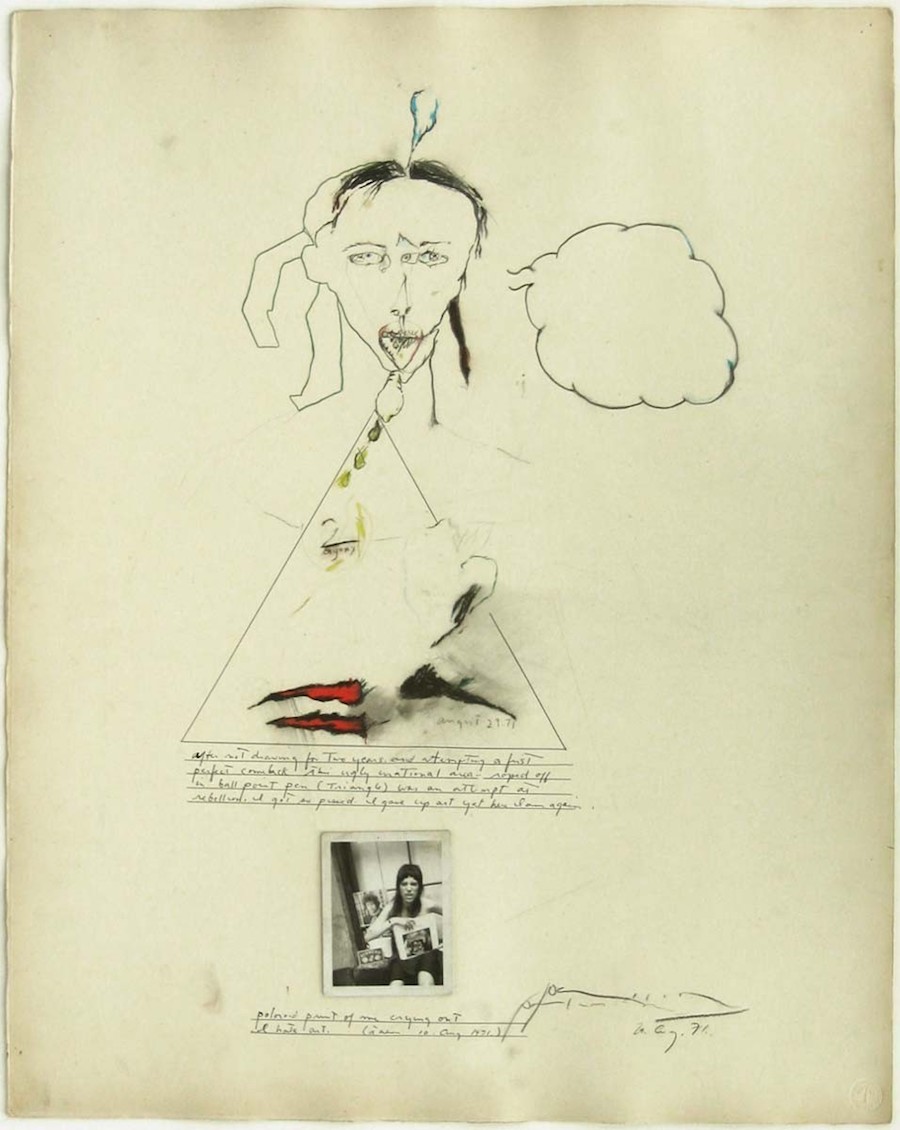
But self-doubt is real. On one self-portrait from 1971, at the top, she writes, “I got pissed. I gave up art yet here I am again.” Smith’s method for overcoming these common feelings —one that emerges as a theme in her memoir Just Kids—might be summarized as: imagine yourself in the company of the artists you and admire and make art in conversation with them. Or as she puts it:
You look at a Pollock, and it can’t give you the tools to do a painting like that yourself, but in doing the work, Pollock shares with you the moment of creative impulse that drove him to do that work. And that continuous exchange—whether it’s with a rock and roll song where you’re communing with Bo Diddley or Little Richard, or it’s with a painting, where you’re communing with Rembrandt or Pollock—is a great thing.
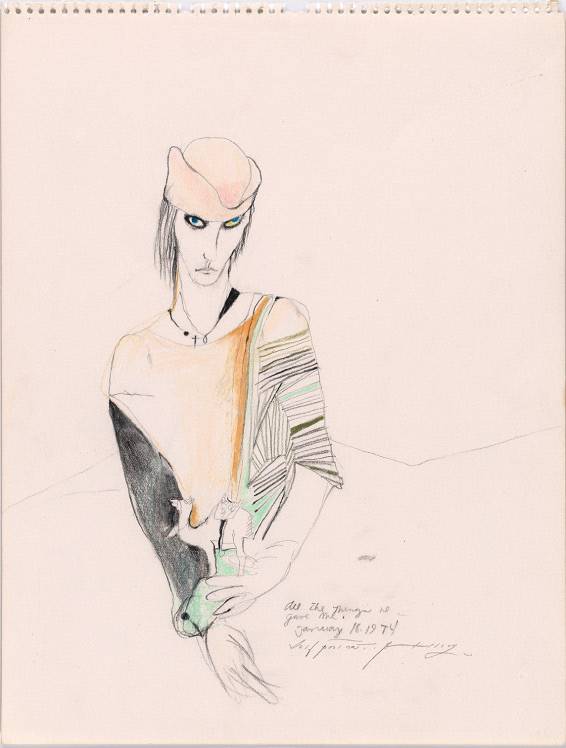
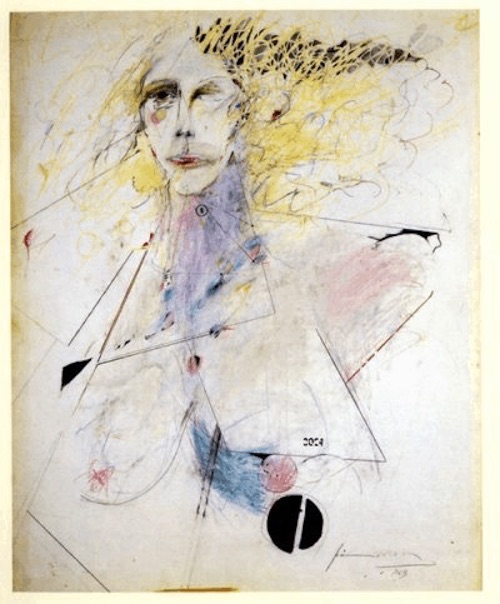
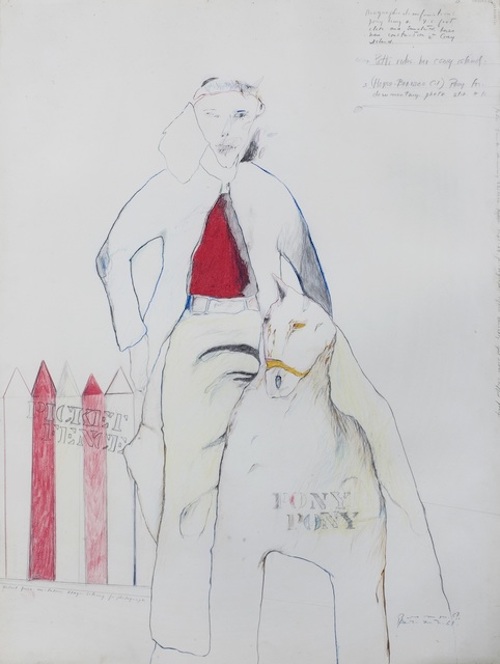
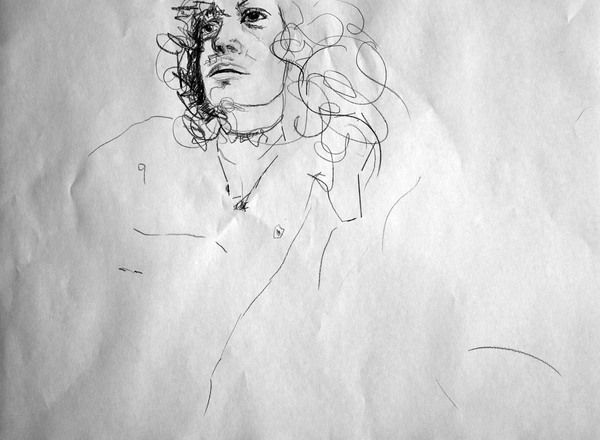
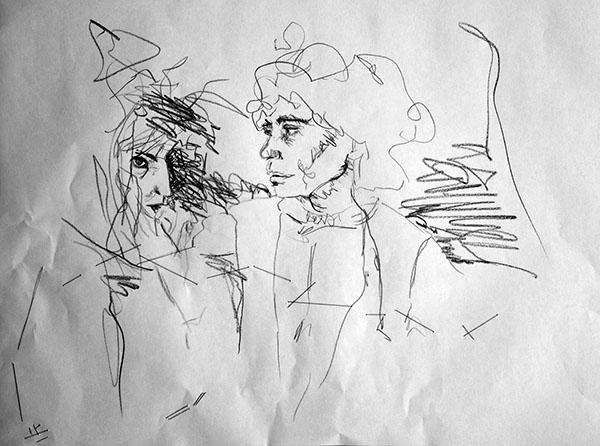
Her many self-portraits show her in conversation with artists like Aubrey Beardsley, in the brooding 1974 drawing further up; Willem de Kooning in the 1969 work above; and maybe Robert Rauschenberg in “Patti Rides Her Coney Island Pony,” from 1969, below. She tried on many different styles, but Smith could also create finely rendered realist portraits, like those of her and Mapplethorpe at the bottom. Her talent is undeniable, but we’d never know it if she hadn’t first taken herself seriously as an artist.
See more of Smith’s work at Dangerous Minds.
Related Content:
Patti Smith’s 40 Favorite Books
How Patti Smith “Saved” Rock and Roll: A New Video Makes the Case
Patti Smith’s Award-Winning Memoir, Just Kids, Now Available in a New Illustrated Edition
Josh Jones is a writer and musician based in Durham, NC. Follow him at @jdmagness
Read More...Watch a Screen Test of 21-Year-Old Orson Welles (1937)
We remember Orson Welles as a film director, and given the influence of Citizen Kane, we do it with good reason. It certainly doesn’t hurt the image of Welles-as-auteur that he was only 25 years old when he made that movie, now considered one of the greatest of all time. Not only did he direct, he co-wrote, produced, and starred, showcasing a set of acting skills he’d been honing on radio and the stage since childhood. If any man was ever born to give commanding performances, it was Welles; when silent film gave way to “talkies,” which favored actors with strong presences and strong voices both, Hollywood studios should have beaten a path to his door. And yet, when he came to Hollywood, one of its biggest studios turned him down.
These clips show a 21-year-old Welles doing a screen test for Warner Brothers in early 1937, by which time he had already established himself as a radio and theatre performer. Whatever spark of genius we feel we can recognize in Welles’ line-readings today, the people at Warners’ evidently couldn’t see it then — or more charitably, they didn’t know how to sell his preternatural gravitas.
As history shows, Welles could in any case make more of a mark with projects under his own control. Later that same year he would co-found the Mercury Theatre, the repertory company now best remembered for its radio broadcasts, specifically the 1938 adaptation of H.G. Wells’ alien-invasion novel War of the Worlds that, so the legend goes, proved a little too real for many listeners across America.
Mastering the dramatic arts is one thing, but setting off nationwide controversy — now that’s the way to get the entertainment industry’s attention. Welles found himself able to parlay the interest generated by War of the Worlds into a historically generous three-picture deal with RKO Pictures, one that allowed him total creative control as well as the use of his actors from the Mercury Theatre. After coming to grips with the art of filmmaking as well as the art of putting together projects, Welles came up with the story of the rise and fall of character modeled on William Randolph Hearst, Howard Hughes, and other American tycoons. Released in 1941, Citizen Kane would mark the zenith of Welles’ fame, though over the next 44 years he would labor over many other cinematic visions — efforts more acclaimed now than they were in his lifetime, and all financially supported by the acting skills that never deserted him.
Related Content:
Watch Orson Welles’ First Ever Film, Directed at Age 19
Orson Welles Explains Why Ignorance Was His Major “Gift” to Citizen Kane
Orson Welles’ Last Interview and Final Moments Captured on Film
Warhol’s Screen Tests of Lou Reed, Dennis Hopper, Nico & More
Marlon Brando Screen Tests for Rebel Without A Cause (1947)
Based in Seoul, Colin Marshall writes and broadcasts on cities, language, and culture. His projects include the book The Stateless City: a Walk through 21st-Century Los Angeles and the video series The City in Cinema. Follow him on Twitter at @colinmarshall, on Facebook, or on Instagram.
Read More...Support Us
We're hoping to rely on loyal readers, rather than erratic ads. Please click the Donate button and support Open Culture. You can use Paypal, Venmo, Patreon, even Crypto! We thank you!

About Us

Open Culture scours the web for the best educational media. We find the free courses and audio books you need, the language lessons & educational videos you want, and plenty of enlightenment in between.
Advertise With Us

FREE UPDATES!
GET OUR DAILY EMAIL
Get the best cultural and educational resources on the web curated for you in a daily email. We never spam. Unsubscribe at any time.
FOLLOW ON SOCIAL MEDIA

Open Culture editor Dan Colman scours the web for the best educational media. He finds the free courses and audio books you need, the language lessons & movies you want, and plenty of enlightenment in between.
Advertise With Us

