The Doobie Brothers Sing Their 1974 Classic, “Black Water,” Live, in Isolation
The Doobie Brothers–they can’t tour this summer and celebrate their 50th anniversary. But they can give you this: a performance of 1974’s “Black Water” performed virtually, live, in isolation. Make sure you catch the fan contributions toward the end…
Read More...Radiohead Covers The Smiths & New Order (2007)
If you grew up at a certain time, with a certain melancholic disposition and morbid sense of humor, you grew up listening to the music of the Smiths. Coincidentally, you’re roughly around the same age as the members of Radiohead, who also grew up listening to the Smiths. Ergo, there’s a good chance you’re a fan of Radiohead, a band whose own melancholic, morbid mood draws from the best Alternative bands (as they were called once) of the 80s and 90s, while updating the sound of that mood on every successive album.
On the 20th anniversary of Radiohead’s massive-selling Ok Computer, guitarist Ed O’Brien remembered their humble beginnings in a Rolling Stone oral history, invoking those bands whose records you likely own in hard copy if you fit the profile above:
We started off at the time of the Smiths’ The Queen is Dead, that era. By the end of that period, or the middle of that period, there was the Pixies, Happy Mondays and Stone Roses and all these things. We dipped our toe, not very effectively, in each. But in doing so we came out with a sound. We came up with our thing. And that’s how we got signed.
No matter how far they ended up straying from guitar rock, their early influences have always been an integral part of their creative DNA. On the 10th anniversary of Ok Computer, well into their transformation from alt-rock superstars to experimental electronic band, Radiohead filmed a two-and-a-half-hour webcast, playing old and new songs, taking turns DJing, and covering one of my favorite Smiths’ songs, “The Headmaster Ritual” from 1985’s Meat is Murder.
It’s a track tailor-made for them—a song that “expresses fury at a kind of school life that has been forgotten,” writes Katharine Viner, but which the fiercely anti-authoritarian Thom Yorke remembered well. Years into his successful career, he still smarted from his unpleasant school years.
In interviews, writes Will Self at GQ, he’s often “waxed disconsolately about his discombobulated childhood, the frequent changes of school, and the bullying at those schools because of his paralysed eye.” If you grew up listening to the Smiths, you too may have a personal affinity for “The Headmaster Ritual.”
And you probably also frequently wallowed to Joy Division—a band that, like Radiohead, radically changed musical direction, albeit for a much more tragic reason. After the suicide of lead singer Ian Curtis, Joy Division reformed as New Order, synth-pop superstars and progenitors of acid house. On their first record, Movement, they had a lot of post-punk brooding to get out of their system, with songs like ICB (which stands for “Ian Curtis Buried”) and “Ceremony,” originally a Joy Division song.
Further up, see Radiohead cover “Ceremony,” a song that defines an era—one, coincidentally, in which Radiohead grew up. And maybe you did, too. But chances are, if you grew up listening to Radiohead, you know their influences no matter when you were born.
Related Content:
Radiohead Will Stream Concerts Free Online Until the Pandemic Comes to an End
Radiohead Puts Every Official Album on YouTube, Making Them All Free to Stream
Josh Jones is a writer and musician based in Durham, NC. Follow him at @jdmagness
Read More...When IBM Created a Typewriter to Record Dance Movements (1973)
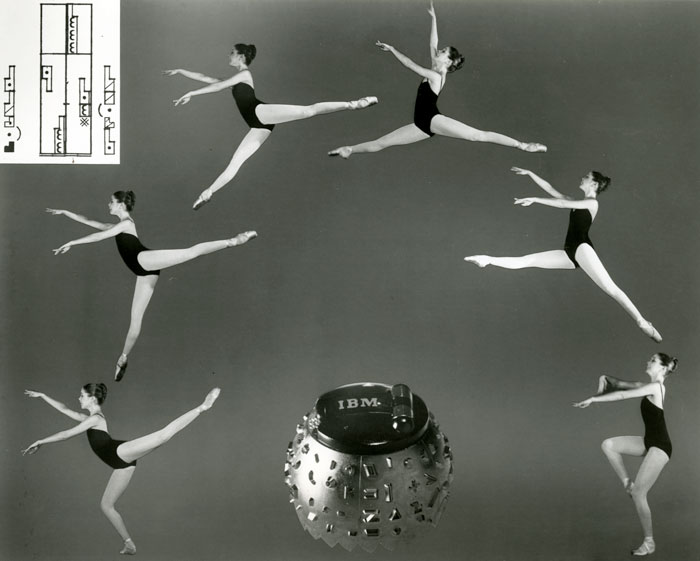
Increasingly many of us in the 21st century have never used a typewriter — indeed, have never seen one in real life. But despite being deep into its obsolescence, the machine has a long cultural half-life. Seeing typewriters in classic and period films, for example, keeps an idea of their look and feel in our minds. Naturally it gets entangled with the romance of the writer, or rather the Writer, whom we imagine pounding away on a culturally iconic model: an Underwood, an Olvetti. “If Olivettis could talk, you’d get the novelist naked,” writes Philip Roth in The Anatomy Lesson. From the then-new electric IBM typewriters, however, you’d hear “only the smug, puritanical workmanlike hum telling of itself and all its virtues: I am a Correcting Selectric II. I never do anything wrong.”
Yet we underestimate the influence of the IBM Selectric, on not just writing but late-20th-century American life in general, at our peril. Introduced in 1961, this technologically revolutionary typewriter replaced the old “typebars” — those thin metal arms that whack a letter onto the page with each keystroke — with a “typeball,” a “compact unit containing all the letters and symbols of a keyboard, rotated and pivoted to the correct position before striking.”
So writes IBM’s Justine Jablonska in an essay on the versatility of the typeball, which could be swapped out and modified according to the needs of the user. In 1973, IBM could say even to those users who needed to type out not words, sentences, and paragraphs but dances that, yes, there’s a typeball for that.
Developed in collaboration with New York City’s Dance Notation Bureau, this unusual typeball “had special Labanotation symbols, developed in the 1920s by Hungarian dancer/choreographer Rudolf Laban to analyze and record movement and dance.” Each symbol’s location “showed which part of the body — arm, leg, torso — was to be used. The symbol’s shape indicated direction. The symbol’s shading showed the level of an arm or leg. And its length controlled the time value of a movement.” In total, writes Karen Hill at Zippy Facts, Labanotation had “88 different symbols, which could be arranged to form a complete vocabulary for recording movement of any kind, from ballet and modern to ethnic, even folk.” Beyond dance, the system could also record “movements in areas like sports, behavioral sciences, physical therapy, and even industrial operations.”
This particular typeball showcased the Selectric’s versatility, but some had higher hopes. In a 1975 paper, dance scholar Drid Williams compares its potential impact to that of “Gutenberg’s invention several centuries ago,” signaling that “the graphic linguistic sign can now be joined by its obvious counterpart, the printed human action sign.” But she also expresses regret that “ ‘the ball’ is being looked on by many as a mere practical aid to recording human movement and it is being associated with specialist fields like dance. As usual, concern with the syntagmata obscures the real issues of the paradigms.” Indeed. A more practical-minded assessment comes from Charles Ditchendorf, employed at the time at IBM’s Office Products Division. “To the best of my knowledge,” Jablonska quotes him as saying, I didn’t sell one.” But then, when has dance ever been enslaved to the market?
Related Content:
The Enduring Analog Underworld of Gramercy Typewriter
Based in Seoul, Colin Marshall writes and broadcasts on cities, language, and culture. His projects include the book The Stateless City: a Walk through 21st-Century Los Angeles and the video series The City in Cinema. Follow him on Twitter at @colinmarshall, on Facebook, or on Instagram.
Read More...Mark Knopfler Plays a Poignant, Overdriven Version of “The Last Post,” Remembering the Many Lives Lost in World War I
World War I symbolism gets lost on Americans. Our historical memories are short and selective, and the War has “largely vanished from view,” as historian Geoffrey Wawro writes at Time magazine. But in Europe, of course, where some armies suffered ten times the casualties as U.S. troops, and where millions of civilian died and towns were bombed into oblivion, the memory of the Great War is very much alive.
In Ypres, Belgium, the War has been memorialized every day since 1928 (with the exception of four years of German occupation during WWII) by the Last Post Association, a devoted company of buglers who play the military song at the Menin Gate memorial every evening to commemorate the British dead at the Battle of Ypres. As of this writing, they’ve held their 31,748th ceremony.
In Britain itself, and around the world, the tune has a long history as a symbol, like the poppy, of Remembrance Day. Just like Taps in the U.S., the Last Post is “a bugle call,” writes the Last Post Association, “played in the British Army (and in the armies of many other lands) to mark the end of the day’s labours and the onset of the night’s rest…. It has come to represent a final farewell to the fallen at the end of their earthly labours and at the onset of their eternal rest.”
Robert Graves summed up the song’s association with death in his 1918 poem, “The Last Post”:
The bugler sent a call of high romance—
“Lights out! Lights out!” to the deserted square.
On the thin brazen notes he threw a prayer,
“God, if it’s this for me next time in France…
O spare the phantom bugle as I lie
Dead in the gas and smoke and roar of guns,
Dead in a row with the other broken ones
Lying so stiff and still under the sky,
Jolly young Fusiliers too good to die.”
I imagine Mark Knopfler, a lover of poetry, might be familiar with Graves’ verse. In his own rendition of the Last Post, above, Knopfler commemorates 17,000 Northumberland Fusiliers killed in the War, who came from his home region and suffered more casualties than any other regiment. Recorded on Remembrance Day, November 8, 2018, the 100th anniversary of the War’s end, Knopfler’s version is both restrained and fiercely overdriven, recalling Hendrix’s “Star-Spangled Banner” in some of its flashier moments of vibrato. Rather than one of his usual iconic guitars, he plays a custom instrument that howls like a keening bugle.
The recording was part of a project in which musicians around the world played the ceremonial call on a variety of instruments. For comparison with Knopfler’s creative interpretation, see a straightforward rendition played above by a member of the Australian Royal Military College Band. The bugle call reminds us of the war dead we may have forgotten, and the millions killed by starvation and influenza after the armistice. And perhaps it also reminds us of the importance of collective mourning for the dead in our own extraordinary historical moment.
Related Content:
Guitar Stories: Mark Knopfler on the Six Guitars That Shaped His Career
Mark Knopfler Gives a Short Masterclass on His Favorite Guitars & Guitar Sounds
The Great War: Video Series Will Document How WWI Unfolded, Week-by-Week, for the Next 4 Years
Josh Jones is a writer and musician based in Durham, NC. Follow him at @jdmagness
Read More...Neil Finn Sings a Lovely Version of David Bowie’s “Heroes,” Live from Home
I needed a lift today. This did the trick. Neil Finn–you know him from Crowded House and Split Enz–plays a beautiful acoustic version of David Bowie’s “Heroes.” Enjoy.
Related Content:
Watch David Byrne Lead a Massive Choir in Singing David Bowie’s “Heroes”
David Bowie’s “Heroes” Delightfully Performed by the Ukulele Orchestra of Great Britain
Read More...Stream Andrea Bocelli’s Easter Concert from Milan
“On Easter Sunday (April 12, 2020), by invitation of the City and of the Duomo cathedral of Milan, Italian global music icon Andrea Bocelli gave a solo performance representing a message of love, healing and hope to Italy and the world. Download the hymn sheet and sing along here.” And watch the concert above.
Read More...Watch the Oscar-Winning Animated Short “Hair Love”
African-American hair has been making headlines for the last few years, usually because another black student has been deemed in violation of the dress code for sporting braids, dreads, or a natural afro.
This year’s Oscar-winning animated short, “Hair Love,” about an African-American dad’s attempt to stay on top of his 5‑year-old daughter’s abundant locks, is the sweet alternative to these upsetting news stories.
Little Zuri’s dad, Stephen, doesn’t have to battle clueless or unfair administrators on his daughter’s behalf, but he does need to gain the upper hand on an adversary with whose ways he’s unfamiliar. (His own hair is styled in tidy dreadlocks.)
It’s implied that tending to Zuri’s hair is not exactly something he volunteered for, and indeed we learn that the task was previously the domain of her mother
In desperation, Stephen seeks advice in the form of YouTube videos, finding a plethora, as did filmmaker and former NFL wide receiver Matthew A Cherry, who referenced some of his actual inspirations in the film, like the viral video of DJ Hines’ attempt to contain daughter Chloe’s thick hair with a ponytail holder, below.
Cherry raised the necessary funding on Kickstarter, and completed the film in about six weeks after posting a call for collaborators on Twitter:
Any 3D artists follow me? I got an Oscar worthy short film idea to go with this image. Get at me
As Cherry points out in the trailer for “Hair Love”’s accompanying book, Zuri’s robust, kinky curls—almost a third character according to illustrator Vashti Harrison—are a marvelous excuse to bust stereotypes by placing an involved, African-American dad front and center.
The tale has also won a lot of fans in the cancer survivor community for its deft portrayal of the effects of Zuri’s mom’s illness and recovery on the family.
Read the San Francisco Film Festival’s teaching guide to “Hair Love” here.
Related Content:
Watch the Pioneering Films of Oscar Micheaux, America’s First Great African-American Filmmaker
Ayun Halliday is an author, illustrator, theater maker and Chief Primatologist of the East Village Inky zine. Join Ayun’s company Theater of the Apes in New York City this month for her book-based variety series, Necromancers of the Public Domain, and the world premiere of Greg Kotis’ new musical, I AM NOBODY. Follow her @AyunHalliday.
Read More...“It’s the End of the World as We Know It,” Michael Stipe Proclaims Again, and He Still Feels Fine
It has taken a viral pandemic, and a mountain of tragic folly and more to come, but the internet has finally delivered the quality content we deserve, at least when it comes to celebrities stuck at home. Nightly bedtime stories read by Dolly Parton? Intimate streamed performances from Neil Young, Ben Gibbard, and many, many others, including stars of Broadway and opera house stages? It can feel a little overwhelming, especially for people working, educating, and doing a hundred other things in quarantine. But if there’s someone I really want to hear from, it’s the guy who told us, thirty-some years ago, “It’s the End of the World As We Know It (And I Feel Fine).”
If you remember the Reagan years, you remember living under the threat of mass extinction by nuclear winter and radiation poisoning. The end of the world seemed imminent at the end of the Cold War. And Michael Stipe, in a manically danceable tune (depending on your level of stamina), proclaimed a need for solitude after issuing his many grievances.
It is still the end of the world, he says in a recent video address about coronavirus on his website (and a shorter version released on social media), and “I do feel fine. I feel okay. The important part of that lyric, that song title, is ‘As We Know It.’ We’re about to go through—we are going through something that none of us have ever encountered before….”
The moment is unique, of worldwide historical significance as was the belligerent arms race of the late eighties, the terrible A.I.D.S. epidemic, and other catastrophic events occurring when R.E.M. released Document, the 1987 album that introduced millions of young fans to art-punk geniuses Wire—whose “Strange” Stipe and company cover; to bluesman Lightnin’ Hopkins and red-baiting senator Joseph McCarthy, who lent their names to two songs; and to Lenny Bruce, pioneering 60s comic, who, like Stipe in the album’s Side One closer, is “not afraid” of earthquakes, birds and snakes, aeroplanes, and other signs of the apocalypse. Things will change irrevocably, and life will probably go on. In the meantime, he says, “don’t mis-serve your own needs.”
You may not be surprised to learn the song re-entered the charts on March 13, 2020, as Polyphonic informs us in their video at the top. “It’s easy to see why.” These days nuclear holocaust seems low on the list of probable causes for the world’s end, what with potential economic collapse and more massive climate events following on COVID-19’s heels. Grim times indeed, as we know them, but they’re hardly the first we’ve faced in living memory. Behind Stipe’s “glib irony” in “It’s the End of the World as We Know It” lies a fierce critique of U.S. greed and violence and, as always, an alternative ethos, one whose call we might especially heed in our days of isolation.
We’re eager to reconnect in myriad ways, but time alone might not be such a bad idea. “Return, listen to yourself churn,” Stipe sings, “listen to your heart beat.” We can hear the final call for solitude as a dig at rugged individualism, or a call to healthy introspection. As the original video suggests, wading through the clutter might help us reclaim the stuff that makes us our best selves. Along with issuing his PSA, Stipe has also released a video, above, of a new demo track, “No Time for Love Like Now.” Here, he ditches the archness and anger of his fiery younger self for a plaintive statement about what the world needs. You guessed it…
Related Content:
Why R.E.M.’s 1991 Out of Time May Be the “Most Politically Important Album” Ever
R.E.M.’s “Losing My Religion” Reworked from Minor to Major Scale
Josh Jones is a writer and musician based in Durham, NC. Follow him at @jdmagness
Read More...Pachelbel’s Canon Played by Train Horns
Because we all need a mental health break these days. Couple it with a version played on a rubber chicken when you’re done…
If you would like to support the mission of Open Culture, consider making a donation to our site. It’s hard to rely 100% on ads, and your contributions will help us continue providing the best free cultural and educational materials to learners everywhere. You can contribute through PayPal, Patreon, and Venmo (@openculture). Thanks!
Related Content:
New Order’s “Blue Monday” Played with Obsolete 1930s Instruments
“Somewhere Over the Rainbow” Played on a 1929 Theremin
Watch Jimi Hendrix’s ‘Voodoo Chile’ Performed on a Gayageum, a Traditional Korean Instrument
Read More...Watch 3,000+ Films Free Online from the National Film Board of Canada
What, exactly, is Canada? The question sometimes occurs to Americans, living as they do right next door. But it might surprise those Americans to learn that Canadians themselves ask the very same question, living as they do in a country that could be defined by any number of its elements — its vastness, its multiculturalism, The Kids in the Hall — but never seems defined by any one of them in particular. Many individuals and groups throughout Canadian history have participated in the project of explaining Canada, and indeed defining it. Few have done as much as the National Film Board of Canada and the filmmakers it has supported, thanks to whom “three thousand films, from documentaries to narrative features to experimental shorts, are available to stream free of charge, even for Americans.”
Those words come from The Outline’s Chris R. Morgan, who writes that, “for the ‘Canuckophile’ (not my coinage but a term I happily own), the NFB’s Screening Room is one of the supreme pleasures of the internet. Since 1939, the NFB has facilitated the telling of Canada’s story in its people’s own words and images.”
Morgan points up to such NFB-supported productions as 1965’s Ladies and Gentlemen … Mr. Leonard Cohen, which “follows the titular 30-year-old poet giving witty readings, partying, and living around Montreal,” and the 2014 Shameless Propaganda, described at the Screening Room as an examination of “Canada’s national art form.” That art form developed in the years after the NFB’s founding in 1939, a time when its founding commissioner John Grierson called documentaries a “hammer to shape society.”
Not that most of what you’ll find to watch in the NFB’s screening room comes down like a hammer — nor does it feel especially propagandistic, as we’ve come to understand that term in the 21st century. Take, for instance, the documentary portraits of Canadian writers like Margaret Atwood and Jack Kerouac.
The latter lead a life described by filmmaker Herménégilde Chiasson as “a Franco-American odyssey,” which will remind even the most Canada-unaware Americans of one thing that clearly sets Canada apart: its bilingualism. That, too, provides material for a few NFB productions, including 1965’s Instant French, a short about “the adventures of a group of businessmen who are forced into taking French lessons to stay competitive in their field.”
“At first put out by this news,” continues the description at the Screening Room, “one by one they begin to realize that gaining fluency in another language has its benefits.” Hokey though it may sound — “definitely a product of its time,” as the NFB now says — a film like Instant French offers a glimpse into not just Canada’s past but the vision for society that has shaped Canada’s present and will continue to shape its future. You can browse the NFB’s large and growing online archive by subject (with categories including literature and language, music, and history) as well as through playlists like “Expo 67: 50 Years Later,” “Extraordinary Ordinary People,” — and, of course, “Hockey Movies,” which reminds us that, elusive though Canadian culture as a whole may sometimes feel, certain important parts of it aren’t that hard to grasp.
Find more free films in our collection, 4,000+ Free Movies Online: Great Classics, Indies, Noir, Westerns, Documentaries & More.
Note: An earlier version of this post appeared on our site in June 2019.
Related Content:
Watch More Than 400 Classic Korean Films Free Online Thanks to the Korean Film Archive
Based in Seoul, Colin Marshall writes and broadcasts on cities, language, and culture. His projects include the book The Stateless City: a Walk through 21st-Century Los Angeles and the video series The City in Cinema. Follow him on Twitter at @colinmarshall, on Facebook, or on Instagram.
Read More...Support Us
We're hoping to rely on loyal readers, rather than erratic ads. Please click the Donate button and support Open Culture. You can use Paypal, Venmo, Patreon, even Crypto! We thank you!

About Us

Open Culture scours the web for the best educational media. We find the free courses and audio books you need, the language lessons & educational videos you want, and plenty of enlightenment in between.
Advertise With Us

FREE UPDATES!
GET OUR DAILY EMAIL
Get the best cultural and educational resources on the web curated for you in a daily email. We never spam. Unsubscribe at any time.
FOLLOW ON SOCIAL MEDIA

Open Culture editor Dan Colman scours the web for the best educational media. He finds the free courses and audio books you need, the language lessons & movies you want, and plenty of enlightenment in between.
Advertise With Us

