Bill Gates, Book Critic, Names His Top 5 Books of 2015
When you think Bill Gates, you think Microsoft co-founder and big-time philanthropist. Now you can add to the list, book critic. This weekend, The New York Times profiled Bill Gates’ penchant for reviewing books on his blog, Gates Notes, and how (much like Oprah) when Gates gives a book a thumbs up, it moves copies. Many copies.
Above, you can watch a Gates-narrated video highlighting his five favorite books of 2015. It includes: 1.) Thing Explainer: Complicated Stuff in Simple Words by Randall Munroe, which “explains various subjects—from how smartphones work to what the U.S. Constitution says—using only the 1,000 most common words in the English language and blueprint-style diagrams”; 2) Mindset: The New Psychology of Success by Carol S. Dweck, a bestselling book that uses “clever research studies and engaging writing” to illuminate “how our beliefs about our capabilities exert tremendous influence on how we learn and which paths we take in life”; and 3) Sustainable Materials With Both Eyes Open, a book written by Cambridge researchers that explores the question, “How much can we reduce carbon emissions that come from making and using stuff?”. Other books on Gates’ short list includes David Brooks’ The Road to Character and Being Nixon: A Man Divided, by Evan Thomas.
You can find a number of Gates’ book reviews in the Books section of his site.
Follow Open Culture on Facebook and Twitter and share intelligent media with your friends. Or better yet, sign up for our daily email and get a daily dose of Open Culture in your inbox. And if you want to make sure that our posts definitely appear in your Facebook newsfeed, just follow these simple steps.
Related Content:
Six Books (and One Blog) Bill Gates Wants You to Read This Summer
Take Big History: A Free Short Course on 13.8 Billion Years of History, Funded by Bill Gates
View Bill Gates’ Mobile Library: The Books & Courses That Help Him Change The World
Read More...The Story of WHER, America’s Pioneering, First All-Woman Radio Station (1955)
Sam Phillips changed the course of music history with his label Sun Records, which gave us Elvis Presley, Carl Perkins, Johnny Cash, and Roy Orbison and essentially the second half of the 20th Century’s pop culture. But he had a second act in a life where most people would have rested on their laurels. Although not as well known, Phillips helped the course of female liberation when he founded the country’s first all-female radio station WHER in 1955, bought with the money he received from selling Presley’s recording contract.
In this intriguing and history-packed two-part audio documentary from Fugitive Waves, we hear from Phillips and many of the disc jockeys who worked at the Memphis station that broadcast from the third-ever Holiday Inn built in the country.
Philips thought the hotel concept was pretty cool and wanted to be associated with its modern design. The studio, called “the Doll Bin,” was tiny, pink and purple and decorated with bras and panties hanging from a clothesline. “1000 Beautiful Watts” was the slogan, and though, yes, that’s a bit cloying to modern ears, in 1955 it was one of the first cracks in the wall of male media dominance.
For an example of the sexism of the time, the podcast plays an except from another Memphis radio station, of Kitty Kelly interviewing musician and composer Sigmund Romberg, who uses the live interview as a chance to drool over his host.
Phillips created the station out of his love of radio and his curiosity over hearing women’s voices on the airwaves. His wife Becky was one of the first DJs at WHER and she, along with many of the women who worked there, narrate the tale. Women ran the entire operation from the voice to the engineer booth. Phillips was used to taking in women with no experience, because he had done the same thing at Sun Records.
WHER lasted through 1973, only two years after the National Press Club opened its membership to women. Ironically, as women claimed more and more rights, men began to work at the station on and off air.
The full documentary is less than an hour and worth the listen, as it proves that one of the volleys in the battle for women’s liberation came not from either of the coasts of America, but right from the heartland.
The Kitchen Sisters podcast–the creator of the episode above–is featured in our collection, The 150 Best Podcasts to Enrich Your Mind
Related Content:
Simone de Beauvoir Explains “Why I’m a Feminist” in a Rare TV Interview (1975)
No Women Need Apply: A Disheartening 1938 Rejection Letter from Disney Animation
The Thrill is Gone: See B.B. King Play in Two Electric Live Performances
Ted Mills is a freelance writer on the arts who currently hosts the artist interview-based FunkZone Podcast. You can also follow him on Twitter at @tedmills, read his other arts writing at tedmills.com and/or watch his films here.
Read More...Hear Jeremy Irons Read T.S. Eliot’s ‘The Naming of Cats’ (For a Limited Time)
Briefly noted: For a limited time (for the next 23 days, to be precise), you can hear Jeremy Irons reading “The Naming of Cats,” a poem from T.S. Eliot’s Old Possum’s Book of Practical Cats (1939). The poem will certainly sound familiar to anyone who has ever seen Andrew Lloyd Webber’s musical, Cats.
As a bonus, if you revisit this post in our archive, you can hear Eliot, himself, reading poems from the very same collection. And this other Open Culture post features Eliot’s own cover design for Old Possum’s Book of Practical Cats. What angle haven’t we covered?
The clip above comes courtesy of BBC Radio 4.
Related Content:
T.S. Eliot Reads Old Possum’s Book of Practical Cats & Other Classic Poems (75 Minutes, 1955)
T.S. Eliot Illustrates His Letters and Draws a Cover for Old Possum’s Book of Practical Cats
Listen to T.S. Eliot Recite His Late Masterpiece, the Four Quartets
1,000 Free Audio Books: Download Great Books for Free
Read More...David Bowie Sings “Changes” in 2006: The Last Time He Performed Live, and Maybe His Last Live Performance Ever
The man of a thousand haircuts, David Bowie has been the vanguard for creative reinvention for longer than many of his fans have been alive. As soon as he’s made us think he’s exhausted his imagination, he reappears with yet another album, another look, another theatrical tour. Except that last bit isn’t likely to happen again. We may have seen the end of Bowie the performer some time ago, according to such sources as longtime Bowie producer Tony Visconti (who worked with him on 2013’s The Next Day) and British concert promoter John Giddings.
“David is one of the best artists I’ve ever worked with,” said Giddings in October, ”but every time I see him now, before I even speak to him, he goes, ‘I’m not touring.’” Does this rule out the odd one-off appearance? Who knows. Nothing is for certain with Bowie. But it may well be that the performance above, a duet of “Changes” with Alicia Keys from 2006, represents the legendary shape shifter’s last gig. (And if so, we hope some better-quality video of it surfaces.)
Bowie appeared with Keys, Damian Marley, and comedian Wanda Sykes at New York’s Hammerstein Ballroom for a fundraiser and sang Station to Station’s “Wild is the Wind” and Lodger’s “Fantastic Voyage” in addition to “Changes,” all fitting notes to end on, if this is indeed the end of his live performing career. He had rarely taken the stage since his 2004 heart attack during the Reality tour, but, Rolling Stone points out, “that didn’t stop him from playing with Arcade Fire twice in 2005 and David Gilmour the following year.”
But that was ten years ago. During the recording of The Next Day, Visconti reported that Bowie insisted there would be no live shows, and there weren’t. Now, Bowie’s surprised us again with a new album, Blackstar, and a ten-minute video, above, that looks like all the paranoid dystopian visions in 90s albums like Outside, Earthling, and Heathen come terrifyingly true. I can imagine this most recent, perhaps final, entry in the Bowie canon would make for a hell of a stage show, but it looks like he will pass that torch to the younger artists who continue to inspire him as he ages gracefully. Blackstar will be released on January 8th, Bowie’s 69th birthday.
Related Content:
50 Years of Changing David Bowie Hair Styles in One Animated GIF
A 17-Year-Old David Bowie Defends “Long-Haired Men” in His First TV Interview (1964)
David Bowie and Cher Sing Duet of “Young Americans” and Other Songs on 1975 Variety Show
Josh Jones is a writer and musician based in Durham, NC. Follow him at @jdmagness
Read More...The Overlook Hotel from The Shining Recreated with Gingerbread & Rice Krispies
From “eudicotyledon” on Reddit comes a holiday project you, too, can maybe try at home. He says: “My family made a gingerbread rendition of the Overlook Hotel from Kubrick’s “The Shining,” complete with a Rice Krispies treat maze and interior rooms depicting famous scenes.” You can flip through 29 images in the gallery above, showing the edible creation from different points of view. Then see a “making-of” gallery here. Enjoy.
Related Content:
Stanley Kubrick’s Annotated Copy of Stephen King’s The Shining
The Hedge Maze from The Shining Gets Recreated by Mythbuster’s Adam Savage
Read More...What is the Good Life? Plato, Aristotle, Nietzsche, & Kant’s Ideas in 4 Animated Videos
We all have some vision of what the good life should look like. Days filled with reading and strolls through museums, retirement to a tropical island, unlimited amounts of time for video games…. Whatever they may be, our concepts tend toward fantasy of the grass is greener variety. But what would it mean to live the good life in the here and now, in the life we’re given, with all its warts, routines, and daily obligations? Though the work of philosophers for the past hundred years or so may seem divorced from mundane concerns and desires, this was not always so. Thinkers like Plato, Aristotle, Immanuel Kant, and Friedrich Nietzsche once made the question of the good life central to their philosophy. In the videos here, University of New Orleans philosophy professor Chris Surprenant surveys these four philosophers’ views on that most consequential subject.
The view we’re likely most familiar with comes from Socrates (as imagined by Plato), who, while on trial for corrupting the youth, tells his inquisitors, “the unexamined life is not worth living.” Pithy enough for a Twitter bio, the statement itself may too often go unexamined. Socrates does not endorse a life of private self-reflection; he means that “an individual become a master of himself,” says Surprenant,”using his reason to reign in his passions, as well as doing what he can to help promote the stability of his community.” In typical ancient Greek fashion, Plato and his mentor Socrates define the good life in terms of reasonable restraint and civic duty.
The Platonic version of the good life comes in for a thorough drubbing at the hands of Friedrich Nietzsche, as do Aristotelian, Kantian, and Judeo-Christian ideals. Nietzsche’s declaration that “God is dead,” and in particular the Christian god, “allows us the possibility of living more meaningful and fulfilling lives,” Surprenant says. Nietzsche, who describes himself as an “amoralist,” uses the proposed death of god—a metaphor for the loss of religious and metaphysical authority governing human behavior—to stage what he calls a “revaluation of values.” His critique of conventional morality pits what he calls life-denying values of self-restraint, democracy, and compassion (“slave morality”) against life-affirming values.
For Nietzsche, life is best affirmed by a striving for individual excellence that he identified with an idealized aristocracy. But before we begin thinking that his definition of the good life might accord well with, say, Ayn Rand’s, we should attend to the thread of skepticism that runs throughout all his work. Despite his contempt for traditional morality, Nietzsche did not seek to replace it with universal prescriptions, but rather to undermine our confidence in all such notions of universality. As Surprenant points out, “Nietzsche is not looking for followers,” but rather attempting to “disrupt old conceptual schemes,” in order to encourage us to think for ourselves and, as much as it’s possible, embrace the hand we’re dealt in life.
For contrast and comparison, see Surprenant’s summaries of Aristotle and Kant’s views above and below. This series of animated videos comes to us from Wireless Philosophy (Wi-Phi for short), a project jointly created by Yale and MIT in 2013. We’ve previously featured video series on metaphysical problems like free will and the existence of god and logical problems like common cognitive biases. The series here on the good life should give you plenty to reflect on, and to study should you decide to take up the challenge and read some of the philosophical arguments about the good life for yourself, if only to refute them and come up with your own. But as the short videos here should make clear, thinking rigorously about the question will likely force us to seriously re-examine our comfortable illusions.
For many more open access philosophy videos, check out the Wi Phi Youtube channel. You can also find complete courses by Prof. Surprenant in our collection of Free Online Philosophy Courses.
Related Content:
Learn Right From Wrong with Oxford’s Free Course A Romp Through Ethics for Complete Beginners
Josh Jones is a writer and musician based in Durham, NC. Follow him at @jdmagness
Read More...John Astin, From The Addams Family, Recites “The Raven” as Edgar Allan Poe
How fitting that the head of The Addams Family would harbor a lifelong obsession with author Edgar Allan Poe.
In the spirit of full disclosure, we should clarify that the true Poe fanboy is not the fictional Gomez Addams, but rather the first actor to bring the character to life, John Astin, of television fame.
Astin’s introduction to the Master of the Macabre came as a child, when his mother retold him the story of “The Murders in the Rue Morgue,” following it up with a copy of “The Purloined Letter.”
His fascination with those tales fomented a ravenous (sorry) appetite for all things Poe.
As Astin told the Baltimore Sun:
His discoveries about human nature were so right, and so accurate, that it’s almost a wonder to read, or reread. There are continually discoveries, in the reading of Poe, about humankind.
Now the director of Johns Hopkins’ Undergraduate Program in Theatre Arts and Studies, Astin collaborated with writers Ron Magid and Paul Day Clemens on Edgar Allan Poe — Once Upon a Midnight, a one-man show that toured extensively throughout the late 90s and early 2000s. In addition to getting across a passel of grim biographical details, the playwrights tasked Astin’s Poe with an unabridged recitation of his best known poem, “The Raven,” above.
Philip Brandes, reviewing a performance in the Los Angeles Times wrote:
Reciting “The Raven” in its entirety, Astin cannot afford to milk each line for atmosphere à la Vincent Price; it would take him most of the second act.
Instead, he races through the poem as an author would in recalling his own familiar words, gradually getting caught up in their power and finishing on a dramatic crescendo.
Powerful stuff. Nevermore!
Related Content:
The Great Stan Lee Reads Edgar Allan Poe’s “The Raven”
5 Hours of Edgar Allan Poe Stories Read by Vincent Price & Basil Rathbone
Gustave Doré’s Splendid Illustrations of Edgar Allan Poe’s “The Raven” (1884)
Ayun Halliday is an author, illustrator, and Chief Primatologist of the East Village Inky zine. Follow her @AyunHalliday
Read More...Watch David Lynch’s Playstation 2 Commercial, Then Go Behind the Scenes and Watch Him Make It
Having lost track of video gaming somewhere around the turn of the millennium, I admit that I have no idea which generation of Playstation you or a friend or family member may have joyfully unwrapped this Christmas morning. I only know that it probably didn’t come advertised with a commercial by David Lynch, so why not take a moment out of your Christmas day to revisit the Playstation — the Playstation 2, to be precise — that did? At the top of the post, we have Lynch’s characteristically surreal spot “Welcome to the Third Place,” featuring flames, a mysterious glowing woman, ominous footsteps, skewed perspectives, organic oddities, a talking duck (whose voice actor I challenge you to identify) — everything, in other words, that a Lynchian hopes for.
What goes on in this Third Place? Why, the sort of vivid, inexplicable sensory experiences not accessible in everyday life — unless, as the advertising logic goes, you choose to pass through the portal of the Playstation. But the man behind Twin Peaks and Blue Velvet has “been living in The Third Place for quite a few years,” says Playstation European marketing director David Patton in the making-of-video just below, shot by Luke Forsythe, who also worked on the commercial. “If there was one person that was gonna to understand what we needed to communicate, it was gonna be David Lynch.”
“I was 24 and it was easy to think having worked for so many impressive directors, that I wasn’t bullish or hard enough to be a director,” remembers Forsythe. “I was living with my parents watching films endlessly having to try and convince my mum that I was actually working. The next minute I’m in LA filming this. Meeting David Lynch, seeing how he worked so playfully and politely made me realise there are lots of ways to direct and be a director. It couldn’t have been better. 15 years later I’m still directing and still full of memories of this lovely man and the time spent seeing him make.”
“The resulting one-minute B&W trailer, shown in theaters in over a hundred countries except the U.S., ended up being classic David Lynch alright,” says fan site Welcome to Twin Peaks. “Except maybe for the 24 major visual effects in just 60 seconds.” Known as quite possibly the art-housiest household-name filmmaker alive, Lynch has shown more enthusiasm for making commercials than have many of his peers: “The money’s good,” he once said, “and the added bonus is that I get to use and learn about the latest technology.” And though he hasn’t made a movie in almost a decade, he hasn’t announced his retirement either. Maybe the U.S. campaign for the next Playstation — and wow, now that I look it up, it’ll be the Playstation 5 already — needs his services. Fifteen years have passed since “Welcome to the Third Place”; I’d say America’s ready.
Related Content:
David Lynch Directs a Mini-Season of Twin Peaks in the Form of Japanese Coffee Commercials
Coffee is for People, Not Robots: The New Ad for David Lynch’s Line of Organic Coffee
David Lynch’s Unlikely Commercial for a Home Pregnancy Test (1997)
David Lynch’s Perfume Ads Based on the Works of Hemingway, F. Scott Fitzgerald & D.H. Lawrence
Cigarette Commercials from David Lynch, the Coen Brothers and Jean-Luc Godard
Based in Seoul, Colin Marshall writes and broadcasts on cities and culture. He’s at work on a book about Los Angeles, A Los Angeles Primer, the video series The City in Cinema, the crowdfunded journalism project Where Is the City of the Future?, and the Los Angeles Review of Books’ Korea Blog. Follow him on Twitter at @colinmarshall or on Facebook.
Read More...B.B. King Plays Live at Sing Sing Prison in One of His Greatest Performances (1972)
“I was told that some of you dudes don’t know anything about blues,” he said from the stage before beginning what he would go on to call the one of the greatest shows of his career: “So I wanna say this to you: I came to swap some with you. I imagine that quite a few of you dudes have the blues already.” After a little more friendly banter and an acknowledgment that it is Thanksgiving Day, B.B. King launches into “Downhearted” (or “How Blue Can You Get”) in front of his admiring audience of inmates at Sing Sing Correctional Facility in Ossining, New York.
It is three years after Johnny Cash performed at San Quentin (four years after his Folsom concert) and one year after Nixon declared the “war on drugs” and began the period of mass incarceration that has reached epidemic proportions today.
The concert at Sing Sing included not only King but also performances from comedian Jimmy Walker (J.J. from Good Times, who introduces King at the top), ensemble vocal group Voices of East Harlem, and Joan Baez and her sister Mimi Fariña, who you can see below sing “I Shall Be Released” and “Viva mi patria Bolivia.” In-between the stars performances, inmates put on a play and recited original poetry.
Baez, as you’ll see, was very well received, but the star of the night was King. The entire show was captured on film by documentary director David Hoffman, who had been teaching film at the prison and who organized the show. In the clips above, Hoffman shows us several close-ups of the inmates’ faces in beautifully humanizing portraits reminiscent of the photographs of Gordon Parks. You can see Hoffman below briefly describe the circumstances of the concert before another clip of the “Downhearted” performance and more.
See a few more clips from the concert on Youtube here, and buy a copy of the complete DVD here (Richard and Mimi Fariña’s website has a complete listing of performances). The Sing Sing concert had an impact on the performers as well as the inmates. Baez wrote an original song for the film’s credits (below) and her sister Mimi was inspired afterward to found Bread & Roses, which organizes concerts for people in hospitals, homeless shelters, prisons, and other institutions (“anywhere they serve Jell‑O,” joked comedian Don Novello).
This was not the first time King had performed at a prison. The year previous, in 1971, he put on a concert at Chicago’s Cook County Jail. The resulting record made Rolling Stone’s 500 best albums list, though it didn’t merit the most favorable review from the magazine. Nonetheless, Allmusic pronounced it a “live album with some real sparks to it,” and “possibly the best live version of ‘The Thrill is Gone’ of all its many incarnations.” Hear it below and decide for yourself, and hear the full Cook County live album here.
Of that earlier prison concert, King’s keyboardist Ron Levy remarked, “If anybody had the blues, it was those people incarcerated. And B.B. really felt compassion for those guys…. People don’t realize B.B. King was much more than just a musician and entertainer. He’s a human being, a humanitarian. He cared. He’s one of the really good guys. There aren’t many like him in history. He’s not just the king of the blues. He’s one of the kings of humanity.”
Related Content:
The Thrill is Gone: See B.B. King Play in Two Electric Live Performances
B.B. King Explains in an Animated Video Whether You Need to Endure Hardship to Play the Blues
B.B. King Changes Broken Guitar String Mid-Song at Farm Aid, 1985 and Doesn’t Miss a Beat
Josh Jones is a writer and musician based in Durham, NC. Follow him at @jdmagness
Read More...In 1911, Thomas Edison Predicts What the World Will Look Like in 2011: Smart Phones, No Poverty, Libraries That Fit in One Book
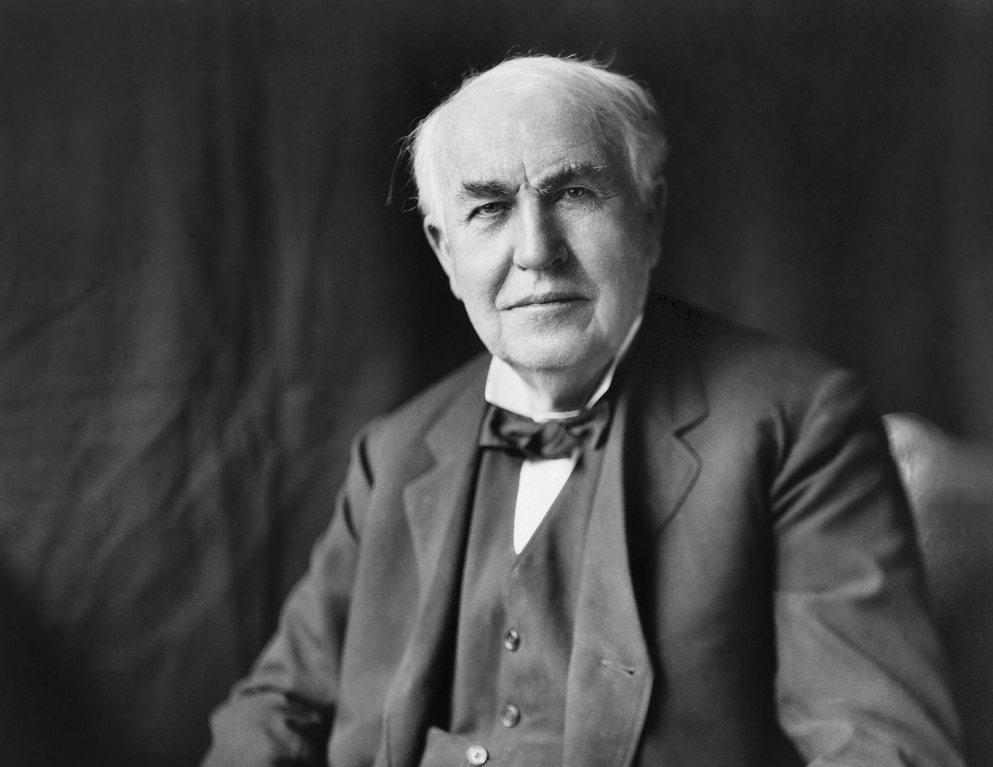
The end of 2015 has been dominated by crises. At times, amidst the daily barrage of fearful spectacle, it can be difficult to conceive of the years around the corner in ways that don’t resemble the next crop of blow-em-up action movies, nearly every one of which depicts some variation on the seemingly inexhaustible theme of the end-of-the-world. There’s no doubt many of our current challenges are unprecedented, but in the midst of anxieties of all kinds it’s worth remembering that—as Steven Pinker has thoroughly demonstrated—“violence has declined by dramatic degrees all over the world.”
In other words, as bad as things can seem, they were much worse for most of human history. It’s a long view cultural historian Otto Friedrich took in a grim survey called The End of the World: A History. Written near the end of the Cold War, Friedrich’s book documents some 2000 years of European catastrophe, during which one generation after another genuinely believed the end was nigh. And yet, certain far-seeing individuals have always imagined a thriving human future, especially during the profoundly destructive 20th century.
In 1900, engineer John Elfreth Watkins made a survey of the scientific minds of his day. As we noted in a previous post, some of those predictions of the year 2000 seem prescient, some preposterous; all boldly extrapolated contemporary trends and foresaw a radically different human world. At the height of the Cold War in 1964, Isaac Asimov partly described our present in his 50 year forecast. In 1926, and again 1935, no less a visionary than Nikola Tesla looked into the 21st century to envision a world both like and unlike our own.
Several years earlier in 1911, Tesla’s rival Thomas Edison made his own set of futuristic predictions for 100 years hence in a Cosmopolitan article. These were also summarized in an article published that year by the Miami Metropolis, which begins by lauding Edison as a “wizard… who has wrested so many secrets from jealous Nature.” We’ve condensed Edison’s predictions in list form below. Compare these to Tesla’s visions for a fascinating contrast of two different, yet complementary future worlds.
1. Steam power, already on the wane, will rapidly disappear: “In the year 2011 such railway trains as survive will be driven at incredible speed by electricity (which will also be the motive force of all the world’s machinery).”
2. “[T]he traveler of the future… will fly through the air, swifter than any swallow, at a speed of two hundred miles an hour, in colossal machines, which will enable him to breakfast in London, transact business in Paris and eat his luncheon in Cheapside.”
3. “The house of the next century will be furnished from basement to attic with steel… a steel so light that it will be as easy to move a sideboard as it is today to lift a drawing room chair. The baby of the twenty-first century will be rocked in a steel cradle; his father will sit in a steel chair at a steel dining table, and his mother’s boudoir will be sumptuously equipped with steel furnishings….”
4. Edison also predicted that steel reinforced concrete would replace bricks: “A reinforced concrete building will stand practically forever.” By 1941, he told Cosmopolitan, “all constructions will be of reinforced concrete, from the finest mansions to the tallest skyscrapers.”
5. Like many futurists of the previous century, and some few today, Edison foresaw a world where tech would eradicate poverty: “Poverty was for a world that used only its hands,” he said; “Now that men have begun to use their brains, poverty is decreasing…. [T]here will be no poverty in the world a hundred years from now.”
6. Anticipating agribusiness, Edison predicted, “the coming farmer will be a man on a seat beside a push-button and some levers.” Farming would experience a “great shake-up” as science, tech, and big business overtook its methods.
7. “Books of the coming century will all be printed leaves of nickel, so light to hold that the reader can enjoy a small library in a single volume. A book two inches thick will contain forty thousand pages, the equivalent of a hundred volumes.”
8. Machines, Edison told Cosmopolitan, “will make the parts of things and put them together, instead of merely making the parts of things for human hands to put together. The day of the seamstress, wearily running her seam, is almost ended.”
9. Telephones, Edison confidently predicted, “will shout out proper names, or whisper the quotations from the drug market.”
10. Anticipating the logic of the Cold War arms race, though underestimating the mass destruction to precede it, Edison believed the “piling up of armaments” would “bring universal revolution or universal peace before there can be more than one great war.”
11. Edison “sounds the death knell of gold as a precious metal. ‘Gold,’ he says, ‘has even now but a few years to live. They day is near when bars of it will be as common and as cheap as bars of iron or blocks of steel.’”
He then went on, astonishingly, to echo the pre-scientific alchemists of several hundred years earlier: “’We are already on the verge of discovering the secret of transmuting metals, which are all substantially the same matter, though combined in different proportions.’”
Excited by the future abundance of gold, the Miami Metropolis piece on Edison’s predictions breathlessly concludes, “In the magical days to come there is no reason why our great liners should not be of solid gold from stem to stern; why we should not ride in golden taxicabs, or substituted gold for steel in our drawing rooms.”
In reading over the predictions from shrewd thinkers of the past, one is struck as much by what they got right as by what they got often terribly wrong. (Matt Novak’s Paleofuture, which brings us the Miami Metropolis article, has chronicled the checkered, hit-and-miss history of futurism for several years now.) Edison’s tone is more strident than most of his peers, but his accuracy was about on par, further suggesting that neither the most confident of techno-futurists, nor the most baleful of doomsayers knows quite what the future holds: their clearest forecasts obscured by the biases, technical limitations, and philosophical categories of their present.
via Paleofuture
Related Content:
In 1964, Arthur C. Clarke Predicts the Internet, 3D Printers and Trained Monkey Servants
In 1704, Isaac Newton Predicts the World Will End in 2060
Josh Jones is a writer and musician based in Durham, NC. Follow him at @jdmagness
Read More...Support Us
We're hoping to rely on loyal readers, rather than erratic ads. Please click the Donate button and support Open Culture. You can use Paypal, Venmo, Patreon, even Crypto! We thank you!

About Us

Open Culture scours the web for the best educational media. We find the free courses and audio books you need, the language lessons & educational videos you want, and plenty of enlightenment in between.
Advertise With Us

FREE UPDATES!
GET OUR DAILY EMAIL
Get the best cultural and educational resources on the web curated for you in a daily email. We never spam. Unsubscribe at any time.
FOLLOW ON SOCIAL MEDIA

Open Culture editor Dan Colman scours the web for the best educational media. He finds the free courses and audio books you need, the language lessons & movies you want, and plenty of enlightenment in between.
Advertise With Us

