Creativity, Not Money, is the Key to Happiness: Discover Psychologist Mihaly Csikszentmihaly’s Theory of “Flow”
The title of the TED talk above, “Flow, the secret to happiness,” might make you roll your eyes. It does indeed sound like self-help snake oil. But as soon as you hear the speaker, psychologist Mihaly Csikszentmihalyi, describe the rationale for his happiness study, you might pay more serious attention. After living through the Second World War in Europe (he grew up in what is now Croatia), Csikszentmihalyi says he “realized how few of the grownups I knew were able to withstand the tragedies that were visited upon them; how few of them could even resemble a normal, contented, satisfied, happy life once their job, their home, their security was destroyed by the war.”
He became interested, he says, “in understanding what contributed to a life that was worth living.” Csikszentmihalyi’s concerns are far from trivial, and his background and wealth of research lend his ideas a good deal of weight and credibility.
After chancing upon a Jungian lecture in Switzerland by a speaker who turned out to actually be Carl Jung, Csikszentmihalyi embarked on a course of study in the field now widely known as “positive psychology.” He now co-directs the Quality of Life Research Center at Claremont Graduate University and studies “human strengths such as creativity, engagement, intrinsic motivation, and responsibility.” Yes, he may present his ideas in popular self-help books and articles, but this does not make his data or conclusions any less sound than in his academic work. “Flow” is the shorthand word he uses to refer to the thesis of his book of the same name: “A person can himself [or herself] be happy, or miserable, regardless of what is actually happening ‘outside,’ just by changing the contents of consciousness.”
What does this mean? Youtuber Fight Mediocrity’s short book video book review above—which also teaches us how to pronounce Csikszentmihalyi’s name—explains the concept in brief, noting the book’s references to Stoic philosophers Epictetus and Marcus Aurelius and psychologist and Holocaust survivor Viktor Frankl to point out that the idea isn’t new but has been around for centuries: The idea being, as Csikszentmihalyi says in his TED talk, that we naturally experience the greatest happiness when fully absorbed in work we find meaningful and fulfilling. What Csikszentmihalyi calls “flow” is a meditative state we might compare to the ancient Buddhist state of ekaggata—or “one-pointed concentration”—a state meditation teacher Shaila Catherine describes as “certainty, deep stability, and clarity…. The mind is completely unified and ‘one with the experience.’”
Indeed, like the Buddhist conception, which contrasts ekaggata with a restless greed that can never be satisfied, Csikszentmihalyi contrasts “flow” with wealth, and cites research suggesting that above a certain level of basic material well-being (which far too many people do not yet have), “increases in material resources do not increase happiness.” Csikszentmihalyi partly reached his conclusions by studying the emotional states of artists, musicians, scientists, and other creative individuals, who all reported experiencing pure states of contentment and joy when so fully concentrated on their work that they forgot themselves—or, more accurately, the constellation of daily anxieties, regrets, worries, fantasies, and preoccupations that we tend to call the self. As Csikszentmihalyi strongly suggests in his books and talks, the more we can lose ourselves intensely in creative activities that bring us fulfillment, the closer we come to being in harmony with ourselves and our world.
See another talk on “flow” and happiness above, from a 2014 “Happiness & its Causes” conference in Sydney, Australia.
If you would like to support the mission of Open Culture, consider making a donation to our site. It’s hard to rely 100% on ads, and your contributions will help us continue providing the best free cultural and educational materials to learners everywhere. You can contribute through PayPal, Patreon, and Venmo (@openculture). Thanks!
Related Content:
Free Online Psychology & Neuroscience Courses
The Keys to Happiness: The Emerging Science and the Upcoming MOOC by Raj Raghunathan
All You Need is Love: The Keys to Happiness Revealed by a 75-Year Harvard Study
A Guide to Happiness: Alain de Botton Shows How Six Great Philosophers Can Change Your Life
Slavoj Žižek: What Fullfils You Creatively Isn’t What Makes You Happy
Josh Jones is a writer and musician based in Durham, NC. Follow him at @jdmagness
Read More...Hear 6 Classic Philip K. Dick Stories Adapted as Vintage Radio Plays
As you can probably tell if you’ve interacted with any of his hard-core fans, the science fiction of Philip K. Dick has a way of getting into readers’ heads. What better way to adapt it, then, than in the medium of radio drama, with its direct route into the head through the ears? Science fiction in general provided radio drama with a good deal of bread-and-butter subject matter since pretty much its inception, and suitably so: its producers didn’t have to bother designing distant worlds, alien races and elaborately futuristic technologies when, with the right sound design, the listeners would design it all themselves in their imaginations.
But does it really do justice to Dick to call his work “science fiction”? Sure, he knocked out a fair few straight-ahead (or sub-straight-ahead) sci-fi potboilers in his productive career, but many of his writings, despite their rough edges, qualify under Walter Benjamin’s definition of great works of literature, which “either dissolve a genre or invent one.”
Some of Dick’s novels and stories even seem to do both at once, creating their own particular (as well as peculiar) psychological space in the process. Can radio drama render a Dickian world of multilayered reality and rich paranoia as easily as it does so many Martian colonies, laser guns, and sentient computers? So you can judge that for yourself, we submit today for your approval six radio plays adapted from Dick’s stories.
From the series Mind Webs, which ran on Wisconsin public radio from the 1970s to the 90s, we have “Impostor,” “The Preserving Machine,” and “The Builder.”
From NBC’s venerable X Minus One, which defined sci-fi at the tail end of old time radio’s “Golden Age,” we have “Colony” and “The Defenders.”
Into the mix we also throw Sci-Fi Radio’s “Sales Pitch,” Dick’s satirical tale of a self-marketing robot. Some of this material, of course, sounds not terribly different than the whiz-bang stories of outer-space adventure children of the 1950s grew up loving.
But some of it sounds altogether more, well… Dickian. Those children of the 1950s, after all, grew into the twentysomethings of the late 1960s and 70s, who knew a thing or two about tuning in to a different headspace.
Find these stories listed in our collection, 1,000 Free Audio Books: Download Great Books for Free.
Related Content:
X Minus One: More Classic 1950s Sci-Fi Radio from Asimov, Heinlein, Bradbury & Dick
33 Sci-Fi Stories by Philip K. Dick as Free Audio Books & Free eBooks
Based in Seoul, Colin Marshall writes and broadcasts on cities and culture. He’s at work on a book about Los Angeles, A Los Angeles Primer, the video series The City in Cinema, the crowdfunded journalism project Where Is the City of the Future?, and the Los Angeles Review of Books’ Korea Blog. Follow him on Twitter at @colinmarshall or on Facebook.
Read More...Downton Abbey Actors Perform Scene from the Show with American Accents
However stiff they may seem on the show, the cast of Downton Abbey can let down its hair and have some fun. Last Christmas, they put together a fun parody episode, where, borrowing from It’s a Wonderful Life, they asked us to imagine what daily life at the Abbey would look like if Lady Grantham spent her days cavorting with George Clooney rather than Lord Grantham.
Now, right before the show’s final season starts airing in the US on January 3, several cast members are giving us another scenario to consider: What would it look if Downton Abbey was performed only with American accents? Appearing on The Late Show with Stephen Colbert, Michelle Dockery (Lady Mary Crawley), Hugh Bonneville (Lord Grantham) and Allen Leech (Tom Bransom) performed an actual scene in their best American accents, and it’s a sight to behold. Particularly Allen, he’s a trip.
Follow Open Culture on Facebook and Twitter and share intelligent media with your friends. Or better yet, sign up for our daily email and get a daily dose of Open Culture in your inbox. And if you want to make sure that our posts definitely appear in your Facebook newsfeed, just follow these simple steps.
Related Content:
A Fun Parody of Downton Abbey Features George Clooney & the Cast of the Show
Three Actresses from Downton Abbey Play a Raunchy Card Game (NSFW)
Watch Meryl Streep Have Fun with Accents: Bronx, Polish, Irish, Australian, Yiddish & More
Read More...The First Episode of Serial: Season 2 Is Now Online: Go Inside the World of Sgt. Bowe Bergdahl
If you’ve been wondering how the Serial podcast would follow up on its remarkable first season, the suspense is over. This morning, Season 2 is getting underway. Episode 1 is now online, ready for download.
A year ago, we got intimately familiar with the 1999 murder of Hae Min Lee and the trial of Adnan Syed. Now, host Sarah Koenig will take us deeper into the world of Sgt. Bowe Bergdahl, the soldier held captive by the Taliban for five years, who is now facing desertion charges by the US Army.
You can subscribe to Serial via Rss feed or iTunes, or listen to the episodes via the web.
Follow Open Culture on Facebook and Twitter and share intelligent media with your friends. Or better yet, sign up for our daily email and get a daily dose of Open Culture in your inbox. And if you want to make sure that our posts definitely appear in your Facebook newsfeed, just follow these simple steps.
Read More...
Watch the Eagles of Death Metal Perform Live Again Tonight in Paris
“There’s nothing left but to introduce you to some people whose lives will forever be a part of the life of Paris. These are our brothers. They were robbed of their stage three weeks ago, and we would like to offer them ours tonight.” And with those words from Bono, the Eagles of Death Metal took the stage again tonight in Paris, just three weeks after the horrific terrorist attack at Le Bataclan. Up top, see them sing, along with U2, a version of Patti Smith’s “People Have the Power.” Next, a version of their own song, “I Love You All the Time.”
Whether the band would perform again was never in doubt. Interviewed days after the attack, the band, still reeling, told Vice they had an obligation to carry on. In the poignant video below, Jesse Hughes said it all: “I cannot wait to get back to Paris. I cannot wait to play. I want to come back. I want to be the first band to play at Le Bataclan when it opens.” Playing at Le Bataclan may have to wait. But getting back to Paris, that’s now certainly done.
Follow Open Culture on Facebook and Twitter and share intelligent media with your friends. Or better yet, sign up for our daily email and get a daily dose of Open Culture in your inbox. And if you want to make sure that our posts definitely appear in your Facebook newsfeed, just follow these simple steps.
Read More...Watch Björk, Age 11, Read a Christmas Nativity Story on a 1976 Icelandic TV Special
The holidays can be hard, starting in October when the red and green decorations begin muscling in on the Halloween aisle.
Most Wonderful Time of the Year, you say? Oh, go stuff a stocking in it, Andy Williams!
The majority of us have more in common with the Grinch, Scrooge, and/or the Little Match Girl.
Still, it’s hard to resist the preternaturally mature 11-year-old Björk reading the nativity story in her native Icelandic, backed by unsmiling older kids from the Children’s Music School in Reykjavík.
Particularly since I myself do not speak Icelandic.
The fact that it’s in black and white is merely the blueberries on the spiced cabbage.
It speaks highly of the Icelandic approach to education that a principal’s office regular who reportedly chafed at her school’s “retro, constant Beethoven and Bach bollocks” curriculum was awarded the plum part in this 1976 Christmas special for the National Broadcasting Service.
It would also appear that little Björk, the fiercely self-reliant latchkey kid of a Bohemian single mother, was far and away the most charismatic kid enrolled in the Barnamúsikskóli.
(Less than a year later her self-titled first album sold 7000 copies in Iceland—a modest amount compared to Adele’s debut, maybe, but c’mon, the kid was 11! And Iceland’s population at the time was a couple hundred thousand and change.)
As to the above performance’s religious slant, it wasn’t a reflection of her personal beliefs. As she told the UK music webzine Drowned in Sound in 2011:
…nature is my religion, in a way… I think everybody has their own private religion. I guess what bothers me is when millions have the same one. It just can’t be true. It’s just…what?
Still, it probably wasn’t too controversial that the programmers elected to cleave to the reason in the season. Icelandic church attendance may be low-key, but the overwhelming majority of its citizens identify as Lutheran, or some other Christian denomination.
(They also believe in elves and 13 formerly fearsome Yule Lads, descendants of the ogres Grýla and Leppalúði. By the time Björk appeared on earth, they had long since evolved, through a combination of foreign influence and public decree, into the kinder, gentler, not quite Santa-esque version, addressing the studio audience at the top of the act.)
Related Content:
Hear the Album Björk Recorded as an 11-Year-Old: Features Cover Art Provided By Her Mom (1977)
Ayun Halliday is an author, illustrator, and Chief Primatologist of the East Village Inky zine. She is proud to originated the role of Santa’s mortal consort, Mary, in her Jewish husband Greg Kotis’ Nordic-themed holiday fantasia, The Truth About Santa. Follow her @AyunHalliday
Read More...How Isaac Asimov Went from Star Trek Critic to Star Trek Fan & Advisor
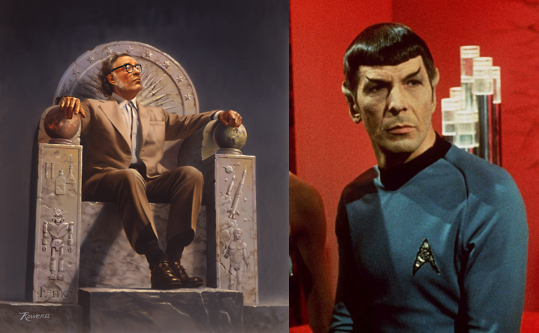
When we think of a science fiction, most of us doubtless think of a Star Trek. Since the original series made its television debut almost a half-century ago, the speculative future it created has come to stand, in many minds, as the very model of the science-fictional enterprise (as it were). But the institution of Star Trek in all its forms — TV shows, movies, movies made out of TV shows, novels, video games, action figures, and so on — still has its detractors, and back at the very beginning it hardly looked like a sure success. Geek.com’s list of five things that nearly killed off Star Trek includes a failed pilot, a near-firing of Leonard Nimoy, and the words of no less a science-fiction titan than Isaac Asimov.
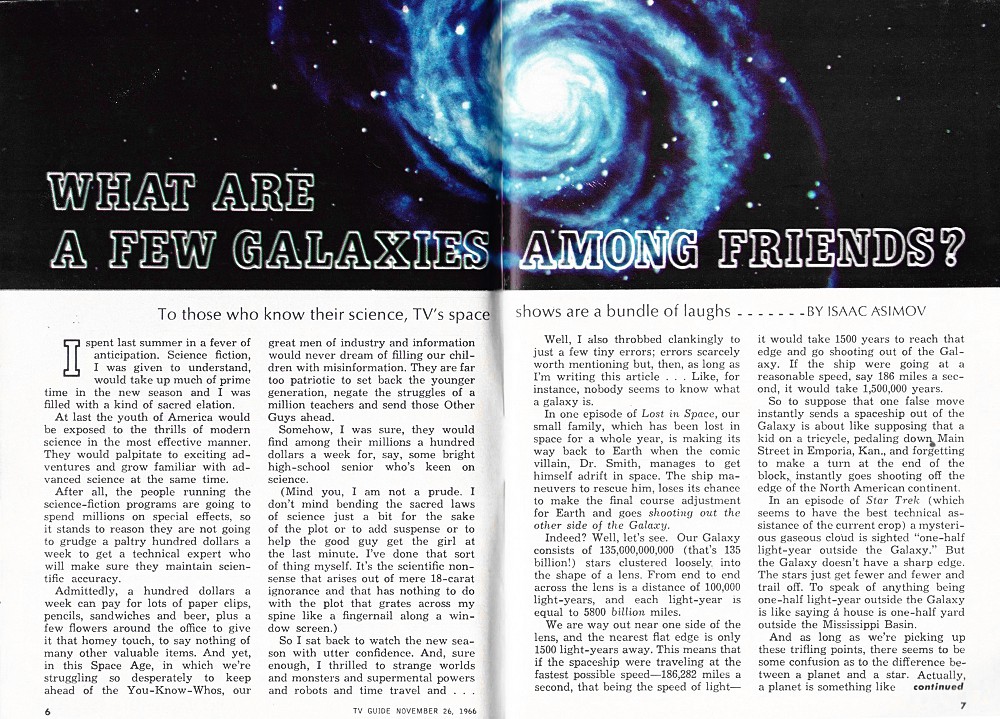
“Star Trek,” wrote its creator Gene Roddenberry in 1966, “almost did not get on the air because it refused to do juvenile science fiction, because it refused to put a ‘Lassie’ aboard the space ship, and because it insisted on hiring Dick Matheson, Harlan Ellison, A.E. Van Vogt, Phil Farmer, and so on.” This came as part of a response to Asimov, who, in a TV Guide article entitled “What Are a Few Galaxies Among Friends?,” criticized Star Trek for getting the science wrong. He cites, for example, a line about a gaseous cloud “one-half light year outside the Galaxy,” which he likens to “saying a house is one-half yard outside the Mississippi Basin.”
Measurement flubs aside, Star Trek, despite its cancellation after three seasons, had become so big by the early 1970s that its fans had begun to put on whole conventions dedicated to the show. You can see in the clip above one such event in 1973, which provides proof that even Asimov had turned fan. He speaks of his appreciation for the show three times during the video, now describing Star Trek as the “sanest” and “most meaningful” program of its kind, one that “tackled real social problems,” was “not devoted entirely to adventure,” and had “fully realized characters” (citing Mr. Spock as Exhibit A). He may still have objected to the infamous split infinitive “to boldly go” (once a nitpicker, always a nitpicker), but he still thought the show “really presented the brotherhood of intelligence.”
After Asimov wrote his initial critique in TV Guide, he and Gene Roddenberry exchanged letters, and the two formidable sci-fi minds became friends and even collaborators thereafter. A 1967 Time magazine profile described Asimov as “batting out books on a new electric typewriter, emerging only occasionally to watch Star Trek (his favorite TV show),” and he went on to become an advisor to the show. A Letters of Note post on Roddenberry and Asimov’s correspondence contains a 1967 exchange wherein they put their heads together to solve the problem of how to give Captain Kirk lines as good as the ones that naturally go to a more unusual character like Spock. Since Asimov also contributed original ideas to the show, after having gone on record as a fan, I wonder: does that mean, in some sense, that Isaac Asimov wrote Star Trek fan fiction?
Related Content:
Klingon for English Speakers: Sign Up for a Free Course Coming Soon
Isaac Asimov Predicts in 1964 What the World Will Look Like Today — in 2014
Free: Isaac Asimov’s Epic Foundation Trilogy Dramatized in Classic Audio
Isaac Asimov Explains the Origins of Good Ideas & Creativity in Never-Before-Published Essay
Isaac Asimov Explains His Three Laws of Robots
Isaac Asimov’s Favorite Story “The Last Question” Read by Isaac Asimov— and by Leonard Nimoy
Based in Seoul, Colin Marshall writes and broadcasts on cities and culture. He’s at work on a book about Los Angeles, A Los Angeles Primer, the video series The City in Cinema, and the crowdfunded journalism project Where Is the City of the Future? Follow him on Twitter at @colinmarshall or on Facebook.
Read More...Steve Martin Writes a Hymn for Hymn-Deprived Atheists
To understand the two sides of Steve Martin’s performing talents, check out his one and only hit single, 1978’s King Tut. On the A‑side was the novelty funk hit about the Egyptian boy king. On the B‑side, two deep cuts that showed off Martin’s formidable Americana/banjo chops: the traditional “Sally Goodin” (circa 1860, but existing on recordings since 1922), and “Hoedown at Alice’s” an original written for his then stand-up manager Bill McEuen’s wife.
It’s not what you’d expect from the “Wild and Crazy Guy,” but Martin’s banjo had always been a part of his act. He taught himself at 15 years old, playing along very slowly to Earl Scruggs records. He told an interviewer:
The reason I played it on stage is because my act was so crazy I thought it’s probably good to show the audience I can do something that looks hard, because this act looks like I’m just making it up. I really wasn’t. I worked very hard on it.
Which is a long way of saying: When Martin recorded an album of banjo favorites in 2009, The Crow, won a Grammy without relying on a single joke, then enlisted the help of the North Carolinian Steep Canyon Rangers to go on a tour, it should not have really been a surprise.
When he teamed up next with The Steep Canyon Rangers and recorded Rare Bird Alert in 2011, Martin started to combine comedy and music once again, and with this above novelty song, he gets to indulge in the beautiful harmony singing that bluegrass groups like The Stanley Brothers, The Louvin Brothers, and the Osbourne Brothers made so popular in the mid-century. (There wasn’t just banjo pickin’ on those LPs, you know.) The above appearance on Letterman is a great rendition of a concert favorite, “Atheists Don’t Have No Songs.”
So in this month of arguments over the Starbucks holiday cup, let Mr. Martin and group add a palliative to any hurt atheist feelings. You guys rock.
P.S. Martin got a chance to play with his hero on the same late-night program.
Related Content
Steve Martin Teaches His First Online Course on Comedy
Steve Martin on the Legendary Bluegrass Musician Earl Scruggs
Steve Martin Releases Bluegrass Album/Animated Video
A Bluegrass Version of Metallica’s Heavy Metal Hit, “Enter Sandman”
Ted Mills is a freelance writer on the arts who currently hosts the artist interview-based FunkZone Podcast. King Tut was the second 45 he ever bought as a kid. You can also follow him on Twitter at @tedmills, read his other arts writing at tedmills.com and/or watch his films here.
Read More...Leonard Cohen Reads The Great World War I Poem, “In Flanders Fields”
Courtesy of Legion Magazine, you can hear Canada’s iconic singer-songwriter Leonard Cohen reading “In Flanders Fields” by Lieutenant-Colonel John McCrae. The clip was recently recorded to commemorate the 100th anniversary of the poem.
World War I inspired many poems. But this one, straight from the beginning, became one of the most popular ones. Poets.org recounts the origins of “In Flanders Fields” thusly:
As the first shots of World War I were fired in the summer of 1914, Canada, as a member of the British Empire, became involved in the fight as well. [John] McCrae was appointed brigade-surgeon to the First Brigade of the Canadian Field Artillery.
In April 1915, McCrae was stationed in the trenches near Ypres, Belgium, in an area known as Flanders, during the bloody Second Battle of Ypres. In the midst of the tragic warfare, McCrae’s friend, twenty-two-year-old Lieutenant Alexis Helmer, was killed by artillery fire and buried in a makeshift grave. The following day, McCrae, after seeing the field of makeshift graves blooming with wild poppies, wrote his famous poem “In Flanders Field,” which would be the second to last poem he would ever write. It was published in England’s Punch magazine in December 1915 and was later included in the posthumous collection In Flanders Fields and Other Poems (G. P. Putnam’s Sons, 1919).
As a sad postscript, McCrae started suffering from asthma attacks and bronchitis in the summer of 1917, then died of pneumonia and meningitis in January of 1918. It’s fitting that Leonard Cohen (an accomplished poet before he became a musician) would recite “In Flanders Fields,” the text of which you can read below. The second reading was recorded live in Los Angeles earlier this year.
In Flanders fields the poppies blow
Between the crosses, row on row,
That mark our place; and in the sky
The larks, still bravely singing, fly
Scarce heard amid the guns below.We are the Dead. Short days ago
We lived, felt dawn, saw sunset glow,
Loved and were loved, and now we lie
In Flanders fields.Take up our quarrel with the foe:
To you from failing hands we throw
The torch; be yours to hold it high.
If ye break faith with us who die
We shall not sleep, though poppies grow
In Flanders fields.
Find Cohen’s reading in our collection, 1,000 Free Audio Books: Download Great Books for Free.
Follow Open Culture on Facebook and Twitter and share intelligent media with your friends. Or better yet, sign up for our daily email and get a daily dose of Open Culture in your inbox. And if you want to make sure that our posts definitely appear in your Facebook newsfeed, just follow these simple steps.
Related Content
Young Leonard Cohen Reads His Poetry in 1966 (Before His Days as a Musician Began)
Ladies and Gentlemen… Mr. Leonard Cohen: The Poet-Musician Featured in a 1965 Documentary
The Poetry of Leonard Cohen Illustrated by Two Short Films
Read More...Learn to Code with Star Wars: The Force Awakens and Minecraft
Code.org, a non-profit dedicated to expanding access to computer science, has created a fun way for students to learn the basics of coding. Teaming up with Disney and Lucasfilm, they’ve launched Star Wars: Building a Galaxy with Code, a tutorial designed to teach students to write JavaScript as they guide Star Wars characters through a fun mission. The module is designed for kids 11 and up. (Adults, that could definitely apply to you.) There’s also a separate beginner’s tutorial for kids between the ages of 6 and 10.
If Star Wars doesn’t hold appeal, then you can always learn to code through the ever-popular video game Minecraft. The Minecraft tutorial, created in partnership with Microsoft, got some pretty nice reviews over on Motherboard.
More Code.org tutorials can be found here. And you’ll find other introductory coding courses (some designed with an older demographic in mind) in the Relateds below.
Related Content:
Harvard’s Free Computer Science Course Teaches You to Code in 12 Weeks
Codecademy’s Free Courses Democratize Computer Programming
Free Online Computer Science Courses
Read More...Support Us
We're hoping to rely on loyal readers, rather than erratic ads. Please click the Donate button and support Open Culture. You can use Paypal, Venmo, Patreon, even Crypto! We thank you!

About Us

Open Culture scours the web for the best educational media. We find the free courses and audio books you need, the language lessons & educational videos you want, and plenty of enlightenment in between.
Advertise With Us

FREE UPDATES!
GET OUR DAILY EMAIL
Get the best cultural and educational resources on the web curated for you in a daily email. We never spam. Unsubscribe at any time.
FOLLOW ON SOCIAL MEDIA

Open Culture editor Dan Colman scours the web for the best educational media. He finds the free courses and audio books you need, the language lessons & movies you want, and plenty of enlightenment in between.
Advertise With Us