Portland, the City in Cinema: See the City of Roses as it Appears in 20 Different Films
Last year, I posted about The City in Cinema, my series of video essays exploring cities as revealed and re-imagined by the films set in them — or rather, at that time, about one city in particular: Los Angeles, birthplace of Hollywood cinema and endlessly fascinating urban phenomenon in its own right. But ever since I first began the project, I knew I’d want to extend it to other cities. When first I stepped beyond Los Angeles with The City in Cinema, I stepped into the city I’ve long considered my favorite to visit in America.
And what city, exactly, would that be? “Portland, Oregon: one of the nation’s most beautiful cities, with Mount Hood rising in the distance, majestic, serene, white with eternal snow,” a “city of wide streets, modern buildings” whose citizens “attend many fine churches” and live in “beautiful homes,” a city where “in the soft climate, gardens grow lush and green throughout the year” with roses “everywhere in profusion,” a “family town, a good place to bring up children.” Or so, in any case, goes the opening of Portland Exposé, a 1957 true-crime morality play, one of the very first films to use Portland as a setting, and the one that opens my latest long-form video essay, Portland, the City in Cinema.
At that time not much more than a small-to-medium-sized town in the woods, Portland claims only a scant cinematic history up through the 1970s. But every Portland movie that came out then, such as the CBS nuclear-strike dramatization A Day Called X and the bohemian land-use satire Property, boasts its own sort of interest. And then, in the 1980s, emerges Gus Van Sant, unquestionably the foremost Portland auteur of his generation. His black-and-white debut feature Mala Noche, which deals humorously with themes of homosexuality on Portland’s former Skid Row (now the thoroughly gentrified Pearl District) drew the Hollywood attention that would ultimately get him making mainstream features like Good Will Hunting and Milk.
But Van Sant has, in parallel, led another career as a thoroughly independent filmmaker, and one who shoots most of those thoroughly independent films in Portland. That track of Van Sant’s work has led to such formidable Portland movies, central to a project like this, as Drugstore Cowboy, My Own Private Idaho, and Paranoid Park. During the 1990s, the time of the “Indiewood” boom in America, other filmmakers discovered Portland’s potential as a rich and underused urban setting: Annette Haywood-Carter for her adaptation of Joyce Carol Oates’ novel Foxfire, for instance, or Jake Kasdan for his unconventional detective story and black romantic comedy Zero Effect.
Albert Pyun, perhaps the last great B‑movie auteur, also came to Portland of the 1990s for his Andrew Dice Clay vehicle Brain Smasher… a Love Story. And not much later, the city hosted the likes of Body of Evidence, a highly unerotic erotic thriller starring Willem Dafoe and Madonna. But it, too, reveals the the city’s potential (or potential for misuse) as a setting, as does the more recent Untraceable, a bland compromise between techno-thriller and torture horror that at least had the money to shoot Portland from some impressive angles.
As the city of Portland has developed in a way appreciated by urbanists for its compact downtown, useful transit system, mostly well-executed architectural preservation, and overall “smart” growth (by American standards, anyway), the cinema of Portland has developed in a way appreciated by critics. The 21st century has so far seen such well-crafted, thoughtful Portland pictures as Kelly Reichardt’s Old Joy and Wendy and Lucy, Aaron Katz’s Dance Party USA and Cold Weather, and Matt McCormick’s Some Days Are Better than Others. But if Portland, the City in Cinema remains, in its current version, the definitive examination of the cinema of Portland, I’ll be terribly disappointed. I intend it in part as an appreciation of the Portland movies already made, certainly, but in larger part as a call for more Portland movies in the future.
Related Content:
The Making of Drugstore Cowboy, Gus Van Sant’s First Major Film (1989)
Based in Seoul, Colin Marshall writes and broadcasts on cities and culture. He’s at work on a book about Los Angeles, A Los Angeles Primer, the video series The City in Cinema, and the crowdfunded journalism project Where Is the City of the Future? Follow him on Twitter at @colinmarshall or on Facebook.
Read More...The Great Stan Lee Reads Edgar Allan Poe’s “The Raven”
What work of American poetry has proven more irresistible than Edgar Allan Poe’s The Raven? Certainly we can seldom refrain ourselves from featuring it here on Open Culture. We’ve posted illustrations by Édouard Manet and Gustave Doré, readings by Christopher Walken, Vincent Price, Christopher Lee (all available here), James Earl Jones, Iggy Pop, and Lou Reed, who offered his own modernized take on Poe’s words. Even notables primarily noted for something other than their recitation ability have got in on The Raven: just above, for instance, you can see a reading by none other than Marvel Comics mastermind Stan Lee.
We recognize Stan Lee, of course, as an icon of American culture for his achievements in the field of comics: doing his part to create enduring characters like Spider-Man, Iron Man, and the X‑Men, fighting censorship from the Comics Code Authority, introducing the concept of coherent — or at least coherent-enough — fictional “universes,” and much more besides. But a decent portion of Lee’s fame also owes to his seemingly bottomless well of enthusiasm, from which he continues to draw, at the age of 92, for every public address to the “true believers,” and he doesn’t leave that enthusiasm behind when it comes time to interpret Edgar Allan Poe.
Having previously gone on the record in interviews naming Poe as one of his favorite authors in childhood (alongside other such high‑, low‑, and middle-browed literary immortals as Edgar Rice Burroughs, Charles Dickens, Mark Twain, O. Henry, and Shakespeare), he makes a certain kind of sense as a Raven-reader. (And hasn’t, say, Spider-Man’s origin story passed into American myth in much the same way as Poe’s tale of a lamenting lover tormented by a talking bird?) He also sets a high bar with his endearing performance itself, which should get you thinking: if you, too, one day become an icon of American culture, how will you approach your inevitable Raven-reading turn?
You can find Lee’s reading in our collection, 1,000 Free Audio Books: Download Great Books for Free. Poe’s text lives here: 800 Free eBooks for iPad, Kindle & Other Devices.
Related Content:
Gustave Doré’s Splendid Illustrations of Edgar Allan Poe’s “The Raven” (1884)
Edgar Allan Poe’s “The Raven,” Read by Christopher Walken, Vincent Price, and Christopher Lee
James Earl Jones Reads Edgar Allan Poe’s “The Raven” and Walt Whitman’s “Song of Myself”
Lou Reed Rewrites Edgar Allan Poe’s “The Raven.” See Readings by Reed and Willem Dafoe
7 Tips from Edgar Allan Poe on How to Write Vivid Stories and Poems
Download the Complete Works of Edgar Allan Poe on His Birthday
Download 55 Free Online Literature Courses: From Dante and Milton to Kerouac and Tolkien
Based in Seoul, Colin Marshall writes and broadcasts on cities and culture. He’s at work on a book about Los Angeles, A Los Angeles Primer, the video series The City in Cinema, and the crowdfunded journalism project Where Is the City of the Future? Follow him on Twitter at @colinmarshall or on Facebook.
Read More...Monty Python’s John Cleese Creates Ads for the American Philosophical Association

Creative Commons image by Paul Boxley
John Cleese, you say, a spokesman for the American Philosophical Association? Why would such a serious organization, whose stated mission is to foster the “broader presence of philosophy in public life,” choose a British comedian famous for such characters as the overbearing Basil Fawlty and ridiculous Minister of Silly Walks as one of their public faces?
They chose him, I imagine, because in his various roles—as a onetime prep school teacher and student of law at Cambridge, as a comedy writer and Monty Python star, and as a post-Python comedian, author, public speaker, and visiting professor at Cornell—Cleese has done more than his part to spread philosophy in public life. Monty Python, you’ll remember, aired a number of absurd philosophy sketches, notable for being as smart as they are funny.
Cleese has presented his personal philosophy of creativity at the World Creativity Forum; he’s explained a common cognitive bias to which media personalities and politicians seem particularly susceptible; and he had his own podcast in which, among other things, he explained (wink) how the human brain works.
Given these credentials, and his ability to apply his intelligence, wit, and comic timing to subjects not often seen as particularly exciting by the general public, Cleese seems like the perfect person for the job, even if he isn’t an American philosopher. The APA, founded in 1900, has recently hosted conferences on religious tolerance and “Cultivating Citizenship.” In 2000, as part of its centennial celebration, the organization had Cleese record 22 very short “Public Service Announcements” to introduce novices to the important work of philosophy. These range from the very general “What Philosophers Do” at the top of the post to the influence of philosophy on social and political reformers like Martin Luther King, Jr., Jane Addams, and Simone de Beauvoir (above), showing philosophy’s “bearing on the real world.”
In this PSA, Cleese makes the controversial claim that “the 21st century may belong far more to philosophy than to psychology or even traditional religion.” “What a strange thought,” he goes on, then explains that philosophy “works against confusion”—certainly a hallmark of our age. There’s not much here to argue with—Cleese isn’t formulating a position, but giving his listeners provocative little nuts to crack on their own, should they find his PSAs intriguing enough to draw them into further study. They might as well begin where most of us do, with Socrates, whom Cleese introduces below.
Hear the rest of Cleese’s philosophy PSAs at the American Philosophical Association’s website. And should you wish to dig deeper, you’ll find an abundance of resources in our archives, which includes big lists of Free Online Philosophy Courses and Free Philosophy eBooks.
Related Content:
Monty Python’s Best Philosophy Sketches
John Cleese Explains the Brain — and the Pleasures of DirecTV
Learn The History of Philosophy in 197 Podcasts (With More to Come)
Download 100 Free Philosophy Courses and Start Living the Examined Life
Josh Jones is a writer and musician based in Durham, NC. Follow him at @jdmagness
Read More...Mark Twain’s Patented Inventions for Bra Straps and Other Everyday Items
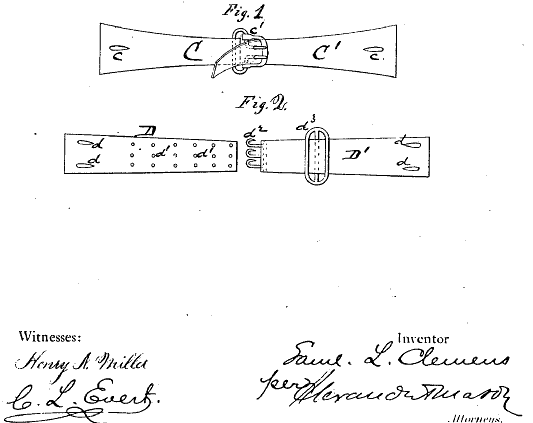
Much has been made of Mark Twain’s financial problems—the imprudent investments and poor management skills that forced him to shutter his large Hartford estate and move his family to Europe in 1891. An early adopter of the typewriter and long an enthusiast of new science and technology, Twain lost the bulk of his fortune by investing huge sums—roughly eight million dollars total in today’s money—on a typesetting machine, buying the rights to the apparatus outright in 1889. The venture bankrupted him. The machine was overcomplicated and frequently broke down, and “before it could be made to work consistently,” writes the University of Virginia’s Mark Twain library, “the Linotype machine swept the market [Twain] had hoped to corner.”
Twain’s seemingly blind enthusiasm for the ill-fated machine makes him seem like a bungler in practical matters. But that impression should be tempered by the acknowledgement that Twain was not only an enthusiast of technology, but also a canny inventor who patented a few technologies, one of which is still highly in use today and, indeed, shows no signs of going anywhere. I refer to the ubiquitous elastic hook clasp at the back of nearly every bra, an invention Twain patented in 1871 under his given name Samuel L. Clemens. (View the original patent here.) You can see the diagram for his invention above. Calling it an “Improvement in Adjustable and Detachable Straps for Garments,” Twain made no mention of ladies’ undergarments in his patent application, referring instead to “the vest, pantaloons, or other garment upon which my strap is to be used.”
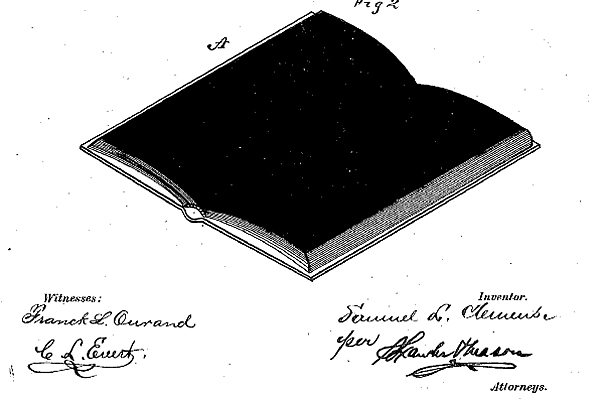
The device, writes the US Patent and Trademark Office, “was not only used for shirts, but underpants and women’s corsets as well. His purpose was to do away with suspenders, which he considered uncomfortable.” (At the time, belts served a mostly decorative function.) Twain’s inventions tended to solve problems he encountered in his daily life, and his next patent was for a hobbyist set of which he himself was a member. After the soon-to-be bra strap, Twain devised a method of improvement in scrapbooking, an avid pursuit of his, in 1873.
Previously, scrapbooks were assembled by hand-gluing each item, which Twain seemed to consider an overly laborious and messy process. His invention—writes The Atlantic in part of a series they call “Patents of the Rich and Famous”—involved “two possible self-adhesive systems,” similar to self-sealing envelopes, in which, as his patent states, “the surfaces of the leaves whereof are coated with a suitable adhesive substance covering the whole or parts of the entire surface.” (See the less-than-clear diagram for the invention above.) The scrapbooking device proved “very popular,” writes the US Patent Office, “and sold over 25,000 copies.”
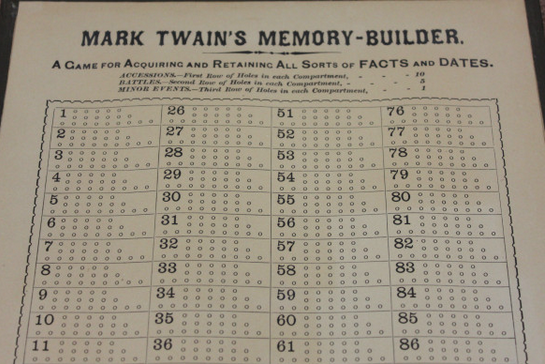
Twain obtained his final patent in 1885 for a “Game Apparatus” that he called the “Memory-Builder” (see it above). The object of the game was primarily educational, helping, as he wrote, to “fill the children’s heads with dates without study.” As we reported in a previous post, “Twain worked out a way to play it on a cribbage board converted into a historical timeline.” Unlike his first two inventions, the game met with no commercial success. “Twain sent a few prototypes to toy stores in 1891,” writes Rebecca Onion at Slate, “but there wasn’t very much interest, so the game never went into production.” Nonetheless, we still have Twain to thank, or to damn, for the bra strap, an invention of no small importance.
Twain himself seems to have had some contradictory attitudes about his role as an inventor, and of the singular recognition granted to individuals through patent law. Perhaps unsurprisingly, the US Patent Office claims that Twain “believed strongly in the value of the patent system” and cites a passage from A Connecticut Yankee in King Arthur’s Court in support. But in a letter Twain wrote to Helen Keller in 1903, he expressed a very different view. “It takes a thousand men to invent a telegraph, or a steam engine, or a phonograph, or a telephone or any other important thing,” Twain wrote, “and the last man gets the credit and we forget the others. He added his little mite—that is all he did. These object lessons should teach us that ninety-nine parts of all things that proceed from the intellect are plagiarisms, pure and simple.”
Related Content:
Mark Twain Wrote the First Book Ever Written With a Typewriter
Play Mark Twain’s “Memory-Builder,” His Game for Remembering Historical Facts & Dates
Josh Jones is a writer and musician based in Durham, NC. Follow him at @jdmagness
Read More...One Man-Band Plays Amazing Covers, Note-for-Note, of Yes, CSNY, Zeppelin & More
I’ve had the opportunity to meet many incredible musicians in person, and I’ve always enjoyed watching them do something better than I ever could, whether it’s wailing away on the drums, guitar, keyboards, bass… whatever the instrument, it’s great fun to see a master in action. And I’ve met a few multitalented individuals who could do a little, or a lot, of everything. But I’ve never met anyone as talented as Jim, the musician in these videos, who goes by the name of Friday Night Lullaby, and who recreates nearly every note and nuance in classic rock songs from Yes, Led Zeppelin, Jethro Tull, the Who, CSNY, and more.
His one-man-band motto is “we are one person,” and you can see why. With the benefit of recording technology, he can turn himself into an orchestra. At the top of the post, see a teaser video in which Jim gives us snippets of the 60 songs he’s remade. And above, see his version of Yes’s “Roundabout.”
Now you can argue that no matter how good he is, he could never reproduce the musical personalities of, say, Steve Howe or Jon Anderson, and that’s fair enough, but beside the point, really. The guy is good beyond belief, and I’m certainly in awe watching these videos of him at work in his home studio, playing all 43 tracks of “Roundabout.” Or, if Yes isn’t your bag, let him wow you below with the vocal harmonies in CSNY’s “Carry On.”
Still not impressed? Check his version of Stairway to Heaven here, or alternatively A‑Ha’s “Take On Me,” below. It’s a departure from the classic rock material he’s clearly more comfortable with, and he handles it with the same deftness and skill, including that mid-song high note, showing off some pretty keen video editing skills to boot. For even more mind blowing covers, check out the Friday Night Lullaby Youtube channel.
via Laughing Squid
Related Content:
Fourteen-Year-Old Girl’s Blistering Heavy Metal Performance of Vivaldi
Dutchman Masters the Art of Singing Led Zeppelin’s “Stairway to Heaven” Backwards
Josh Jones is a writer and musician based in Durham, NC. Follow him at @jdmagness
Read More...When David Lynch Directed a Mini-Season of Twin Peaks in the Form of Japanese Coffee Commercials
I recently read Merry White’s Coffee Life in Japan, a history of the west’s favorite beverage in the Land of the Rising Sun. As with so many cultural imports, the Japanese first entertained a fascination with coffee, then got more serious about drinking it, then made an official place for it in their society, then got even more serious about not just drinking it but artisanally preparing and serving it, winding up with an originally foreign but now unmistakably Japanese suite of products and associated experiences. Having spent a fair bit of time in Japanese cafés myself, I can tell you that the country has some damn fine coffee.
But what about its cherry pie? Only one man could take that case: FBI Special Agent Dale Cooper, the main character of David Lynch’s groundbreakingly strange ABC television drama Twin Peaks. A great many Japanese people love coffee, but no small number also love David Lynch.
And so, when the opportunity arose to take simultaneous advantage of local enthusiasm for beverage and filmmaker alike, Georgia Coffee seized it, working in the robust tradition of Japanese advertisements starring American celebrities to reunite members of Twin Peaks’ cast, reconstruct the fictional town of Twin Peaks itself, and have Lynch direct a new mini-mini-mini-season of the show, each episode a forty-second Georgia Coffee commercial.
The first episode, “Mystery of G,” finds Cooper in the Twin Peaks Sheriff’s Department, enlisted in the search for a missing Japanese woman named Asami. He and Asami’s husband examine the first piece of evidence: an origami crane with a G on it. The second, “Lost,” introduces two more inscrutable artifacts: a photo of Asami beside a rare roadster, and a mounted deer’s head. The latter leads him to Big Ed’s Gas Farm, where in the third episode, “Cherry Pie,” he spots the car and, on its passenger seat, a mysterious wedge of red billiard balls (which, of course, reminds him of his favorite dessert). The fourth, “The Rescue,” closes the case in the woods, where Cooper finds Asami, trapped and backwards-talking, in — where else? — the red-curtained room of the extra-dimensional Black Lodge.
Every step of the solution to this mystery requires a cup of Georgia Coffee — or, rather, a can of Georgia Coffee, Georgia being one of the best-known varieties of that vending machine-ready category of beverage. The west may never have gone in for canned coffee, but Japan drinks it in enormous quantities. What better way to advertise a Japanese interpretation of coffee in the early 1990s, then, than with a Japanese interpretation of Twin Peaks? Alas, the higher-ups at Georgia Coffee didn’t ultimately think that way, giving the axe to the planned second series of Twin Peaks commercials. Maybe that’s for the best since, as for the actual taste of Georgia Coffee — well, I’ve had damn finer.
Related Content:
Japanese Movie Posters of 10 David Lynch Films
Coffee is for People, Not Robots: The New Ad for David Lynch’s Line of Organic Coffee
David Lynch’s Unlikely Commercial for a Home Pregnancy Test (1997)
David Lynch’s Perfume Ads Based on the Works of Hemingway, F. Scott Fitzgerald & D.H. Lawrence
Based in Seoul, Colin Marshall writes and broadcasts on cities and culture. He’s at work on a book about Los Angeles, A Los Angeles Primer, the video series The City in Cinema, and the crowdfunded journalism project Where Is the City of the Future? Follow him on Twitter at @colinmarshall or on Facebook.
Read More...Meet Congo the Chimp, London’s Sensational 1950s Abstract Painter
A few years ago, I watched and enjoyed My Kid Could Paint That, a documentary about Marla Olmstead, a four-year-old abstract painter who became a brief art-world sensation, her canvases (which towered over the tiny artist) at one point selling for thousands of dollars apiece. Olmstead raised the bar high indeed for all subsequent preschool-aged art celebrities, but the world of unlikely painters in general has a fuller, stranger history. Witness, for instance, Congo the Chimp, the London Zoo’s artistic sensation of the 1950s, a noted animal artist who sold work to such noted non-animal artists as Picasso, Miró, and Dalí, the last of whom made a comparison with one of the best-known abstract painters of the day: “The hand of the chimpanzee is quasihuman; the hand of Jackson Pollock is totally animal!”
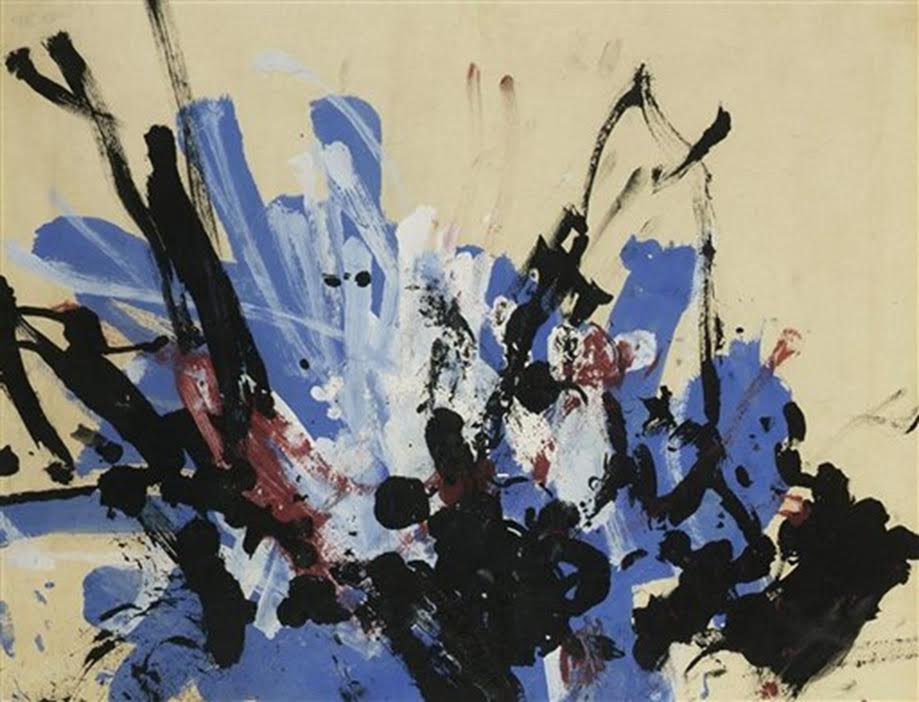
Congo, who began his art career the moment he happened to pick up a pencil, went on, writes the Telegraph’s Nigel Reynolds, to become “a television celebrity in the late 1950s as the star of Zootime, an animal programme presented from the London Zoo by Desmond Morris, the zoologist and anthropologist. He became even more of a cause célèbre when the Institute of Contemporary Arts mounted a large exhibition of his work in 1957.
Critics had a field day and debate about the meaning of art raged furiously.” You can see Morris, a surrealist painter himself, in addition to his zoological, anthropological, and televisual work, interacting with Congo in the 1950s and reflecting on the place of the chimpanzee artist in his own career in the clip at the top of the post. The newsreel below covers an exhibition called The Young Idea, which featured paintings not just from Congo but from such Marla Olmstead predecessors as three-year-old Timothy Vaughn and eighteen-month-old Graham Phillips. One of Congo’s paintings appears above.
And so to the obvious question: But Is It Art? And assuming it is, writes John Valentine in The Philosopher, “what then follows from such a classification? What sort of difference does it or should it make in the way we approach and appreciate chimpanzee paintings? If they are art, what sort of critical or interpretive discourse about them should we engage in? Do we simply appreciate the lines, colours, and forms of Congo’s paintings and stop at that? Does it make any difference that the paintings were done by a member of a different species? Should species differences make any difference in artistic value?” It may not, at least commercially speaking: Congo may have had his moment six decades ago, but don’t think that means his work will come cheap; back in 2005, some of his paintings went up on the auction block and fetched more than $25,620.
Based in Seoul, Colin Marshall writes and broadcasts on cities and culture. He’s at work on a book about Los Angeles, A Los Angeles Primer, the video series The City in Cinema, and the crowdfunded journalism project Where Is the City of the Future? Follow him on Twitter at @colinmarshall or on Facebook.
Read More...A Comic Book Adaptation of Edgar Allan Poe’s Poignant Poem, Annabel Lee
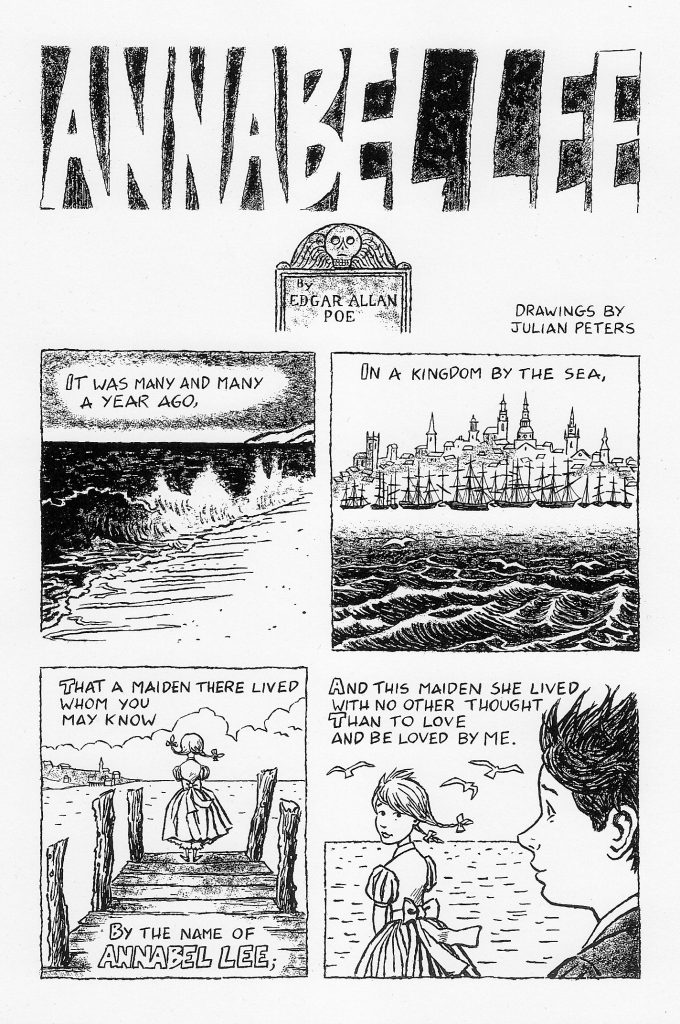
We’ve highlighted the comic art of Montreal-based Julian Peters before on Open Culture. He’s the man who undertook a 24-page illustrated adaptation of T.S. Eliot’s “The Love Song of J. Alfred Prufrock” and then also delivered a manga version of W. B. Yeats’ “When You Are Old,” recreating the style of Japanese romance comics to a T.
While studying in a Masters program early examples of literary graphic novels, Peters is also turning into a fine illustrator of poetry whether classic (Rimbaud, Keats) or contemporary (teaming up with John Philip Johnson on an upcoming book of illustrated poems, one of which you can find here.)
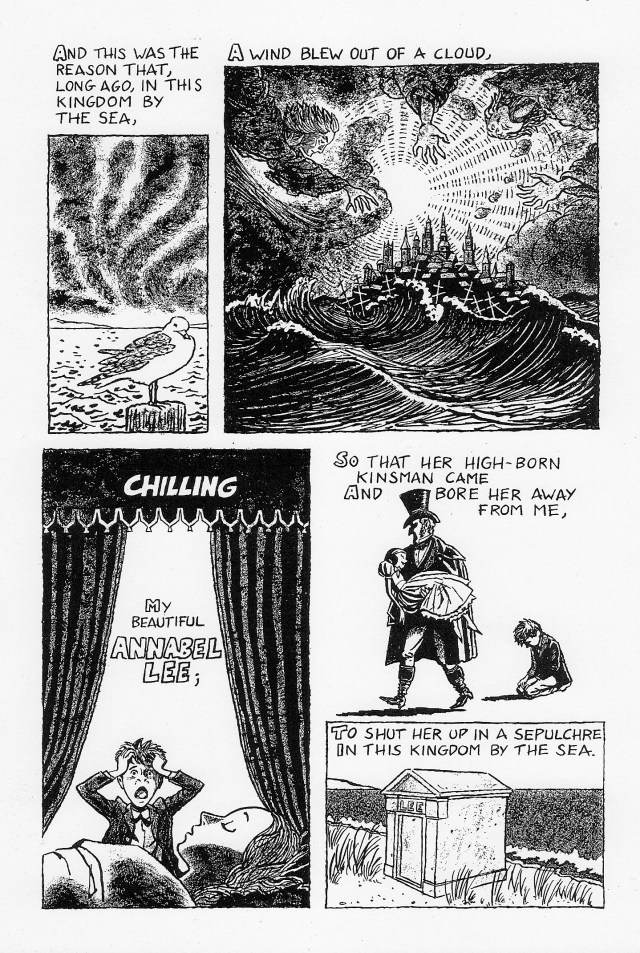
This adaptation (above) of Edgar Allan Poe’s “Annabel Lee” dates from 2011. Poe’s work gives illustrators narrative aplenty, but it also gives them repetition and ellipses. In his rendition, Peters gives us two pre-teen sweethearts similar to Tom Sawyer and Becky Thatcher, and when Annabel Lee dies from “the wind that came out of the cloud by night,” we get a full panel of Annabel’s final healthy moments. Wind is everywhere to be found in the comic, forming white caps on the ocean, and blowing Annabel’s pigtails when we first see her.
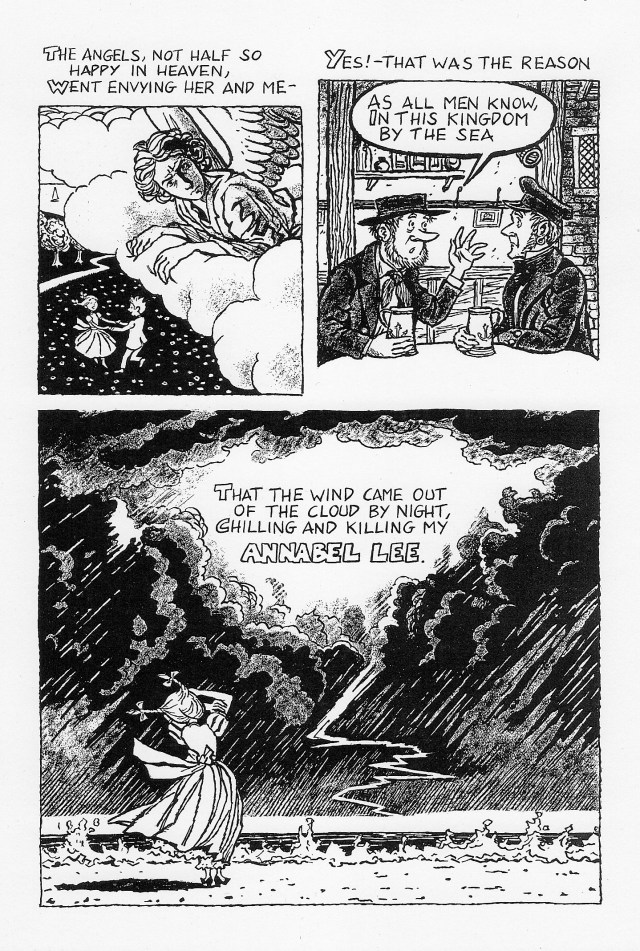
Scholars tend to agree that “Annabel Lee” was based on Poe’s first cousin and teen bride Virginia Clemm, whom he married when she was 13 (and Poe was 27), but who passed away from tuberculosis at 24 years of age. The image of the beautiful corpse continues through his work from “The Raven” to “Ligeia”.
You can find the first few panels of Peters’ adaptation above. Read the rest here.
Related content:
Bob Dylan Reads From T.S. Eliot’s Great Modernist Poem The Waste Land
Watch the 1953 Animation of Edgar Allan Poe’s “The Tell-Tale Heart,” Narrated by James Mason
Ted Mills is a freelance writer on the arts who currently hosts the FunkZone Podcast. You can also follow him on Twitter at @tedmills, read his other arts writing at tedmills.com and/or watch his films here.
Read More...An Interactive Timeline Covering 14 Billion Years of History: From The Big Bang to 2015
For his final project in Bezalel Academy of Arts and Design in Jerusalem, Matan Stauber created Histography, an interactive timeline that covers 14 billion years of history. The timeline, writes Stauber, “draws historical events from Wikipedia, and it self-updates daily with new recorded events.” And the interface lets users see history in smaller chunks (decades at a time) or bigger ones (millions of years at a time). To get a vague feel for how Histography works, you can watch the video above. But really the best way to experience things is to dive right in here.
Follow Open Culture on Facebook and Twitter and share intelligent media with your friends. Or better yet, sign up for our daily email and get a daily dose of Open Culture in your inbox. And if you want to make sure that our posts definitely appear in your Facebook newsfeed, just follow these simple steps.
Related Content:
An Interactive Map of Odysseus’ 10-Year Journey in Homer’s Odyssey
The History of Modern Art Visualized in a Massive 130-Foot Timeline
Big History: David Christian Covers 13.7 Billion Years of History in 18 Minutes
Free Online History Courses
Read More...NASCAR Meets the Paranormal in Terry Gilliam’s Short Film, The Legend of Hallowdega
I think we here at Open Culture can freely own up to a deficiency in our content: despite its outsized presence in American culture, we’ve really neglected to post much about NASCAR. Luckily, film director, animator, and Monty Python member Terry Gilliam has given us reason to change our ways by shooting a short film at Alabama’s Talladega Superspeedway, one of the best-known venues for NASCAR races. But The Legend of Hallowdega, made to promote something called AMP Energy Juice, tells not a straight (or rather, constantly left-turning) story about racing, but adds another layer of intrigue: the paranormal.
That might sound like a random conceptual mashup, but a little bit of research reveals Talladega as a regular Overlook Hotel, what with its history of mysterious compulsions, freak injuries and deaths, and unexplained acts of sabotage. (Some even chalk all this up to a curse placed on the Talladega’s valley by its original Native American inhabitants, driven out for their collaboration with Andrew Jackson.) Enter tattooed, Fu-Manchu’d, bead-festooned ghost hunter Kiyash Monsef, here to answer the question, “What is the truth? And what is truer that the truth?” — the words of the khaki-wrapped host of World of the Unexplained, the fictitious, highly sensationalistic, and not especially competent television show that frames The Legend of Hallowdega’s story.
Nothing in the first few minutes of the film gives it away as a Terry Gilliam project, but as soon as it enters Monsef’s elaborate yet makeshift, thoroughly analog lair — located underneath Talladega itself — the famously imaginative director starts making his touch apparent. We could easily dismiss David Arquette’s performance as Monsef as over-the-top, but to many of us, he surely comes off as no more unfamiliar than some of the locals providing their own testimony about the curse in the interview segments. Where has the oft-lamented “old, weird America” gone? In (the American-born but British-naturalized and thus sufficiently distanced) Terry Gilliam’s eyes, it lives on, especially in places like Talladega.
Related Content:
Terry Gilliam Reveals the Secrets of Monty Python Animations: A 1974 How-To Guide
Terry Gilliam’s Lost Animations from Monty Python and the Holy Grail Are Now Online
Watch Terry Gilliam’s Animated Short, The Christmas Card (1968)
4,000+ Free Movies Online: Great Classics, Indies, Noir, Westerns, Documentaries & More
Colin Marshall writes elsewhere on cities, language, Asia, and men’s style. He’s at work on a book about Los Angeles, A Los Angeles Primer, the video series The City in Cinema, and the crowdfunded journalism project Where Is the City of the Future? Follow him on Twitter at @colinmarshall or on Facebook.
Read More...Support Us
We're hoping to rely on loyal readers, rather than erratic ads. Please click the Donate button and support Open Culture. You can use Paypal, Venmo, Patreon, even Crypto! We thank you!

About Us

Open Culture scours the web for the best educational media. We find the free courses and audio books you need, the language lessons & educational videos you want, and plenty of enlightenment in between.
Advertise With Us

FREE UPDATES!
GET OUR DAILY EMAIL
Get the best cultural and educational resources on the web curated for you in a daily email. We never spam. Unsubscribe at any time.
FOLLOW ON SOCIAL MEDIA

Open Culture editor Dan Colman scours the web for the best educational media. He finds the free courses and audio books you need, the language lessons & movies you want, and plenty of enlightenment in between.
Advertise With Us


