A 103-Year-Old Harlem Renaissance Dancer Sees Herself on Film for the First Time & Becomes an Internet Star
The Harlem Renaissance lives in the form of Alice Barker, a soft spoken lady who just last week received a belated Happy 103rd Birthday card from the Obamas.
That’s her on the right in the first clip, below. She’s in the back right at the 2:07 mark. Perched on a lunch counter stool, showing off her shapely stems at 9:32.
Barker’s newfound celebrity is an unexpected reward for one who was never a marquee name.
She was a member of the chorus—a pretty, talented, hardworking young lady, whose name was misspelled on one of the occasions when she was credited. She danced throughout the 1930s and 40s in legendary Harlem venues like the Apollo, the Cotton Club, and the Zanzibar Club. Shared the stage with Frank Sinatra, Gene Kelly, and Bill “Bojangles” Robinson. Racked up a number of film, commercial and TV credits, getting paid to do something she later confided from a nursing home bed she would have gladly done for free.
Barker’s chorus girl days had been mothballed for decades when she crossed paths with video editor David Shuff, a volunteer visitor to the nursing home where she lives. Shuff seems to be a kindred spirit to the writer David Greenberger, whose Duplex Planet zines—and later books, comics, and performances—captured the stories (and personalities) of the elderly residents of a Boston nursing home where he served as activities director.
Intrigued by glimmers of Barker’s glamorous past, Shuff joined forces with recreational therapist Gail Campbell, to see if they could truffle up any evidence. Barker herself had lost all of the photos and memorabilia that would have backed up her claims.
Eventually, their search led them to historians Alicia Thompson and Mark Cantor, who were able to identify Barker strutting her stuff in a handful of extant 1940s jukebox shorts, aka “soundies.”
Though Barker had caught herself in a couple of commercials, she had never seen any of her soundie performances. A friend of Shuff’s serendipitously decided to record her reaction to her first private screening on Shuff’s iPad. The video went viral as soon as it hit the Internet, and suddenly, Barker was a star.
The loveliest aspect of her late-in-life celebrity is an abundance of old fashioned fan mail, flowers and artwork. She also received a Jimmie Lunceford Legacy Award for excellence in music and music education.
Fame is heady, but seems not to have gone to Barker’s, as evidenced by a remark she made to Shuff a couple of months after she blew up the Internet, “I got jobs because I had great legs, but also, I knew how to wink.”
Shuff maintains a website for fans who want to stay abreast of Alice Barker. You can also write her at the address below:
Alice Barker
c/o Brooklyn Gardens
835 Herkimer Street
Brooklyn, NY11233
Related Content:
A 1932 Illustrated Map of Harlem’s Night Clubs: From the Cotton Club to the Savoy Ballroom
Ayun Halliday is an author, illustrator, and Chief Primatologist of the East Village Inky zine. Her play, Fawnbook, is running through November 20 in New York City. Follow her @AyunHalliday
Read More...Download the Software That Provides Stephen Hawking’s Voice

Creative Commons image via NASA
Ah to be possessed of a highly distinctive voice.
Actress Katherine Hepburn had one.
As did FDR…
And noted Hollywood Square Paul Lynde…
Physicist Stephen Hawking may trump them all, though his famously recognizable voice is not organic. The one we all associate with him has been computer generated since worsening Amyotrophic lateral sclerosis, aka Lou Gehrig’s disease, led to a tracheotomy in 1985.
Without the use of his hands, Hawking controls the Assistive Context-Aware Toolkit software with a sensor attached to one of his cheek muscles.
Recently, Intel has made the software and its user guide available for free download on the code sharing site, Github. It requires a computer running Windows XP or above to use, and also a webcam that will track the visual cues of the user’s facial expressions.
The multi-user program allows users to type in MS Word and browse the Internet, in addition to assisting them to “speak” aloud in English.
The software release is intended to help researchers aiding sufferers of motor neuron diseases, not pranksters seeking to borrow the famed physicist’s voice for their doorbells and cookie jar lids. To that end, the free version comes with a default voice, not Professor Hawking’s.
Download the Assistive Context-Aware Toolkit (ACAT) here.
Related Content:
Stephen Hawking’s Big Ideas Explained with Simple Animation
Stephen Hawking’s Universe: A Visualization of His Lectures with Stars & Sound
Ayun Halliday is an author, illustrator, and Chief Primatologist of the East Village Inky zine. Her play, Fawnbook, is currently playing in New York City. Follow her @AyunHalliday
Read More...The Night John Lennon & Yoko Ono Jammed with Frank Zappa at the Fillmore East (1971)
It’s unfortunate, I think, that legions of Beatles fans turned on Yoko Ono with such ferocious animosity after the breakup of the band. Most fans still absolutely despise Yoko. (See the legion of often crudely misogynist comments under every Youtube video in which she appears.) Sure, her voice and music is certainly not to everyone’s taste, but without her artistic and conceptual influence on John Lennon post-Beatles, it’s unlikely his amazing solo albums John Lennon/Plastic Ono Band (1970) and Imagine (1971) would sound the way they do. Yoko, in fact, more or less gave Lennon the seeds of “Imagine,” the song, in her quirky 1964 self-published book, Grapefruit: A Book of Instructions and Drawings, though she never took the credit for it.
Like it or not, if we love solo Lennon, we have no choice but to take the more traditionally great songwriting with the messy, experimental, and sometimes unlistenable. They cannot be completely untangled, to the dismay of a great many people. As Damian Fanelli at Guitar World comments on Lennon and the Plastic Ono Band’s impromptu performance/jam with Eric Clapton in Toronto in 1969, “Yoko screams—very loudly—during the entire otherwise-decent performance.” This is not an exaggerated or especially biased characterization. “Someday,” Fanelli then goes on, “I’ll vent about how terrible and depressing this is.” Fine, but whether we think of her singing as challenging performance art or “depressing” caterwauling, we’re stuck with it. But do the dynamics of John and Yoko onstage change when we add another polarizing weirdo—Frank Zappa—to the mix? See for yourself in the videos here, from an onstage jam session the two did with Zappa and the Mothers of Invention at the Fillmore East in 1971.
See Zappa, Lennon, et al. do Walter Ward’s “Well (Baby Please Don’t Go),” which Fanelli declares “the highlight of the jam, for sure.” Zappa announces to the band the key and “not standard blues changes,” then Lennon introduces the tune as “a song I used to sing while I was in the Cavern in Liverpool. I haven’t done it since.” Zappa rips out a fantastic solo and the band—though seemingly in the dark at first—lays down a righteous groove. And Yoko? Well, it’s true, as Fanelli notes, “all she did was scream her head off.” In this straight-ahead blues number, I have to say, it’s pretty obnoxious. But her vocal tics play much better in more freeform, oddball, Zappa-lead jams like “Jamrag” and “King Kong,” and the shouty, repetitive “Scumbag,” which sounds almost like a Can outtake.
Zappa and band, as always, are in top form. Lennon at times looks out of place and uncertain in their improvisatory environment, but he gamely keeps up. Yoko… Yoko does her usual lot of screaming, howling, yodeling, etc. But before you gin up to tear her to pieces in yet another nasty online comment, bear in mind, for what it’s worth, no Yoko, no “Imagine.”
As Fanelli notes, “the performance was released as part of Lennon and Ono’s poorly received (and not very good at all) 1972 studio/live album, Sometime in New York City.” See Allmusic’s review for a much more thorough, fair-minded assessment of that recording, which “found the Lennons in an explicitly political phase.”
Related Content:
The Night Frank Zappa Jammed With Pink Floyd … and Captain Beefheart Too (Belgium, 1969)
Download the John Lennon/Yoko Ono “War is Over (If You Want It)” Poster in 100+ Languages
Hear John Lennon’s Final Interview, Taped on the Last Day of His Life (December 8, 1980)
Josh Jones is a writer and musician based in Durham, NC. Follow him at @jdmagness
Read More...Listen to Ira Glass’ 10 Favorite Episodes of This American Life
Even when one is a longtime, jaded denizen of a major city, celebrity sightings can still induce a thrill. During my tenure in New York City, I ran across my share of famous names, though I’ve never been one to bother a stranger, world famous or no. This almost changed when I ran past Ira Glass one evening and found myself sorely tempted to chat him up. I’m sure he’d be glad I resisted the urge, but having heard his voice on the radio every week for well over a decade… well, I felt like I knew him.
Since 1995, Glass has hosted This American Life, perhaps the most popular public radio show ever produced and—before its hugely successful spin-off Serial—the most popular podcast in the U.S. The show is quickly approaching its twenty-year anniversary (its first episode aired November 17th; hear it here), and in honor of that milestone, we revisit another: the show’s 500th episode, which aired in 2013. For that occasion, Buzzfeed visited with Glass for a revealing interview.
Though he responded to episode 500 with typical understatement—saying it felt “more like an odometer rolling over than anything else”—many fans of the show, myself included, felt a great deal more enthusiasm, as did Los Angeles’ KPCC, who brings us the list below of Glass’ top ten episodes (including one two-parter). Glass noted that his top picks also happen to be fan favorites as well. You can hear all of his favorites at the links below:
- Notes on Camp
- Harper High School One and Two
- The Giant Pool of Money
- Somewhere in the Arabian Sea — “I love how funny and human-sized everyone is in this show. It’s a surprisingly funny show about the war on terror,” Glass writes.
- Switched at Birth — Glass: “The structure of this show — where the whole episode you wonder how a mom could know for decades she was raising the wrong baby and finally, she answers it in the end — is perfect.”
- Break-Up — “The standout story is Starlee Kine’s essay on breakup songs, which includes an interview with Phil Collins that’s so menschy and real, it changed how I saw him forever.”
- Babysitting — “Especially the interview with Myron Jones, which is the best interview I’ve ever done, mainly because he had so much grace and humor talking about his past. Any question I could think of, he’d come back with an amazing story, which is rare.”
- My Big Break — “David Segal takes a turn in the middle of this story that’s one of my favorite reveals in any radio story ever.”
- Harold Washington — “How can you go wrong when the central figure in your story is funny and cantankerous and bighearted and idealistic and utterly pragmatic and on top of all that, totally charismatic? If you don’t know who Harold is, be prepared for a treat.”
- Heretics — “Carlton Pearson, like Harold, is someone they should make a movie about, for lots of the same reasons. An idealistic preacher whose idealism costs him pretty much everything: the church he runs, his reputation, his fortune, nearly his family.”
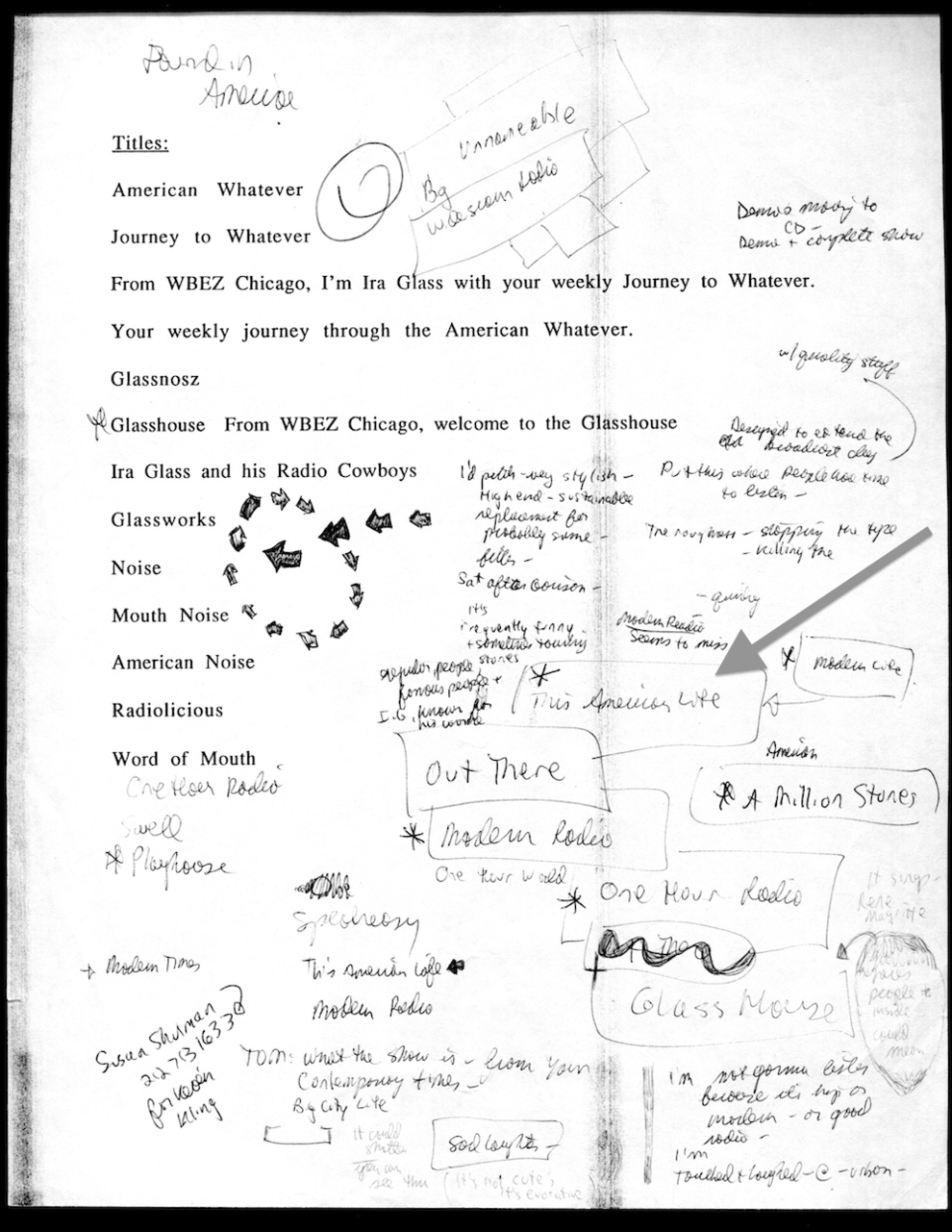
As a special treat, Glass also shared with Buzzfeed the document at the top of the post, a page of ideas for alternate titles for the show originally called Your Radio Playhouse. Before renaming the show in March of 1996, Glass and his crew considered such titles as the uninspiring “American Whatever,” weird “Mouth Noise,” and goofy “Ira Glass and his Radio Cowboys.”
I kind of wish they’d gone with the latter, but it’s hard to imagine the show we know as This American Life could ever have been called anything else. (See it penciled in almost as an afterthought above.) The show’s title perfectly sums up the breadth and scope of a program that tackles everything from the trivial to the highly consequential, often back-to-back in the same themed hour. Though Glass would surely balk at such high praise, I think his show has done more to help Americans know and understand ourselves over the last twenty years than nearly anything else on radio, TV, or the podcasting world.
Related Content:
Ira Glass on the Art and Craft of Telling Great Radio Stories
This American Life Demystifies the American Healthcare System
Josh Jones is a writer and musician based in Durham, NC. Follow him at @jdmagness
Read More...Watch “The Poetry of Perception”: Harvard Animates Walt Whitman, Emily Dickinson & William Carlos Williams
Two years ago, a series of animated science videos began to pop up on a Vimeo account called HarvardX Neuroscience. As its name suggests, it’s coming out of Harvard University, and, with the help of animators, they originally created a series of scientific shorts pitched between the layman and the serious scientist. In the last month, however, they’ve stepped further into the arts realm with a mini-series of animations (five and counting as of this writing) that look to poetry to explain what science renders dry and academic.
The new video series features “representations of perception and sensation” as realized through the poems of Walt Whitman, America’s great transcendentalist poet, Emily Dickinson, and William Carlos Williams (whose own reading is used as the audio for a video). Opening all the senses to the wonders of the world is “the origin of all poems” according to Whitman, and this curation focuses on smell, taste, sight, touch, and sound to prove his point.
The readers you hear in this videos, collectively entitled Poetry of Perception, include poet/artist Peter Blegvad, Anna Martine, Harvard’s own Sarah Jessop, and artist/animator Nak Yong Choi. And the animations are brought to you by Sophie Koko Gate, Hannah Jacobs, Lily Fang, Isaac Holland, Brian Smee, all who bring a tactile, mutable quality to these short poems.
There will be another three videos in the series, so please bookmark the Vimeo account.
Related Content:
Walt Whitman’s Poem “A Noiseless Patient Spider” Brought to Life in Three Animations
William Carlos Williams Reads His Poetry (1954)
Marilyn Monroe Reads Walt Whitman’s Leaves of Grass (1952)
The Second Known Photo of Emily Dickinson Emerges
Ted Mills is a freelance writer on the arts who currently hosts the artist interview-based FunkZone Podcast. You can also follow him on Twitter at @tedmills, read his other arts writing at tedmills.com and/or watch his films here.
Read More...55 Covers of Vintage Philosophy, Psychology & Science Books Come to Life in a Short Animation
We all know that toys come alive at night, but what about mid-century vintage paperback covers, such as you might find in the psychology or philosophy sections of a dimly-lit used bookstore?
Watching 55 minimalist covers from graphic and motion designer Henning M. Lederer’s 2200 title-strong collection begin to spin, drift, and seethe in the short animation above, I got the impression that they were the ones dictating the terms. Or perhaps Lederer is the vessel through which the intentions of the original designers—Rudolph de Harak and John + Mary Condon to name a few—flow. Covers is not an act of reimagination or crowd-pleasing irreverence, but rather one logical motion, elegantly applied.
Habitués of used bookstores may find their usual browsing habits slightly altered by the hypnotic results.
Lederer makes no bones about judging books by their covers. Strong graphics, not content, are the primary determining factor as to which titles he acquires. The stately geometrics set in motion here are relics from another age, but the uncluttered abstracts so favored by 60s era publishers are not the only genre to catch his eye.
Shame Drifter, Dusky Desire, and Sinsurance are some of the decidedly non-minimalist titles spicing up his collection’s online gallery. After all of those arrows, angles, and spheres, Lederer might have craved animating something with a bit more…personality.
Related Content:
Free Online Philosophy Courses
Artist Animates Famous Book Covers in an Elegant, Understated Way
Illustrations for a Chinese Lord of the Rings in a Stunning “Glass Painting Style”
Lolita Book Covers: 100+ Designs From 37 Countries (Plus Nabokov’s Favorite Design)
83 Years of Great Gatsby Book Cover Designs: A Photo Gallery
Free Online Psychology Courses
Ayun Halliday is an author, illustrator, and Chief Primatologist of the East Village Inky zine. Her post-digital, pre apocalyptic dark comedy, Fawnbook, is now playing in New York City. Follow her @AyunHalliday
Read More...Hear Sylvia Plath Read 50+ of Her Dark, Compelling Poems
No matter how casual a relationship you’ve had with 20th-century American poetry, you’ve heard the name Sylvia Plath. Maybe you’ve already dared to experience her dark but compelling literary world, or maybe you just know a few of the basic elements of her life and career: her autobiographical novel The Bell Jar, her famously harrowing poetry collection Ariel, her stormy marriage to British poet laureate Ted Hughes, her death by her own hand at the age of thirty. But what better day than today, the 83rd anniversary of Plath’s birth, to get better acquainted with her work?
And what better way than to hear that work read in Plath’s own voice? Sure, you could just pick up one of the many yellowed mass-market paperback copies of Ariel you see on bookshelves all across America and plunge in, but you might first consider turning to our archives, which contain a 2013 post in which we featured Plath reading fifteen poems that would appear in the Ariel collection that, published two years after her death (“left sitting on the kitchen table to be found along with her body,” noted Josh Jones), would raise her poetic reputation to new heights. You can hear the first part of these readings, recorded in 1962, at the top of this post, and the rest at this original post.
We might feel lucky that, in her short life, she left even those performances for posterity, but there’s more: last year, we featured Sylvia Plath reading her poetry, the 1977 record released by pioneering pre-audiobook label Caedmon which contains 23 poems Plath committed to tape as early as 1959. Find all of the readings here.
If these two audio collections give you a taste for the poet biographer Carl Rollyson called “the Marilyn Monroe of modern literature,” have a listen to Credo Records’ album Sylvia Plath, which offers some material you’ll have heard alongside some you won’t have. Having listened to all this, you’ll hardly associate the adjective “celebratory” with Plath’s work — but that doesn’t mean that, on what would have been her 83rd birthday, poetry-lovers can’t celebrate it.
If you would like to support the mission of Open Culture, consider making a donation to our site. It’s hard to rely 100% on ads, and your contributions will help us continue providing the best free cultural and educational materials to learners everywhere. You can contribute through PayPal, Patreon, and Venmo (@openculture). Thanks!
Related Content:
Hear Sylvia Plath Read Fifteen Poems From Her Final Collection, Ariel, in 1962 Recording
The Art of Sylvia Plath: Revisit Her Sketches, Self-Portraits, Drawings & Illustrated Letters
Sylvia Plath Reads Her Poetry: 23 Poems from the Last 6 Years of Her Life
Sylvia Plath, Girl Detective Offers a Hilariously Cheery Take on the Poet’s College Years
Colin Marshall writes elsewhere on cities, language, Asia, and men’s style. He’s at work on a book about Los Angeles, A Los Angeles Primer, the video series The City in Cinema, and the crowdfunded journalism project Where Is the City of the Future? Follow him on Twitter at @colinmarshall or on Facebook.
Read More...Mr. Rogers Goes to Congress and Saves PBS: Heartwarming Video from 1969
What kind of delusional self-aggrandizer, called to testify before a United States Senate Subcommittee, uses it as an opportunity to quote the lyrics of a song he’s written… in their entirety!?
Sounds like the work of a certain rapper/prospective political candidate or perhaps some daffy buffoon as brought to life by Ben Stiller or Will Ferrell.
Only children’s television host Fred Rogers could pull such a stunt and emerge unscathed, nay, even more beloved, as he does above in documentary footage from 1969.
Mister Rogers’ impulse to recite What Do You Do With the Mad That You Feel to then-chairman of the Subcommittee on Communications, Senator John Pastore, was ultimately an act of service to the Corporation for Public Broadcasting and its child viewers.
Newly elected President Richard Nixon opposed public television, believing that its liberal bent could only undermine his administration. Determined to strike first, he proposed cuts equal to half its $20 million annual operating budget, a measure that would have seriously hobbled the fledgling institution.
Mr. Rogers appeared before the Committee armed with a “philosophical statement” that he refrained from reading aloud, not wishing to monopolize ten minutes of the Committee’s time. Instead, he sought Pastore’s promise that he would give it a close read later, speaking so slowly and with such little outward guile, that the tough nut Senator was moved to crack, “Would it make you happy if you did read it?”
Rather than taking the bait, Rogers touched on the ways his show’s budget had grown thanks to the public broadcasting model. He also hipped Pastore to the qualitative difference between frenetic kiddie cartoons and the vastly more thoughtful and emotionally healthy content of programming such as his. Mr. Roger’s Neighborhood was a place where such topics as haircuts, sibling relationships, and angry feelings could be discussed in depth.
Rogers’ emotional intelligence seems to hypnotize Pastore, whose challenging front was soon dropped in favor of a more respectful line of questioning. By the end of Rogers’ heartfelt, non-musical rendition of What Do You Do… (it’s much peppier in the original), Pastore has goosebumps, and the Corporation for Public Broadcasting has its 2 mil’ back in the bag.
What do you do with the mad that you feel
When you feel so mad you could bite?
When the whole wide world seems oh, so wrong…
And nothing you do seems very right?
What do you do? Do you punch a bag?
Do you pound some clay or some dough?
Do you round up friends for a game of tag?
Or see how fast you go?
It’s great to be able to stop
When you’ve planned a thing that’s wrong,
And be able to do something else instead
And think this song:
I can stop when I want to
Can stop when I wish.
I can stop, stop, stop any time.
And what a good feeling to feel like this
And know that the feeling is really mine.
Know that there’s something deep inside
That helps us become what we can.
For a girl can be someday a woman
And a boy can be someday a man.
Related Content:
Mr. Rogers Takes Breakdancing Lessons from a 12-Year-Old (1985)
Puppet Making with Jim Henson: A Priceless Primer from 1969
Ayun Halliday’s new play, Fawnbook, debuts as part of the Bad Theater Festival in NYC tomorrow night. Follow her @AyunHalliday
Read More...David Lynch Draws a Map of Twin Peaks (to Help Pitch the Show to ABC)
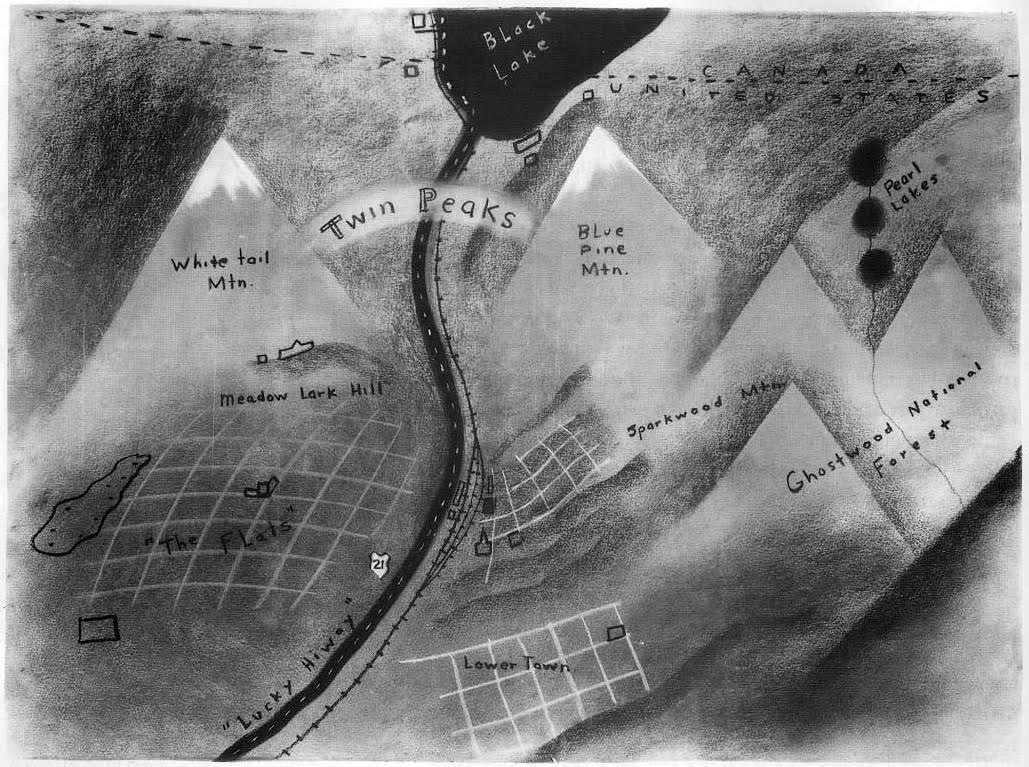
“How did this even get on the air?” Both the die-hard fans and bewildered haters asked that question about Twin Peaks, David Lynch and Mark Frost’s surreal television drama that famously aired on ABC primetime in 1990 and 1991. That such an unconventional vision — and one realized, at least throughout the first season, with such thorough commitment — ever made it to the mainstream airwaves now seems like a historical achievement in and of itself. So how, given the stultifying rigors of the entertainment industry, did Lynch and Frost actually sell this package of cryptic dreams, backward speech, small-town savagery, a murdered homecoming queen, and damn fine cherry pie?
First, Lynch drew a map. Knowing that no TV executive would understand Twin Peaks without understanding Twin Peaks, the fictional Washington town which gives the story its setting and title, he drew what you see above. Nigel Holmes included it in his out-of-print Pictorial Maps, commenting that “the peaks of the title, and the town they name, are clearly visible as white-topped mountains rising out of the modeled landscape.
By creating a sense of place, Lynch made the town all the more believable. A straightforward map would have been dull by comparison and might have suggested that there was something intrinsically interesting about the geography of the place. What was much more important to convey was the mood of the story, and it’s nicely captured in Lynch’s quirky drawing.”
The book also includes a quote from Lynch himself, on the utility of the map: “We knew where everything was, and it helped us decide what mood each place had, and what could happen there. Then the characters just introduced themselves to us and walked into the story.” As any Twin Peaks fan will notice, the map identifies a host of locations referenced in the show, such as White Tail and Blue Pine mountains (the peaks themselves), Ghostwood National Forest, and Lucky Highway 21. But “can you locate Sparkwood and 21, One-Eyed Jack’s and The Great Northern?” asks fan site Welcome to Twin Peaks. And if the much-discussed 21st-century Twin Peaks revival comes to fruition, will it dust off this trusty reference document and revive the askew but deep sense of place we (or at least some us) savored the first time around?
Related Content:
David Lynch’s Twin Peaks Title Sequence, Recreated in an Adorable Paper Animation
Play the Twin Peaks Video Game: Retro Fun for David Lynch Fans
Elementary School Students Perform in a Play Inspired by David Lynch’s Twin Peaks
Colin Marshall writes elsewhere on cities, language, Asia, and men’s style. He’s at work on a book about Los Angeles, A Los Angeles Primer, the video series The City in Cinema, and the crowdfunded journalism project Where Is the City of the Future? Follow him on Twitter at @colinmarshall or on Facebook.
Read More...A Fittingly Strange Animation of What’s Going On Inside Charles Manson’s Mind
In 1968, Charles Manson listened to The Beatles’ White Album and came away thinking that America was on the verge of an apocalyptic race war between whites and blacks. As Manson imagined it, the race war would be triggered by a shocking, chaotic event called “Helter Skelter” — a named borrowed from a song on the White Album. And, like most megalomaniacs, Manson put himself at the center of the drama. In the summer of 1969, Manson had members of his cult commit a series of infamous murders in Southern California, hoping that African-Americans would be blamed and the race war would begin. Instead, a lengthy police investigation led to Manson’s arrest on December 2, 1969 and his conviction soon thereafter, making him then, and now, one of America’s notorious inmates.
Through the 1980s, Manson, even though behind bars, remained a very public figure, giving high profile interviews to Tom Snyder, Charlie Rose, and Geraldo Rivera. But then, he began to fade from view, for whatever reasons. For the past 20 years, we haven’t heard much from him. Until this came along. Above, you can watch Leah Shore’s animation of never-before-heard phone conversations between Charles Manson and Marlin Marynick (who later published a best-selling biography called Charles Manson Now). Fittingly strange, the animation reminds us of the very odd things going on inside Manson’s mind. Off kilter as ever, he goes in all kinds of unexpected directions.
Related Content:
The Time Neil Young Met Charles Manson, Liked His Music, and Tried to Score Him a Record Deal
Timothy Leary’s Wild Ride and the Folsom Prison Interview
Read More...Support Us
We're hoping to rely on loyal readers, rather than erratic ads. Please click the Donate button and support Open Culture. You can use Paypal, Venmo, Patreon, even Crypto! We thank you!

About Us

Open Culture scours the web for the best educational media. We find the free courses and audio books you need, the language lessons & educational videos you want, and plenty of enlightenment in between.
Advertise With Us

FREE UPDATES!
GET OUR DAILY EMAIL
Get the best cultural and educational resources on the web curated for you in a daily email. We never spam. Unsubscribe at any time.
FOLLOW ON SOCIAL MEDIA

Open Culture editor Dan Colman scours the web for the best educational media. He finds the free courses and audio books you need, the language lessons & movies you want, and plenty of enlightenment in between.
Advertise With Us

