Free Today: Watch Online the Pioneering Films of the Late Chantal Akerman
Those who watch and dislike Chantal Akerman’s best-known film, Jeanne Dielman, 23 quai du Commerce, 1080 Bruxelles, often complain that “nothing happens” in it. But in my experience of introducing it — nay, evangelizing for it — to friends, it usually only takes a solid viewing or two of that 1975 three-hour-and-twenty-minute tale of a Belgian single mother’s days and nights spent cooking (a short clip of which you can see above), cleaning, and possibly engaging in prostitution to feel — or at least in the immediate aftermath of viewing, feel — that in no movie but Jeanne Dielman, 23 quai du Commerce, 1080 Bruxelles does anything truly happen. Every other movie plays, by comparison, as if on fast-forward, or like a set of filmed Cliff’s Notes.
Clearly, Akerman saw, and realized, a wider storytelling potential in cinema than do most filmmakers. So much worse the loss, then, when she died earlier this month, leaving behind a filmography consisting of not just her early masterpiece Jeanne Dielman, which she directed at just 25 years of age, but a variety of feature films and shorts made between 1968 and this year. As a tribute, the cinephile-beloved home video company The Criterion Collection has, for a very limited time, made all of their Akerman films free to view on Hulu (unfortunately, for viewers in certain territories only), including 1978’s Les rendezvous d’Anna, embedded just above, 1972’s Hotel Monterey and La chambre, 1975’s Je tu il elle, 1976’s News from Home…
… and of course, Jeanne Dielman. If you plan to enjoy a free Akerman marathon on Hulu thanks to Criteron, you’d better do it soon, since they’ll only remain free to view through the next day. And do invite all your most cinematically adventurous friends to join your side, as with most auteur films, the interest that doesn’t lie in watching them lies in arguing about their merits afterward. You can hear one such fun conversation on a 2011 episode of The Criterioncast, a podcast dedicated to films released by the Criterion Collection, just above. It actually features yours truly as the special guest, discussing Jeanne Dielman with the regular panelists. Do you side with the likes of an Akerman partisan like me, or does your opinion most closely resemble one of the others who doesn’t take quite such a rich experience from their every viewing? Today, you can find out where you stand on this and other of Akerman’s fascinating works for free. And you can always find many more free films in our collection, 4,000+ Free Movies Online: Great Classics, Indies, Noir, Westerns, Documentaries & More.
Related Content:
An Ambitious List of 1400 Films Made by Female Filmmakers
120 Artists Pick Their Top 10 Films in the Criterion Collection
Slavoj Žižek Names His Favorite Films from The Criterion Collection
Colin Marshall writes elsewhere on cities, language, Asia, and men’s style. He’s at work on a book about Los Angeles, A Los Angeles Primer, the video series The City in Cinema, and the crowdfunded journalism project Where Is the City of the Future? Follow him on Twitter at @colinmarshall or on Facebook.
Read More...Terry Gilliam’s Lost Animations from Monty Python and the Holy Grail Are Now Online
This year marks the 40th anniversary of Monty Python and the Holy Grail and as the group has always been upfront about shamelessly milking their fans for cash, there’s a new version of the Blu-Ray out, and a new print touring the world. John Cleese and Eric Idle are currently also on an American tour, sharing the stage as a duo for the first time. Michael Palin has a book tour for the third volume of his diaries. Terry Jones is still working on movies and plugging charities on his Twitter stream. Terry Gilliam has an autobiography coming out this month. And Graham Chapman, despite his beautiful plumage, is still dead.
However, the Pythons are giving a few things away and one of them is the above compilation of unused animations by Gilliam from the Holy Grail. They can be found on the new Blu-Ray, but the group’s official Youtube channel is sharing them-—first with Gilliam’s commentary, then with sound effects—for free.
These animations are links between the skits that make up Holy Grail, and include dragons, giants, and a very large snail. Gilliam took a lot of the illustrations that he didn’t do himself from a book on illuminated manuscripts, and, seeing them all together in one go, one can imagine an alternative universe where the animator makes an entire movie this way. (On the commentary track, he half-jokingly describes himself as “the man who could have gone on to become a great animator but was forced into live action film.”)
As per Python, a lot of the commentary track berates the viewer for throwing money away on a redundant version of what the consumer probably owns, and how Gilliam isn’t getting paid enough to do this. (Cue some coinage sound effects and Gilliam gets back on mic.)
If this kind of archiving is going on, it would be interesting to know the status of Gilliam’s other animations for both Python and the various shows he did in the years running up to it. There are indeed some interesting early works out there that need a facelift.
As for Gilliam and the Holy Grail, he says he doesn’t watch it:
I’m glad it makes a lot of money and keeps me in the style I’ve grown accustomed to. But watch it again? Why? We’ve got lives to lead.
Related content:
Terry Gilliam Reveals the Secrets of Monty Python Animations: A 1974 How-To Guide
Monty Python and the Holy Grail Re-Imagined as an Epic, Mainstream Hollywood Film
Watch Terry Gilliam’s Animated Short, The Christmas Card (1968)
Ted Mills is a freelance writer on the arts who currently hosts the FunkZone Podcast. You can also follow him on Twitter at @tedmills, read his other arts writing at tedmills.com and/or watch his films here.
Read More...How to Sing Two Notes At Once (aka Polyphonic Overtone Singing): Lessons from Singer Anna-Maria Hefele
Last year we drew your attention to the video above from Munich-based singer Anna-Maria Hefele in which she gives us a stunning demonstration of polyphonic overtone singing. It’s a technique common to Tuva, Inuit, and Xhosa cultures but largely unfamiliar to us in Western music.
Many readers pointed out that Hefele’s fine example of her technique did not in fact show us how to do it, only that it could be done in a variety of different, all equally impressive, ways. Well, today, we bring you a series of lessons Hefele has posted as a response to her first video’s popularity. In each of these videos, she offers detailed instructions on how to harness the power of your voice to sing two notes at once.
Before beginning Hefele’s course, you may wish to get a more theoretical overview of how polyphonic singing works. For that purpose, the video above gives us a visual representation of the overtones in Hefele’s voice. As she demonstrates via spectrogram, her normal singing voice contains several tones at once already, which we typically hear as only one note. Similarly, ethnomusicologist and student of throat singing Mark van Tongeren explains at Smithsonian Folkways, “everyone continuously when you’re speaking [or singing] produces a whole spectrum of sound.” The throat singing method involves altering the voice to enhance overtones. Hefele uses some slightly different techniques to “filter,” as she puts it, specific tones in her voice.
The first introduction to the overtone filtering technique comes to us in Lesson 1 above. Hefele demonstrates how to move from tone to tone by gradually transitioning to different vowel sounds. She also teases the second and third lessons, below, which show how to amplify specific tones once you have isolated them. Hefele is a personable and engaging instructor—she would, I imagine, make an excellent language teacher as well—and her cheeky presentation takes us into the shower with her in Lesson 2, the best place, unsurprisingly, to practice your polyphonic overtone singing. And to hear how Hefele uses her vocal techniques in beautifully haunting, almost otherworldly music, make sure to watch this solo performance from 2012 or hear this Hildegard von Bingen choral composition adapted to Hefele’s polyphonic solo voice.
H/T Natalie in the UK
Related Content:
Watch Stephen Sondheim Teach a Kid How to Sing “Send In the Clowns”
Dutchman Masters the Art of Singing Led Zeppelin’s “Stairway to Heaven” Backwards
Josh Jones is a writer and musician based in Durham, NC. Follow him at @jdmagness
Read More...Inmates in New York Prison Defeat Harvard’s Debate Team: A Look Inside the Bard Prison Initiative
If you want to prepare for a career practicing law, you could do much worse than joining Harvard University’s debate team. But if, far on the other end of the spectrum of the American experience, you end up deep on the wrong side of the law, going to prison rather than college, you need not relinquish your dreams of excelling at this traditional intellectual sport. We now have the precedent to prove it: “Months after winning a national title,” reports the Guardian’s Lauren Gambino, “Harvard’s debate team has fallen to a group of New York prison inmates.”
“The showdown,” which revolved around the question of whether public schools should be allowed to turn away undocumented students, “took place at the Eastern correctional facility in New York, a maximum-security prison where convicts can take courses taught by faculty from nearby Bard College, and where inmates have formed a popular debate club.” They call this program the Bard Prison Initiative, under which inmates have the chance to earn a Bard College degree (through a non-vocational “liberal arts curriculum, including literature, foreign language, philosophy, history and the social sciences, mathematics, science, and the arts”) at satellite campuses established in six New York state prisons. You can see this selective, rigorous and highly unusual educational institution in action in the Washington Post video above. And also in a 2011 PBS News Hour profile below.
The Bard Prison Initiative’s debate victory over Harvard made for a notable event in the program’s history indeed. “But it’s also worth pointing out,” writes Peter Holley, author of the Post article, “the fallacy of our underlying assumptions about such a matchup — the first (and most pernicious) being that criminals aren’t smart. If a definitive link between criminality and below-average intelligence exists, nobody has found it.” The Bard Prison Initiative has operated on that premise since 2001, and its debate team’s previous high-profile win saw it beating that of West Point — all, you may hardly believe, through old-fashioned research, without any kind of access to the internet. If you’d like to leave your condolences for the Harvard College Debating Union, you may do so at their Facebook page. You can also make a worthwhile financial contribution to the Bard Prison Initiative here.
Related Content:
James Baldwin Debates Malcolm X (1963) and William F. Buckley (1965): Vintage Video & Audio
Norman Mailer & Marshall McLuhan Debate the Electronic Age
Clash of the Titans: Noam Chomsky & Michel Foucault Debate Human Nature & Power on Dutch TV, 1971
The Historic LSD Debate at MIT: Timothy Leary v. Professor Jerome Lettvin (1967)
1,700 Free Online Courses from Top Universities
Colin Marshall writes elsewhere on cities, language, Asia, and men’s style. He’s at work on a book about Los Angeles, A Los Angeles Primer, the video series The City in Cinema, and the crowdfunded journalism project Where Is the City of the Future? Follow him on Twitter at @colinmarshall or on Facebook.
Read More...The Great Leonard Nimoy Reads H.G. Wells’ Seminal Sci-Fi Novel The War of the Worlds
As you know if you saw our previous posts featuring Leonard Nimoy’s readings of stories by Ray Bradbury and Isaac Asimov, the late Star Trek icon could — unsurprisingly, perhaps — tell a science-fiction tale with the best of them. It turns out that he could also give masterful readings of science fiction from other eras too, as far back as the earliest works to define the genre, which we’ve discovered after hearing his performance of H.G. Wells’ The War of the Worlds, an out-of-print edition recently digitized from cassette tape and posted to Youtube in two parts.
With this story of Earth invaded from “across the gulf of space” by aliens with “minds that are to our minds as ours are to those of the beasts that perish, intellects vast and cool and unsympathetic,” Wells did much to help give science fiction the form we recognize today. The War of the Worlds came out in book form in 1898, preceded by such similarly speculative and innovative works as The Time Machine and The Invisible Man, and then followed by the likes of The First Men in the Moon and The Shape of Things to Come. (Find most of these works neatly packaged in the HG Wells Classic Collection.) This Leonard Nimoy recording originally came out in 1976, published by the record label Caedmon, known for doing plenty of innovation of their own in the then-yet-unnamed field of audiobooks.
Caedmon put out not just this album and the one with Nimoy reading Bradbury, but others featuring Kurt Vonnegut, Vincent Price, Tennessee Williams, T.S. Eliot, Ernest Hemingway, and Sylvia Plath. As much as science-fiction die-hards will enjoy hearing this pairing of Nimoy and Wells here, some will certainly want to track down the actual LP — not just for the collectors’ value, but because it features liner notes by none other than that other vastly influential creator of sci-fi as we know it, Isaac Asimov. It looks like there’s one used copy on Amazon. The reading, we should note, is an abridged version of the original text.
Related Content:
Isaac Asimov’s Favorite Story “The Last Question” Read by Isaac Asimov— and by Leonard Nimoy
Leonard Nimoy Narrates Short Film About NASA’s Dawn: A Voyage to the Origins of the Solar System
Colin Marshall writes elsewhere on cities, language, Asia, and men’s style. He’s at work on a book about Los Angeles, A Los Angeles Primer, the video series The City in Cinema, and the crowdfunded journalism project Where Is the City of the Future? Follow him on Twitter at @colinmarshall or on Facebook.
Read More...Watch Gandhi Talk in His First Filmed Interview (1947)
The Gandhi of history doesn’t line up with the Gandhi of legend, just as the beatified Mother Teresa presents a very different picture in certain astute critics’ estimation. But as with most saints, ancient and modern, people tend to ignore Gandhi’s many contradictions and troublingly racist and casteist views. He comes to us more as myth and martyr than deeply flawed human individual. An indispensable part of the mythmaking, Richard Attenborough’s 1982 biopic, Gandhi, may be “over-sanitized,” as The Guardian writes, but Ben Kingsley’s performance as the anti-colonial leader is genuinely “sublime” in his evocation of Gandhi’s “intensity… wit and even the distinctive, determined walk.” It’s these personal qualities—and of course Gandhi’s defeat of the largest empire on the planet with nonviolent action and a spiritual philosophy—that continue to inspire movements for justice and civil rights.
We see a little of that determined walk in the short newsreel interview above, the very first “talking picture” made of Gandhi, and we also hear his intensity and wit, though much subdued by his physical frailty after years of fasting. Taken in 1947 by Fox Movietone News, the film marks a pivotal period in the Indian leader’s life. Very shortly after this Parliament passed the Indian Independence Act. That year also marked the start of a bloody new struggle, instigated by another colonial intervention, as the British partitioned India into two warring countries, an act so poignantly dramatized in Salmon Rushdie’s Midnight’s Children.
This year of turmoil was also Gandhi’s last; he was assassinated in 1948 by a Hindu nationalist who accused him of siding with Pakistan. In the interview, we hear what we might think of as some of Gandhi’s final public pronouncements on such subjects as child marriage, prohibition, his deeply held convictions about an authentic Indian cultural identity, and the lengths that he would go for his country’s independence. At the end of the short interview, the American reporter asks Gandhi, presciently, “would you be prepared to die in the cause of India’s Independence?” to which Gandhi replies, “this is a bad question.”
Related Content:
Albert Einstein Expresses His Admiration for Mahatma Gandhi, in Letter and Audio
Hear Gandhi’s Famous Speech on the Existence of God (1931)
Josh Jones is a writer and musician based in Durham, NC. Follow him at @jdmagness
Read More...20 New Lines from The Epic of Gilgamesh Discovered in Iraq, Adding New Details to the Story
The Epic of Gilgamesh, one of the oldest narratives in the world, got a surprise update last month when the Sulaymaniyah Museum in the Kurdistan region of Iraq announced that it had discovered 20 new lines of the Babylonian-Era poem of gods, mortals, and monsters. Since the poem has existed in fragments since the 18th century BC, there has always been the possibility that more would turn up. And yet the version we’re familiar with — the one discovered in 1853 in Nineveh — hasn’t changed very much over recent decades. The text remained fairly fixed — that is, until the fall of Baghdad in 2003 and the intense looting that followed yielded something new.
Since that time, the History Blog notes:
the [Sulaymaniyah] museum has a matter of policy paid smugglers to keep artifacts from leaving the country, no questions asked. The tablet was acquired by the museum in late 2011 as part of a collection of 80–90 tablets sold by an unnamed shady character. Professor Farouk Al-Rawi examined the collection while the seller haggled with museum official Abdullah Hashim. When Al-Rawi saw this tablet, he told Hashim to pay whatever the seller wanted: $800.
That’s a pretty good deal for these extra lines that not only add to the poem’s length, but have now cleared up some of the mysteries in the other chapters. These lines come from Chapter Five of the epic and cast the main characters in a new light. Gilgamesh and his companion Enkidu are shown to feel guilt over killing Humbaba, the guardian of the cedar forest, who is now seen as less a monster and more a king. Just like a good director’s cut, these extra scenes clear up some muddy character motivation, and add an environmental moral to the tale.
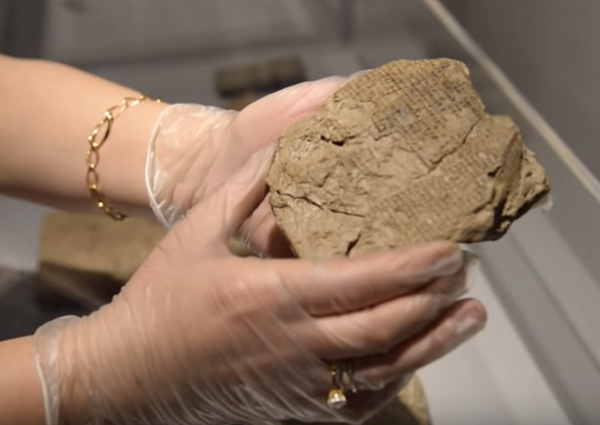
The History Blog article has an in depth description of the translation, with links to a scholarly paper on this very important find, and prompts the question, how much more is there to be discovered?
In the video above, Hazha Jalal, manager of the tablet’s section of the Sulaymaniyah Museum talks (in Kurdish) about the new discovery, saying (in translation): “The tablet dates back to the Neo-Bablyonian period, 2000–1500 BCE. It is a part of tablet V of the epic. It was acquired by the Museum in the year 2011 and [then] Dr. Farouk Al-Raw transliterated it. It was written as a poem and many new things this version has added, for example Gilgamesh and his friend met a monkey. We are honored to house this tablet and anyone can visit the Museum during its opening hours from 8:30 morning to noon. The entry is free for you and your guests. Thank you.”
In the meantime, if you’ve got a few minutes to spare, you can click here to Hear The Epic of Gilgamesh Read in the Original Akkadian and Enjoy the Sounds of Mesopotamia.
You can also find the epic in our twin collections, 1,000 Free Audio Books: Download Great Books for Free and 800 Free eBooks for iPad, Kindle & Other Devices.
Related content:
Hear the World’s Oldest Instrument, the “Neanderthal Flute,” Dating Back Over 43,000 Years
Hear Homer’s Iliad Read in the Original Ancient Greek
Download 55 Free Online Literature Courses: From Dante and Milton to Kerouac and Tolkien
Ted Mills is a freelance writer on the arts who currently hosts the FunkZone Podcast. You can also follow him on Twitter at @tedmills, read his other arts writing at tedmills.com and/or watch his films here.
Read More...Bernie Sanders: I Will Be an Arts President
Art is speech. Art is what life is about.
- Bernie Sanders, Democratic Candidate for President of the United States
A rousing sentiment, and one rarely expressed by those running for the nation’s highest office.
Once a candidate has been safely elected, he may feel comfortable betraying a deeper affinity, or ceding to the tastes of an arts-inclined First Lady. Sanders isn’t waiting, pledging in the video above, that he will be an Arts President.
The Americans for the Arts Action Fund tracks the candidates’ records with regard to arts advocacy, and it appears that Sanders has been walking the walk for quite some time.
He filmed a half-hour long documentary about labor leader Eugene Debs.
He recorded a 1987 folk album with the help of 30 Vermont musicians, stoutly pronouncing the lyrics to “This Land is Your Land” and “Where Have All the Flowers Gone” a la Rex Harrison.
Vice’s Paul Best made a compelling case for how Bernie Sanders shaped the northeast punk scene.
If Allen Ginsberg could vote from beyond the grave, I’m pretty sure I know which lever he’d be pulling…
With regard to living celebrities, it’s no big surprise to see that Will Ferrell, Susan Sarandon, and John C Reilly are among the artists supporting Bernie Sanders. Hollywood has long embraced liberal candidates. They are joined on the ever growing list of Artists and Cultural Leaders for Bernie Sanders by musicians Jello Biafra and The Red Hot Chili Peppers, comedians Margaret Cho and Sarah Silverman, and graffiti artists Ron English and Shepard Fairey, creator of the Obama Hope poster.
As Sanders fans wait to see whether Fairey will perform a similar service for his 2016 pick, Stencils for Bernie is taking up the slack with downloadable images for the DIY-inclined.
I presume that it’s only a matter of time before some young animator puts him or herself at Sanders’ disposal, though I kind of hope not. The candidate’s short video is reassuringly devoid of the snappy visuals that have become a staple of the form, thanks to such popular series as Crash Course, CGP Grey, The School of Life, and TED Ed.
Related Content:
Allen Ginsberg’s Handwritten Poem For Bernie Sanders, “Burlington Snow” (1986)
Ayun Halliday is an author, illustrator, and Chief Primatologist of the East Village Inky zine. Her play, Fawnbook, opens in New York City later this month. Follow her @AyunHalliday
Read More...Adam Savage’s Animated Lesson on the Simple Ideas That Lead to Great Scientific Discoveries
Educator, industrial design fabricator and Myth Busters cohost Adam Savage is driven by curiosity.
Science gets his wheels turning faster than the notched disc Hippolyte Fizeau used to measure the speed of light in 1849.
In his TED-Ed talk on how simple ideas lead to scientific discoveries, above, Savage zips across the centuries to share the work of three game changers — Fizeau, Eratosthenes, and Richard Feynman (one of the de facto patron saints of science-related TED talks).
I found it difficult to wrap my head around the sheer quantities of information Savage shoehorns into the seven minute video, giving similarly voluble and omnivorous mathmusician Vi Hart a run for her money. Clearly, he understands exactly what he’s talking about, whereas I had to take the review quiz in an attempt to retain just a bit of this new-to-me material.
I’m glad he glossed over Feynman’s childhood fascination with inertia in order to spend more time on the lesser known of his three subjects. Little Feynman’s observation of his toy wagon is charming, but the Nobel Prize winner’s life became an open book to me with Jim Ottaviani and Leland Myrick’s excellent graphic biography. What’s left to discover?
How about Eratosthenes? I’d never before heard of the Alexandrian librarian who calculated the Earth’s circumference with astonishing accuracy around 200 BC. (It helped that he was good at math and geography, the latter of which he invented.) Inspiration fuels the arts, much as it does science, and I’d like to learn more about him.
Ditto Fizeau, whom Savage describes as a less sexy scientific swashbuckler than methodical fact checker, which is what he was doing when he wound up cracking the speed of light in 1849. Two centuries earlier Galileo used lanterns to determine that light travels at least ten times faster than sound. Fizeau put Galileo’s number to the test, experimenting with his notched wheel, a candle, and mirrors and ultimately setting the speed of light at a much more accurate 313,300 Km/s. Today’s measurement of 299792.458 km/s was arrived at using technology unthinkable even a few decades ago.
Personally, I would never think to measure the speed of light with something that sounds like a zoetrope, but I might write a play about someone who did.
Related Content:
Neil deGrasse Tyson Delivers the Greatest Science Sermon Ever
Sam Harris: Science Can Answer Moral Questions
Ayun Halliday is an author, illustrator, and Chief Primatologist of the East Village Inky zine. Her play, Fawnbook, opens in New York City later this fall. Follow her @AyunHalliday
Read More...F. Scott Fitzgerald Reads Shakespeare’s Othello and Keats’ “Ode to a Nightingale” (1940)
When F. Scott Fitzgerald died in 1940 at the age of 44, he was considered a tragic failure. The New York Times eulogized him by writing that “the promise of his brilliant career was never fulfilled.” Though he masterfully captured all the mad flash of the Jazz era and the damaged young men of the Lost Generation, Fitzgerald’s novels hadn’t been fully recognized for their greatness at the time of his death. Now, of course, one could make a plausible argument that The Great Gatsby is the great American novel of the 20th century. Nonetheless, there’s a lingering sense of what could have been that hangs over the author’s life. How many more great books could have been written if it weren’t for his alcoholism, his bouts with depression, or his famously tempestuous relationship with his wife Zelda?
As the facts of his biography ossify into legend, it’s always bracing to see some reminder of the man himself. In the clips above and below you can listen to his actual voice. For reasons that still remain unclear, Fitzgerald recorded himself reading the works of William Shakespeare and John Keats in 1940, the last year of his life.
Above, you can see listen to him read Othello’s speech to the Venetian Senators from Act 1, Scene 3 of Othello. While his delivery doesn’t have the polish of a trained Shakespearean actor, it does have a sonorous, emotive authority to it even when he stumbles and slurs.
And here Fitzgerald recites John Keats’ “Ode to a Nightingale” from memory, which wasn’t quite as good, one imagines, as he hoped. Fitzgerald flubs a bit here, skips a bit there, before grinding to a halt somewhere around line 25. Still, it’s much better than I could have done.
Check the videos out. It might just give you a new appreciation for the author.
Related Content:
F. Scott Fitzgerald Creates a List of 22 Essential Books, 1936
Seven Tips From F. Scott Fitzgerald on How to Write Fiction
F. Scott Fitzgerald Conjugates “to Cocktail,” the Ultimate Jazz-Age Verb (1928)
Jonathan Crow is a Los Angeles-based writer and filmmaker whose work has appeared in Yahoo!, The Hollywood Reporter, and other publications. You can follow him at @jonccrow. And check out his blog Veeptopus, featuring lots of pictures of vice presidents with octopuses on their heads. The Veeptopus store is here.
Read More...Support Us
We're hoping to rely on loyal readers, rather than erratic ads. Please click the Donate button and support Open Culture. You can use Paypal, Venmo, Patreon, even Crypto! We thank you!

About Us

Open Culture scours the web for the best educational media. We find the free courses and audio books you need, the language lessons & educational videos you want, and plenty of enlightenment in between.
Advertise With Us

FREE UPDATES!
GET OUR DAILY EMAIL
Get the best cultural and educational resources on the web curated for you in a daily email. We never spam. Unsubscribe at any time.
FOLLOW ON SOCIAL MEDIA

Open Culture editor Dan Colman scours the web for the best educational media. He finds the free courses and audio books you need, the language lessons & movies you want, and plenty of enlightenment in between.
Advertise With Us

