Mick Jagger Acts in The Nightingale, a Televised Play from 1983
Pity the man who has everything. Satisfaction is but fleeting.
One wonders if rock god Mick Jagger might know a thing or two about the condition. He doesn’t seem to know all that much about acting, as evidenced by his turn in The Nightingale episode of Shelley Duvall’s Faerie Tale Theatre series.
No matter. His artlessness is part of the charm. As the spoiled emperor of Cathay, he makes no effort to alter his Mockney accent. He also keeps his famous strut under wraps, weighted down by his royal robes (and top knot!).
The 1983 episode cleaves closely to the Hans Christian Andersen original that inspired it. To summarize the plot:
The emperor demands an audience with a nightingale, after hearing tell of its song, but the toadies who comprise his court are too rarified to locate one in the forest.
A lowly kitchen maid (Barbara Hershey, on the brink of stardom) is the only one with the know how to deliver.
But the emperor is fickle — it isn’t long before his head is turned by a jewel encrusted, mechanics facsimile…a common enough rock n’ roll pitfall.
A large part of Faerie Tale Theater’s magic was the juxtaposition of high wattage stars and extremely low production budgets. There’s an element of student film to the proceedings. The videotape on which it was shot flattens rather than flatters. This is not a criticism. It makes me awfully fond of the big shots who agreed to participate.
In addition to Jagger and Hershey, look for Angelica Huston, Edward James Olmos, and Jagger’s then girlfriend, Jerry Hall, in smaller roles. There’s also Bud Cort of Harold and Maude, flapping around the sparsely decorated forest like a visitor from an entirely different story, nay, planet.
A curious enterprise indeed.
Related Content:
Stephen Fry Reads Oscar Wilde’s Children’s Story “The Happy Prince”
Ayun Halliday will be appearing at the Brooklyn Book Festival in New York City this weekend.. Follow her @AyunHalliday
Read More...An Animated Margaret Atwood Explains How Stories Change with Technology
From the Future Of StoryTelling video series comes an animation featuring Margaret Atwood meditating on how technology shapes the way we tell stories. Just like the Gutenberg Press did almost 600 years ago, the recent advent of digital platforms (the internet, ebooks, etc.) has created new ways for us to tell, distribute and share stories. And Atwood hasn’t been afraid to explore it all, writing stories on Wattpad and Twitter. Atwood will appear at The Future of Storytelling Summit on October 7 and 8.
If you would like to support the mission of Open Culture, consider making a donation to our site. It’s hard to rely 100% on ads, and your contributions will help us continue providing the best free cultural and educational materials to learners everywhere. You can contribute through PayPal, Patreon, and Venmo (@openculture). Thanks!
Related Content:
800 Free eBooks for iPad, Kindle & Other DevicesKurt Vonnegut Diagrams the Shape of All Stories in a Master’s Thesis Rejected by U. Chicago
Writing Tips by Henry Miller, Elmore Leonard, Margaret Atwood, Neil Gaiman & George Orwell
1,000 Free Audio Books: Download Great Books for Free Read More...18-Year-Old James Joyce Writes a Fan Letter to His Hero Henrik Ibsen (1901)
When it comes to theories of artistic lineage, few have been as influential as Harold Bloom’s The Anxiety of Influence, in which the august literary critic argues, “Poetic Influence—when it involves two strong, authentic poets—always proceeds by a misreading of the prior poet, an act of creative correction that is actually and necessarily a misinterpretation.” This kind of misreading—what Bloom calls “misprision”—often takes place between two artists separated by vast gulfs of time and space: the influence of Dante on T.S. Eliot, for example, or of Shakespeare on Herman Melville.
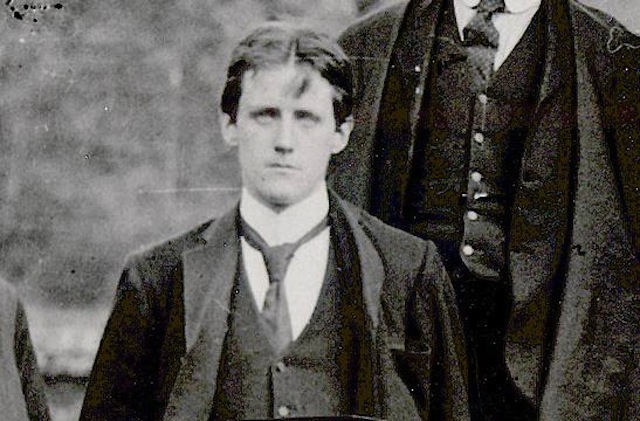
When we come to a study of James Joyce (1882–1941), however, we find the groundbreaking modernist corresponding directly with one of his foremost literary heroes, Norwegian playwright Henrik Ibsen (1828–1906), whom Maria Popova calls Joyce’s “spiritual and mental ancestor.” As Bloom points out, Joyce described Ibsen’s work as being “of universal import.” He extolled and defended Ibsen’s then-controversial work in his student days, both in a 1900 lecture he delivered at University College, Dublin, and in an essay he published that same year in the London journal Fortnightly Review. (See the young Joyce above in 1902, at 20 years of age.)
Joyce’s article, “Ibsen’s New Drama,” focused on the playwright’s latest, When We Dead Awaken, and was warmly received by Ibsen himself, who—through his English translator William Archer—described the essay as “velvillig,” or “benevolent.” Archer conveyed Ibsen’s sentiments in a letter soon after the essay’s publication, and thereafter, Joyce’s essay—writes the James Joyce Centre—was “no longer just a review but a review that Ibsen had read and praised.”
Thus began a three-year correspondence between Joyce and Archer, and a friendly relationship—at some remove—between Joyce and Ibsen. In 1901, on the playwright’s 73rd birthday, Joyce wrote a letter to Ibsen directly. He mentions the circumstances of the review and expresses much youthful admiration, self-confidence, and gratitude for Ibsen’s response. The young Joyce laments that his “immature and hasty article” came to Ibsen’s attention first, “rather than something better,” and boasts, “I have claimed for you your rightful place in the history of drama.”
Read the letter in full below, in all its exuberant egotism. According to James Joyce A to Z: The Essential Reference to the Life and Work, as he matured, the novelist “drew upon Ibsen less for creative encouragement than for psychological inspiration. In Joyce’s mind, Ibsen remained the model of the artist who defies conventional creative approaches and who remains true to the demands of an individual aesthetic.” Whether Joyce “misread” and “creatively corrected” Ibsen is a question I leave for others. You can read many more “fan letters” written by other famous authors to their literary heroes—including George R.R. Martin to Stan Lee, Charles Dickens to George Eliot, and Ray Bradbury to Robert Heinlein—at Flavorwire.
Honoured Sir,
I write to you to give you greeting on your seventy-third birthday and to join my voice to those of your well-wishers in all lands. You may remember that shortly after the publication of your latest play ‘When We Dead Awaken’, an appreciation of it appeared in one of the English reviews — The Fortnightly Review — over my name. I know that you have seen it because some short time afterwards Mr. William Archer wrote to me and told me that in a letter he had from you some days before, you had written, ‘I have read or rather spelled out a review in the Fortnightly Review by Mr. James Joyce which is very benevolent and for which I should greatly like to thank the author if only I had sufficient knowledge of the language.’ (My own knowledge of your language is not, as you see, great but I trust you will be able to decipher my meaning.) I can hardly tell you how moved I was by your message. I am a young, a very young man, and perhaps the telling of such tricks of the nerves will make you smile. But I am sure if you go back along your own life to the time when you were an undergraduate at the University as I am, and if you think what it would have meant to you to have earned a word from one who held so high a place in your esteem as you hold in mine, you will understand my feeling. One thing only I regret, namely, that an immature and hasty article should have met your eye, rather than something better and worthier of your praise. There may not have been any willful stupidity in it, but truly I can say no more. It may annoy you to have your work at the mercy of striplings but I am sure you would prefer even hotheadedness to nerveless and ‘cultured’ paradoxes.
What shall I say more? I have sounded your name defiantly through a college where it was either unknown or known faintly and darkly. I have claimed for you your rightful place in the history of the drama. I have shown what, as it seemed to me, was your highest excellence — your lofty impersonal power. Your minor claims — your satire, your technique and orchestral harmony — these, too, I advanced. Do not think me a hero-worshipper. I am not so. And when I spoke of you, in debating-societies, and so forth, I enforced attention by no futile ranting.
But we always keep the dearest things to ourselves. I did not tell them what bound me closest to you. I did not say how what I could discern dimly of your life was my pride to see, how your battles inspired me — not the obvious material battles but those that were fought and won behind your forehead — how your willful resolution to wrest the secret from life gave me heart, and how in your absolute indifference to public canons of art, friends and shibboleths you walked in the light of inward heroism. And this is what I write to you of now.
Your work on earth draws to a close and you are near the silence. It is growing dark for you. Many write of such things, but they do not know. You have only opened the way — though you have gone as far as you could upon it — to the end of ‘John Gabriel Borkman’ and its spiritual truth — for your last play stands, I take it, apart. But I am sure that higher and holier enlightenment lies — onward.
As one of the young generation for whom you have spoken I give you greeting — not humbly, because I am obscure and you in the glare, not sadly because you are an old man and I a young man, not presumptuously, nor sentimentally — but joyfully, with hope and with love, I give you greeting.
Faithfully yours,
James A. Joyce
Related Content:
James Joyce Reads From Ulysses and Finnegans Wake In His Only Two Recordings (1924/1929)
James Joyce’s “Dirty Letters” to His Wife (1909)
The Very First Reviews of James Joyce’s Ulysses: “A Work of High Genius” (1922)
Josh Jones is a writer and musician based in Durham, NC. Follow him at @jdmagness
Read More...Watch Online The Passion of Joan of Arc by Carl Theodor Dreyer (1928)
Sit back and enjoy The Passion of Joan of Arc, a 1928 silent film based on the historical record of the trial of Joan of Arc. Directed by Carl Theodor Dreyer and starring Renée Jeanne Falconetti, the film is considered a landmark of cinema. In fact, in the BFI’s poll of 846 critics, it was voted the 8th best film of all time.
Find more classic films in our meta collection, 4,000+ Free Movies Online: Great Classics, Indies, Noir, Westerns, Documentaries & More.
Follow us on Facebook, Twitter, Google Plus and LinkedIn and share intelligent media with your friends. And if you want to make sure that our posts definitely appear in your Facebook newsfeed, just follow these simple steps.
Read More...The Solar System Drawn Amazingly to Scale Across 7 Miles of Nevada’s Black Rock Desert
Wylie Overstreet and Alex Gorosh set out to create something you’ve never seen before — our solar system drawn to actual scale. Forget what you’ve seen in books, or on web sites. To depict things accurately, you need a bigger surface. A really large canvas. Like a seven-mile expanse in Nevada’s Black Rock Desert (which otherwise hosts The Burning Man Festival). It’s on this dry lakebed that Overstreet and Gorosh built “the first scale model of the solar system with complete planetary orbits” and it’s a sight to behold. Creative, industrious, and humbling. Enjoy.
Follow us on Facebook, Twitter, Google Plus and LinkedIn and share intelligent media with your friends. Or better yet, sign up for our daily email. And if you want to make sure that our posts definitely appear in your Facebook newsfeed, just follow these simple steps.
Related Content:
Free Online Astronomy Courses
Magnifying the Universe: Move From Atoms to Galaxies in HD
Carl Sagan, Stephen Hawking & Arthur C. Clarke Discuss God, the Universe, and Everything Else
Lawrence Krauss Explains How You Get ‘A Universe From Nothing’
Read More...Thomas Dolby Potty Trains His Cat, and There’s Video Proof
One of our favorite curiosities is the The Charles Mingus CAT-alogue for Toilet Training Your Cat–a pamphlet written by the mercurial jazz musician that offers step-by-step advice on how to get your cat to use the loo. The one thing Mingus didn’t provide is video proof that it could actually be done.
That’s where another musician steps in. Above, we have video of Thomas Dolby’s cat, “Mozart,” in action. Dolby, best known for his 1982 hit “She Blinded Me with Science,” is a teacher at heart. The son of an Oxford and Cambridge don, he’s now the Professor of the Arts at Johns Hopkins University. And, on his Youtube channel, he explains how he pulled off the seemingly impossible:
This is my cat Mozart, a Cornish Rex, peeing on the toilet. Many believed this was not possible, but it’s 100% real. When he was a kitten we tried to teach him to use the toilet, using a DVD. We thought it was a no go. But then aged about 3 he suddenly started to do it. Now sometimes when I get up in the night to pee Mo nips in ahead of me and I have to wait till he’s done. Next we need to teach him to flush! ~TD
If anyone is familiar with the DVD he’s referencing, please identify it in the comments below.
Follow us on Facebook, Twitter, Google Plus and LinkedIn and share our posts with your friends. And if you want to make sure that our posts definitely appear in your Facebook newsfeed, just follow these simple steps.
Related Content:
Thomas Dolby Explains How a Synthesizer Works on a Jim Henson Kids Show (1989)
Charles Mingus’ Instructions For Toilet Training Your Cat, Read by The Wire’s Reg E. Cathey
Insanely Cute Cat Commercials from Studio Ghibli, Hayao Miyazaki’s Legendary Animation Shop
Read More...48 Animated Videos Explain the History of Ideas: From Aristotle to Sartre
This year we’ve been featuring short animated videos from BBC Radio 4, all covering the big questions: How did everything begin? What makes us human? What is love? How can I know anything at all? They’ve all come scripted by philosopher Nigel Warburton (he of Philosophy Bites podcast fame) and narrated by a host of notables from both sides of the pond like Stephen Fry, Gillian Anderson, Aidan Turner, and Harry Shearer. They’ve illustrated the philosophical concepts at hand not just with elaborate and joke-filled drawings that come to life before your eyes, but with direct reference to the ideas of history’s best-known thinkers: Aristotle, Descartes, Hume, Wittgenstein, de Beauvoir, Sartre, Freud, Chomsky — the list goes on.
Now you can experience all of them in the one big playlist embedded just above, which provides a grand history of ideas with a succession of bite-size videos. The intellectual journey begins with Diotima’s concept of desire as a form of beauty and ends, 47 one- to two-minute celebrity-narrated and philosophically scintillating productions later, with Karl Popper’s concept of falsification, under which an idea only attains the designation scientific if it could, in principle, be proven false.
Once you’ve gone through all these videos, despite how much they themselves will have taught you, you’ll surely want to go even deeper into all these big ideas. In the service of that goal, why not have a look through some of the other philosophical resources we’ve featured, including our archive of Free Philosophy Courses, our collection of Free Philosophy eBooks, podcasts like Oxford’s philosophy lectures and The History of Philosophy Without Any Gaps, Bryan Magee’s television interviews with philosophers, and of course, philosophy explained with donuts.
If you would like to support the mission of Open Culture, consider making a donation to our site. It’s hard to rely 100% on ads, and your contributions will help us continue providing the best free cultural and educational materials to learners everywhere. You can contribute through PayPal, Patreon, and Venmo (@openculture). Thanks!
Related Content:
What is Love? BBC Philosophy Animations Feature Sartre, Freud, Aristophanes, Dawkins & More
What Makes Us Human?: Chomsky, Locke & Marx Introduced by New Animated Videos from the BBC
Philosophy Bites: Podcasting Ideas From Plato to Singularity Since 2007
Colin Marshall writes elsewhere on cities, language, Asia, and men’s style. He’s at work on a book about Los Angeles, A Los Angeles Primer, the video series The City in Cinema, and the crowdfunded journalism project Where Is the City of the Future? Follow him on Twitter at @colinmarshall or on Facebook.
Read More...Behold the Largest Atlas in the World: The Six-Foot Tall Klencke Atlas from 1660
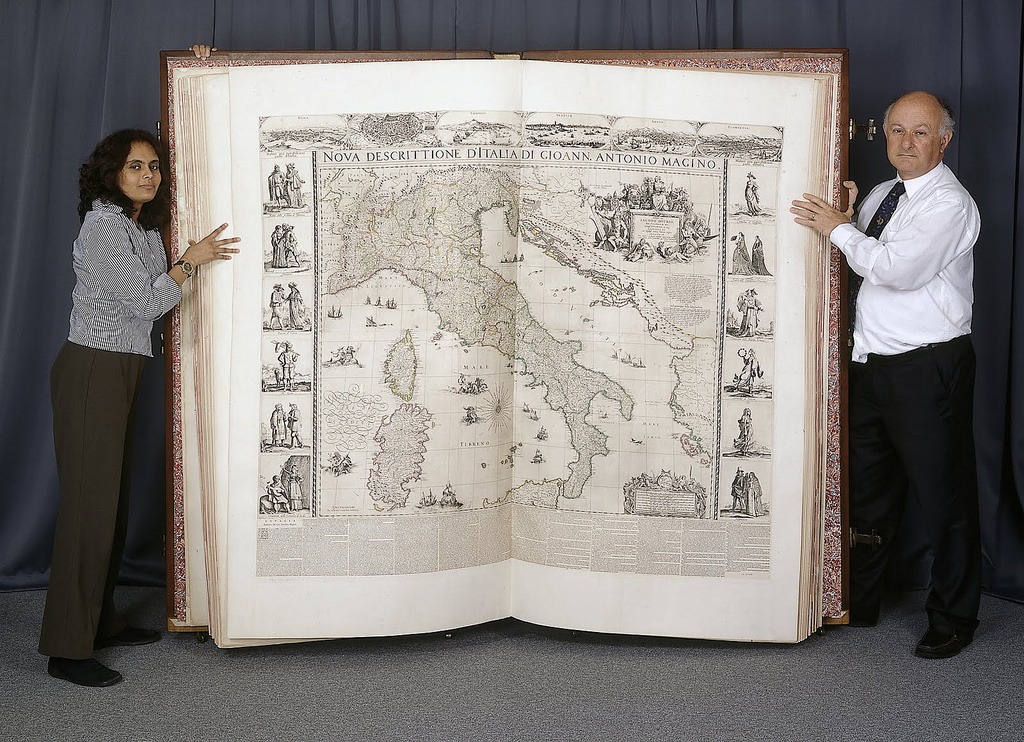
Last week, we featured the free digital edition of the The History of Cartography. Or what’s been called “the most ambitious overview of map making ever undertaken.” The three-volume series contains illustrations of countless maps, produced over hundreds of years. And it, of course, references this fine specimen: A gift given to England’s Charles II in 1660, The Klencke Atlas featured state-of-the-art maps of the continents and various European states. It was also notable for its size. Standing six feet tall and six feet wide (when opened), the volume remains 355 years later the largest atlas in the world. Learn more about it with the BBC clip below.
If you would like to support the mission of Open Culture, consider making a donation to our site. It’s hard to rely 100% on ads, and your contributions will help us continue providing the best free cultural and educational materials to learners everywhere. You can contribute through PayPal, Patreon, and Venmo (@openculture). Thanks!
Related Content:
The History of Cartography, the “Most Ambitious Overview of Map Making Ever,” Now Free Online
A Wonderful Scientific Map of the Moon from 1679: Can You Spot the Secret Moon Maiden?
Galileo’s Moon Drawings, the First Realistic Depictions of the Moon in History (1609–1610)
New York Public Library Puts 20,000 Hi-Res Maps Online & Makes Them Free to Download and Use
Read More...The Drawings & Paintings of Richard Feynman: Art Expresses a Dramatic “Feeling of Awe”
I first encountered bongo-playing physicist Richard Feynman in a college composition class geared toward science majors. I was not, mind you, a science major, but a disorganized sophomore who registered late and grabbed the last available seat in a required writing course. Skeptical, I thumbed through the reading in the college bookstore. As I browsed Surely You’re Joking, Mr. Feynman!—the first of many popular memoirs released by the affable contrarian scientist—the humanist in me perked up. Here was a guy who knew how to write; a theoretical physicist who spoke the language of everyday people.

Feynman cultivated his populist persona to appeal to those who might be otherwise turned off by abstract, abstruse scientific concepts. Like Carl Sagan and Neil deGrasse Tyson, his name has come to stand for the best examples of popular science communication. It is often through one of Feynman’s accessible, non-specialist books or presentations that people learn of his work with the Manhattan project, his contributions to quantum mechanics, and his Nobel Prize. But Feynman’s extracurricular pursuits—from safe-cracking to drumming to experimenting with LSD—were also genuine expressions of his idiosyncratic character, as was another of his passions for which he is not very well known: art.
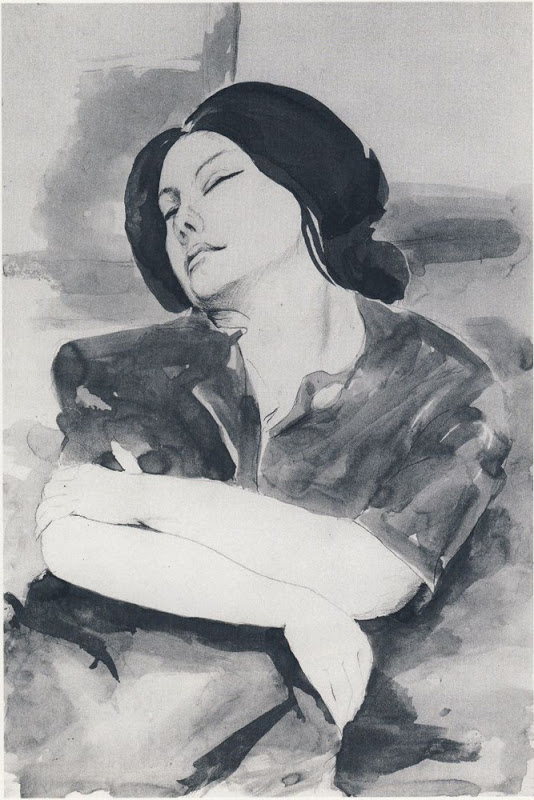
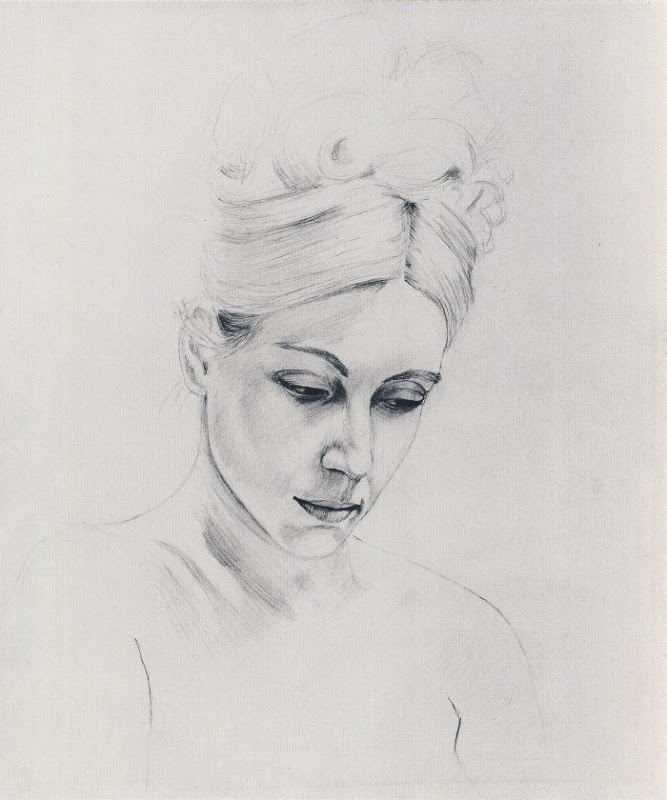
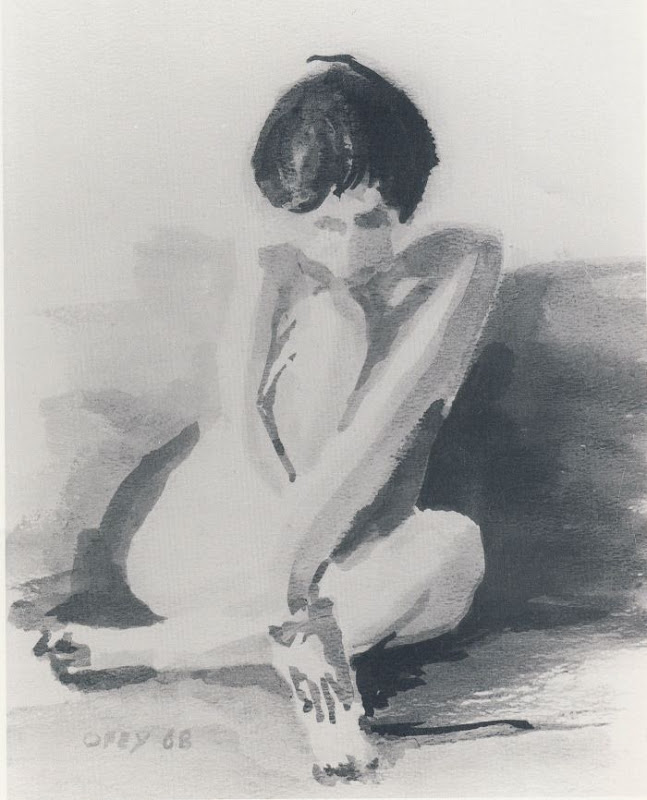
Feynman took up the pursuit at the age of 44, and continued to draw and paint for the rest of his life, signing his work “Ofey.” Many of his drawings display the awkward, off-kilter perspective of the beginner, and a great many others look very accomplished indeed. In an introductory essay to a published collection of his artwork, Feynman describes what motivated him to take up this particular avocation:
I wanted very much to learn to draw, for a reason that I kept to myself: I wanted to convey an emotion I have about the beauty of the world. It’s difficult to describe because it’s an emotion. It’s analogous to the feeling one has in religion that has to do with a god that controls everything in the universe: there’s a generality aspect that you feel when you think about how things that appear so different and behave so differently are all run ‘behind the scenes’ by the same organization, the same physical laws. It’s an appreciation of the mathematical beauty of nature, of how she works inside; a realization that the phenomena we see result from the complexity of the inner workings between atoms; a feeling of how dramatic and wonderful it is. It’s — of scientific awe — which I felt could be communicated through a drawing to someone who had also had that emotion. I could remind him, for a moment, of this feeling about the glories of the universe.
As you can see above, he took his work seriously. Most of his drawings consist of portraits and nudes, with the occasional landscape or still life. You can see more extensive galleries of Feynman’s art at AmusingPlanet, Museum Syndicate and Brain Pickings.
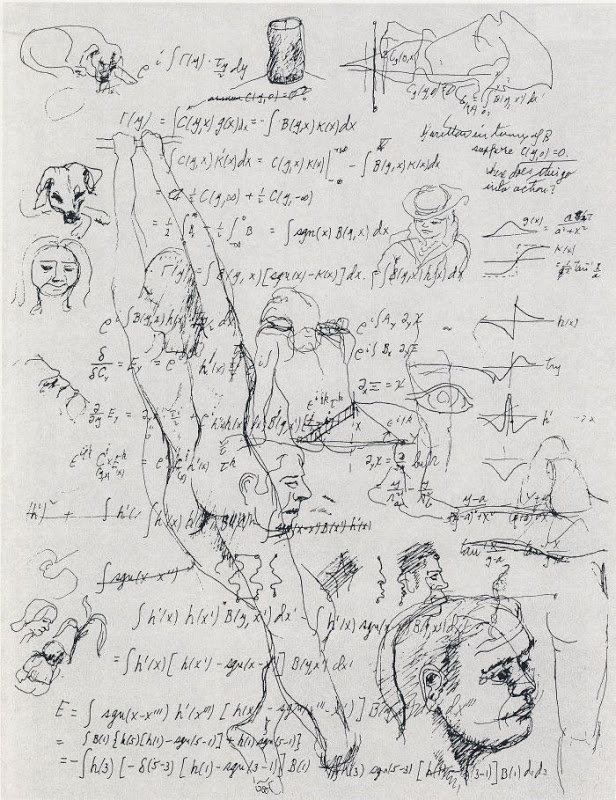
Feynman’s preoccupation—and full immersion—in the relationship between the arts and sciences marks him as a Renaissance man in perhaps the purest definition of the term: his approach closely resembles that of Leonardo da Vinci, a likeness that comes to the fore in the work below, which is either a collection of sketches doodled over with formulae, or a collection of formulae covered with doodles. Either way, it’s a perfect representation of the visionary mind of Feynman and his regard for ordinary language, people, and objects—and for “scientific awe.”
Related Content:
Learn How Richard Feynman Cracked the Safes with Atomic Secrets at Los Alamos
Josh Jones is a writer and musician based in Durham, NC. Follow him at @jdmagness
Read More...Stream Jim Rockford’s Answering Machine Messages: All Six Seasons
The Rockford Files hit the airwaves in September 1974, and until the show ended in 1980, each episode began in the same way. During the title sequence, you’d hear a phone ring, and then an answering machine would start to play, “This is Jim Rockford. At the tone, leave your name and message. I’ll get back to you.” With each new episode, a caller would leave a different message after the beep:
“It’s Norma at the market. It bounced. You want me to tear it up, send it back, or put it with the others?”
“It’s Laurie at the trailer park. A space opened up. Do you want me to save it or are the cops going to let you stay where you are?”
“It’s Audra. Remember last summer at Pat’s? I’ve got a twelve hour layover before I go to Chicago. How about it?”
“This is the message phone company. I see you’re using our unit, now how about paying for it?”
“I staked out that guy only it didn’t work out like you said. Please call me. Room 234. County Hospital.”
“Hey Rockford, very funny. I ain’t laughing. You’re gonna get yours.”
The short messages told you pretty much everything you needed to know about Jim Rockford. He’s a private detective living paycheck to paycheck. He cuts corners and bends rules when he needs to. He has friends among women, and enemies among men. He’s a quintessential private dick.
In total, 122 different answering machine messages were left during the run of the series. (Apparently, many featured the voices of 1970s celebrities and public figures.) You can play Season 1 above, and the remaining seasons below.
Support Us
We're hoping to rely on loyal readers, rather than erratic ads. Please click the Donate button and support Open Culture. You can use Paypal, Venmo, Patreon, even Crypto! We thank you!

About Us

Open Culture scours the web for the best educational media. We find the free courses and audio books you need, the language lessons & educational videos you want, and plenty of enlightenment in between.
Advertise With Us

FREE UPDATES!
GET OUR DAILY EMAIL
Get the best cultural and educational resources on the web curated for you in a daily email. We never spam. Unsubscribe at any time.
FOLLOW ON SOCIAL MEDIA

Open Culture editor Dan Colman scours the web for the best educational media. He finds the free courses and audio books you need, the language lessons & movies you want, and plenty of enlightenment in between.
Advertise With Us

