Hayao Miyazaki’s Masterpieces Spirited Away and Princess Mononoke Imagined as 8‑Bit Video Games
As an unapologetic member of the “Millennial” generation, allow me to tell you how to win over a great many of us at a stroke: just appeal to our long-instilled affinity for Japanese animation and classic video games. Raised, like many of my peers born in the late 1970s and early 1980s, on a steady diet of those art forms — not that everyone knew to acknowledge them as art forms back then — I respond instinctively to either of them, and as for their intersection, well, how could I resist?
I certainly can’t resist the sterling example of anime-meets-retrogaming in action just above: an 8‑Bit Cinema double-feature, offering David and Henry Dutton’s pixelated renditions of hugely respected Japanese animation master Hayao Miyazaki’s films Spirited Away and Princess Mononoke. In just under eight minutes, the video tells both stories — the former of a young girl transported into not just the spirit realm but into employment at one of its bathhouses; the latter of the unending struggle between humans and forest gods in 15th-century Japan — as traditional side-scrolling, platform-jumping video games.
Clearly labors of love by true classic gamers, these transformations get not just the graphics (which actually look better than real games of the era, in keeping with Miyazaki’s artistry) but the sound, music, and even gameplay conventions just right. I’d love to play real versions of these games, especially since, apart from an unloved adaptation of Nausicaä of the Valley of the Wind, Miyazaki’s movies haven’t plunged into the video-game realm.
And if you respond better to the aesthetic of classic gaming than to that of Japanese animation, do have a look at 8‑Bit Cinema’s other work, much of which you can sample in their show reel with clips from their versions of pictures like The Shining, Kill Bill, and The Life Aquatic with Steve Zissou. I remember many childhood conversations about how video games would eventually look just like our favorite movies, animated or otherwise; little did we know that, one day, our favorite movies would also look just like video games.
Related Content:
Hayao Miyazaki’s Universe Recreated in a Wonderful CGI Tribute
The Simpsons Pay Wonderful Tribute to the Anime of Hayao Miyazaki
The Philosophy of Friedrich Nietzsche Explained with 8‑Bit Video Games
8‑Bit Philosophy: Plato, Sartre, Derrida & Other Thinkers Explained With Vintage Video Games
The Big Lebowski Reimagined as a Classic 8‑Bit Video Game
The Great Gatsby and Waiting for Godot: The Video Game Editions
Colin Marshall writes on cities, language, Asia, and men’s style. He’s at work on a book about Los Angeles, A Los Angeles Primer, and the video series The City in Cinema. Follow him on Twitter at @colinmarshall or on Facebook.
Read More...Watch Neil deGrasse Tyson’s Clever Promo for Ridley Scott’s New Sci-Fi Film, The Martian
“Ever since our species first looked up at the sky, we dreamed of reaching Mars. Back in 2029, that dream became real, when the first humans stepped foot on the Red planet. And, in a few months, a new group of astronauts will make the journey.…”
It all seems like many other Neil deGrasse Tyson videos you’ve seen before. Until he says, “Back in 2029.” Wait, what?
Behold Neil deGrasse Tyson appearing in a clever promo for Ridley Scott’s upcoming film The Martian.
Based on Andy Weir’s bestselling 2011 novel The Martian , the movie will star Matt Damon as Mark Watney, an astronaut who goes on a big mission to Mars — the one so stirringly described by Tyson above. But the journey to Mars is not where the real action happens, and we’ll just leave it at that. No spoilers here.
The film will hit theaters in October. You can watch an official trailer here. And, in the meantime, you can always listen to Neil’s Star Talk Radio Show (referenced in the clip) anytime.
Related Content:
William Shatner Narrates Space Shuttle Documentary
Neil deGrasse Tyson Lists 8 (Free) Books Every Intelligent Person Should Read
Read More...Oliver Sacks’ Last Tweet Shows Beethoven’s “Ode to Joy” Movingly Flashmobbed in Spain
“A beautiful way to perform one of the world’s great musical treasures.” The video above, and the accompanying 58-character sentence, make up the last tweet from Oliver Sacks, the influential neurologist who passed away earlier today. The clip (originally highlighted on our site back in 2012) features 100 musicians and singers from the Orchestra Simfonica del Valles, Amics de l’Opera de Sabadell, Coral Belles Arts, and Cor Lieder Camera performing what’s now the anthem of the European Union — Beethoven’s “Ode to Joy” from his Symphony No. 9. It’s a pretty stirring performance, and certainly a worthwhile way to punctuate a Twitter stream. (Side note: Dr. Sacks started following our Twitter stream several years ago, and we still consider it a great honor, a high point in OC history.)
You can read Mr. Sacks’ obituary here, and an appraisal of his intellectual contributions here.
h/t @miafarrow
If you would like to support the mission of Open Culture, consider making a donation to our site. It’s hard to rely 100% on ads, and your contributions will help us continue providing the best free cultural and educational materials to learners everywhere. You can contribute through PayPal, Patreon, and Venmo (@openculture). Thanks!
Related Content:
This is What Oliver Sacks Learned on LSD and Amphetamines
30 Renowned Writers Speaking About God: From Isaac Asimov to Oliver Sacsks & Margaret Atwood
Read More...Hear Demos of Keith Richards Singing Lead Vocals on Rolling Stones Classics: “Gimme Shelter,” “Wild Horses” & More
In the early seventies, at the height of their powers, unforgettable hits seemed to tumble out one after another from The Rolling Stones, solidifying Jagger and Richards’ reputation for elemental, immediate songwriting that seemed to cut through more baroque studio productions of the late sixties and seventies and deliver the goods raw. As Brian Jones’ influence waned, Richards’ dark, raunchy riffs took over the band’s sound, and even when Jagger’s vocals are near incomprehensible, as in much of Exile on Main Street, his peculiar intonation—part fake Delta bluesman, part sneering delinquent schoolboy—gets across everything you need to know about the Rolling Stones’ ethos.
The immediacy of the Stones’ recordings is largely an artifact of their trial-and-error method in the studio. Unafraid of last-minute inspiration and unorthodox technical experiments, they built songs like “Gimme Shelter” from inspired demos to powerful anthems over the course of many versions and mixes. We’ve told the story of that song’s last-minute inclusion of Merry Clayton’s stirring vocal performance. Now, at the top, hear an early demo of the song lacking not only her voice, but Jagger’s as well—at least in the lead spot. Everything else is there: the tremolo-soaked opening riff, the haunting, reverb-drenched “Oooo”’s. But instead of Jagger’s faux-Southern drawl suddenly breaking the tension, we get the much more subdued voice of Richards, pushed rather far back in the mix and sounding pretty underwhelming next to the final album version.
It’s not that Richards is a bad singer—here he almost captures the cadences of Jagger, if not the projection (we do hear Jagger’s voice backing his). It’s just that we’ve come to associate the song so closely with Jagger’s quirks that hearing anyone else deliver the lyrics is a little jarring. On the other hand, Richard’s unadorned acoustic demo of “Wild Horses,” above, gets right to the heart of the song, sounding more like his friend Gram Parsons’ mournful early version than the later 1971 release on Sticky Fingers. (Hear another acoustic demo here, with Jagger on vocals.)
These two tracks represent rare opportunities to hear Richards take the vocal lead on Stones tracks, though he would begin releasing solo work in 1978 and fronted his own band, the X‑pensive Winos, in 1987, assembled in tribute to his hero Chuck Berry. Just the year previous, the Stones released Dirty Work, a high point in an otherwise creative slump for the band. The album’s first track, “One Hit (to the Body),” became its second big hit, and you can hear a scratchy, lo-fi demo version, with Keith on lead vocals, above. A thread at the Steve Hoffman Music Forums points us toward many more demos of Stones songs with Keith’s vocals, from outtakes and demos of Voodoo Lounge, Talk is Cheap and other albums. Many of these recordings show how much Richards was responsible for the band’s vocal melodies as well their signature guitar tones and rhythms. Amidst all these demos—of varying degrees of sound quality and states of inebriation—one song in particular stands out, and it’s not a Stones song.
Above, Richards’ delivers a Bourbon Street take on “Somewhere Over the Rainbow.” His quiet voice haunts the song, again pushed so far back in the mix you have to strain to hear him at all as he trails in and out. The recording, from 1977, leaked in 2008, along with Richards covers of other standards by Hoagy Carmichael and Perry Como. “The songs,” writes The Guardian, “feature melancholy piano, an even more melancholy Keef and sound like he’s doing an impression of early Tom Waits.” Fitting, then, that Richards would collaborate with Waits in 2006, on a recording that sounds like he’d been practicing for it his entire career.
Related Content:
Tom Waits and Keith Richards Sing Sea Song “Shenandoah” for New Pirate-Themed CD: Listen Online
The Rolling Stones Release a Soulful, Never-Heard Acoustic Version of “Wild Horses”
Josh Jones is a writer and musician based in Durham, NC. Follow him at @jdmagness
Read More...A‑ha’s “Take On Me” Performed by North Korean Kids with Accordions
This week, 1,000 North Koreans witnessed the first live performance by a Western pop act on its soil. And it was perhaps a bit anti-climatic.
The East Germans got their first taste of Western rock in 1988 when Bruce Springsteen played a massive gig in East Berlin. (See video here.) The North Koreans had to settle for the Slovenian industrial rock band, Laibach. According to The New York Times, their set included a “ ‘Sound of Music’ medley. A cover of the Beatles’ ‘Across the Universe.’ [And a] martial-sounding version of the arena rock anthem ‘The Final Countdown.’ ” You can watch short clips of the concert just below.
Laibach’s historic North Korean gig was apparently arranged by Morten Traavik, a Norwegian artist who previously made the Internet gyrate when he released a clip of young North Korean accordion players performing A‑ha’s 1984 hit, “Take On Me.” In 2012, Traavik met the musicians from the Kum Song Music School while traveling in North Korea. He told the BBC, “I lent them a CD of Take on Me on a Monday morning. By the following Wednesday morning they had mastered the song, with no annotation and no outside help. It showed incredible skill.” And, says Traavik, it all just goes to show, “you can have fun in North Korea.”
Related Content:
Watch 98 Korean Feature Films Free Online, Thanks to the Korean Film Archive
Watch Jimi Hendrix’s ‘Voodoo Chile’ Performed on a Gayageum, a Traditional Korean Instrument
Pakistani Musicians Play Amazing Version of Dave Brubeck’s Jazz Classic, “Take Five”
Read More...18 Stories & Novels by Neil Gaiman Online: Free Texts & Readings by Neil Himself
Neil Gaiman might just be the most beloved fantasy author out there. He writes weird, twisted, exhilarating tales about hidden realities and the bizarre, fanciful creatures that live in them. His works, like Sandman, Fragile Things and American Gods, are pure escapism and a blast to read. No doubt, that’s the major reason why the author has developed such a rabid fan base.
But perhaps another reason is that he is simply more available than most writers. Sure, other authors, like J. K. Rowling for instance, might have inspired an entire generation with her Harry Potter series but she prefers to keep a certain remove from her readership. Though she has a Twitter account, she uses it sparingly.
Gaiman, on the other hand, is seemingly always on Twitter — he has, as of this writing, tweeted at least nine times in the past 24 hours, interacting with fans, publishers and the press. This is the guy who once reportedly signed 75,000 copies of his book The Ocean at the End of the Lane, after all.
He has also posted a lot of his work for free up on the internet. Below is a list of Gaiman’s work that you can read, see or hear online. Many are read by Neil himself. If you know of any missing texts, please let us know and we’ll get them added to our list ASAP.
Above you can find videos of Gaiman reading the first chapter of his book Coraline, and also the story “The Man Who Forgot Ray Bradbury.”
Audio & Video
- Click-Clack the Rattle Bag — Free Video
- Coraline — Free Video
- “Harlequin Valentine” — Free Audio at Last.FM
- “How to Talk to Girls at Parties” – Free MP3
- “Orange” (read live) – Free Video
- “Other People” (read live) – Free Video
- “The Day the Saucers Came” — Free Video
- “The Man Who Forgot Ray Bradbury” — Free Audio
- The Truth Is a Cave in the Black Mountains — Free Audio
- The Graveyard Book (a novel read live with illustrations) – Free Video
- “A Study in Emerald” – Free iTunes
Text
- “A Calendar of Tales” — Read Online
- “A Study in Emerald” — Read Online
- “Bitter Grounds” — Read Online
- “Cinnamon” – Read Online
- ‘Click-clack the Rattlebag’ — Read Online
- “Down to a Sunless Sea” — Read Online
- “How To Talk To Girls At Parties” — Read Online
- “I Cthulhu” – Read Online
- “The Case of the Four and Twenty Blackbirds” – Read Online
- “The Day the Saucers Came” – Read Online
- The Truth Is a Cave in the Black Mountains — Read Online
Related Content:
1,000 Free Audio Books: Download Great Books for FreeNeil Gaiman Reads “The Man Who Forgot Ray Bradbury”
Where Do Great Ideas Come From? Neil Gaiman Explains
Amanda Palmer Animates & Narrates Husband Neil Gaiman’s Unconscious Musings
Jonathan Crow is a Los Angeles-based writer and filmmaker whose work has appeared in Yahoo!, The Hollywood Reporter, and other publications. You can follow him at @jonccrow. And check out his blog Veeptopus, featuring lots of pictures of vice presidents with octopuses on their heads. The Veeptopus store is here.
Read More...Michael Stipe Recommends 10 Books for Anyone Marooned on a Desert Island

Image by David Shankbone
Michael Stipe’s tenure as frontman and lyricist for R.E.M. certainly revealed a literate mind. A former art major at the University of Georgia and current art teacher at NYU, his best lyrics scan well as poetry. One can imagine being invited over for a dinner party to Mr. Stipe’s place, and, glass of wine in hand, absolutely having to nose through his bookshelf. What does the writer of “Nightswimming” read? With the historical references that course through those early albums, would he have socio-political books about America? Would he pull a book off the shelf and say, here, “You have to read this. It will change your life”?
Wonder no more, because Stipe was recently asked to write down his Top Ten list of books to take to a desert island. The list was published in The New York Times. Find a skeletal version here:
- Complete Works — Arthur Rimbaud
- On the Road — Jack Kerouac
- Dhalgren — Samuel R. Delaney
- Breakfast of Champions — Kurt Vonnegut
- All Families Are Psychotic — Douglas Coupland
- Lolita — Vladimir Nabokov
- Play It as It Lays — Joan Didion
- Four Plays by Aristophanes (translated by William Arrowsmith)
- Bonjour Tristesse — François Sagan
- Just Kids — Patti Smith
Some of these are classics—for example Kerouac’s On the Road , which Stipe calls “my band’s template”—and the one poet on the list, Rimbaud, is very much an early influence on his writing. Dhalgren was also a favorite of David Bowie’s, who based a lot of Diamond Dogs on the novel. The Copeland and Didion choices stand out, mostly by being less obvious selections from their bibliographies. And as he says that he’s currently reading the Patti Smith book (now being turned into a series on Showtime), we can’t take the selection too seriously. Maybe he just wants to take it to the desert island to finish it.
Stipe has included a few sentences on each book to explain his choices. Find them here.
Related content:
Patti Smith’s List of Favorite Books: From Rimbaud to Susan Sontag
Ted Mills is a freelance writer on the arts who currently hosts the FunkZone Podcast. You can also follow him on Twitter at @tedmills, read his other arts writing at tedmills.com and/or watch his films here.
Read More...How to Bake Ancient Roman Bread Dating Back to 79 AD: A Video Primer
Ecce panis—try your hand at the kind of loaf that Mel Brooks’ 2000-year-old man might have sunk his teeth into. Literally.
In 1930 a loaf of bread dating to AD 79 (the year Vesuvius claimed two prosperous Roman towns) was excavated from the site of a bakery in Herculaneum.
Eighty-three years later, the British Museum invited London chef Giorgio Locatelli, above, to take a stab at creating an edible facsimile for its Pompeii Live exhibition.
The assignment wasn’t as easy as he’d anticipated, the telegenic chef confesses before whipping up a lovely brown miche that appears far more mouth watering than the carbonized round found in the Herculaneum oven.
His recipe could be mistaken for modern sourdough, but he also has a go at several details that speak to bread’s role in ancient Roman life:
Its perimeter has a cord baked in to provide for easy transport home. Most Roman homes were without ovens. Those who didn’t buy direct from a bakery took their dough to community ovens, where it was baked for them overnight.
The loaf was scored into eight wedges. This is true of the 80 loaves found in the ovens of the unfortunate baker, Modestus. Locatelli speculates that the wedges could be used as monetary units, but I suspect it’s more a business practice on par with pizza-by-the-slice.
(Nowadays, Roman pizza is sold by weight, but I digress.)
The crust bears a telltale stamp. Locatelli takes the opportunity to brand his with the logo of his Michelin-starred restaurant, Locanda Locatelli. His inspiration is stamped ‘Property of Celer, Slave of Q. Granius Verus.’ To me, this suggests the possibility that the bread was found in a communal oven.
Locatelli also introduces a Flintstonian vision when he alludes to specially-devised labor saving machines to which Roman bakers yoked “animals,” presumably donkeys…or knowing the Romans and their class system, slaves.
His published recipe is below. Here is a conversion chart for those unfamiliar with metric measurements.
INGREDIENTS
400g biga acida (sourdough)
12g yeast
18g gluten
24g salt
532g water
405g spelt flour
405g wholemeal flour
Melt the yeast into the water and add it into the biga. Mix and sieve the flours together with the gluten and add to the water mix. Mix for two minutes, add the salt and keep mixing for another three minutes. Make a round shape with it and leave to rest for one hour. Put some string around it to keep its shape during cooking. Make some cuts on top before cooking to help the bread rise in the oven and cook for 30–45 minutes at 200 degrees.
For an even more artisanal attempt (and extremely detailed instructions) check out the Artisan Pompeii Miche recipe on the Fresh Loaf bread enthusiast community.
True Roman bread for true Romans!
via Metafilter/Make
Related Content:
Cook Real Recipes from Ancient Rome: Ostrich Ragoût, Roast Wild Boar, Nut Tarts & More
Animation Gives You a Glimpse of What Life Was Like for Teenagers in Ancient Rome
Building The Colosseum: The Icon of Rome
Ayun Halliday is an author, illustrator, and Chief Primatologist of the East Village Inky zine. Follow her @AyunHalliday
Read More...See Berlin Before and After World War II in Startling Color Video
Beautiful city, shame about all those Nazis.
Yes, this color newsreel above shows Berlin in 1936 as it gets ready to welcome the world for the Olympic Games. It’s a PR film meant to show the upside of the Reich, as Germans looked forward to a “better future”, and indeed the city looks just as gorgeous and exciting as other bustling European metropolises. There’s new construction alongside the classical architecture. There’s couples dancing to the latest hit tunes—Malneck and Mercer’s “Goody Goody” (which Benny Goodman had just released in February). There’s young men frolicking in the Wannsee while ladies sunbathe.
But then there’s those Nazis, ruining everybody’s travel plans. The streets are “festively decorated with flags with the current pattern” (ie. the swastika); we see a group of Hitler youth on a parade for the Führer; and while the “changing of the guard” may put some in mind of Buckingham Palace, here they’ve got the full goose-stepping going on. And the film ends very oddly: a shot of the guards outside the Ministry of Aviation, home to morphine addict and concentration camp co-creator Hermann Göering.
Flash forward to July 1945, and what a difference surrender to the Allies makes: Berlin in ruins, large posters of Stalin, and the signs of the divisions that eventually end in the 1961 building of the Berlin Wall. The newsreel concludes with a dramatic aerial shot of the entire city, taking in the amount of destruction.
We’ve featured this 1945 film before, but this before-and-after comparison speaks to the devastation of war and the determination to rebuild.
If you would like to support the mission of Open Culture, consider making a donation to our site. It’s hard to rely 100% on ads, and your contributions will help us continue providing the best free cultural and educational materials to learners everywhere. You can contribute through PayPal, Patreon, and Venmo (@openculture). Thanks!
Related Content
Berlin Street Scenes Beautifully Caught on Film (1900–1914)
1,000,000 Minutes of Newsreel Footage by AP & British Movietone Released on YouTube
Watch World War II Rage Across Europe in a 7 Minute Time-Lapse Film: Every Day From 1939 to 1945
Ted Mills is a freelance writer on the arts who currently hosts the FunkZone Podcast. You can also follow him on Twitter at @tedmills, read his other arts writing at tedmills.com and/or watch his films here.
Read More...The First Scientific Map of the Moon (1679)
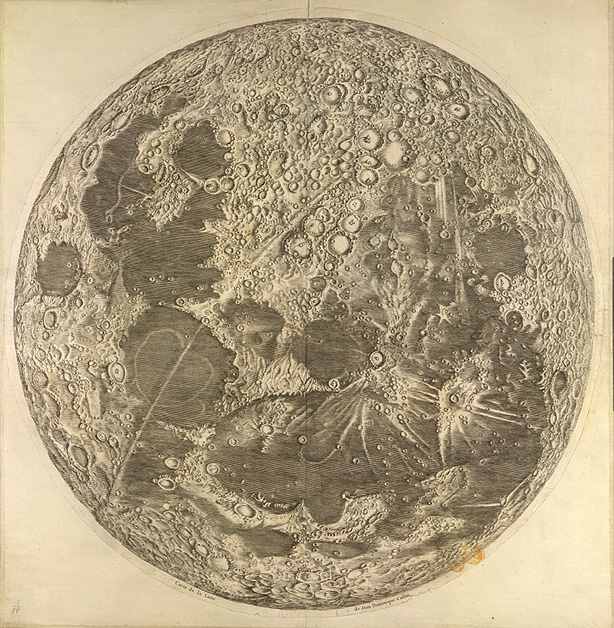
Millions watched as astronaut Neil Armstrong put boots to the moon in 1969.
It was, as he famously remarked, one “giant leap for mankind,” but from a scientific standpoint the territory was far from virgin.
Nearly 300 years earlier, engineer Giovanni Domenico Cassini, astronomer to Sun King Louis XIV, made lunar history in 1679, when he published the first scientific map of the moon, above.
Needless to say, the event was not televised and Cassini never had the opportunity to walk on the surface he studied. Instead he observed it through the eyepiece of a telescope, a relatively new invention.
His predecessors, including Galileo, used the then-revolutionary tool to delve deeper into their own lunar obsessions, making sketches and performing experiments designed to replicate the craters they noticed in the moon’s crust.
Cassini, then eight years into his forty year career as Director of the Paris Observatory, produced a map so exhaustive, it provided his peers with far more details of the moon’s surface than they had with regard to their own planet.
He also used his powers of observation to expand human understanding of Mars, Saturn, and France itself (which turned out to be much smaller than previously believed).
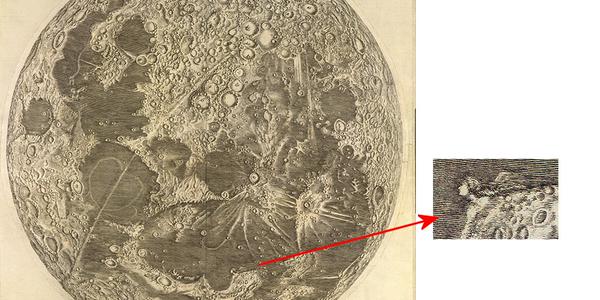
A man of science, he may not have been entirely immune to the sort of moon-based whimsy that has long infected poets, songwriters, and 19th-century romantic heroines. Hiding in the lower right quadrant, near Cape Heraclides on the Sinus Iridum (aka Bay of Rainbows), is a tiny, bare-shouldered moon maid. See right above.
Or perhaps this appealingly playful vision can be attributed to Cassini’s engraver Claude Mellan.
Either way, she seems exactly the sort of female life form a 17th-century human male might hope to encounter on a trip to the moon.
via Pickover Reality Carnival
Related Content:
Free Online Astronomy Courses
Galileo’s Moon Drawings, the First Realistic Depictions of the Moon in History (1609–1610)
The Birth of the Moon: How Did It Get There in the First Place?
Ayun Halliday is an author, illustrator, and Chief Primatologist of the East Village Inky zine. Follow her @AyunHalliday
Read More...Support Us
We're hoping to rely on loyal readers, rather than erratic ads. Please click the Donate button and support Open Culture. You can use Paypal, Venmo, Patreon, even Crypto! We thank you!

About Us

Open Culture scours the web for the best educational media. We find the free courses and audio books you need, the language lessons & educational videos you want, and plenty of enlightenment in between.
Advertise With Us

FREE UPDATES!
GET OUR DAILY EMAIL
Get the best cultural and educational resources on the web curated for you in a daily email. We never spam. Unsubscribe at any time.
FOLLOW ON SOCIAL MEDIA

Open Culture editor Dan Colman scours the web for the best educational media. He finds the free courses and audio books you need, the language lessons & movies you want, and plenty of enlightenment in between.
Advertise With Us

