John Cleese on The Importance of Making and Embracing Mistakes
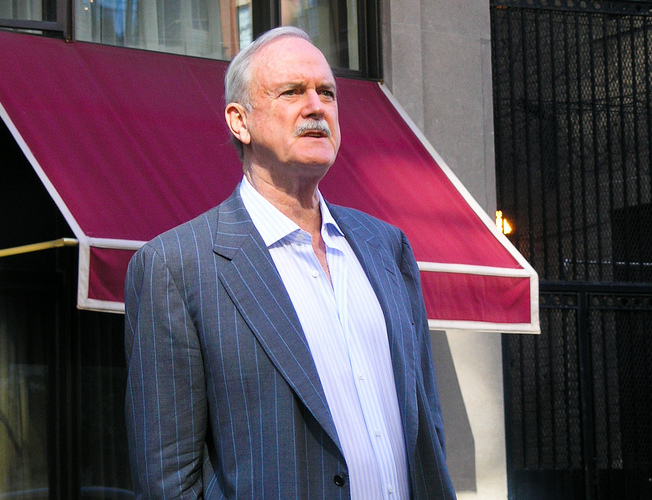
Creative Commons image by Paul Boxley
In his essay “The Relativity of Wrong,” Isaac Asimov argues persuasively against the common belief that “’right’ and ‘wrong’ are absolute; that everything that isn’t perfectly and completely right is totally and equally wrong.” Instead, he says, “it seems to me that right and wrong are fuzzy concepts,” and that certain ideas can be true in a sense, but still in need of further correction with new information. I can’t testify as to the strength of his argument when it comes to theoretical physics, but as far as basic inductive reasoning goes it seems perfectly sound to me, and a point worth making frequently. We don’t experience a world of binaries, but one full of “fuzziness” and near misses of all kinds.
As in science—argues former Monty Python member, comedy writer, and intellectual gadfly John Cleese—so in business. Cleese gave a motivational speech called “The Importance of Mistakes” in 1988 to an audience of 500 businessman at the British-American Chamber of Commerce, a demographic he has addressed remotely since 1972 with a series of business training videos made by his company, Video Arts. (“Better job training through entertainment,” as Kate Callen at UPI describes the company’s mission. Videos have titles like “Meetings, Bloody Meetings,” and “If Looks Could Kill.”)
In “The Importance of Mistakes,” Cleese explains that we do not veer wildly off course into total wrongness every time we make an error. Instead, our mistakes provide us with opportunities for feedback, which enables us to make course corrections, where we will inevitably make another mistake, receive more feedback, etc., until we hit the mark. These metaphors are not mine; Cleese uses a story called Gordon the Guided Missile as his primary example—which he dubiously claims was “the first nursery story I ever remember my mother reading to me”:
Gordon the guided missile sets off in pursuit of its target. It immediately sends out signals to discover if it is on the right course to hit that target. Signals come back: “No, you are not on course. So change it. Up a bit and slightly to the left.” And Gordon changes course as instructed and then, rational little fellow that he is, sends out another signal. “Am I on course now?” Back comes the answer, “No, but if you adjust your present course a bit further up and a bit further to the left, you will be.” He adjusts his course again and sends out another request for information. Back comes the answer, “No, Gordon, you’ve still got it wrong. Now you must come down a bit and a foot to the right.” And the guided missile goes on and on making mistakes, and on and on listening to feedback and on and on correcting its behavior until it blows up the nasty enemy thing. And we applaud the missile for its skill. If, however some critic says, “Well, it certainly made a lot of mistakes on the way”, we reply, “Yes, but that didn’t matter, did it? It got there in the end.” All its mistakes were little ones, in the sense that they could be immediately corrected. And as a results of making many hundreds of mistakes, eventually the missile succeeded in avoiding the one mistake which really would have mattered: missing the target.
The story illustrates, Cleese says, the importance of a “tolerant attitude towards mistakes”—even, a “positive attitude.” To take any other view would be to behave “irrationally, unscientifically, and unsuccessfully.” Cleese more or less recommends his audience adopt Asimov’s scientific perspective on error: mistakes are not disastrously irrecoverable missteps, but ways of learning how to get things “less wrong.”
Some clarification: Cleese means to validate only “those mistakes which, at the time they were committed, did have a chance.” A reasonably good try, in other words. There are some absolutes in the world, after all, and there are “true copper bottomed mistakes, like spelling the word ‘rabbit with three m’s or … starting a land war in Asia.” But the point stands. We’re usually in the realm of in-between, and instead of letting the anxiety of indeterminacy overwhelm us, Cleese recommends we take risks and “gain the confidence to contribute spontaneously to what’s happening,” thus overcoming inhibitions and the fear of looking ridiculous.
Cleese delivered this speech to a body of people not typically known for acting spontaneously. And while it seems to me that these days top executives can make egregious errors (or commit egregious fraud) and land squarely on their feet, I wonder if those on the tiers below have the privilege of daring to make errors in most industries. In any case, whether an assembly of corporate managers can afford to loosen up, the rest of us probably can, if we’re willing to adopt a “positive attitude” toward mistakes and consistently—scientifically, even—view them as opportunities to learn.
All of this requires a fine balance of the confidence to screw up and the humility to take constructive feedback when you do. “Healthy behavior actually arises out of confidence,” Cleese observed in an interview after his speech, and yet, “the worst problem in management—in fact, the worst problem in life—is the ego.”
Read many more excerpts from Cleese’s speech here.
Related Content:
John Cleese Explores the Health Benefits of Laughter
John Cleese’s Philosophy of Creativity: Creating Oases for Childlike Play
Josh Jones is a writer and musician based in Durham, NC. Follow him at @jdmagness
Read More...Celebrate Edgar Allan Poe’s Birthday With Three Animations of “The Tell-Tale Heart”
Today is Edgar Allan Poe’s birthday, or would be had he lived to be 207 years old. I can’t imagine he would have relished the prospect. When Poe did meet his end, it was under mysterious and rather awful circumstances, fittingly (in a grimly ironic sort of way) for the man often credited with the invention of detective fiction and the perfecting of the gothic horror story.
“True!” begins his most famous story, “The Tell-Tale Heart”—“nervous, very, very dreadfully nervous I had been and am,” and we surely believe it. But when he finishes his intimate introduction to us, we are much less inclined to trust his word:
But why will you say that I am mad? The disease had sharpened my senses—not destroyed—not dulled them. Above all was the sense of hearing acute. I heard all things in the heaven and in the earth. I heard many things in hell. How, then, am I mad? Hearken! and observe how healthily—how calmly I can tell you the whole story.
Have we ever been confronted with a more unnerving and unreliable narrator? Poe’s genius was to draw us into the confidence of this terrifying character and keep us there, rapt in suspense, even though we cannot be sure of anything he says, or whether the entire story is nothing more than a paranoid nightmare. And it is that, indeed.
In the animation above by Annette Jung—adapted from Poe’s chilling tale—the madman Ed resolves to take the life of an old man with a creepy, staring eye. In this version, however, a central ambiguity in Poe’s story is made clear. We’re never entirely sure in the original what the relationship is between Poe’s narrator and the doomed old man. In Jung’s version, they are father and son, and the old man is rendered even more grotesque, Ed’s psychological torments even more… shall we say, animated, with clearly comic intent. Jung publishes a web comic called Applehead, and on her short film’s website (in German), she refers to her “Tell-Tale Heart” as “an animated satire.”
Poe’s talent for sustaining controlled hyperbole and for creating unforgettable images like the old man’s evil eye and loudly beating heart make his work especially inviting to animators, and we’ve featured many animations of that work in the past. Just above, see the original animated “Tell-Tale Heart” from 1954. Narrated by the ideally creepy-voiced James Mason, the film received an “X” rating in the UK upon its release, then went on to an Academy Award nomination for Best Animated Short (though it did not win). Just below, Aaron Quinn—who has also animated Poe’s “The Raven” and other 19th century classics by Oscar Wilde, Lewis Carroll and others—updates Mason’s narration with his own frighteningly stark, animated take on the story. Poe, had he lived to see the age of animation, may not have been pleased to see his story adapted in such graphic styles, but we, as his devoted readers over 150 years later, can be grateful that he left us such wonderfully weird source material for animated films.
Related Content:
Download The Complete Works of Edgar Allan Poe: Macabre Stories as Free eBooks & Audio Books
Edgar Allan Poe & The Animated Tell-Tale Heart
Edgar Allan Poe Animated: Watch Four Animations of Classic Poe Stories
Josh Jones is a writer and musician based in Durham, NC. Follow him at @jdmagness
Read More...How to Take Advantage of Boredom, the Secret Ingredient of Creativity
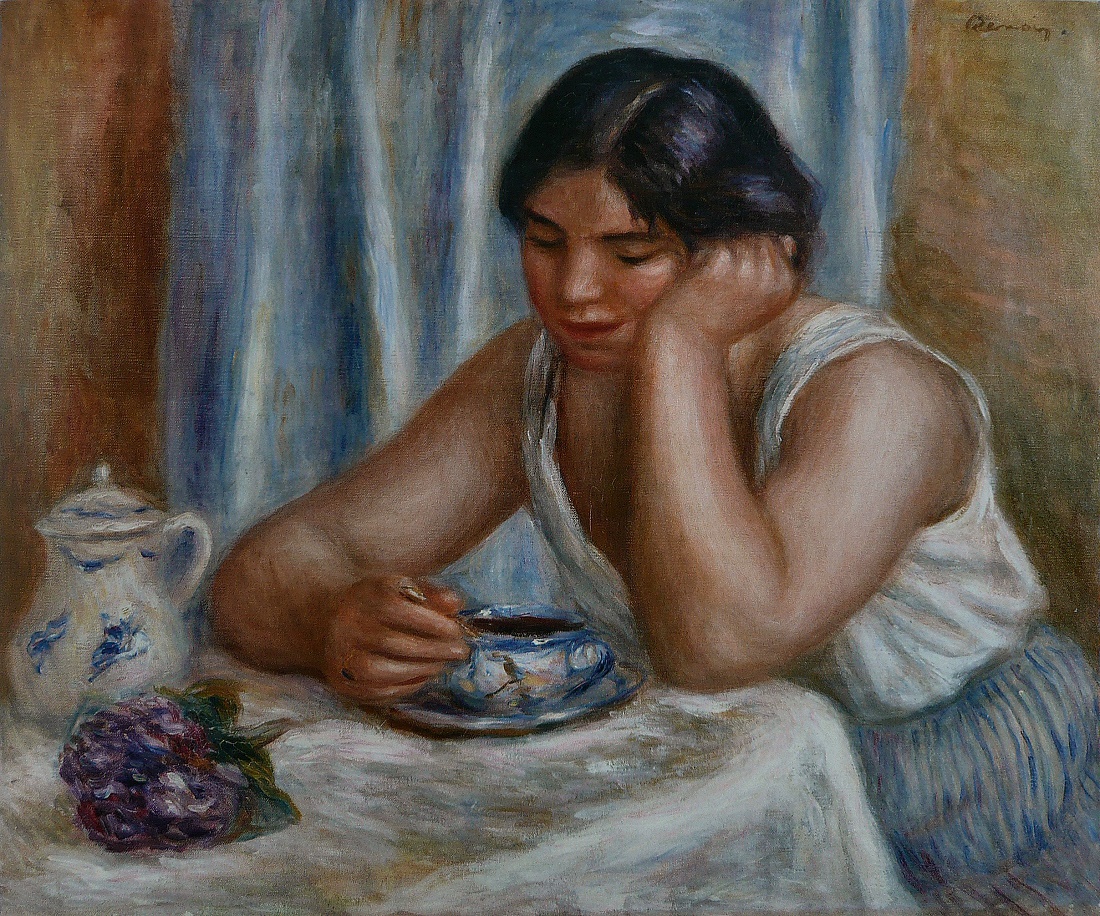
Pierre-August Renoir, La Tasse de chocolat
Last year we told you about the importance of messy desks and walking to creativity. This year, the time has come to realize how much creativity also depends on boredom. In a sense, of course, humankind has utterly vanquished boredom, what with our modern technologies — computers, high-speed internet, smartphones — that make possible sources of rich and frequent stimulation such as, well, this very site. But what if we need a little boredom? What if boredom, that state we 21st-century first-worlders worry about avoiding more than any other, actually helps us create?
Even if we feel no boredom in our free time, surely we still endure the occasional bout of it at work. “Admitting that boredom to coworkers or managers is likely something few of us have ever done,” writes the Harvard Business Review’s David Burkus. “It turns out, however, that a certain level of boredom might actually enhance the creative quality of our work.”
He cites a well-known scientific experiment which found that volunteers did better at a creative task (like finding different uses for a pair of plastic cups) when first subjected to a boring one (like copying numbers out of the phone book) which “heightens the ‘daydreaming effect’ on creativity — the more passive the boredom, the more likely the daydreaming and the more creative you could be afterward.”
Burkus also refers to another paper documenting the performance of different subjects on word-association tests after watching different video clips, one of them deliberately boring. Who came up with the most creative associations? You guessed it: those who watched the boring video first. Boredom, the experimenters suggest, “motivates people to approach new and rewarding activities. In other words, an idle mind will seek a toy. (Anyone who has taken a long car ride with a young child has surely experienced some version of this phenomenon.)”
Writing about those same experiments, Fast Company’s Vivian Giang quotes researcher Andreas Elpidorou of the University of Louisville as claiming that “boredom helps to restore the perception that one’s activities are meaningful or significant.” He describes it as a “regulatory state that keeps one in line with one’s projects. In the absence of boredom, one would remain trapped in unfulfilling situations, and miss out on many emotionally, cognitively, and socially rewarding experiences. Boredom is both a warning that we are not doing what we want to be doing and a ‘push’ that motivates us to switch goals and projects.”
“Boredom is a fascinating emotion because it is seen as so negative yet it is such a motivating force,” says Dr. Sandi Mann of the University of Central Lancashire, one of the masterminds of the experiments with the phone book and the plastic cups, quoted by Telegraph science editor Sarah Knapton. “Being bored is not the bad thing everyone makes it out to be. It is good to be bored sometimes! I think up so many ideas when I am commuting to and from work – this would be dead time, but thanks to the boredom it induces, I come up with all sorts of projects.” (This also manifests in her parenting: “I am quite happy when my kids whine that they are bored,” she said: “Finding ways to amuse themselves is an important skill.”)

“Nearly the Weekend,” by David Feltkamp. Creative Commons image
How to make use of all this? “Taken together,” Burkus writes, “these studies suggest that the boredom so commonly felt at work could actually be leveraged to help us get our work done better,” perhaps by “spending some focused time on humdrum activities such as answering emails, making copies, or entering data,” after which “we may be better able to think up more (and more creative) possibilities to explore.” In the words of Dr. Mann herself, “Boredom at work has always been seen as something to be eliminated, but perhaps we should be embracing it in order to enhance our creativity.” And so to an even more interesting question: “Do people who are bored at work become more creative in other areas of their work – or do they go home and write novels?”
David Foster Wallace took on the relationship between boredom and creativity in an ambitious way when he started writing The Pale King, his unfinished novel (which he privately called “the Long Thing”) set in an Internal Revenue Service branch office in mid-1980s Peoria. The papers related to the project he left behind included a note about the book’s larger theme:
It turns out that bliss – a second-by-second joy + gratitude at the gift of being alive, conscious – lies on the other side of crushing, crushing boredom. Pay close attention to the most tedious thing you can find (tax returns, televised golf), and, in waves, a boredom like you’ve never known will wash over you and just about kill you. Ride these out, and it’s like stepping from black and white into color. Like water after days in the desert. Constant bliss in every atom.
This, as well as the more everyday suggestions about working more creatively by doing the boring bits first, would seem to share a basis with the ancient tradition of meditation. If indeed humanity has gone too far in its mission to alleviate the discomfort of boredom, it has produced the even more pernicious condition in which we all feel constantly and unthinkingly desperate for new distractions (which Shop Class as Soulcraft author Matthew B. Crawford memorably called “obesity of the mind”) while knowing full well that those distractions keep us from our important work, be it designing a scientific experiment, coming up with a sales strategy, or writing a novel.
Maybe we can undo some of the damage by deliberately, regularly shutting off our personal flow of interesting sensory input for a while, whether through meditation, data entry, phone-book copying, of whichever method feels right to you. (WNYC’s Manoush Zomorodi even launched a project last year called “Bored and Brilliant: The Lost Art of Spacing Out,” which challenged listeners to minimize their phone-checking and put the time gained to more creative use.) But we all need some high-quality stimulation sooner or later, so when you feel ready for another dose of it, you know where to find us.
Related Content:
Why You Do Your Best Thinking In The Shower: Creativity & the “Incubation Period”
John Cleese’s Philosophy of Creativity: Creating Oases for Childlike Play
Free Online Psychology Courses
Based in Seoul, Colin Marshall writes and broadcasts on cities and culture. He’s at work on a book about Los Angeles, A Los Angeles Primer, the video series The City in Cinema, the crowdfunded journalism project Where Is the City of the Future?, and the Los Angeles Review of Books’ Korea Blog. Follow him on Twitter at @colinmarshall or on Facebook.
Read More...Plato’s Cave Allegory Animated Monty Python-Style
There’s something about Plato’s Allegory of the Cave that inspires people to get creative. Orson Welles once narrated an animated adaptation of the Cave allegory. The folks at Bullhead Entertainment brought to life the allegory appearing in Book VII of Plato’s Republic using some fine claymation. And Alex Gendler recently crafted a version in an aesthetic that calls Dr. Seuss to mind. Now, comes another one by The School of Life, done in a style reminiscent of Terry Gilliam’s cut-out animations for Monty Python. It’s part of a series of 22 animated philosophy videos, which takes you from the Ancients (Aristotle, Plato, and the Stoics) straight through to the Moderns (Sartre, Camus, and Foucault). Find a complete playlist here.
Related Content:
Terry Gilliam Reveals the Secrets of Monty Python Animations: A 1974 How-To Guide
What is the Good Life? Plato, Aristotle, Nietzsche, & Kant’s Ideas in 4 Animated Videos
Free Online Philosophy Courses
Read More...29 Sketchbooks by Renowned Artist Richard Diebenkorn, Containing 1,045 Drawings, Now Freely Viewable Online
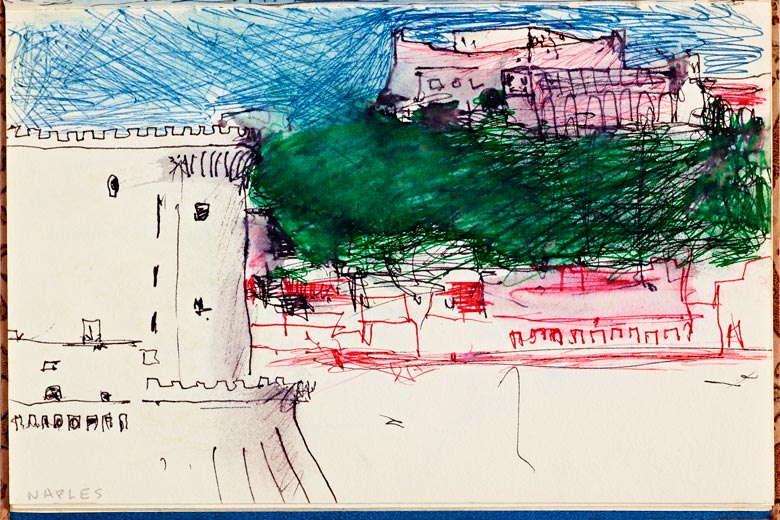
We owe the way we see California today in part to the painter Richard Diebenkorn, “whose deeply lyrical abstractions evoked the shimmering light and wide-open spaces” of the state “where he spent virtually his entire life.” Those words come from his 1993 New York Times obituary, which suggested that Diebenkorn’s resistance to brief aesthetic movements and art-world fads (a resistance aided by the distance between California and New York) would ensure that the influence of his vision long survive him. Now, thanks to Stanford University’s Cantor Arts Center, we can look more closely than ever at what went into that vision in a new online exhibition of Diebenkorn’s sketchbooks.
“Throughout his long career,” writes the Stanford Report’s Anna Koster, “Diebenkorn, AB ’49, kept a sketchbook – a ‘portable studio,’ as he called it – to capture his ideas. These books, now in the Cantor’s collection, span 50 years and represent the range of styles and subjects he explored, including deeply personal portraits of his wife, studies of the figure, landscape studies and compositions that point to Diebenkorn’s signature blend of figuration and abstraction.” The sketchbooks, donated by the artist’s widow and the Diebenkorn Foundation, currently sit on display at the Cantor’s exhibition Richard Diebenkorn: The Sketchbooks Revealed, which runs through August 22, 2016.
But if you can’t make it to northern California before then, you can have a look at all of them online and behold in detail their 1,045 drawings spanning fifty years of Diebenkorn’s life. They give not only an insight into how he rendered the material for so many of our California dreams, but how he handled his famously contrarian oscillations between styles, from Abstract Expressionism to figuration and back to the abstract again, with some of his richest work in-between. “I was never throwing things away when I switched from one way of painting to another,” he once said. “You can see a continuum from representation to abstraction, although I must say it never felt like a smooth transition while I was in the middle of it.”
Related Content:
45,000 Works of Art from Stanford University’s Cantor Arts Center Now Freely Viewable Online
178,000 Images Documenting the History of the Car Now Available on a New Stanford Web Site
The Art of Living: A Free Stanford Course Explores Timeless Questions
How the CIA Secretly Funded Abstract Expressionism During the Cold War
Based in Seoul, Colin Marshall writes and broadcasts on cities and culture. He’s at work on a book about Los Angeles, A Los Angeles Primer, the video series The City in Cinema, the crowdfunded journalism project Where Is the City of the Future?, and the Los Angeles Review of Books’ Korea Blog. Follow him on Twitter at @colinmarshall or on Facebook.
Read More...David Bowie as Tilda Swinton, and Vice Versa
David Bowie as Tilda Swinton. Tilda Swinton as David Bowie. pic.twitter.com/N8npqeQEtJ
— Eric Alper (@ThatEricAlper) January 11, 2016
Just a great photo on Twitter via @ThatEricAlper and had to share :)
If you would like to support the mission of Open Culture, consider making a donation to our site. It’s hard to rely 100% on ads, and your contributions will help us continue providing the best free cultural and educational materials to learners everywhere. You can contribute through PayPal, Patreon, and Venmo (@openculture). Thanks!
Read More...David Bowie Sings “Changes” in His Last Live Performance, 2006
Note: This post was published on our site less than two weeks ago–December 29, 2015–when we had no idea that David Bowie was in the final days of an 18 month battle with cancer. In the post, Josh Jones wondered whether the video featured above would be Bowie’s last live performance. And, alas, tonight we discover that it’s apparently so. David Bowie’s official Twitter and Facebook accounts, not to mention major newspapers, have just reported that David Bowie has died, only two days after his 69th birthday and the release of his new album Blackstar. We’ll have more to say about Bowie, a hero of ours, in the coming days. But, for now, we leave you with the sad news and this now historic performance caught on lamentably grainy video. –D.C
The man of a thousand haircuts, David Bowie has been the vanguard for creative reinvention for longer than many of his fans have been alive. As soon as he’s made us think he’s exhausted his imagination, he reappears with yet another album, another look, another theatrical tour. Except that last bit isn’t likely to happen again. We may have seen the end of Bowie the performer some time ago, according to such sources as longtime Bowie producer Tony Visconti (who worked with him on 2013’s The Next Day) and British concert promoter John Giddings.
“David is one of the best artists I’ve ever worked with,” said Giddings in October, ”but every time I see him now, before I even speak to him, he goes, ‘I’m not touring.’” Does this rule out the odd one-off appearance? Who knows. Nothing is for certain with Bowie. But it may well be that the performance above, a duet of “Changes” with Alicia Keys from 2006, represents the legendary shape shifter’s last gig. (And if so, we hope some better-quality video of it surfaces.)
Bowie appeared with Keys, Damian Marley, and comedian Wanda Sykes at New York’s Hammerstein Ballroom for a fundraiser and sang Station to Station’s “Wild is the Wind” and Lodger’s “Fantastic Voyage” in addition to “Changes,” all fitting notes to end on, if this is indeed the end of his live performing career. He had rarely taken the stage since his 2004 heart attack during the Reality tour, but, Rolling Stone points out, “that didn’t stop him from playing with Arcade Fire twice in 2005 and David Gilmour the following year.”
But that was ten years ago. During the recording of The Next Day, Visconti reported that Bowie insisted there would be no live shows, and there weren’t. Now, Bowie’s surprised us again with a new album, Blackstar, and a ten-minute video, above, that looks like all the paranoid dystopian visions in 90s albums like Outside, Earthling, and Heathen come terrifyingly true. I can imagine this most recent, perhaps final, entry in the Bowie canon would make for a hell of a stage show, but it looks like he will pass that torch to the younger artists who continue to inspire him as he ages gracefully. Blackstar will be released on January 8th, Bowie’s 69th birthday.
Related Content:
50 Years of Changing David Bowie Hair Styles in One Animated GIF
A 17-Year-Old David Bowie Defends “Long-Haired Men” in His First TV Interview (1964)
David Bowie and Cher Sing Duet of “Young Americans” and Other Songs on 1975 Variety Show
Ricky Gervais Creates Outlandish Comedy with David Bowie
Josh Jones is a writer and musician based in Durham, NC. Follow him at @jdmagness
Read More...The Memorial Service & Celebration of “Lemmy” Kilmister, Motörhead Frontman, is Now Streaming Live
Note: Though the service came to an end earlier today, it looks like you can now watch a recording of the farewell ceremony above. If you make it to the end, you’ll notice that there was an issue with the audio when Dave Grohl began speaking. You can hear a slightly touched-up version here.
Just a quick note: “Lemmy” Kilmister’s memorial service is now streaming live on Youtube. Click play above. Ian Fraser Kilmister was an English musician, singer and songwriter who founded and fronted the rock band Motörhead. He died on December 29th, at the age of 70.
Follow us on Facebook, Twitter, Google Plus and LinkedIn and share intelligent media with your friends. And if you want to make sure that our posts definitely appear in your Facebook newsfeed, just follow these simple steps.
Read More...Making Chocolate the Traditional Way, From Bean to Bar: A Short French Film
Chef turned restaurateur Alain Ducasse has rather a lot to say on the subject of chocolate.
On the website of Le Manufacture, the small-batch chocolate factory he founded in a former Renault Garage, he waxes poetic, sharing wide-eyed childhood memories of the “terribly sensual and bewitching substance.”
He’s a bit more mercenary in the pages of the The Wall Street Journal and Harvard Business Review, noting that the chocolate operation grew out of his desire to control the process from cacao beans to dessert plates in his numerous fine dining establishments.
His involvement in the day-to-day operations is likely ceremonial, but in a chocolate making stint early in his career, he found the “olfactory universe” pleasurable and “intoxicating to the point of being disturbing.”
Take that, Hersheys!
His fondness for vintage machinery and traditional methods opens the door to some serious cacao porn, above, starring former executive pastry chef Nicolas Berger.
The word “meticulous” comes up more than once in the voiceover narration. Hopefully, Saturday Night Live will take note. Tasked by Epicurious to identify a guilty pleasure on the order of chocolate or wine, Ducasse named BLT sandwiches, but he musters the requisite, parody-worthy romanticism for director Simon Pénochet:
Beyond gourmandise, we are seeking truth, a quest which is more primal than original.
Related Content:
The Marvelous Health Benefits of Chocolate: A Curious Medical Essay from 1631
An Ivory Coast Cocoa Farmer Gets His Very First Taste of Chocolate
How to Make Sushi: Free Video Lessons from a Master Sushi Chef
Ayun Halliday is an author, illustrator, and Chief Primatologist of the East Village Inky zine. Follow her @AyunHalliday
Read More...An Animated Carol Dweck on Why Parents Who Tell Their Kids How Smart They Are Aren’t Doing Them Any Favors
After a long hiatus, the RSA (The Royal Society for the Encouragement of Arts, Manufactures and Commerce) has returned with another one of the whiteboard animated-lectures they pioneered five years ago.
The original set of videos, you might recall, featured Slavoj Zizek on the Surprising Ethical Implications of Charitable Giving; Barbara Ehrenreich (author of Nickel and Dimed) on The Perils of Positive Psychology; Daniel Pink on The Surprising Truth About What Motivates Us, and Stanford psychologist Philip Zimbardo on The Secret Powers of Time.
The animated reboot (above) brings to life the thoughts of another Stanford psychology professor, Carol S. Dweck. The author of Mindset: The New Psychology of Success (a book that appeared on Bill Gates’s Best of 2015 list), Dweck has looked closely at how our beliefs/mindsets strongly influence the paths we take in life. And, in this clip, she talks about how well-meaning parents, despite their best intentions, might be creating the wrong mindsets in their kids, paving the way for problems down the road. You can watch the complete, unanimated lecture here.
If you would like to support the mission of Open Culture, consider making a donation to our site. It’s hard to rely 100% on ads, and your contributions will help us continue providing the best free cultural and educational materials to learners everywhere. You can contribute through PayPal, Patreon, and Venmo (@openculture). Thanks!
Related Content:
Good Capitalist Karma: Zizek Animated
Daniel Pink: The Surprising Truth about What Motivates Us
Good Capitalist Karma: Zizek Animated
Free Online Psychology & Neuroscience Courses
Read More...Support Us
We're hoping to rely on loyal readers, rather than erratic ads. Please click the Donate button and support Open Culture. You can use Paypal, Venmo, Patreon, even Crypto! We thank you!

About Us

Open Culture scours the web for the best educational media. We find the free courses and audio books you need, the language lessons & educational videos you want, and plenty of enlightenment in between.
Advertise With Us

FREE UPDATES!
GET OUR DAILY EMAIL
Get the best cultural and educational resources on the web curated for you in a daily email. We never spam. Unsubscribe at any time.
FOLLOW ON SOCIAL MEDIA

Open Culture editor Dan Colman scours the web for the best educational media. He finds the free courses and audio books you need, the language lessons & movies you want, and plenty of enlightenment in between.
Advertise With Us


