City of Scars: The Impressive Batman Fan Film Made for $27,000 in 21 Days
The system is broken…
A common enough sentiment in an election year, but in this case, the speaker is Batman, and the proof is the 30-minute labor of love above.
Five years ago, father and son Batman fans Sean and Aaron Schoenke spent $27,000 to make City of Scars, this thrillingly grim entry into the canon.
The Joker may have escaped, but the Schoenkes part ways with a certain Hollywood franchise by confining the cynicism to the story. The prospect of measly box office returns didn’t stop them! They knew from the get go that their take would be zero. DC Comics allows ordinary mortals to use its characters in their own independent projects, provided they don’t attempt to realize a profit.
Predictably dismal box office figures aside, the Schoenkes’ efforts have paid off splendidly in other ways. City of Scars, and its 2011 sequel, Seeds of Arkham, below, have garnered a generous helping of attention and awards (The Wall Street Journal called City of Scars “impressive”), and the talented volunteer cast and crew have benefited from increased visibility. Rather than rewarding himself with a new car or a mansion in Bel Air, Schoenke the Younger broke with tradition, and cast himself as Nightwing.
These days, the Shoenkes’ production company, Bat in the Sun, has legions of fans, just like Batman! Superhero devotees are a notoriously tough crowd, but Bat in the Sun’s dark psychological vision passes muster with them, as does its taste in villains.
Box office totals notwithstanding, the same cannot be said for the stuff the studio churns out. (The system is broken, remember?)
The Schoenkes have channeled their indie success into a franchise of their own, Super Power Beat Down, a monthly web series wherein viewers get to decide which superhero won the staged battle. Watch it below, in preparation for choosing the next victor.
Related Content:
The Evolution of Batman in Cinema: From 1939 to Present
Batman & Other Super Friends Sit for 17th Century Flemish Style Portraits
Russian Superheroes: Artist Draws Traditional Russian Folk Heroes in a Modern Fantasy Style
Ayun Halliday is an author, illustrator, and Chief Primatologist of the East Village Inky zine. You don’t need to cos-play to hang with her at the New York Feminist Zinefest this Sunday. Follow her @AyunHalliday
Read More...David Foster Wallace Reads Franz Kafka’s Short Story “A Little Fable” (and Explains Why Comedy Is Key to Kafka)
Just last night I was out with a novelist friend, one of whose books a reviewer described as “the funny version of Kafka.” While he surely appreciated the praise, my friend had an objection: “But Kafka is already comedy!” Casual readers, many of whom haven’t set eyes on Franz Kafka since college, might carry with them a mental image of the early 20th-century Austria-Hungary-born writer as a craftsman of pure bleakness: of frustratingly inaccessible castles, of persecution for unexplained crimes, of hopeless battles with bureaucracy, of salesmen transformed into giant bugs. But Kafka enthusiasts know well the humor from which all that springs, and their ranks have always contained quite a few other novelists willing to point it out.
None of them have done it quite so eloquently as David Foster Wallace, who delivered a ten-minute speech on the subject at the 1998 symposium “Metamorphosis: A New Kafka,” which later appeared in print in Harper’s Magazine, where he acted as contributing editor. He begins, by way of illustrating Kafka’s comedy, with the shorter-than-short 1920 story “A Little Fable”:
“Alas,” said the mouse, “the whole world is growing smaller every day. At the beginning it was so big that I was afraid, I kept running and running, and I was glad when I saw walls far away to the right and left, but these long walls have narrowed so quickly that I am in the last chamber already, and there in the corner stands the trap that I must run into.”
“You only need to change your direction,” said the cat, and ate it up.
He also mentions that he’d already given up teaching the story in literature classes (one of whose syllabi we’ve previously featured), which leads him to explain the “signal frustration in trying to read Kafka with college students,” that “it is next to impossible to get them to see that Kafka is funny… nor to appreciate the way funniness is bound up with the extraordinary power of his stories.” Part of the problem arises from the fact that “Kafka’s humor has almost none of the particular forms and codes of contemporary U.S. amusement,” especially to “children whom our culture has trained to see jokes as entertainment and entertainment as reassurance.” So what kind of jokes can we find in Kafka’s stories, if we know how to get them?
Therein, Wallace argues, lies another part of the problem: “It’s not that students don’t ‘get’ Kafka’s humor but that we’ve taught them that humor is something you get — the same way we’ve taught them that a self is something you just have,” all of which gets in the way of perceiving “the really central Kafka joke — that the horrific struggle to establish a human self results in a self whose humanity is inseparable from that horrific struggle.” Of course, as Wallace adds in one of his signature footnotes, since “most of us Americans come to art essentially to forget ourselves — to pretend for a while that we’re not mice and all walls are parallel and the cat can be outrun — it’s no accident that we’re going to see ‘A Little Fable’ as not all that funny.” But read enough Kafka, preferably outside the walls of a classroom, and you’ll get a much more expansive sense of humor itself.
Related Content:
David Foster Wallace’s 1994 Syllabus
Franz Kafka’s Kafkaesque Love Letters
Vladimir Nabokov Makes Editorial Tweaks to Franz Kafka’s Novella The Metamorphosis
The Art of Franz Kafka: Drawings from 1907–1917
The Animated Franz Kafka Rock Opera
Based in Seoul, Colin Marshall writes and broadcasts on cities, language, and style. He’s at work on a book about Los Angeles, A Los Angeles Primer, the video series The City in Cinema, the crowdfunded journalism project Where Is the City of the Future?, and the Los Angeles Review of Books’ Korea Blog. Follow him on Twitter at @colinmarshall or on Facebook.
Read More...The Princeton Bitcoin Textbook Is Now Free Online

Image by Jason Benjamin, via Flickr Commons
On the Freedom to Tinker blog, Arvind Narayanan, a computer science professor at Princeton, announced yesterday:
The first complete draft of the Princeton Bitcoin textbook is now freely available. We’re very happy with how the book turned out: it’s comprehensive, at over 300 pages, but has a conversational style that keeps it readable.
If you’re looking to truly understand how Bitcoin works at a technical level and have a basic familiarity with computer science and programming, this book is for you. Researchers and advanced students will find the book useful as well — starting around Chapter 5, most chapters have novel intellectual contributions.
Princeton University Press is publishing the official, peer-reviewed, polished, and professionally done version of this book. It will be out this summer. If you’d like to be notified when it comes out, you should sign up here.
The Princeton Bitcoin textbook is already being used in American university classrooms (including at Stanford) and it’s also the text that supports a Princeton Bitcoin course being taught on Coursera.
You can now find it added to our collection of Free Textbooks.
If you would like to support the mission of Open Culture, consider making a donation to our site. It’s hard to rely 100% on ads, and your contributions will help us continue providing the best free cultural and educational materials to learners everywhere. You can contribute through PayPal, Patreon, and Venmo (@openculture). Thanks!
Related Content:
Bitcoin, the New Decentralized Digital Currency, Demystified in a Three Minute Video
Harvard’s Free Computer Science Course Teaches You to Code in 12 Weeks
Calculus Lifesaver: A Free Online Course from Princeton
Read More...Iggy Pop Reads Walt Whitman in Collaborations With Electronic Artists Alva Noto and Tarwater
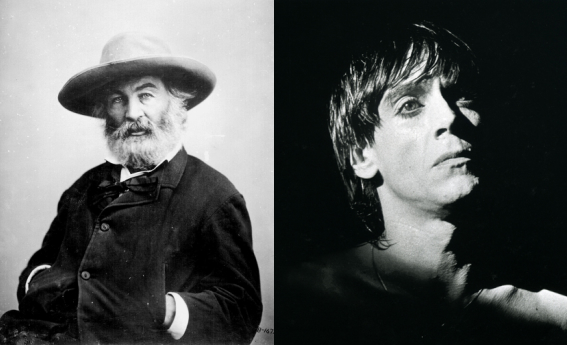
Image of Iggy Pop by Patrick McAlpine, via Wikimedia Commons
I don’t know why no one thought of this ages ago: an album of Walt Whitman’s poetry, set to moody, atmospheric electronic music and read by former Stooge and current American badass Iggy Pop. It makes perfect sense. Though Pop may lack Whitman’s verbal excesses, preferring more Spartan punk rock statements, he perfectly embodies—in a very literal way—Whitman’s fearless, sexually-charged “barbaric yawp.” And both artists are very much American originals: largely self-taught Whitman cast aside 19th-century decorum and formal constraints to write wildly expressive verse that celebrated the body, the individual, and American industrial noise; self-taught Pop cast aside 20th century rock formalism to create dangerously expressive music that celebrated… well, you get the idea.
I don’t know if he would have written “Now I wanna be your dog,” but in contrast to “the popular, well-educated poets of the time, those sensitive noblemen,” Whitman wrote—says Pop in his own distinctive paraphrase—“Fuc% as$.”
You know, I think he had something like Elvis. Like Elvis ahead of his time, one of the first manic American populists. You know you’re looking at pictures of him, and he was obviously someone who was very much involved with his own physical appearance. His poetry is always about motion and rushing ahead, and crazy love and blood pushing through the body. He would have been the perfect gangster rapper. Whitman says, even the most beautiful face is not as beautiful as the body. And to say that in the middle of the 19th century is outrageous. It’s a slap in the face.
Of the many rock and roll interpreters of literary greats we’ve featured on this site, I’d say Iggy Pop’s reading of, and commentary on, Whitman may be my favorite.
Unfortunately, we can only bring you a short excerpt, above, from Pop’s collaboration with instrumental duo Tarwater and German electronic artist Alva Noto (who recently scored Alejandro Iñárritu’s The Revenant with Yellow Magic Orchestra’s Ryuichi Sakamoto). This two-minute sample comes from a 2014 album these artists made together called Kinder Adams—Children of Adam, which features several abridged renditions in German of Whitman’s most famous book, Leaves of Grass by various voice actors, then a complete reading by Pop, set to a throbbing, haunting score.
Now, Pop, Alva Noto, and Tarwater have come together again to revisit Whitman with a seven-track EP simply titled Leaves of Grass. Like the early, self-published first edition of Whitman’s book, this work will only reach a few hands. “Released on Morr Music with no digital version planned,” reports Fact Mag, “Leaves of Grass is only available in a limited vinyl edition of just 500 copies, complete with embossed artwork.” You can purchase a copy of this artifact here (act fast), or—if you prefer your more traditional Iggy Pop without the literature, moody, post-rock soundscapes, and rarefied formats—wait for his new album in March with Queens of the Stone Age’s Josh Homme, sure to hit digital outlets near you. Whether or not he’s reading Whitman, he’s always channeling the poet’s energy.
Related Content:
Iggy Pop Reads Edgar Allan Poe’s Classic Horror Story, “The Tell-Tale Heart”
Tom Waits Reads Two Charles Bukowski Poems, “The Laughing Heart” and “Nirvana”
Walt Whitman’s Poem “A Noiseless Patient Spider” Brought to Life in Three Animations
Orson Welles Reads From America’s Greatest Poem, Walt Whitman’s “Song of Myself” (1953)
Josh Jones is a writer and musician based in Durham, NC. Follow him at @jdmagness
Read More...Alan Rickman Recites “If Death Is Not the End,” a Moving Poem by Robyn Hitchcock
Oddball singer-songwriter Robyn Hitchcock is a man who knows how to mark milestones. Back in 2003, he staged a concert at London’s Queen Elizabeth Hall in honor of his own 50th birthday, and in so doing, created a time release milestone of sorts for his friend, actor Alan Rickman.
Marking a half-century with passive aggressive-gag gifts and cards may suffice for the rabble, but a lyricist as gifted as Hitchcock deserves better. No one can deny Rickman of failing to deliver, when he regaled the crowd in Queen Elizabeth Hall with a recitation of Hitchcock’s own poem, “If Death Is Not the End,” above.
It’s an inimitable performance that becomes all the more poignant when one listens to it again, following Rickman’s recent death at the age of 69:
Life is what happened to the dead.
Forever we do not exist
Except for now.
Birthday Boy Hitchcock captured Rickman’s appeal in a tribute posted to his Facebook page:
His morose erotic drawl and gloriously disdainful demeanor sheltered a passionate artist and made for a charismatic performer whom I was proud to have as a friend. I just can’t believe I’ll never see him again.
As the poem says, he was made of life.
If Death Is Not the End
If death is not the end, I’d like to know what is.
For all eternity we don’t exist,
except for now.
In my gumshoe mac, I shuffled to the clifftop,
Stood well back,
and struck a match to light my life;
And as it flared it fell in darkness
Lighting nothing but itself.
I saw my life fall and thought:
Well, kiss my physics!
Time is over, or it’s not,
But this I know:
Life passes through us like the blade
Of bamboo growing through the prisoner pegged down in the glade
It pierces your blood, your screaming head -
Life is what happened to the dead.
Forever we do not exist
Except for now.
Life passes through us like a beam
Of charcoal green — a golden gleam,
The opposite of how it seems:
It’s not you that goes through life
- life is the knife that cuts your dream
Around the seam
And leaves you turned on in the stream, laughing with your mouth
open,
Until the stream is gone,
Leaving you cracked mud,
Not even there to be absent,
From the heartbeat of a dying fish.
In bed, upstairs, I feel your pulse run with the clock
And reach your hand
And lock us with our fingers
As if we were bumping above the Pole.
Yet I know by dawn
Your hand will be dry bone
I’ll have slept through your goodbye, no matter how long I wake.
Life winds on,
Through Cheri and Karl who can no longer smell chocolate,
Or see with wonder wind inflate the sail,
Or answer mail
Life flies on
Through Katy who was Catherine but is bound for Kate
Who looks over her shoulder at the demon Azmodeus,
And sees the Daily Mail
(I clutch my purse. I had it just now.)
Life slices through
The frozen butter in the Alpine wreck.
(I found your photo upside down
I never kissed a girl so long,
So long, so lovely or so wrong)
Life is what kills you in the end
And I can cry
But you won’t be there to be sorry
You were made of life
For ever we did not exist
We woke and for a second kissed.
Related Content:
The Late, Great Alan Rickman Reads Shakespeare, Proust & Thomas Hardy
Ayun Halliday is an author, illustrator, and Chief Primatologist of the East Village Inky zine. Her play, Fawnbook, opens in New York City later this fall. Follow her @AyunHalliday
Read More...Hear The Alan Parson Project’s Prog-Rock Interpretation of Isaac Asimov’s, I Robot (1977)
Progressive rock, at its best, meant bringing in techniques and influences not, up to that point, common in rock music. Part of this meant employing a kind of technical virtuosity more often heard in more established musical traditions, and another part meant drawing from a wider and deeper pool of musical and cultural influences than did other rock compositions. The Alan Parsons Project established their prog-rock credentials right out of the gate with their intricately crafted debut album Tales of Mystery and Imagination, not just based on the work of Edgar Allan Poe but including a reading from that work by none other than Orson Welles.
How to follow up a record like that? For an answer, Parsons and his collaborator in the Project Eric Woolfson turned from the past toward the future — or rather, toward Isaac Asimov’s vision of the future.
I Robot appeared in 1977, having taken its inspiration in the studio from Asimov’s Robot series, a universe of stories and novels which posited the invention of machines with something resembling human consciousness.
Asimov very much liked the idea of the album, but couldn’t—a production company having bought the rights to his 1950 book I, Robot—grant permission for a legally straight adaptation. And so Parsons and Woolfson stayed out of trouble by removing the comma from their title, and working forward from Asimov’s concepts rather than referencing them directly. The result stands up to the test of time better than most science fiction, and certainly better than most prog rock. You can listen and judge for yourself on Spotify, where the album recently appeared free to listen. (Don’t have Spotify’s software yet? You can download it here.)
You can also watch the rough but still haunting early music video for its hit “I Wouldn’t Want to Be Like You” at the top of the post. The album on the whole proved quite successful, due in large part, of course, to its musical craftsmanship and enduring story, described by the liner notes as that of “the rise of the machine and the decline of man, which paradoxically coincided with his discovery of the wheel.” But the timing couldn’t have hurt: I Robot came out just a few weeks after Star Wars, which stoked again humanity’s interest in far-flung realities, outer space journeys, near-mystical high technologies, and machines coming to life. In the words of Parsons himself, “there was a whole new generation of sci-fi lovers,” and his music had an important place in that generation’s soundtrack.
Related Content:
Hear Orson Welles Read Edgar Allan Poe on a Cult Classic Album by The Alan Parsons Project
Isaac Asimov Predicts in 1964 What the World Will Look Like Today — in 2014
Isaac Asimov’s Favorite Story “The Last Question” Read by Isaac Asimov— and by Leonard Nimoy
Free: Isaac Asimov’s Epic Foundation Trilogy Dramatized in Classic Audio
Isaac Asimov Explains the Origins of Good Ideas & Creativity in Never-Before-Published Essay
Isaac Asimov Explains His Three Laws of Robots
Based in Seoul, Colin Marshall writes and broadcasts on cities and culture. He’s at work on a book about Los Angeles, A Los Angeles Primer, the video series The City in Cinema, the crowdfunded journalism project Where Is the City of the Future?, and the Los Angeles Review of Books’ Korea Blog. Follow him on Twitter at @colinmarshall or on Facebook.
Read More...Professional Pickpocket Apollo Robbins Explains the Art of Misdirection
You’ve got to pick-a-pocket or two, boys
You’ve got to pick-a-pocket or two.
Unlike the Artful Dodger and other light-fingered urchins brought to life by Charles Dickens and, more recently, composer Lionel Bart, professional pickpocket Apollo Robbins confines his practice to the stage.
Past exploits include relieving actress Jennifer Garner of her engagement ring and basketball Hall-of-Famer Charles Barkley of a thick bankroll. In 2001, he virtually picked former U.S. president Jimmy Carter’s Secret Service detail clean, netting badges, a watch, Carter’s itinerary, and the keys to his motorcade. (Robbins wisely steered clear of their guns.)
How does he does he do it? Practice, practice, practice… and remaining hyper vigilant as to the things commanding each individual victims’s attention, in order to momentarily redirect it at the most convenient moment.
Clearly, he’s a put lot of thought into the emotional and cognitive components. In a TED talk on the art of misdirection, above, he cites psychologist Michael Posner’s “Trinity Model” of attentional networks. He has deepened his understanding through the study of aikido, criminal history, and the psychology of persuasion. He understands that getting his victims to tap into their memories is the best way to temporarily disarm their external alarm bells. His easygoing, seemingly spontaneous banter is but one of the ways he gains marks’ trust, even as he penetrates their spheres with a predatory grace.
Watch his hands, and you won’t see much, even after he explains several tricks of his trade, such as securing an already depocketed wallet with his index finger to reassure a jacket-patting victim that it’s right where it belongs. (Half a second later, it’s dropping below the hem of that jacket into Robbins’ waiting hand.) Those paws are fast!
I do wonder how he would fare on the street. His act depends on a fair amount of chummy touching, a physical intimacy that could quickly cause your average straphanger to cry foul. I guess in such an instance, he’d limit the take to one precious item, a cell phone, say, and leave the wallet and watch to a non-theoretical “whiz mob” or street pickpocket team.
Though he himself has always been scrupulous about returning the items he liberates, Robbins does not withhold professional respect for his criminal brothers’ moves. One real-life whiz mobber so impressed him during a television interview that he drove over four hours to pick the perp’s brains in a minimum security prison, a confab New Yorker reporter Adam Green described in colorful detail as part of a lengthy profile on Robbins and his craft.
One small detail does seem to have escaped Robbins’ attention in the second demonstration video below, in which reporter Green willingly steps into the role of vic’. Perhaps Robbins doesn’t care, though his mark certainly should. The situation is less QED than XYZPDQ.
While you’re taking notice, don’t forget to remain alert to what a potential pickpocket is wearing. Such attention to detail may serve you down at the station, if not onstage.
Related Content:
Watch Björk’s 6 Favorite TED Talks, From the Mushroom Death Suit to the Virtual Choir
The Kitty Genovese Myth and the Popular Imagination
Ayun Halliday is an author, illustrator, and Chief Primatologist of the East Village Inky zine. The sleeping bag-like insulating properties of her ankle-length faux leopard coat make her very popular with the pickpockets of New York. Follow her @AyunHalliday
Read More...Tiny Tim Performs a Bizarre Cover of Rod Stewart’s “Do Ya Think I’m Sexy” on The Tonight Show (1979)
In 1979, cult musician Tiny Tim ditched his ukulele and tiptoed out of the tulips to cover Rod Stewart’s “Do Ya Think I’m Sexy” on The Tonight Show, above.
The Gong Show-worthy performance left host Johnny Carson—and presumably the majority of home viewers—speechless.
Was it comedy or a fading, mentally unbalanced novelty act’s attempt to rekindle the passion of a fickle spotlight?
Maybe just a particularly unbridled foray into new artistic territory… Like his elaborately formal manners, Tiny Tim’s usual repertoire harkened to an earlier period. (“No one knew more about old music than Tiny Tim,” Bob Dylan once remarked.)
His oddly demure comportment is in short supply here as he veers from his customary falsetto to a more manly lower register, stripping off jacket and braces to showcase a portly, middle aged mid-section. Musicianship also seems a bit wanting, though to be fair, that’s rarely the criteria by which we measure the success of an act that ends with writhing on the floor.
Whatever his intentions, Tiny Tim’s place in the annals of WTF performance history would be secured on this turn alone.
A few years later, he recorded a 20s-tinged “Do Ya Think I”m Sexy” with Gary Lawrence & His Sizzling Syncopators, released inside a greeting card as a 6” flexi disc. The video, below, honors his vintage sensibilities while simultaneously screaming 1982.
Related Content:
George Harrison Explains Why Everyone Should Play the Ukulele, With Words and Music
Read More...David Bowie Lists His 25 Favorite LPs in His Record Collection: Stream Most of Them Free Online
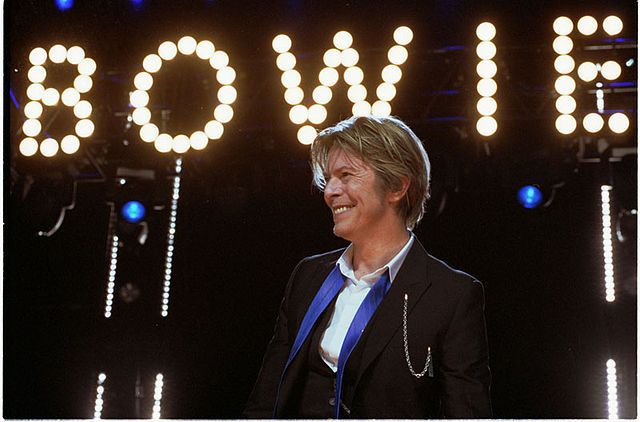
Image by Adam Bielawski, via Wikimedia Commons
This is the kind of thing we usually just mention on our Twitter stream. But perhaps you’re not following us there, and we didn’t want you to miss this.…
In 2003, David Bowie rummaged through his collection of 2500 vinyl LPs and created a list of his 25 favorite albums for Vanity Fair. The list came prefaced by these (and other) words:
If you can possibly get your hands on any of these, I guarantee you evenings of listening pleasure, and you will encourage a new high-minded circle of friends, although one or two choices will lead some of your old pals to think you completely barmy. So, without chronology, genre, or reason, herewith, in no particular order, 25 albums that could change your reputation.
Just as eclectic as you might expect, the list recommends everything from blues tunes by John Lee Hooker, minimalist compositions by Steve Reich, avant garde rock by The Velvet Underground, electronic music by The Electrosoniks, psychedelic folk music by The Incredible String Band, and the last works of Richard Strauss. You can view a copy of Bowie’s list here (and perhaps couple it with his list of 100 Favorite Books).
And despite his concerns about finding these albums in supply, you can stream most of his favorite albums for free on Spotify using the playlist above. (Yes, we got a little inspired and pulled it together.) If you need the software, download it here.
If you would like to support the mission of Open Culture, consider making a donation to our site. It’s hard to rely 100% on ads, and your contributions will help us continue providing the best free cultural and educational materials to learners everywhere. You can contribute through PayPal, Patreon, and Venmo (@openculture). Thanks!
Related Content:
Kurt Cobain Lists His 50 Favorite Albums: Features LPs by David Bowie, Public Enemy & More
Read More...How to Make a Book From Scratch
In a new video series from “How To Make Everything” — a Youtube channel dedicated to finding out how to break down complex production processes and make things from scratch — you can watch Andy George create a book using very traditional techniques. And when I say traditional, I mean traditional. He creates papyrus, parchment, ink and leather book covers by hand. And be warned, some parts may make you a bit squeamish. “The How to Make a Book” series is divided into eight separate videos. If you click play above, you can watch them all from start to finish.
If you would like to support the mission of Open Culture, consider making a donation to our site. It’s hard to rely 100% on ads, and your contributions will help us continue providing the best free cultural and educational materials to learners everywhere. You can contribute through PayPal, Patreon, and Venmo (@openculture). Thanks!
Related Content
1,000 Free Audio Books: Download Great Books for Free
Watch a Japanese Craftsman Lovingly Bring a Tattered Old Book Back to Near Mint Condition
The Birth and Decline of a Book: Two Videos for Bibliophiles
800 Free eBooks for iPad, Kindle & Other Devices
Read More...Support Us
We're hoping to rely on loyal readers, rather than erratic ads. Please click the Donate button and support Open Culture. You can use Paypal, Venmo, Patreon, even Crypto! We thank you!

About Us

Open Culture scours the web for the best educational media. We find the free courses and audio books you need, the language lessons & educational videos you want, and plenty of enlightenment in between.
Advertise With Us

FREE UPDATES!
GET OUR DAILY EMAIL
Get the best cultural and educational resources on the web curated for you in a daily email. We never spam. Unsubscribe at any time.
FOLLOW ON SOCIAL MEDIA

Open Culture editor Dan Colman scours the web for the best educational media. He finds the free courses and audio books you need, the language lessons & movies you want, and plenty of enlightenment in between.
Advertise With Us


