2,200 Radical Political Posters Digitized: A New Archive
I recently heard someone say his college-bound nephew asked him, “What’s a union?” Whether you love unions, loathe them, or remain indifferent, the fact that an ostensibly educated young person might have such a significant gap in their knowledge should cause concern. A historic labor conflict, after all, provided the occasion for Ronald Reagan to prove his bona fides to the new conservative movement that swept him into power. His crushing of the Professional Air Traffic Controllers Organization (PATCO) in 1981 set the tone for the ensuing 30 years or so of economic policy, with the labor movement fighting an uphill battle all the way. Prior to that defining event, unions held sway over politics local and national, and had consolidated power blocks in the American political landscape through decades of struggle against oppressive and dehumanizing working conditions.
In practical terms, unions have stood in the way of capital’s unceasing search for cheap labor and new consumer markets; in social and cultural terms, the politics of labor have represented a formidable ideological challenge to conservatives as well, by way of a vibrant assemblage of anarchists, civil libertarians, anti-colonialists, communists, environmentalists, pacifists, feminists, socialists, etc. A host of radical isms flourished among organized workers especially in the decades between the 1870s and the 1970s, finding their voice in newsletters, magazines, pamphlets, leaflets, and posters—fragile mediums that do not often weather well the ravages of time. Thus the advent of digital archives has been a boon for students and historians of workers’ movements and other populist political groundswells. One such archive, the Joseph A. Labadie Collection at the University of Michigan Library, has recently announced the digitization of over 2,200 posters from their collection, a database that spans the globe and the spectrum of leftist political speech and iconography.
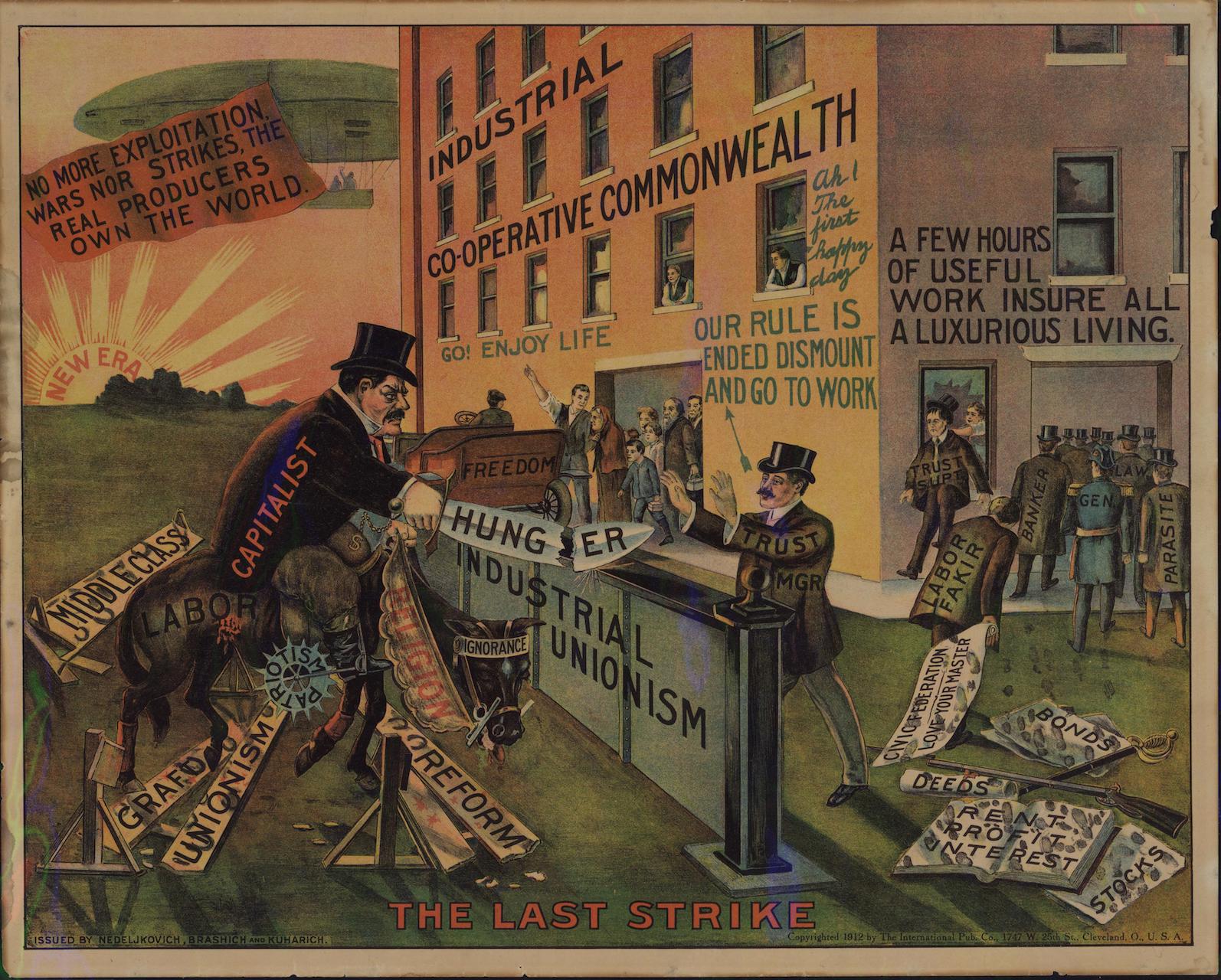
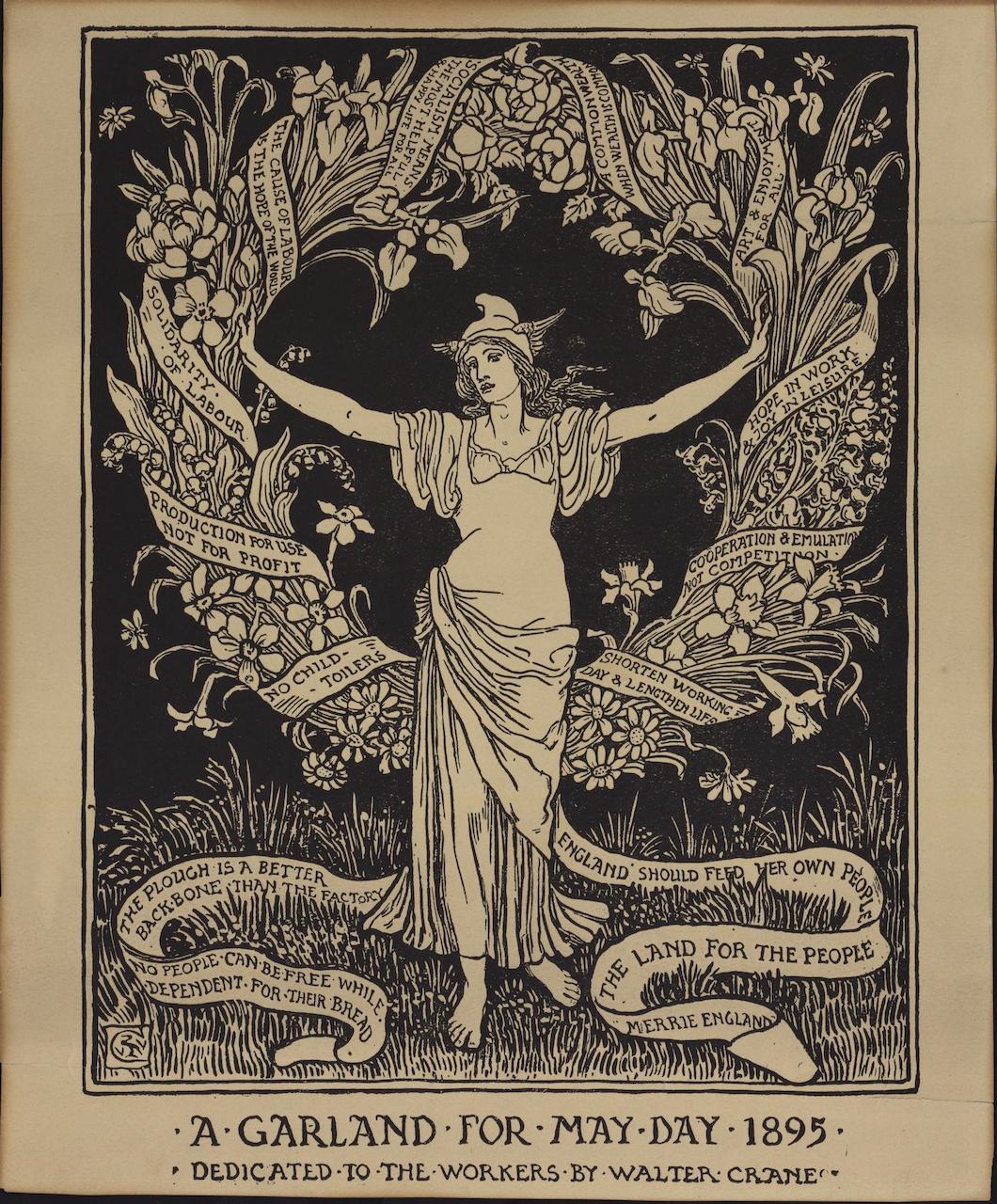
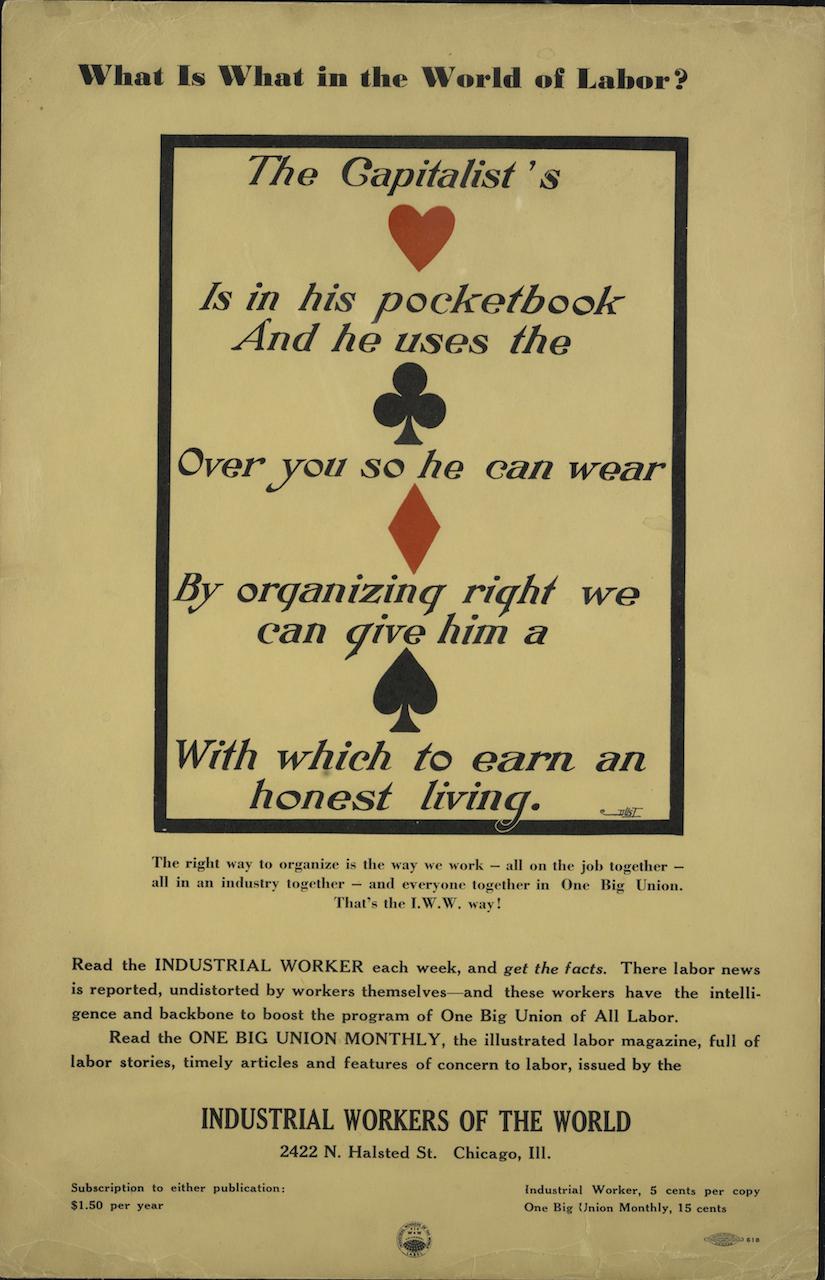
We have cleverly-designed visual puns like the Chicago Industrial Workers of the World poster just above, titled “What is what in the world of labor?” Promoting itself as “One Big Union of All Labor,” the IWW made some of the most ambitious propaganda, like the 1912 poster (middle) in which an “Industrial Co-Operative Commonwealth” replaces the tyranny of the capitalist, who is told by his “trust manager” peer, “Our rule is ended, dismount and go to work.” In this post-revolutionary fantasy, the IWW promises that “A few hours of useful work insure all a luxurious living,” though it only hints at the details of this utopian arrangement. Up top, we have an ornate May Day poster from 1895 by Walter Crane, hoping for a “Merrie England” with “No Child Toilers,” “Production for Use Not For Profit,” and “The Land For the People,” among other, more nationalist, sentiments like “England Should Feed Her Own People.”
“While all of the posters were scanned at high resolution,” writes Hyperallergic, “they appear online as thumbnails with navigation to zoom.” You can download the images, but only the smaller, thumbnail size in most cases. These hundreds of posters represent “just a portion of the material in the Labadie Collection”—named for a “Detroit-area labor organizer, anarchist, and author” who “had the idea for the social protest archive at the university in 1911.” You can view other political artifacts in the UMich library’s digital collections here, including anarchist pamphlets, political buttons, and a digital photo collection. The collection as a whole gives us a potentially inspiring, or infuriating, mosaic of political thought at its boldest and most graphically assertive from a time before online petitions and hashtag campaigns took over as the primary circulators of popular radical thought.
via Hyperallergic (where you can find some other big, visually striking posters)
Related Content:
Wonderfully Kitschy Propaganda Posters Champion the Chinese Space Program (1962–2003)
Free Online Political Science Courses
Josh Jones is a writer and musician based in Durham, NC. Follow him at @jdmagness
Read More...A Look Inside Martin Scorsese’s Vintage Movie Poster Collection
When Martin Scorsese isn’t making films, he’s busy preserving them, from helping fund the restoration of classics to collecting the ephemera of his youth, especially posters. A selection of his movie poster collection, representing the height of film advertising from the 1930’s to the 1960s, currently hangs at MoMA through October 25, 2015.
The power that a poster held in the imagination decades ago should not be understated. For many it was the only knowledge they had about the film they were about to see, and many artists, hired in house by the studios, hyped up the sexiest parts of the films. It sold tickets.
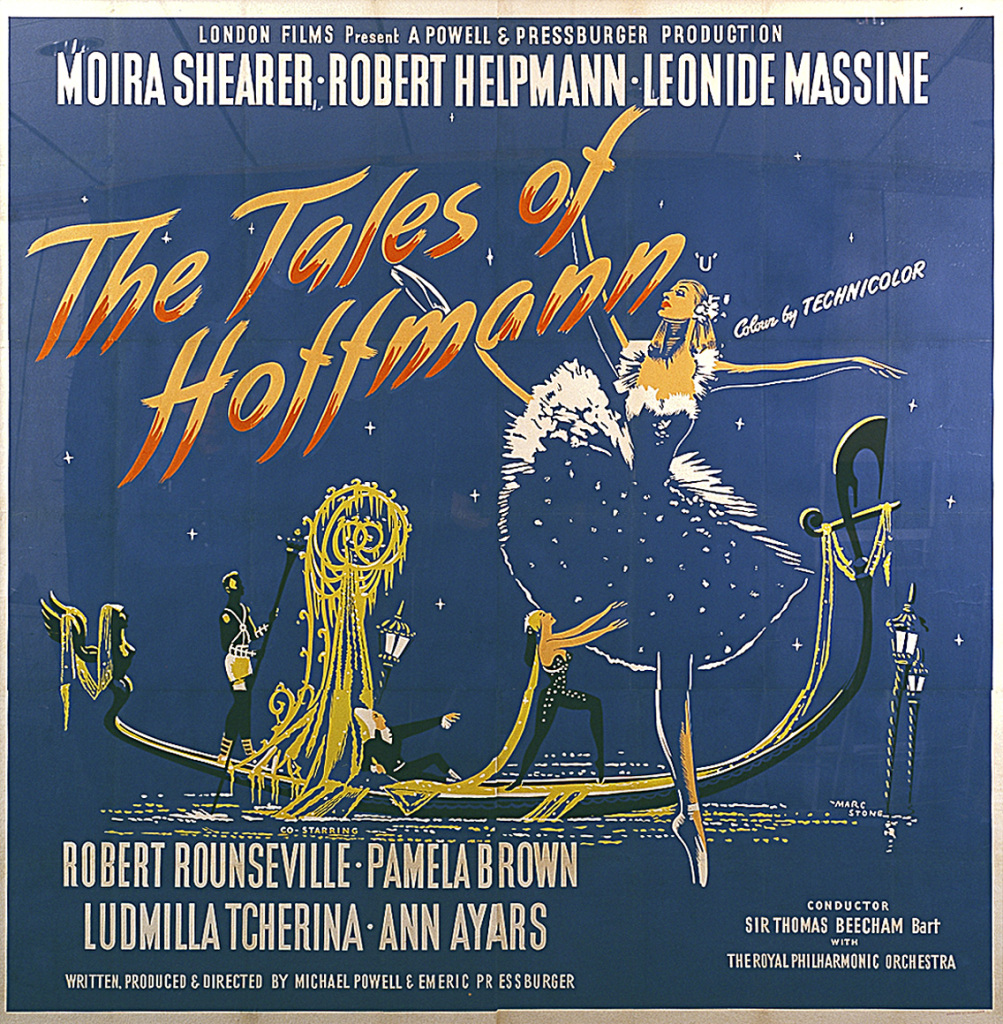
The MoMA exhibit is centered on the billboard sized poster for Powell and Pressburger’s Tales of Hoffmann (1951), a stunning work when seen large. (For an understanding about the impressive size of most posters, check out this graphic.)
It’s only because of collectors like Scorsese and Ira. M. Resnick (for whose book Scorsese wrote an introduction) that the artists behind these posters have been named and recognized.
Although the MoMA web page promoting the exhibition is surprisingly stingy when it comes to naming all the artists in the show, some internet sleuthing brings up some names. The illustrator behind the Hoffmann poster, Marc Stone, was also a painter of World War II propaganda posters in the UK.
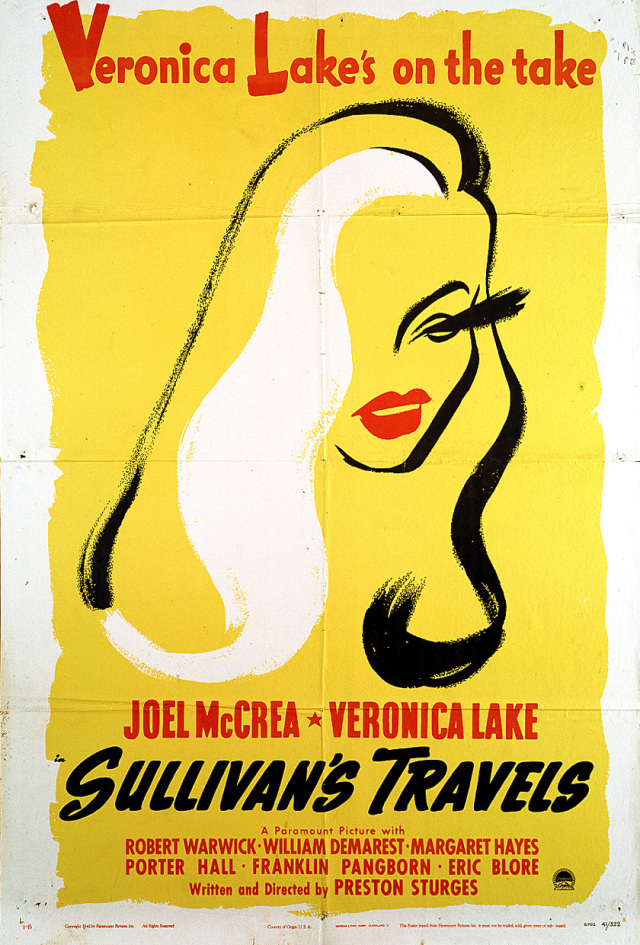
The minimal, Risko-esque rendering of Veronica Lake for Sullivan’s Travels (1941) is credited to Maurice Kallis, though an anonymous comment on the movie poster blog Citizen K. credits it to Fritz Siebel, the commenter’s father. Siebel, who immigrated to the U.S. from Vienna, wound up illustrating A Fly Went By for Dr. Seuss’ children’s book imprint and creating the famous Yul Brynner-lookalike and cleaning product mascot Mr. Clean.
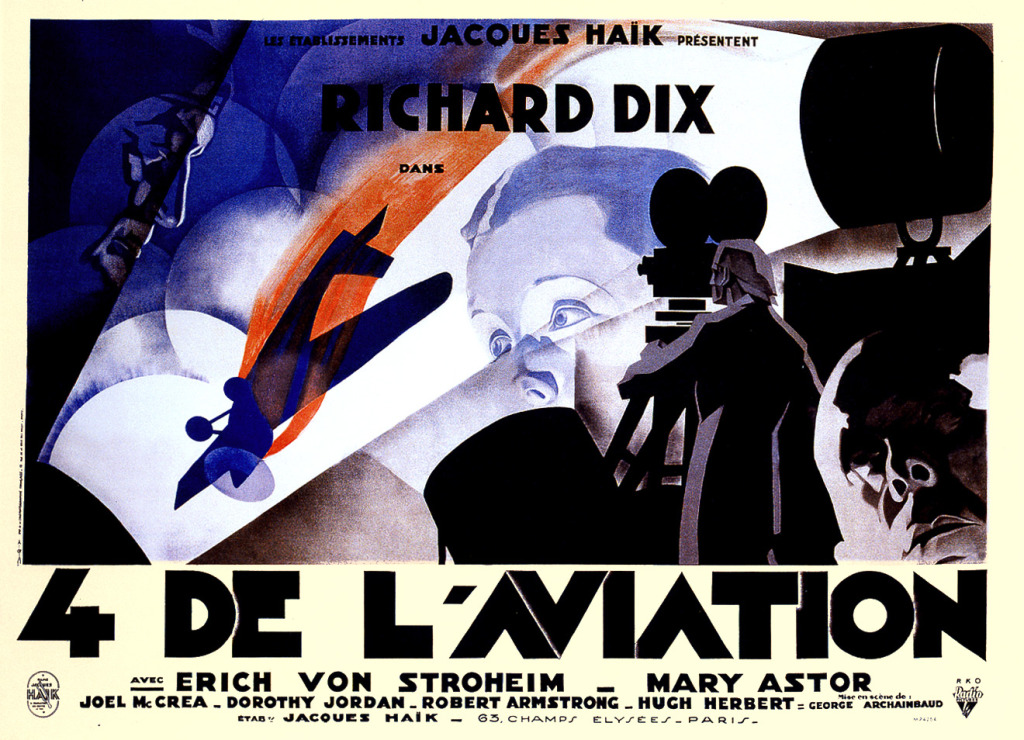
René Péron, who created the beautiful Expressionistic design for Erich von Stroheim’s The Lost Squadron (1932) started his career with posters for silent classics like Abel Gance’s Napoleon and Carl Theodor Dreyer’s The Passion of Joan of Arc (1928). But he’s probably best known for the iconic caricature of Jacques Tati gracing the poster for Mr. Hulot’s Holiday.
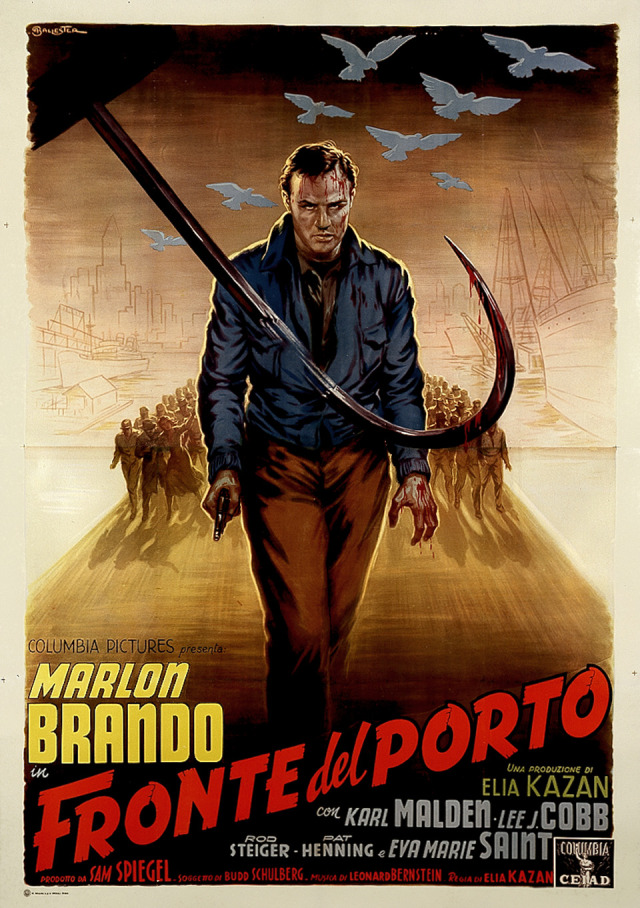
Both the poster for Powell and Pressburger’s Black Narcissus and Kazan’s On the Waterfront are by one of the Italian kings of movie posters, Anselmo Ballester. His style is lurid and pulpy, and if there is one dame in distress in a movie, he would make her the selling point of the poster. He was also known for his love of Rita Hayworth, for whom he would produce his best work. (Just look at this poster for Salome, which is way more interesting than the picture it represents.)
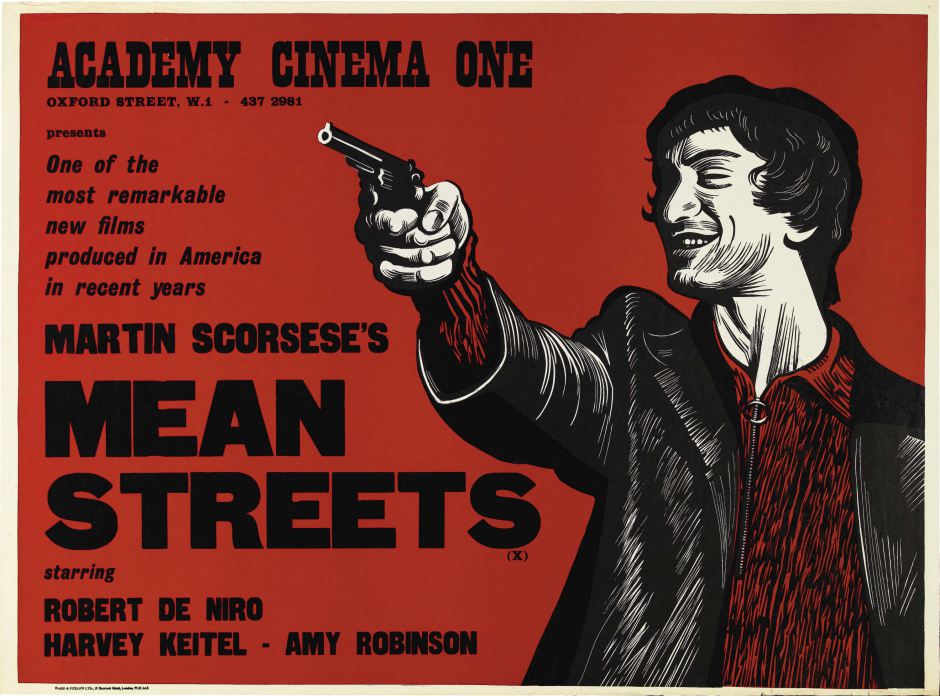
Lastly, Scorsese has added one of his own film’s posters: Peter Strausfeld’s stunning woodblock poster for Mean Streets. The British artist had a very particular style (text on one side, graphic on the other), and was hired by the Academy Cinema in London as their designer. (Now, *that’s* a job.)
The fact that we can watch trailers on our televisions and now iPhones has long diminished the power of the poster. However, there are still signs of life in the industry, and the amount of artists creating beautiful limited edition prints of posters for their favorite films increases every year.
via Quartz
Related content:
50 Film Posters From Poland: From The Empire Strikes Back to Raiders of the Lost Ark
100 Greatest Posters of Film Noir
Martin Scorsese Reveals His 12 Favorite Movies (and Writes a New Essay on Film Preservation)
Gaze at Global Movie Posters for Hitchcock’sVertigo: U.S., Japan, Italy, Poland & Beyond
The Strange and Wonderful Movie Posters from Ghana: The Matrix, Alien & More
Ted Mills is a freelance writer on the arts who currently hosts the FunkZone Podcast. You can also follow him on Twitter at @tedmills, read his other arts writing at tedmills.com and/or watch his films here.
Read More...George Orwell Blasts American Fashion Magazines (1946)

While the print magazine industry as a whole has seen better days, publications dedicated to women’s fashion still go surprisingly strong. Perhaps as a result, they’ve continued to attract criticism, not least for their highly specific, often highly altered visions of the supposedly ideal body image emblazoned across their covers. One critic called it an “overbred, exhausted, even decadent style of beauty,” with nearly all of the women on display “immensely elongated” with narrow hips and “slender, non-prehensile hands like those of a lizard.”
This hardly counts as a recent phenomenon; that particular criticism comes from 1946, the critic none other than Animal Farm and 1984 author George Orwell. He lodged his complaint against an “American fashion magazine which shall be nameless” in his “As I Please” column for the British Tribune. The New Republic, which subsequently ran Orwell’s broadside stateside, re-published it on their web site last year. On the magazine’s cover Orwell sees a photograph of “the usual elegant female, standing on a chair while a gray-haired, spectacled, crushed-looking man in shirtsleeves kneels at her feet” — a tailor about to take a measurement. “But to a casual glance he looks as though he were kissing the hem of the woman’s garment—not a bad symbolical picture of American civilization.”
But this wouldn’t count as an Orwellian indictment of the state of Western society without a harsh assessment of the language used, and the author of “Politics and the English Language” doesn’t neglect to make one here. In the fashion magazine Orwell finds “an extraordinary mixture of sheer lushness with clipped and sometimes very expensive technical jargon. Words like suave-mannered, custom-finished, contour-conforming, mitt-back, inner-sole, backdip, midriff, swoosh, swash, curvaceous, slenderize and pet-smooth are flung about with evident full expectation that the reader will understand them at a glance. Here are a few sample sentences taken at random”:
“A new Shimmer Sheen color that sets your hands and his head in a whirl.” “Bared and beautifully bosomy.” “Feathery-light Milliken Fleece to keep her kitten-snug!” “Others see you through a veil of sheer beauty, and they wonder why!” “An exclamation point of a dress that depends on fluid fabric for much of its drama.” “The miracle of figure flattery!” “Molds your bosom into proud feminine lines.” “Isn’t it wonderful to know that Corsets wash and wear and whittle you down… even though they weigh only four ounces!” “The distilled witchery of one woman who was forever desirable… forever beloved… Forever Amber.” And so on and so on and so on.
From what I can tell by the fashion magazines of 2015 my girlfriend leaves around the house, while the specific terminology might have changed, the brand-strewn overall wordscape of meaninglessness and obscurantism remains. Orwell surely didn’t foresee that lamentable linguistic and aesthetic situation changing any time soon — though it might surprise him that, despite it all, American civilization itself, in its characteristically unsleek, inelegant, and provisional way, has continued lumbering on.
You can read Orwell’s short essay on Fashion here.
Related Content:
George Orwell Reviews Mein Kampf (1940)
The Only Known Footage of George Orwell (Circa 1921)
George Orwell and Douglas Adams Explain How to Make a Proper Cup of Tea
For 95 Minutes, the BBC Brings George Orwell to Life
George Orwell’s Final Warning: Don’t Let This Nightmare Situation Happen. It Depends on You!
Colin Marshall writes on cities, language, Asia, and men’s style. He’s at work on a book about Los Angeles, A Los Angeles Primer, and the video series The City in Cinema. Follow him on Twitter at @colinmarshall or on Facebook.
Read More...Fritz Lang Invents the Video Phone in Metropolis (1927)
On Monday, we brought you evidence that Stanley Kubrick invented the tablet computer in 1968’s 2001: A Space Odyssey. Today, we go back forty years further into cinematic history to ask whether Fritz Lang invented the video phone in 1927’s Metropolis. In the clip above, you can watch a scene set in the home of Joh Fredersen, stern master of the vast, futuristic, titular industrial city of 2026. In order to best rule all he surveys — and to complete the image of a 20th-century dystopia — he lives high above the infernal roil of Metropolis, safely ensconced in one of its vertiginous towers and equipped with the latest hulking, wall-mounted, inexplicably paper-spouting video phone technology.
Fredersen, writes Joe Malia in his notes on video phones in film, “appears to use four separate dials to arrive at the correct frequency for the call. Two assign the correct call location and two smaller ones provide fine video tuning. He then picks up a phone receiver with one hand and uses the other to tap a rhythm on a panel that is relayed to the other phone and displayed as flashes of light to attract attention.”
Not content to infer the mechanics of these imaginary devices, Malia would go on to create the supercut below, a survey of video phones throughout the history of film and television, from Metropolis onward, including a stop at 2001:
The supercut also includes a clip from Ridley Scott’s Blade Runner, whose (on the whole, astonishingly timeless) design I called out for using video phones in a video essay of my own. In reality, contrary to all these 20th-century visions of the far-flung future, video phone technology didn’t develop quite as rapidly as predicted, and when it did develop, it didn’t spread in quite the same way as predicted. Even the rich world of 2015 lacks bulky video phone boxes in every home and on every street corner, but with voice over internet protocol services like Skype, many in even the poorest parts of the world can effectively make better video phone calls than these grand-scale sci-fi productions dared imagine — then again, they do often make them on tablets more or less straight out of 2001.
Related Content:
Did Stanley Kubrick Invent the iPad in 2001: A Space Odyssey?
A 1947 French Film Accurately Predicted Our 21st-Century Addiction to Smartphones
Nikola Tesla Accurately Predicted the Rise of the Internet & Smart Phone in 1926
Colin Marshall writes on cities, language, Asia, and men’s style. He’s at work on a book about Los Angeles, A Los Angeles Primer, and the video series The City in Cinema. Follow him on Twitter at @colinmarshall or on Facebook.
Read More...Watch an Animation of Jonathan Safran Foer’s New Story, “Love Is Blind and Deaf”
Briefly noted: Jonathan Safran Foer (Extremely Loud and Incredibly Close and Everything Is Illuminated) has a new short story, “Love Is Blind and Deaf,” in the Summer Fiction Issue of The New Yorker. And, by short, I mean short. His quirky Adam and Eve story runs 592 words.
You can read the story free online here (if you haven’t exceeded the monthly quota of The New Yorker’s paywall). Or, if you’re more visual, you can watch an animated adaptation of the story above. Directed by Gur Bentwich and animated by Ofra Kobliner, the video was produced by Storyvid, a nonprofit production company that aspires to create “the literary equivalent of a music video.”
For more Foer, listen to him read Amos Oz’s story, “The King of Oz,” which otherwise appears in our collection of 630 Free Audio Books.
If you would like to support the mission of Open Culture, consider making a donation to our site. It’s hard to rely 100% on ads, and your contributions will help us continue providing the best free cultural and educational materials to learners everywhere. You can contribute through PayPal, Patreon, and Venmo (@openculture). Thanks!
Related Content
700 Free eBooks for iPad, Kindle & Other Devices
The New Yorker’s Fiction Podcast: Where Great Writers Read Stories by Great Writers
Read More...The Psychology of Messiness & Creativity: Research Shows How a Messy Desk and Creative Work Go Hand in Hand

You may have come into contact at some point with Tracey Emin’s My Bed, an art installation that reproduces her private space during a time when she spent four days as a shut-in in 1998, “heartbroken”: the bed’s unmade, the bedside strewn with cigarettes, moccasins, a bottle of booze, food, and “what appears to be a sixteen year old condom”…. If you were savvy enough to be Tracey Emin in 1998—and none of us were—you would have sold that messy room for over four million dollars last year at a Christie’s auction. I doubt another buyer of that caliber will come along for a knock-off, but this doesn’t mean the messes we make while slobbing around our own homes are without their own, intangible, value.
Those messes, in fact, may be seedbeds of creativity, confirming a cliché as persistent as the one about doctors’ handwriting, and perhaps as accurate. It seems a messy desk, room, or studio may genuinely be a mark of genius at work. Albert Einstein for example, writes Elite Daily, had a desk that “looked like a spiteful ex-girlfriend had a mission to destroy his workspace.” Einstein responded to criticism of his work habits by asking, “If a cluttered desk is a sign of a cluttered mind, then what are we to think of an empty desk?”
Mark Twain also had a messy desk, “perhaps even more cluttered than that of Albert Einstein.” To find out whether the messiness trait’s relation to creativity is simply an “urban legend” or not, Kathleen Vohs (a researcher at the University of Minnesota’s Carlson School of Management) and her colleagues conducted a series of experiments in both tidy and unruly spaces with 188 adults given tasks to choose from.
Vohs describes her findings in the New York Times, concluding that messiness and creativity are at least very strongly correlated, and that “while cleaning up certainly has its benefits, clean spaces might be too conventional to let inspiration flow.” But there are trade-offs. Read about them in Vohs’ paper—“Physical Order Produces Healthy Choices, Generosity, and Conventionality, Whereas Disorder Produces Creativity.” And just above, see Vohs’ co-author Joe Redden, Assistant Professor of Marketing at the University of Minnesota’s Carlson School of Management, discuss the team’s fascinating results. If conducting such an experiment on yourself, it might be best to do so in a space that’s all your own, though, like the rest of us, you’re too late to creatively turn the mess you make into lucrative conceptual art.
Related Content:
Why You Do Your Best Thinking In The Shower: Creativity & the “Incubation Period”
John Cleese’s Philosophy of Creativity: Creating Oases for Childlike Play
Josh Jones is a writer and musician based in Durham, NC. Follow him at @jdmagness
Read More...Meta Star Wars: All Six Films in One
We’ve shown our fair share of Star Wars mashups and fan films over the years. I cite for example:
- Hardware Wars: The Mother of All Star Wars Fan Films (and the Most Profitable Short Film Ever Made)
- A 2 Hour Annotated Star Wars Film That Reveals the Cinematic Influences Behind George Lucas’ Classic Film
- Fans Reconstruct the Authentic Version of Star Wars, As It Was Shown in Theaters in 1977.
- Star Wars Recut as Silent Film
The latest and maybe not greatest fan reworking of Star Wars (now available on YouTube) lets you watch all six Star Wars films online. At once. With one film layered upon the other.
Is there some cultural value to this layering of films? Maybe only insofar as it gives the keen observer the chance to find some meta trends running through the films. One YouTuber commented, “The really interesting part is that they’re similarly paced. If you skip around you’ll almost always find all talking scenes lined up and all action scenes lined up. Just shows how formulaic movies are (or at least how formulaic George Lucas is).”
Feel free to drop your own observations in the comments section below. And, by the way, the person who created this mashup has also made available a full gallery of HD still frames on imgur here.
Follow us on Facebook, Twitter, Google Plus and LinkedIn and share intelligent media with your friends. Or better yet, sign up for our daily email and get a daily dose of Open Culture in your inbox.
Read More...Free: Read 9 Travel Books Online by Monty Python’s Michael Palin

Image courtesy of Chipps
Most of us come to Michael Palin through his work as a comic actor (in the role of dead parrot salesman or otherwise), but at this point almost as many know him second as a founding member of Monty Python, and first as an affable globetrotter. That part of his career began in 1988, when he hosted the Earth-circumnavigating BBC travel series Around the World in 80 Days. (See an episode here.) Its success has led him, over the subsequent 27 years, onto further (and farther-flung) televised journeys: from the North Pole to the South, around the Pacific Rim, in the adventurous footsteps of Ernest Hemingway, across the Sahara, up the Himalayas, across the “new” central and eastern Europe, around the world again, and most recently through Brazil.
Not content to set a high watermark for travel television, Palin has also written a companion book for each series, lavishly collecting maps, pictures, and his own travel diaries. Those last reveal a more nuanced side of “the nicest chap in Britain,” whose famously easygoing, deferential, and unsurprisingly good-humored persona place him so well to deal with the world’s staggering variety of people, places, and inconveniences. “I can summon up nothing but resignation at the thought of cooking with the locals all morning, then having to listen to music and songs I don’t understand for the rest of the afternoon,” he writes after waking up on yet another island, in an entry excerpted in last year’s Travelling to Work, the latest published volume of his life’s diaries. “And, worst of all, having to look as if I’m enjoying it.”
But these books also reveal that most of the time, Palin really is enjoying it. His insatiable curiosity (not to mention his inexorable production schedule) drives him continuously ahead, a curiosity in which you, too can share now that he’s made all these books free to read online at palinstravels.co.uk. Click on the links/titles below, and then look for the prompts that say “Discover the Series Here” and, below that, “Start Reading the Book.”
- Around the World in 80 Days
- Pole to Pole
- Full Circle
- Hemingway Adventure
- Sahara
- Himalaya
- New Europe
- 80 Days Revisited
- Brazil
And if you make a free account at the site, it will even allow you to you keep virtual “bookmarks” in as many of the books as you like, guaranteeing that you won’t get lost amidst this wealth of travel content. But if you choose to follow Palin’s example and actually get out there into every corner of the world, well, no such anti-lostness guarantees exist — but as every fan of Palin’s Travels knows, those very complications make it worthwhile. As least you won’t have a five-man crew trailing behind.
Related Content:
Trains and the Brits Who Love Them: Monty Python’s Michael Palin on Great Railway Journeys
Michael Palin’s Tour of the Best Loved Monty Python Sketch Locations
Colin Marshall writes on cities, language, Asia, and men’s style. He’s at work on a book about Los Angeles, A Los Angeles Primer, and the video series The City in Cinema. Follow him on Twitter at @colinmarshall or on Facebook.
Read More...Christopher Lee Reads “The Tell-Tale Heart,” Edgar Allan Poe’s 1843 Classic
Last Friday, after we marked the passing of Christopher Lee by featuring his reading of Edgar Allan Poe’s 1845 narrative poem “The Raven,” we stumbled, by chance, upon Lee’s reading of another Poe classic–“The Tell-Tale Heart.” Operating with the theory that there’s no such thing as too much Edgar Allan Poe, and certainly no such thing as too much Christopher Lee reading Edgar Allan Poe, we’ve featured that second reading above. It’ll be added to our collection of Free Audio Books…
via the Edgar Allan Poe Facebook Page
If you would like to support the mission of Open Culture, consider making a donation to our site. It’s hard to rely 100% on ads, and your contributions will help us continue providing the best free cultural and educational materials to learners everywhere. You can contribute through PayPal, Patreon, and Venmo (@openculture). Thanks!
Read More...Hear Friedrich Nietzsche’s Classical Piano Compositions: They’re Aphoristic Like His Philosophy
In March, we featured 43 original tracks of classical music by philosopher and self-taught composer Friedrich Nietzsche, better known as the author of books like Thus Spoke Zarathustra and Beyond Good and Evil. Despite the enduring importance of his textual output, Josh Jones noted that “what Nietzsche loved most was music.” He “found the mundane work of politics and nationalist conquest, with its tribalism and moral pretensions, thoroughly distasteful. Instead, he considered the creative work of artists, writers, and musicians, as well as scientists, of paramount importance.”
Today we offer more of the eccentric, highly opinionated 19th-century German philosopher’s musical side. In the playlist just above, you can hear his piano compositions as collected on Michael Krücker’s Friedrich Nietzsche: Complete Solo Piano Works. “Most of the works on this album date from the 1860s, when [Nietzsche] was a celebrated young professor and philosopher,” writes AllMusic’s James Manheim. “The music is light, often quasi-improvisatory, and some of it resembles the keyboard music of the composer whom Nietzsche extolled later in life, Georges Bizet. The most substantial piece, the 20-minute Hymnus an die Freundschaft, was essentially his last composition, but he later reworked it with texts by his then-love interest, Lou Andreas-Salomé; that version was later arranged for chorus and orchestra by another composer.”
Manheim also notes that this selection of piano pieces, in their brevity, suggest that “the aphoristic style of Nietzsche’s late writings was anticipated by his musical thinking.” Enthusiasts of Nietzsche’s life and career will certainly find themselves making even more connections between his musical and philosophical work than that. But those looking for his motivation to work in this purest of all arts perhaps need look no further than this typically unequivocal pronouncement: “Without music, life would be a mistake.”
You can find more Nietzschean piano compositions below, these performed by Dorothea Klotz. To hear the music, you will need to download Spotify’s free software, if you haven’t already.
Hear Classical Music Composed by Friedrich Nietzsche: 43 Original Tracks
130+ Free Online Philosophy Courses
The Philosophy of Nietzsche: An Introduction by Alain de Botton
The Digital Nietzsche: Download Nietzsche’s Major Works as Free eBooks
Colin Marshall writes on cities, language, Asia, and men’s style. He’s at work on a book about Los Angeles, A Los Angeles Primer, and the video series The City in Cinema. Follow him on Twitter at @colinmarshall or on Facebook.
Read More...
Support Us
We're hoping to rely on loyal readers, rather than erratic ads. Please click the Donate button and support Open Culture. You can use Paypal, Venmo, Patreon, even Crypto! We thank you!

About Us

Open Culture scours the web for the best educational media. We find the free courses and audio books you need, the language lessons & educational videos you want, and plenty of enlightenment in between.
Advertise With Us

FREE UPDATES!
GET OUR DAILY EMAIL
Get the best cultural and educational resources on the web curated for you in a daily email. We never spam. Unsubscribe at any time.
FOLLOW ON SOCIAL MEDIA

Open Culture editor Dan Colman scours the web for the best educational media. He finds the free courses and audio books you need, the language lessons & movies you want, and plenty of enlightenment in between.
Advertise With Us