Vladimir Nabokov’s Hand-Drawn Sketches of Mind-Bending Chess Problems
Most of us strive to achieve some kind of distinction—or competence—in one, often quite narrow, field. And for some of us, the path to success involves leaving behind many a path not taken. Childhood pursuits like ballet, for example, the high jump, the trumpet, acting, etc. become hazy memories of former selves as we grow older and busier. But if you have the formidable will and intellect of émigré Russian novelist Vladimir Nabokov, you see no need to abandon your beloved avocations simply because you are one of the 20th century’s most celebrated writers—in both Russian and English. No indeed. You also go on to become a celebrated amateur lepidopterist (see his butterfly drawings here), earning distinction as curator of lepidoptera at Harvard’s Museum of Comparative Zoology and originator of an evolutionary theory of butterfly migration. And as if that were not enough, you spend your spare time formulating complicated chess problems, earning such a reputation that you are invited in 1970 to join the American chess team to create problems for international competitions.
Nabokov was not easily impressed by other writers or scientists, but he held chess players in especially high regard. His “heroes include a chess grandmaster,” writes Nabokov scholar Janet Gezari, “and a chess problem composer…; chess games occur in several of the novels; and chess and chess problem language and imagery regularly put his readers’ chess knowledge to the test.” His third novel, 1930’s The Defense, centers on a chess master driven to despair by his genius, a character based on real grandmaster Curt von Bardeleben. For Nabokov, the skill and ingenuity required for composing chess problems paralleled that required for great writing: “The strain on the mind is formidable,” he wrote in his memoir Speak, Memory, “the element of time drops out of one’s consciousness.” Puzzling out chess problems and solutions, he wrote, “demand from the composer the same virtues that characterize all worthwhile art: originality, invention, conciseness, harmony, complexity and splendid insincerity”—all qualities, we’d have to agree, of Nabokov’s finely wrought fictions.
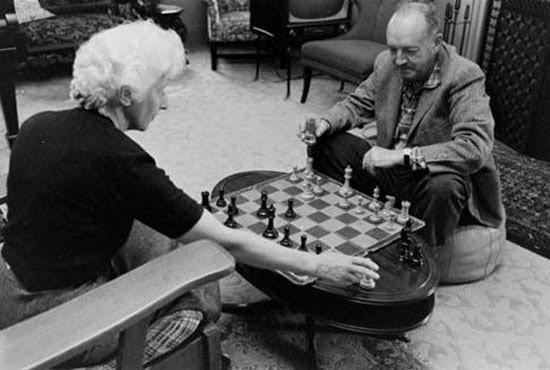
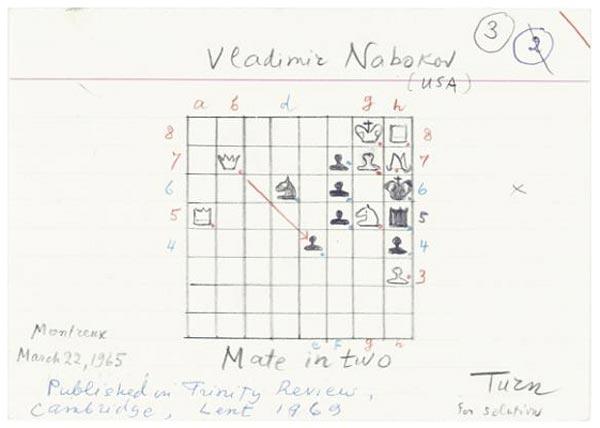
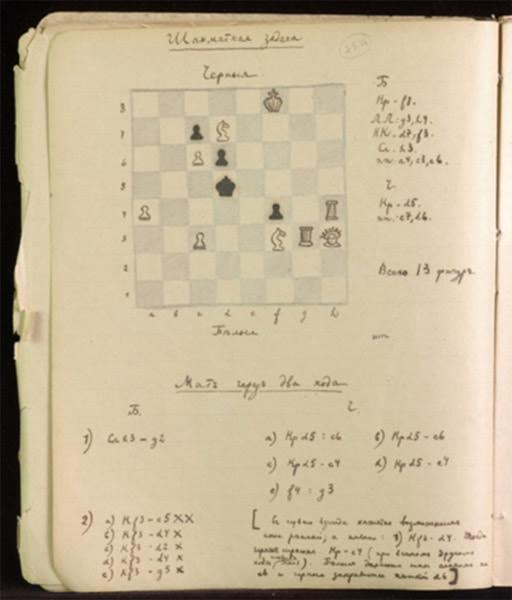
In 1970, Nabokov published Poems and Problems, a collection of thirty-nine Russian poems, with English translations, fourteen English poems, and eighteen chess problems, with solutions. He had pursued this passion since his teens, and published nearly three dozen chess problems in his lifetime. At the top of the post, see one of them, “Mate in 2,” sketched out in Nabokov’s hand (try to solve it yourself here). Below it, see another of the author’s chess problem sketches, and in the photo above, see Nabokov absorbed in a chess game with his wife.
Though it may seem that Nabokov had limitless energy and time to devote to his extra-literary pursuits, he also wrote with regret about the price he paid for his obsession: “the possessive haunting of my mind,” as he called it, “with carved pieces or their intellectual counterparts swallowed up so much time during my most productive and fruitful years, time which I could have better spent on linguistic adventures.” Like the lepidopterists still marveling over Nabokov’s contributions to that field, the chess lovers who encounter his problems, and his ingenious use of the game in fiction, would hardly agree that his pursuit of chess was fruitless or unproductive.
Related Content:
Vladimir Nabokov’s Delightful Butterfly Drawings
Vladimir Nabokov Creates a Hand-Drawn Map of James Joyce’s Ulysses
Vladimir Nabokov Names the Greatest (and Most Overrated) Novels of the 20th Century
Josh Jones is a writer and musician based in Durham, NC. Follow him at @jdmagness
Read More...The Two Gentlemen of Lebowski: What If The Bard Wrote The Big Lebowski?
We live in an age of mash ups. A few years ago some malcontent came up with Pride and Prejudice and Zombies. Our cities are teeming with food trucks hawking Korean tacos and ramen burgers. And chess boxing is apparently a thing. So perhaps it isn’t surprising that some evil genius would merge the most quotable movie of the past 20 years, The Big Lebowski, with William Shakespeare.
The resulting book, written by Adam Bertocci, is called Two Gentlemen of Lebowski, and it does a surprisingly good job of capturing the language of the Bard while staying true to the original movie. The author reportedly wrote the first draft of the book in a single sleepless weekend. An impressive feat that the author dismisses in an interview with CNN that you can see above.
“Anybody could, given the lack of a social life,” deadpans Bertocci, “take a weekend with a movie they admired and an author that they knew well and make a similarly lengthy mash up of it.”
In Bertocci’s fevered reworking (read the first 3 scenes for free here), the Dude is recast as The Knave. His belligerent best friend is Sir Walter of Poland. The hapless Donnie is Sir Donald of Greece. Knox Harrington, Mauve’s gratingly giggly conceptual artist friend, is in this version a tapestry artist. And of course, Da Fino, the PI, who shadows the Dude in the movie, is listed simply as Brother Seamus.
But where Bertocci really shines is in his clever appropriation of Shakespearean language. The film’s copious profanity has been replaced with more Bard-worthy epithets like “rash egg” or “varlet.” The word “verily” peppers the Knave’s dialogue as the word “like” peppers the Dude’s. And when Walter waxes poetic about the rules of bowling, he does so in iambic pentameter.
To get a sense of the differences, compare the clip above from the movie with the Bard-ofied text of the same scene below.
THE KNAVE’s house. Enter THE KNAVE, carrying parcels, and BLANCHE and WOO. They fight.
BLANCHE
Whither the money, Lebowski? Faith, we are as servants to Bonnie;
promised by the lady good that thou in turn were good for’t.WOO
Bound in honour, we must have our bond; cursed be our tribe
if we forgive thee.BLANCHE
Let us soak him in the chamber-pot, so as to turn his head.WOO
Aye, and see what vapourises; then he will see what is foul.They insert his head into the chamber-pot.
BLANCHE
What dreadful noise of waters in thine ears! Thou hast cool’d
thy head; think now upon drier matters.WOO
Speak now on ducats else again we’ll thee duckest; whither the
money, Lebowski?THE KNAVE
Faith, it awaits down there someplace; prithee let me glimpse
again.WOO
What, thou rash egg! Thus will we drown thine exclamations.They again insert his head into the chamber-pot.
BLANCHE
Trifle not with the fury of two desperate men. Long has thy
wife sealed a bond with Jaques Treehorn; as blood is to blood,
surely thou owest to Jaques Treehorn in recompense.WOO
Rise, and speak wisely, man—but hark;
I see thy rug, as woven i’the Orient,
A treasure from abroad. I like it not.
I’ll stain it thus; to deadbeats ever thus.He stains the rug.
THE KNAVE
Sir, prithee nay!BLANCHE
Now thou seest what happens, Lebowski, when the agreements
of honourable business stand compromised. If thou wouldst
treat money as water, flowing as the gentle rain from heaven,
why, then thou knowest water begets water; it will be a watery
grave your rug, drown’d in the weeping brook. Pray remember,
Lebowski.THE KNAVE
Thou err’st; no man calls me Lebowski. Hear rightly, man!—for
thou hast got the wrong man. I am the Knave, man; Knave in
nature as in name.BLANCHE
Thy name is Lebowski. Thy wife is Bonnie.THE KNAVE
Zounds, man. Look at these unworthiest hands; no gaudy gold
profanes my little hand. I have no honour to contain the ring. I
am a bachelor in a wilderness. Behold this place; are these the
towers where one may glimpse Geoffrey, the married man? Is
this a court where mistresses of common sense are hid? Not for
me to hang my bugle in an invisible baldric, sir; I am loath to
take a wife, or she to take me until men be made of some other
mettle than earth. Hark, the lid of my chamber-pot be lifted!
Personally, I’m hoping that the Globe Theatre stages a version of this.
While you are waiting for that to happen, you can see another scene from Two Gentlemen from Lebowski above where The Knave and Sir Walter commiserate about a rug, which was besmirched by a “most miserable tide.”
Related Content:
The Big Lebowski Reimagined as a Classic 8‑Bit Video Game
Watch the Coen Brothers’ TV Commercials: Swiss Cigarettes, Gap Jeans, Taxes & Clean Coal
Jonathan Crow is a Los Angeles-based writer and filmmaker whose work has appeared in Yahoo!, The Hollywood Reporter, and other publications. You can follow him at @jonccrow. And check out his blog Veeptopus, featuring lots of pictures of vice presidents with octopuses on their heads. The Veeptopus store is here.
Read More...Radiohead’s “Creep” Performed in a Vintage Jazz-Age Style
Smashing Pumpkins’ leader—and sole remaining original member—Billy Corgan is a man of many opinions, most of which I find easy to ignore. But in one of his recent made-for-headlines quotes, he referred to fellow nineties alt-rock superstars Radiohead as “the last band that did anything new with the guitar.” It is, of course, impossible to quantify this not-especially controversial statement, but I haven’t found it easy to dismiss either. After Radiohead’s first three albums, we had maybe a solid decade of musicians looking back to a time before electric guitars to find an alternate path forward (as Radiohead themselves largely traded guitars for synthesizers). That said, in the years since Pablo Honey, The Bends, and OK Computer, Thom Yorke and band’s breakout song, “Creep,” has successfully translated to so many unplugged arrangements that they deserve credit for writing a universally beloved new standard as well as reinventing rock guitar—even if they’d prefer we all forget their first, angst-ridden hit.
There’s Mexican actor Diego Luna’s powerful rendition, as the animated troubadour Manolo in Jorge Gutierrez’s Book of Life. There’s Tori Amos’ characteristically intense, live voice and piano version; there’s Amanda Palmer on ukulele, Damien Rice on acoustic guitar, and Korn—believe it or not—in a very tasteful acoustic cover. Now we can add to these the bring-down-the-house swing arrangement at the top of the post, with jazz singer Haley Reinhart, who slides from playful vamp to an almost gospel crescendo, and all, we’re told, on a first take. This jazz-age cover comes to us from pianist Scott Bradlee’s Postmodern Jukebox, a touring collection of ensemble musicians that Bradlee assembles to re-interpret famous pop songs. He previously recorded a sweet, classic soul cover of “Creep” with Karen Marie, above. The list of other Postmodern Jukebox covers ranges from a “Sad Clown with a Golden Voice” version of Lorde’s “Royals” to a klezmer take on Jason Derulo’s club anthem “Talk Dirty” (with the song’s 2 Chainz rap in Yiddish). We previously featured a New Orleans jazz rendition of “Sweet Child O’ Mine,” with stage actress and singer Miche Braden. As Ayun Halliday wrote of the Guns n’ Roses’ reimagining, the Radiohead covers above are “not without gimmick, but it’s a winning one.”
Related Content:
Guns N’ Roses “Sweet Child O’ Mine” Retooled as 1920s New Orleans Jazz
Patti Smith’s Passionate Covers of Jimi Hendrix, Nirvana, Jefferson Airplane & Prince
Listen to a New Album Featuring Tom Waits Songs in Hebrew (2013)
Hear 38 Versions of “September Song,” from James Brown, Lou Reed, Sarah Vaughan and Others
Josh Jones is a writer and musician based in Durham, NC. Follow him at @jdmagness
Read More...Allen Ginsberg’s Top 10 Favorite Films
Before Netflix killed Blockbuster, Blockbuster killed the mom and pop video store. Maybe you had your favorite ma and pa shop, where under the surface of new releases you’d find the quirky, curated selections that reflected the mind of the owner.
When Allen Ginsberg lived in New York’s East Village, it was Kim’s Video, opened in 1987 by Yongman Kim. With so many artists frequenting its St. Marks Place location, Kim asked its more famous customers to share their lists of top ten favorite films. Ginsberg obliged. And you can now find his top 10 list online (in two parts: Part 1 — Part 2) thanks to The Allen Ginsberg Project.
Ginsberg’s oldest choice is Sergei Eisenstein’s 1925 Battleship Potemkin, which you can watch above. One must wonder if it was the very poetic editing that drew Ginsberg to the film, or something else, perhaps, maybe the film’s revolutionary nature?
Many of Ginsberg’s choices reflect his interest in poetic realism, the French film movement that combined stories of real folks with sometimes very impressionist camera work. Three of its most famous proponents, Julian Duvivier, Jean Renoir, and Marcel Carné appear on the Ginsberg list.
Julian Duvivier’s Pépé le Moko (1937) is set in that most wonderful location for the Beat poets, Tangiers, and inspired Graham Greene to write The Third Man. Marcel Carné’s classic Children of Paradise (1945) makes the list, as does his 1938 film noir Port of Shadows. Jean Renoir’s The Grand Illusion, which still tops many top 10 film lists today, is here too.
Another Frenchman, Jean Cocteau gets on the list twice, with two films from his Orphic trilogy, The Blood of a Poet (1930) and Orpheé (1950). The mix of the dreamlike and the erotic make a perfect choice for the poet.
Ginsberg saves space for Beat cinema, a lot of which is still not on DVD. Ron Rice’s The Flower Thief (1960) is often called one of the main films of the Beat Generation, a largely improvised, low budget film about the artists and writers of San Francisco. It sadly remains unavailable on DVD, and one wonders if the film was even available at Kim’s, as it doesn’t appear to be on VHS either.
More available are his final two choices, Robert Frank and Alfred Leslie’s Pull My Daisy (1959), which was named after (and executed in a style similar to) an Exquisite Corpse-style poem written by Ginsberg, Jack Kerouac, and Neil Cassady in the late ‘40s. Also largely improvised, the film involves bohemian party crashers who make life complicated for a man and wife trying to impress a respectable bishop who’s come for dinner.
Lastly, Ginsberg names Harry Smith’s visionary cut-up animation masterpiece Heaven and Earth Magic (1957 — 1962), which you can see above. Smith was not just a superb filmmaker, but a great influence on the Beats through his interest in psychedelics and mysticism, as well as the man behind the American Anthology of Folk Music on Folkways records. A great friend of Ginsberg, Harry Smith gets the final tip of the hat.
via The Allen Ginsberg Project
Related Content:
13 Lectures from Allen Ginsberg’s “History of Poetry” Course (1975)
The First Recording of Allen Ginsberg Reading “Howl” (1956)
Ted Mills is a freelance writer on the arts who currently hosts the FunkZone Podcast. You can also follow him on Twitter at @tedmills, read his other arts writing at tedmills.com and/or watch his films here.
Read More...Vintage 1930s Japanese Posters Artistically Market the Wonders of Travel
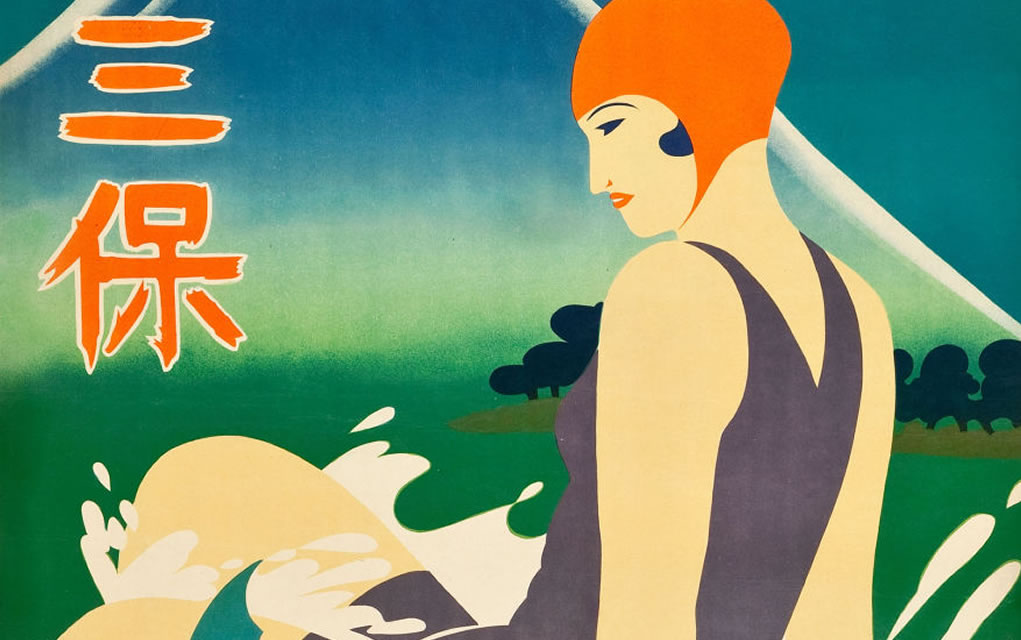
Earlier this year, we featured vintage Japanese print advertisements from the golden age of Art Deco and for such products as beer, sake, and cigarettes. If you like that sort of thing, you might consider paying attention to the recently launched Branding in Asia, a site detected to covering “the art of branding” as expressed in “the exciting new ideas and concepts exploding from the mind of Asia” — or the exciting old ideas and concepts which, aesthetically speaking, remain pretty explosive still.
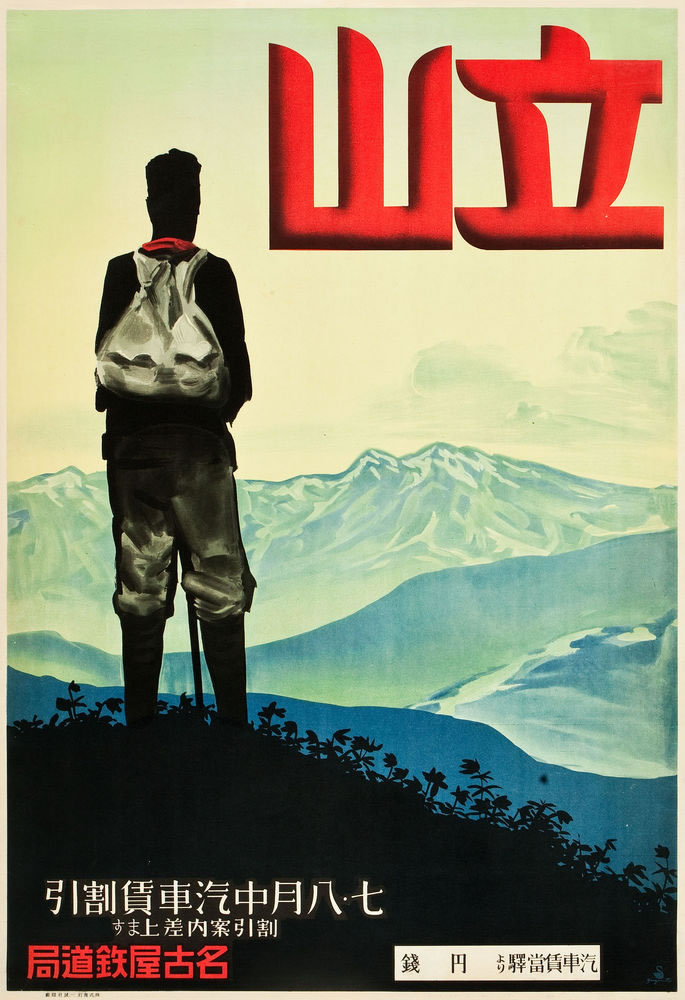
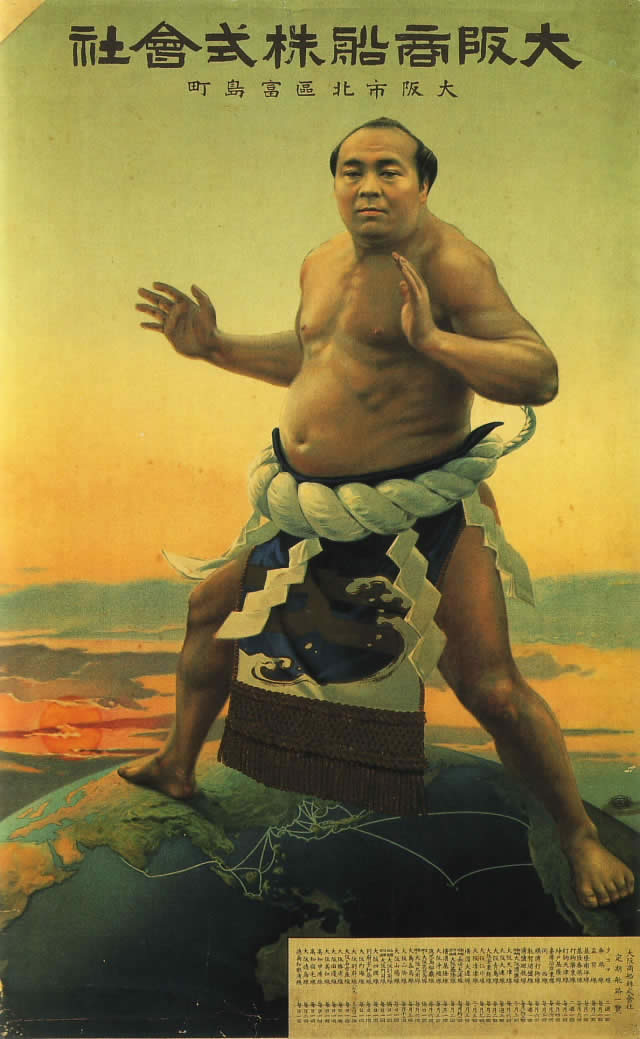
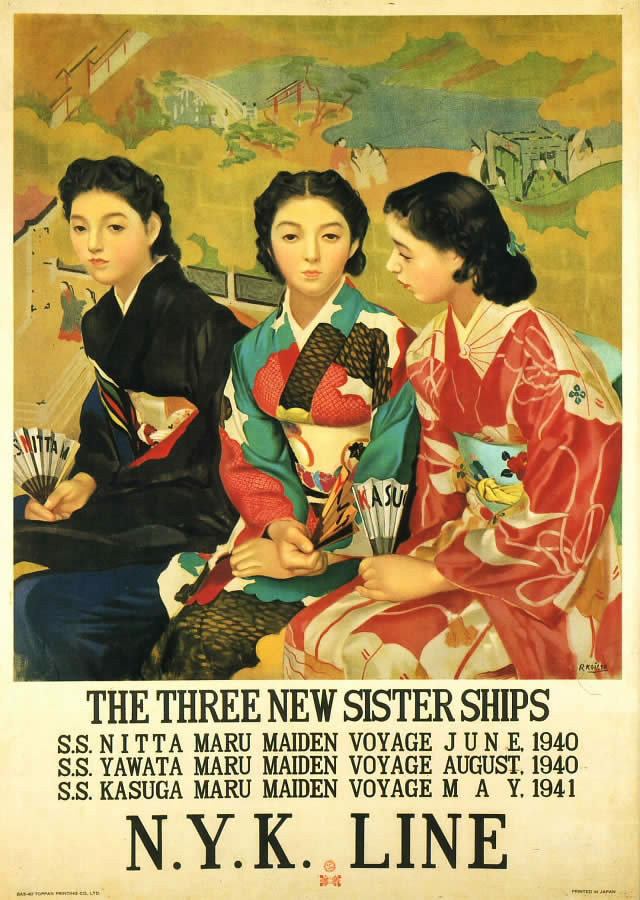
Take, for instance, their collection of classic Japanese steamship ads. “In the early part of the 20th century,” writes Steph Aromdee, “Japan’s increasingly prosperous middle class was taking to the high seas for travel. One company, the Japan Mail Steamship, advertised heavily, hoping to attract would-be tourists to their luxury ships. What were likely at the time regarded as simple advertisements and brochures that simply showed departures and destinations, have today become viewed as stunning works of art.”
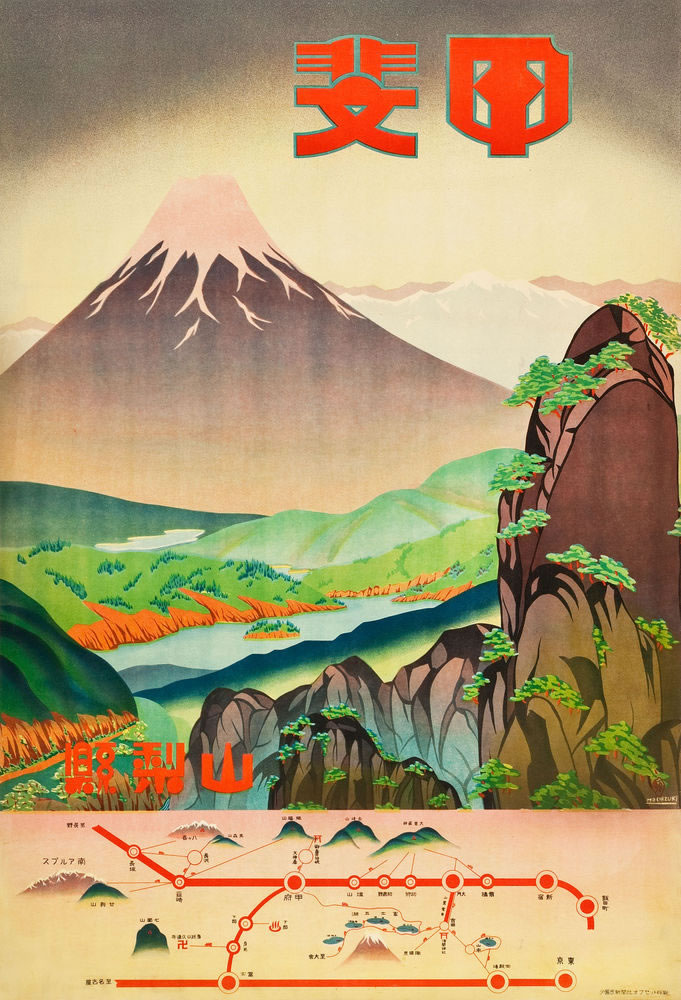
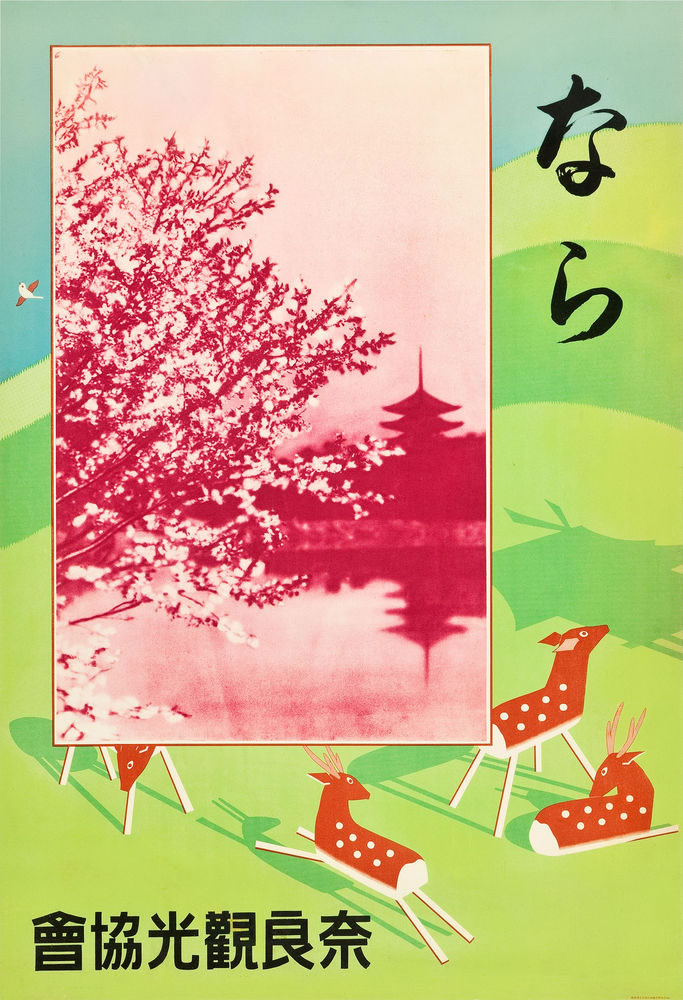
Here we’ve excerpted a few such advertisements from their impressive selection which, as you can see, ranges artistically from the stylized to the realistic, and conceptually from the practical to the purely evocative. They might entice readers onto a steamship voyage with an Art Deco bathing beauty, a contrast of human traveler against mountain’s majesty, a detailed map enumerating a variety of possible destinations, or, as in the case of deer-filled Nara, a scattering of local icons.
The age of the steamship has, of course, long since dissolved into the romantic past, even in Japan. Or perhaps I should say especially in Japan, whose shinkansen bullet train not only put every other mode of transport straight into obsolescence, but — at least to my mind — also boasts a cutting-edge romance of its own.
And so these advertisements, more than 70 years after their printings, still get me planning my next trip to Japan, a country that knows a thing or two about desire and place. “Even in Kyoto,” wrote 17th-century poet Matsuo Bashō, “I long for Kyoto.”
Related Content:
Advertisements from Japan’s Golden Age of Art Deco
Glorious Early 20th-Century Japanese Ads for Beer, Smokes & Sake (1902–1954)
Hand-Colored Photographs of 19th Century Japan
Colin Marshall writes on cities, language, Asia, and men’s style. He’s at work on a book about Los Angeles, A Los Angeles Primer, and the video series The City in Cinema. Follow him on Twitter at @colinmarshall or on Facebook.
Read More...Read the First Chapter of Harper Lee’s New Book, Then Hear It Read by Reese Witherspoon
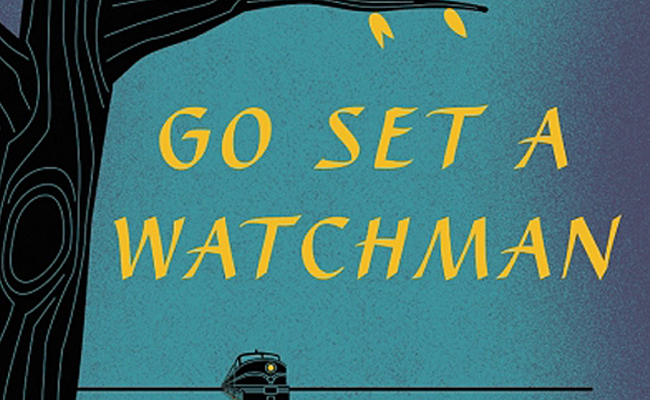
After much press and debate, Harper Lee’s new novel — a sequel of sorts to her beloved book, To Kill a Mockingbird — will be released on July 14th. You can pre-order Go Set a Watchman: A Novel (already #1 on Amazon’s bestseller list). But, even better, you can head over to the The Wall Street Journal or The Guardian and read the first chapter online. The Guardian also features an audio version read by the Oscar-winning actress Reese Witherspoon. Stream it right below. (And, fyi, you can always download a free audio copy of To Kill a Mockingbird through the free trial programs run by Audiobooks.com and Audible.com.)
Follow us on Facebook, Twitter, Google Plus and LinkedIn and share intelligent media with your friends. Note: There’s now a way to make sure that our posts show up in your Facebook newsfeed. Find info on that here.
Read More...Download & Play The Shining Board Game
Stephen King’s 1977 psychological horror novel The Shining has inspired several other works, most notably Stanley Kubrick’s 1980 film adaptation, a movie widely considered to have elevated King’s story of the possessed Overlook Hotel and its luckless winter caretakers, the Torrance family, to a higher artistic plane. But King himself never really approved of Kubrick’s interpretation: “Parts of the film are chilling, charged with a relentlessly claustrophobic terror,” he said, “but others fall flat. A visceral skeptic such as Kubrick just couldn’t grasp the sheer inhuman evil of the Overlook Hotel.”
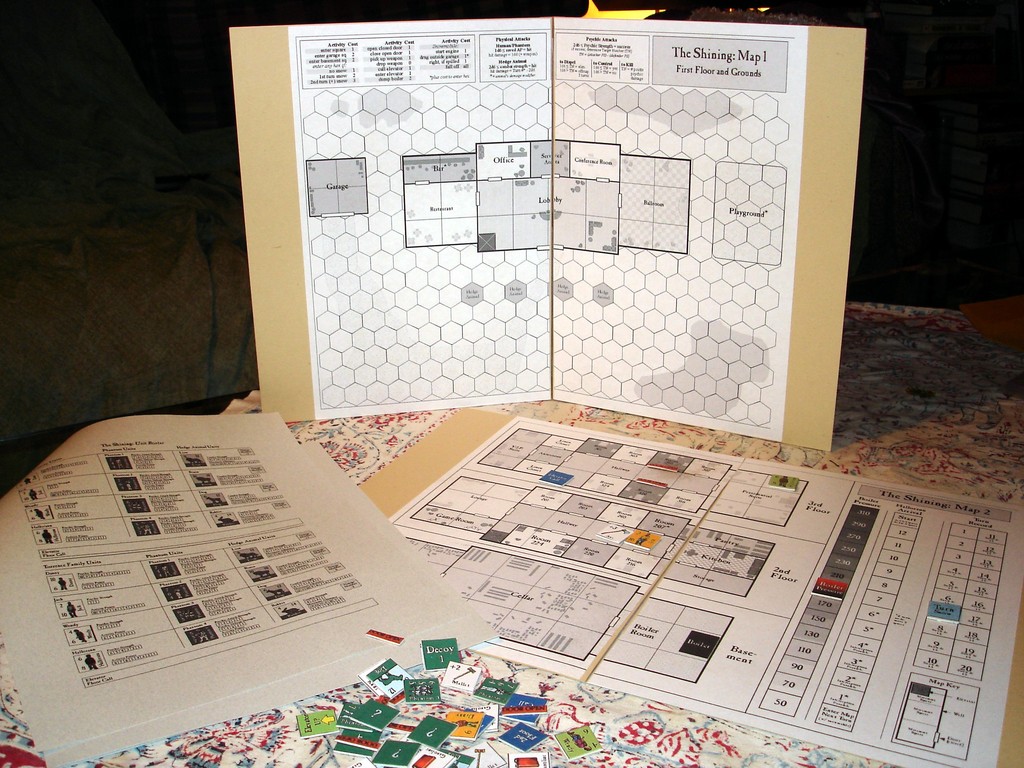
Presumably King had a better time playing the board game of The Shining, which won the first Microgame Design Contest in 1998, and about which you can read more at Board Game Geek. It has been said that King himself helped with the game’s development and offered his services as an early play-tester, though some will contest that. (See the claims in the comments section below.)
You can tell that the game’s faith lies with King’s novel rather than Kubrick’s film by its use of things that never made it from page to screen as gameplay elements, such as the hotel grounds’ hedge-sculpture animals that come to vicious life.

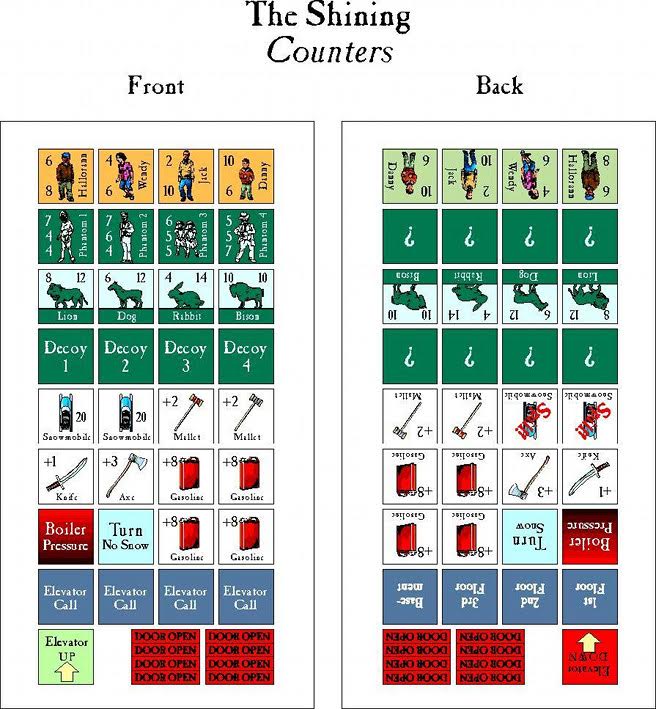
You can play The Shining board game as the Torrance family, in which case you’ll have to fight those hedge animals. Or you can play it as the Overlook Hotel itself, in which case you’ll control them. Each player has a host of implements at their disposal — ghosts, decoys, the famous axe and snowmobile — all meant to help them accomplish the task of driving the other side away. Think of it as a simplified wargame set in a haunted hotel.
If you’d like to see how you fare, whether in the shoes of the Torrances or the Indian-burial-ground foundation of the Overlook, you’ll find all the game’s materials freely available on the Micrograme Design Contest’s site. Print them out, set them up, and prepare to feel some sheer inhuman evil for yourself.
If you would like to support the mission of Open Culture, consider making a donation to our site. It’s hard to rely 100% on ads, and your contributions will help us continue providing the best free cultural and educational materials to learners everywhere. You can contribute through PayPal, Patreon, and Venmo (@openculture). Thanks!
Related Content:
Stanley Kubrick’s Annotated Copy of Stephen King’s The Shining
7 Free Stephen King Stories: Presented in Text, Audio, Web Comic & a Graphic Novel Video
Stephen King Reveals in His First TV Interview Whether He Sleeps With the Lights On (1982)
Stephen King’s Top 20 Rules for Writers
Stephen King Creates a List of 96 Books for Aspiring Writers to Read
Colin Marshall writes on cities, language, Asia, and men’s style. He’s at work on a book about Los Angeles, A Los Angeles Primer, and the video series The City in Cinema. Follow him on Twitter at @colinmarshall or on Facebook.
Read More...How Walking Fosters Creativity: Stanford Researchers Confirm What Philosophers and Writers Have Always Known
Image via Diego Sevilla Ruiz
A certain Zen proverb goes something like this: “A five year old can understand it, but an 80 year old cannot do it.” The subject of this riddle-like saying has been described as “mindfulness”—or being absorbed in the moment, free from routine mental habits. In many Eastern meditative traditions, one can achieve such a state by walking just as well as by sitting still—and many a poet and teacher has preferred the ambulatory method.
This is equally so in the West, where we have an entire school of ancient philosophy—the “peripatetic”—that derives from Aristotle and his contemporaries’ penchant for doing their best work while in leisurely motion. Friedrich Nietzsche, an almost fanatical walker, once wrote, “all truly great thoughts are conceived by walking.” Nietzsche’s mountain walks were athletic, but walking—Frédéric Gros maintains in his A Philosophy of Walking—is not a sport; it is “the best way to go more slowly than any other method that has ever been found.”
Gros discusses the centrality of walking in the lives of Nietzsche, Rimbaud, Kant, Rousseau, and Thoreau. Likewise, Rebecca Solnit has profiled the essential walks of literary figures such as William Wordsworth, Jane Austen, and Gary Snyder in her book Wanderlust, which argues for the necessity of walking in our own age, when doing so is almost entirely unnecessary most of the time. As great walkers of the past and present have made abundantly clear—anecdotally at least—we see a significant link between walking and creative thinking.
More generally, writes Ferris Jabr in The New Yorker, “the way we move our bodies further changes the nature of our thoughts, and vice versa.” Applying modern research methods to ancient wisdom has allowed psychologists to quantify the ways in which this happens, and to begin to explain why. Jabr summarizes the experiments of two Stanford walking researchers, Marily Oppezzo and her mentor Daniel Schwartz, who found that almost two hundred students tested showed markedly heightened creative abilities while walking. Walking, Jabr writes in poetic terms, works by “setting the mind adrift on a frothing sea of thought.” (Hear Dr. Oppezzo discuss her study in a Minnesota public radio interview above.)
Oppezzo and Schwartz speculate, “future studies would likely determine a complex pathway that extends from the physical act of walking to physiological changes to the cognitive control of imagination.” They recognize that this discovery must also account for such variables as when one walks, and—as so many notable walkers have stressed—where. Researchers at the University of Michigan have tackled the where question in a paper titled “The Cognitive Benefits of Interacting with Nature.” Their study, writes Jabr, showed that “students who ambled through an arboretum improved their performance on a memory test more than students who walked along city streets.”
One wonders what James Joyce—whose Ulysses is built almost entirely on a scaffolding of walks around Dublin—would make of this. Or Walter Benjamin, whose concept of the flâneur, an archetypal urban wanderer, derives directly from the insights of that most imaginative decadent poet, Charles Baudelaire. Classical walkers, Romantic walkers, Modernist walkers—all recognized the creative importance of this simple movement in time and space, one we work so hard to master in our first years, and sometimes lose in later life if we acquire it. Going for a walk, contemporary research confirms—a mundane activity far too easily taken for granted—may be one of the most salutary means of achieving states of enlightenment, literary, philosophical, or otherwise, whether we roam through ancient forests, over the Alps, or to the corner store.
via The New Yorker/Stanford News
Related Content:
Why You Do Your Best Thinking In The Shower: Creativity & the “Incubation Period”
John Cleese’s Philosophy of Creativity: Creating Oases for Childlike Play
Free Online Psychology Courses
Josh Jones is a writer and musician based in Durham, NC. Follow him at @jdmagness
Read More...The Declaration of Independence Read by Thespians: Morgan Freeman, Kevin Spacey, Renee Zellweger & More
Somewhere along the line today, take a break from the festivities and remind yourself what we’re actually celebrating here in America — the signing of America’s founding document 239 years ago. Drafted by Thomas Jefferson, The Declaration of Independence remains perhaps the best statement of our country’s aspirations. And after the Supreme Court’s recent Obergefell v. Hodges decision, many would say that the document — proclaiming that “all men are created equal” and have inalienable rights, “Life, Liberty and the pursuit of Happiness” — feels more alive than it has for some time. But no matter where you sit on the political spectrum, it’s helpful to return to The Declaration and its core principles. You can read the opening lines below, and the full text here.
Above, we have some very recognizable Hollywood celebs (including eight Oscar winners) reading The Declaration. (Beneath it, we’ve included a grainier version that features a nice preface by Morgan Freeman). For the sake of making this worthwhile, pretend it isn’t the infamous Mel Gibson reading the very first lines.
When in the Course of human events, it becomes necessary for one people to dissolve the political bands which have connected them with another, and to assume among the powers of the earth, the separate and equal station to which the Laws of Nature and of Nature’s God entitle them, a decent respect to the opinions of mankind requires that they should declare the causes which impel them to the separation.
We hold these truths to be self-evident, that all men are created equal, that they are endowed by their Creator with certain unalienable Rights, that among these are Life, Liberty and the pursuit of Happiness.–That to secure these rights, Governments are instituted among Men, deriving their just powers from the consent of the governed, –That whenever any Form of Government becomes destructive of these ends, it is the Right of the People to alter or to abolish it, and to institute new Government, laying its foundation on such principles and organizing its powers in such form, as to them shall seem most likely to effect their Safety and Happiness. Prudence, indeed, will dictate that Governments long established should not be changed for light and transient causes; and accordingly all experience hath shewn, that mankind are more disposed to suffer, while evils are sufferable, than to right themselves by abolishing the forms to which they are accustomed. But when a long train of abuses and usurpations, pursuing invariably the same Object evinces a design to reduce them under absolute Despotism, it is their right, it is their duty, to throw off such Government, and to provide new Guards for their future security.–Such has been the patient sufferance of these Colonies; and such is now the necessity which constrains them to alter their former Systems of Government. The history of the present King of Great Britain is a history of repeated injuries and usurpations, all having in direct object the establishment of an absolute Tyranny over these States. To prove this, let Facts be submitted to a candid world.
If you would like to support the mission of Open Culture, consider making a donation to our site. It’s hard to rely 100% on ads, and your contributions will help us continue providing the best free cultural and educational materials to learners everywhere. You can contribute through PayPal, Patreon, and Venmo (@openculture). Thanks!
Related Content:
Free Online History Courses
Bertrand Russell’s Ten Commandments for Living in a Healthy Democracy
Hear Johnny Cash Deliver Lincoln’s Gettysburg Address
John Wayne Recites the Pledge of Allegiance
Read More...Roberto Bolaño’s 12 Tips on “the Art of Writing Short Stories”
For some certain romantic reasons, a segment of the English-language reading population fell in love with Roberto Bolaño in the first few years of this millennium. One invariably glimpsed Bolaño’s award-winning 1998 novel The Savage Detectives on endtables and nightstands after its translation in 2007, with or without bookmarks. When 2666—the Chilean writer’s dizzyingly enormous work on the darkest of events in 1990’s Northern Mexico—appeared, it did so posthumously, further elevating Bolaño’s literary outlaw mythos. In addition to being a hard-bitten Trotskyist nomad, Bolaño—who died of liver failure in 2003—was said to have been a heroin addict and alcoholic. Neither was the case, writes Hector Tobar in the LA Times, quoting a Mexico City-based journalist on the author: “He had a super boring daily life. It was a life built around his own writing rituals and habits.”
For all his legendary exploits as a globetrotting journalist and poet, Bolaño also seems to have built his life around reading. “Reading,” Bolaño has said, “is more important than writing.” He finds much company with this statement among fellow writers. Patti Smith, for example, who urges reading “anything by Bolaño,” could also “recommend a million” books to anyone who asks. A much shorter but still challenging list of hers reveals a deep and broad investment in literature. William S. Burroughs, who probably didn’t read Bolaño but worked in a similarly hallucinatory vein, taught a class on “Creative Reading” that was only secondarily a class on writing, filled with example after example from writer after treasured writer. The best writing advice writers can dispense, it seems, is this: Read.
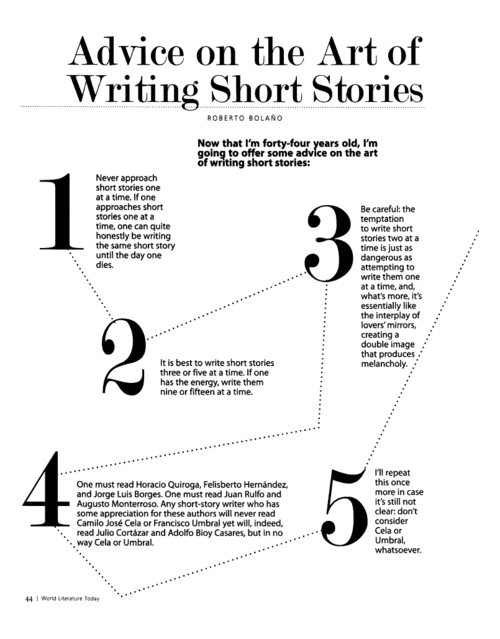
Such is the approach of Bolaño himself, in a short, pithy essay on how to write short stories. He begins in a perfunctory way, almost with a sigh: “Now that I’m forty-four years old, I’m going to offer some advice on the art of writing short stories.” The advice, found in the graphic form above on The Paris Review’s Tumblr and reprinted in a non-fiction collection titled Between Parenthesis, quickly becomes exuberantly pedantic, permeating the boundaries of its neatly ordered list form with tongue moving from cheek to cheek. Does he really mean that we should read “the notable Pseudo-Longinus” on the sublime? Or to suggest—after insistent reference to several essential Latin American writers’ writers—that “with Edgar Allan Poe, we would all have more than enough good material to read”? Probably. But the gist, with more than enough sincerity, is this: Read the greats, whoever they are, and read them often.
See Bolaño’s complete text here at Electric Cereal and an excerpted version below.
(1) Never approach short stories one at a time. If one approaches short stories one at a time, one can quite honestly be writing the same short story until the day one dies.
(2) It is best to write short stories three or five at a time. If one has the energy, write them nine or fifteen at a time.
(4) One must read Horacio Quiroga, Felisberto Hernández, and Jorge Luis Borges. One must read Juan Rulfo and Augusto Monterroso. Any short-story writer who has some appreciation for these authors will never read Camilo José Cela or Francisco Umbral yet will, indeed, read Julio Cortázar and Adolfo Bioy Casares, but in no way Cela or Umbral.
(5) I’ll repeat this once more in case it’s still not clear: don’t consider Cela or Umbral, whatsoever.
(6) A short-story writer should be brave. It’s a sad fact to acknowledge, but that’s the way it is.
(9) The honest truth is that with Edgar Allan Poe, we would all have more than enough good material to read.
(10) Give thought to point number 9. Think and reflect on it. You still have time. Think about number 9. To the extent possible, do so on bended knees.
(12) Read these books and also read Anton Chekhov and Raymond Carver, for one of the two of them is the best writer of the twentieth century.
Related Content:
Patti Smith’s List of Favorite Books: From Rimbaud to Susan Sontag
Junot Díaz’s Syllabi for His MIT Writing Classes, and the Novels on His Reading List
Josh Jones is a writer and musician based in Durham, NC. Follow him at @jdmagness
Read More...Support Us
We're hoping to rely on loyal readers, rather than erratic ads. Please click the Donate button and support Open Culture. You can use Paypal, Venmo, Patreon, even Crypto! We thank you!

About Us

Open Culture scours the web for the best educational media. We find the free courses and audio books you need, the language lessons & educational videos you want, and plenty of enlightenment in between.
Advertise With Us

FREE UPDATES!
GET OUR DAILY EMAIL
Get the best cultural and educational resources on the web curated for you in a daily email. We never spam. Unsubscribe at any time.
FOLLOW ON SOCIAL MEDIA

Open Culture editor Dan Colman scours the web for the best educational media. He finds the free courses and audio books you need, the language lessons & movies you want, and plenty of enlightenment in between.
Advertise With Us

