The First Color Photos From World War I: The German Front

On June 28, 1914, Gavrilo Princip assassinated Archduke Franz Ferdinand of Austria. Most of us know this — or at least if we don’t know the exact date, we know it happened in 1914, 100 years ago. We also know that the spark of the killing ignited the international geopolitical tinderbox just waiting to flame into the First World War. Yet as military historians often remind us, no one event can really start a conflict of that unprecedented scale any more than one event can stop it. The second half of the year 1914 saw a series of interrelated crises, responses, counter-crises, and counter responses that, these hundred years on, few of us could cite off the top of our heads.

We can compensate for the century between us and the Great War by reading up on it, of course. Of the countless volumes available, I personally recommend Geoff Dyer’s The Missing of the Somme. But nothing brings home the detailed reality of this ever-more-distant “huge murderous public folly,” in the words of J.B. Priestly, like looking at color photos from the front.

That color photography exists of anything in mid-1910s Europe, much less as momentous and disastrous a period as World War I, still surprises some people. We owe these shots to the efforts of German photographer Hans Hildebrand, as well as to his country’s already-established appreciation for the art and adeptness in engineering its tools. “In 1914, Germany was the world technical leader in photography and had the best grasp of its propaganda value,” writes R.G. Grant in World War I: The Definitive Visual History. “Some 50 photographers were embedded with its forces, compared with 35 for the French. The British military authorities lagged behind. It was not until 1916 that a British photographer was allowed on the Western Front.” But among his countrymen, only Hildebrand took pictures in color.

“The overwhelming majority of photos taken during World War I were black and white,” writes Spiegel Online, where you can browse a gallery of eighteen of his photos, “lending the conflict a stark aesthetic which dominates our visual memory of the war.” Hildebrand’s images thus stand out with their almost unreal-looking vividness, a result achieved not simply by his use of color film, but by his relatively long experience with a still fairly new medium. He’d already founded a color film society in his native Stuttgart three years before the Archduke’s assassination, and had tried his hand at autochrome printing as early as 1909.

Though not himself a dyed-in-the-wool propagandist, he did need to pose the soldiers for these photos, due to the lack of a film sensitive enough to capture actual action. Still, they give us a clearer idea of the situation than do most contemporary images. Hardly a glorification, Hildebrand’s work seems to speak to what those of us now, one hundred years in the future, would come to see in World War I: its misery, its oppressive sense of futility, and the haunting destruction it left behind.

Related Content:
Watch World War I Unfold in a 6 Minute Time-Lapse Film: Every Day From 1914 to 1918
British Actors Read Poignant Poetry from World War I
Frank W. Buckles, The Last U.S. Veteran of World War I
World War I Remembered in Second Life
Colin Marshall hosts and produces Notebook on Cities and Culture and writes essays on cities, language, Asia, and men’s style. He’s at work on a book about Los Angeles, A Los Angeles Primer. Follow him on Twitter at @colinmarshall or on Facebook.
Read More...Pakistani Orchestra Plays Enchanting Rendition of The Beatles’ “Eleanor Rigby”
Last year, we brought you an incredible cover of Dave Brubeck’s classic “Take Five” performed by the Pakistan-based group, the Sachal Studios Orchestra (also known as the Sachal Jazz Ensemble). You can find that song, along with two takes on “The Girl From Ipanema,” on their 2011 album Sachal Jazz. You won’t find the Sachal Orchestra’s version of “Eleanor Rigby” (above) on that album. This comes to us from Sachal’s 2013 Jazz and All That, a record Guardian critic John Fordham calls “smooth-jazzier” than its predecessor and “more improvisationally inhibited.” I must say, if that’s the case, I’ll take my jazz smooth just this once.
“Eleanor Rigby,” of course, has always been played by an orchestra, and its mixture of modes makes it a particularly good choice for the sitar soloist, who could have sat in comfortably in studio sessions for nearly every song on the Eastern-inflected Revolver. He shares the spotlight with a dynamite tablas player (watch for his solo at 1:27). It’s no wonder the Sachal players have made such an impression with their unique interpretations of standards and classics. Drawn from “virtuosos who cut their teeth in Pakistan’s once-flourishing Lollywood film industry,” their website informs us, “the Sachal Jazz Ensemble brings together some of the most accomplished classical musicians of the subcontinent.” Lollywood, Lahore’s once-thriving film industry, has still barely recovered from the repressive regime of General Zia-ul-Haq.
The musicians of Sachal are refugees of a sort; rescued from poverty, these “veteran session players [had been] retired since the 1980s due to various anti-music zealotries.” During those times, writes Yaqoob Khan Bangash, television drama provided “great succor to a fatigued and demoralized society.” Musicals, however, were very much frowned on by the regime, which banned most Western-influenced productions and shuttered most of the Lahore studios. We should be glad the Sachal Studios Orchestra can now perform and tour. They recently appeared with Wynton Marsalis at Lincoln Center in an event, Fordham writes, suggesting that “the most creative phase of Sachal Studios’ heartening story of renewal might just be beginning.”
For more on Sachal Studios, watch the introductory video, “Who We Are…,” above—shot at, where else, the studios at Abbey Road.
Related Content:
Pakistani Musicians Play Amazing Version of Dave Brubeck’s Jazz Classic, “Take Five”
Watch Jimi Hendrix’s ‘Voodoo Chile’ Performed on a Gayageum, a Traditional Korean Instrument
A Middle-Eastern Version of Radiohead’s 1997 Hit “Karma Police”
Josh Jones is a writer and musician based in Durham, NC. Follow him at @jdmagness.
Read More...
Watch Frank Zappa Play Michael Nesmith on The Monkees (1967)
In December 1967, The Monkees blew their audience’s minds by hosting Frank Zappa, “participant in and perhaps even leader of” the Mothers Of Invention.
Or did they?
The tidal wave of affection that comprises twenty-first century Monkees mania makes us forget that children were the primary audience for The Monkees’ titular sitcom. (One might also say that The Monkees were the sitcom’s titular band.)
But even if the kids at home weren’t sufficiently conversant in the musical underground to identify the special guest star of the episode, “The Monkees Blow Their Minds,” we are.
It’s a joy to see Zappa and The Monkees’ supremely laid back Michael Nesmith (he auditioned for the show with his laundry bag in tow) impersonating each other.
Zappa’s idea, apparently. He’s in complete control of the gimmick from the get go, whereas Nesmith struggles to keep their names straight and his prosthetic nose in place before getting up to speed.
It’s important to remember that it’s not Frank, but Nesmith playing Frank who accuses The Monkees’ music of being banal and insipid.
Zappa himself was a great supporter of The Monkees. “When people hated us more than anything, he said kind things about us,” Nesmith recalled in Barry Miles’ Zappa biography. Zappa attempted to teach Nesmith how to play lead guitar, and offered drummer Micky Dolenz a post-Monkees gig with The Mothers of Invention.
Their mutual warmth makes lines like “You’re the popular musician! I’m dirty gross and ugly” palatable. It put me in mind of comedian Zach Galifianakis’ Between Two Ferns, and countless other loosely rehearsed web series.
After a couple of minutes, Nesmith gets his hat back to conduct as Zappa smashes up a car to the tune of the Mother’s Of Invention’s “Mother People.”
Watch the full episode here, or if pressed for time, perhaps just Zappa’s cameo in the Monkees’ movie Head, as a studio lot bull wrangler who counsels lead singer Davy Jones on his career.
Related Content:
A Young Frank Zappa Turns the Bicycle into a Musical Instrument on The Steve Allen Show (1963)
In One of his Final Interviews, Frank Zappa Pronounces Himself “Totally Unrepentant”
Ayun Halliday is an author, homeschooler, and Chief Primatologist of the East Village Inky zine. Follow her @AyunHalliday
Read More...
The Historic LSD Debate at MIT: Timothy Leary v. Professor Jerome Lettvin (1967)
On May 3, 1967, Dr. Timothy Leary, that high priest of hallucinogens, faced off in a debate with MIT professor Dr. Jerome Lettvin about LSD in MIT’s Kresge Auditorium. Leary spent the debate in the lotus position, dressed in a white gown, beads and bare feet. The very picture of a counter culture icon. Lettvin, on the other hand, cuts a distinctly conservative figure, sporting a short-sleeved white shirt, a skinny tie and thick-framed glasses. On first blush, the debate might look like a stereotypical clash between the hip versus the square, but it ended up being much more interesting than that. Lettvin, who proved to be at least as charismatic as Leary, more than held his own against the man Richard Nixon once called “the most dangerous man in American.” You can watch the full debate above.
Leary speaks for the first half of the video. For those familiar with his routine, little of what you see will come as a surprise. He argues that LSD is a “a way of life and a sacrament and a sacrament is something that gets you high.” He goes on to cite groundbreaking figures like Einstein, Newton and William James who struggled to understand reality and consciousness. “The real goal of the scientist is to flip out,” he said to a packed auditorium filled with future scientists. “I don’t know if LSD is good or bad. It’s a gamble. It’s a risk. The sacrament is always a risk. … What isn’t? But LSD is the best gamble in the house.” Aiding him with his argument is a psychedelic picture show featuring a steady stream of images including ocean waves rolling backward, children bouncing on trampolines, and a man in a goatee eating soup, all set to a soundtrack by Ravi Shankar.

“Tim, your argument is exceedingly seductive,” Lettvin concedes at the beginning of his presentation (it begins around the 30:30 mark), which had none of the visual razzamatazz of Leary’s spiel. “I feel like this man is [in] the hands of the devil.”
Lettvin, however, proves not to be your standard anti-drug scold. At one point in the debate, he proclaims, “I can conceive of no more immoral thing than has been done by the government in the wholesale banning of drugs. … There’s a fundamentally monstrous thing about forbidding rather than reasoning people out.” And that’s exactly what Lettvin set out to do — reason the audience against taking acid. “The question is not scientific but moral,” he says. LSD has the potential to rob takers of their critical faculties, rendering them permanently spaced out. “The price seems a little steep to pay. You are settling for a permanent second rate world by the abnegation of the intellect.”
Lettvin’s performance is all the more impressive because he had little time to prepare. The faculty member who was originally slated to debate Leary bowed out at the last moment, and organizers scrambled to get someone, anyone, to face down the famed guru. Lettvin reportedly came straight from the lab to the auditorium and he even had to borrow a tie. Too bad Leary didn’t have a spare Nehru jacket.
Related Content:
Beyond Timothy Leary: 2002 Film Revisits History of LSD
Artist Draws Nine Portraits on LSD During 1950s Research Experiment
Watch The Bicycle Trip: An Animation of The World’s First LSD Trip in 1943
Beyond Timothy Leary: 2002 Film Revisits History of LSD
Jonathan Crow is a Los Angeles-based writer and filmmaker whose work has appeared in Yahoo!, The Hollywood Reporter, and other publications. You can follow him at @jonccrow. And check out his blog Veeptopus, featuring one new drawing of a vice president with an octopus on his head daily. The Veeptopus store is here.
Read More...David Bowie & Brian Eno’s Collaboration on “Warszawa” Reimagined in a Comic Animation
If you want to talk about David Bowie, you’ll sooner or later have to talk about Brian Eno. That music producer, visual artist, technological tinkerer, and “drifting clarifier” hasn’t had a hand in all the image-shifting rock star’s work, of course, but what collaborations they’ve done rank among the most enduring items in the Bowie catalog. “I’m Afraid of Americans,” which Eno co-wrote, remains a favorite of casual and die-hard fans alike; the 1995 Eno-produced “cybernoir” concept album 1.Outside seems to draw more acclaim now than it did on its release. But for the highest monument to the meeting of Bowie and Eno’s minds, look no further than Low, and Heroes, and Lodger, which the two crafted together in the late 1970s. These albums became informally known as the “Berlin trilogy,” so named for one of the cities in which Bowie and Eno worked on them. Oh, to have been a fly on the wall during those sessions.
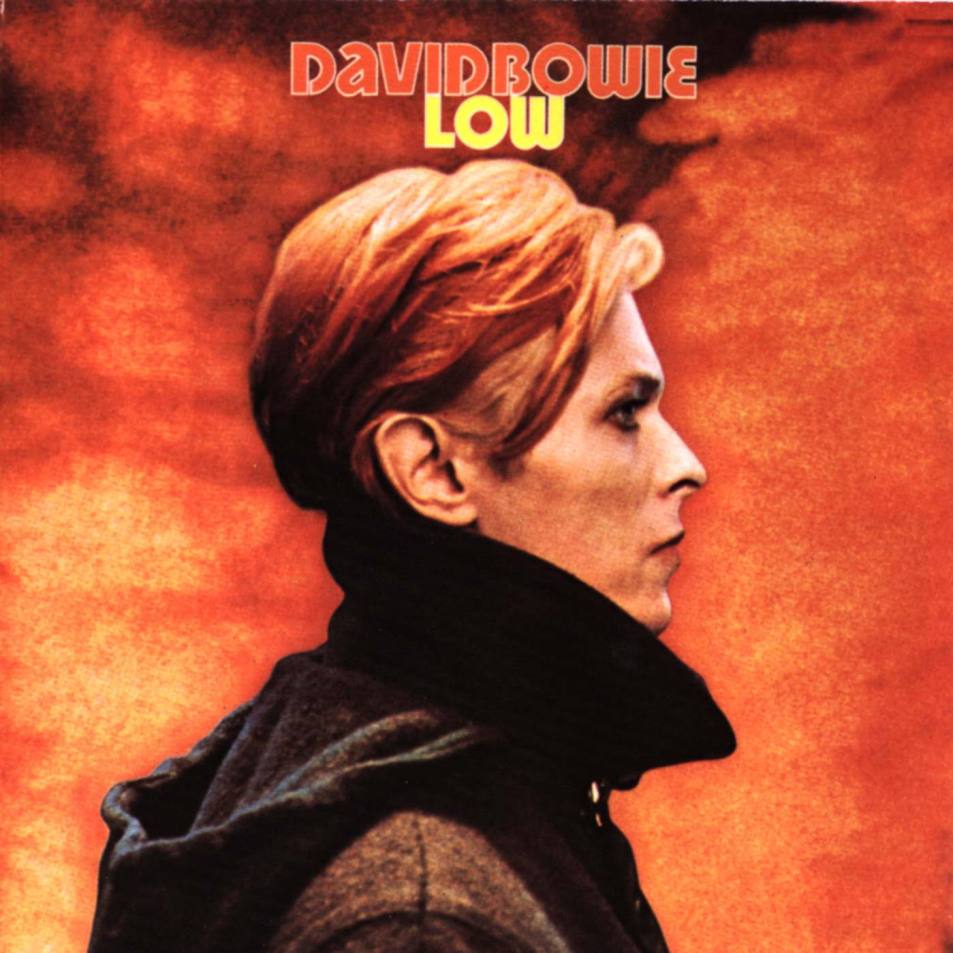
Animators the Brothers McLeod have given us just that perspective in the cartoon above. It opens in September 1976 at the Château d’Hérouville, the “northern Frenchland” studio which hosted the bulk of Low’s recording sessions. These three and a half minutes, in which Bowie, Eno, and producer Tony Visconti lay down a couple of takes for what will become “Warszawa,” one of the album’s most memorable tracks, come loaded with gags just for the Bowie-Eno enthusiast. The cartoon Bowie (voiced uncannily by comedian Adam Buxton) sports exactly the look he did in the Man Who Fell to Earth publicity photo repurposed for Low’s cover. Eno offers Bowie a piece of ambient music, explaining that, if Bowie doesn’t like it, “I’ll use on one of my weird albums” (like Music for Bus Stops). Visconti constantly underscores his doing, as a producer, “more than people think.” And when Bowie and Eno find themselves in need of some creative inspiration, where else would they turn than to the infallible advice of Oblique Strategies — even if it advises the use of “a made-up language that sounds kind of Italian”?
via Biblioklept
Related Content:
David Bowie Releases Vintage Videos of His Greatest Hits from the 1970s and 1980s
David Bowie Recalls the Strange Experience of Inventing the Character Ziggy Stardust (1977)
Jump Start Your Creative Process with Brian Eno’s “Oblique Strategies”
Brian Eno on Creating Music and Art As Imaginary Landscapes (1989)
How David Byrne and Brian Eno Make Music Together: A Short Documentary
Colin Marshall hosts and produces Notebook on Cities and Culture and writes essays on cities, language, Asia, and men’s style. He’s at work on a book about Los Angeles, A Los Angeles Primer. Follow him on Twitter at @colinmarshall or on Facebook.
Read More...100 Great Bass Riffs Played in One Epic Take: Covers 60 Years of Rock, Jazz and R&B
Back in June, our very own Josh Jones took us on an audio tour of five great rock bassists, breaking down the styles of Paul McCartney, Sting, John Deacon, John Paul Jones & Geddy Lee. If you got into the groove of that post, you’ll almost certainly enjoy watching bassist Marc Najjar, accompanied by Nate Bauman on drums, taking you through 100 great bass riffs. The rhythm duo covers 60 years of music history, in 17 minutes, just above.
The riffs were notably performed in one continuous take, with a Sandberg Umbo HCA Crème bass. (Find more gear used in the video here.) And the clip was put together by the Chicago Music Exchange, the same folks who assembled the 2012 viral video, A History of Rock ‘n’ Roll in 100 Guitar Riffs. They also sold me a sweet acoustic guitar that same year.
You can find a complete list of the riffs, and the songs from which they came, below. (Click the “more” link to see them, if they’re not already visible.) Please note that the bass sounds a little muted at the outset, but it quickly comes to the fore.
Read More...Hear David Foster Wallace Read His Own Essays & Short Fiction on the 6th Anniversary of His Death,
Yesterday, of course, marked the 13th anniversary of the horrible attacks on the Twin Towers and the Pentagon. Today marks the 6th anniversary of David Foster Wallace’s death by suicide. The two events are related not only by proximity, and not because they are comparable tragedies, but because Wallace’s work, in particular his 1993 essay “E Unibus Pluram: Television and U.S. Fiction,” has become such a touchstone for the discourse of “post-irony” or “the new sincerity” since 9/11, when Vanity Fair editor Graydon Carter and others proclaimed the “end of irony.” But the cultural consciousness has shifted measurably since those heady days of fervent affirmation. In a reconsideration of Wallace on irony, Bradley Warshauer writes, “he wasn’t wrong—but he is obsolete.” Our national discourse—as much as it can be defined in broad terms—may have, some argue, swung further toward sincerity and sentimental reverence than Wallace would have liked. And he may have been much more an ironist than he liked to believe.
Wallace, writes Warshauer, was “a wannabe sentimentalist who was too absurdly talented and probably too obsessed with the artificiality of fiction to be the sort of ‘anti-rebel’ that he himself talked about.” While he may have romanticized the high-minded figure who “stands for” things in uncomplicated ways, Wallace himself was complicated, prickly, and just too hyper-aware—of himself and others—to be seduced by easy sentiment, what Somerset Maugham called “unearned emotion.” While his work pulls us still toward deeper levels of analysis, toward contemplation and critique, toward serious considerations of value, it does not do so by eschewing irony. In the descriptive force of his prose are the evasions, parries, asides, circumlocutions, and jarringly odd juxtapositions of the ironist, the satirist, and—what might be the same thing—the moralist. “The inherent contradiction”—the irony, if you will—of Wallace’s stance, Washauer argues, citing 1999’s Brief Interviews With Hideous Men, is that he himself “was addicted to ironic detachment.” But, of course, it’s not so simple as that.
Today we bring you several readings by David Foster Wallace of his own work. We begin at the top with “Death is Not the End” from Brief Interviews, that collection of “weird metafiction” that couches raw and painful confessions in layers of irony. Below it, from that same collection, we have “Suicide as a Sort of Present,” a piece that, in hindsight, offers its own potential morbidly ironic readings. Just above, hear Wallace read the short story “Incarnations of Burned Children” from the 2005 collection Oblivion, full of stories Wyatt Mason described as “tightly withhold[ing]… hiding on high shelves the keys that unlock their treasures.” Replete with tiny mechanisms that can take many careful readings to parse, these stories are fine-art studies in ironic language and situations.
One may class David Foster Wallace as a master ironist, despite his critical stance against its overuse, but this reduces the full range of his mastery to one mode among so many. His work embraced the voice of irony and the voice of sincerity as equally valid rhetorical means, alternating between the two in what A.O. Scott once called a “feedback loop.” “The View From Mrs. Thompson’s,” the essay Wallace reads above from 2005’s essay collection Consider the Lobster, is a piece he wrote just days after 9/11. Written quickly as a commission from Rolling Stone, the essay records his trenchant observations of the reactions in Bloomington, Illinois between September 11–13. It’s a piece that showcases the tension between Wallace’s sincere desire for immediacy and his almost uncontrollable impulse to amused detachment. And hearing Wallace commemorate the tragic events we remembered yesterday highlights the sad irony of memorializing his own death today.
You can hear many more of David Foster Wallace’s readings and interviews at the David Foster Wallace Audio Project, and be sure to stop by our sizable collection, 30 Free Essays & Stories by David Foster Wallace on the Web.
Related Content:
‘This Is Water’: Complete Audio of David Foster Wallace’s Kenyon Graduation Speech (2005)
David Foster Wallace: The Big, Uncut Interview (2003)
David Foster Wallace’s 1994 Syllabus: How to Teach Serious Literature with Lightweight Books
Read Two Poems David Foster Wallace Wrote During His Elementary School Days
Josh Jones is a writer and musician based in Durham, NC. Follow him at @jdmagness
Read More...Thomas Pynchon Edits His Lines on The Simpsons: “Homer is my role model and I can’t speak ill of him.”
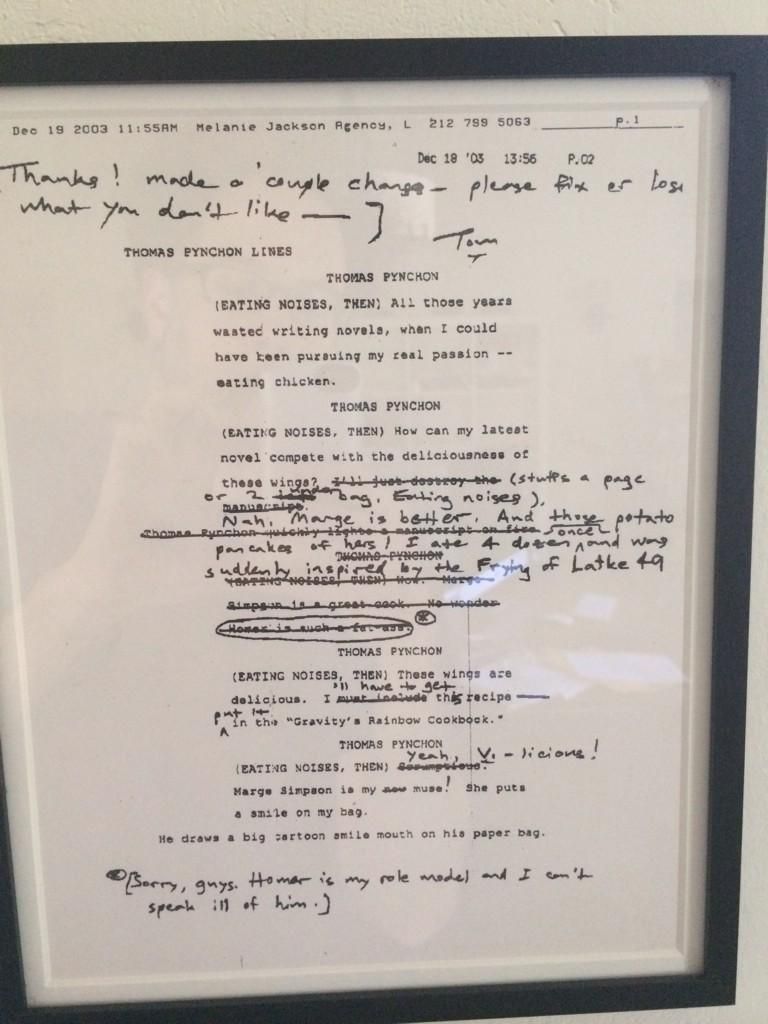
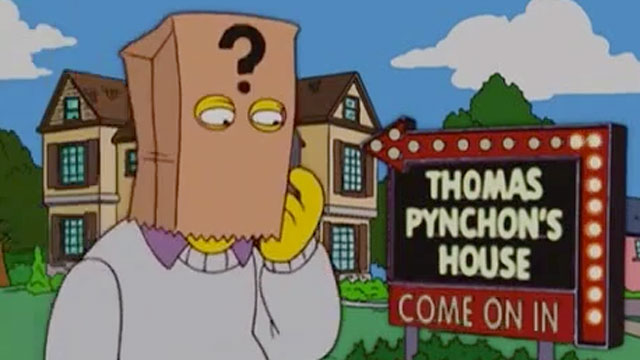
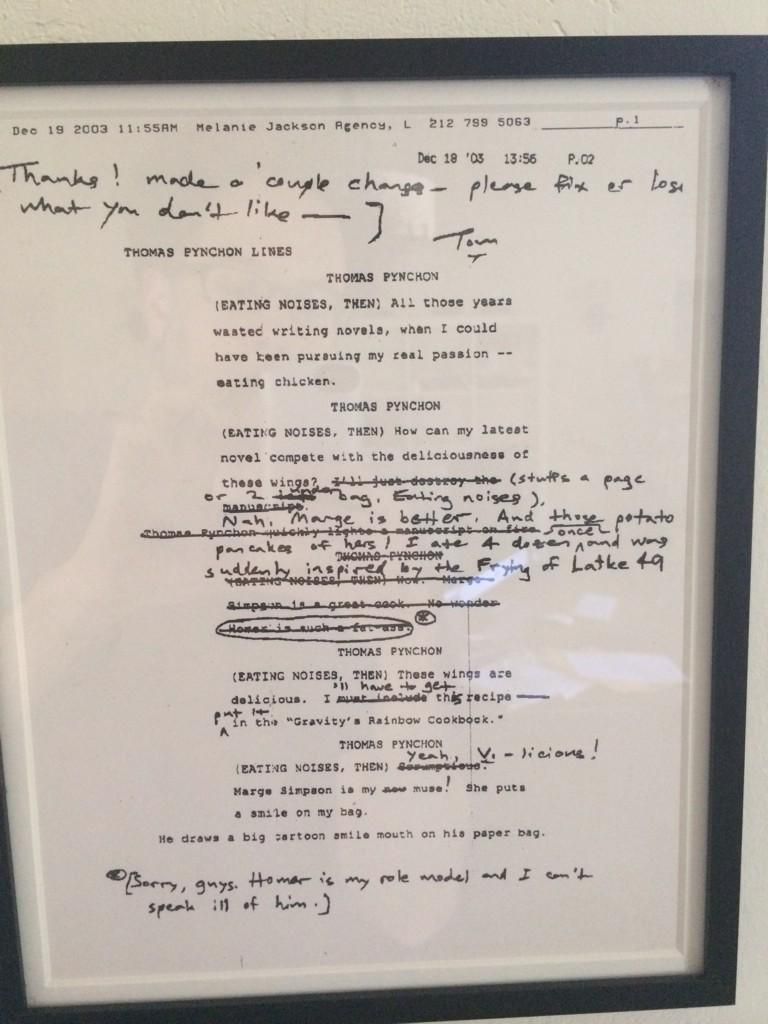
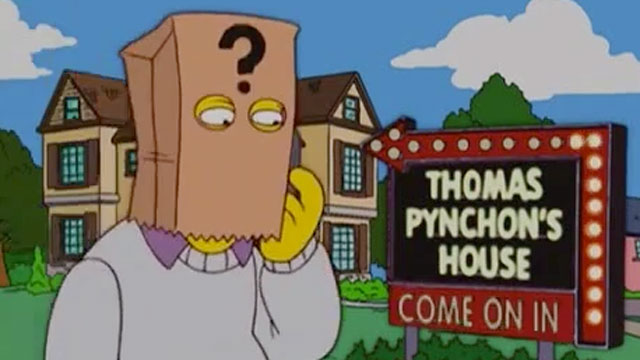
In 2002, the elusive novelist Thomas Pynchon made two cameo appearances on The Simpsons. Of course, we didn’t actually get to see Pynchon. His cartoon depiction wore, rather humorously, a bag over his head. But, we did get to hear Pynchon’s voice. And apparently that, alone, was a first.
This past week, Matt Selman, an executive producer for The Simpsons, shed some more light on those playful cameos. On Twitter, he posted a copy of the script Pynchon edited and faxed back to the show’s writers. (Click on the image above to see it in a larger format.) In some cases, Pynchon, always the writer, tweaked the language to make it flow as he liked. In other cases, he added his own material to the script — new sound effects, jokes, and puns. (The word “Scrumptious” gets turned into Vi-licious.) And, in one case, he removed a joke. Deleting the words “No wonder Homer is such a fat ass,” Pynchon scrawled the comment: “Sorry, guys. Homer is my role model and I can’t speak ill of him.” Finally, Homer gets some respect.
Related Content:
Before The Simpsons, Matt Groening Illustrated a “Student’s Guide” for Apple Computers (1989)
Take a Cinematic Journey into the Mind of Thomas Pynchon and His New Book, Bleeding Edge
Read More...
Before The Simpsons: Homer Groening Directs a 1969 Short Film, The Story, Starring His Kids Maggie, Lisa & Matt
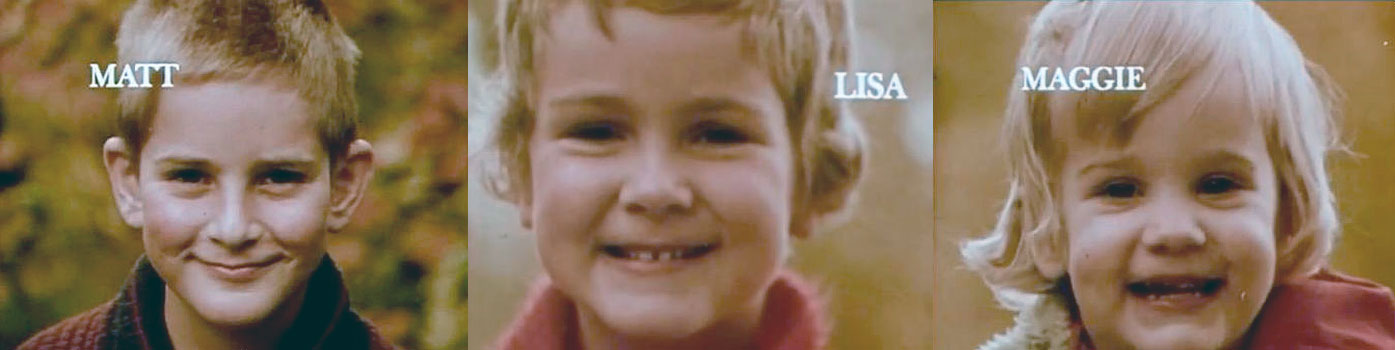
The Story (1969) is a cute short film about two kids, Matt and Lisa, telling their younger sister Maggie a bedtime story about meeting some animals, and an alien, in the woods. You can watch it above. The Matt in this film is none other than Matt Groening, who would go on to create The Simpsons. Their dad, Homer, made the movie. The Simpsons, as Groening admitted in an interview with Smithsonian magazine, is more than a little autobiographical.
I had been drawing my weekly comic strip, “Life in Hell,” for about five years when I got a call from Jim Brooks, who was developing “The Tracey Ullman Show” for the brand-new Fox network. He wanted me to come in and pitch an idea for doing little cartoons on that show. I soon realized that whatever I pitched would not be owned by me, but would be owned by Fox, so I decided to keep my rabbits in “Life in Hell” and come up with something new.
While I was waiting—I believe they kept me waiting for over an hour—I very quickly drew the Simpsons family. I basically drew my own family. My father’s name is Homer. My mother’s name is Margaret. I have a sister Lisa and another sister Maggie, so I drew all of them. I was going to name the main character Matt, but I didn’t think it would go over well in a pitch meeting, so I changed the name to Bart.
Groening incorporated other autobiographical elements into The Simpsons too. For instance, the Groening family, like Bart and company, lived on Evergreen Terrace. In that same interview with Smithsonian, he all but admitted that the show is set in his native Oregon. And he even hinted that the names of a couple despised schoolyard bullies made their way into the show.
The real Homer, however, was very different from the donut-obsessed rube in the cartoon. “My father was a real man’s man, you know. He was a B17 bomber pilot in the War, stationed in England. So I grew up with this very intimidating, tough act to follow,” Groening told the Telegraph. “The nice thing was that he would leave his pens out for me to play with. But then he was not particularly approving of what I came up with.”
And while the early episodes of the Simpsons, which show Homer being perpetually irritated by his smart aleck son, hints at the complicated relationship Groening had with his father, he also credits him – and the movie above in particular – for inspiring his hugely successful show.
He used to tape-record the family surreptitiously, either while we were driving around or at dinner, and, in 1963, he and I made up a story about a brother and a sister, Lisa and Matt, having an adventure out in the woods with animals. I told it to my sister Lisa, and she in turn told it to my sister Maggie. My father recorded the telling of the story by Lisa to Maggie, and then he used it as the soundtrack to a movie. So the idea of dramatizing the family—Lisa, Maggie, Matt—I think was the inspiration for doing something kind of autobiographical with “The Simpsons.” There is an aspect of the psychodynamics of my family in which it makes sense that one of us grew up and made a cartoon out of the family and had it shown all over the world.
via Laughing Squid/Dangerous Minds
Related Content:
Before The Simpsons, Matt Groening Illustrated a “Student’s Guide” for Apple Computers (1989)
Jonathan Crow is a Los Angeles-based writer and filmmaker whose work has appeared in Yahoo!, The Hollywood Reporter, and other publications. You can follow him at @jonccrow. And check out his blog Veeptopus, featuring one new drawing of a vice president with an octopus on his head daily.
Read More...Extensive Archive of Avant-Garde & Modernist Magazines (1890–1939) Now Available Online
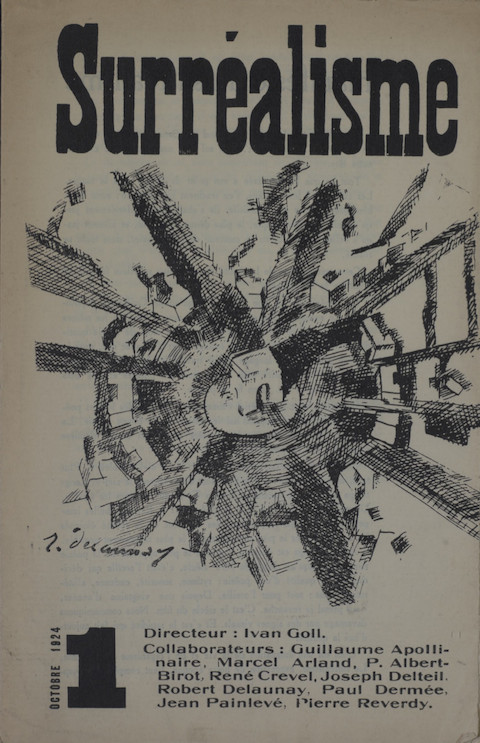
Having once been involved in the founding of an arts magazine, I have experienced intimately the ways in which such an endeavor can depend upon a community of equals pooling a diversity of skills. The process can be painful: egos compete, certain elements seek to dominate, but the successful product of such a collaborative effort will represent a living community of artists, writers, editors, and other masters of technique who subordinate their individual wills, temporarily, to the will of a collective, creating new gestalt identities from conceptual atoms. As Monoskop—“a wiki for collaborative studies of art, media and the humanities”—points out, “the whole” of an arts magazine, “could become greater than the sum of its parts.” Often when this happens, a publication can serve as the platform or nucleus of an entirely new movement.
Monoskop maintains a digital archive of printed avant-garde and modernist magazines dating from the late-19th century to the late 1930s, published in locales from Arad to Bucharest, Copenhagen to Warsaw, in addition to the expected New York and Paris. From the latter city comes the 1924 first issue of Surrealisme at the top of the post.
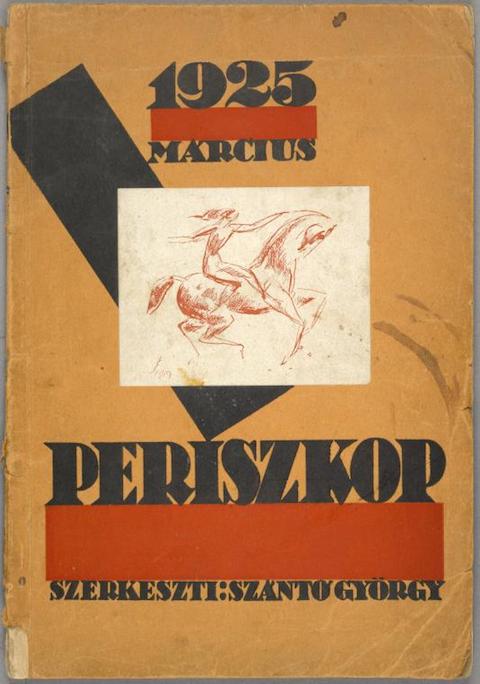
From the much smaller city of Arad in Romania comes the March, 1925 issue 1 of Periszkóp above, published in Hungarian and featuring works by Picasso, Marc Chagall, and many lesser-known Eastern European artists. Just below, see another Paris publication: the first, 1929 issue of Documents, a surrealist journal edited by Georges Bataille and featuring such luminaries as Cuban novelist Alejo Carpentier and artists Georges Braque, Giorgio De Chirico, Salvador Dali, Marcel Duchamp, Paul Klee, Joan Miro, and Pablo Picasso. Further down, see the first, 1926, issue of the Bauhaus journal, vehicle of the famous arts movement founded by Walter Gropius in 1919.
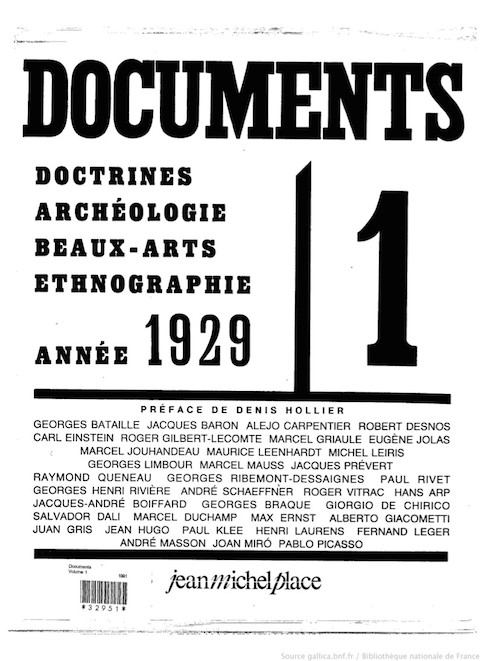
The variety of modernist and avant garde publications archived at Monoskop “provide us with a historical record of several generations of artists and writers.” They also “remind us that our lenses matter.” In an age of “the relentless linearity of digital bits and the UX of the glowing screen” we tend to lose sight of such critically important matters as design, typography, layout, writing, and the “techniques of printing and mechanical reproduction.” Anyone can build a website, fill it with “content,” and propagate it globally, giving little or no thought to aesthetic choices and editorial framing. But the magazines represented in Monoskop’s archive are specialized creations, the products of very deliberate choices made by groups of highly skilled individuals with very specific aesthetic agendas.

A majority of the publications represented come from the explosive period of modernist experimentation between the wars, but several, like the journal Rhythm: Art Music Literature—first published in 1911—offer glimpses of the early stirrings of modernist innovation in the Anglophone world. Others like the 1890–93 Parisian Entretiens politiques et littéraires showcase the work of pioneering early French modernist forebears like Jules Laforgue (a great influence upon T.S. Eliot) and also André Gide and Stéphane Mallarmé. Some of the publications here are already famous, like The Little Review, many much lesser-known. Most published only a handful of issues.
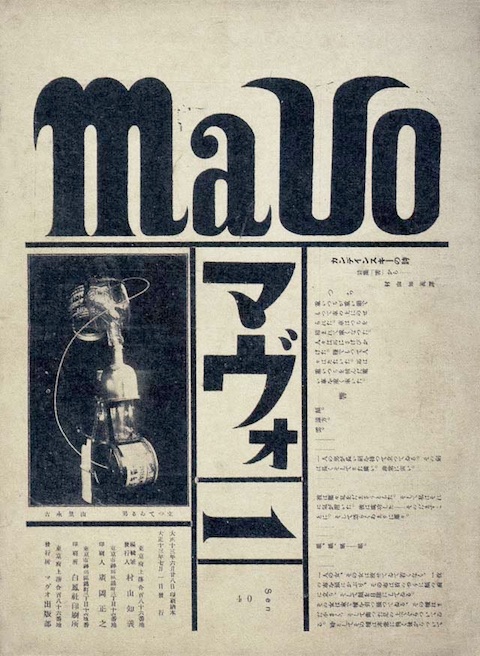
With a few exceptions—such as the 1923 Japanese publication MAVO shown above—almost all of the journals represented at Monoskop’s archive hail from Eastern and Western Europe and the U.S.. While “only a few journals had any significant impact outside the avant-garde circles in their time,” the ripples of that impact have spread outward to encompass the art and design worlds that surround us today. These examples of the literary and design culture of early 20th century modernist magazines, like those of late 20th century postmodern ‘zines, provide us with a distillation of minor movements that came to have major significance in decades hence.
Related Content:
The ABCs of Dada Explains the Anarchic, Irrational “Anti-Art” Movement of Dadaism
William S. Burrough’s Avant-Garde Movie ‘The Cut Ups’ (1966)
Josh Jones is a writer and musician based in Durham, NC. Follow him at @jdmagness
Read More...Support Us
We're hoping to rely on loyal readers, rather than erratic ads. Please click the Donate button and support Open Culture. You can use Paypal, Venmo, Patreon, even Crypto! We thank you!

About Us

Open Culture scours the web for the best educational media. We find the free courses and audio books you need, the language lessons & educational videos you want, and plenty of enlightenment in between.
Advertise With Us

FREE UPDATES!
GET OUR DAILY EMAIL
Get the best cultural and educational resources on the web curated for you in a daily email. We never spam. Unsubscribe at any time.
FOLLOW ON SOCIAL MEDIA

Open Culture editor Dan Colman scours the web for the best educational media. He finds the free courses and audio books you need, the language lessons & movies you want, and plenty of enlightenment in between.
Advertise With Us