Hear the Nazi’s Bizzaro Propaganda Jazz Band, “Charlie and His Orchestra” (1940–1943)
As you might expect from a vicious political movement fronted by a frustrated illustrator, the Nazi party had a complicatedly disdainful yet aspirational — and needless to say, unceasingly fascinating — relationship with art. We previously featured their philistine grudge against modernism that led to the “Degenerate Art Exhibition” of 1937, their mega-budget propaganda film on the Titanic disaster that turned into a disaster itself, and their control-freak list of rules for dance orchestras. The Nazis, as you might expect, didn’t much care for jazz, or at least saw some political capital in openly denouncing it. Yet it seems they also saw some in embracing it, turning the quintessentially free art form toward, as always, their own propagandistic purposes. What if they could come up with their own popular jazz band and, using long-distance short- and medium-wave broadcast signals, turn the Allies’ own music against them? Enter, in 1940, Charlie and His Orchestra. Another Joseph Goebbels creation.
“The idea behind the Nazis’ Charlie campaign,” writes the Wall Street Journal’s Will Friedwald, “was that they could undermine Allied morale through musical propaganda, with a specially devised orchestra broadcasting messages in English to British and American troops.” The groups’ featured singer, “Charlie” himself (real name: Karl Schwedler), would sing not just “irresistible” jazz standards but versions with anti-British, ‑American, and ‑Semitic lyrics. You can hear much of their catalog in the clips here, including what Friedwald cites as their “weirdest recordings”: “Irving Berlin’s ‘Slumming on Park Avenue,’ in which Schwedler, portraying a British pilot with a mock-English accent, sings ‘Let’s go bombing!’ ” and “So You Left Me for the Leader of a Swing Band” refashioned as “So You Left Me for the Leader of the Soviets.” Ultimately, not only did the outside world prove to have better taste than the Nazis, their own fighters did too: “Not only did the Charlie project fail to convert any Allies to the other side, but even Germany’s own troops couldn’t bring themselves to take Nazi swing seriously.” It don’t mean a thing if it ain’t got that swing, I suppose — and Charlie and his Orchestra definitely didn’t have it. More audio samples can be heard over at WFMU.
Related Content:
The Nazis’ 10 Control-Freak Rules for Jazz Performers: A Strange List from World War II
The Nazi’s Philistine Grudge Against Abstract Art and The “Degenerate Art Exhibition” of 1937
Colin Marshall hosts and produces Notebook on Cities and Culture and writes essays on cities, language, Asia, and men’s style. He’s at work on a book about Los Angeles, A Los Angeles Primer. Follow him on Twitter at @colinmarshall or on Facebook.
Read More...The Chemistry Behind the Smell of Old Books: Explained with a Free Infographic

What gives old books that ever-so-distinctive smell? Andy Brunning, a chemistry teacher in the UK, gives us all a quick primer with this infographic posted on his web site, Compound Interest. The visual comes accompanied by this textual explanation. Writes Brunning:
Generally, it is the chemical breakdown of compounds within paper that leads to the production of ‘old book smell’. Paper contains, amongst other chemicals, cellulose, and smaller amounts of lignin – much less in more modern books than in books from more than one hundred years ago. Both of these originate from the trees the paper is made from; finer papers will contain much less lignin than, for example, newsprint. In trees, lignin helps bind cellulose fibres together, keeping the wood stiff; it’s also responsible for old paper’s yellowing with age, as oxidation reactions cause it to break down into acids, which then help break down cellulose.
‘Old book smell’ is derived from this chemical degradation. Modern, high quality papers will undergo chemical processing to remove lignin, but breakdown of cellulose in the paper can still occur (albeit at a much slower rate) due to the presence of acids in the surroundings. These reactions, referred to generally as ‘acid hydrolysis’, produce a wide range of volatile organic compounds, many of which are likely to contribute to the smell of old books. A selected number of compounds have had their contributions pinpointed: benzaldehyde adds an almond-like scent; vanillin adds a vanilla-like scent; ethyl benzene and toluene impart sweet odours; and 2‑ethyl hexanol has a ‘slightly floral’ contribution. Other aldehydes and alcohols produced by these reactions have low odour thresholds and also contribute.
The Aroma of Books infographic can be viewed in a larger format here. And because it has been released under a Creative Commons license, it can be downloaded for free. For another explanation of this phenomenon — this one in video — see this previous post in our archive: The Birth and Decline of a Book: Two Videos for Bibliophiles
If you would like to support the mission of Open Culture, consider making a donation to our site. It’s hard to rely 100% on ads, and your contributions will help us continue providing the best free cultural and educational materials to learners everywhere. You can contribute through PayPal, Patreon, and Venmo (@openculture). Thanks!
Related Content:
A Secret Bookstore in a New York City Apartment: The Last of a Dying Breed
Old Books Bound in Human Skin Found in Harvard Libraries (and Elsewhere in Boston)
Spike Jonze Presents a Stop Motion Film for Book Lovers
Wearable Books: In Medieval Times, They Took Old Manuscripts & Turned Them into Clothes
Read More...A Secret Bookstore in a New York City Apartment: The Last of a Dying Breed
Even in our era of digital media — and even as a creator of digital media myself — I can’t help but evaluate each new city I visit, or the state of each old city I visit, in part by the quality and quantity of its bookstores. Toronto, where I’ve spent the past week or so, does surprisingly well on this count, though I hear from longtime locals that recent circumstances have forced a few beloved spots to shut down, relocate or downsize. A similar fate may loom over New York City’s Brazenhead Books, the by-appointment-only underground Upper East Side bookstore we featured back in 2011. New York still does pretty well in terms of bookstores, of course, but here we have a rare specimen in any city: a bookstore run almost in secret, a place where, according to Fodor’s, you’ll find three rooms of an apartment “crammed floor to ceiling with books, both new and used, including some rare titles,” where, “on Saturday nights, the city’s intellectuals can be found sipping whiskey and discussing classic and contemporary literature.”
If that sounds like an evening to you, you might want to pay a visit sooner than later. According to the website DNAInfo, Brazenhead’s owner, Michael Seidenberg, wrote on his Facebook page this summer, “Brazenhead Books turns its last page on October 31st.” “Lost our lease…lots of things must go.” If you can’t make it to New York before then, at least have a look at the video tour of Brazenhead at the top of the post.
As the bookselling industry has shifted over the past few decades, those omnipresent, large, orderly, utilitarian chain spaces meant for customers in search of a specific title — remember those? — have given way to smaller, more idiosyncratic bookstores, each of which provides a different set of textual and social experiences. Far at the latter end of the spectrum, we have Brazenhead, a one-man center of literary culture that you’ve got to know about just to enter. Hopefully it will survive, in some form, beyond October. But no matter what, the short video just above reminds us that what holds true about your favorite bookstore — whichever bookstore you call your favorite — holds especially for this one: you won’t find another place like it.
Related Content:
Remembering George Whitman, Owner of Famed Bookstore, Shakespeare & Company
World’s Most Interesting Bookstores
Colin Marshall hosts and produces Notebook on Cities and Culture and writes essays on cities, language, Asia, and men’s style. He’s at work on a book about Los Angeles, A Los Angeles Primer. Follow him on Twitter at @colinmarshall or on Facebook.
Read More...The Eyes of Hitchcock: A Mesmerizing Video Essay on the Expressive Power of Eyes in Hitchcock’s Films
Kogonada has made a career of producing elegantly conceived video essays that dissect the stylistic eccentricities of cinema’s greatest formalists. In one video, he neatly illustrated Wes Anderson’s love of symmetrical compositions. In another, he observed how frequently Japanese master Yasujiro Ozu, a director with more stylistic quirks than just about anyone else, populated his movies with shots of corridors and doorways. And, in perhaps his best, Kogonada shows just how often Stanley Kubrick relies on one-point perspective. Kogonada’s latest video, called The Eyes of Hitchcock, explores how the director used facial expressions to convey suspense and fear. You can watch it above.
Alfred Hitchcock once said, “There is no terror in the bang, only in the anticipation of it.” This is a guy who directed the greatest slasher scene in movie history – the shower scene in Psycho — but famously never showed Norman Bates’s knife actually stabbing his victim, Marion Crane. The horror of the scene was conveyed through actress Janet Leigh’s shocked expression. Though directors have always understood the power of the face, Hitchcock consistently used facial expressions to carry a movie’s suspense. A person’s face relates primal emotions much more efficiently than shots just of knives, guns or explosions. (Michael Bay, take note.)
For this video, Kogonada strings together expressions from Hitchcock’s vast oeuvre, from Jimmy Stewart’s wild-eyed baby blues waking up from a nightmare in Vertigo, to Ingrid Bergman’s tearful, anxious look in Notorious, to Norman Bates’s bat shit crazy death stare in Psycho. Hitch tended to frame these moments in extreme close up with the eyes right in the middle of the frame. Kogonada rolls back and forth on a couple frames of these moments, giving the video an otherworldly shimmer, timed perfectly with the music. It’s completely mesmerizing.
If you have a hankering to watch complete movies by the master, check out Open Culture’s list of 23 Hitchcock Films. You can watch them right now, online, for free.
Related Content:
Alfred Hitchcock’s Seven-Minute Editing Master Class
Listen to François Truffaut’s Big, 12-Hour Interview with Alfred Hitchcock (1962)
The Perfect Symmetry of Wes Anderson’s Movies
Signature Shots from the Films of Stanley Kubrick: One-Point Perspective
Jonathan Crow is a Los Angeles-based writer and filmmaker whose work has appeared in Yahoo!, The Hollywood Reporter, and other publications. You can follow him at @jonccrow. And check out his blog Veeptopus, featuring one new drawing of a vice president with an octopus on his head daily. The Veeptopus store is here.
Read More...Sylvia Plath Reads Her Poetry: 23 Poems from the Last 6 Years of Her Life
In March of last year, Toronto collector Greg Gatenby auctioned off “some 1,700 LPs, 45s, and 10-inch discs”-worth of recorded literary history, containing readings by such canonical figures as “Auden and Atwood, Camus and Capote, Eliot, Faulkner, Kipling, Shaw and Yeats,” and the recordings featured here from Sylvia Plath. Gatenby’s entire collection went on sale for a buy-it-now price of $85,000 (I assume it’s sold by now), and while we might have preferred that he donated these artifacts to libraries, there may have been no need. Most of them are already, or we hope soon will be, digitized and free online. Sylvia Plath reading her poetry (now out of print) was originally released on vinyl and cassette in 1977 by prolific spoken word record label Caedmon, but of course the readings they document all took place over fifteen years earlier, some at least as early as 1959, the year before the publication of her first book, The Colossus and Other Poems.
Many of the poems here appeared in The Colossus, the only collection of poems Plath published in her lifetime. Some, like “November Graveyard”—first published in Mademoiselle in 1958—were collected late, in the Ted Hughes-edited Collected Poems in 1981, and the rest appeared in Ariel and other posthumous collections. Oddly, the title poem of her first book doesn’t appear, nor will you hear any of the poems that made Plath an infamous literary figure: no “Ariel,” no “Daddy,” no “Lady Lazarus,” though you can hear her read those poems elsewhere. Many of these poems are more lush, less visceral and personal, though no less rich with arresting and sometimes disturbing imagery. Several of these readings took place in February 1959 at Harvard’s Woodberry Poetry Room. The album’s official description tells us these are “selections from the last 6 years of her life,” and also include “readings for the BBC before she wrote her controversial novel, The Bell Jar.”
Before Caedmon collected these lesser-known poems recorded readings of “Daddy” and “Lady Lazarus” had already been released on the compilation record The Poet Speaks in 1965. Listening to Plath read these poems may prompt you to pull out your own editions to read them for yourself, whether again or for the first time. To see a full listing of the poems Plath reads above, scroll to the bottom of this bibliography page on sylviaplath.info.
Find more great poetry readings in our audio collection — 1,000 Free Audio Books: Download Great Books for Free.
Related Content:
Hear Sylvia Plath Read Fifteen Poems From Her Final Collection, Ariel, in 1962 Recording
For Sylvia Plath’s 81st Birthday, Hear Her Read ‘A Birthday Present’
Josh Jones is a writer and musician based in Durham, NC. Follow him at @jdmagness.
Read More...Christopher Walken Reads Where The Wild Things Are
Perhaps you saw Spike Jonze and Dave Egger’s twee, sunlit, achingly earnest adaptation of the Maurice Sendak classic Where the Wild Things Are. Perhaps you found it irresistibly charming. Perhaps, however, you missed the sharp edges of Sendak’s lean adventure, its undercurrent of feral violence, its flirtations with matricide and cannibalism. Well who better to convey such frightening undertones than master of casual menace Christopher Walken?
Just above, hear him read Wild Things like you’ve never heard it before. Walken’s interpolated commentary on the illustrations draws our attention to a few features we probably missed in our several hundred readings of the book, such as the possible suicide of Max’s teddy bear and a potential swarm of giant insects in his transformed bedroom. After you hear Walken’s take, Max’s harmless suppertime daydream might give you nightmares.
Walken has long enjoyed entertaining the kiddies with his creepy interpretations of children’s stories. Just above see him read the Three Little Pigs in 1993 on the British comedy series Saturday Zoo. Once again, he adds his own explanatory comments. He’s a little more Billy Crystal than Captain Koons this time, and if his delivery doesn’t make you LOL, his day-glo sweater and wicker throne won’t fail to. Host Jonathan Ross liked the reading so much he invited Walken to read again in 2009 on his BBC show Friday Night with Jonathan Ross. This one’s for the older kids—a deadpan rendition of Lada Gaga’s “Poker Face,” below. Can’t get enough of Walken’s readings? Don’t miss Kevin Pollack’s spot-on parody of the actor Mickey Rourke once called a “strange being from another place.”
If you would like to support the mission of Open Culture, consider making a donation to our site. It’s hard to rely 100% on ads, and your contributions will help us continue providing the best free cultural and educational materials to learners everywhere. You can contribute through PayPal, Patreon, and Venmo (@openculture). Thanks!
Related Content:
Edgar Allan Poe’s “The Raven,” Read by Christopher Walken, Vincent Price, and Christopher Lee
Horror Legend Christopher Lee Presents a Heavy Metal Version of The Little Drummer Boy
Lou Reed Rewrites Edgar Allan Poe’s “The Raven.” See Readings by Reed and Willem Dafoe
Josh Jones is a writer and musician based in Durham, NC. Follow him at @jdmagness.
Read More...How Edward Hopper “Storyboarded” His Iconic Painting Nighthawks
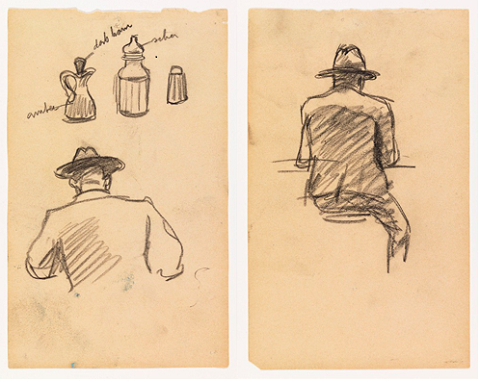
Edward Hopper’s Nighthawks (1942) doesn’t just evoke a certain stripe of mid-century, after-hours, big-city American loneliness; it has more or less come to stand for the feeling itself. But as with most images that passed so fully into the realm of iconhood, we all too easily forget that the painting didn’t simply emerge complete, ready to embed itself in the zeitgeist. Robin Cembalest at ARTnews has a post on how Edward Hopper “storyboarded” Nighthawks, finding and sketching out models for those three melancholic customers (one of whom you can see in an early rendering above), that wholesome young attendant in white, and the all-night diner (which you can see come together in chalk on paper below) in which they find refuge.
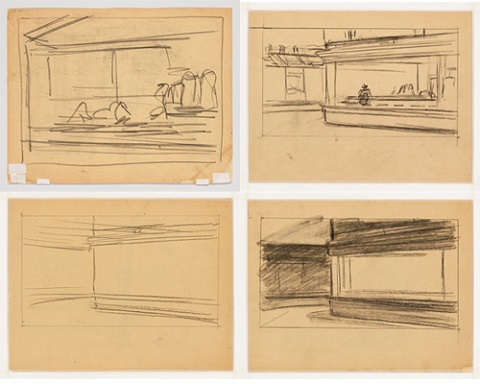
These “19 studies for Nighthawks,” writes Cembalest, “reveal how Hopper choreographed his voyeuristic scene of the nighttime convergence of the man, a couple, and a server in the eerie Deco diner, refining every nuance of the countertop, the figures, the architecture, and the effects of the fluorescent lighting.”
In each sketch, more pieces have fallen into place: a diner assumes their position, the light finds its angle, the perspective shifts to that of an outsider on the darkened street. Cembalest quotes Whitney curator Carter Foster describing the final product as a “marvelous demonstration of both extreme specificity and near abstract compositional summation on the same surface beguilingly [which] reflects how empirical observation and imagination coexisted in Hopper’s head.”
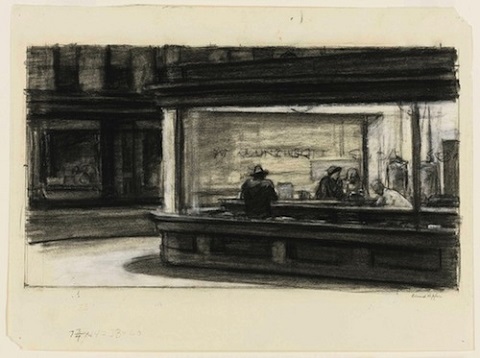
Despite how many elements of the real world Hopper studied to create Nighthawks, it ultimately depicts no real place. The painter himself posed for the male figures, and his wife modeled for the female. As for the locale, seen in the final drawing just above, Cembalest notes that “after years of research and scholarship, experts have determined that Nighthawks was not inspired by one specific diner. Rather, it was a composite of wedge-shaped intersections around Greenwich Avenue. Its curving prow seems partly inspired by the Flatiron Building.” In a way, it almost seemed too realistically New York to actually exist in New York. Hopper painted a distillation of a sense of American place, and like many American places, I’ve never quite known whether I’d love to drop in at the Nighthawks diner (though I’d have to find a front door first), or whether I should count myself lucky that life hasn’t relegated me to it. You can learn more about the fascinating storyboarding of Nighthawks at Art News and see many more sketches. Speaking of the sketches, they come courtesy of The Whitney Museum of American Art.
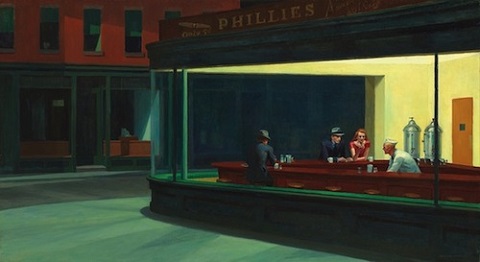
via ARTNews
Related Content:
Painters Painting: The Definitive Documentary Portrait of the New York Art World (1940–1970)
Jackson Pollock 51: Short Film Captures the Painter Creating Abstract Expressionist Art
William S. Burroughs Shows You How to Make “Shotgun Art”
Colin Marshall hosts and produces Notebook on Cities and Culture and writes essays on cities, language, Asia, and men’s style. He’s at work on a book about Los Angeles, A Los Angeles Primer. Follow him on Twitter at @colinmarshall or on Facebook.
Read More...Watch George Harrison’s Final Interview and Performance (1997)
Before John Fugelsang was a well-known political commentator regularly opining at Huffington Post, MSNBC, and CNN, he caught a big break as a host on VH1 in the 90s, where he was, in his own words, “their de facto classic rock guy.” Interviewing the illustrious likes of Paul McCartney, Pete Townshend, Eric Clapton, Robbie Robertson, and Willie Nelson, Fugelsang had the chance to host “the most incredible all-star concerts that nobody would watch.” At least one of those concerts became tremendously significant in hindsight—on July 24, 1997, George Harrison came by the studio, talked at length about the Beatles, his own music, and spirituality, giving what would turn out to be his very last public interview and performance. Watch it above in a re-broadcast. That same year, Harrison was diagnosed with throat cancer. He died in 2001.
Harrison appeared with his old friend Ravi Shankar—he had just produced Shankar’s Chants of India—and had only planned to stop by, Fugelsang says, and “give us a little 10-minute sound byte.” Instead they talked for twice that long and Harrison played, among other things, his classic “All Things Must Pass” from his 1970 solo record of the same name (above). The interview was, of course, a high point for the show’s host, who did everything he could to keep Harrison talking, connecting with him over their shared interest in religious faith. For Harrison, there was no separating music and spirituality. Reflecting on Shankar’s album, he says
And that’s really why for me this record’s important, because it’s another little key to open up the within. For each individual to be able to sit and turn off, um…“turn off your mind relax and float downstream” and listen to something that has its root in a transcendental, because really even all the words of these songs, they carry with it a very subtle spiritual vibration. And it goes beyond intellect really. So if you let yourself be free to let that have an effect on you, it can have an effect, a positive effect.
Harrison and Fugelsang also discussed the 1970 Concert for Bangladesh, which was partly set in motion by Shankar. In a life that included playing in the most famous band in the world then sustaining one of the most productive and successful solo careers in rock, 1970 was a watershed year for Harrison. The Bangladesh benefit marked the live debut of many of Harrison’s first solo compositions; and for a great many George Harrison fans, the Phil Spector-produced All Things Must Pass is the purest expression of the soft-spoken musician’s genius.
I only speak for myself in pointing to the haunting, hypnotic “The Ballad of Sir Frankie Crisp” (above) as the most beautiful and mysterious song on that album. Last night—it being George Harrison week on Conan O’Brien—Harrison’s son Dhani came on the show to play that song and “Let It Down,” also from All Things Must Pass. His appearance follows Paul Simon’s Tuesday night rendition of “Here Comes the Sun” and Beck’s cover of Harrison’s “Wah Wah” on Monday. These performances mark the release of a new Harrison box set, which has also occasioned a September 28th all-star tribute concert at L.A.’s Fonda Theater. Learn more about that event and other Harrison tributes and happenings at Consequence of Sound.
Related Content:
George Harrison Explains Why Everyone Should Play the Ukulele, With Words and Music
Ravi Shankar Gives George Harrison a Sitar Lesson … and Other Vintage Footage
Josh Jones is a writer and musician based in Durham, NC. Follow him at @jdmagness.
Read More...Read 14 Great Banned & Censored Novels Free Online: For Banned Books Week 2014
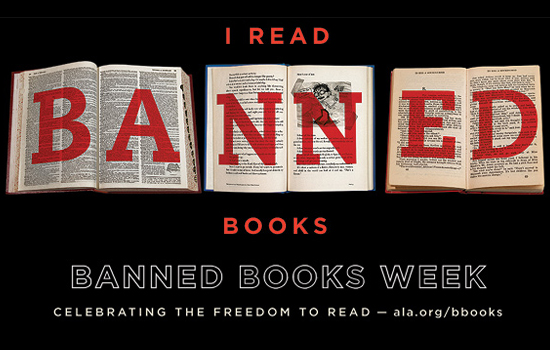
We well know of the most famous cases of banned books: James Joyce’s Ulysses, Henry Miller’s Tropic of Cancer, Allen Ginsberg’s Howl. In fact, a full 46 of Modern Library’s “100 Best Novels” have been suppressed or challenged in some way. The American Library Association maintains a page that details the charges against each one. Harper Lee’s To Kill a Mockingbird saw a challenge in the Vernon Verona Sherill, New York school district in 1980 as a “filthy, trashy novel” and in 1996, Lindale, Texas banned it from the advanced placement English reading list because it “conflicted with the values of the community.” Steinbeck’s Grapes of Wrath has a lengthy rap sheet, including total banning in Ireland (1953), Morris, Manitoba (1982), and all high school classes in Kanawha, Iowa (1980). The list of censored undisputed classics—every one of which surely has its own piece of giant store art in Barnes & Nobles nationwide—goes on.
In many ways this is typical. “The banned books lists you’ll find in many libraries and bookstores,” writes John Mark Ockerbloom at Everybody’s Libraries, “doesn’t [sic] focus much on the political samizdat, security exposés, or portrayals of Mohammed that are the objects of forcible suppression today. Instead, they’re often full of classics and popular titles sold widely in bookstores and online—or dominated by books written for young readers, or assigned for school reading.” Are these lists—and the banned books celebrations that occasion them—just “shameless propaganda” as conservative Thomas Sowell alleges? “Is it wrong to call these books banned?” asks Ockerbloom in his essay “Why Banned Books Week Matters.” Of course he answers in the negative; “not if you take readers seriously. An unread book, after all, has as little impact as an unpublished book.” Books that don’t pass muster with administrators, school boards, library associations, and legislators of all kinds, argues Ockerbloom, can be as inaccessible to young readers as those that get destroyed or fully suppressed in parts of the world without legal provisions for free speech.
This situation is in great part remediated by the free availability of texts on the internet, whether those currently under a ban or those that—even if they line the shelves in brick and mortar stores and Amazon warehouses—still meet with frequent challenges from community organizations eager to control what their citizens read. Today, in honor of this year’s Banned Books Week, we bring you free online texts of 14 banned books that appear on the Modern Library’s top 100 novels list. Next to each title, see some of the reasons these books were challenged, banned, or, in many cases, burned.
- The Great Gatsby, by F. Scott Fitzgerald (Read Online)
This staple of high school English classes everywhere seems to mostly get a pass. It did, however, see a 1987 challenge at the Baptist College in Charleston, SC for “language and sexual references.”
- Ulysses, by James Joyce (Read Online)
Seized and burned by postal officials in New York when it arrived stateside in 1922, Joyce’s masterwork generally goes unread these days because of its legendary difficulty, but for ten years, until Judge John Woolsey’s decision in its favor in 1932, the novel was only available in the U.S. as a bootleg. Ulysses was also burned—and banned—in Ireland, Canada, and England.
- 1984, by George Orwell (Read Online)
Orwell’s totalitarian nightmare often seems like one of the very few things liberals and conservatives can agree on—no one wants to live in the future he imagines. Nonetheless, the novel was challenged in Jackson County, Florida in 1981 for its supposedly “pro-communist” message, in addition to its “explicit sexual matter.”
- Animal Farm, by George Orwell (Read Online)
Again the target of right-wing ire, Orwell’s work was challenged in Wisconsin in 1963 by the John Birch Society, who objected to the words “masses will revolt.” A 1968 New Survey found that the novel regularly appeared on school lists of “problem books.” The reason most often cited: “Orwell was a communist.”
- Slaughterhouse Five, by Kurt Vonnegut (Audio)
Vonnegut’s classic has been challenged by parents and school boards since 1973, when it was burned in Drake, North Dakota. Most recently, it’s been removed from a sophomore reading list at the Coventry, RI high school in 2000; challenged by an organization called LOVE (Livingstone Organization for Values in Education) in Howell, MI in 2007; and challenged, but retained, along with eight other books, in Arlington Heights, IL in 2006. In that case, a school board member, “elected amid promises to bring her Christian beliefs into all board decision-making, raised the controversy based on excerpts from the books she’d found on the internet.” Hear Vonnegut himself read the novel here.
- The Call of the Wild, by Jack London (Read Online)
London’s most popular novel hasn’t seen any official suppression in the U.S., but it was banned in Italy and Yugoslavia in 1929. The book was burned in Nazi bonfires in 1933; something of a historical irony given London’s own racist politics.
- The Jungle, by Upton Sinclair (Read Online)
The Nazis also burned Sinclair’s novel because of the author’s socialist views. In 1959, East Germany banned the book as “inimical to communism.”
- Lady Chatterley’s Lover, by D.H. Lawrence (Read Online)
Lawrence courted controversy everywhere. Chatterly was banned by U.S. customs in 1929 and has since been banned in Ireland (1932), Poland (1932), Australia (1959), Japan (1959), India (1959), Canada (1960) and, most recently, China in 1987 because it “will corrupt the minds of young people and is also against the Chinese tradition.”
- In Cold Blood, by Truman Capote (Read First Section Online)
This true crime classic was banned, then reinstated, at Savannah, Georgia’s Windsor Forest High School in 2000 after a parent “complained about sex, violence, and profanity.”
- Sons and Lovers, by D.H. Lawrence (Read Online)
Lawrence endured a great deal of persecution in his lifetime for his work, which was widely considered pornographic. Thirty years after his death, in 1961, a group in Oklahoma City calling itself Mothers Unite for Decency “hired a trailer, dubbed it ‘smutmobile,’ and displayed books deemed objectionable,” including Sons and Lovers.
- Naked Lunch, by William S. Burroughs (Audio)
If anyone belongs on a list of obscene authors, it’s Burroughs, which is only one reason of the many reasons he deserves to be read. In 1965, the Boston Superior Court banned Burroughs’ novel. The State Supreme Court reversed that decision the following year. Listen to Burroughs read the novel here.
- Women in Love, by D.H. Lawrence (Read Online)
Poor Lawrence could not catch a break. In one of many such acts against his work, the sensitive writer’s fifth novel was declared obscene in 1922 by the rather unimaginatively named New York Society for the Suppression of Vice.
- An American Tragedy, by Theodore Dreiser (Read Online)
American literature’s foremost master of melodrama, Dreiser’s novel was banned in Boston in 1927 and burned by the Nazi bonfires because it “deals with low love affairs.”
You can learn much more about the many books that have been banned, suppressed, or censored at the University of Pennsylvania’s “Banned Books Online” page, and learn more about the many events and resources available for Banned Books Week at the American Library Association’s website.
Related Content:
74 Free Banned Books (for Banned Books Week)
Allen Ginsberg Reads His Famously Censored Beat Poem, Howl (1959)
Josh Jones is a writer and musician based in Durham, NC. Follow him at @jdmagness.
Read More...Watch Miles Davis, Grace Jones, Adam Ant & Devo in 1980s Ads for Honda Scooters
Beginning scooter riders can find a veritable biker’s breakfast of pointers on the Internet. One could cobble them together to make a contemporary owners manual, covering such crucial topics as braking, throttling, steering, and staying upright. But sometimes one craves something a bit more elusive, a bit more spiritual. Is there a youtube equivalent of Zen and the Art of Motorcycle Maintenance?
Not really, but there are these early 80s ads for Honda scooters, featuring some of the era’s most iconoclastic acts.
They put Adam Ant’s dashing post-punk appeal to the test by confining him in close quarters with Grace Jones. Grace, above, dominated, with all the confidence and ease of a tiger caged up with a peacock.
The prize? Can’t speak for Adam, but Grace got to film another spot. Her co-stars this time were a grid of infants, whose mothers must’ve been relieved that the alien diva queen never actually interacted with them. Can you imagine if Huggies had shared Honda’s adventurous advertising sensibilities?
Jazz great musician Miles Davis didn’t have to do much to lend an air of cool to that scooter. Even the cardboard boxes scattered in the background of his garage benefit from his presence. The Prince of Darkness’ reputation was never an 80’s-specific phenomenon, but he looks the part, kitted out like the Road Warrior.
Synth-pop superstars Devo urged beginning riders to adopt their extremely unconventional brand of conformity, suggesting that the band’s uniform of coveralls and, uh, shoes was the perfect thing to wear while riding that Honda. Those who wanted to hang on to some semblance of individuality could do so via scooter color.
Ironic though it may have been, their willingness to be seen sporting, nay, promoting helmets makes Devo’s ad my personal favorite.
To see Lou Reed’s contribution to Honda’s series of ads, see our previous post: Selling Cool: Lou Reed’s Classic Honda Scooter Commercial, 1984
Related Content:
David Lynch’s Perfume Ads Based on the Works of Hemingway, F. Scott Fitzgerald & D.H. Lawrence
Watch Laurence Olivier, Liv Ullmann and Christopher Plummer’s Classic Polaroid Ads
Klaus Nomi’s Ad for Jägermeister (Circa 1980)
Ayun Halliday is an author, homeschooler, and Chief Primatologist of the East Village Inky zine. Follow her @AyunHalliday
Read More...Support Us
We're hoping to rely on loyal readers, rather than erratic ads. Please click the Donate button and support Open Culture. You can use Paypal, Venmo, Patreon, even Crypto! We thank you!

About Us

Open Culture scours the web for the best educational media. We find the free courses and audio books you need, the language lessons & educational videos you want, and plenty of enlightenment in between.
Advertise With Us

FREE UPDATES!
GET OUR DAILY EMAIL
Get the best cultural and educational resources on the web curated for you in a daily email. We never spam. Unsubscribe at any time.
FOLLOW ON SOCIAL MEDIA

Open Culture editor Dan Colman scours the web for the best educational media. He finds the free courses and audio books you need, the language lessons & movies you want, and plenty of enlightenment in between.
Advertise With Us

