The Five Best North Korean Movies: Watch Them Free Online
According to official propaganda, Kim Jong-Il was a remarkably impressive individual. He learned to walk when he was just three weeks old; he wrote 1,500 books while at university; and, during his first and only game of golf, he scored 11 holes in one. Yet for some reason becoming the world’s first North Korean professional golf player didn’t seem to interest Kim. He wanted to make movies. So, in 1978, while his father Kim Il-Sung was still the country’s supreme leader, Kim set out to modernize the film industry of the Democratic People’s Republic of Korea.
“The North’s filmmakers are just doing perfunctory work,” Kim said to South Korean film director Shin Sang-ok. “They don’t have any new ideas…their works have the same expressions, redundancies, the same old plots. All our movies are filled with crying and sobbing. I didn’t order them to portray that kind of thing.”

Of course, Kim’s bold plan to jumpstart the industry was to kidnap Shin and his wife, both celebrities in South Korea. He was abducted in Hong Kong and, when he had the temerity to try to escape, he ended up spending four years toiling in prison, subsisting on little more than grass and a little rice. Eventually, Shin was approached by Kim and given an offer he dare not refuse: make movies in North Korea.
Like the films cranked out in China during the height of the Cultural Revolution, North Korean movies are largely propaganda delivery systems designed exclusively for a domestic audience. After Shin’s kidnapping, DPRK movies started to get just a bit less didactic. Simon Fowler, who writes probably the only English-language blog on North Korean cinema, just wrote an article for The Guardian where he selected the best films to come out of the Hermit kingdom. You can watch a few of these movies here and find the others at The Guardian. They might be goofy, maudlin and ham-fisted, but for movie mavens and aficionados of Communist kitsch, they are fascinating.
Perhaps the most important North Korean movie ever is The Flower Girl (1972). Watch it above. Set during Japan’s colonial occupation of Korea, the film follows a young woman who endures one injustice after another at the hands of the Japanese before Kim Il-Sung’s army marches into her village and saves the day. The movie set the template for many of the movies to come afterwards. As Fowler writes, “the importance of The Flower Girl within the DPRK cannot be overestimated. The star, Hong Yong-hee, adorns the one won bank note in North Korea, and is revered as a national hero. Although not always an easy watch, those wanting to learn more about the average North Koreans’ sensibilities could do far worse than to watch this picturesque but tragic film.”
Hong Kil Dong (1986) is clearly one of the movies Shin Sang-ok influenced; it foregrounded entertainment over ideology, a rarity at that point in the country’s film history. The movie is about a character from Korean literature who, like Robin Hood, not only robs from the rich and gives to the poor but knows how to deliver a beatdown. Hong plays out like a particularly low-budget Shaw Brothers kung fu spectacle with plenty of flying kicks, sword play and wire work.
https://www.youtube.com/watch?v=eCKSR0JArUQ#t=5000
And finally, there’s Pulgasari (1985), North Korea’s attempt at making a kaiju movie. Set in feudal times, the film is about a statue that comes to life, grows to monstrous proportions and, unable to sate its unquenchable thirst for metal, starts to smash things. Shin managed to get technical help for the movie from Toho, the same Japanese studio that cranked all those Godzilla movies. In fact, they even got veteran kaiju actor, Kenpachiro Satsuma, to don a rubber suit for this movie. Years later, Pulgasari was released in Japan about the same time as Roland Emmerich’s god awful Hollywood remake of Godzilla (not to be confused with Gareth Edward’s god awful Hollywood remake from earlier this year). Satsuma publically stated what a lot of Japanese privately thought – Pulgasari is better than Emmerich’s big-budget dud.
Not long after Shin completed Pulgasari, he and his wife managed to escape in Vienna thanks to the help of the CIA and a host of other unlikely parties. Kim Jong-Il might have had super human abilities, but talent retention did not seem to be one of them.
You can watch the three films listed above, plus Marathon Runner and Centre Forward over at The Guardian.
More free films can be found in our collection, 4,000+ Free Movies Online: Great Classics, Indies, Noir, Westerns, Documentaries & More.
via Coudal
Related Content:
Kim Jong-il’s Godzilla Movie & His Free Writings on Film Theory
North Korea’s Cinema of Dreams
Jonathan Crow is a Los Angeles-based writer and filmmaker whose work has appeared in Yahoo!, The Hollywood Reporter, and other publications. You can follow him at @jonccrow. And check out his blog Veeptopus, featuring one new drawing of a vice president with an octopus on his head daily.
Read More...Andy Warhol’s 85 Polaroid Portraits: Mick Jagger, Yoko Ono, O.J. Simpson & Many Others (1970–1987)

Polaroid photography, which looked about to fade out forever for a while there, has in recent years made a comeback. Chalk it up, if you must, to a grand revaluing wave of the physically analog in our age of digital ephemerality — the same tide on which enthusiasm for vinyl, zines, and even VHS tapes has risen again. But we must acknowledge that Andy Warhol, in a sense, got there first. It hardly counts as the only matter on which the mastermind of the Factory showed prescience; take, for instance, his quip about everyone in the future getting fifteen minutes of fame, a prediction which, as Jonathan Lethem put it, has in our present hardened into “drab processional.” Some of these very 21st-century people now enjoying (or enduring) their own fifteen minutes — most of them presumably not even born within Warhol’s lifetime — surely keep a Polaroid camera at hand. They acknowledge, on some level, what the consummate 20th-century “pop artist” sensed: that the ostensibly cheap and disposable, including self-developing film used for untrained vacation snapshots and mere reference material for “real” works of art, has its own kind of permanence.
Here we have a selection of Warhol’s own works of Polaroid photography, a medium he took up around 1970 and used to further his interest in portraiture. The University of California, Berkeley Art Museum, just one of the institutions to put them on display, says that “these images often served as the basis for his commissioned portraits, silk-screen paintings, drawings, and prints.” The wide subset they showed “reveals that superstars were not the only figures that Warhol photographed with his Polaroid Big Shot, the distinct plastic camera he used for the majority of his sittings. Over half of those who sat for him were little known or remain unidentified.” Whether of Mick Jagger, Yoko Ono, O.J. Simpson, Debbie Harry, himself, a row of bananas, or someone faintly recognizable yet ultimately unnamable, each of Warhol’s Polaroids remains “fully identified with the artwork that ultimately grew out of it; the face depicted becomes a kind of signifier for larger cultural concepts of beauty, power, and worth.”
You can see at least 85 of Warhol’s polaroid portraits at a site called These Americans.
Now what would Warhol, a known early enthusiast of computer art, have said about the arrival of Instagram filters meant to make our instantaneous, high-resolution digital photos look like Polaroids again?
Related Content:
Andy Warhol Digitally Paints Debbie Harry with the Amiga 1000 Computer (1985)
Andy Warhol’s Lost Computer Art Found on 30-Year-Old Floppy Disks
The Masterful Polaroid Pictures Taken by Filmmaker Andrei Tarkovsky
Watch Laurence Olivier, Liv Ullmann and Christopher Plummer’s Classic Polaroid Ads
A Celebration of Retro Media: Vinyl, Cassettes, VHS, and Polaroid Too
Colin Marshall hosts and produces Notebook on Cities and Culture and writes essays on cities, language, Asia, and men’s style. He’s at work on a book about Los Angeles, A Los Angeles Primer. Follow him on Twitter at @colinmarshall or on Facebook.
Read More...Fellini’s Three Bank of Rome Commercials, the Last Thing He Did Behind a Camera (1992)
It happened before, and it still happens now and again today, but in the second half of the twentieth century, auteurs really got into making commercials: Ingmar Bergman, Jean-Luc Godard, David Lynch. Not, perhaps, the first names in filmmaking you’d associate with commerciality, but there we have it. Where, though, to place Federico Fellini, director of La Dolce Vita, Satyricon, and Amarcord, movies that, while hardly assembled by the numbers, could never resist the entertaining and even pleasurable (or the somehow pleasurably displeasurable) spectacle? On one hand, Fellini went so far as to campaign against commercials airing during the broadcast of motion pictures; on the other hand, he made a few of the things, and not minor ones, either. In a post here on Fellini’s own commercials, Mike Springer referenced a trio shot for the Bank of Rome, quoting on the subject Fellini biographer Peter Bondanella, who notes their inspiration by “various dreams Fellini had sketched out in his dream notebooks,” and other Fellini biographer Tullio Kezich, who describes them as “the golden autumn of a patriarch of cinema who, for a moment, holds again the reins of creation.” Today, we present all three.
“Money is everywhere but so is poetry,” Fellini himself once said. “What we lack are the poets.” In these three spots, the creator synonymous with Italian auteurhood brings poetry and money together — even more so than most commercial-making “creative” filmmakers, given the overtly financial nature of the client’s business. You can read more about the project, “the last thing he did behind a camera,” at Sight & Sound: “In 1992, the year before his death, [Fellini] realised his best corporate work. [ … ] Here Fellini comprehended, skilfully conveyed and exposed the ultimate essence of advertising: the creation of needs and fears that the given product will magically solve.” The setup involves Paolo Villaggio as a nightmare-plagued man and Fernando Rey as his attentively listening analyst — and in addition to his professional interests, evidently quite a Bank of Rome enthusiast. The spot at the top of the post includes English subtitles, but as with Fellini’s features, even non-Italophones can expect rich, long-form (by commercial standards) audiovisual experiences watching the other two as well (above) — and ones, unlike any experience you’d have actually stepping into a bank, not quite of this reality. Today, we present all three, the last films Fellini ever made.
Related Content:
Fellini’s Fantastic TV Commercials
Watch All of the Commercials That David Lynch Has Directed: A Big 30-Minute Compilation
Jean-Luc Godard’s After-Shave Commercial for Schick
Ingmar Bergman’s Soap Commercials Wash Away the Existential Despair
Colin Marshall hosts and produces Notebook on Cities and Culture and writes essays on cities, language, Asia, and men’s style. He’s at work on a book about Los Angeles, A Los Angeles Primer. Follow him on Twitter at @colinmarshall or on Facebook.
Read More...Miles Davis’ Chili Recipe Revealed
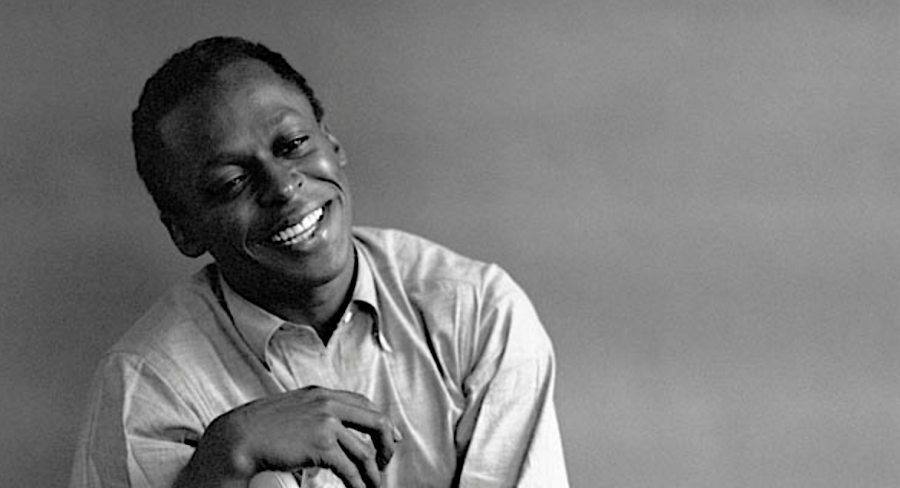
Image by Tom Palumbo, via Wikimedia Commons
No one cooked on the trumpet like Miles Davis. And, as it turns out, he was also quite good in the kitchen (see? I spared you a pun). Tired of going out to restaurants, the foodie Davis decided to learn to make his favorite dishes. “I taught myself how to cook by reading books and practicing, just like you do on an instrument,” he wrote in his autobiography, “I could cook most of the French dishes—because I really liked French cooking—and all the black American dishes.”
Davis, writes the Chicago Sun-Times, “knew how to simmer with soul […] He made chili, Italian veal chops and he fried fish in a secret batter.” Davis’ cookbook has disappeared, and he’s apparently taken his recipe secrets to the grave with him. All but one—his favorite, “a chili dish,” he writes, “I called Miles’s South Side Chicago Chili Mack. I served it with spaghetti, grated cheese, and oyster crackers.”
While Davis didn’t exactly spell out the ingredients or instructions for his beloved chili in his memoir, his first wife Frances, whom Davis trusted implicitly with the chili making, submitted the following to Best Life magazine in 2007. While you’re prepping, I recommend you put on 1956’s Cookin’ With the Miles Davis Quintet.
Miles’s South Side Chicago Chili Mack (Serves 6)
1/4 lb. suet (beef fat)
1 large onion
1 lb. ground beef
1/2 lb. ground veal
1/2 lb. ground pork salt and pepper
2 tsp. garlic powder
1 tsp. chili powder
1 tsp. cumin seed
2 cans kidney beans, drained
1 can beef consommé
1 drop red wine vinegar
3 lb. spaghetti
parmesan cheese
oyster crackers
Heineken beer1. Melt suet in large heavy pot until liquid fat is about an inch high. Remove solid pieces of suet from pot and discard.
2. In same pot, sauté onion.
3. Combine meats in bowl; season with salt, pepper, garlic powder, chili powder, and cumin.
4. In another bowl, season kidney beans with salt and pepper.
5. Add meat to onions; sauté until brown.
6. Add kidney beans, consommé, and vinegar; simmer for about an hour, stirring occasionally.
7. Add more seasonings to taste, if desired.
8. Cook spaghetti according to package directions, and then divide among six plates.
9. Spoon meat mixture over each plate of spaghetti.
10. Top with Parmesan and serve oyster crackers on the side.
11. Open a Heineken.
Mental Floss, who bring us the above, also cites another recipe Davis learned from his father, quoted by John Szwed in So What: The Life of Miles Davis. This one comes with no instructions, so “like a jazz musician, you’ll have improvise.”
bacon grease
3 large cloves of garlic
1 green, 1 red pepper
2 pounds ground lean chuck
2 teaspoons cumin
1/2 jar of mustard
1/2 shot glass of vinegar
2 teaspoons of chili powder
dashes of salt and pepper
pinto or kidney beans
1 can of tomatoes
1 can of beef brothserve over linguine
Dig it, man.
via Mental Floss
Related Content:
Leo Tolstoy’s Family Recipe for Macaroni and Cheese
1967 Cookbook Features Recipes by the Rolling Stones, Simon & Garfunkel, Barbra Streisand & More
Ernest Hemingway’s Summer Camping Recipes
Alice B. Toklas Reads Her Famous Recipe for Hashish Fudge (1963)
Josh Jones is a writer and musician based in Durham, NC. Follow him at @jdmagness
Read More...Shakespeare’s Restless World: A Portrait of the Bard’s Era in 20 Podcasts
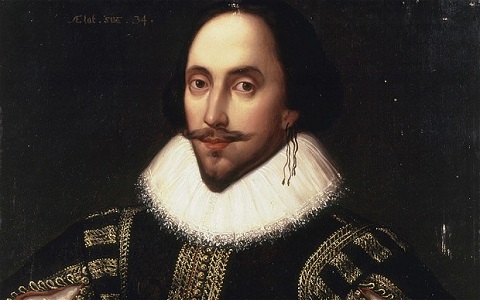
The BBC’s acclaimed podcast A History of the World in 100 Objects brought us just that: the story of human civilization as told through artifacts from the Egyptian Mummy of Hornedjitef to a Cretan statue of a Minoan Bull-leaper to a Korean roof tile to a Chinese solar-powered lamp. All those 100 items came from the formidable collection held by the British Museum, and any dedicated listener to that podcast will know the name of Neil MacGregor, the institution’s director. Now, MacGregor has returned with another series of historical audio explorations, one much more focused both temporally and geographically but no less deep than its predecessor. The ten-part Shakespeare’s Restless World “looks at the world through the eyes of Shakespeare’s audience by exploring objects from that turbulent period” — i.e., William Shakespeare’s life, which spanned the 1560s to the 1610s: a time of Venetian glass goblets, African sunken gold, chiming clocks, and horrific relics of execution.
These treasures illuminate not only the English but the global affairs of Shakespeare’s day. The Bard lived during a time when murderers plotted against Elizabeth I and James I, England expelled its Moors, Great Britain struggled to unite itself, humanity gained an ever more precise grasp on the keeping of time, and even “civilized” nations got spooked and slaughtered their own. Just as the study of Shakespeare’s plays reveals a world balanced on the tipping point between the modern consciousness and the long, slow awakening that came before, the study of Shakespeare’s time reveals a world that both retains surprisingly vivid elements of its brutal past and has already begun incorporating surprisingly advanced elements of the future to come. Even if you don’t give a hoot about the literary merits of Richard III, Titus Andronicus, or The Merchant of Venice, these real-life stories of political intrigue, gruesome bloodshed, and, er, Venice will certainly hold your attention. You can start with the “tabloid history of Shakespeare’s England” in the first episode of Shakespeare’s Restless World above, then continue on either at the series’ site or on iTunes. And if you find yourself getting into the series, you can get MacGregor’s companion book, Shakespeare’s Restless World: Portrait of an Era.
via Metafilter
Related Content:
A History of the World in 100 Objects
Discover What Shakespeare’s Handwriting Looked Like, and How It Solved a Mystery of Authorship
Read All of Shakespeare’s Plays Free Online, Courtesy of the Folger Shakespeare Library
Colin Marshall hosts and produces Notebook on Cities and Culture and writes essays on cities, language, Asia, and men’s style. He’s at work on a book about Los Angeles, A Los Angeles Primer. Follow him on Twitter at @colinmarshall or on Facebook.
Read More...The ABCs of Dada Explains the Anarchic, Irrational “Anti-Art” Movement of Dadaism
If asked to explain the art movement known as Dada, I’d feel tempted to quote Louis Armstrong on the music movement known as jazz: “Man, if you have to ask, you’ll never know.” But maybe I’d do better to sit them down in front of the half-hour documentary The ABCs of Dada. They may still come away confused, but not quite so deeply as before — or maybe they’ll feel more confused, but in an enriched way.
Even the video, which gets pretty thorough about the origins of and contributors to Dada, quotes heavily from the relevant Wikipedia article in its description, framing the movement as “a protest against the barbarism of World War I, the bourgeois interests that Dada adherents believed inspired the war, and what they believed was an oppressive intellectual rigidity in both art and everyday society.” They came to the conclusion that “reason and logic had led people into the horrors of war, so the only route to salvation was to reject logic and embrace anarchy and irrationality.” So there you have it; don’t try to understand.
Perhaps you remember that vintage Onion article, “Republicans, Dadaists Declare War on Art,” satirizing, among other things, the way proponents of Dada called its fruit not art, but “anti-art.” They made it deliberately meaningless where “real” art strove to deliver messages, deliberately offensive where it strained to appeal to common sensibilities. The ABCs of Dada examines Dada through a great many of these Dadaists themselves, such as Sophie Taeuber-Arp, a teacher and dancer forced to wear a mask for her Dada activities due to the group’s scandalous reputation in the academy; architect Marcel Janco, who remembers of the group that “among us were neither blasé people nor cynics, actors nor anarchists who took the Dada scandal seriously”; and “Dada-marshal” George Grosz, who declared that “if one calls my work art depends on whether one believes that the future belongs to the working class.” You can find further clarification among UBUweb’s collection of Dada, Surrealism, & De Stijl Magazines, such as Zurich’s Cabaret Voltaire and Berlin’s Der Dada. Or perhaps you’ll find further obfuscation, but that aligns with the Dada spirit — in a world that has ceased to make sense, so the Dadaists believed, the duty falls to you to make even less.
Related Content:
William S. Burroughs on the Art of Cut-up Writing
Anémic Cinéma: Marcel Duchamp’s Whirling Avant-Garde Film (1926)
Man Ray and the Cinéma Pur: Four Surrealist Films From the 1920s
Colin Marshall hosts and produces Notebook on Cities and Culture and writes essays on cities, language, Asia, and men’s style. He’s at work on a book about Los Angeles, A Los Angeles Primer. Follow him on Twitter at @colinmarshall or on Facebook.
Read More...In the Voice of Robin Williams, Impressionist Jim Meskimen Reads an Elegy for the Departed Comedian
We’ve previously featured the impressionist work of Jim Meskimen on Open Culture, particularly his fab reading of a monologue from Shakespeare’s Richard III in 25 celebrity voices. It includes everyone from Woody Allen to Jack Nicholson to Droopy Dog. Today he returns on a more solemn occasion. In the voice of Robin Williams, Meskimen reads a poem he wrote to the dearly departed comedian. You can watch it above. His poem appears below:
IN MEMORY OF ROBIN WILLIAMS
by Jim Meskimen
THEY DIDN’T BURN ALL THE PIANOS
WHEN FREDRICK CHOPIN DIED
DIDN’T OUTLAW OIL PAINTS
WHEN PICASSO TOOK HIS FINAL RIDE
NO ONE PUT A STOP TO BASEBALL
WHEN MICKEY MANTLE’S TIME WAS UP
OR BANNED ALL RUSSIAN NOVELS
WHEN TOLSTOY WENT BELLY UP
ON SHAKESPEARE’S DEATH, NOBODY SAID
“NOW HATH ARRIVED THE DAY–
FROM THIS POINT HENCE LET NONE DARE
PUT FORTH PEN TO WRITE A PLAY!”
WE CELEBRATE WHAT’S LEFT
BY THE DEPARTED, IT’S OUR CHOICE
YET IT DOES SEEM SACRILIGEOUS
TO DO ROBIN WILLIAM’S VOICE
A VOICE THAT WAS DESIGNED TO SOOTHE,
SOFT, DEEP TONES TO RESONATE
AND CASCADE GENTLY OUTWARD
FROM BEHIND A SMILING FACE
A VOICE THAT COULD ACCELERATE
TO CATCH UP WITH THE MIND
LIKE SHIFTING INTO OVERDRIVE
TO NOT GET LEFT BEHIND
A VOICE THAT COULD CHANGE CHARACTER
LIKE SECONDS ON A CLOCK
OR HIJACK NATIONALITIES
FOR A SPIN AROUND THE BLOCK
SHIFT AGE, SHIFT VIEWPOINT, SHIFT I.Q.,
WHATEVER’S NOT NAILED DOWN
DESTROY, REBUILD, DESTROY AGAIN,
A FORMIDABLE CLOWN
WE’LL HEAR THIS VOICE IN FUTURE TIMES
IN RERUNS ON TV,
IT WILL OCCUPY THE WORLD WIDE WEB
LIVE ON, DIGITALLY
WE’LL HEAR ITS ECHOES COME
FROM OTHER MOUTHS AND OTHER LIPS
IN TRIBUTES AND HOMAGES, AND,
LIKE PSYCHEDELIC TRIPS
WE’LL THINK THE OWNER’S BACK AGAIN
WITH HIS FAMILIAR SOUND
BUT THEY’LL ALL BE IMITATIONS–
JUST AN AUDIBLE REBOUND
NEW JOKES AREN’T IN THE PIPELINE NOW,
NOT THAT THE WELL WENT DRY-
BUT THE JESTER WHO POSSESSED THIS VOICE
JUST CHOSE TO SAY GOODBYE
WITH THE WEALTH OF JOY HE LEFT US
WE SHOULD PROBABLY REJOICE
BUT IT’S HARD TO TO GRASP WE LOST THE GUY
WHO USED TO HAVE THIS VOICE.
RIP ROBIN.
Read More...Philosophy Referee Hand Signals
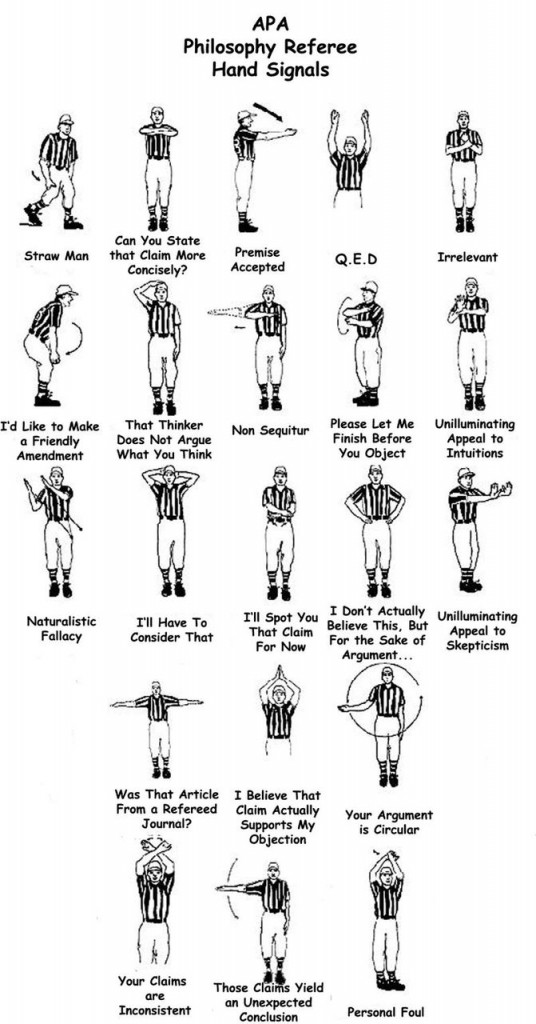
The next time you’re presiding over an intense philosophical debate, feel free to use these hand signals to referee things. Devised by philosophy prof Landon Schurtz, these hand signals were jokingly meant to be used at APA (American Philosophy Association) conferences. Personally, I think they would have made a great addition to the famous Monty Python soccer match where the Germans (Kant, Nietzsche & Marx) played the indomitable Ancient Greeks (Aristotle, Plato & Archimedes). Imagine Confucius, the referee, whirling his hand in a circle and penalizing Wittgenstein for making a circular argument. Priceless.
Related Content:
The Monty Python Philosophy Football Match: The Greeks v. the Germans
Download 100 Free Philosophy Courses and Start Living the Examined Life
Read More...Ernest Hemingway: T.S. Eliot “Can Kiss My Ass As a Man”
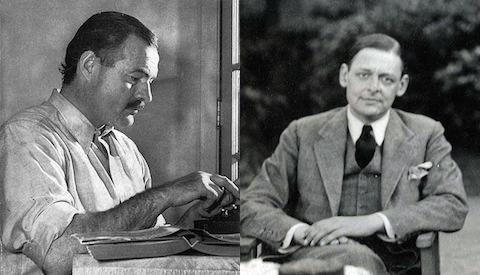
T.S. Eliot may have been the most unavoidable force in American letters in the early 20th century, but he was probably not a very likable person. At least Ernest Hemingway didn’t think so. The burly novelist, often in the habit of telling fellow writers to “kiss my ass,” wrote in a July 1950 letter to writer and editor Harvey Breit that Eliot could do just that “as a man,” since he “never hit a ball out of the infield in his life and he would not have existed for dear old Ezra [Pound], the lovely poet and stupid traitor.” Of Pound’s “stupid” treason, Hemingway had previously written some choice words; Of Eliot’s sins—in addition to his failing to measure up to Yogi Berra, despite both of them hailing from St. Louis—Hemingway included the following: “Royalist, Anglo-Catholic and conservative”
Despite all this, however, Hemingway, like most of his modernist contemporaries, owed a debt to Eliot, whom Papa almost-grudgingly admitted was “a damned good poet and a fair critic,” though “there isn’t any law a man has to go and see [Eliot’s play] the Cocktail party” [sic]. Writes Wendolyn E. Tetlow, author of Hemingway’s In Our Time: Lyrical Dimensions, “despite Hemingway’s acid comments, however, he could not escape Eliot’s influence.” Of particular significance for Hemingway’s terse, elliptical style was the Eliot doctrine of the “objective correlative,” something of a refinement of Pound’s imagism. In Hemingway’s ruminations on his own process, it seems he could not have done without this poetic technique—one of encapsulating abstract concepts and fleeting, insubstantial emotions in the amber of concrete, discrete objects, symbols, and acts.
“Find what gave you the emotion,” Hemingway wrote in “The End of Something,” remarking on a schooner moving through a ruined mill town, “then write it down making it clear so the reader will see it and have the same feeling.” Eliot would never have been so vulgar as to plainly spell out his method in the text itself, like a set of instructions, but Hemingway does so again in Death in the Afternoon:
I was trying to write then and I found the greatest difficulty, aside from knowing truly what you really felt, rather than what you were supposed to feel, and had been taught to feel, was to put down what really happened in action; what the actual things were which produced the emotion that you experienced.
Compare these passages with Eliot’s definition in his 1919 essay on Hamlet: “The only way of expressing emotion in the form of art is by finding an ‘objective correlative’; in other words, a set of objects, a situation, a chain of events which shall be the formula of that particular emotion.” The influence—if not outright borrowing—is unmistakable. Yet Hemingway remained leery of Eliot “as a man.” In 1954, Robert Manning of The Atlantic visited Hemingway in Cuba and found him surly on the subject and “not warm toward T.S. Eliot,” preferring instead to “praise Ezra Pound.” Hemingway would go so far, in fact, as to claim that Pound deserved Eliot’s Nobel.
We shouldn’t take any of this salty talk too seriously. After all, Hemingway, the great boaster, liked to trash people he envied. Even Joe Louis, whom you would think aspiring boxer Hemingway would hold in highest esteem, “never learned to box,” though he was, Papa admitted, “a good getter-upper.”
via Biblioklept
Related Content:
Ernest Hemingway to F. Scott Fitzgerald: “Kiss My Ass”
Josh Jones is a writer and musician based in Durham, NC. Follow him at @jdmagness
Read More...The 1985 Soviet TV Adaptation of The Hobbit: Cheap and Yet Strangely Charming
If you call yourself a Tolkien fanboy or fangirl, you’ve almost certainly kept up with the various film and television adaptations of not just the Lord of the Rings trilogy, but of its predecessor, The Hobbit, or There and Back Again. Tolkien’s first children’s novel (or so the literary world first received it). The story it tells of the reluctant hero Bilbo Baggins and the band of raffish compatriots who drag him out to claim some treasure from Smaug the dragon offers understandably irresistible material for adaptation: the richly detailed, often funny high-fantasy adventure has, over the decades, made for numerous productions on the stage, radio, and screen.
They’ve ranged from low- to high-profile, from Gene Deitch’s loose-as-possible 12-minute “animated” adaptation that came out in 1966 to Peter Jackson’s tripartite, high-framerate, nine-hour series of major motion pictures, two currently released with one to go. But what to make of the Soviet Hobbit above?
Known in English as The Fairytale Journey of Mr. Bilbo Baggins, The Hobbit and in Russian, in full, as Сказочное путешествие мистера Бильбо Бэггинса, Хоббита, через дикий край, чёрный лес, за туманные горы. Туда и обратно. По сказочной повести Джона Толкина “Хоббит,” the hourlong TV movie debuted on the Leningrad TV Channel’s children’s show Tale After Tale in 1985. This unlicensed adaptation frames itself with the words of a Tolkien stand-in called “the Professor,” using live actors to play the main characters like Bilbo, Thorin, Gandalf, and Gollum, portraying the more exotic ones with either puppets or, according to Tolkien Gateway, dancers from the Leningrad State Academic Opera and Ballet Theatre. The fact that this version of The Hobbit only recently became available with real English subtitles (as opposed to goofy parody ones) goes to show just how seriously the Tolkien fandom has taken it, but it does retain a kind of handcrafted charm. Plus, it gives the internet the chance to indulge in the obligatory Yakov Smirnoff gag: in Soviet Russia, ring finds you.
Related Content:
The Hobbit: The First Animation & Film Adaptation of Tolkien’s Classic (1966)
C.S. Lewis’ Prescient 1937 Review of The Hobbit by J.R.R. Tolkien: It “May Well Prove a Classic”
Listen to J.R.R. Tolkien Read a Lengthy Excerpt from The Hobbit (1952)
Soviet-Era Illustrations Of J. R. R. Tolkien’s The Hobbit (1976)
Illustrations of The Lord of the Rings in Russian Iconography Style (1993)
Download Eight Free Lectures on The Hobbit by “The Tolkien Professor,” Corey Olsen
Colin Marshall hosts and produces Notebook on Cities and Culture and writes essays on cities, language, Asia, and men’s style. He’s at work on a book about Los Angeles, A Los Angeles Primer. Follow him on Twitter at @colinmarshall or on Facebook.
Read More...Support Us
We're hoping to rely on loyal readers, rather than erratic ads. Please click the Donate button and support Open Culture. You can use Paypal, Venmo, Patreon, even Crypto! We thank you!

About Us

Open Culture scours the web for the best educational media. We find the free courses and audio books you need, the language lessons & educational videos you want, and plenty of enlightenment in between.
Advertise With Us

FREE UPDATES!
GET OUR DAILY EMAIL
Get the best cultural and educational resources on the web curated for you in a daily email. We never spam. Unsubscribe at any time.
FOLLOW ON SOCIAL MEDIA

Open Culture editor Dan Colman scours the web for the best educational media. He finds the free courses and audio books you need, the language lessons & movies you want, and plenty of enlightenment in between.
Advertise With Us


