Stanford’s Robert Sapolsky Demystifies Depression, Which, Like Diabetes, Is Rooted in Biology
We know that depression affects people from all walks of life. Rich. Poor. Celebs. Ordinary Joes. Young. Old. But, somehow after the death of Robin Williams, there’s a renewed focus on depression, and my mind turned immediately to a lecture we featured on the site way back in 2009. The lecture is by Robert Sapolsky, a Stanford biologist, who has a talent for making scientific subjects publicly accessible. A recipient of the MacArthur genius grant, Sapolsky notes that depression — currently the 4th greatest cause of disability worldwide, and soon the 2nd — is deeply biological. Depression is rooted in biology, much as is, say, diabetes. As the lecture unfolds, you will see how depression changes the body. When depressed, our brains function differently while sleeping, our stress response goes way up 24/7, our biochemistry levels change, etc. You will see that biology is at work.
Sapolsky is one compelling teacher. So you might not want to miss his Stanford course, Introduction to Human Biology. It’s equally worth your time. You can always find it housed in our collection 1,700 Free Online Courses from Top Universities.
If you would like to support the mission of Open Culture, consider making a donation to our site. It’s hard to rely 100% on ads, and your contributions will help us continue providing the best free cultural and educational materials to learners everywhere. You can contribute through PayPal, Patreon, and Venmo (@openculture). Thanks!
Read More...Andrei Tarkovsky Creates a List of His 10 Favorite Films (1972)

If you, as a filmgoer, have anything in common with me — and if you happen to live in Los Angeles as well — you’ve spent the past few weeks excited about the Andrei Tarkovsky double-bill coming up at the Quentin Tarantino-owned New Beverly Cinema. We’ve previously featured the famously (and extremely) cinephilic Tarantino’s lists of favorite films, but what about Tarkovsky? What movies did the man who made The Mirror and Nostalghia — to name only two of his most strikingly personal films, not to mention the same ones coming up at the New Beverly — look to for inspiration? Nostalghia.com has one set of answers in the form of a list Tarkovsky once gave film critic Leonid Kozlov. “I remember that wet, grey day in April 1972 very well,” writes Kozlov in a Sight and Sound article re-posted there. “We were sitting by an open window and talking about various things when the conversation turned to Otar Ioseliani’s film Once Upon a Time There Lived a Singing Blackbird.”
Tarkovsky struggled toward an assessment of that picture, eventually deeming it “a very good film.” Kozlov then asked the filmmaker to draw up a list of his favorites. “He took my proposition very seriously and for a few minutes sat deep in thought with his head bent over a piece of paper,” the critic recalls. “Then he began to write down a list of directors’ names — Buñuel, Mizoguchi, Bergman, Bresson, Kurosawa, Antonioni, Vigo. One more, Dreyer, followed after a pause. Next he made a list of films and put them carefully in a numbered order. The list, it seemed, was ready, but suddenly and unexpectedly Tarkovsky added another title — City Lights.” The fruit of his internal deliberations reads as follows:
- Diary of a Country Priest (Robert Bresson, 1951)
- Winter Light (Ingmar Bergman, 1963)
- Nazarin (Luis Buñuel, 1959)
- Wild Strawberries (Ingmar Bergman, 1957)
- City Lights (Charlie Chaplin, 1931)
- Ugetsu Monogatari (Kenji Mizoguchi, 1953)
- Seven Samurai (Akira Kurosawa, 1954)
- Persona (Ingmar Bergman, 1966)
- Mouchette (Robert Bresson, 1967)
- Woman of the Dunes (Hiroshi Teshigahara, 1964)
Among respected directors’ greatest-films lists, Tarkovsky’s must rank as, while certainly one of the most considered, also one of the least diverse. “With the exception of City Lights,” Kozlov notes, “it does not contain a single silent film or any from the 30s or 40s. The reason for this is simply that Tarkovsky saw the cinema’s first 50 years as a prelude to what he considered to be real film-making.” And the lack of Soviet films “is perhaps indicative of the fact that he saw real film-making as something that went on elsewhere.” Overall, we have here “not only a list of Tarkovsky’s favorite films, but equally one of his favorite directors,” especially Ingmar Bergman, who places no fewer than three times. The esteem went both ways; you may remember how Bergman once described Tarkovsky as “the greatest of them all.” Still, as cinematic mutual appreciation societies go, I suppose you couldn’t ask for two more qualified members.
If you can’t make it to the New Beverly Cinema, you can watch many of Tarkovsky’s major films (and early student films) online here.
Related Content:
Quentin Tarantino Lists His Favorite Films Since 1992
Martin Scorsese Reveals His 12 Favorite Movies (and Writes a New Essay on Film Preservation)
Stanley Kubrick’s List of Top 10 Films (The First and Only List He Ever Created)
Colin Marshall hosts and produces Notebook on Cities and Culture and writes essays on cities, language, Asia, and men’s style. He’s at work on a book about Los Angeles, A Los Angeles Primer. Follow him on Twitter at @colinmarshall or on Facebook.
Read More...50 Free Noir Films: An Easy Way to Sample a Great Cinematic Tradition
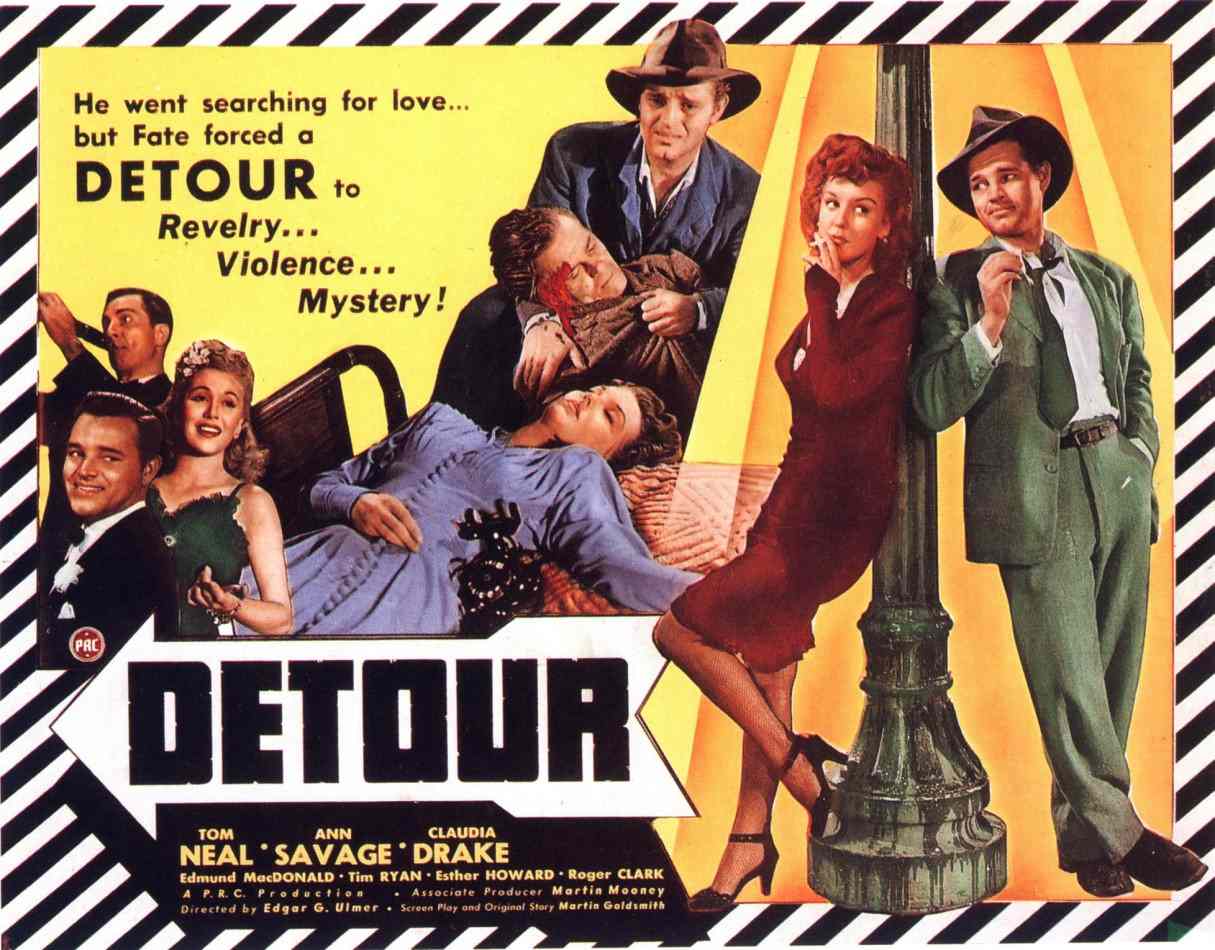
What is Film Noir? Ask that question to the Film Noir Foundation and this is what they’ll tell you:
Film noir is one of Hollywood’s only organic artistic movements. Beginning in the early 1940s, numerous screenplays inspired by hardboiled American crime fiction were brought to the screen, primarily by European émigré directors who shared a certain storytelling sensibility: highly stylized, overtly theatrical, with imagery often drawn from an earlier era of German “expressionist” cinema. Fritz Lang, Robert Siodmak, Billy Wilder, and Otto Preminger, among others, were among this Hollywood vanguard.
During and immediately following World War II, movie audiences responded to this fresh, vivid, adult-oriented type of film — as did many writers, directors, cameramen and actors eager to bring a more mature world-view to Hollywood product. Largely fueled by the financial and artistic success of Billy Wilder’s adaptation of James M. Cain’s novella Double Indemnity(1944), the studios began cranking out crime thrillers and murder dramas with a particularly dark and venomous view of existence.
In 1946 a Paris retrospective of American films embargoed during the war clearly revealed this trend toward visibly darker, more cynical crime melodramas. It was noted by several Gallic critics who christened this new type of Hollywood product “film noir,” or black film, in literal translation.
Few, if any of the artists in Hollywood who made these films called them “noir” at the time. But the vivid co-mingling of lost innocence, doomed romanticism, hard-edged cynicism, desperate desire, and shadowy sexuality that was unleashed in those immediate post-war years proved hugely influential, both among industry peers in the original era, and to future generation of storytellers, both literary and cinematic.
If you want to get another angle on the question, you can always take into consideration Roger Ebert’s 10 Essential Characteristics of Noir Films. But our suggestion, especially on a long Sunday afternoon, is to spend some time watching the classic movies gathered in our collection of 50 Free Noir Films. The collection features public domain films by John Huston, Fritz Lang, Orson Welles and other celebrated directors. Here’s a quick sample of what’s in the archive:
- Beat the Devil – Free – Directed by John Huston and starring Humphrey Bogart, the film is something of a comic and dramatic spoof of the film noir tradition. (1953)
- D.O.A. — Free — Rudolph Maté’s classic noir film. Called “one of the most accomplished, innovative, and downright twisted entrants to the film noir genre.” (1950)
Five Minutes to Live — Free — Memorable bank heist movie stars Johnny Cash, Vic Tayback, Ron Howard, and country music great, Merle Travis. (1961) - Quicksand - Free — Peter Lorre and Mickey Rooney star in a story about a garage mechanic’s descent into crime. (1950)
- Scarlet Street — Free — Directed by Fritz Lang with Edward G. Robinson. A film noir great. (1945)
- The Hitch-Hiker - Free — The first noir film made by a woman noir director, Ida Lupino. (1953)
- The Stranger - Free — Directed by Orson Welles with Edward G. Robinson. One of Welles’s major commercial successes. (1946)
We recently added another 15 films to the collection of free noir films. So even if you’ve perused the list in the past, there’s now something new to enjoy.
Related Content:
25 Noir Films That Will Stand the Test of Time: A List by “Noirchaelogist” Eddie Muller
100 Greatest Posters of Film Noir
4,000+ Free Movies Online: Great Classics, Indies, Noir, Westerns, Documentaries & More
Read More...The Religions of Bob Dylan: From Delivering Evangelical Sermons to Singing Hava Nagila With Harry Dean Stanton
My first reaction upon learning about Bob Dylan’s brief conversion to Evangelical Christianity may have been something like “What in the hell?” It wasn’t a religious Dylan that surprised me; it was Dylan embracing a faith that can often seem doggedly literal and, well, just a little inflexible. What with his love of ambiguity, of occult symbolism and symbolist poetry, and his resolute contempt for convention, Dylan has always struck me as more of an ancient Gnostic than a modern Bible thumper. While Dylan’s immersion in the Christian world may have been brief, it was deep, and it was confusing—enough so that Andy Greene in Rolling Stone comments that his proselytizing from the stage “took audience provocation to the next level.”
In his gospel shows of 1979/80, Dylan presented “a night of music devoted exclusively to selections from his new gospel records, often pausing for long, rambling sermons about Christ’s imminent return and the wickedness of man.” Hear one of those sermons at the top, a seven-minute theological disquisition, before Dylan and band launch into a powerful performance of “Solid Rock.” Just above, in another sermon from 1979, Dylan holds forth on the “spirit of the Antichrist” before an unsympathetic crowd in Tempe, Arizona. That same year, he gave an interview to Bruce Heiman of KMGX Radio in Tucson on the subject of his conversion (below).
In a certain way, a Dylan obsessed with divine judgment and the book of Revelation jibes with his pursuit of the arcane and the mystical, with his consistently apocalyptic vision, prophetic mumblings, and tendency to moralize. But the preaching is just…. well, kinda weird. I mean, not even Dylan’s friend, the deeply devout Johnny Cash, used his musical platform to harangue audiences about the Bible. Was it a stunt or a genuine, if perhaps overzealous, expression of deeply held beliefs? That question could be asked of almost every move Dylan has ever made. This brief period of very public religiosity may seem anomalous, but Dylan’s interest in religion is not. Google his name and any faith term, and you’ll see suggestions for “Dylan and Islam,” “Dylan and Buddhism,” “Dylan and Catholicism,” and, of course, “Dylan and Judaism,” the religion of his birth. Some contend that Dylan still keeps faith with Jesus, and that it doesn’t mutually exclude his Jewishness.
And yet, how Dylan’s Christian preaching could line up with his later commitment to Chabad—an Orthodox Hasidic movement that isn’t exactly warm to the idea of the Christian messiah, to put it mildly—is beyond my ken. But logical consistency does not rank highly on any list of virtues I’m familiar with. Dylan seemed to be reconnecting with Judaism when he explicitly expressed solidarity with Israel in 1983 in his Zionist anthem “Neighborhood Bully” from Infidels, in other respects, a wholly secular record.
Three years later, Dylan appeared on the Chabad telethon (above), accompanying his son-in-law Peter Himmelman on harmonica in a rendition of “Hava Nagila,” along with, of all people, Harry Dean Stanton (whose chilling turn as polygamous Mormon sect leader in HBO’s Big Love you may well recall). By this time, at least according to Jewish Journal, “Chabad rabbis had helped Dylan return to Judaism after the musician embraced Christianity for a time.” The mid-90s saw Dylan worshipping with Brooklyn Lubavitchers, and in 2007, he was sighted in Atlanta at Yom Kippur services at the Chabad-Lubavitch of Georgia, saying the “blessings in Hebrew without stumbling, like a pro.”
So is Bob Dylan a firebreathing Christian or an Orthodox Jew? Or, somehow… both? Only Dylan knows, and frankly, only Dylan needs to. His beliefs are his business, but his public expressions of faith have given his fans much to puzzle over, reading the lyrical tea leaves for evidence of a solid rock center amidst the shifting sands of Dylanology. Let ‘em sift. Some people obsess over Dylan’s religious commitments, others over his “secret” wife and daughter, his corporate sellouts, or his sometimes inscrutable personal politics. It’s all part of the business of fame. What I find fascinating about the many layers of Bob Dylan is not how much they tell me about the man, who has the right to change his mind, or not, as often as he likes, but how much they reveal about his strange lyrical themes. After all, Dylan’s seemingly contradictory allegiances and ambivalent identities as an artist may in in fact make him all the more the archetypal American songwriter he’s always said to be.
Related Content:
An Introduction to Dylanology, or How to Understand Bob Dylan by Digging Through His Garbage
The Times They Are a‑Changin’: 1964 Broadcast Gives a Rare Glimpse of the Early Bob Dylan
Animated Video: Johnny Cash Explains Why Music Became a Religious Calling
Johnny Cash Reads the Entire New Testament
Josh Jones is a writer and musician based in Durham, NC. Follow him at @jdmagness
Read More...Is It Always Right to Be Right?: Orson Welles Narrates a 1970 Oscar-Winning Animation That Still Resonates Today
Is it possible for a short film made during the Nixon administration to perfectly describe America’s current, completely screwed up political situation? Sure, Lee Mishkin’s Oscar-winning animated short Is It Always Right to Be Right? (1970) might date itself through oblique references to hippies, the Vietnam war and the Civil Rights movement, not to mention the movie’s groovy animation style, but the message of the movie feels surprisingly relevant today. You can watch the movie above.
The short, which is narrated by none other than Orson Welles, describes a land where everyone believed themselves to be right, and where indecisiveness and complexity were considered utterly weak. “When differences arose between the people of this land,” intones Welles at one point, “they looked not for truth but for confirmation for what they already believed.”
Wow, that sounds just like cable news. As the divisions grew and deepened, the land eventually ground to a halt. “Everyone was right, of course. And they knew it. And were proud of it. And the gap grew wider until the day came when all activity stopped. Each group stood in its solitary rightness, glaring with proud eyes at those too blind to see their truth, determined to maintain their position at all costs. This is the responsibility of being right.” Wow, that sounds like Congress.
Then someone tried to temper this stark black-and-white world by saying things like “I might be wrong,” which starts a cascade of introspection and tolerance. Ah, the 70s – that innocent time before the 24-hour news cycle. A time before network execs realized that bloviating morons preaching the rightness of their own position just plain makes good TV.
A year later, you might be interested to know, Orson Welles narrated another animated parable. Watch Freedom River here.
Is It Always Right to Be Right? will be added to the Animation section of our collection, 4,000+ Free Movies Online: Great Classics, Indies, Noir, Westerns, Documentaries & More as well as our collection of Free Oscar-Winning Films.
Related Content:
Listen to Eight Interviews of Orson Welles by Filmmaker Peter Bogdanovich (1969–1972)
Watch Orson Welles’ The Stranger Free Online, Where 1940s Film Noir Meets Real Horrors of WWII
The Hearts of Age: Orson Welles’ Surrealist First Film (1934)
Orson Welles Explains Why Ignorance Was His Major “Gift” to Citizen Kane
Jonathan Crow is a Los Angeles-based writer and filmmaker whose work has appeared in Yahoo!, The Hollywood Reporter, and other publications. You can follow him at @jonccrow. And check out his blog Veeptopus, featuring one new drawing of a vice president with an octopus on his head daily.
Read More...Two Legends: Weird Al Yankovic “Interviews” James Brown (1986)
Last week, America’s reigning bard of silly parody songs, “Weird Al” Yankovic scored his first number one album, Mandatory Fun. His vastly improved take on Robin Thicke’s catchy, if deeply creepy, earworm Blurred Lines alone might just be worth the price of the album. This weekend saw the release of the James Brown biopic Get On Up, starring Chadwick Boseman, Octavia Spencer and Dan Aykroyd. So we thought you all might be interested in watching Weird Al’s interview of the Godfather of Soul in 1986. You can watch it above.
Ok, so that interview didn’t actually happen. It was cobbled together to make it look like Weird Al was peppering the music legend with bizarre and inane questions. Example: “What was it like the very first time you sat in a bucket full of warm oatmeal?” or “What can you do with a duck that you can’t do with an elephant?”
Back in the ‘80s and early ‘90s when MTV played videos and not endless reality TV shows about the drunk and the vapid, Weird Al regularly hosted Al-TV, a parody of the music channel. Boasting the tagline “putting the ‘vid’ in video and the ‘odd’ in audio,” Al-TV featured skits, fake news reports and, of course, Weird Al’s trademark music video spoofs. It also featured dada-esque “interviews,” like the one with Brown. Below we have some more to check out, like this one where Weird Al ridicules that most dull and pompous of pop stars, Sting.
Weird Al’s interview with pop genius Prince is really odd, and not just because of Weird Al’s dopey questions — “What do you do when someone on the street gives you a piece of cheese?” Perhaps it’s that knowing smirk on Prince’s face. Or maybe it’s because the interview happens while surrounded by his well-coiffed entourage.
And finally, Weird Al doesn’t have to do much with Avril Lavigne. One suspects that the original interview would be pretty funny even without the jokes. At one point, Yankovic asks, “Can you ramble incoherently for a while about something that nobody cares about?”
Related Content:
“Weird Al” Yankovic Releases “Word Crimes,” a Grammar Nerd Parody of “Blurred Lines”
Every Appearance James Brown Ever Made On Soul Train. So Nice, So Nice!
James Brown Blows Away the Rolling Stones in 18 Electric Minutes (1964)
James Brown Gives You Dancing Lessons: From The Funky Chicken to The Boogaloo
Jonathan Crow is a Los Angeles-based writer and filmmaker whose work has appeared in Yahoo!, The Hollywood Reporter, and other publications. You can follow him at @jonccrow. And check out his blog Veeptopus, featuring one new picture of a vice president with an octopus on his head daily.
Read More...A 17-Year-Old David Bowie Defends “Long-Haired Men” in His First TV Interview (1964)
Have you heard of the Society for the Prevention of Cruelty to Long-Haired Men? If not, you can’t say you know all of David Bowie’s groups. Fifty years ago, in his very first television interview, Bowie appeared in the capacity of its spokesman, as well as that of “President of the International League for the Preservation of Animal Filament.” “I think we’re all fairly tolerant,” says the 17-year-old then known as David (or even Davey) Jones, “but for the last two years we’ve had comments like ‘Darling!’ and ‘Can I carry your handbag?’ thrown at us, and I think it just has to stop now.” Cliff Michelmore, host of the BBC program Tonight where this all went down in November 1964, asks if such behavior surprises him, because, “after all, you’ve got really rather long hair, haven’t you?” “We have, yes,” replies the proto-Bowie Bowie. “I think we all like long hair, and we don’t see why other people should persecute us because of this.”
The “we” to which he refers comprises all the equally mop-topped young dudes flanking him. Together, they would later appear on another BBC program, Gadzooks! It’s All Happening, as the group — this time musical — the Manish Boys, performing their big number, a cover of Bobby Bland’s “I Pity the Fool.” But according to the David Bowie FAQ, producer Barry Langford had, for that appearance, previously “insisted that David cut his 17” long hair,” resulting in the brief formation of the Society for the Prevention of Cruelty to Long-Haired Men and, consequently, “numerous newspaper reports… of course it was all a scam for some free publicity.” Whatever his style — and he’s had a few — Bowie has clearly always known how to work the ever-reengineered publicity machine. Sometimes he’s done it by going with the flow, but only partially, as we see here, where he and the Manish Boys sport roughly nine-inch hair rather than cuts to the harsh early-1960s standard. Bowie, never one of rock’s dedicated longhairs, can’t have found this too terribly oppressive in reality, although when he returned to the BBC 35 years later for a chat with the more strident Jeremy Paxman, he did so with a look that might have done the old Society proud.
Related Content:
David Bowie and Cher Sing Duet of “Young Americans” and Other Songs on 1975 Variety Show
David Bowie Recalls the Strange Experience of Inventing the Character Ziggy Stardust (1977)
David Bowie Talks and Sings on The Dick Cavett Show (1974)
Colin Marshall hosts and produces Notebook on Cities and Culture and writes essays on cities, language, Asia, and men’s style. He’s at work on a book about Los Angeles, A Los Angeles Primer. Follow him on Twitter at @colinmarshall or on Facebook.
Read More...Farmer Serenades Cows by Playing Lorde’s “Royals” on the Trombone
Farmers like Derek Klingenberg know that you can enchant cows with music. Above, watch him start playing Lorde’s “Royals” on the trombone and the cows come a runnin’.
If you’ve been an OC reader long enough, you won’t be surprised by this scene. Earlier this year, we featured A Playlist of Music Scientifically-Proven to Increase Cows’ Milk Production — a playlist that includes tunes by REM, Aretha Franklin, Simon & Garfunkel, and Lou Reed. And, before that, we’ve shown you cows grooving to some New Orleans-style jazz. Music isn’t just “the universal language of mankind,” as Henry Wadsworth Longfellow once said. It belongs clearly to our bovine friends too…
via Metafilter
Related Content:
Sir Patrick Stewart Demonstrates How Cows Moo in Different English Accents
Read More...
A Drone’s Eye View of Los Angeles, New York, London, Bangkok & Mexico City
Unmanned aerial vehicles, more colloquially known as drones, have drawn bad press in recent years: as the intrusive tools of the coming surveillance state, as deliverers of death from above in a host of war zones, as the purchase-delivering harbingers of world domination by Amazon.com. But as with any technology, you can also use drones for the good, or at least for the interesting. A number of urban photographers have attracted a great deal of attention in the past few months doing just that, buying or building camera-equipped drones of their own, taking to the skies above their cities, and capturing views of them we’d never see otherwise. I live in Los Angeles and like to think I explore its ever-more-revitalized downtown (from which I type this post) on a regular basis, but nearly every shot Ian Wood got in the early morning with his drone in the video above shows off an aesthetic element of the neighborhood I hadn’t noticed before.
Above, Randy Scott Slavin provides us an equally dreamlike drone’s eye view of America’s other metropolis, New York City, and below that you can also get a sweeping view of London, its architectural icons on full display, from sure-handed drone pilot/cameraman Evan Skuthorpe.
Then we have a flight around the monuments of Mexico City, in my experience an endlessly fascinating place from any altitude and at any angle, by A&H Aerial Productions.
Those of you who know Bangkok might feel startled to get the highly unusual view of it, nearly free of people provided by Coconuts TV, who took a camera drone out on a day when protesters shut down seven of the city’s most vital intersections. (It reminds me of a few favorite moments by that most celebrated Thai “auteur of languor,” Apichatpong Weerasethakul.) But you may have noticed that all the videos here focus on depopulated places, due most likely to the tricky host of applicable laws to do with privacy and aerial photography. So if you decide to film a drone flythrough of your own city, perhaps have a chat with your lawyer first.
Related Content:
Great Cities at Night: Views from the International Space Station
Prize-Winning Animation Lets You Fly Through 17th Century London
London Mashed Up: Footage of the City from 1924 Layered Onto Footage from 2013
What Makes Paris Look Like Paris? A Creative Use of Google Street View
Colin Marshall hosts and produces Notebook on Cities and Culture and writes essays on cities, language, Asia, and men’s style. He’s at work on a book about Los Angeles, A Los Angeles Primer. Follow him on Twitter at @colinmarshall or on Facebook.
Read More...Brian Eno’s Take on the Gaza Conflict Appears on David Byrne’s Web Site

On his web site, former Talking Heads frontman David Byrne writes:
I received this email last Friday morning from my friend, Brian Eno. I shared it with my office and we all felt a great responsibility to publish Brian’s heavy, worthy note. In response, Brian’s friend, Peter Schwartz, replied with an eye-opening historical explanation of how we got here. What’s clear is that no one has the moral high ground.
First comes Eno’s clearly heartfelt condemnation of civilian deaths in Gaza (particularly the death of children) and America’s apparent indifference to what’s happening there:
Today I saw a picture of a weeping Palestinian man holding a plastic carrier bag of meat. It was his son. He’d been shredded (the hospital’s word) by an Israeli missile attack — apparently using their fab new weapon, flechette bombs. You probably know what those are — hundreds of small steel darts packed around explosive which tear the flesh off humans. The boy was Mohammed Khalaf al-Nawasra. He was 4 years old.
I suddenly found myself thinking that it could have been one of my kids in that bag, and that thought upset me more than anything has for a long time.
Then I read that the UN had said that Israel might be guilty of war crimes in Gaza, and they wanted to launch a commission into that. America won’t sign up to it.
What is going on in America? I know from my own experience how slanted your news is, and how little you get to hear about the other side of this story. But — for Christ’s sake! — it’s not that hard to find out. Why does America continue its blind support of this one-sided exercise in ethnic cleansing? WHY?
What follows is part of futurist Peter Schwartz’s response, which, rich in historical detail, splits the blame somewhere down the middle. Echoing Byrne’s sense that the two sides have lost their moral positions, Schwartz notes:
Even though I have no support for the Israeli position I find the opposition to Israel questionable in its failure to be similarly outraged by a vast number of other moral horrors in the recent past and currently active. Just to name a few; Cambodia, Tibet, Sudan, Somalia, Nicaragua, Mexico, Argentina, Liberia, Central African Republic, Uganda, North Korea, Bosnia, Kosovo, Venezuela, Syria, Egypt, Libya, Zimbabwe and especially right now Nigeria. The Arab Spring, which has become a dark winter for most Arabs and the large scale slaughter now underway along the borders of Iraq and Syria are good examples of what they do to themselves. And our nations, the US, the Brits, the Dutch, the Russians and the French have all played their parts in these other moral outrages. The gruesome body count and social destruction left behind dwarfs anything that the Israelis have done. The only difference with the Israeli’s is their claim to a moral high ground, which they long ago left behind in the refugee camps of Lebanon. They are now just a nation, like any other, trying to survive in a hostile sea of hate.
We should be clear, that given the opportunity, the Arabs would drive the Jews into the sea and that was true from day one. There was no way back from war once a religious state was declared. So Israel, once committed to a nation state in that location and granted that right by other nations have had no choice but to fight. In my view therefore, neither side has any shred of moral standing left, nor have the nations that supported both sides…
I don’t think there is any honor to go around here. Israel has lost its way and commits horrors in the interest of their own survival. And the Arabs and Persians perpetuate a conflict ridden neighborhood with almost no exceptions, fighting against each other and with hate of Israel the only thing that they share.
To read the complete exchange, head over to Byrne’s site and read Gaza and the Loss of Civilization.
Related Content:
How David Byrne and Brian Eno Make Music Together: A Short Documentary
Listen to “Brian Eno Day,” a 12-Hour Radio Show Spent With Eno & His Music (Recorded in 1988)
Jump Start Your Creative Process with Brian Eno’s “Oblique Strategies”
David Byrne: How Architecture Helped Music Evolve
Read More...Support Us
We're hoping to rely on loyal readers, rather than erratic ads. Please click the Donate button and support Open Culture. You can use Paypal, Venmo, Patreon, even Crypto! We thank you!

About Us

Open Culture scours the web for the best educational media. We find the free courses and audio books you need, the language lessons & educational videos you want, and plenty of enlightenment in between.
Advertise With Us

FREE UPDATES!
GET OUR DAILY EMAIL
Get the best cultural and educational resources on the web curated for you in a daily email. We never spam. Unsubscribe at any time.
FOLLOW ON SOCIAL MEDIA

Open Culture editor Dan Colman scours the web for the best educational media. He finds the free courses and audio books you need, the language lessons & movies you want, and plenty of enlightenment in between.
Advertise With Us

