Take a Road Trip with Cyberspace Visionary William Gibson, Watch No Maps for These Territories (2000)
“I probably worry less about the real future than the average person,” says William Gibson, the man who coined the term “cyberspace” and wrote books like Neuromancer, Idoru, and Pattern Recognition. These have become classics of a science-fiction subgenre branded as “cyberpunk,” a label that seems to pain Gibson himself. “A snappy label and a manifesto would have been two of the very last things on my own career want list,” he says to David Wallace-Wells in a 2011 Paris Review interview. Yet the popularity of the concept of cyberspace — and, to a great extent, its having become a reality — still astonishes him. “I saw it go from the yellow legal pad to the Oxford English Dictionary, but cyberspace is everywhere now, having everted and colonized the world. It starts to sound kind of ridiculous to speak of cyberspace as being somewhere else.” A dozen years earlier, in Mark Neale’s biographical documentary No Maps for These Territories, the author tells of how he first conceived it as “an effective buzzword,” “evocative and essentially meaningless,” and observes that, today, the prefix “cyber-” has very nearly gone the way of “electro-”: just as we’ve long since taken electrification for granted, so we now take connected computerization for granted.
“Now,” of course, means the year 1999, when Neale shot the movie’s footage. He did it almost entirely in the back of a limousine, tricked out for communication and media production, that carried Gibson on a road trip across North America. The long ride gives us an extended look into Gibson’s curious, far-reaching mind as he explores issues of the inevitability with which we find ourselves “penetrated and co-opted” by our technology; growing up in a time when “the future with a capital F was very much a going concern in North America”; the loss of “the non-mediated world,” a country to which we now “cannot find our way back”; the modern reality’s combination of “a pervasive sense of loss” and a Christmas morning-like “excitement about what we could be gaining”; his early go-nowhere pastiches of J.G. Ballard and how he then wrote Neuromancer as an approach to the “viable but essentially derelict form” of science fiction; his fascination with the sheer improbability of those machines known as cities; and his mission not to explain our moment, but to “make it accessible,” finding the vast, near-incomprehensible structure underlying the pounding waves of thought, trend, and technology through which we all move. Watching No Maps for These Territories here in cyberspace, I kept forgetting that Gibson said these things a tech-time eternity ago, so pertinent do they sound to this moment. And happiness, as he puts it in one aside, “is being in the moment.”
Related Content:
William Gibson, Father of Cyberpunk, Reads New Novel in Second Life
Colin Marshall hosts and produces Notebook on Cities and Culture and writes essays on cities, language, Asia, and men’s style. He’s at work on a book about Los Angeles, A Los Angeles Primer. Follow him on Twitter at @colinmarshall or on Facebook.
Read More...Learn the Elements of Cinema: Spielberg’s Long Takes, Scorsese’s Silence & Michael Bay’s Shots
Ever since the advent of YouTube and the release of Thom Andersen’s Los Angeles Plays Itself, the video essay about filmmaking has blossomed on the internet. When these essays are good, they force you to look at movies anew. Kogonada’s brilliant interrogation of Stanley Kubrick’s use of one-point perspective, Matt Zoller Seitz’s dissection of Wes Anderson’s cinematic style and, in a completely different tone, Red Letter Media’s blistering, exhaustive take down of George Lucas’s regrettable Star Wars prequels, all argue convincingly that perhaps the best way to discuss the merits and flaws of a movie or filmmaker is through the medium of film itself.
Add to this list Tony Zhou’s Every Frame a Picture. An editor by trade, Zhou has created a series of videos about how the masters of cinema use the basic elements of cinema – the duration of a shot, the application of sound, the use of a tracking shot. In his elegant videos he makes arguments that are unexpected. Martin Scorsese, for instance, who is famous for his groundbreaking use of music, is just as brilliant with his judicious use of silence. You can watch it above.
And below, Zhou argues that Steven Spielberg, a filmmaker not commonly associated with restraint, is actually a master of the understated long take.
And in this video, he argues that while Michael Bay might make adolescent, over-stuffed, soulless spectacles, he does know how to construct a shot.
You can nerd out and watch even more of Zhou’s films here.
Related Content:
The Perfect Symmetry of Wes Anderson’s Movies
Signature Shots from the Films of Stanley Kubrick: One-Point Perspective
Jonathan Crow is a Los Angeles-based writer and filmmaker whose work has appeared in Yahoo!, The Hollywood Reporter, and other publications. You can follow him at @jonccrow. And check out his blog Veeptopus, featuring pictures of vice presidents with octopuses on their heads.
Read More...
An Ivory Coast Cocoa Farmer Gets His Very First Taste of Chocolate
Here is how MetropolisTV, a global collective of young filmmakers and TV producers coming out of Holland, sets up their touching video:
Farmer N’Da Alphonse grows cocoa [in the Ivory Coast] and has never seen the finished product. “To be honest I do not know what they make of my beans,” says farmer N’Da Alphonse. “I’ve heard they’re used as flavoring in cooking, but I’ve never seen it. I do not even know if it’s true.”
It’s great — and yet, in its own way, sad — to watch his face light up as he gets his very first taste…
via Devour
Related Content:
Science & Cooking: Harvard Profs Meet World-Class Chefs in Unique Online Course
The Recipes of Iconic Authors: Jane Austen, Sylvia Plath, Roald Dahl, the Marquis de Sade & More
MIT Teaches You How to Speak Italian & Cook Italian Cuisine All at Once (Free Online Course)
Read More...Watch Mad Magazine’s Edgy, Never-Aired TV Special (1974)
1974 was a cynical time. That was the year that Nixon resigned after the grueling Watergate scandal, Vietnam War was finally grinding to a halt and, thanks to the Oil Shock of ’73, the economy was in the toilet. It was also a time when TV execs were scrambling to keep up with America’s rapidly changing cultural tastes. Audiences wanted something with a little edge. The TV adaptation of Robert Altman’s lacerating war comedy MASH became a huge hit. As did All in the Family, about everyone’s favorite armchair bigot Archie Bunker. Saturday Night Live was just a year away from premiering. So it isn’t surprising that execs from ABC approached the “usual gang of idiots” at Mad Magazine — that fount of anti-authoritarian satire — about making a series. The resulting pilot, which was later rebranded as a TV special, never aired because it provided way too much edge for the network. You can watch it above.
The show, culled from some of the better bits from the magazine, features art from Don Martin, Mort Drucker, Al Jaffee and Dave Berg – names that will be very familiar to you if you grew up obsessively reading the magazine as a child, like I did – and the animation was supervised by Jimmy Murakami along with Chris Ishii and Gordon Bellamy.
The network claimed that the show was shelved because it had too much “adult” humor. In this post-South Park, post-Family Guy world, the adult humor in this show, by comparison, seems downright tame. What the Mad Magazine TV Special does have in abundance is withering barbs. Something about translating the cynical, adolescent humor of the magazine from the page to screen made its satire feel much, much sharper. During their parody of The Godfather, called the Oddfather, mafia don Vito Minestrone (groan) tells a group of mobsters that their gang war must stop. “We must stop destroying each other and start destroying the plain, ordinary citizens again. Like normal American businessmen.”
The show’s most caustic zingers, however, are reserved for America’s bloated, complacent auto industry where a Walter Cronkite-like journalist interviews auto exec Edsel Lemon. In five or so minutes, the bit unsparingly lays out why GM and Ford eventually lost out to Toyota and Honda – crappy cars, lousy safety, and an upper management that was as mendacious as it was shortsighted. While field testing a new model, which involved coasting the car down a hill, Lemon quips, “If our prototype can go 500 feet without falling apart we’ll put it into production.” This seemingly explains how the Ford Pinto got made.
In the end, the networks squeamishness with the show was more due to its ridicule of an industry with deep pockets than with its toilet humor. As Dick DeBatolo, the MAD’s maddest writer, who penned much of the show noted, “Nobody wanted to sponsor a show that made fun of products that were advertised on TV, like car manufacturers.”
Related Content:
Shel Silverstein Narrates an Animated Version of The Giving Tree (1973)
A Short History of America, According to the Irreverent Comic Satirist Robert Crumb
Watch the First Animations of Peanuts: Commercials for the Ford Motor Company (1959–1961)
Jonathan Crow is a Los Angeles-based writer and filmmaker whose work has appeared in Yahoo!, The Hollywood Reporter, and other publications. You can follow him at @jonccrow. And check out his blog Veeptopus, featuring pictures of vice presidents with octopuses on their heads.
Read More...11-Year-Old Martin Scorsese Draws Storyboards for His Imagined Roman Epic Film, The Eternal City
Martin Scorsese’s mean streets are as long gone as graffiti-festooned subway trains, the real Max’s Kansas City, and Yogi Berra’s pennant-winning Mets. But while the 1973 film that broke open his career is now over forty years old, Scorsese hasn’t looked back, nor has he stayed trapped in the rough milieu of New York gangster films. He’s adapted Edith Wharton, told stories of the Dalai Lama, Howard Hughes, handfuls of rock and blues stars, and cinematic hero Georges Méliès (sort of).
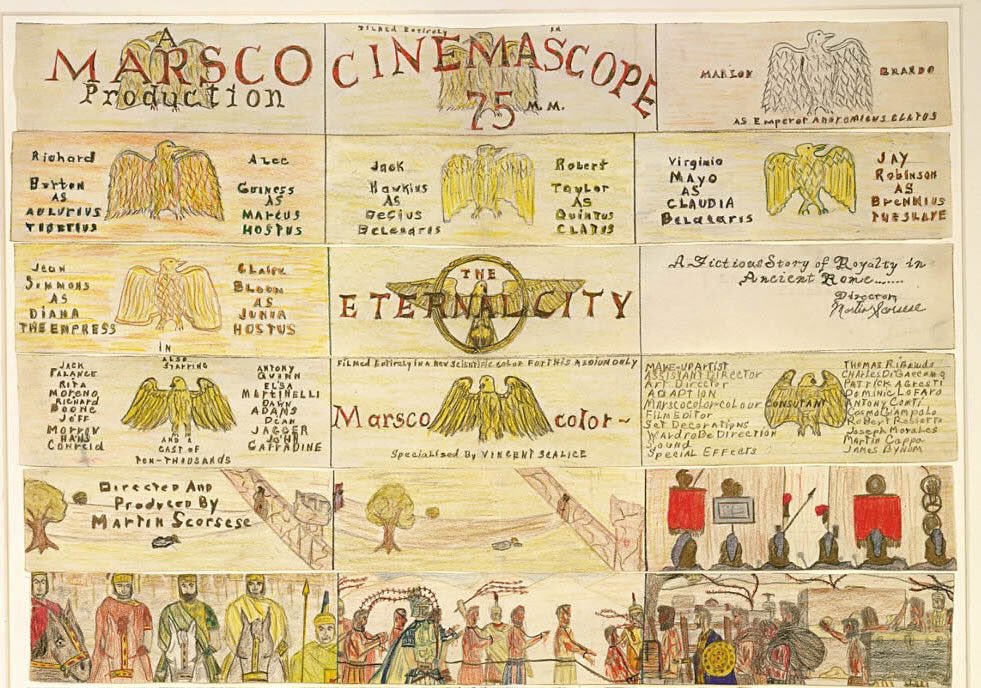
Last year’s The Wolf of Wall Street further cemented Scorsese’s reputation as a director with more breadth than almost any of his contemporaries. But it would perhaps be a mistake to call Scorsese’s genre-hopping an evolutionary development. The series of storyboards here for an imagined widescreen Roman epic called The Eternal City— drawn by 11-year-old Scorsese—show us that his vision always exceeded the cramped Little Italy streets of his youth.
Young Scorsese described his Cecil B. Demille-like production as “A fictitious story of Royalty in Ancient Rome,” and though he didn’t give us character names, he made sure to specify the film’s actors, casting Marlon Brando, Richard Burton, Virginia Mayo, and Alec Guinness, among others. As for Scorsese’s own role, The Independent notes, “it is striking that he has given himself a bigger credit as producer-director than any of the stars.” Reproduced in David Thompson’s series of interviews, Scorsese on Scorsese, the drawings’ impressive level of detail demonstrate a precocious eye for shot composition and the dramatic perspectives that characterize his mature work.
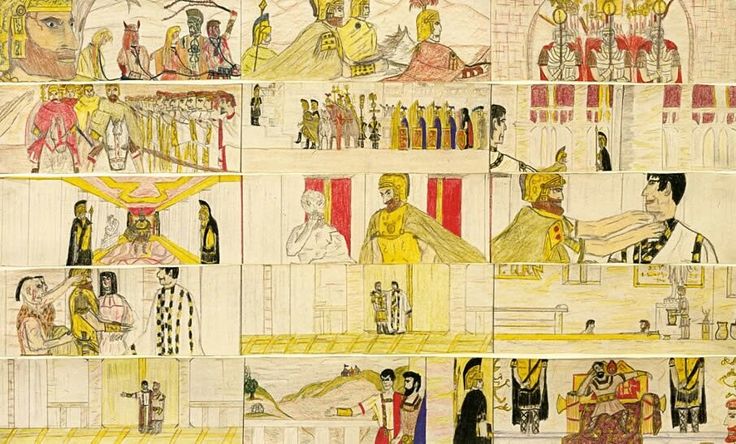
The director of such meticulously composed films as Taxi Driver and Goodfellas has had much to say about the importance of storyboards to his process. (We’ve previously featured his hand-drawn storyboards for Taxi Driver.) They are, he’s said, “the way to visualize the entire movie in advance,” to “show how I would imagine a scene and how it should move to the next.” And while many directors would make similar claims about this essential production tool, Scorsese cherishes the craft as well as the utility of the storyboard. “Pencil drawing is my favorite,” he remarks. “The pencil line leaves little impression on the paper, so if the storyboard is photocopied it loses something. I refer back to my original drawings in order for me to conjure up the idea I had when I saw the pencil line made.”
Can we look forward to Scorsese looking back, just once, to his plans for The Eternal City? He’d have to recast, of course, but given how confidently he sketches out each of his films on paper, the 71-year-old director might find much to work with in this youthful cinematic vision of antiquity.
View the storyboards in a larger format here.
Related Content:
Revisit Martin Scorsese’s Hand-Drawn Storyboards for Taxi Driver
Martin Scorsese’s Very First Films: Three Imaginative Short Works
Saul Bass’ Vivid Storyboards for Kubrick’s Spartacus (1960)
Josh Jones is a writer and musician based in Durham, NC. Follow him at @jdmagness
Read More...Bertolt Brecht Sings “Mack the Knife” in a 1929 Recording

Since 2008, a recording has been making the rounds on YouTube of Bertolt Brecht singing ‘Die Moritat von Mackie Messer,’ or what’s more commonly known as “Mack the Knife” in English, a song Kurt Weill and Brecht composed for The Threepenny Opera, which premiered in Berlin in 1928. The Brecht recording dates back to 1929, and, according to Discogs, it was released in 1960 on a 7‑inch German album called Bertolt Brecht Singt. Below, you can hear Brecht make his way through the tune. The clip comes accompanied by a quirky, new animated video created by the studio Quality Schnallity, Inc.
“Mack the Knife” has, of course, been covered by countless artists over the years. Bobby Darin sang perhaps the most famous, swinging version in 1958. There are also classic versions by Louis Armstrong, Frank Sinatra, and Ella Fitzgerald, not to mention more contemporary ones by Lyle Lovett, The Psychedelic Furs, The Young Gods, Nick Cave, and Marianne Faithfull. Did we miss one of your favorites?
If you would like to support the mission of Open Culture, consider making a donation to our site. It’s hard to rely 100% on ads, and your contributions will help us continue providing the best free cultural and educational materials to learners everywhere. You can contribute through PayPal, Patreon, and Venmo (@openculture). Thanks!
via WFMU
Related Content:
The Cleanest Recordings of 1920s Louis Armstrong Songs You’ll Ever Hear
Bertolt Brecht Testifies Before the House Un-American Activities Committee (1947)
Read More...Colorized Photos Bring Walt Whitman, Charlie Chaplin, Helen Keller & Mark Twain Back to Life
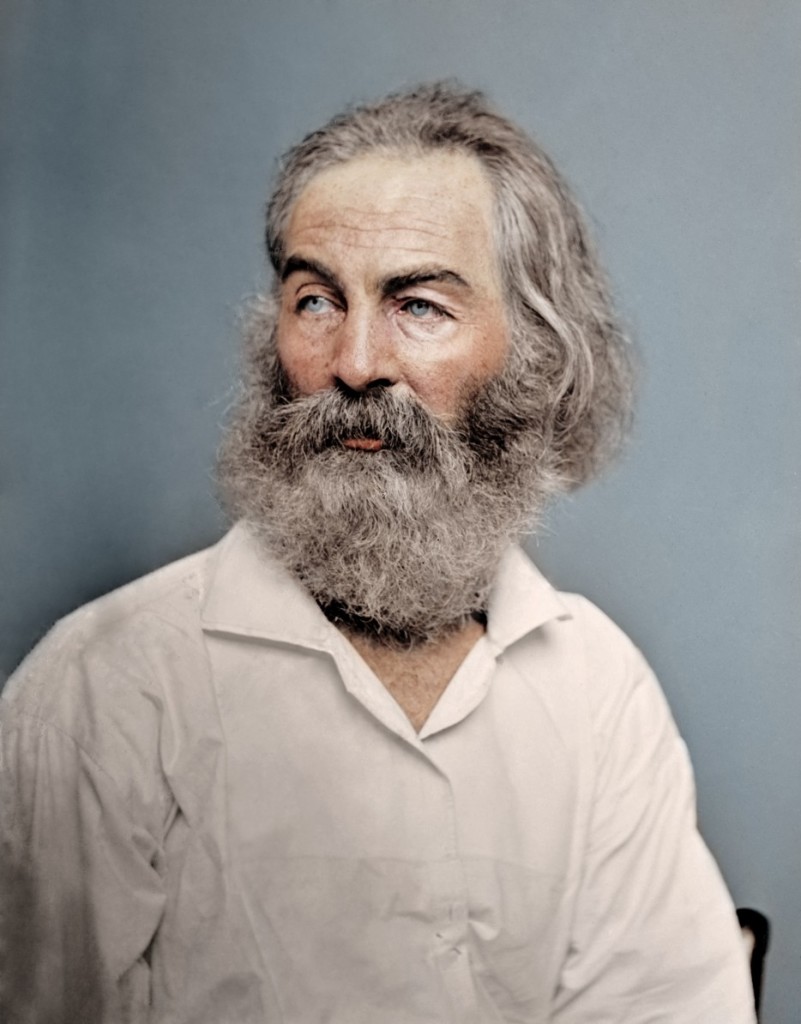
When disco pioneer Giorgio Morodoer released a colorized version of Fritz Lang’s Metropolis – featuring a soundtrack with Billy Squier, Pat Benatar and Adam Ant, no less – film purists everywhere howled with disbelief at how the film’s moody black and white had been turned into Easter egg pinks and blues. It felt like a gimmick and, worse, it just didn’t look real.
Colorization has come a long way since then. In the hands of the right Photoshop wizard — like artist Dana Keller — a colorized photograph of, say, the Oklahoma dust bowl or turn-of-the-century Coney Island gives viewers the chill of the uncanny. People and things that have long since departed this world suddenly seem vital and alive. It makes that foreign country called the past feel eerily familiar.
Above is a picture of poet Walt Whitman. His trademark long hair and Karl Marx beard would look right at home in certain corners of Portland. Apart from that, there is both a sensitivity and ferociousness about this picture. Whitman definitely looks like he’s capable of delivering a barbaric yawp. You can see what the picture looked like in its original black and white here.
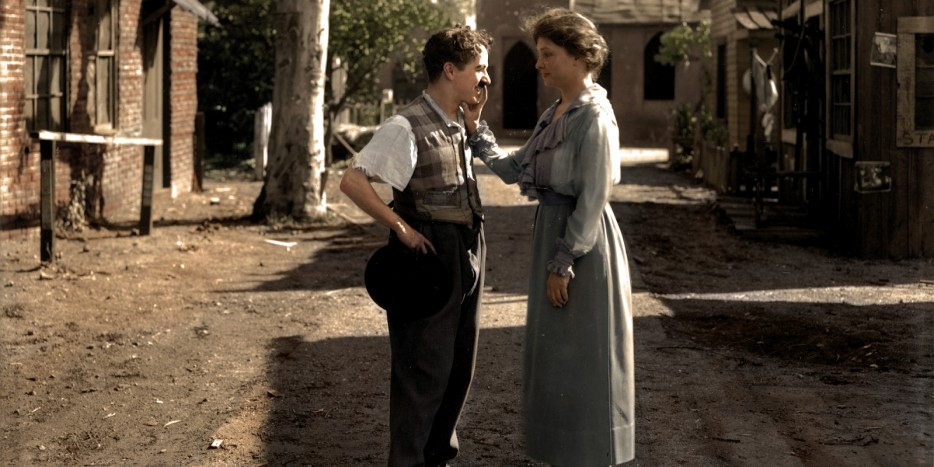
This photograph of Helen Keller drawing a hand over Charlie Chaplin’s face from 1919 looks like it could be a still from an upcoming Oscar bait biopic. In fact the picture was taken in Hollywood while Keller was on one of her speaking tours. (See original here.)
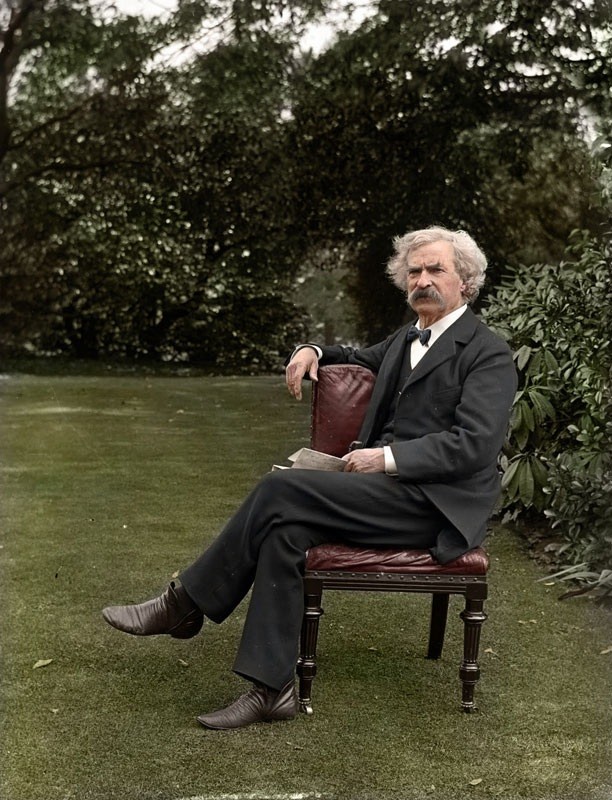
Likewise with this portrait (original here) of Mark Twain. You can almost hear him make some pithy comment like “A photograph is a most important document, and there is nothing more damning to go down to posterity than a silly, foolish smile caught and fixed forever.” As you can see from the picture, Twain didn’t take that risk, opting for more of a whiskery scowl.
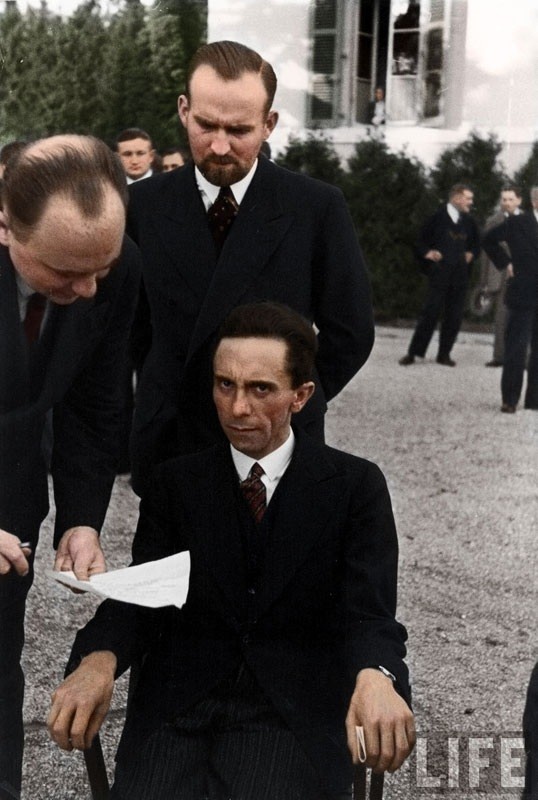
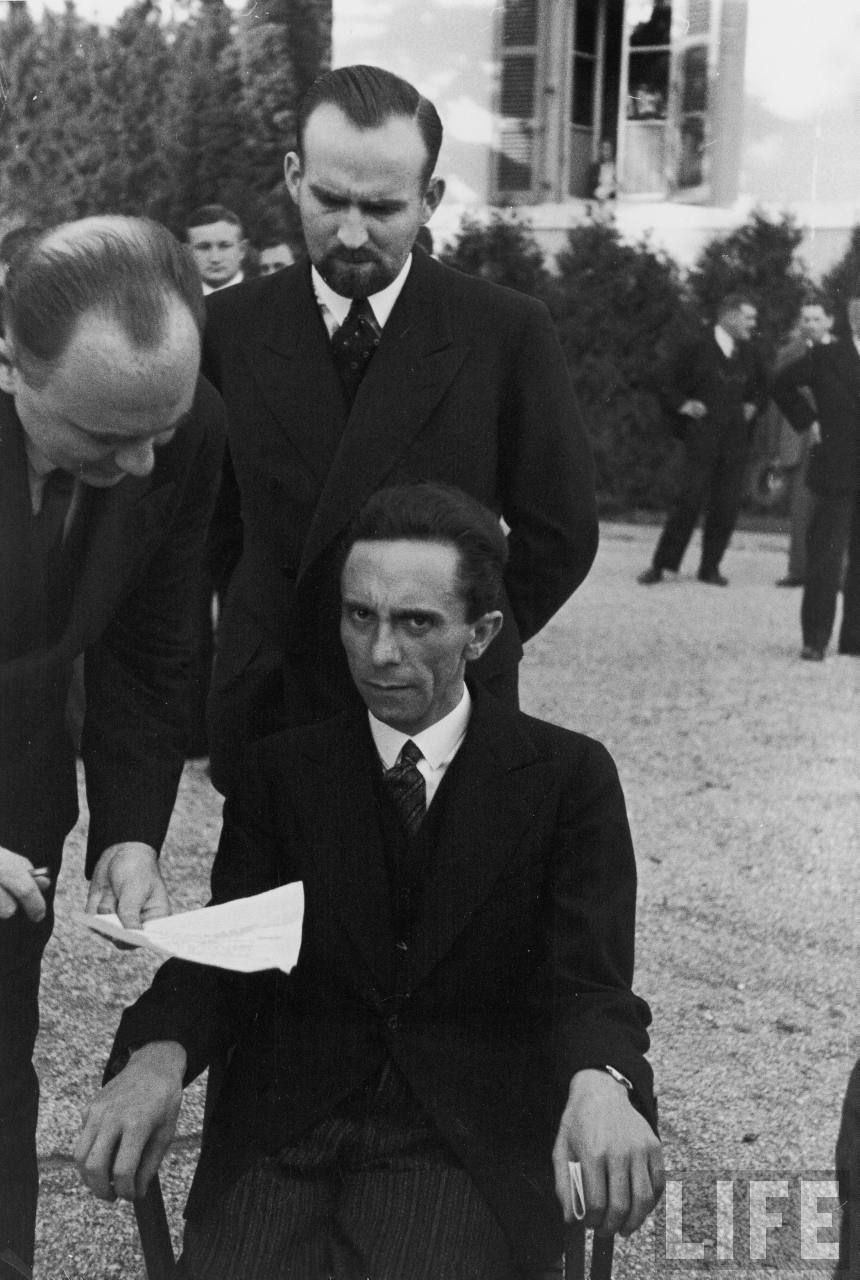
This picture of Joseph Goebbels (original) staring down a Jewish photographer is simply terrifying. It’s the sort of death stare common among psycho-killers, death row inmates and, apparently, Nazi propaganda ministers.

And this picture of a humble burger flipper from 1938 is so crisp that it looks like it might have been taken yesterday.
If you have an hour to kill, you can see many, many more colorized pics from the past over at Inspire 52.
A big H/T to Natalie W. G. for sending these our way.
Related Content:
Hand-Colored Photographs of 19th Century Japan
1923 Photo of Claude Monet Colorized: See the Painter in the Same Color as His Paintings
Mark Twain Writes a Rapturous Letter to Walt Whitman on the Poet’s 70th Birthday (1889)
Marilyn Monroe Reads Walt Whitman’s Leaves of Grass (1952)
Jonathan Crow is a Los Angeles-based writer and filmmaker whose work has appeared in Yahoo!, The Hollywood Reporter, and other publications. You can follow him at @jonccrow. And check out his art blog Veeptopus.
Read More...Above LA: A Top-Down Timelapse View of the Great Megacity
Chris Pritchard tells us: “Above LA showcases the often unseen beauty of Los Angeles from above. It was shot on hilltops, mountains, and high-rise rooftops around the city and features a number of day to night transitions and rare weather. My goal was to capture the depth, beauty, and movement of a vast and bustling megacity from a new angle, and encourage people to get out and experience their environments in new ways. I never thought I’d appreciate this city so much until I spent countless hours staring at it from high above.” You can learn more about Above LA over at Chris’ blog here.
Read More...One Woman, 17 British Accents
In April, we featured a tour of 14 British accents in 84 seconds. But as any commenter to that video will tell you, such a selection only scratches the surface of the variety of ways a given Briton could potentially speak English. “It’s important to state that there is no ‘British’ accent,” says the web site of BBC America’s Anglophenia. “There are so many regional dialects spread across tiny geographical areas that to arrive in, say, Swansea or Leicester (pronounced “lester” — you’re welcome), and launch into a stream of corblimey cockneyisms would go down extraordinarily badly.” This blog and video series, which brands itself “British Culture with an American Accent,” has spent more than a little energy helping its fans sort out the “infinite world of variety in the accents of the British Isles.” At the top of the post, Anglophenia host Siobhan Thompson demonstrates no fewer than seventeen British accents.
And not only can Thompson speak them, she can tell you who else speaks them. Other users of the middle-class, BBC-friendly “received pronunciation” include currently bankable film and television actors Martin Freeman and Benedict Cumberbatch. And pretty much only on film and television do you hear the more refined-sounding “heightened received pronunciation,” and even then mainly from characters like Downton Abbey’s Dowager Countess. She also does a truly Lock, Stock, and Two Smoking Barrels London accent, the flat East Anglian inflection that everyone loses when they move out of East Anglia, and thirteen more from across the rest of England as well as Wales, Scotland, and Ireland. Once you learn to comprehend all these varieties of speech, though, you may still fail to grasp the meaning of what you hear. The Anglophenia episode above, “How to Speak British,” gives you a primer on a series of expressions — “Away with the fairies,” “Swings and roundabouts,” “Horses for courses” — you’ll only ever hear said in a British accent.
Related Content:
A Brief Tour of British Accents: 14 Ways to Speak English in 84 Seconds
Peter Sellers Gives a Quick Demonstration of British Accents
Peter Sellers Reads The Beatles’ “She Loves You” in Four Different Accents
Sir Patrick Stewart Demonstrates How Cows Moo in Different English Accents
Colin Marshall hosts and produces Notebook on Cities and Culture and writes essays on cities, language, Asia, and men’s style. He’s at work on a book about Los Angeles, A Los Angeles Primer. Follow him on Twitter at @colinmarshall or on Facebook.
Read More...Read 15,000 Marvel Comics Online for 99 Cents (for a Limited Time)

Right now, Marvel is running a promotion where if you join Marvel Unlimited, using the promo code SDCC14, you can pay 99 cents for your first month, during which time you can access “over 15,000 Digital Comics, featuring Earth’s Mightiest Heroes and the galaxy’s vilest villains – all spanning Marvel’s 75 year history!” Yes, that includes the Incredible Hulk, Captain America, The Mighty Thor & many other favorites.
According to Wired, the “comics can be viewed on PC and Mac, as well as iOS and Android devices through a Marvel Unlimited app. Readers can download up to 12 comics at a time for offline reading.”
A Marvel Unlimited subscription usually costs 69 dollars a year or $9.99 a month, but the terms and conditions say that “Subscribers can cancel their subscription at any time by accessing My account or e‑mailing Marvel customer service.” In other words, you can subscribe for one month, pay 99 cents, read a heck of a lot of comics, then decide if you want to continue the subscription — or not — before the end of 30 days. (Just as an fyi, Audible.com offers a similar arrangement with audio books. You can join their 30-day free trial, download a free audio book, then decide whether you want to stick with the program before the month’s end. No matter what you decide, you can keep the free audio book. Find more details here.)
If you prefer to just pay zero cents for comics, please see our two prior posts.
Download 15,000+ Free Golden Age Comics from the Digital Comic Museum
Download Over 22,000 Golden & Silver Age Comic Books from the Comic Book Plus Archive
Read More...
Support Us
We're hoping to rely on loyal readers, rather than erratic ads. Please click the Donate button and support Open Culture. You can use Paypal, Venmo, Patreon, even Crypto! We thank you!

About Us

Open Culture scours the web for the best educational media. We find the free courses and audio books you need, the language lessons & educational videos you want, and plenty of enlightenment in between.
Advertise With Us

FREE UPDATES!
GET OUR DAILY EMAIL
Get the best cultural and educational resources on the web curated for you in a daily email. We never spam. Unsubscribe at any time.
FOLLOW ON SOCIAL MEDIA

Open Culture editor Dan Colman scours the web for the best educational media. He finds the free courses and audio books you need, the language lessons & movies you want, and plenty of enlightenment in between.
Advertise With Us