Why Tattoos Are Permanent? New TED Ed Video Explains with Animation
For the last three decades my right ankle has been the site of a deeply botched tattoo. It was supposed to be a yin yang, but with every passing year, it looks more and more like a cancerous mole. The drunken Vietnam Vet who administered it barely glanced at the design taking shape on my once virgin skin as he chatted with a pal. I was too intimidated to say, “Um…is it just me or are you filling in the white circle?” (I convinced myself that he knew what he was doing, and the ink would recede as it healed. Needless to say…)
My pathetic, little yin-ya’ is an embarrassment in an era of intricate four-color sleeves and souped up rockabilly gorgeousness, but I confess, I’ve grown fond of it. The fact that I have an out-of-balance symbol for balance permanently engraved onto my body is far more appropriate than the poorly grasped flash art could have been. It’ll be with me til the day I die.
Longer, actually, to judge by the decorative markings of an 8000 ‑year-old Peruvian mummy.
I feel fortunate to have developed tender feelings for my bush league modification. Claudia Aguirre’s TED-Ed lesson “What Makes Tattoos Permanent,” above, does not make an easy case for removal.
In the words of your grandma, don’t embellish your birthday suit with any old junk.
Your gang affiliation may feel like a forever-thing now, but what if you decide to switch gangs in a few years? Erasing those memories can be painful. Ask Johnny “Winona Forever” Depp.
Dolphins may strike you as peaceful, spiritual creatures, but I’ll bet there are ways to appreciate them that don’t involve having one punctured through your epidermis at 50–3000 micro-wounds per minute.
Choose wisely! If you’re veering toward a Tasmanian devil or a rose, do yourself a favor and browse the Museum of Online Museums. Feel a kinship with anything there? Good! Once you’ve figured out how to best feature it on your hide, take Aguirre’s anatomy-based quiz. See if it’s true that you’ll be barred from burial in a Jewish cemetery. Your tattoo artist will likely be impressed that you cared enough to do some research. Watch a couple of episodes of the Smithsonian’s Tattoo Odyssey for good measure.
Then lay in a tube of Preparation H, and prepare to love whatever you wind up with. It’s a lot easier than the pain of regret.
Related Content:
Get Ancient Advice on Losing Weight, Sobering Up, Removing a Tattoo & More at Ask The Past
TED ED Animation Gives You a Glimpse of What Life Was Like for Teenagers in Ancient Rome
Ayun Halliday is up to her eyeballs in Bye Bye Birdie and so should you be. Follow her @AyunHalliday
Read More...The Sex Pistols Play in Dallas’ Longhorn Ballroom; Next Show Is Merle Haggard (1978)
“Johnny Rotten and Sid Vicious were both punched in the face by girl fans as the Sex Pistols performed today deep in the heart of Texas.” That was the lede for the English newspaper The Evening News covering the Pistol’s concert at The Longhorn Ballroom in Dallas, TX on January 10, 1978. It proved to be one of the strangest, most contentions shows in one of the strangest, most contentious tours in rock history. You can watch it above. All 37 minutes.
By the time of the concert, the Sex Pistols were already notorious in the U.K. They had released a single – “God Save the Queen” – that called Britain’s head of state a fascist on the date of her Silver Jubilee. The single became a huge hit in spite of – or perhaps because of – it getting banned by the BBC. They famously hurled obscenities at a chat show host on live TV. But to be fair, host Bill Grundy literally asked for it. “You’ve got another five seconds,” he told Johnny Rotten and company. “Say something outrageous.” They did.
Though the band started out as an elaborate Situationist-inspired performance art piece dreamed up by megalomaniac manager Malcolm McLaren, they evolved beyond just being a stunt. Their music was loud, aggressive and gleefully nihilist with lines like “And I wanna be anarchist, I get pissed, destroy!” That music and that attitude touched some deep simmering well of cultural discontent — be it lower class frustrations, dissatisfaction with consumer culture or some darker primal urge to burn everything down. Their music resonated.
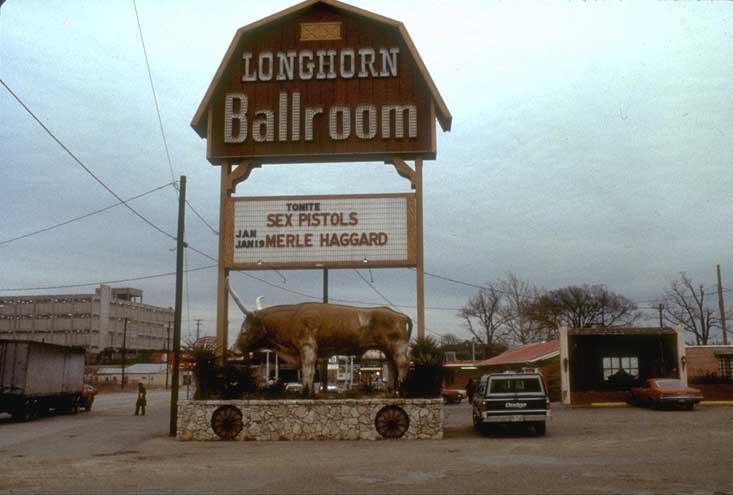
For their 1978 tour of the United States, McLaren wasn’t interested in building a fan base. He was interested in pissing people off. So the tour completely bypassed seemingly obvious tour stops, like New York, Chicago and Los Angeles, in favor of places like Memphis, Tulsa and San Antonio – none of which were exactly hot beds for punk. A famous picture of the marquee of the Longhorn Balloon shows the Pistols listed alongside Merle Haggard, giving you a feel for just how weird this tour was. Prior to the concert, Sid Vicious confessed his fears to a reporter about playing in Dallas. “They killed Kennedy here and everybody has warned us that the people are crazy. I think there’s a real danger that this is the town where I am going to be blown away.” (Weird historical side note: The Longhorn Ballroom was owned for a spell by Jack Ruby, the guy who shot Lee Harvey Oswald.)
The police were also reportedly worried. The Dallas police department had a SWAT team ready just in case the show turned into a riot. It didn’t, but just barely. The audience was equally split between hardcore fans – for example, Lamar St. John, the woman who decked Sid Vicious in the nose, drove from Los Angeles to see the show – and skeptical locals who wanted to see what the fuss was all about. As one Dallas paper wrote, “most of the people last night came to see the people who came to see the Sex Pistols.”
As you can see from the video, Johnny Rotten, who spent much of the show looking like a tweaker in the throes of a demonic possession, wasted few opportunities to ridicule the audience. “I see that we have a whole section of the silent majority around there,” he sneered. As the band worked its way through the set list, culminating in a blistering rendition of “Anarchy in the U.K.,” the audience hurled beer cans, tomatoes, garbage and the occasional punch at the stage. It’s not clear if the people who were doing the throwing were fans or irate cowboys. Such is the world of punk. Sid Vicious, the band’s outrageous if utterly untalented bassist, jumped around on stage and occasionally contributed some atonal backing vocals. After the punch, he let his nose bleed and soon he was covered in blood. “The bass player rubbed blood over his face and chest,” wrote the Evening News, “so that he looked like a demented cannibal.”
“Sid was really fucked up. Really drunk,” recalled writer Nick Barbaro. “He played for a while without his guitar plugged in. He played for a while with a fish. I think somebody threw it up there, a bass or something. People seemed pissed at him. He’d spit on the audience; they’d spit on him. That’s what you did. There was this element of, ‘You paid to see us play?’”
Four days later, the band broke up. “This is no fun. No fun at all. Ever feel like you’ve been cheated?” Rotten wearily said on stage in San Francisco, the Sex Pistol’s final concert, before walking off stage and quitting the band. Vicious was dead a year later from a heroin overdose.
Related Content:
Malcolm McLaren: The Quest for Authentic Creativity
Jonathan Crow is a Los Angeles-based writer and filmmaker whose work has appeared in Yahoo!, The Hollywood Reporter, and other publications. You can follow him at @jonccrow.
Read More...Ayn Rand Trashes C.S. Lewis in Her Marginalia: He’s an “Abysmal Bastard”
Images via Wikimedia Commons
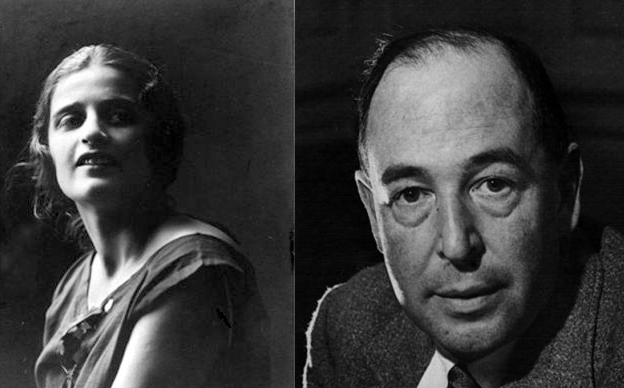
The political intersection of Ayn Randian libertarians and Evangelical conservatives is a baffling phenomenon for most of us outside the American right. It’s hard to reconcile the atheist arch-capitalist and despiser of social welfare with, for example, the Sermon on the Mount. But hey, mixed marriages often work out, right? Well, as for Rand herself, one would hardly find her sympathetic to religion or its expositors at any point in her career. Take her sound lashing of writer, scholar, and lay theologian C.S. Lewis, intellectual hero of Protestant Christianity. (Wheaton College houses his personal library, and there exists not only a C.S. Lewis Institute, but also a C.S. Lewis Foundation.) Lewis’ The Abolition of Man (1943), while ostensibly a text on education, also purports, like Aquinas’ Summa Theologica, to expound the principles of natural law and objective moral value. Rand would have none of it.
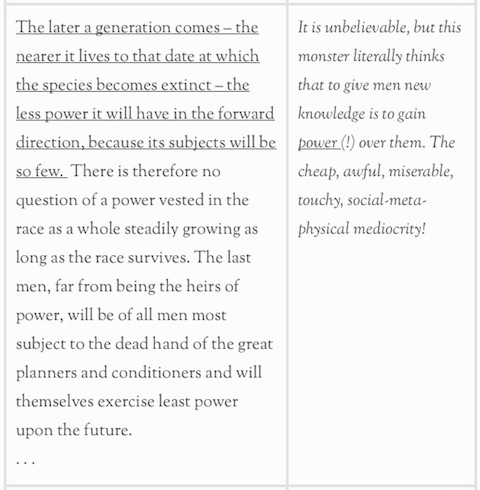
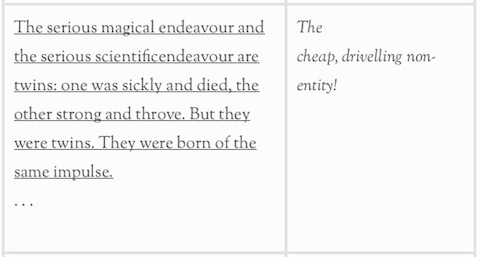
Religion journal First Things brings us excerpts from the edited collection, Ayn Rand’s Marginalia: Her critical comments on the writings of over 20 authors. In it, Rand glosses Lewis’s Abolition of Man with savage ferocity, calling the author an “abysmal bastard,” “cheap, drivelling non-entity” [sic], and “abysmal scum!” The screenshot above (Lewis left, Rand’s annotations right) from the First Things’ blog post offers a typical representation of Rand’s tone throughout, and includes some particularly elaborate insults.
The C.S. Lewis Foundation comments that Lewis “probably would not have approved of the level of venom, but he probably would not have liked Rand’s philosophy much either.” Another Christian academic has successfully squared an appreciation for both Rand and Lewis, but writes critically of Rand, who “seems to have interpreted Lewis’s book as a Luddite screed against science and technology,” part of her “tendency to caricature her opponents.” Certainly no one ever accused her of subtlety. “It’s pretty clear,” our professor continues, “that when showing students how to engage in scholarly discourse, Ayn Rand should not be the model.” No, indeed, but how she would thrive on the Internet.
Read more at First Things, and download a PDF of the Rand-annotated Lewis excerpts here.
Related Content:
Free Audio: Download the Complete Chronicles of Narnia by C.S. Lewis
The Only Known Recordings of C.S. Lewis (1944–1948)
Watch Hand-Drawn Animations of 7 Stories & Essays by C.S. Lewis
Flannery O’Connor: Friends Don’t Let Friends Read Ayn Rand (1960)
Josh Jones is a writer and musician based in Durham, NC. Follow him at @jdmagness
Read More...5 Free Short Stories by Nadine Gordimer
By now, you know that Nadine Gordimer has died. She was 90 years old. Back in 1991, when she won the Nobel Prize, The New York Times made this announcement:
Nadine Gordimer, whose novels of South Africa portray the conflicts and contradictions of a racist society, was named winner of the 1991 Nobel Prize in Literature today as her country finally begins to dismantle the system her works have poignantly explored for more than 40 years.
In a brief citation, the Swedish Academy, which confers the awards, referred to her as “Nadine Gordimer, who through her magnificent epic writing has — in the words of Alfred Nobel — been of very great benefit to humanity.”
The academy also added that “her continual involvement on behalf of literature and free speech in a police state where censorship and persecution of books and people exist have made her ‘the doyenne of South African letters.’ ”
Yesterday, The New Yorker commented that, although she wrote 15 novels, it was “through her short fiction Gordimer made her presence felt the most.” Gordimer published her very first short story, “Come Again Tomorrow,” in a Johannesburg magazine in 1938, when she was just 15 years old. Thirteen years later, there came another first — the first of many stories she published in The New Yorker (“A Watcher of the Dead”). Although many of Gordimer’s New Yorker stories remain locked up, available only to the magazine’s subscribers, we’ve managed to dig up several open ones. Above, you can watch Gordimer read her 1999 story called “Loot” while visiting Harvard University in 2005. The text has since been re-published on the Nobel Prize web site. Below, you can also listen to author Tessa Hadley read “City Lovers,” first published in The New Yorker in 1975. The story “focusses on a love affair between a white man and a ‘colored’ woman in Apartheid South Africa. It’s deeply political in its details—the man is a geologist at a mining company, the couple’s affair is illegal, and they cover it up by pretending that she is his servant. ”
Other Gordimer stories available online include “The First Sense” and “A Beneficiary”, published respectively in The New Yorker in 2006 and 2007. “The Second Sense” came out in The Virginia Quarterly, also in 2007. If you, dear Open Culture readers, happen to know of any other Gordimer stories published online, please let us know in the comments sections below, and we’ll add them to the roundup.
Related Content
1,000 Free Audio Books: Download Great Books for FreeRead 18 Short Stories From Nobel Prize-Winning Writer Alice Munro Free Online
10 Free Stories by George Saunders, Author of Tenth of December
Neil Gaiman’s Free Short Stories
30 Free Essays & Stories by David Foster Wallace on the Web
800 Free eBooks for iPad, Kindle & Other Devices
Read More...Jimi Hendrix at Woodstock (1969)
What must it have been like to have been at Woodstock? Like, really have been there, not just watched the film or the 2009 movie about Woodstock, not just have gone to any of the several million muddy, druggy outdoor festivals that proliferated in Woodstock’s wake, but really been there, man? I’ll never know. The real experience of the 1960s can feel as forever irretrievable as that of the 1860s. But, wow, am I glad for the development of moving pictures and live audio recording in that 100 years.
Not only can we see the throngs of happy hippies making their way across Max and Miriam Yasgur’s dairy farm in the initial few minutes above, but we do not have to smell them! Seriously, the footage leading up to Jimi Hendrix’s Woodstock performance is fun, including a brief glimpse of Jerry Garcia hanging out with the people. But you’re here to see Jimi, so, if you can’t wait, skip to ahead. The crowd certainly waited—waited three days for Hendrix to close the festival Sunday night with his band Gypsy Sun & Rainbows. Then they waited some more, all night, in fact, until Hendrix finally took the stage at 8:00 a.m. that Monday morning, August 18, 1969. I imagine everyone who stayed would say it was well worth it. Part 2 of the video is here.
The performances, as you know, are legendarily blistering and include Hendrix’s famously screaming, feedback-drenched “Star-Spangled Banner.” See it above like you never could if you were knee-deep in mud and standing behind a crowd of thousands in the summer sun. Hear it above in audio from Internet Archive, who also have mp3 and ogg vorbis versions of each song for free download. And hear a radio documentary about that performance below. Enjoy!
Related Content:
‘Electric Church’: The Jimi Hendrix Experience Live in Stockholm, 1969
Jimi Hendrix’s Final Interview on September 11, 1970: Listen to the Complete Audio
Jimi Hendrix Unplugged: Two Rare Recordings of Hendrix Playing Acoustic Guitar
Josh Jones is a writer and musician based in Durham, NC. Follow him at @jdmagness
Read More...Slavoj Žižek Charged With Plagiarizing A White Nationalist Magazine Article

Anyone who does any sort of research-based writing knows how easy it is for an occasional close approximation of another’s prose to slip into a summary. Such instances rarely constitute plagiarism, but they can occupy an uncomfortable gray area. Recent allegations against Slovenian theorist Slavoj Žižek, however, charge the wholesale theft of entire passages of text, almost verbatim. It’s an unusual story, not least because of the source material Žižek allegedly lifted—an article in American Renaissance, identified by the Southern Poverty Law Center as a white supremacist publication.
As Critical Theory reports, the first hints of a possible borrowing came on July 8 from Steve Sailer, writing for the The Unz Review (an alternative outlet with its own sometimes peculiar preoccupations when it comes to race). Sailer points to a portion of Žižek’s 2006 article “A Plea for a Return to Différance (with a Minor Pro Domo Sua)” that is uncharacteristically lucid and, well, un-Žižek-like. The text in question summarizes Kevin MacDonald’s anti-Semitic evolutionary-psychology book The Culture of Critique. The day after Sailer’s observation, blogger Deogolwulf tracked down a review of the MacDonald book by Stanley Hornbeck in American Renaissance and placed Žižek and Hornbeck’s prose side by side. Observe the significant similarities and minor differences here.
In a July 11th article breaking the story, Newsweek wrote that it had contacted Deogolwulf and Sailer for comment, but neither responded by the time of publication. However, James Williams, senior managing editor for the journal Critical Inquiry, which published Žižek’s article, did, saying Žižek “absolutely” borrowed from Hornbeck. Had they known, said Williams, “we would have certainly asked him to remove the illegal passages.” Hornbeck also responded, calling the borrowing “contemptible.”
Did Žižek knowingly plagiarize American Renaissance (does Žižek even read American Renaissance)? According to Žižek himself, the answer is no. In an email to Critical Theory, he writes that the close resemblance between his article and Hornbeck’s review is the result of a summary of MacDonald’s work given to him by an unnamed “friend.” Here’s more from Žižek’s email. (Note: he uses the word “résumé” here in the sense of “summary”):
With regard to the recent accusations about my plagiarism, here is what happened. When I was writing the text on Derrida which contains the problematic passages, a friend told me about Kevin Macdonald’s theories, and I asked him to send me a brief resume. The friend send [sic] it to me, assuring me that I can use it freely since it merely resumes another’s line of thought. Consequently, I did just that – and I sincerely apologize for not knowing that my friend’s resume was largely borrowed from Stanley Hornbeck’s review of Macdonald’s book.
“The problematic passages,” Žižek continues in his defense, “are purely informative, a report on another’s theory for which I have no affinity whatsoever.” He adds at the end, “I nonetheless deeply regret the incident.”
It is true that unlike, say, Senator Rand Paul—who apparently passed off almost wholly plagiarized articles as his own original work—Žižek does not take any credit for MacDonald’s ideas and summarizes them only in an attempt to refute them. Nonetheless, as Newsweek notes (in an unfortunate choice of words), for conservative critics, Žižek is “a big scalp” and the matter a very serious one. Zizek’s “sloppy citations,” writes Critical Theory, have come under fire before—notably in his feud with Noam Chomsky, who caught Žižek misattributing a racist quote to him. (Žižek “admitted the mistake and apologized.”) This case seems much more severe for the length of the passages lifted as well as Žižek’s failure to check and cite his source. Charges of academic plagiarism frequently go to press. But with such a public figure (and film star) as the flamboyant Marxist Žižek, and such inflammatory far right source material, this particularly regrettable incident—unintentional as it may be—makes for some particularly sensationalist headlines.
Related Content:
Slavoj Žižek Responds to Noam Chomsky: ‘I Don’t Know a Guy Who Was So Often Empirically Wrong’
Vice Meets Up with Superstar Communist Cultural Theorist Slavoj Žižek
Slavoj Žižek’s Pervert’s Guide to Ideology Decodes The Dark Knight and They Live
Josh Jones is a writer and musician based in Durham, NC. Follow him at @jdmagness
Read More...Flannery O’Connor’s Satirical Cartoons: 1942–1945
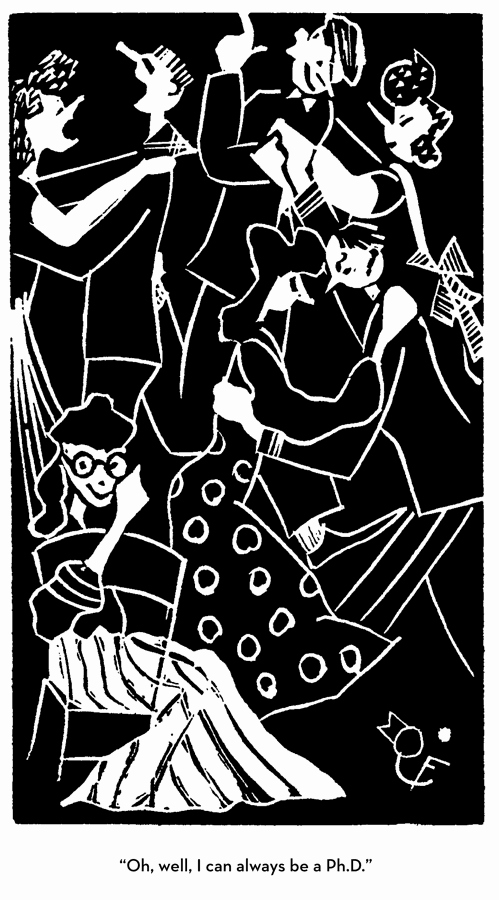
Sci-fi author B.C. Kowalski recently posted a short essay on why the advice to write every day is, for lack of a suitable euphemism, “bullshit.” Not that there’s anything wrong with it, Kowalski maintains. Only that it’s not the only way. It’s said Thackeray wrote every morning at dawn. Jack Kerouac wrote (and drank) in binges. Every writer finds some method in-between. The point is to “do what works for you” and to “experiment.” Kowalski might have added a third term: diversify. It’s worked for so many famous writers after all. James Joyce had his music, Sylvia Plath her art, Hemingway his machismo. Faulkner drew cartoons, as did his fellow Southern writer Flannery O’Connor, his equal, I’d say, in the art of the American grotesque. Through both writers ran a deep vein of pessimistic humor, oblique, but detectable, even in scenes of highest pathos.
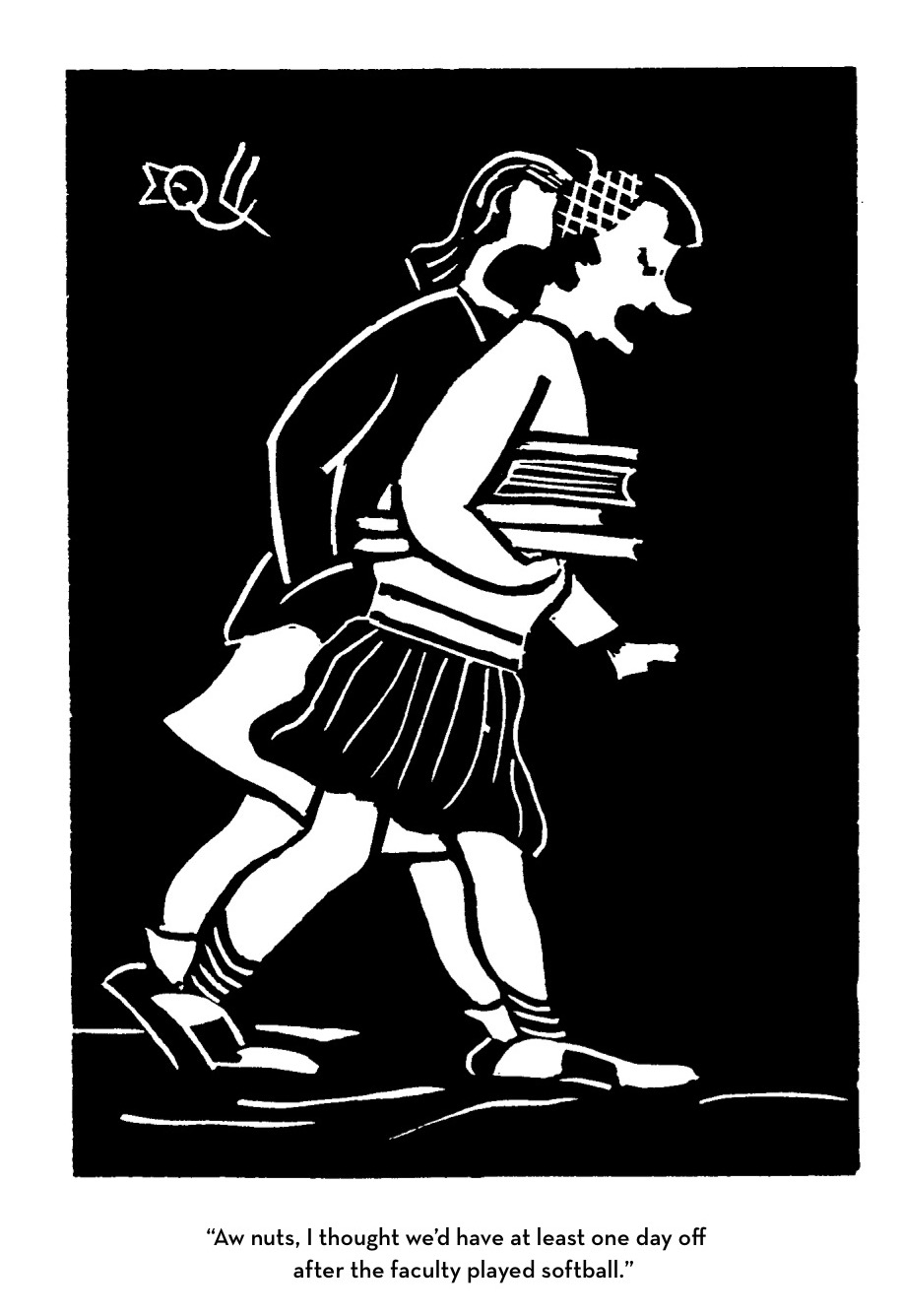
O’Connor’s visual work, writes Kelly Gerald in The Paris Review, was a “way of seeing she described as part of the ‘habit of art’”—a way to train her fiction writer’s eye. Her cartoons hew closely to her authorial voice: a lone sardonic observer, supremely confident in her assessments of human weakness. Perhaps a better comparison than Faulkner is with British poet and doodler Stevie Smith, whose bleak vision and razor-sharp wit similarly cut through mountains of… shall we say, bullshit. In both pen & ink and linoleum cuts, O’Connor set deadpan one-liners against images of pretension, conformity, and the banality of college life. In the cartoon at the top, she seems to mock the pursuit of credentials as a refuge for the socially disaffected. Above, a campaigner for a low-level office deploys bombastic pseudo-Leninist rhetoric, and in the cartoon below, a cranky character escapes a horde of identical WAVES.
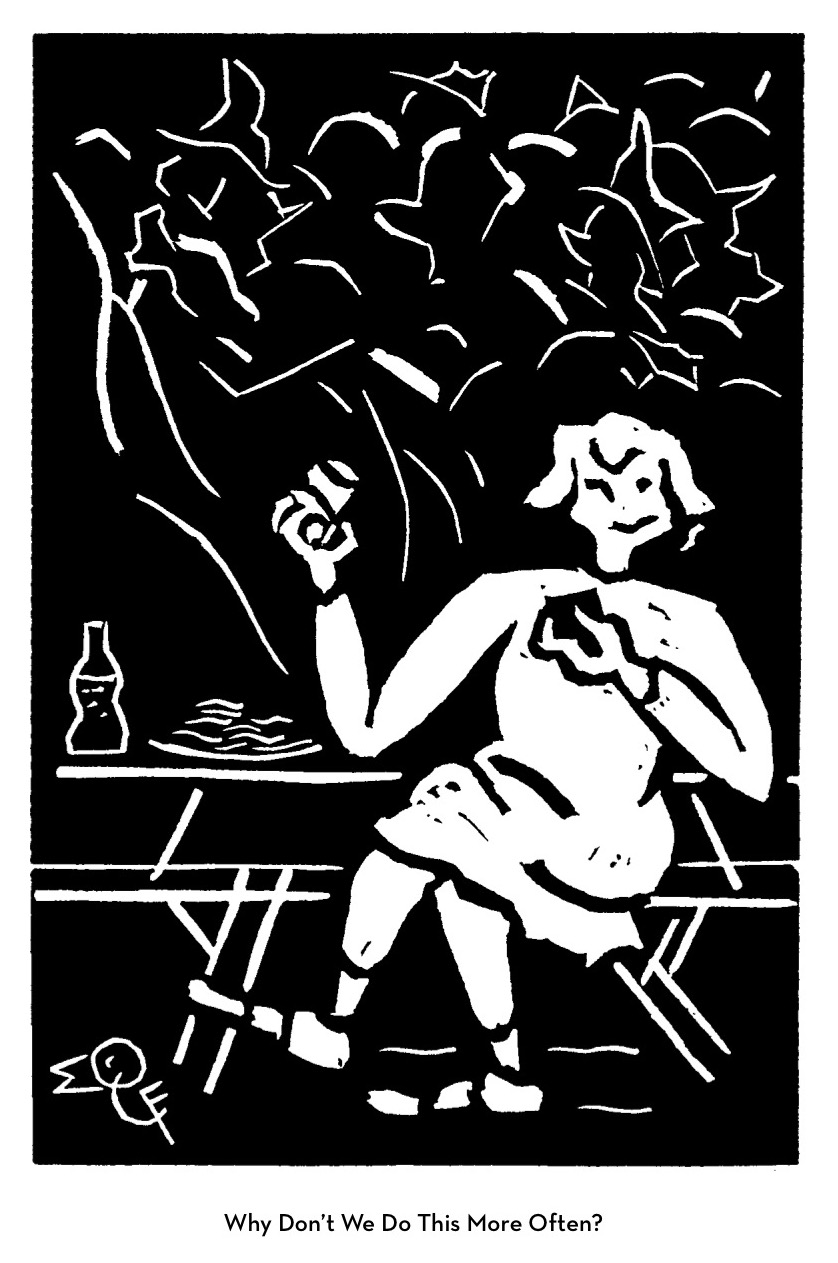
O’Connor was an intensely visual writer with, Gerald writes, a “natural proclivity for capturing the humorous character of real people and concrete situations,” fully credible even at their most extreme (as in the increasingly horrific self-lacerations of Wise Blood’s Hazel Motes). She began drawing at five and produced small books and sketches as a child, eventually publishing cartoons in almost every issue of her high-school and college’s newspapers and yearbooks. Her alma mater Georgia College, then known as Georgia State College for Women, has published a book featuring her cartoons from her undergraduate years, 1942–45.
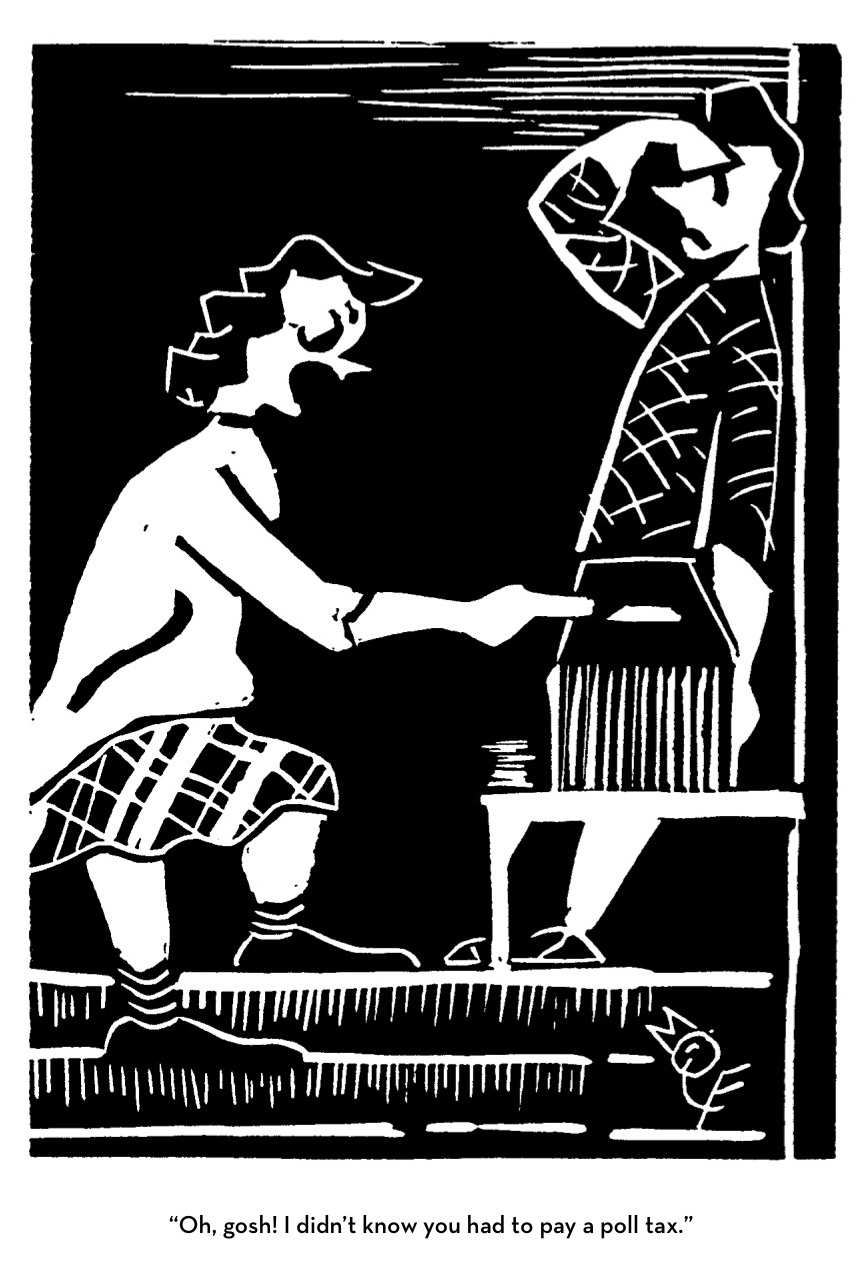
More recently, Gerald edited a collection called Flannery O’Connor: The Cartoons for Fantagraphics. In his introduction, artist Barry Moser describes in detail the technique of her linoleum cuts, calling them “coarse in technical terms.” And yet, “her rudimentary handling of the medium notwithstanding, O’Connor’s prints offer glimpses into the work of the writer she would become” with their “little O’Connor petards aimed at the walls of pretentiousness, academics, student politics, and student committees.” Had O’Connor continued making cartoons into her publishing years, she might have, like B.C. Kowalski, aimed one of those petards at those who dispense dogmatic, cookie-cutter writing advice as well.
Related Content:
The Art of William Faulkner: Drawings from 1916–1925
The Art of Sylvia Plath: Revisit Her Sketches, Self-Portraits, Drawings & Illustrated Letters
The Art of Franz Kafka: Drawings from 1907–1917
Rare 1959 Audio: Flannery O’Connor Reads ‘A Good Man is Hard to Find’
Flannery O’Connor: Friends Don’t Let Friends Read Ayn Rand (1960)
Josh Jones is a writer and musician based in Durham, NC. Follow him at @jdmagness
Read More...Roger Ebert’s Final List of His Top 10 Favorite Films

Image by Sound Opinions, via Flickr Commons
Roger Ebert seems to have resented star ratings, which he had to dish out atop each and every one of his hundreds upon hundreds of regular newspaper movie reviews. He also emphasized, every once in a while, his disdain for the “thumbs up” and “thumbs down” system that became his and Gene Siskel’s television trademark. And he could hardly ever abide that run-of-the-mill critic’s standby, the top-ten list. Filmgoers who never paid attention to Ebert’s career will likely, at this point, insist that the man never really liked anything, but those of us who read him for years, even decades, know the true depth and scope of his love for movies, a passion he even expressed, regularly, in list form. He did so for, as he put it, “the one single list of interest to me. Every 10 years, the ancient and venerable British film magazine, Sight & Sound, polls the world’s directors, movie critics, and assorted producers, cinematheque operators and festival directors, etc., to determine the Greatest Films of All Time.”
“Why do I value this poll more than others?” Ebert asks. “It has sentimental value. The first time I saw it in the magazine, I was much impressed by the names of the voters, and felt a thrill to think that I might someday be invited to join their numbers. I was teaching a film course in the University of Chicago’s Fine Arts Program, and taught classes of the top ten films in 1972, 1982 and 1992.” His dream came true, and when he wrote this reflection on sending in his list every decade, he did so a year nearly to the day before his death in 2013, making his entry in the 2012 Sight & Sound poll a kind of last top-ten testament:
- 2001: A Space Odyssey (Stanley Kubrick, 1968)
- Aguirre, the Wrath of God (Werner Herzog, 1972)
- Apocalypse Now (Francis Ford Coppola, 1979)
- Citizen Kane (Orson Welles, 1941)
- La dolce vita (Federico Fellini, 1960)
- The General (Buster Keaton, 1926) — free online
- Raging Bull (Martin Scorsese, 1980)
- Tokyo Story (Yasujirô Ozu, 1953)
- The Tree of Life (Terrence Malick, 2010)
- Vertigo (Alfred Hitchcock, 1958)
Deciding that he must vote for “one new film” he hadn’t included on his 2002 list, Ebert narrowed it down to two candidates: The Tree of Life and Charlie Kaufman’s Synecdoche, New York. “Like the Herzog, the Kubrick and the Coppola, they are films of almost foolhardy ambition. Like many of the films on my list, they were directed by the artist who wrote them. Like several of them, they attempt no less than to tell the story of an entire life. [ … ] I could have chosen either film — I chose The Tree of Life because it’s more affirmative and hopeful. I realise that isn’t a defensible reason for choosing one film over the other, but it is my reason, and making this list is essentially impossible, anyway.” That didn’t stop his cinephilia from prevailing — not that much ever could.
Related Content:
Roger Ebert Talks Movingly About Losing and Re-Finding His Voice (TED 2011)
The Two Roger Eberts: Emphatic Critic on TV; Incisive Reviewer in Print
Roger Ebert Lists the 10 Essential Characteristics of Noir Films
4,000+ Free Movies Online: Great Classics, Indies, Noir, Westerns, Documentaries & MoreColin Marshall hosts and produces Notebook on Cities and Culture and writes essays on cities, language, Asia, and men’s style. He’s at work on a book about Los Angeles, A Los Angeles Primer. Follow him on Twitter at @colinmarshall or on Facebook.
Read More...Johnny Cash Reads the New Testament
The best gospel recordings—by Aretha Franklin, The Staples Singers, The Carter Family, even Elvis—hum with a deep sincerity that can be truly moving, despite the unintentionally funny earnestness of ballads like “He Touched Me” (not to mention some of those album covers). You can add to the list of Southern gospel greats the name of Johnny Cash, who, like Elvis, got his start singing gospel and returned frequently to the hymns of his youth. Unlike the King, however, Cash also returned to the fold in the 1970s, partly influenced by his wife June Carter.
Cash would record a total of eight solo gospel albums with Columbia Records over his career, and a sort of old-time gospel greatest hits with The Million Dollar Quartet (Cash, Elvis, Jerry Lee Lewis, and Carl Perkins). He wrote a 1986 novelization of the life of the Apostle Paul called Man in White, and a song of the same name (below), and in 1990, the aging star recorded the entire New Testament, New King James Version. Hear the Gospel of Matthew above, and listen to it on Youtube. Running over 19 hours, the recording was repackaged in 2008 as a DVD called Chapter and Verse, with a slideshow and a CD of 14 of Cash’s gospel recordings.
Like his life and career, Cash’s religious journey was tumultuous, but once he’d kicked his addiction, he became something of a “staunch, conservative Bible thumper,” writing in the introduction to The Man in White, “Please understand that I believe the Bible, the whole Bible, to be the infallible, indisputable Word of God.” His theological views may have tempered over the years, but they remained staunchly Evangelical to the end of his life. That said, Cash “was a private man and preferred to keep his faith to himself,” once declaring, “If I’m with someone who doesn’t want to talk about it, I don’t talk about it. I don’t impose myself on anybody in any way, including religion.”
As in everything else Cash recorded, his conviction comes through in his reading above. While he didn’t preach, he did practice what he understood to be the values of his faith, standing up for the poor, imprisoned, and oppressed and against the power structures that constantly beat them down. Cash’s humility and commitment to principle have inspired millions of people who share his beliefs and millions who don’t. To learn more about this little-discussed side of the Man in Black, listen to the one-hour radio documentary below from Public Radio Exchange.
Related Content:
Animated Video: Johnny Cash Explains Why Music Became a Religious Calling
The First Episode of The Johnny Cash Show, Featuring Bob Dylan & Joni Mitchell (1969)
Harvard Presents Two Free Online Courses on the Old Testament
Free Online Religion Courses
Josh Jones is a writer and musician based in Durham, NC. Follow him at @jdmagness
Read More...Watch 1970s Animations of Songs by Joni Mitchell, Jim Croce & The Kinks, Aired on The Sonny & Cher Show
The Sonny and Cher Show aired in the years right before I was born. Not only do I have no memory of it, of course, but I don’t believe I’ve ever seen an entire episode, either in re-runs or on the internet. Nevertheless, I immediately recognized the style of the show’s animator, English artist John David Wilson, when I encountered these music videos Wilson made for the singing comedy duo’s variety hour. Though a much less famous name, Wilson’s work seems to have animated the 70s in the way that R. Crumb’s illustrated the 60s. The opening sequences to iconic productions Grease and The Carol Burnett Show are Wilson’s, as are animations for Laugh In and cheesy Saturday morning kids’ show The Hudson Brothers Razzle Dazzle Show (best known now, perhaps, because of Hudson brother progeny Kate Hudson). Though Wilson’s career stretches back to the 50s—with work on Mr. Magoo, Peter Pan, and Lady and the Tramp—and into the 90s, with FernGully: The Last Rainforest, he seems to belong to the decade of “I Got You Babe” more so than any other.
Drawn “in a simplistic, funky-looking style” and with goofy sound effects added (probably by the Sonny and Cher producers), Wilson’s animated films for Joni Mitchell’s “Big Yellow Taxi” (top), Jim Croce’s “Bad, Bad Leroy Brown” (above), and The Kinks “Demon Alcohol” (below, sung by Wayne Carpenter) enhance songs already rich with narrative. This, the blog Media Funhouse points out, was by design: “Wilson was wise to concentrate on the ‘story songs’ of the time, in order to create repeating characters and have the viewer ‘connect’ with the piece in a very short span of time.”
In most cases, Sonny and Cher’s vocals were dubbed over the original tracks, but in many of the animations that surfaced on VHS in the eighties and now appear on Youtube, the original songs have been restored, as in the two above. If you grew up with the show, you’ve surely seen at least a couple of these early music videos, a form Wilson is widely credited with pioneering. Beginning in the second season, Wilson’s company, Fine Arts Films, produced a total of fourteen animated shorts for the show.
The story-songs above of environmental degradation, tough street characters, and the depths of addiction seem so very characteristic of the period, though Wilson certainly animated more lighthearted pop fare, such as Melanie’s “Brand New Key” (sung here by Cher). For more of Wilson’s animated music videos, see Dangerous Minds or Media Funhouse, and for the full range of Wilson’s long career in animation, check out the website of the production company he founded, Fine Arts Films.
Related Content:
Watch Joni Mitchell Perform “Both Sides Now” on the First Episode of The Johnny Cash Show (1969)
A Short History of America, According to the Irreverent Comic Satirist Robert Crumb
Josh Jones is a writer and musician based in Durham, NC. Follow him at @jdmagness
Read More...Support Us
We're hoping to rely on loyal readers, rather than erratic ads. Please click the Donate button and support Open Culture. You can use Paypal, Venmo, Patreon, even Crypto! We thank you!

About Us

Open Culture scours the web for the best educational media. We find the free courses and audio books you need, the language lessons & educational videos you want, and plenty of enlightenment in between.
Advertise With Us

FREE UPDATES!
GET OUR DAILY EMAIL
Get the best cultural and educational resources on the web curated for you in a daily email. We never spam. Unsubscribe at any time.
FOLLOW ON SOCIAL MEDIA

Open Culture editor Dan Colman scours the web for the best educational media. He finds the free courses and audio books you need, the language lessons & movies you want, and plenty of enlightenment in between.
Advertise With Us

