How J.K. Rowling Plotted Harry Potter with a Hand-Drawn Spreadsheet
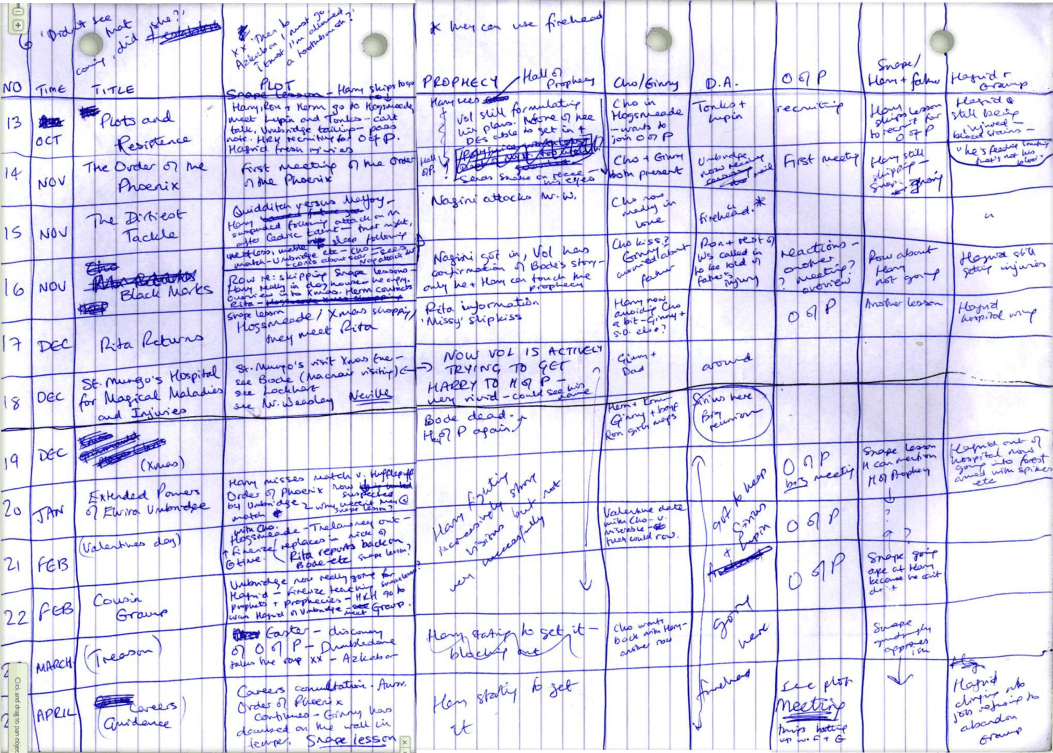
At the height of the Harry Potter novels’ popularity, I asked a number of people why those books in particular enjoyed such a devoted readership. Everyone gave almost the same answer: that author J.K. Rowling “tells a good story.” The response at once clarified everything and nothing; of course a “good story” can draw a large, enthusiastic (and, at that time, impatient) readership, but what does it take to actually tell a good story? People have probably made more money attempting, questionably, to pin down, define, and teach the best practices of storytelling, but at the top of this post, we have a revealing scrap of Rowling’s own process. And I do, almost literally, mean a scrap: this piece of lined paper contains part of the handwritten plot spreadsheet she used to write the fifth Harry Potter novel, Harry Potter and the Order of the Phoenix.
This particular page (click to view it in a larger format) covers chapters 13 through 24, during which even more happens than you may now remember. It may have amounted to more than Rowling, too, could remember, hence the spreadsheet itself. Endpaper explains some of her story notes as follows:
- “Prophecy”: A subplot about the prophecy Harry finds himself concerned about all through the book
- “Cho/Ginny”: The book’s romantic subplot
- “D.A.”: What’s happening with the resistance army, or “Dumbledore’s Army”
- “O of P”: What’s happening with the “Order of the Phoenix” group
- “Snape/Harry”: What’s happening with Snape and Harry
- “Hagrid and Grawp”: What’s happening with Hagrid and Grawp
“If you think about Harry Potter and the Order of the Phoenix, that’s it,” writes /Film’s Germain Lussier. “Those columns pretty much encompass the whole story.” Rowling, of course, hardly counts as the only novelist to write with such techniques, and based on this example, hers don’t get nearly as elaborate as some. (I recall once reading that Vikram Chandra had to bust out Microsoft Project to keep track of the complications of Sacred Games, his 900-page novel about the Mumbai underworld.) But Rowling must certainly rank as the most famous novelist to, quite literally, draw up spreadsheets like this. I suppose it does leave her books even more exposed to accusations of overplotting than before, but something tells me it won’t bother her.
Related Content:
Download Two Harry Potter Audio Books for Free (and Get the Rest of the Series for Cheap)
Take Free Online Courses at Hogwarts: Charms, Potions, Defense Against the Dark Arts & More
The Quantum Physics of Harry Potter, Broken Down By a Physicist and a Magician
Harry Potter Prequel Now Online
Colin Marshall hosts and produces Notebook on Cities and Culture and writes essays on cities, language, Asia, and men’s style. He’s at work on a book about Los Angeles, A Los Angeles Primer. Follow him on Twitter at @colinmarshall or on Facebook.
Read More...Neil deGrasse Tyson, High School Wrestling Team Captain, Invented a Physics-Based Wrestling Move
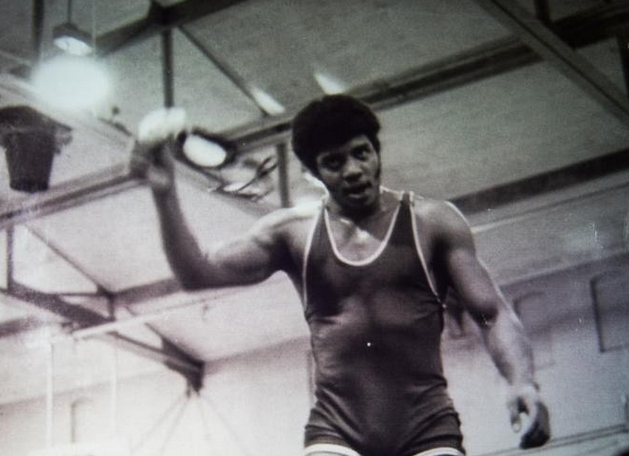
We know that Neil deGrasse Tyson was something of a wunderkind during his high school years. If you’re an OC regular, you’ve read all about how Carl Sagan personally recruited Tyson to study with him at Cornell. Deftly, politely, the young Tyson declined and went to Harvard.
There’s perhaps another side of the precocious Tyson you might not know as much about. The athletic side. While a student at The Bronx High School of Science, Tyson (class of 1976) wore basketball sneakers belonging to the Knick’s Walt “Clyde” Frazier. He ran an impressive 4:25 mile. And he captained the school’s wrestling team, during which time he conjured up a new-fangled wrestling move. In professional wrestling, Ric Flair had the dreaded Figure Four Leg Lock, and Jimmy Snuka, a devastating Superfly Splash. Tyson? He had the feared “Double Tidal Lock.” He explains and demonstrates the physics-based move in the video below, originally recorded at the University of Indianapolis.
Related Content:
When Samuel Beckett Drove Young André the Giant to School: A True Story
Andy Warhol’s One Minute of Professional Wrestling Fame (1985)
Neil deGrasse Tyson Lists 8 (Free) Books Every Intelligent Person Should Read
Read More...Stephen Fry Reads the Legendary British Shipping Forecast
If you live in England, you’re probably familiar with the Shipping Forecast, a nightly BBC radio broadcast that details the weather conditions for the seas surrounding Britain. The broadcast has been on the airwaves since 1911. And many Brits will tell you that the forecast, always read in a soporific voice, can lull you to sleep quicker than a dose of Ambien. The broadcast has a strict format. It can’t exceed 350 words, and it always begins: “And now the Shipping Forecast, issued by the Met Office on behalf of the Maritime and Coastguard Agency at [fill in the time] today.” Below y0u can listen to a recording of actual forecasts. (Or catch the one from 6/29/2014 here.) Don’t listen to it while driving, or operating heavy machinery. A primer that decodes the unfamiliar terminology in the radio transmission can be found here.
All of this gives you just enough context to appreciate Stephen Fry’s parody reading of the Shipping Forecast. It was recorded in 1988, for the first episode of his radio show Saturday Night Fry. (Full episode here.) You can read along with the transcript, while listening to the clip up top:
And now, before the news and weather, here is the Shipping Forecast issued by the Meteorological Office at 1400 hours Greenwich Mean Time.
Finisterre, Dogger, Rockall, Bailey: no.
Wednesday, variable, imminent, super.
South Utsire, North Utsire, Sheerness, Foulness, Eliot Ness:
If you will, often, eminent, 447, 22 yards, touchdown, stupidly.
Malin, Hebrides, Shetland, Jersey, Fair Isle, Turtle-Neck, Tank Top, Courtelle:
Blowy, quite misty, sea sickness. Not many fish around, come home, veering suggestively.
That was the Shipping Forecast for 1700 hours, Wednesday 18 August.
Related Content:
Stephen Fry Reads Oscar Wilde’s Children’s Story “The Happy Prince”
Shakespeare’s Satirical Sonnet 130, As Read By Stephen Fry
Stephen Fry Profiles Six Russian Writers in the New Documentary Russia’s Open Book
Read More...Watch 1990s Video of Sacha Baron Cohen Playing Christo, the Proto Borat (NSFW)
In 2005, a hirsute Kazakh journalist named Borat Sagdiyev ventured to America to make a documentary about “the Greatest Country in the World.” Along the way, he had extremely awkward conversations with politicians Bob Barr and Alan Keyes, unwittingly participated in a Gay Pride parade, and accidentally destroyed a gift shop filled with Confederacy memorabilia. When he visited a Virginia rodeo, he nearly caused a riot. Prior to the event, he praised the War on Terror — which got cheers — and then wished that “George W. Bush will drink the blood of every man, woman and child in Iraq,” which got fewer cheers. He then sang the lyrics of the Kazakh national anthem to the tune of the “Star Spangle Banner.” That got boos.
Borat is, of course, a fictional character played by British comedian Sacha Baron Cohen, made famous in his hugely successful 2006 movie Borat: Cultural Learnings of America for Make Benefit Glorious Nation of Kazakhstan. While his brand of gonzo comedy might not be everybody’s cup of tea, you have to admit he’s brave and weirdly dedicated to his craft. The cops were called over 90 times during the production of Borat and Baron Cohen never broke character once.
Of all of Baron Cohen’s characters – the dim-witted wannabe gangster Ali G and the equally oblivious gay fashionista Bruno, Borat is perhaps his most likeable, and therefore his most dangerous, character. He’s so naively ignorant, so benighted by provincial prejudices that he evokes a tone of kindly condescension from just about everyone he encounters – at least before they call the cops on him. And that condescension can prove to be a trap. Borat’s casual, jarringly overt homophobia, sexism and anti-Semitism can often lead interviewees to say things out loud that they wouldn’t normally say in front of a camera. When Borat stated, “We hang homosexuals in my country!” Bobby Rowe, the producer of that rodeo quipped: “That’s what we’re trying to do here.”
The first incarnation of Borat was a Moldavian journalist named Alexi who appeared on the Granada TV show F2F in the mid-90s. For the BBC Two show Comedy Nation, Baron Cohen turned Alexi into Christo from Albania. You can see a couple of his early skits as Christo. In the one up top, he tries the patience of famed socialite Lady Colin Campbell by insisting on carrying the train of her haute couture dress. Below that, Christo stumbles uncomprehendingly into the world of S&M. Both videos, as you might expect, are NSFW.
Related Content:
Ali G at Harvard; or How Sacha Baron Cohen Got Blessed by America’s Cultural Establishment
George Carlin Performs His “Seven Dirty Words” Routine: Historic and Completely NSFW
Lenny Bruce Riffs and Rants on Injustice and Hypocrisy in One of His Final Performances (NSFW)
Jonathan Crow is a Los Angeles-based writer and filmmaker whose work has appeared in Yahoo!, The Hollywood Reporter, and other publications. You can follow him at @jonccrow.
Read More...Hardware Wars: The Mother of All Star Wars Fan Films (and the Most Profitable Short Film Ever Made)
Back in 1977, San Francisco filmmaker Ernie Fosselius had the brainwave to make a spoof of a movie that had just come out. It was a risky move. Nobody had any sense that Star Wars would become the worldwide cultural phenomenon that it did. And just as George Lucas’s space opera earned staggering amounts of money, so did Fosselius’s parody, Hardware Wars. You can watch it above. Made for a mere eight grand, the 13-minute movie became a pre-internet viral hit and a staple on the festival circuit, ultimately earning over $1,000,000 – an unheard of haul for a short film. In fact, in terms of money spent versus money earned, Hardware Wars ended up being far more profitable than Star Wars. And it’s considered the most profitable short film ever made.
“I think a lot of the charm of that movie is the fact that we didn’t really know what we were doing,” said Scott Mathews, who donned a blonde wig to play the movie’s lead, Fluke Starbucker. The movie’s production is so gleefully cheap and half-assed that you can’t help but be charmed by it. Irons, toasters, and tape players are used in place of spaceships.
A canister vacuum cleaner stands in for R2D2, and Chewbacca appears to be a Cookie Monster puppet dyed brown. At one point, while on a desert planet of Tatooine, you see a beach-goer sauntering in the background. And Star Wars’s famous cantina scene is in this movie simply a stroll through a crowded tavern. If you know anything about the bar scene in 1970s San Francisco, you know that it was at least as weird as anything George Lucas managed to put up on the screen.
The often litigious Lucas reportedly really liked the movie, called it “cute.” He even invited Fosselius to voice the inconsolable sobs of Jabba the Hutt’s animal trainer after his beloved Rancor gets killed by Luke Skywalker in Return of the Jedi.
Hardware Wars ended up launching an entire subgenre of movie – the Star Wars fan film. And with the advent of Youtube and digital filmmaking technology, the ability of nerds and mavens to make increasingly sophisticated takes on Lucas’s universe became easier and easier. One of the better, and older, ones is Troops. A mash up of Star Wars and the reality TV series Cops, the short shows the challenges and the struggles of being an Imperial Stormtrooper. Check it out below.
via FilmmakerIQ
Related Content:
How Star Wars Borrowed From Akira Kurosawa’s Great Samurai Films
Freiheit, George Lucas’ Short Student Film About a Fatal Run from Communism (1966)
Watch the Very First Trailers for Star Wars, The Empire Strikes Back & Return of the Jedi (1976–83)
Joseph Campbell and Bill Moyers Break Down Star Wars as an Epic, Universal Myth
Hundreds of Fans Collectively Remade Star Wars; Now They Remake The Empire Strikes Back
4,000+ Free Movies Online: Great Classics, Indies, Noir, Westerns, Documentaries & MoreJonathan Crow is a Los Angeles-based writer and filmmaker whose work has appeared in Yahoo!, The Hollywood Reporter, and other publications. You can follow him at @jonccrow.
Read More...
Hear the Earliest Known Talking Heads Recordings (1975)
We’ve featured a fair few early Talking Heads performances, from Dortmund and Rome in 1980 to Syracuse in 1978 all the way back to CBGB in 1975. But you haven’t really heard early Talking Heads until you’ve heard the earliest Talking Heads. The same year of that CBGB show (one of many they played after their debut there opening for the Ramones), the trio of David Byrne, Chris Frantz, and Tina Weymouth recorded a series of demos at CBS studios. Still unsigned and in their early twenties, this first configuration of the Heads (after the band, newly arrived in New York, shed their identity as “The Artistics” from their days together at the Rhode Island School of Design) laid down the very first known recorded versions of such notable tracks as “Psycho Killer” above, “Thank You for Sending Me an Angel” below, and “I’m Not in Love” below.
You can find a fuller playlist, which includes more songs from these CBS sessions like “I Wish You Wouldn’t Say That,” “Tentative Decisions,” and “Stay Hungry,” here. We often hear these songs described as the defining material of a pioneering “post-punk” band like Talking Heads, so the fact that all these tracks come from 1975 make them perhaps the first examples of the genre ever recorded. This way of playing slightly ahead of their time may actually have kept the group from finding a label to sign them until 1977, when Sire picked up the now-quartet (with the addition of multi-instrumentalist Jerry Harrison) and put out the immortal pair of LPs Talking Heads: 77 and More Songs About Buildings and Food. Yes, even though they’d recorded these demos at CBS studios, CBS Records passed up the chance to take them on. Surely they lived it down more quickly than did Decca Records after having rejected The Beatles, but still, nobody every stayed atop the zeitgeist by turning their back to the Talking Heads.
Related Content:
Watch the Talking Heads Play Live in Dortmund, Germany During Their Heyday (1980)
Watch the Talking Heads Play a Vintage Concert in Syracuse (1978)
Talking Heads Play CBGB, the New York Club that Shaped Their Sound (1975)
Live in Rome, 1980: The Talking Heads Concert Film You Haven’t Seen
David Byrne: How Architecture Helped Music Evolve
Colin Marshall hosts and produces Notebook on Cities and Culture and writes essays on cities, language, Asia, and men’s style. He’s at work on a book about Los Angeles, A Los Angeles Primer. Follow him on Twitter at @colinmarshall or on Facebook.
Read More...Discover the Lost Films of Orson Welles
To know an artist, you must know all the work they ever made public. But to truly, thoroughly know an artist, you must also know all the work they never made public. This notion, in our age of DVD deleted scenes, dedicated university courses, and other aids to completist enthusiasm, has gained quite a lot of traction. But how many creators working today give you the sense of only seeing the tip of their productive iceberg than did Orson Welles, whose rumored unseen or never fully developed works sometimes seem even to outnumber those in his impressive and (in the main) highly acclaimed canon? Sure, the man made War of the Worlds and Citizen Kane, but everyone knows those. What about The Dreamers, The Deep, The Other Side of the Wind — seen any of those? Now, thanks to Cinephilia and Beyond, you can see them, or at least parts of them, in 1995’s Orson Welles: The One-Man Band by German filmmaker and serious Welles fan Vassili Silovic.
In collaboration with the auteur’s longtime companion Oda Kojar, Silovic digs into the Welles archives and bring to light evidence of all sorts of projects unrealized, unfinished, or simply unreleased. The New York Times’ Stephen Holden writes that Silovic’s film “offers tantalizing excerpts from Welles’s later works along with reminiscences by Ms. Kodar of their nomadic life together. As Welles dashed about the globe pursuing acting jobs and financing for his projects, he toted around a 16-millimeter editing table and a giant suitcase of equipment that made him the film-making equivalent of a one-man band. Many of his smaller projects might be described as ambitious home movies filmed on the spot wherever he happened to be.” We see bits and pieces of an incomplete thriller, a clip from the pilot for a proposed television talk show, some of “the story of an aging, ferociously independent film director (played by John Huston) wrestling with the Hollywood establishment to complete an iconoclastic work.” We even get a glimpse, as if you still needed evidence that Welles led a storied life, of a chat he had with the Muppets.
You can find some iconic, complete films by Welles in our collection, 4,000+ Free Movies Online: Great Classics, Indies, Noir, Westerns, Documentaries & More.
Related Content:
Listen to Eight Interviews of Orson Welles by Filmmaker Peter Bogdanovich (1969–1972)
Watch The Trial (1962), Orson Welles’ Worst or Best Film, Adapted From Kafka’s Classic Work
Watch Orson Welles’ The Stranger Free Online, Where 1940s Film Noir Meets Real Horrors of WWII
The Hearts of Age: Orson Welles’ Surrealist First Film (1934)
Orson Welles Explains Why Ignorance Was His Major “Gift” to Citizen Kane
Colin Marshall hosts and produces Notebook on Cities and Culture and writes essays on cities, language, Asia, and men’s style. He’s at work on a book about Los Angeles, A Los Angeles Primer. Follow him on Twitter at @colinmarshall or on Facebook.
Read More...Eddie Vedder Sings Disney’s “Let It Go” at Pearl Jam Concert in Italy
If you’re a parent of young girls, you can’t escape “Let It Go,” the song from Disney’s 2013 animated film, Frozen. Not even Eddie Vedder (father of daughters born in 2004 and 2008) can shake it. Just witness what happened on Friday night when Vedder performed Pearl Jam’s 1993 hit, “Daughter,” live in Milan, Italy. You apparently can’t think “Daughter” without thinking “Let It Go.” A longer version of the Pearl Jam performance can be viewed here.
via That Eric Alper
Related Content
Patti Smith’s Cover of Nirvana’s “Smells Like Teen Spirit” Strips the Song Down to its Heart
Springsteen Plays Lorde’s “Royals” & AC/DC’s “Highway to Hell” in Down Under Concerts
Bill Murray Croons a Soulful Cover of “The House of the Rising Sun”
Read More...Mavis Staples and The Band Sing “The Weight” In Martin Scorsese’s The Last Waltz (1978)
It’s a tough choice, but I think the moment above may be one of my favorites from the 1978 Martin Scorsese-filmed farewell concert for The Band, The Last Waltz. In this clip from the film, The Band performs one of their signature songs, “The Weight,” with soul and gospel legends The Staples Singers. Staples patriarch and guitarist Roebuck sings some lead vocals, as does, of course, the group’s star Mavis. “As the song finishes up,” writes Elon Green at The New Yorker, “Mavis, closest to the camera, throws her head back, leans toward the mic, and says, almost inaudibly, ‘Beautiful.’” It’s a beautiful moment, for sure, and a great story that Mavis tells in full on Green’s “Culture Desk” post (excerpt below).
It was so beautiful to me. I was surprised that was caught on tape, you know, because I thought I was whispering. It wasn’t rehearsed to go like that. It was just a feeling that brought that on. The excitement of being with our friends—Levon and Danko and those guys were such good friends of ours—to be singing with them, and knowing that this is going to be on the big screen, the silver screen, it was just a moment in time for me. You could probably, had you been there, you would have heard my heart pounding.
Despite its roots in American country and Appalachian folk, like so much of The Band’s music—and so much Americana—“The Weight” lends itself equally to soul and R&B interpretations. The song’s been covered by The Supremes and The Temptations (singing together), Aretha Franklin recorded a funky, soulful version, and it’s long been a part of Mavis Staples’ live set. “The Weight” is also one of those great songs that brings black and white artists together; it’s testament to The Band’s keen appreciation for American roots music (which they learned by heart as backing band for rockabilly star Ronnie Hawkins and later Bob Dylan). Below, see Wilco, Nick Lowe, and Mavis Staples rehearse the song backstage at the Civic Opera House in Chicago in 2011.
via The New Yorker
Related Content:
Watch The Band Play “The Weight,” “Up On Cripple Creek” and More in Rare 1970 Concert Footage
The Queen of Soul Conquers Europe: Aretha Franklin in Amsterdam, 1968
Josh Jones is a writer and musician based in Durham, NC. Follow him at @jdmagness
Read More...Hear Isolated Tracks From Five Great Rock Bassists: McCartney, Sting, Deacon, Jones & Lee
Last week we sparked some heated debate (and some typical internet vitriol) with a post featuring isolated drum tracks from six of rock’s best drummers. Well, here we go again, this time with isolated bass tracks…. Bear in mind that the bassists featured here are some of the top players in rock who actually have bass tracks available online. There are many more I’d love to hear out of the mix—and no shortage of jazz, reggae, funk, and soul bassists I deeply dig. If you don’t see your favorite player here… really, don’t take it personally.
The bass guitar tends to be a forgotten instrument, sometimes not even missed when it’s gone (think Black Keys, The Doors), but despite the success of the rare bass-less band, it’s hard to imagine some of the songs represented here without the fundamental thump and groove of well-played basslines. We begin with John Deacon’s bassline for Queen and David Bowie’s “Under Pressure,” above. As we mentioned in a recent post on that song’s evolution, Stylus named this the #1 bassline of all time.
I don’t know what that accolade is worth, but the bassline is at least one of the most recognizable, thanks in no small part to Vanilla Ice. In the context of Queen, Deacon’s perhaps best known for the pounding stomp of “Another One Bites the Dust,” one of many songs he wrote for the band. He has very deliberately disappeared from the spotlight since Freddie Mercury’s death, but his tasteful, melodic playing is in no danger of being forgotten.
Led Zeppelin’s John Paul Jones, on the other hand, refuses to leave the stage, for which the several dozen musicians he’s toured and recorded with since Zeppelin’s demise are all grateful. Currently one-third of supergroup Them Crooked Vultures (with Dave Grohl and Queens of the Stone Age’s Josh Homme), Jones also plays mandolin (on Zep’s “Going to California,” for example), lap steel, and this triple-necked monster. For all his continued relevance into the 21st century, Jones’s sometimes smooth, sometimes burly basslines for Led Zeppelin, such as the unforgettable “Ramble On” riff above, will be his enduring legacy. One would have to be a hell of a bass player to keep up with John Bonham, and John Paul Jones is exactly that. He got his start playing jazz at age 15, and while still a teenager, played in a jazz-rock collective that included John McLaughlin (whom Jeff Beck has called “the best guitarist alive”). Want to learn how Jones does it? Check out this bass lesson with the master himself.
When the subject of rock bassists arises, Geddy Lee’s name will invariably come up. Like his bandmate Neil Peart, Lee’s musicianship astounds, his prog-rock stylings seem inimitable, except perhaps by Primus’ Les Claypool (who Lee names as one of his favorites). Bass magazine No Treble calls Rush’s “YYZ” (above) “one of the greatest bass lines of all time.” It’s not exactly my cup of tea, but I do know at least one bass player who left for Berklee College of Music hating Rush, then came back listening to this song over and over in hushed awe. Not everyone loves Lee’s over-the-top high pitched vocals, but one has to admire the fact that he plays basslines like this while singing some of the most philosophical lyrics in rock, courtesy of drummer Peart.
The last two bass tracks feature bassists who, like Lee, are also singers. No one pulls that off with more grace and style than Paul McCartney. In the bassline to The Beatles “Come Together” (above), you can hear the deep, resonant tone of McCartney’s semi-hollow Hofner violin bass (many of which have been “nicked” over the years). Of McCartney’s playing, John Lennon once said, “Paul was one of the most innovative bass players ever. And half the stuff that is going on now is directly ripped off from his Beatles period.” In my own bass-playing days, I certainly stole my share of ideas from McCartney—or more probably, his basslines were etched into my music brain, and my fingers automatically plucked out McCartney-style patterns. Music Radar puts “Come Together” at the top of a list of “Paul McCartney’s 12 greatest Beatles bass performances,” for the “spooky, sinuous, throbbing and groovy” track above, “as original as it gets.”
Our isolated drum tracks post happened to feature the other rhythmic halves of every player on this list except John Deacon, and while this wasn’t exactly by design, it’s no surprise to me that’s how it worked out. A great rhythm section works as a closely-aligned team, finding locked grooves, creating emphasis and punctuation, building structures and spaces for lead players to fill. A drummer like the Police’s Stewart Copeland needed a bassist as precise yet passionate as Sting. Very few other bands have successfully fused punk, jazz, and reggae rhythms into a greater whole, a feat accomplished in part because of Sting’s versatility as a player. From the muted “train engine” punk of “Next to You” to the left-field pop of “Message in a Bottle” (above), Sting’s aggressive playing, often fretless, mostly finger-picked—to quote that reputable source Uncyclopedia—“makes him better than all other musicians combined by 12 orders of magnitude, and that’s a pop fact.”
But seriously, he’s good, and so are dozens of other rock bassists who don’t appear above. Name your favorites, and if you find their bass tracks online, share ‘em! Alright, let the bass slugfest begin, and be sure to check out No Treble’s “Isolated Bass Track Week” posts, with tracks from undisputed masters of the instrument like James Jamerson and Jaco Pastorious.
Related Content:
Isolated Drum Tracks From Six of Rock’s Greatest: Bonham, Moon, Peart, Copeland, Grohl & Starr
Paul McCartney Offers a Short Tutorial on How to Play the Bass Guitar
The Story of the Bass: New Video Gives Us 500 Years of Music History in 8 Minutes
Josh Jones is a writer and musician based in Durham, NC. Follow him at @jdmagness
Read More...Support Us
We're hoping to rely on loyal readers, rather than erratic ads. Please click the Donate button and support Open Culture. You can use Paypal, Venmo, Patreon, even Crypto! We thank you!

About Us

Open Culture scours the web for the best educational media. We find the free courses and audio books you need, the language lessons & educational videos you want, and plenty of enlightenment in between.
Advertise With Us

FREE UPDATES!
GET OUR DAILY EMAIL
Get the best cultural and educational resources on the web curated for you in a daily email. We never spam. Unsubscribe at any time.
FOLLOW ON SOCIAL MEDIA

Open Culture editor Dan Colman scours the web for the best educational media. He finds the free courses and audio books you need, the language lessons & movies you want, and plenty of enlightenment in between.
Advertise With Us

