15-Year-Old George R.R. Martin Writes a Fan Letter to Stan Lee & Jack Kirby (1963)
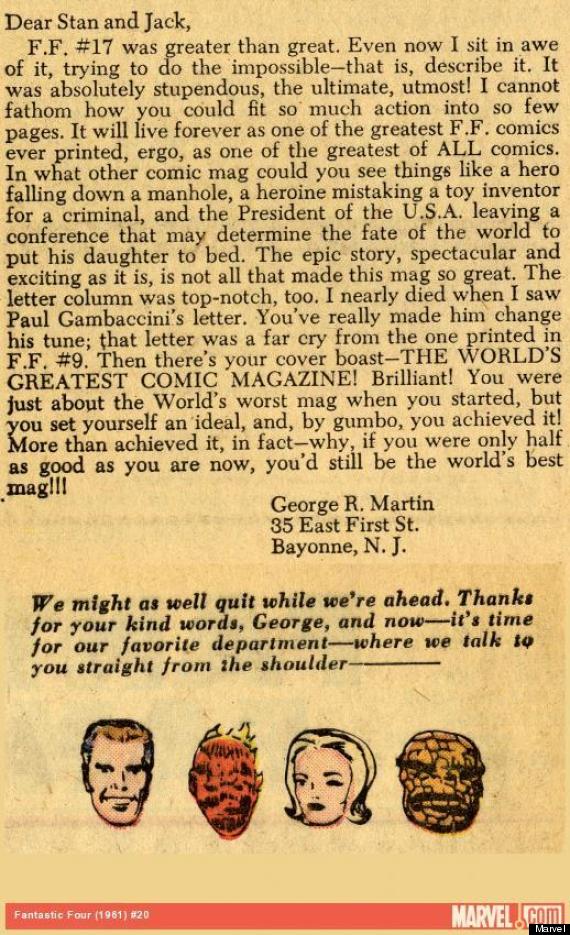
The letter above goes to show two things. George Raymond Richard Martin, otherwise known as George R.R. Martin, or simply as GRRM, had fantasy and writing in his blood from a young age. Decades before he wrote his fantasy novel series A Song of Ice and Fire, which HBO adapted into Game of Thrones, a 15-year-old George R. Martin sent a fan letter to Stan Lee and Jack Kirby, the legendary creators of Spider-Man, the Hulk, Thor, the X‑Men and the Fantastic Four (called “F.F.” in the letter). When you read the note, you can immediately tell that young Martin was steeped in sci-fi and fantasy literature. He could also string together some fairly complex sentences during his teenage years — sentences that many adults would struggle to write. But here’s the cool part for me. Wunderkind Martin lived in good old Bayonne, NJ, the town where yours truly has deep family roots. You can find the cover of the much-praised F.F. #17 below.
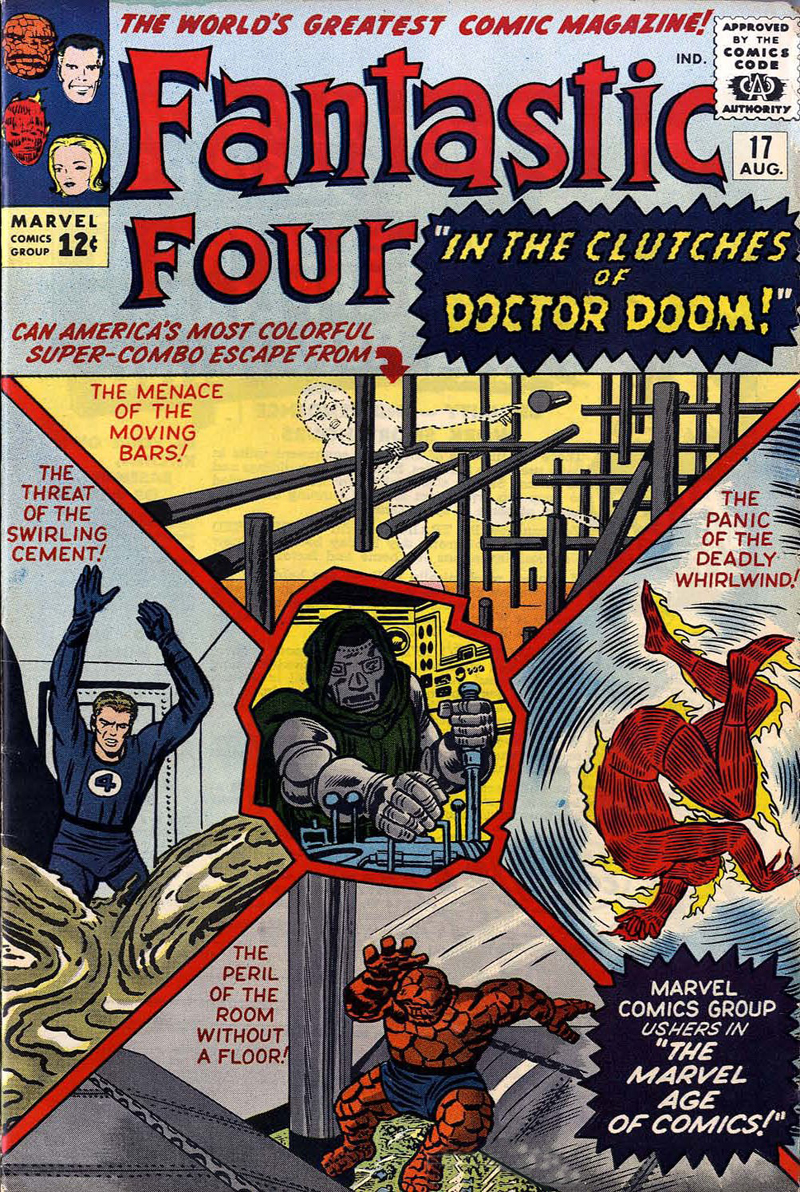
via HuffPo
Related Content:
Download 15,000+ Free Golden Age Comics from the Digital Comic Museum
Lars von Trier’s Animated Movie Made When He Was 11 Years Old
See Carl Sagan’s Childhood Sketches of The Future of Space Travel
Read More...Lars von Trier’s Animated Movie Made When He Was 11 Years Old
Words like “adorable” and “cute” don’t come readily to mind when talking about Danish director Lars von Trier, but that’s exactly how you can describe the stop motion animated film he made when he was 11 years old. Sure, you can also describe the two-minute short — Turen til Squashland: En Super Pølse Film (The Trip to Squash Land: A Super Sausage Film) — as creepy and vaguely unsettling, adjectives much more commonly applied to the filmmaker.
Von Trier is, of course, cinema’s reigning bad boy. His Antichrist is a scarring descent into madness filled with bad sex, talking foxes and horrifically graphic self-mutilation. Anyone who’s seen the movie will never look at a pair of scissors in the same way. His 2011 movie Melancholia is a glorious ode to depression and global annihilation; a beautiful anti-revelry on how much everything in the world sucks. And his most recent movie, Nymphomaniac, is a 4‑hour long movie — divided in two, Kill Bill style — featuring some of the most joyless unsimulated onscreen couplings this side of the Paris Hilton sex tape.
Turen til Squashland, on the other hand, is about a sentient sausage who rides a black whale to rescue a bunny rabbit. The film was shot by the tweenaged Trier (he added the ‘von’ to his name in film school) on his Super 8mm camera in 1967. In terms of technique and design, it is shockingly good. The short has a naïve sweetness that Wes Anderson often aspires to while having the uncanny dream-like quality of an early David Lynch movie.
It’s tempting to parse Turen til Squashland to gain some insight into von Trier’s later auteurist obsessions. Does von Trier’s tendency to place the vulnerable and the loveable in the clutches of a cruel and heartless villain start here? While the ever-adorable Björk ends up dangling from the end of a rope in Dancer in the Dark, the bunny in this movie thankfully makes it out alive. Castration is another reoccurring theme in von Trier’s work. Does that have anything to do with the free-range sausage protagonist? And does the talking fox in Antichrist have its origins in this movie’s trio of head spinning rabbits?
The one element, however, that has no connection to his later work is the short’s end, which shows a placard reading “Slut.” That has nothing to do with his latest movie or von Trier’s complicated relationship with women. The word “slut” means “The End” in Danish.
More animated films can be found in our collection, 4,000+ Free Movies Online: Great Classics, Indies, Noir, Westerns, Documentaries & More.
Related Content:
Watch Steven Spielberg’s Debut: Two Films He Directed as a Teenager
Tim Burton’s Early Student Films: King and Octopus & Stalk of the Celery Monster
See Carl Sagan’s Childhood Sketches of The Future of Space Travel
Jonathan Crow is a Los Angeles-based writer and filmmaker whose work has appeared in Yahoo!, The Hollywood Reporter, and other publications. You can follow him at @jonccrow.
Read More...Hear Roger Waters’ Early, Work-in-Progress Recordings of Pink Floyd’s The Wall
My first exposure to Pink Floyd’s rock opera The Wall left me feeling nothing less than astonishment. And though I never had the chance to see the outrageous stage show, with its very literal wall and giant inflatable pig, the film has always struck me as a suitably dark piece of psychodrama. Over a great many subsequent listens, the melodramatic double-album can still blow my mind, but I’ve come to feel that some of the strongest material are those songs penned jointly by Roger Waters and David Gilmour, and those are relatively few. (Mark Blake quotes Gilmour as saying “things like ‘Comfortably Numb’ were the last embers of mine and Roger’s ability to work collaboratively together.) The bulk of the album belongs to Waters, its autobiographical details and personal themes, and the album and film can sometimes feel as stifled and claustrophobic as its protagonist does. This is either a creative failing or a brilliant melding of form and content.
Inspired by an incident in which an exasperated Waters spat on a rowdy fan at a stadium show in Montreal during the band’s 1977 “In the Flesh Tour,” The Wall documents the painful rise and even more painful fall of a fictive rock star named, of course, Pink (played by Bob Geldof in the film version), whose life closely parallels Waters’, down to the spitting. It has always seemed an odd irony that Waters responded to the alienation of touring massive stadiums by creating a stadium show bigger than anything the band had yet done, but it speaks to the bassist and singer’s grandiose personality and obsessive desire to turn his angst into theater. Oftentimes the results were spectacular, other times bombastic and confusing (at least to critics, some of whom are easily confused). The recording of the album, as many well know, strained the band almost to breaking, and by many accounts, Waters’ imperiousness didn’t help matters, to say the least.
All of the behind-the-scenes drama may or may not eclipse the drama of the album itself, depending on your level of fandom and interest in Pink Floyd biography. Lovers of Waters’ epic rock dramaturgy will find edification at the extensive online critical commentary Pink Floyd The Wall: A Complete Analysis, an online work in progress that delivers on its title. For a very brief account of the story behind the story, co-producer Bob Ezrin’s interview with Grammy.com offers perspective from someone involved in the project who wasn’t a member of what came to seem like The Roger Waters’ Band. Ezrin describes The Wall as “Roger’s own project and not a group effort,” and his own role as “a kind of referee between him and the rest of the band.”
In the beginning we had a very long demo that Roger had written. We started to separate out the pieces, and when we looked at the storyline we realized what we needed was a through line, something to get us from start to finish.
Ezrin recounts that he “closed [his] eyes and wrote out the movie that would become The Wall,” handed the script out to the band, and marked songs missing from Waters’ demo as “’TBW’—‘to be written.’” (Among those songs was “Comfortably Numb.”)
The recordings at the top of the post—which surfaced in 2001 with the title Under Construction—represent a step in The Wall’s evolutionary development between Waters’ rudimentary demos (short excerpts above) and the completed album. (See the Youtube page for a complete tracklist. Contrary to the uploader’s description, Roger Waters certainly does not play all the instruments.) While Under Construction has generally been referred to as a “demo,” Rick Karhu of Pink Floyd fanzine Spare Bricks expresses his doubts about the use of a term he takes to denote “a fairly polished recording”: “Demos are not rough recordings or works-in-progress […]. I doubt very much that Under Construction is a demo of The Wall.”
It’s too rough around the edges—at times shockingly so—to be strictly considered a demo recording. At points, things are haphazardly edited together. Songs cut off abruptly, fade unexpectedly or drop out entirely for a moment as if someone at the mixing desk hit the wrong button at some point. Vocal tracks peak-out, often causing anguish to the listener’s ear drums. Some instrument lines (mostly the bass guitar) meander through the background as if the person playing is making up the part as they go. Equalization is nonexistent on most tracks. Overall, most of it sounds like a 4‑track recording by a band who has only the vaguest notion of how the equipment works.
Lest we take this description as disparagement, Karhu clarifies: “It is precisely for those reasons […] that I love them dearly and consider them one of the most valuable, unauthorized Floyd recordings to be unearthed. Ever.” Many Youtube commenters agree, some even arguing that these rough sketches are superior to the final polished product. It’s a debate I won’t weigh in on, though I will say that like Karhu, I enjoy the lo-fi raggedness of this version of The Wall. It seems to convey the emotionally frayed edges of these songs in a way the slick production of the studio album may not at times. Either as a mere document of the album’s early history or an alternate, fragmented—and hence more traumatized—take on The Wall, this unofficial version is haunting and strange. Does it perhaps better represent Waters’ desire to make his psychic unease into art? We invite you to judge for yourselves. And if, like me, you can listen to “Comfortably Numb” (and that incredible guitar solo) on repeat for hours on end, you may be interested to hear David Gilmour discuss the song’s composition in the interview below.
Hear more demo tracks on YouTube here.
Related Content:
David Gilmour & David Bowie Sing “Comfortably Numb” Live (2006)
Watch Documentaries on the Making of Pink Floyd’s Dark Side of the Moon and Wish You Were Here
Josh Jones is a writer and musician based in Durham, NC. Follow him at @jdmagness.
Read More...Salvador Dalí & Walt Disney’s Destino: See the Collaborative Film, Original Storyboards & Ink Drawings
Unlikely collaborations in pop music abound: Run DMC and Aerosmith? It works! U2 and Luciano Pavarotti? Why not? Robert Plant and Alison Krauss? Sure! Anyone and Kermit the Frog? Yes. They don’t always work out, but the attempts, whether kismet or trainwreck, tend to reveal a great deal about the partners’ strengths and weaknesses. Unlikely collaborations in feature film are somewhat rarer, though not for lack of wishing. I would guess the high financial stakes have something to do with this, as well as the sheer number of people required for the average production. One particularly salient example of an ostensible mismatch in animated movies—a planned co-creation by surrealist Salvador Dalí and populist Walt Disney—offers a fascinating look at how the two artists’ careers could have taken very different creative directions. The collaboration may also have fallen victim to a film industry whose economics discourage experimental duets.
We’ve previously featured the animated short— Destino—at the top of the post. The 6 and a half minute film shows us what Dalí and Disney’s planned project might have looked like. Recreated from 17 seconds of original animation and storyboards drawn by Dalí and released in 2003 by Disney’s nephew Roy, Destino gives us an almost perfect symbiosis of the two creators’ sensibilities, with Walt Disney’s Fantasia-like flights smoothly animating Dalí’s fluid dream imagery. According to Chris Pallant, author of Demystifying Disney, work between the two on the original project also moved smoothly, with little friction between the two artists. Meeting in 1945, Dalí and Disney “quickly developed an industrious working relationship” and “ease of collaboration.” Pallant writes that “Disney’s desire for absolute creative control changed, and, for the first time, the animators working within the studio felt the influence of other artistic forces.” I imagine it might prove difficult, if not impossible, to micromanage Salvador Dalí. In any case, the fruitful relationship produced results:
Destino reached a relatively advanced stage before being abandoned. By mid-1946 the Disney- Dalí collaboration encompassed approximately ’80 pen-and-ink sketches’ and numerous ‘storyboards, drawings and paintings that were created over nine months in 1945 and 1946.’
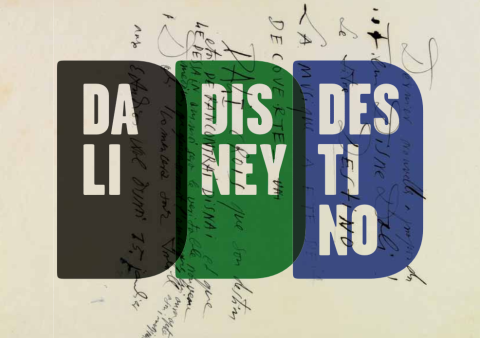
Roy E. Disney discovered Dalí’s Destino artwork in the late 90s, leading to his short re-creation of what might have been. Above, you can flip through a slideshow of twelve of those drawings and storyboards, courtesy of Park West Gallery, who represent the work. The Destino materials went on display at the Drawings Room in Figueres, Spain. The exhibition featured “1 oil painting, 1 watercolour, 15 preparatory drawings—10 of which are unpublished—and 9 photographs of Dalí in the creative process of this material, of the Disney couple in Port Lligat in 1957, and the Dalí couple in Burbank.” You can see many of those photographs in the exhibit’s pamphlet (in pdf here, in Spanish and English; cover image below), which offers a detailed description of the original project, including its narrative concept, a “love story” between a dancer and “baseball-player-cum-god Cronos” meant to represent “the importance of time as we wait for destiny to act on our lives.”
Inspired by a Mexican song by Armando Dominguez, Destino, on its face, seems like a very strange choice for Disney, who generally trafficked in more recognizable (and European) folk-tale sources. And yet, the exhibition pamphlet asserts, the co-production made a great deal of sense for Dalí, “if we consider that one Dalinian constant is his bringing together of the elitist artistic idea and mass culture (and vice versa) […]. Destino becomes a unique artistic product in which Dalinian expressiveness is combined with Disney’s fantasy and sonority, making it a film in which Dalí’s images take on movement and Disney’s figures become ‘Dalinised.’ ”
And yet, while both Dalí and Disney worked excitedly on the project, it was ultimately not to be, at least until almost sixty years later. Destino would have been part of a “package film,” like Fantasia, a compilation of short vignettes. John Hench, a Disney artist who worked on the project with Dalí, speculated that the company “foresaw the end” of such features. Pallant, however, goes further in speculating the film “would have resembled a potential box-office bomb” for Disney, who remarked later that is was “no fault of Dalí’s that the project… was not completed—it was simply a case of policy changes in our distribution plans.”
This cryptic remark, writes Pallant, alludes to Disney’s plans to focus his creative energy on “safe” feature-length projects “to strengthen the company’s position within the film industry.” While such a decision might have made good business sense, it probably doomed many more Destino-like ideas that might have made the Walt Disney company a very different entity indeed. One can only imagine what the studio might have become had Disney opted to pursue experiments like this instead of taking the more profitable route. Of course, given the market pressures on the movie industry, it’s also possible the studio might not have survived at all.
Related Content:
Destino: The Salvador Dalí – Disney Collaboration 57 Years in the Making
Alfred Hitchcock Recalls Working with Salvador Dali on Spellbound
Josh Jones is a writer and musician based in Durham, NC. Follow him at @jdmagness.
Read More...1756 TED Talks Listed in a Neat Spreadsheet

A quick update for TED heads. In early 2011 we mentioned that someone put together a handy online spreadsheet that lists 875 TED Talks, with handy links to each video. It’s worth mentioning the spreadsheet again because this evolving Google doc now lists 1756 talks. That works out to more than 440 hours of “riveting talks by remarkable people.” Because the page gets updated on a regular basis, you’ll want to bookmark it and keep tabs on the new additions.
Related Content:
1,700 Free Online Courses from Top Universities.
1,000 Free Audio Books: Download Great Books for Free.
800 Free eBooks for iPad, Kindle & Other Devices.
Read More...Rare Video: Fidel Castro Plays Baseball (1959)
Baseball has the great capacity to transcend politics. People on the right love it. (Think George Will, the columnist who finds himself at the center of a hot controversy this week). The same holds true for folks on the left. One leftist with a deep and abiding love for baseball is Fidel Castro. Before he seized power in 1959, Castro spent some time on the diamond. Baseball-Reference.com tells us that Fidel likely “pitched in intramural competition in college for the University of Havana law school.” But “he was not good enough to pitch on the college’s varsity team.” Nor is the long-standing myth true that “Castro tried out for either the New York Yankees or Washington Senators and failed to impress enough to sign a contract.” He was never going to have a big league career. That’s for sure. But once Castro actually rose to power, no one was going to stop him from hitting or pitching in a 1959 charity game. (Watch above.) As they say, sometimes “it’s good to be the king.” Just ask Vladimir Putin, who recently scored 6 goals, and made 5 assists, in a hockey game.
The 1959 clip above comes from British Pathé, which made an archive of 85,000 historical films available on YouTube in April. Don’t miss it.
Related Content:
Bill Murray’s Baseball Hall of Fame Speech (and Hideous Sports Coat)
The Grateful Dead Rock the National Anthem at Candlestick Park: Opening Day, 1993
Free: Watch Jackie Robinson Star in The Jackie Robinson Story (1950)
Lou Gehrig, Yankee Legend, Stars in 1938 Western Rawhide
Read More...The Hobbit: The First Animation & Film Adaptation of Tolkien’s Classic (1966)
If you come to the first film production of J.R.R. Tolkien’s 1937 novel The Hobbit expecting anything like a reverent rendition of the story, prepare yourself for disappointment. Produced in 1966, the 12-minute animated short takes elements of the classic work of fantasy and adapts—or corrupts—them to fit a different story, one with a dragon, a hobbit, a wizard, and an Arkenstone, to be sure, but with a great many odd liberties taken with Tolkien’s world. Instead of the great Smaug, we have a dragon named “Slag.” Instead of pillaging The Lonely Mountain, he steals the treasure of the village of Dale. Instead of a troupe of dwarves, we have one General Oakenshield, a princess named “Mika,” and an unnamed watchman. Trolls and goblins become “Groans” and “Grablins,” and Gollum appears as “Goloom.”
Is this some off-brand knock-off, you may ask? Not exactly. Producer William Snyder became the first person to acquire rights to Tolkien’s book, and he originally intended a feature length film. The project failed, but when the novel’s popularity soared, Snyder contracted Prague-based comic illustrator and animator Gene Deitch to create the short film you see above. Snyder’s motives, it seems, were mercenary: he wanted to extend his license, which he then sold back to Tolkien’s publishers for $100,000. But the film itself has a certain charm, despite the narrative butchery. Deitch hired Czech illustrator Adolf Born for the project, and he renders the story in the colorful, folk-art style of Eastern Europe (some of the drawings remind me of the lurid caricatures of German artist George Grosz, some of Rocky and Bullwinkle).
If Deitch’s Hobbit short fails to move you, consider it at least a minor entry in the career of a fascinating character in the world of comics, animation, and folk music. Deitch produced cartoons for Columbia, 20th Century Fox, MGM, and Paramount (including some Tom and Jerry and Popeye shorts) and made recordings of John Lee Hooker and Pete Seeger, as well as the recently re-discovered wonder Connie Converse. He also wrote the popular guide How to Succeed in Animation and fathered three cartoonist sons, the most well-known of whom, Kim Deitch, holds a special place in the history of underground comics. But I offer none of this information to excuse the flaws of Deitch and Snyder’s Hobbit short. Fans of comic art may love it, Tolkien purists not at all. Deitch tells the full story of the “Hollywoodized” short film’s slapdash making on his blog, and it is well worth a read. The film itself can be found in the Animation section of our collection, 4,000+ Free Movies Online: Great Classics, Indies, Noir, Westerns, Documentaries & More.
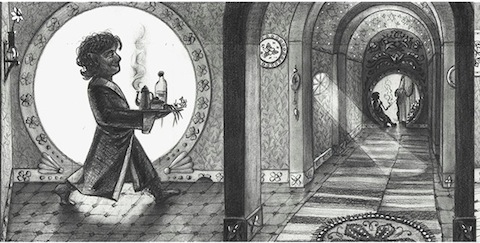
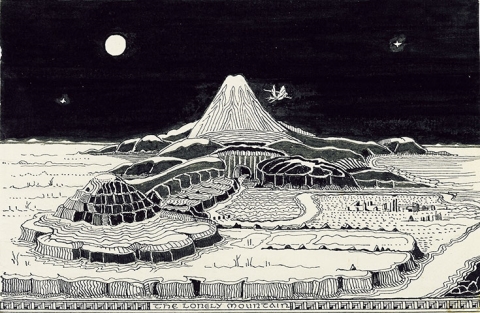
For another, much more faithful—albeit wordless—illustrated take, see Anna Repp’s Endless Book Project (screen shot above). A Metafilter user describes it as “one continuous scroll, with new artwork added almost every week.” Each panel has a unique look—some in the intricate style of German Renaissance engraving, some resembling woodcuts, some inkwash drawings. And of course, you cannot go wrong with Tolkien’s own original illustrations for The Hobbit, some published in the first edition, and many more lately discovered among the author’s papers. See Tolkien’s drawing of The Lonely Mountain at night below, and visit Brainpickings for more.
Related Content:
“The Tolkien Professor” Presents Three Free Courses on The Lord of the Rings
C.S. Lewis’ Prescient 1937 Review of The Hobbit by J.R.R. Tolkien: It “May Well Prove a Classic”
Listen to J.R.R. Tolkien Read a Lengthy Excerpt from The Hobbit (1952)
Soviet-Era Illustrations Of J. R. R. Tolkien’s The Hobbit (1976)
Josh Jones is a writer and musician based in Durham, NC. Follow him at @jdmagness.
Read More...David Brooks’ List of “Really Good Books”

In the pages of The New York Times, David Brooks reeled off a list of Really Good Books. He prefaces the list with this: “People are always asking me what my favorite books are. I’ve held off listing them because it seems self-indulgent. But, with summer almost here, I thought I might spend a couple columns recommending eight books that have been pivotal in my life.” [He actually recommends more than 8 in the end.] Some of the books will help you think about living a life of “civilized ambition.” Others will nurture your inner spirit. And still others will help you think more intelligently about writing and politics. Along the way, he adds a quick caveat about what these books “can’t do.” “They can’t carve your convictions about the world. Only life can do that — only relationships, struggle, love, play and work. Books can give you vocabularies and frameworks to help you understand and decide, but life provides exactly the education you need.”
The list was published in two parts: Part 1 and Part 2. In each installment, Brooks explains why he selected each work. Where possible, we have provided links to texts available online. You can also find them listed in our collection, 800 Free eBooks for iPad, Kindle & Other Devices.
1. A Collection of Essays by George Orwell
2. Anna Karenina by Leo Tolstoy
3. “Rationalism in Politics” by Michael Oakeshott
4. All the King’s Men by Robert Penn Warren
5. The Peloponnesian War by Thucydides
6. The Confessions by St. Augustine
7. The Lonely Man of Faith by Joseph Soloveitchik
8. Man’s Search for Meaning by Viktor Frankl (see Frankl talk about that great search here.)
9. Middlemarch by George Eliot
10. Endless Love by Scott Spencer
Related Content:
Stephen King Creates a List of 96 Books for Aspiring Writers to Read
Neil deGrasse Tyson Lists 8 (Free) Books Every Intelligent Person Should Read
Read More...Free Physics Textbooks
Free textbooks (aka open textbooks) written by knowledgable scholars are a relatively new phenomenon. Below, find a meta list of Free Physics Textbooks, part of our larger collection 200 Free Textbooks: A Meta Collection. Also see our online collection, 1,700 Free Online Courses from Top Universities.
- Age of Einstein, by Frank W. K. Firk, Yale University.
- Calculus-Based Physics by Jeffrey W. Schnick, Saint Anselm College
- Classical Electrodynamics by Bo Thidé, Uppsala School of Engineering
- College Physics (introductory, algebra-based, two-semester college physics book) by OpenStax
- Conceptual Physics by Benjamin Crowell, Fullerton College
- Conservation Laws by Benjamin Crowell, Fullerton College
- Essential Physics 1, Frank W.K. Firk, Yale University
- Fields by Warren Siegel, SUNY
- General Relativity by Benjamin Crowell, Fullerton College
- Introduction to Groups, Invariants & Particles, by Frank W. K. Firk, Yale University
- Introduction to String Field Theory by Warren Siegel, SUNY
- Introduction to Statics and Dynamics by Andy Ruina and Rudra Pratap, Cornell University
- Mountain Motion by Dr. Christoph Schiller PhD, trained at Université Libre de Bruxelles
- Optics by Benjamin Crowell, Fullerton College
- Principles of Modern Physics — Robert B. Leighton, Caltech
- Programming Languages: Application and Interpretation by Dr. Shriram Krishnamurthi, Brown University
- Simple Nature: An Introduction to Physics for Engineering and Physical Science Students by Ben Crowell, Fullerton College
- Superspace: One Thousand and One Lessons in Supersymmetry by Warren Siegel. Jim Gates, Marc Grisaru, and Martin Rocek, SUNY, McGill, University of Maryland
- The Feynman Lectures on Physics by Richard Feynman, Robert B. Leighton and Matthew Sands
- Volume 1: Read Online Now
- Volume 2: Read Online Now
- Volume 3: Read Online Now
- The Light and Matter Series (Six texts) by Benjamin Crowell, Fullerton College
- Vibrations and Waves by Benjamin Crowell, Fullerton College
- The Modern Revolution in Physics by Benjamin Crowell, Fullerton College
- The People’s Physics Book by James H. Dann, UC Santa Cruz
- 21st Century Physics Flexbook: A Compilation of Contemporary and Emerging Technologies, by the Secretaries of Education and Technology and the Department of Education in the state of Virginia
Free Math Textbooks
Free textbooks (aka open textbooks) written by knowledgable scholars are a relatively new phenomenon. Below, find a meta list of Free Math Textbooks, part of our larger collection 200 Free Textbooks: A Meta Collection. Also see our online collection, 1,700 Free Online Courses from Top Universities.
- Abstract Algebra: The Basic Graduate Year by Robert B. Ash, University of Illinois
- Abstract Algebra: Theory and Applications by Thomas W. Judson, Stephen F. Austin State University
- Advanced Algebra II by Kenny Felder, Raleigh Charter High School
- Advanced Calculus by Sternberg Shlomo and Lynn Loomis, Harvard University
- Algebra 1 (Grades 9 & 10) by Andrew and Anne Gloag, High Tech High in San Diego, California
- Algebra and Analysis for Computer Science by Jean Gallier, University of Pennsylvania.
- Applied Probability by Paul Pfeiffer, Rice University
- Basic Analysis by Jiří Lebl, University of Illinois at Urbana-Champaign
- Basic Concepts of Mathematics by Elias Zakon, The University of Windsor
- Basic Probability Theory by Robert B. Ash, University of Illinois
- Basic Probability and Statistics by Brenda Meery, high school mathematics teacher in Glace Bay, Nova Scotia
- Book of Proof by Dr. Richard Hammack, Virginia Commonwealth University
- Calculus for Beginners and Artists by MIT
- Calculus Online Textbook, by Gilbert Strang, MIT
- Calculus (PDF) by David Guichard, Whitman College.
- Calculus (PDF) by Gilbert Strang, MIT
- Calculus 1 by Paul Dawkins, Lamar University
- Calculus 2 by Paul Dawkins, Lamar University
- Calculus 3 by Paul Dawkins, Lamar University
- Calculus with Applications, by Daniel Kleitman, MIT
- CK-12 Geometry (Grades 10–12) by multiple authors. Covers California curriculum.
- CK-12 Single Variable Calculus (Grades 11–12) by Multiple authors. Covers California curriculum.
- CK-12 Trigonometry — Second Edition (Grades 10–12) by multiple authors. Covers California curriculum.
- Collaborative Statistics by Barbara Illowsky, Ph.D and Susan Dean, De Anza College
- College Algebra by Paul Dawkins, Lamar University
- Complex Analysis by George Cain, Georgia Institute of Technology
- Complex Variables by Robert B. Ash, University of Illinois
- Computational Geometry by Nicholas M. Patrikalakis, Takashi Maekawa, MIT
- A Computational Introduction to Number Theory and Algebra by Victor Shoup, NYU
- A Course In Algebraic Number Theory by Robert B. Ash, University of Illinois
- A Course In Commutative Algebra by Robert B. Ash, University of Illinois
- Design of Comparative Experiments by R. A. Bailey, University of London
- Difference Equations to Differential Equations: An Introduction to Calculus by Dan Sloughter, Furman University
- Differential Equations by Paul Dawkins, Lamar University
- Discrete Mathematics: An Open Introduction by Oscar Levin, University of Northern Colorado
- Dynamical Systems by S. Sternberg, Harvard University
- Electronic Statistics Textbook by T. Hill & P. Lewicki.
- Elementary Abstract Algebra by W. Edwin Clark, University of Southern Florida
- Elementary Calculus: An Infinitesimal Approach by H. Jerome Keisler, University of Wisconsin-Madison
- Elementary Differential Equations (PDF) by William F. Trench, Trinity University
- Elementary Differential Equations with Boundary Value Problems (PDF) by William F. Trench, Trinity University
- Student Solutions Manual for Elementary Differential Equations and Elementary Differential Equations with Boundary Value Problems (PDF) by William F. Trench, Trinity University
- Elementary Linear Algebra by Keith Matthews, University of Queensland
- Elementary Number Theory by W. Edwin Clark, University of Southern Florida
- Elements of Abstract and Linear Algebra by Edwin H. Connell, University of Miami
- First Course in Complex Analysis by Matthias Beck, Gerald Marchesi, and Dennis Pixton, SUNY — Binghamton
- First Course in Linear Algebra by Dr. Robert Beezer, University of Puget Sound
- Functions Defined by Improper Integrals (PDF) by William F. Trench, Trinity University
- GeneratingFunctionology by Herbert Wilf, University of Pennsylvania
- Introduction to Matrix Algebra by Autar K Kaw, University of South Florida
- Introduction to Probability, Statistics, and Random Processes by Hossein Pishro-Nik, UMass Amherst
- Introduction to Probability (PDF) by Charles Grinstead & J. Laurie Snell, Swarthmore & Dartmouth Colleges
- Introduction to Real Analysis (PDF) by William F. Trench, Trinity University
- An Introduction to Statistical Learning (PDF) by Gareth James, Daniela Witten, Trevor Hastie and Robert Tibshirani
- Introduction to Social Network Methods by Robert A. Hanneman and Mark Riddle, UC Riverside
- Introduction to Statistical Thought by Michael Lavine, UMASS
- Introduction to the Theory of Numbers by Leo Moser, McGill
- Introductory Statistics: Concepts, Models, and Applications by David W. Stockburger, Missouri State
- Lectures on Probability, Statistics and Econometrics by Marco Taboga, Economist, Bank of Italy
- Lectures on Statistics by Robert B. Ash, University of Illinois
- Linear Algebra (PDF) by Jim Hefferon, Saint Michael’s College
- Linear Algebra by Paul Dawkins, Lamar University
- Math Alive by Ingrid Daubechies, Princeton University
- Math in Society by David Lipmann, Pierce College
- Math, Numerics, and Programming (for Mechanical Engineers) by Masayuki Yano, MIT
- Mathematical Methods of Engineering Analysis (PDF) by Erhan Çinlar and Robert J. Vanderbei, Princeton University
- Multivariable Calculus by George Cain & James Herod, Georgia Tech
- Proofs and Concepts: The Fundamentals of Abstract Mathematics by Dave Witte Morris and Joy Morris, University of Lethbridge
- Real Variables with Basic Metric Space Topology by Robert B. Ash, University of Illinois
- Statistics by Philip B. Stark, University of California — UC Berkeley
- A Summary of Calculus by Karl Heinz Dovermann, University of Hawaii
- The Book “A=B” by Marko Petkovsek, Herbert Wilf and Doron Zeilberger, Univ. of Pennsylvania and Rutgers
- The Elements of Statistical Learning by Trevor Hastie, Robert Tibshirani and Jerome Friedman
- The Method of Lagrange Multipliers (PDF) by William Trench, Trinity University
- The Calculus of Functions of Several Variables by Dan Sloughter, Furman University
- Yet Another Calculus Text by Dan Sloughter, Furman University
Support Us
We're hoping to rely on loyal readers, rather than erratic ads. Please click the Donate button and support Open Culture. You can use Paypal, Venmo, Patreon, even Crypto! We thank you!

About Us

Open Culture scours the web for the best educational media. We find the free courses and audio books you need, the language lessons & educational videos you want, and plenty of enlightenment in between.
Advertise With Us

FREE UPDATES!
GET OUR DAILY EMAIL
Get the best cultural and educational resources on the web curated for you in a daily email. We never spam. Unsubscribe at any time.
FOLLOW ON SOCIAL MEDIA

Open Culture editor Dan Colman scours the web for the best educational media. He finds the free courses and audio books you need, the language lessons & movies you want, and plenty of enlightenment in between.
Advertise With Us

