30 Errol Morris Movies That Can Be Streamed Online
Why do I check into Metafilter every day? Just so that I don’t miss a post like this. A Metafilter community member who goes by the name of “Going to Maine” has pulled together a list of Thirty Errol Morris movies that can be streamed on YouTube. The list includes some of Morris’ major documentaries, but also many excellent short films (and interviews) directed by Morris over the years. Above, you can see “Team Spirit,” a bizarre little film Morris made for ESPN about fans who are deadly serious about sports. In fact, they take their love of sports right to the grave. Below, you can find various other Morris films we’ve featured over the years. They otherwise reside in our collection of Free Documentaries, a subset of our Free Movies collection.
How Benoit Mandelbrot Discovered Fractals: A Short Film by Errol Morris
Errol Morris Captures Competitive Eating Champion “El Wingador”
Watch A Brief History of Time, Errol Morris’ Film About the Life & Work of Stephen Hawking
November 22, 1963: Watch Errol Morris’ Short Documentary About the Kennedy Assassination
“They Were There” — Errol Morris Finally Directs a Film for IBM
11 Excellent Reasons Not to Vote?
Read More...
The Getty Adds Another 77,000 Images to its Open Content Archive
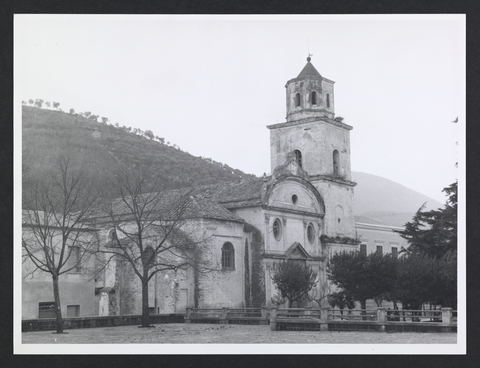
Last summer we told you that the J. Paul Getty Museum launched its Open Content Program by taking 4600 high-resolution images from the Getty collections, putting them into the public domain, and making them freely available in digital format. We also made it clear — there would be more to come.
Yesterday, the Getty made good on that promise, adding another 77,000 images to the Open Content archive. Of those images, 72,000 come from the Foto Arte Minore collection, a rich gallery of photographs of Italian art and architecture, taken by the photographer and scholar Max Hutzel (1911–1988).
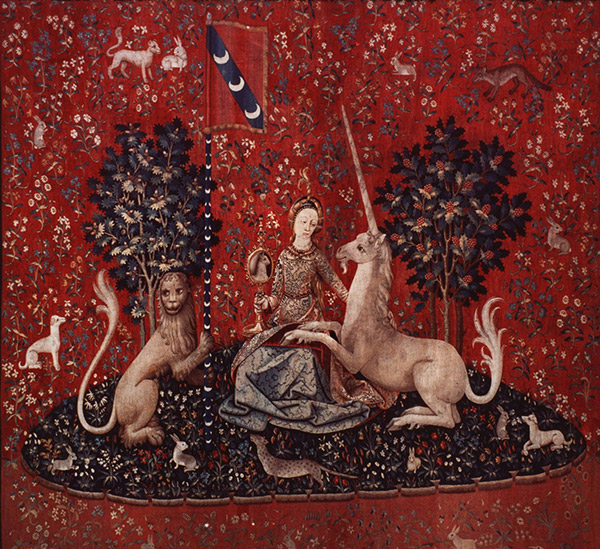 The Getty also dropped into the archive another 4,930 images of European and American tapestries dating from the late 15th through the late 18th centuries.
All images in the Getty Open Content program — now 87,000 in total — can be downloaded and used without charge or permission, regardless of whether you’re a scholar, artist, art lover or entrepreneur. The Getty only asks that you give them attribution.
You can start exploring the complete collection by visiting the Getty Search Gateway. Images can also be accessed via the Museum’s Collection webpages. Be sure to look for the “download” link near the images.
For more information on the Open Content program, please visit this page. For more open content from museums, see the links below.
Related Content:
Download Over 250 Free Art Books From the Getty Museum
40,000 Artworks from 250 Museums, Now Viewable for Free at the Redesigned Google Art Project
LA County Museum Makes 20,000 Artistic Images Available for Free Download
The Rijksmuseum Puts 125,000 Dutch Masterpieces Online, and Lets You Remix Its Art
Read More...Sylvia Plath Annotates Her Copy of The Great Gatsby
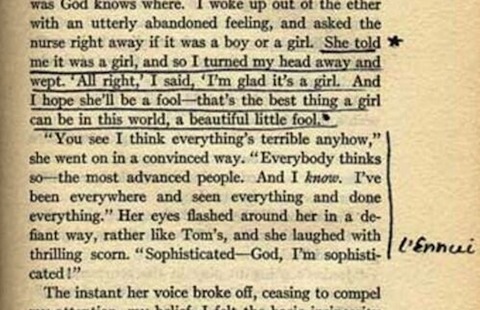
The true fan of a writer desires not just that writer’s complete works, even if they all come signed and in first editions. No — the enthusiast most dedicated to their literary luminary of choice must have, in addition, the books written by that author, those owned by that author, preferably anointed with liberal quantities of revealing marginalia. In the case of such relatively recently deceased writers as David Markson, the whole of whose well-annotated personal library got donated to The Strand shortly after his passing, you can sometimes actually come to possess such treasures. In the case of poet Sylvia Plath, part of a page of whose copy of F. Scott Fitzgerald’s The Great Gatsby you see above, you might have a trickier time getting your hands on them. Justin Ray’s post at Complex, which quotes Plath as calling Fitzgerald “a word painter with a vivid palette” who chooses words with “jewel-cut precision,” has more on the book and its markings.
“Plath studied a crap-ton of literature in school,” Ray writes. “It isn’t immediately clear whether she was in high school or college when she annotated Gatsby,” but whenever she did it, she underlined “Daisy’s prediction of what her daughter will be like” with the word “L’Ennui,” a word she would use to name an early poem that reflects “a post romanticism and the death of idealism, two ideas also in Gatsby, according to an essay by Anna Journey.” Elsewhere, you can also read “Princess Daisy,” Park Bucker’s piece on Plath’s annotated Gatsby. “The volume represents a fascinating piece of evidence of Fitzgerald’s rising reputation and influence in the early 1950s, as well as the academic background and tastes of a major American poet,” writes Bucker. “Although Sylvia Plath and F. Scott Fitzgerald rarely inhabit the same sentence, their association should not appear strained. A young, intense poet would naturally be drawn to the lyric quality of Fitzgerald’s prose.” And just imagine its value to die-hard fans of both of those tragic pillars of American letters — a group in which, if you’ve read this post and everything to which it links, you should perhaps consider counting yourself.
Related Content:
Hear Sylvia Plath Read Fifteen Poems From Her Final Collection, Ariel, in 1962 Recording
Haruki Murakami Translates The Great Gatsby, the Novel That Influenced Him Most
83 Years of Great Gatsby Book Cover Designs: A Photo Gallery
Read F. Scott Fitzgerald’s Great Gatsby & Other Major Works Free Online
Gertrude Stein Sends a “Review” of The Great Gatsby to F. Scott Fitzgerald (1925)
Colin Marshall hosts and produces Notebook on Cities and Culture and writes essays on cities, language, Asia, and men’s style. He’s at work on a book about Los Angeles, A Los Angeles Primer. Follow him on Twitter at @colinmarshall or on Facebook.
Read More...Orson Welles Tells Some Damn Good Stories in the Orson Welles’ Sketch Book (1955)
On the first episode of Orson Welles’ Sketch Book, the man who made Citizen Kane remembers an anxiety-inducing evening early in his career: having somehow already gained a reputation as an entertaining after-dinner speaker, he found himself standing before a roomful of what seemed like every movie star in the flesh that he’d ever seen on the screen. Desperate to impress all these celebrities who had so impressed him, he pulled out the only amusing story in his repertoire, only to realize halfway through the telling that he couldn’t remember how it ended. Luckily, one of California’s earthquakes struck just before he reached that forgotten ending, sending the whole Hollywood crowd out the door and letting him off the raconteur hook. By the time he tells the next tale, of his longer-ago, more stressful and much more formative debut onstage in front of a decidedly uncooperative Dublin audience, you’ll wonder why he couldn’t handle the after-dinner speaking; if anyone has a natural storyteller’s instinct, he does.
The BBC must have thought so, in any case, when they put together this series of television commentaries from Welles, none of which need more than his then slightly unfamiliar face (without, he underscores, the usual false nose he wears for roles), his unmistakable voice, and his illustrations — taken, literally, from his sketchbook. In these six fifteen-minute broadcasts, which originally aired in 1955, Welles talks about not just the inauspicious beginnings of his illustrious working life but his experiences with the critics, the police, John Barrymore and Harry Houdini, the infamous radio production of War of the Worlds (which you can hear in our post for its 75th anniversary), and bullfighting (see also our post on his friendship with Ernest Hemingway). Though interesting in and of themselves, he uses these subjects to tie together a variety of recollections and observations from his life and career: on the finer points of producing Shakespeare with voodoo witch-doctors, on media-induced gullibility, on the invasion of privacy, on the art of line prompting. Not settling for status as a creative genius in film, theater, and radio, it seems Welles also laid down the example for a form that wouldn’t actually arrive for another fifty years: vlogging.
Related Content:
Orson Welles Remembers his Stormy Friendship with Ernest Hemingway
Orson Welles Explains Why Ignorance Was His Major “Gift” to Citizen Kane
Orson Welles’ Last Interview and Final Moments Captured on Film
Revisit Orson Welles’ Iconic ‘War of the Worlds’ Broadcast That Aired 75 Years Ago Today
Colin Marshall hosts and produces Notebook on Cities and Culture and writes essays on cities, language, Asia, and men’s style. He’s at work on a book about Los Angeles, A Los Angeles Primer. Follow him on Twitter at @colinmarshall or on Facebook.
.
Read More...The Origins of Michael Jackson’s Moonwalk: Vintage Footage of Cab Calloway, Sammy Davis Jr., Fred Astaire & More
Michael Jackson took one giant leap for pop history on March 25, 1983 when he gave an adoring public their first taste of his signature moonwalk in honor of Motown Records’ 25th birthday. (See below)
Novelty-wise, it wasn’t quite a Neil Armstrong moment. Like many artists, Jackson had many precedents from which he could and did draw. He can be credited with bringing a certain attitude to the proceedings. The expert practitioners in the video above are more ebullient, tapping, sliding and proto-moonwalking themselves into a state of rapture that feeds off the audience’s pleasure.
The line-up includes artists lucky enough to have left lasting footprints—Cab Calloway, Sammy Davis Jr., Fred Astaire, as well as those we’d do well to rediscover: Rubberneck Holmes, Earl “Snakehips” Tucker, Buck and Bubbles.…
Lacking the Internet, however, it does seem unlikely that Jackson would’ve spent much time poring over the footwork of these masters. (He may have taken a sartorial cue from their socks.)
Instead, he invested a lot of time breaking down the street moves, what he referred to in his autobiography as “a ‘popping’ type of thing that black kids had created dancing on the street corners in the ghetto.”
Jackson’s sister, LaToya, identified former Soul Train and Solid Gold dancer Jeffrey Daniel, below, as her brother’s primary tutor in this endeavor. (He went on to co-choreograph Jackson’s videos for “Bad” and “Smooth Criminal”.) As to the story behind his moonwalk, or backslide as he called it before Jackson’s version obliterated the possibility of any other name, Daniel gave props to the same kids Jackson did.
For those of you who mentioned it on Twitter and in our comments, we’ve added Charlie Chaplin’s scene in Modern Times.
via Metafilter
Related Content:
Keeping Jacko in Perspective
James Brown Gives You Dancing Lessons: From The Funky Chicken to The Boogaloo
Ayun Halliday is the author of seven books, and creator of the award winning East Village Inky zine. Follow her @AyunHalliday
Read More...Sir Patrick Stewart & Sir Ian McKellen Play The Newlywed Game
I’m gonna go out on a limb and guess that this is the first time two knighted cultural figures have played The Newlywed Game — a version of that wince (and nostalgia) ‑inducing game show that ran from the 1960s through the 1990s. Although Stewart and McKellen aren’t married, they know each other plenty well. They’ve worked together on stage (in a production of Waiting for Godot) and in film (they’ll be appearing together in an upcoming X‑Men movie.) And suffice it to say, they’ve formed a tight friendship. When Stewart married Sunny Ozell last year, McKellen officiated at the wedding ceremony.
This little bit took place at a BuzzFeed Brews event back in February. You can watch their full 48 minute appearance here. Also find the two in a deeper conversation recorded at the Screen Actors Guild Foundation just last month.
Related Content:
Sir Patrick Stewart Demonstrates How Cows Moo in Different English Accents
Sir Ian McKellen Reads Manual for Changing Tires in Dramatic Voice
Read More...“The Periodic Table of Storytelling” Reveals the Elements of Telling a Good Story
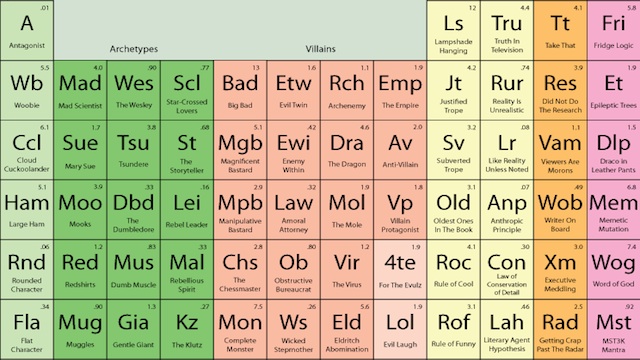
Dmitri Mendeleev might have designed the original periodic table – a graphic representation of all the basic building blocks of the universe – but artist James Harris has done something way cool with that template — the Periodic Table of Storytelling.
That’s right. Harris has taken all the tropes, archetypes and clichés found in movies (not to mention TV, comic books, literature, video and even professional wrestling) and synthesized them into an elegantly realized chart. Instead of grouping the elements by noble gases or metals, Harris has organized them by story elements — structure, plot devices, hero archetypes. Each element is linked to a vast wiki that gives definitions and examples. For instance, if you click on the element Chk, you’ll go to a page explaining the trope of Chekhov’s Gun. And if you click on Neo, you’ll go to the page for, of course, the Chosen One.
Below the chart, Harris has even created story molecules for a few specific movies. Ghostbusters, for example, is the combination of an atom consisting of 5ma (Five Man Band) and Mad (Mad Scientist) and one consisting of Iac (Sealed Evil in a Can) and Hil (Hilarity Ensues).
So if you’re in film school or if you have a copy of Robert McKee’s Story on your bookshelf or if you’re one of the roughly three dozen people in the Los Angeles coffee shop where I’m writing this article who are banging out screenplays, you need to check this table out. But be warned: it will suck away a good chunk of your day.
via No Film School
Related Content:
Pixar’s 22 Rules of Storytelling
Ira Glass, the Host of This American Life, Breaks Down the Fine Art of Storytelling
World’s Smallest Periodic Table on a Human Hair
“The Periodic Table Table” — All The Elements in Hand-Carved Wood
Free Online Chemistry Courses
Jonathan Crow is a Los Angeles-based writer and filmmaker whose work has appeared in Yahoo!, The Hollywood Reporter, and other publications. You can follow him at @jonccrow.
Read More...Two Artificial Intelligence Chatbots Talk to Each Other & Get Into a Deep Philosophical Conversation
The folks at the Cornell Creative Machines Lab are “interested in robots that create and are creative.” Here’s one such example of robots getting creative. Above, the lab lets two chatbots (essentially computer programs designed to simulate an intelligent conversation) start chatting with one another. They start by exchanging pleasantries. Then things get deeply philosophical, fairly quickly. It’s fun to watch it play out.
via Gizmodo
Related Content:
Download 100 Free Philosophy Courses and Start Living the Examined Life
Learn to Code with Harvard’s Intro to Computer Science Course And Other Free Tech Classes
Noam Chomsky Explains Where Artificial Intelligence Went Wrong
Read More...
Hear Patti Smith Read 12 Poems From Seventh Heaven, Her First Collection (1972)
So it’s National Poetry Month, and the Academy of American Poets recommends 30 Ways to Celebrate, including some old standbys like memorizing a poem, reading a poem a day, and attending a reading. All sensible, if somewhat staid, suggestions (I myself have been re-reading all of Wallace Stevens’ work—make of that what you will). Here’s a suggestion that didn’t make the list: spend some time digging the poetry of Patti Smith.
A living breathing legend, Smith doesn’t appear in many academic anthologies, and that’s just fine. What she offers are bridges from the Beats to the sixties New York art scene to seventies punk poetry and beyond, with spandrels made from French surrealist leanings and rock and roll obsessions. A 1977 Oxford Literary Review article aptly describes Smith in her heyday:
In the late sixties and early seventies Patti Smith was a member of Warhol’s androgynous beauties living under the fluorescent lights of New York City’s Chelsea Hotel…Her performances were sexual bruisings with the spasms of Jagger and the off-key of Dylan. Her musical poems often came from her poetical fantasies of Rimbaud.
Smith’s work is sensual and wildly kinetic, as is her process, which she once described as “a real physical act.”
When I’m home writing on the typewriter, I go crazy
I move like a monkey
I’ve wet myself, I’ve come in my pants writing
Emily Dickenson she ain’t, but Smith also has an abiding love and respect for her literary forebears, whether now-almost-establishment figures like Virginia Woolf or still-somewhat-outré characters like Antonin Artaud and Jean Genet.
Smith’s first published collection of poetry, Seventh Heaven, appeared in 1972 and included tributes to Edie Sedgwick and Marianne Faithfull. She dedicated the book to gangster writer Mickey Spillane and Rolling Stones’ muse, and partner of both Brian Jones and Keith Richards, Anita Pallenberg.
The book has not been reissued, and print copies are rare. Yet, as the afore-quoted article notes, Patti Smith’s is an “oral poetics” that “uses much of her voice rhythms.” The line between her work as a punk singer and performance poet is ephemeral, perhaps nonexistent—Patti Smith on the page is great, but Patti Smith on stage is greater. Hear for yourself, above, in a 1972 recording of Smith reading twelve poems from her first collection at St. Mark’s Church in New York City. She sounds almost exactly like Linda Manz from Terrence Malick’s Days of Heaven, a streetwise kid with a romantic streak a mile wide.
Over three decades and many more publications later, Smith is now a National Book Award winner and a considerably mellower presence, but she has never strayed far from her roots. Above, see her at back at St. Marks in 2011, reading her poem “Oath,” first written in 1966, whose famous first line “Jesus died for somebody’s sins, but not mine” became the unforgettable opening to her equally unforgettable “Gloria.” For contrast, hear her read the same poem below, in 1973, over squalling guitar feedback (and with the famous line beginning “Christ died…”). Classic, classic stuff.
See and hear many more of her readings on Youtube, and see this site for a partial Patti Smith bibliography, publication history, and selected archive of poems, essays, and reviews.
Smith’s readings of Seventh Heaven will be added to our collection of Free Audio Books.
via Flavorwire
Related Content:
See Patti Smith Give Two Dramatic Readings of Allen Ginsberg’s “Footnote to Howl”
Josh Jones is a writer and musician based in Durham, NC. Follow him at @jdmagness
Read More...Listen to 21-Year-Old David Letterman’s College Radio Show (1969)
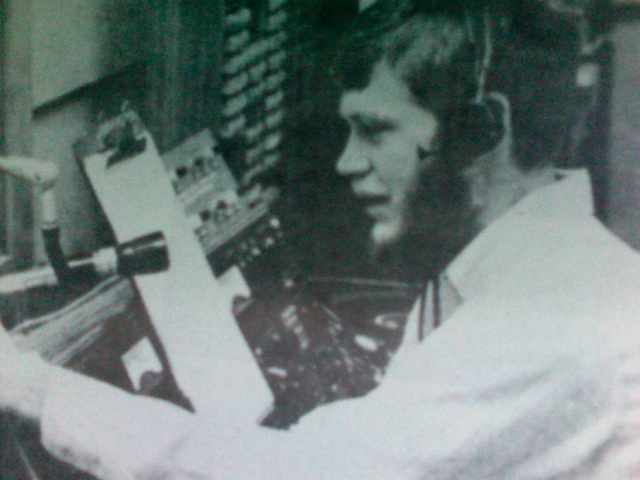
Over thirty years at the desk of his very own late-night talk show, multiple generations of fans, the respect of comedians the world over: David Letterman has had, by any measure, an awfully good run. Though they had to know it could come sooner or later, thousands of viewers, since Letterman announced last Thursday that he plans to retire in 2015, face the imminent prospect of a world without the Late Show as they know it. For the young and young-ish among them, many of whom didn’t come into the world themselves until after Letterman’s 1982 national debut (see video at bottom), this constitutes an entirely new and troublingly less absurd televisual reality. But the master comedy host didn’t simply emerge on to the scene, fully formed, those 32 years ago. Anyone who’s watched long enough to notice the frequency of Letterman’s references to Indianapolis, his hometown and the media market that granted him his first “big” chance as a weatherman, knows that he never forgot his roots.
As with many illustrious careers, Letterman’s humble early shot followed even humbler, earlier shots. Just above, you can hear the 21-year-old “Dave Letterman”’s broadcast from April Fool’s Day 1969 on WAGO-AM, the closed-circuit radio station he helped to found at his future alma mater, Ball State University. Though only a five-minute clip, this recording showcases not just Letterman’s preternatual microphone presence, but his way with the near-psychedelic walls of sound effects, seemingly free-associative speech, and pure wackiness that so came into its own in the late sixties and early seventies. (The Firesign Theater would soon perfect it.) Letterman followers who must know everything — and they certainly exist — should note that, when he calls a delirious-sounding woman in this segment, he calls none other than Michelle Cook, the very first Mrs. Letterman. Though we have yet to learn the identity of Letterman’s Late Show replacement, I feel certain, after this listening experience, that the Letterman of twenty years from now will rise from the ranks of podcasting. Listen out for him; he may not drop colorful phrases just like “horse dentures falling into a rusted howitzer artillery shell,” but you’ll know him when you hear him. Or her.
Below you can watch Bill Murray’s appearance on Letterman’s first 1982 show.
via WFMU’s Beware of the Blog
Related content:
Tom Waits and David Letterman: An American Television Tradition
Colin Marshall hosts and produces Notebook on Cities and Culture and writes essays on cities, language, Asia, and men’s style. He’s at work on a book about Los Angeles, A Los Angeles Primer. Follow him on Twitter at @colinmarshall or on Facebook.
Read More...Support Us
We're hoping to rely on loyal readers, rather than erratic ads. Please click the Donate button and support Open Culture. You can use Paypal, Venmo, Patreon, even Crypto! We thank you!

About Us

Open Culture scours the web for the best educational media. We find the free courses and audio books you need, the language lessons & educational videos you want, and plenty of enlightenment in between.
Advertise With Us

FREE UPDATES!
GET OUR DAILY EMAIL
Get the best cultural and educational resources on the web curated for you in a daily email. We never spam. Unsubscribe at any time.
FOLLOW ON SOCIAL MEDIA

Open Culture editor Dan Colman scours the web for the best educational media. He finds the free courses and audio books you need, the language lessons & movies you want, and plenty of enlightenment in between.
Advertise With Us

